Home Blog Page 3647

Opposition told to focus on local governance

By Kyle Aristophere T. Atienza, Reporter

OPPOSITION forces need to focus on consolidating power at the level of local government units (LGUs), while they are still recovering from major electoral losses in previous years, political analysts said.

Maria Ela L. Atienza, who teaches political science at the University of the Philippines, said progressive groups need to get the backing of local officials and communities to popularize their governance platforms and secure national seats.

“A strong opposition with alternative, progressive platforms will need strong support from the local levels, not just local officials but communities,” she said in a Viber message. “Thus, it is logical to have progressive candidates challenging local traditional politicians.”Arjan P. Aguirre, who teaches political science at the Ateneo de Manila University, said local politics has been an important arena for politicians seeking national posts, citing the case of former president Rodrigo R. Duterte, who ruled Davao City for over 22 years.“He proved to the people that he can do something despite being a local politician,” Mr. Aguirre said via Messenger chat.

He said opposition forces should have focused on building political power at the local level “during the time when the opposition is having a hard time winning national posts.”

“The struggle should have shifted to the local and try to be closer to the people and make their presence felt more by making sure that government services are delivered even though you’re in the opposition.” he said.

From six seats in the 18th Congress, the left-leaning Makabayan bloc secured only three seats in the 19th Congress — one each for Kabataan, ACT Teachers, and Gabriela party-lists. Bayan Muna, a popular group in the former 12-member bloc, in 2022 lost for the first time since joining in 2001.

The centrist Akbayan Party-list, which had been represented by Senator Risa Hontiveros-Baraquel in the House of Representatives in the 2000s and which allied itself with the Liberal Party in 2010, failed to secure a seat in the last two national elections.

After two failed attempts, Ms. Hontiveros was elected to the Senate in 2016. She was re-elected in 2022. In 2019, the midterm polls under Mr. Duterte, none of the opposition candidates vying for a Senate seat won.

The Sanlakas Party-list, a democratic socialist party with links to the late unionist Filemon “Ka Popoy” Lagman, lost for the first time in 2004 after securing a single seat in 2001 and in 1998, when the first party-list election was held.

The Partido Lakas ng Masa (PLM), which has ties with Sanlakas, had never secured a House seat since its first electoral participation in 2019.

“The local level has always been a crucial source of political support for the national contest. This still matters even now that we are in the age of social media,” Mr. Aguirre said, noting how the opposition should be “targeting seemingly harmless positions such as council members to expand their reach and presence at the local level.”

He noted that Katipunan ng Nagkakaisang Pilipino (KaNP), which was established in 2020, is the only progressive force that is “known to be focusing on the local arena.”

Ronald Llamas, the late former president Benigno S. Aquino, III political adviser, said opposition groups should fight in all arenas possible — both at the national and local levels.“It should be both national and local at the same time,” he said in a Viber message.

The presence of opposition forces has been under public scrutiny amid a widening rift within the personality-driven alliance between the families of President Ferdinand R. Marcos, Jr. and Vice-President Sara Duterte-Carpio, whose father has openly attacked the current administration amid an International Criminal Court (ICC) probe of his deadly war on drugs.

Days after holding a political rally in Davao City late last month, which was highly critical of Mr. Marcos, Mr. Duterte pushed for the separation of Mindanao from the rest of the nation.

Mr. Marcos and his Cabinet officials have already rejected the idea, with the Philippine leader saying it’s “doomed to fail” because it’s “anchored on a false premise.”

Tensions within the ruling alliance had been apparent after the President’s allies in Congress, which is headed by his cousin House Speaker Martin G. Romualdez, moved for the removal of Ms. Duterte-Carpio’s proposed confidential funds as vice president and education secretary from the 2024 national budget.

Mr. Duterte won the presidency in 2016 on the back of hardline promises to eradicate criminality and illegal drugs, vowing to replicate what he supposedly did in his home city despite records of human rights violations.

The ICC probe covers crimes committed in Davao City from November 2011 to June 2016 when he was still its mayor, as well as cases during his presidency up until March 16, 2019, the day before the Philippines withdrew from the ICC.

Marcos foreign trips generate $14.2B in investments — DTI

PHILSTAR FILE PHOTO

By Justine Irish D. Tabile, Reporter

THE Department of Trade and Industry (DTI) said on Sunday that President Ferdinand R. Marcos, Jr.’s foreign trips have generated $14.2 billion in actual investment, for a hit rate of about 20% of investment pledges.

“These investments span various sectors, such as manufacturing, information technology and business process management (IT-BPM), renewable energy, infrastructure, transport and logistics, agriculture, and retail,” the department said in a statement.

As of December, the DTI said the President’s travels generated pledges of $72.2 billion across 148 projects.

Forty-six projects have come forward and are currently operating, registered with an investment promotion agency, or are in some other stage of implementation.

Manufacturing accounted for 16 projects or 35% of the total, while IT-BPM had 10 (22%) and nine renewable energy (20%).

“The most significant countries as investment sources by the number of projects that have been actualized are Japan with 21 and the US with 13,” the DTI said.

Meanwhile, 102 projects valued at $58 billion are in the pre-implementation or planning stages as some projects, such as those in offshore wind or major infrastructure projects, require “a more extended implementation period of up to 7 years.”

“The investment flows into the country in phases over the implementation period, during which the project transitions into operational status and begins generating revenue,” the DTI said.

“The duration of the implementation period depends on the sector to which a particular project belongs,” it added.

It said that this is why investment commitments in the IT-BPM sector and in light manufacturing comprise most of the projects that were first to operate.

“While the FDI values are modest, the early actualization of investment commitments in these sectors contributes to the decrease in the unemployment rate in the Philippines, given that IT-BPM and manufacturing are significant generators of direct employment,” DTI said.

The Philippine Statistics Authority said the jobless rate dropped to 4.3% last year from 5.4% in 2022.

Trade Secretary Alfredo E. Pascual said that the overseas visits of Mr. Marcos “have been pivotal in generating serious investment interest in the Philippines.”

“Our dedication to turning investment pledges into reality is unwavering. We also leverage each Presidential visits as springboards for building up the pipeline of investment opportunities and making the Philippines an investment destination of choice,” Mr. Pascual said.

In February 2023, Mr. Marcos approved Executive Order No. 18 which established Green Lanes that the DTI said have sparked interest among investors because of the promise of expedited approvals for strategic investments.

As of Feb. 8, the Board of Investments has granted green lane certification to 41 projects, 20 of which were the result of Presidential visits.

Freeze on MAV seen pressuring prices of pork, corn upwards

PHILSTAR FILE PHOTO

By Adrian H. Halili, Reporter

THE suspension of the minimum access volume (MAV) for pork and corn will push prices higher, economists said.

“If the MAV is not followed, then the domestic prices of the imported goods will rise. Consumers will then suffer, “Monetary Board member Bruce J. Tolentino said in a Viber message.

The MAV allows trading partners guaranteed market access subject to volume quotas, The MAV system is a feature of the World Trade Organization (WTO) trading system.

The Philippines has committed to admit 54,210 metric tons (MT) of pork and 216,940 MT of corn.

“The MAV system is a key aspect of the Philippines’ commitments as a member of WTO. The MAV is the minimum volume of a commodity that shall be imported at a lower tariff,” Mr. Tolentino said.

In December, the government extended the lowered tariff regime on pork, rice, and corn until December 2024 through Executive Order (EO) No. 50.

EO 50 had kept tariff rates for corn at 5% for shipments within the quota and 15% for those exceeding, while pork was kept at 15% for in-quota and 25% for out-of-quota shipments. The tariff rate on rice currently stands at 35%, regardless of its country of origin.

Calixto V. Chikiamco, Foundation for Economic Freedom president, said the suspension of the MAV will have a knock-on impact on the price of chicken through rising feed prices.

“Suspending the MAV for pork and corn will increase the prices of pork but also chicken since corn prices constitute the biggest cost of livestock production,” Mr. Chikiamco said in a Viber message.

“Not only will this have a negative impact on individual consumers but also the downstream industries of tourism, restaurants, meat processing, and hotels, which use chicken and pork,” he added.

Mr. Chikiamco noted the suspension will add to growing food inflation.

The Philippine Statistics Authority (PSA) reported that food inflation for January was 3.3%, against 5.5% in December and 11.2% a year earlier. The PSA said lower prices of vegetables, tubers, cooking bananas, fish, and meat had contributed to the decrease.

He added that the proposal will need approval from the Tariff Commission and the WTO.

“The best solution is to reform the tariff structure entirely to a uniform and relatively low rate. And get rid of the MAV system entirely,” Mr. Tolentino said.

On the other hand, Ateneo de Manila economics professor Leonardo A. Lanzona said that the price of pork and corn may drop as the proposal may attract greater imports.

“The suspension of the MAV for pork and corn is beneficial to the consumers since this will induce greater imports. As such, prices of pork and corn will decline” he added.

“The issue is how the government expects to sustain these imports as the country’s trade deficits are expected to increase as well,” he said.

Last week, the British Chamber of Commerce of the Philippines (BCCP) raised concerns regarding a Department of Agriculture proposal to suspend the MAV for the two commodities.

The BCCP has said that the move affects supply and disrupts trade agreements.

ARTA, AIM to create ‘dashboard’ to monitor PHL competitiveness

THE Asian Institute of Management (AIM) and Anti-Red Tape Authority (ARTA) will jointly compile various competitiveness metrics to be monitored via a so-called “dashboard.”

“We are collaborating with ARTA in putting together a competitiveness dashboard website where indicators and indices relevant to national competitiveness will be available for anyone to track how the Philippines fares relative to other countries,” Jamil Paolo S. Francisco, executive director of AIM’s Rizalino S. Navarro Policy Center for Competitiveness, told BusinessWorld.

“This will serve as a quick and reliable reference for investors from here and abroad to assess the country’s standing and recent performance vis-a-vis other countries in areas such as business efficiency, ease of doing business, digital and talent readiness, among others,” Mr. Francisco added.

The project will consolidate independently released indices in a single website.

“This may also provide positive pressure on our national and local government and private sector leaders to adopt strategies aimed at tackling hurdles to Philippine competitiveness,” Mr. Franciso said.

Asked to comment, Rizal Commercial Banking Corp. Chief Economist Michael L. Ricafort said the collaboration will point policymakers towards the appropriate intervention measures.

“This would (constitute) anecdotal evidence on sources of competitiveness and the intervention measures needed to address these shortcomings more effectively and in a more measured manner,” Mr. Ricafort said in a Viber message.

“This will also guide the private sector and foreign investors accordingly and also make them aware of the adjustments needed… and to (help them) lobby policymakers for changes,” he added.

Last week, ARTA Director General Ernesto V. Perez cited the need to collaborate after AIM cited slow processing times by government agencies and inaccurate data as the key challenges in monitoring competitiveness.

“Last year they shared that the reason why it is hard for them to submit updated figures is because it is difficult for them to get responses from the agencies, not being to get the data on time or receiving inaccurate data,” Mr. Perez said.

“With ARTA on board, as we are mandated to require agencies to respond within the appropriate period, the chances will be better to improve our competitiveness ranking by way of gathering more accurate and updated data from government agencies,” he added.

He said that ARTA and AIM signed a memorandum of understanding in December and are currently in the preliminary planning stages for the project.

“We only had two to three meetings with them, I think I will be able to share more about our collaboration later this year,” he added. — Justine Irish D. Tabile

Islamic insurance seen helping deepen Philippine product penetration

PHILSTAR FILE PHOTO

By Luisa Maria Jacinta C. Jocson, Reporter

Islamic insurance products can help address the low insurance penetration rate in the Philippines, a market which remains largely untapped, analysts said.

“There is still a great opportunity to increase the insurance penetration in the country per se since this is still relatively lower compared to other Asian countries amid improved financial literacy and still huge potential for increased financial inclusion, especially in the countryside, including in Mindanao,” Rizal Commercial Banking Corp. Chief Economist Michael L. Ricafort said in a Viber message.

The Insurance Commission (IC) estimated the Philippine insurance penetration rate at 1.68% of gross domestic product (GDP) at the end of the third quarter. This refers to premium volume as a share of GDP or the effective share of the insurance sector in the national economy.

According to the Bangko Sentral ng Pilipinas Financial Inclusion Survey, fewer Filipinos had savings and insurance in 2021. The share of adults with insurance declined to 17% in 2021 from 23% in 2019.

The survey also found that only 2% of respondents were able to correctly answer all six basic financial literacy questions while 69% correctly answered at least half of the questions.

A bill seeking to include financial literacy in the senior high school curriculum is currently pending at the House of Representatives committee on Basic Education and Culture. If passed into law, the curriculum will include the basics of personal financial management, budgeting, saving, investing, credit and debit, insurance and taxes.

“There is potential to tap the Islamic markets with compliant products in terms of different products locally and in the international market, including Sukuk and other financial or insurance products,” Mr. Ricafort added.

Sun Life Philippines Chief Distribution Officer Al D. Quitangon said that the insurance firm is studying the potential of offering takaful insurance products.

“Are we open to it? If there is the proper time and opportunity and regulatory approvals. We do have assessments going on. We do feasibility studies,” he said.

He highlighted the need to study the regulations governing these products since they are new to the market.

“Not just as a company, I think as an industry, it’s an ongoing review of what we can offer the market that Filipinos would need in the future. And of course, for our Muslim brothers, we also have to cater to their own needs and hopefully when the right time and the right approvals happen, then we’ll have our own surprises,” Mr. Quitangon added.

Insurance Commissioner Reynaldo A. Regalado has said some insurance companies offer products that are takaful-compliant.

Takaful is an Islamic form of insurance consisting of pooled money that payouts are taken from.

The IC is currently studying how takaful insurance can be processed and regulated.  It will then conduct a pilot test of these products.

Last week, the IC and Budget department signed a memorandum of understanding on takaful insurance. Details of the memorandum have yet to be released.

SC backs employer in dismissing worker over lewd conversations

PHILSTAR FILE PHOTO

THE Supreme Court (SC) has ruled in favor of JP Morgan Chase Bank N.A. Philippine Global Service Center, after it dismissed an employee for engaging in lewd online conversations during work hours.

In a 16-page decision, the tribunal said JP Morgan validly fired its former customer service representative for knowingly violating workplace guidelines by engaging in indecent conversation during work hours.

“His own admission of participating and using the company chatroom in uttering indecent words about female colleagues and sending out company information to his personal e-mail address amount to a willful transgression of the company’s Guidelines on Workplace Behavior,” according to the ruling written by Associate Justice Marvic M.V.F Leonen.

Under the Labor Code, misconduct is defined as a “transgression of some established and definite rule of action, a forbidden act, a dereliction of duty, willful in character, and implies wrongful intent and not mere error in judgment.”

The former customer service representative, who had been hired in 2008, had participated in a private online chatroom that used obscene language about other coworkers.

The High Court noted that he had been a human resources department employee for more than six years and was well aware of company rules.

The National Labor Relations Commission had upheld an arbiter’s ruling that ordered JP Morgan to pay its former employee P1.92 million for legal fees, separation pay and back wages.

The Court of Appeals reversed the ruling saying the firm had validly dismissed him for violating company rules through the online chatroom and forwarding company information to his personal e-mail address.

“In the exercise of its management prerogative, the employer can discipline its employees, impose appropriate penalties on their infractions pursuant to company rules, and may not be compelled to continue employing persons whose continuance in the service will be inimical to its interest,” it said. — John Victor D. Ordoñez

Transforming bold vision into a successful IPO journey 

(Second of two parts)

In this period of economic recovery, entrepreneurs are increasingly looking at initial public offerings (IPOs) as an avenue to raise additional funds. But in the face of economic and geopolitical headwinds, how can CEOs turn their bold vision into a successful IPO?

In the first part of this article, we discussed how a company can start its IPO journey and the key factors to consider in order to succeed. However, now that we know what characterizes a successful IPO journey, CEOs need to ask if they are ready to deliver. Here, we discuss how the right IPO strategy and preparation can contribute to a successful IPO.

IPO STRATEGY
An IPO strategy starts with an equity story that incorporates a well-built corporate strategy and a fine-tuned business plan. A corporate strategy focuses on the company’s long-term goals, an optimal group structure, and growth objectives, while a business plan defines how the company can compete within the market and seize new opportunities. With a well-polished IPO strategy, IPO aspirants can better evaluate their strategic options by deciding on potential multi-track approaches to listing and the potential listing venues, coordinating with external advisors and identifying the right capital market that will resonate with the company’s business sentiments and growth ambitions.

A well-defined IPO strategy should be anchored on a holistic end-to-end view of the key milestones in an entity’s IPO journey — from strategic planning to IPO execution and after-market performance. This strategy is typically supported by a health check to identify any potential gaps within the company’s structures, finance function, environmental, social and governance (ESG) agenda, systems and controls, and investor relations.

STRUCTURES
Organizational structures bind the teams working together towards a common goal and demarcate functions between them. Given an IPO’s transformational nature, aspirants should consider revisiting and reshaping their current structures where needed to support the efficient functioning of the organization as a public company. This might also entail re-evaluating the group structure, governance, ownership and corporate structure.

IPO aspirants should reevaluate the group structure if the potential issuer or listing vehicle is part of a group. The group should define which company will be the potential issuer or listing vehicle, the country of registration, and its legal form. They must also assess which group structure is best positioned for listing through a transfer pricing analysis of current and future related party transactions.

Governance structure reevaluation can start by assessing whether there is a defined set of regulations and documented policies and procedures, and whether these align with governance reporting requirements and provide adequate transparency and accountability to current stakeholders. Since company ownership will be opened to the public, current shareholders should assess the ownership structure, the optimal proportion the public will own, what types of investors they are planning to attract, and the corporate image they want to project since these potential investors can influence the strategy and direction of the company post-IPO.

Corporate structure should also be reassessed to let potential investors identify each business unit or department’s level of responsibility and accountability. A well-defined corporate structure separates management and ownership roles. Internally, the structure should also allow CEOs to articulate the business plan to the group organization, how the IPO affects employees, and how business operations will be adjusted prior to and upon realization of the IPO transaction.

FINANCIAL
IPO aspirants must look at the finance organization through the lens of public markets even before they go public. Depending on the listing venue, changes to generally accepted accounting and financial reporting principles currently being applied may be required in preparing the financial statements. Companies need to check if the current finance infrastructure and processes can produce timely financial reports, as these are vital in building investor trust and confidence. As regulations on financial reporting vary across jurisdictions, a well-functioning financial statements close process that is supported by a capable mix of resources with the appropriate skills are necessary in responding to expanded reporting requirements.

Potential public and institutional investors will also consider the company’s external auditor. Appointing a credible external auditor will help improve investor confidence in the financial reports of the company. External advisers can provide objective viewpoints that can help in addressing any financial reporting gaps that the company may have overlooked in previous periods to optimize the finance function.

ESG AGENDA
In the Philippines, the ESG agenda is emerging as an important element for stakeholders in the IPO stage. Investors have started to consider ESG factors when making investment decisions, along with a company’s financial performance, resilience, and ability to sustain operations during adverse situations. Public companies are required to disclose their sustainability efforts as well as include their plans to further improve performance and achieve their ESG targets.

Companies can ensure compliance with sustainability principles by engaging advisers with an ESG background. Regulators also continue to develop and standardize climate disclosures required of public companies, such as the Securities and Exchange Commission’s (SEC) Revised Sustainability Reporting Guidelines and the Sustainability Reporting Form, to keep up with global developments around sustainability reporting.

SYSTEMS AND CONTROLS
IPO aspirants should revisit their enterprise-wide systems and controls to identify potential weaknesses and opportunities for improvement. Continuous process improvement should be implemented to ensure that the systems and controls are effective in capturing and mitigating potential risks, especially in a growing business operations setting. Entity-level controls, information technology (IT) general controls, and business processes controls should be documented properly to ensure they can support the requirements of a public company.

An effective internal audit function should be in place, performing as intended in the organization’s overall control framework. Internal audits can focus on areas such as the effectiveness of the company’s internal controls, corporate governance, and accounting processes. Internal audits also help the company in its continuous process improvement efforts.

INVESTOR RELATIONS AND COMPLIANCE FUNCTIONS
A company’s investor relations function facilitates two-way communication between the company’s corporate management and its investors. It also enables the integration between finance, communication, marketing and legal functions. Critical information provided by the investor relations function includes press releases, earnings reports, and analyst briefings which contribute to a transparent relationship between the company and its stakeholders. They help ensure that shareholder concerns and interests are also communicated to management and the board.

Further, the investor relations function cohesively monitors the company’s stock price, performance, competitive position, and public image. An investor relations officer normally reports to the company’s Chief Financial Officer (CFO) or Treasurer who has the primary responsibility over investor relations.

Meanwhile, the compliance function becomes even more relevant due to the additional regulatory requirements for a publicly listed company. These include regular reporting and ad hoc disclosures such as information on mergers and acquisitions, changes in leadership, legal issues, and significant sales or purchases of assets.

TIMING
Appropriately timing the market can result in a win-win situation by providing optimal valuation and IPO proceeds for the company, and investment returns for IPO investors. IPO aspirants must be able to communicate a realistic timeline to the entire IPO team and set milestones tracked by a Project Steering Committee and a Project Management Office (PMO).

The PMO ensures that the IPO project has enough resources throughout the IPO process, monitoring the strength and buoyancy of capital markets, current economic indicators, and company performance. Some companies decided to postpone or withdraw IPO plans due to market volatility, after-market performance of previous IPOs, and geopolitical uncertainties. In such cases, contingency plans are necessary to achieve the right timing — especially when the market reaches its ideal state for IPO listing. The PMO should be able to assess when to execute these contingency plans and consider the multi-track approach designed during the evaluation of the company’s IPO strategy.

IPO TRANSFORMATION
Starting the IPO journey does not mean immediately closing any gaps found during preparation. Instead, it presents the organization with an opportunity to identify them, prioritize which gaps require immediate action, and plan how to close gaps which can affect the company’s valuation before and post-IPO.

Our accumulated experience in supporting IPO aspirants tells us that IPO journey must be approached as a structured, managed transformation of the people, processes, systems and culture of an organization. Through careful planning and consideration of these factors, companies will be better equipped to transform their bold vision for growth into a successful IPO.

This article is for general information only and is not a substitute for professional advice where the facts and circumstances warrant. The views and opinions expressed above are those of the authors and do not necessarily represent the views of SGV & Co. 


Aris C. Malantic is a partner and the Financial Accounting Advisory Services (FAAS) leader and Julius Ivan L. Bautista is a FAAS associate director of SGV & Co.

There’s still more to come from Brooke Van Sickle, Petro Gazz

BROOKE VAN SICKLE -- PETRO GAZZ ANGELS

BROOKE VAN SICKLE and Petro Gazz are just getting started.

Fresh from a stunning title run in the Philippine National Volleyball Federation (PNVF) Champions League, the Angels said that it was only the tip of the iceberg for the grander things they want to achieve — starting in the much-awaited Premier Volleyball League (PVL) stint later this month.

Albeit parading a rejigged roster, a new coach from Japan and coming in as the No. 3 team in the knockout rounds, Petro Gazz braved on and stole the crown from erstwhile unbeaten Cignal with a masterful 25-19, 27-25, 25-22 sweep.

Ms. Van Sickle was at the forefront of that commendable campaign for coach Koji Tsuzurabara’s wards, winning the Best Open Hitter and Most Valuable Player (MVP) awards to somehow issue a glaring statement in her first Philippine volleyball appearance.

“There’s still more to come from what we’re working up. We’ve kind of touched the surface but there’s a lot of cool things that coach Koji (Tsuzurabara) wants to improve. We’re still working on it,” said Ms. Van Sickle, a former Big West Conference MVP in the US NCAA.

Ms. Van Sickle, from the University of Oregon and the University of Hawaii, arrived only late last month that’s almost the same time as Mr. Tsuzurabara’s arrival.

The limited training camp hardly derailed the Angels’ route to the PNVF cup and with still more than a week before their PVL debut, expect them to polish the bearings and fine-tune their chemistry for an even stronger showing.

“I do believe that we’re a force to be reckoned with moving forward. We’re slowly proving ourselves and we’re building confidence slowly as each day goes by. We’re building that team chemistry and everything,” she beamed.

To do that, Ms. Van Sickle and Mr. Tsuzurabara will not march onto the battlefield alone as Jonah Sabete (Second Best Open Hitter) and team captain Remy Palma (Second Best Middle Blocker) are expected to provide solid coverage.

“It’s just the cherry-on-top type of finish. I’m very proud of my entire team. Knowing that I always have their back and they have mine, that’s my goal moving forward,” vowed Ms. Van Sickle. — John Bryan Ulanday

‘Records will be set’: Americans bet big on Super Bowl 58

LAS VEGAS — The sports gambling industry is preparing for a record-breaking inflow of money as Americans bet on Sunday’s Super Bowl in Las Vegas.

A record 67.8 million American adults are expected to bet a combined $23.1 billion on the matchup between the Kansas City Chiefs and San Francisco 49ers, the American Gaming Association (AGA) said this week.

So far, the highest wager at Caesars Palace in Las Vegas is $1 million towards the San Francisco 49ers beating the Kansas City Chiefs, according to Caesars Sportsbook Assistant Director of Trading Adam Pullen.

“They’re very passionate about their teams, the Bay Area fans, and they come over and they use their passion at the betting windows,” Mr. Pullen said.

“You might get more people that maybe wouldn’t bet, are going to throw a bet down, just because everybody knows it’s here. So, yeah, records will be set.”

The number of American adults planning to bet on the National Football League’s title game is up 35% from a survey conducted last year by the trade group representing the US casino industry, while the estimated value of wagers is well up from $16 billion last year.

With the expansion of legal sports betting, the AGA said traditional Super Bowl wagers are expected to pass casual wagers for a second consecutive year.

Las Vegas native Robert Jansing, a 49ers fan, was putting his faith — and money — in favor of San Francisco at the Caesars Sportsbook.

“I don’t bet a lot, but on the Super Bowl, I always do the Super Bowl…biggest game of the year,” Mr. Jansing said. “And I won the last two. I bet on Kansas City last year and I bet on the Rams a year before. So we’ll see how it goes.”

According to the AGA, 42.7 million American adults plan to place a traditional sports wager online, at a retail sportsbook or with a bookie, up 41% from 2023, while 36.5 million plan to bet casually with friends, up 32% from 2023.

The AGA also said bettors are nearly split on the outcome of the game, with 47% planning to bet on the defending champion Chiefs and 44% planning to bet on the 49ers. — Reuters

Ateneo alumni football friendly series kicks off Feb. 24

THE 4th INTER-ATENEO Football Friendlies (IAF) will kick off again on Saturday, Feb. 24, at the Ateneo de Manila High School in Quezon City.

Alumni from the five Ateneo universities will compete in two separate divisions to crown this year’s champions. In the last edition of the IAF in Zamboanga last year, the home team, Ateneo de Zamboanga, topped the 40+ age group while the visitors from the Ateneo de Manila were declared champions of the 48+ division.    This edition of the IAF is the biggest one yet with organizers expecting 300 athletes representing 15 teams coming from Cagayan de Oro, Davao, Naga, Zamboanga, and Manila. Each team will play in at least 5 20-minute games with an 8-a-side format.

At stake are trophies and bragging rights, though the games are typically spirited, with old high school and college rivalries bubbling to the surface.

Despite the competitive energy on the pitch, the IAF’s unofficial motto is “kalaro kita, hindi kalaban.” According to an organizer: “We fight and play very hard but, at the end of the day, we’re all Ateneans united in our passion for this beautiful game.”

While former national team members and college varsity members dominate the rosters, the line-ups also have a healthy representation of weekend warriors and those who took up the sport later in life.

The IAF is presented by partner Bank of the Philippine Islands, and supporting sponsors Red Rock IT Security, SMC Infrastructure, Rebisco, Likha Residences, BMW Motorrad, PAGCOR, Thunderbird Resort and Casino, Arton by Rockwell, and Randy’s Donuts.

The IAF is an annual football tournament open to former students of the various Ateneo.

It first kicked off in Cagayan de Oro in February 2020. After a hiatus due to the pandemic, it re-started in Davao in 2022 and continued in Zamboanga in 2023. This year, it is Manila’s turn to host, to be followed by Naga in 2025.

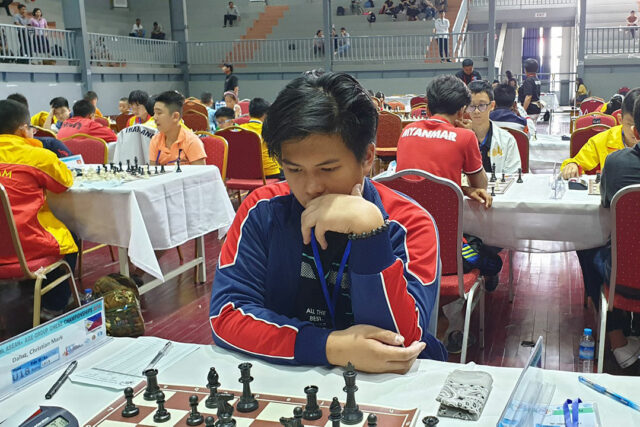
Christian Daluz tops ‘Bolok’ Memorial Open rapid chess

CHRISTIAN MARK DALUZ -- FACEBOOK.COM/LETRAN.EDU

FIDE Master (FM) Christian Mark Daluz shocked Grandmaster Darwin Laylo in topping the Antonio “Bolok” Memorial Open rapid chess tournament at the Brgy. Jesus Dela Peña Covered Court in Marikina City on Saturday.

The 21-year-old Mr. Daluz, a native of Sorsogon, ended up with a perfect score of seven points in claiming the top purse worth P10,000 in a tournament bankrolled by Boy Bolok Santos and organized by Isagani “Fischer” De Ramos, Jr. FM Noel dela Cruz turned back Phil Martin Casiguran to seize solo second spot with 6.5 points.

Mr. Laylo slipped to an eight-player group at third with six points but still took No. 3 after emerging with the highest tiebreaker.

Rounding out the top 10 were Mr. Casiguran, Jeremy Marticio, Sherwin Tiu, International Master Daniel Quizon, Leonel Escote, Carlo Caranyagan and Jonathan Jota.

Antonella Berthe Racasa emerged the best Marikina junior player plum after finishing with 4.5 points. — Joey Villar

Liverpool responds to stay top after Manchester City win

MANCHESTER City claimed the Premier League summit only to be swiftly knocked off it by Liverpool on Saturday, in a sign of what is likely to be in store over the coming weeks in a nail-biting title race.

Erling Haaland’s double — his first goals since returning from a foot injury — earned champions Manchester City a 2-0 victory over an obdurate Everton side at The Etihad Stadium.

That cranked up the pressure on Liverpool but Juergen Klopp’s side duly responded by beating Burnley 3-1 with Dioga Jota, Luis Diaz and Darwin Nunez all on target.

It meant the day ended as it had begun with Liverpool two points clear of City, who have played one game less.

Liverpool have 54 points from 24 games with City on 52 from 23 and third-placed Arsenal, who face West Ham United on Sunday, on 49 from 23 games.

Mr. Klopp’s side, beaten by Arsenal last week, were not at their best again and had to work hard to subdue Burnley who actually equalized through Dara O’Shea’s header and looked capable of taking something home as they battle against relegation.

Mr. Jota headed Liverpool into the lead in the 31st minute and Mr. Diaz and Mr. Nunez, also with headers, secured the victory after the break to return Liverpool above City.

City also found Everton a tough nut to crack and they did not muster a shot on target in the opening half.

Such is the firepower available to Pep Guardiola that even the stiffest resistance is usually pierced and Mr. Haaland’s return to the scoresheet was inevitable. His 15th and 16th goals of the season saw the Norwegian reclaim sole top spot in the league’s scorer list — his second set up by Kevin De Bruyne, also recently back from injury.

Tottenham Hotspur moved back into the top four — leapfrogging Aston Villa — thanks to Brennan Johnson who struck deep in stoppage time to secure a 2-1 home victory against Brighton and Hove Albion. — Reuters