Chinese President Xi Jinping speaks during the opening ceremony of the 20th National Congress of the Communist Party of China, at the Great Hall of the People in Beijing, China Oct. 16, 2022. — REUTERS
GYEONGJU, South Korea/BEIJING — Chinese President Xi Jinping gifted South Korea’s President Lee Jae Myung a pair of Xiaomi smartphones and jokingly urged him to “check if there’s a backdoor,” during a state visit on Saturday that capped the Asia-Pacific Economic Cooperation (APEC) forum.
Mr. Lee hosted Mr. Xi at a state summit and dinner after the APEC leaders’ meeting in the South Korean city of Gyeongju, marking Mr. Xi’s first visit to the US ally in 11 years.
The choice of the gift —China-made Xiaomi devices brought to the home country of smartphone giant Samsung Electronics — underscored Mr. Xi’s technological ambitions, recently reinforced in China’s economic development plan for the next five years.
After Mr. Lee presented Mr. Xi with “the finest” wooden board for ancient strategy game Go, the pair walked over to the smartphones wrapped in black boxes and an official noted the displays on the devices were made in South Korea.
Mr. Lee lifted one of the boxes and looked at it. He then asked Mr. Xi: “How is the communication security?” Upon which Mr. Xi and other gathered officials erupted in laughter. Mr. Xi then pointed at the phones and responded: “You can check if there’s a backdoor.”
A backdoor risk refers to a hidden method of bypassing normal authentication or security controls.
Both leaders laughed, and Mr. Lee clapped his hands as they proceeded with the presentation of gifts, which also included a traditional Korean mother-of-pearl inlay lacquered tray.
Mr. Xi’s comment harkened back to concerns expressed by China over a US proposal for advanced chips sold abroad to be equipped with tracking and positioning functions that prompted US chipmaker Nvidia to say its chips had no “backdoors.”
China’s foreign ministry and Xiaomi did not immediately respond to Reuters’ requests for comment on the exchange. Mr. Lee’s office said it had no separate comment on Mr. Xi’s gifts.
At the summit, Mr. Lee sought Mr. Xi’s help in efforts to resume talks with nuclear-armed neighbor North Korea, while Mr. Xi told Mr. Lee he was willing to widen cooperation and jointly tackle the challenges they face.
In other recent off-the-cuff remarks by Mr. Xi, a hot mic caught the Chinese leader and Russian President Vladimir Putin discussing organ transplants and the possibility that humans could live to 150 years at a military parade in Beijing in September. — Reuters
Army soldier figurines are displayed in front of the Ukrainian and Russian flag colors background in this illustration taken, Feb. 13, 2022. — REUTERS/DADO RUVIC/ILLUSTRATION
A UKRAINIAN drone attack damaged and set ablaze a tanker and infrastructure at a major oil terminal in Russia’s key Black Sea port of Tuapse overnight, authorities in the southern region of Krasnodar said on Sunday.
The attack on the southern outlet for Russia’s crude and refined products came a day after traders told Reuters shipments from the seaport were set to rise in November, threatening knock-on effects for export flows.
“In the port of Tuapse, fragments of unmanned aerial vehicles (UAVs) fell on an oil tanker, damaging the deck superstructure,” the administration said on the Telegram messaging app.
“A fire broke out on the vessel. The crew were evacuated.”
The port is home to the Tuapse Black Sea oil terminal and a Rosneft-controlled oil refinery, which Ukraine has targeted with several drone strikes this year.
It was not immediately known if the terminal was operating after the attack, which the administration said damaged its buildings and other infrastructure.
Unofficial Russian and Ukrainian Telegram news channels posted images that appeared to show a terminal and a tanker ablaze at night, reporting several fires burning in the port’s vicinity. Reuters could not independently verify the reports.
The Russian Defense Ministry said on Sunday air defense units destroyed 32 Ukrainian drones over the Krasnodar region, among a total of 164 downed over Russian territory, the Crimean Peninsula and the Black and Azov seas.
The ministry reports only drones destroyed, not how many Ukraine launches.
There was no immediate comment from Ukraine about the attack.
Kyiv has stepped up its strikes on Russian refineries, depots and pipelines in recent months to strain fuel supplies, disrupt military logistics and raise wartime costs, a campaign it calls retaliation for Russian attacks on its power grid.
Falling drone debris also damaged an apartment building in the village of Sosnovyi, just outside Tuapse. No injuries were reported though the railway station in Tuapse suffered some minor damage, the regional administration said.
The overnight attack forced temporary closure of scores of Russian airports, chiefly in the country’s south and west, for safety reasons, Russia’s aviation watchdog Rossaviatsiya said on Telegram. — Reuters
HANOI — Tourists are returning to Vietnam’s ancient town of Hoi An as residents clean up mud and debris to reopen the UNESCO-listed site following floods that devastated the central region and killed at least 35 people.
Tourism and services, driven by accommodation, dining and ticket sales, form the backbone of Hoi An’s economy and contributed nearly two-thirds of regional income last year as the town welcomed more than 4.4 million visitors, including 3.6 million foreigners, official data showed.
Domestic and international visitors were seen strolling along the riverfront and visiting heritage landmarks from Saturday, despite most hotels, lantern shops and restaurants undergoing extensive cleaning to prepare for a full reopening ahead of the peak travel season.
The historic floods last week submerged Hoi An’s lantern-lit streets and centuries-old wooden houses, forcing hundreds of businesses to temporarily close.
While no official financial damage estimates have been released, small shop owners reported losses in the hundreds of millions of dong, which equates to thousands of US dollars.
The nearby city of Thua Thien Hue, also impacted by the heavy rains, reopened its iconic citadel to tourists on Friday.
Authorities, however, continue to warn of rising river levels and potential renewed flooding as prolonged rains are expected in the coming days.
The floods also left five people missing and inundated more than 16,000 houses and 5,300 hectares (13,100 acres) of crops. Around 75,000 people are still experiencing power shortages, the government’s disaster agency said in a report.
Vietnam, prone to severe storms and flooding, frequently faces widespread property damage during its storm season, which typically lasts from June to October. — Reuters
AUSTRALIAN PRIME MINISTER ANTHONY ALBANESE — REUTERS
SYDNEY — Australian Prime Minister Anthony Albanese said on Sunday that he wrote to Turkish President Tayyip Erdogan to resolve a long-running tussle over who will host next year’s Conference of the Parties (COP31) summit.
Australia and Turkey submitted bids in 2022 to host the United Nations climate conference and both countries have refused to concede to the other ever since.
Asked on Sunday if he thought Australia would end up as host, Mr. Albanese said: “There’s no real process for finalizing the matter. I’ve written to President Erdogan of Türkiye, we’re continuing to engage.”
“It’s hard when there’s no consensus when you’ve got two bids. Our bid, of course, is in partnership with the Pacific,” Mr. Albanese added, according to an official transcript of remarks on Sky News television.
A regional diplomatic bloc of 18 countries, the Pacific Islands Forum, is backing Australia’s bid. Several Pacific island nations are at risk from rising seas.
Mr. Albanese said Australia wanted to ensure Pacific island nations’ interests are protected.
“They’re particularly vulnerable to climate change. For them, countries like Tuvalu and Kiribati, this is an existential threat to their very existence, which is why this is such a strong issue in our region,” he said.
Turkey has previously argued its Mediterranean location would help reduce emissions from flights bringing delegates to the conference and has pointed out its smaller oil and gas industry compared to Australia.
In July, the United Nations urged Australia and Turkey to resolve the hosting standoff, calling the delay unhelpful and unnecessary. It had set a deadline for June for the group to reach consensus.
The annual talks rotate through five regional groups, with COP31’s host needing to be unanimously agreed upon by the 28 members of the Western Europe and Others Group bloc. — Reuters
JOSH BOUTWOOD receives his two Michelin Stars award.
JOSH BOUTWOOD receives his two Michelin Stars award.
JOSH BOUTWOOD, corporate chef at the Bistro Group, was once bypassed when chefs were asked to talk at a prestigious culinary congress because he didn’t have his own restaurant.
Now, his restaurant, Helm, is the country’s first restaurant with two Michelin Stars. Meanwhile, Ember, Juniper, and The Test Kitchen, three more of his restaurants, are in the list of Selected Restaurants in the very first Philippine edition of the Michelin Guide.
In a scrum at the red carpet just minutes after receiving two Michelin stars, he told the press about how he planned to celebrate: “I can’t wait to leave, go to my restaurant, celebrate, open a bottle of champagne, and drink a shitload of beer, and just really have a nice night with my team.”
Responding to a question about how Helm got the two stars, he admitted, “I have no idea. I literally can’t believe it. In my head, it doesn’t make sense.” He cited his fellow star winners — Gallery by Chele, Inatô, and Toyo Eatery, each earning one star. “It doesn’t make sense to me why they’ve given me two. It’s something that I have to figure out and analyze.
“But right now, I just want to enjoy the moment, rather than go straight to figuring out what happened, why it’s happened to me, and not somebody else.”
Asked to think about the things he did right, however, he said, “I have no idea.” Ever the jokester, he said, “My personality and sense of humor.”
On a serious note, he says, “Helm is a very personal restaurant. Everyone that comes in is part of my home, just walking into my house. We put a lot of focus on making sure that the experience is the experience.”
Asked to pose for pictures with the trophy granting him his stars, we noticed that in the struggle to hold all of them, his other awards had been placed at his feet. “I am so proud of my teammates, who worked tirelessly to make sure that my vision is executed. I couldn’t do what I do without the remarkable people that work with me.
“All of this is for them. I’m here representing my restaurants. But at the end of the day, they are the heart and soul of what I do every day.”
THE 1ST PHL MICHELIN GUIDE AWARDS NIGHT The restaurants included in Michelin Guide Manila and Environs & Cebu 2026, the first for this country, were announced on Oct. 30 in a ceremony at the Marriott Grand Ballroom.
One hundred and eight establishments are listed in the guide, varying in distinction from Michelin Guide Selected Restaurants, Bib Gourmand Awards, and the coveted Michelin stars. The country had 74 Michelin Selected restaurants and 25 Bib Gourmand awardees. Eight were awarded one Michelin Star, and just one, Mr. Boutwood’s Helm, received two Michelin Stars.
The Guide says about Helm, “Led by chef Josh Boutwood, Helm presents a deeply personal expression of his half-British, half-Filipino heritage, infused with Spanish influences. His creative yet disciplined approach results in a modern tasting menu that’s intimate, precise and profoundly expressive. Each course a reflection of craftsmanship, identity and culinary evolution.”
In his acceptance speech, Mr. Boutwood was surprisingly calm, and even managed to joke: “Is this going to be like the Oscars, if I talk too long, the music’s going to come on?
“I was born into this industry, with both parents being restaurateurs and hoteliers. I had no other option but to continue what they did,” he said. “It has been my absolute love to do what I do.
“I couldn’t do what I do without all the teams behind me. My wife’s over there,” he said, and mentioned his children as well. Before going up on stage, he paused on the red carpet and looked for his wife, giving her a kiss before going up the stage to receive his award. “Without their dedication and support, I don’t think this would have been achievable. This has been a childhood dream, ever since I was young. To actually go onstage for the first time and receiving two stars is an absolute honor.”
LOVE LETTER TO THE PHILIPPINES The country’s first one-starred restaurants include Asador Alfonso and Gallery by Chele, both by Chele Gonzalez, with Andres Osorio at Asador Alfonso and Carlos Villaflor at Gallery, respectively. Gallery by Chele, a longtime industry favorite, also received the Michelin Green Star, an award for sustainable gastronomy.
Mr. Boutwood and Mr. Gonzalez had the most restaurants that were honored in different categories.
Upon receiving his award for Asador Alfonso, Mr. Gonzalez said, “In my case, my heart is divided in two: I’m Spanish, but I’m also Filipino by heart.”
He continued after receiving his award for Gallery by Chele, “Gallery by Chele opened its doors about 13 years ago. Through the 13 years, hundreds of people, having passed there: this award is for all of them. This award is also for the Philippines. The inspiration of the restaurant is really the Philippines: dreams and everything that we do. We believe that Gallery by Chele is a love letter to the Philippines.”
Celera (by Nicco Santos and Quenee Vilar); Hapag (by John Kevin Navoa, Thirdy Dolatre, and Erin Recto — Ms. Recto also took home the Service Award for hospitality); Inatô (by JP Cruz); Kasa Palma (by Aaron Isip); Linamnam (by Don Baldosano who also took home the Young Chef Award); and Toyo Eatery (by Jordy Navarra, another industry favorite) round out the list of the inaugural one Michelin Star awardees in the Philippines.
Mr. Santos said upon receiving his award, “I think I’m just proud of all the hard work my team has put out for the last eight months since we’ve been open. For me, for us, this is just one star: to add to my 18 stars in the restaurant, waiting.”
Mr. Navarra, whose restaurant has consistently placed in Asia’s 50 Best List of restaurants and has consistently been one of the top restaurants in the country, said, “Salamat sa lahat (thanks for everything).
“Super happy to see everyone here celebrated,” he said. “Super proud of everyone. I’m happy to be here, and I’m happy all of us are here.” He thanked his team with some tears in his eyes. “We always say: ‘Mata sa langit, paa sa lupa (eyes on the sky, feet on the ground).’” This slogan was printed on his T-shirt, glimpsed underneath the Michelin-star embroidered jackets awarded to the winners.
STARS EXPLAINED According to the Michelin Guide’s website, “One Michelin Star is awarded to restaurants using top quality ingredients, where dishes with distinct flavors are prepared to a consistently high standard.” This is summarized by the tagline “High quality cooking, worth a stop!” Meanwhile, “Two Michelin Stars are awarded when the personality and talent of the chef are evident in their expertly crafted dishes; their food is refined and inspired,” the guide continues. Two Stars in the guide means, “Excellent cooking, worth a detour!”
The Guide says, “We take into account five universal criteria: the quality of the ingredients, the harmony of flavors, the mastery of techniques, the personality of the chef as expressed through their cuisine and, just as importantly, consistency both across the entire menu and over time.”
Winners are decided by official inspectors who dine incognito. “Once several inspectors have eaten at a restaurant, they then discuss their experiences as a team in order to make a final decision.”
BIB GOURMAND, GUIDE SELECTION LIST Two of the three special awards were mentioned earlier, the third honoree being Benjamin Leal of Uma Nota who went home with the Exceptional Cocktails Award.
The next two categories — the Bib Gourmand and the Selections list — feature a wide variety of restaurants, from humble carinderias and pansiterias to hotel fine-dining restaurants and some of the fanciest of establishments.
The Bib Gourmand selection awards restaurants that offer “exceptional food at moderate prices,” according to the Guide.
In Manila and its environs, these are Bolero, Brick Corner, Cabel, COCHI, Em Hà Nội, Hálong, Kumba, La Pita, Lampara, Los Tacos, Manam at the Triangle, Morning Sun Eatery, Palm Grill (Diliman), Pilya’s Kitchen, Sarsa, Some Thai, Taquería Franco, The Underbelly, and Your Local. In Cebu, the Bib Gourmand selections are Abaseria Deli & Café, CUR8, Esmen, Lasa, Pares Batchoy Food House, and The Pig & Palm.
As for the Michelin Selected Restaurants, numbering 74, these were recognized for “the quality of their cuisine, character of their dining experience, and overall consistency.”
The recipients were:
12/10
Abli
Aida’s Kitchen
Antonio’s
ATO-AH
Aurora
Automat
Ayà
Benjarong
Blackbird
BUTCHER BOY
Cantabria by Chele Gonzalez
Canton Road
Carmelo’s Steakhouse
Chie Chie’s Pancit Batil Patung
China Blue
Cirkulo
COCO
Cru Steakhouse
Deo Gracias
DIP
El Poco Cantina (Malate)
Ember
Enye by Chele Gonzalez
Esmeralda Kitchen
Fong Wei Wu
Fresca Trattoria
Ginza Nagaoka
Gordon Ramsay Bar & Grill
Goxo
House of Lechon
Iai
Juniper
Kamakura
Kei
Kodawari (Salcedo)
Lantaw (Compostela, Cebu)
Locavore (Taguig)
Lola Helen
Lore
Lusso (Legazpi)
Mamacita
Man Ho
Maya
Metiz
Mireio
MŌDAN
Now Now
Oak & Smoke
Offbeat
Old Manila
Origine
Osteria Antica
Pablo
Papillon
Pares Pares (N. Escario Street)
People’s Palace
Ramen Ron
Sala
Seva
Sialo
Socarrat
Spices
Steak & Frice
Summer Palaxe
Super Uncle Claypot
Tandem
Taupe
Terraza Martinez
The Test Kitchen
Txanton
Uma Nota
Umu
Yamazato
“This selection pays tribute to a new generation of Filipino chefs, and international chefs who have embraced the Philippines, drawing inspiration from local heritage, bold flavors, and heartfelt hospitality. Whether it’s fine dining or street-side eateries, our inspectors were truly impressed by the culinary authenticity and creativity found across the country,” said Gwendal Poullennec, International Director of the Michelin Guide in a statement. In a speech during the awards night, he said, “Filipino cuisine is bold, generous, deeply personal. It tells a story of heritage and innovation.
“What sets the Philippines apart is the new generation of chefs. Many are under 30 years old. Some honed their skills abroad, or right here at home. Together, they are shaping a new era for modern Filipino cuisine.” — Joseph L. Garcia
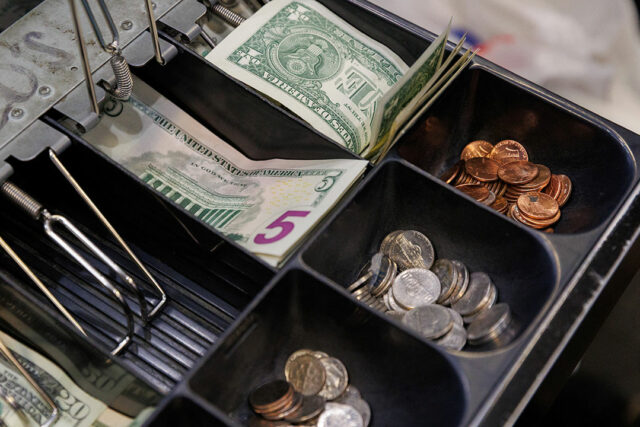
Pennies and other US currency denominations in a cash register at a QuikTrip in Dallas, Texas, U.S., Oct. 23, 2025. The US Treasury has stopped making pennies, causing some businesses to have to create new workarounds for cash transactions. — REUTERS/SHELBY TAUBER
Now that the United States no longer makes pennies, there is a scramble among gas stations, fast-food chains and big-box stores to adjust prices and round cash transactions, and it could potentially eat into their profits.
Pennies are drying up faster than retailers anticipated following President Donald Trump’s decision earlier this year to halt production of the one-cent coin. Retail groups recently told Reuters that they are frustrated by the lack of guidance from the Trump administration and lawmakers, forcing them to round down to avoid angering customers and violating laws in some states — potentially costing high-volume businesses significant money.
The National Retail Federation said the dearth of pennies has hit retailers in urban and rural areas, with no clear geographic pattern. Members of some state restaurant associations have voiced concerns about penny shortages.
“Any merchant that accepts cash is grappling with this,” said Dylan Jeon, senior director of government relations with the National Retail Federation, whose members include Walmart, Target, Macy’s, and Old Navy.
Some major convenience chains have already begun warning customers.
Sheetz, a family-owned convenience store, posted signs at one of its Pennsylvania stores that read: “The US Mint will no longer produce pennies, so we are short on change!” The signs encourage customers to use cashless payment options, round up purchases to support charity, or exchange $1 in spare pennies for a free self-serve drink.
Kwik Trip, the convenience store chain based in La Crosse, Wisconsin, announced that its 850 stores across the Midwest would round cash transactions down to the nearest nickel. At a Dallas location, a sign warns customers: “The US Treasury has stopped making pennies and we may experience shortages.”
KrogerUS, one of the largest US grocery chains, told Reuters it is still assessing the impact of the penny shortage. Many of its 2,700 locations have displayed signs asking customers for exact change.
Individual stores with other large chains have done the same, such as a CVS in Alexandria, Virginia, that posted a notice asking for exact change because of a “penny shortage.”
Treasury did not respond to multiple requests for comment.
Several countries, including Canada, Australia, Ireland and New Zealand, have phased out their lowest-value coins, rounding cash transactions up or down to the nearest five cents while keeping electronic payments exact. The moves cut minting costs and simplified cash handling for retailers.
In the US, phasing out pennies would require similar rounding practices at stores, adjustments to registers, and clear communication to consumers, but could deliver comparable savings and efficiency gains.
Several states, including California, New York and Illinois, however, have consumer protection laws that require retailers to provide exact change on cash transactions, creating legal uncertainty as pennies disappear from circulation. Retail groups say those rules make it difficult to adjust prices or round totals without risking fines or customer complaints.
LOOKING FOR CONSISTENT RULES While Trump’s directive initiated the end to production, Congress retains authority over coinage, meaning legislation may still be required for a permanent discontinuation. The NRF has been lobbying the Trump administration and Congress to provide consistent guidance, particularly around rounding transactions.
“What’s most helpful in the near term is clarity on rounding practices — whether retailers can round up or down on transaction totals or change,” Jeon said.
A group of trade organizations that include gas stations, convenience stores, travel centers and grocery stores warned in a September 30 letter to congressional leaders that “if these remedies are not addressed in short order, it will be challenging to legally engage in cash transactions with customers in growing swaths of the country.”
Love’s Travel Stops, which operates more than 640 locations in 42 states, said the phaseout of penny production is affecting its retail operations.
“If one of our stores runs out of pennies, all change on cash transactions will be adjusted in the favor of the customer and Love’s will cover the difference,” a company spokesperson said. “This is a temporary measure while we work toward a long-term solution.”
Months after Trump ordered a halt to production of pennies, the Treasury Department in May placed its final order for blank penny planchets. Several Federal Reserve Bank sites, which distribute coins to banks and credit unions, have already stopped fulfilling orders for pennies.
Producing a penny currently costs more than its face value — about 3.69 cents per coin in recent years. The government now projects savings of roughly $56 million annually by ending penny minting.
There are about 114 billion pennies currently in circulation in the United States, but they are greatly underutilized, the Treasury says. The penny was one of the first coins made by the US Mint after its establishment in 1792.
Supporters of the penny argue it helps keep consumer prices down and is a source of income to charities. For its critics, the coin is a nuisance that ends up being discarded in drawers, ashtrays and piggy banks.
“I can’t even tell you the last time I carried pennies — even loose change — when I left the house,” said Pennsylvania resident Sandy Berger, 45. “I really don’t think people will care to see them gone.” — Reuters
BEIJING — China’s military said on Saturday it monitored and tracked a joint patrol organised by the Philippines in the disputed South China Sea on October 30 and October 31.
Washington and Manila have beefed up military cooperation, unveiling plans on Friday to form a new joint task force for areas including the South China Sea, a conduit for more than $3 trillion of annual ship-borne commerce.
Tian Junli, a spokesperson of the Southern Theater Command of the Chinese People’s Liberation Army, said the patrol, with unnamed partners, “seriously undermined regional peace and stability”.
He called the Philippines “a troublemaker” in the region.
“The theater command forces remain on high alert and will resolutely safeguard national territorial sovereignty and maritime rights and interests,” Tian added in a statement.
The Philippine embassy in Beijing did not immediately respond to an emailed request for comment.
The armed forces of Australia, New Zealand, the Philippines and the United States held a drill in the South China Sea on October 30 and 31.
The U.S. 7th Fleet said the exercise aimed to demonstrate “a collective commitment to strengthen regional and international cooperation in support of a free and open Indo-Pacific”.
China claims almost the entire South China Sea, including parts claimed by Brunei, Indonesia, Malaysia, the Philippines and Vietnam.
In 2016 the Permanent Court of Arbitration in the Hague ruled that China’s claims were not supported by international law, a decision Beijing rejects. — Reuters
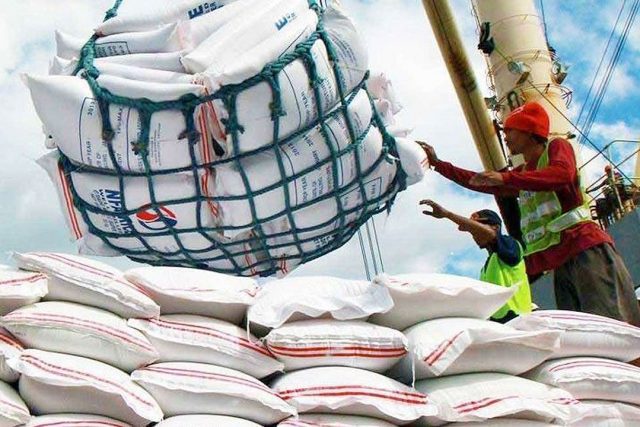
Philippine President Ferdinand R. Marcos, Jr. has approved an extension of the country’s rice import ban until year-end to help stabilize farmgate prices for unfilled rice, Agriculture Secretary Francisco P. Tiu Laurel, Jr. said on Sunday.
An executive order formalizing the decision would be issued on Nov. 3, he said in a statement.
“With the import ban having little impact on retail prices and supply of rice but a significant effect on the farmgate price of palay, President Marcos deemed it necessary to extend the suspension for two more months,” he added.
Palace Press Officer Clarissa A. Castro did not immediately reply to a Viber message when asked for confirmation.
The administration first imposed the import halt in September to counter falling palay prices ahead of the wet harvest season. Prices briefly improved after the suspension but began easing again as the policy neared its Oct. 31 expiry.
The Agriculture chief said the extended ban, coupled with assistance to farmers and fisherfolk and the implementation of a floor price for palay, would provide continued relief to rice farmers as harvests proceed across several regions. — Chloe Mari A. Hufana
SOUTH KOREA — China’s Xi Jinping took center stage at an annual gathering of Pacific Rim leaders in South Korea on Friday, meeting Canadian and Japanese counterparts after securing a fragile trade truce with U.S. President Donald Trump.
That agreement, struck just before Mr. Trump left South Korea, skipping the main two-day Asia-Pacific Economic Cooperation summit, cooled spiraling tensions between the world’s two largest economies that have jolted global commerce.
With Mr. Trump playing host for the White House’s annual Halloween party back in Washington, Mr. Xi sought to cast China as the predictable champion of free and open trade at the forum, a role the US has dominated for decades.
“Changes unseen in a century are accelerating across the world,” Mr. Xi told leaders of the 21-member Asia-Pacific Economic Cooperation (APEC) bloc on Friday in the historic town of Gyeongju.
“The rougher the seas, the more we must pull together,” Mr. Xi added in a speech calling for protection of the multilateral trading system and deeper economic cooperation.
However, many Asian nations are wary of China’s rhetoric, given its muscular defense posture in the region, dominance in manufacturing and its own willingness to use export controls and other tools in trade disputes.
Deputizing for Mr. Trump, US Treasury Secretary Scott Bessent told the gathered leaders – many of whom have been hammered by Mr. Trump’s barrage of tariffs – that Washington was “rebalancing its trade relationships to build a stronger foundation for global growth”.
The IMF initially cut the global growth outlook after Mr. Trump’s ‘Liberation Day’ tariff announcement in April, but has edged it back up as shocks and financial conditions have proved more benign than expected.
XI MEETS JAPAN’S NEW HAWKISH LEADER
Among the most hotly-anticipated bilateral meetings, the Chinese leader held talks with Japan’s newly elected leader Sanae Takaichi. In brief remarks at the start of their meeting, both leaders said they would seek to advance ties.
While relations between the historic rivals have been on a sounder footing in recent years, Ms. Takaichi’s surprise elevation to become Japan’s first female leader may strain ties due to her nationalistic views and hawkish security policies.
One of her first acts since taking office last week, was to accelerate a military build-up aimed at deterring the territorial ambitions of an increasingly assertive China in East Asia. Japan also hosts the biggest concentration of US military abroad.
The detention of Japanese nationals in China and Beijing’s import restrictions on Japanese beef, seafood and agricultural products were also likely to be among sensitive issues on the agenda.
CANADA SEEKS TO RESTART CHINA ENGAGEMENT
Canadian Prime Minister Mark Carney also held talks with Mr. Xi, aiming to restart broad engagement with China after years of poor relations.
Embroiled in a bitter trade dispute with the United States, Canada’s biggest trading partner, Carney told a gathering of executives running parallel to the main summit on Friday that Ottawa aimed to double its non-US exports over the next decade.
China is Canada’s second-biggest trading partner.
Under the leadership of Carney’s predecessor Justin Trudeau, Canadians were detained and executed by the Chinese government and Canada’s security authorities concluded that China interfered in at least two federal elections. Mr. Xi also publicly scolded Mr. Trudeau, alleging he leaked their discussions to the press.
China announced preliminary anti-dumping duties on Canadian canola imports in August, a year after Canada said it would levy a 100% tariff on imports of Chinese electric vehicles. Senior officials from both sides met to discuss those issues earlier this month but gave no indication of any looming breakthrough.
Mr. Xi also met Thai Prime Minister Anutin Charnvirakul, while South Korean President Lee Jae Myung will tackle Korean denuclearization with the Chinese leader at a summit on Saturday.
As he held his summits, Mr. Xi’s commerce minister delivered a speech on his behalf to the gathering of executives, in which he said China was the “ideal” destination for global business and investment.
In other business, Taiwan said it was making progress on a tariff deal with the United States, and South Korea said final details of its deal with Washington were almost ready after a breakthrough agreed on Wednesday.
SOUTH KOREA HOPEFUL OF JOINT DECLARATION
South Korean Foreign Minister Cho Hyun said on Thursday that he was hopeful APEC leaders would issue a joint declaration when the summit concludes on Saturday.
Two APEC member-nation diplomats privately expressed skepticism that any statement would be particularly substantive given fractures in global politics.
APEC, which stretches from Russia to Chile and accounts for 50% of global trade, failed to adopt a joint declaration in 2018 and 2019, during Trump’s first presidency.
There was also some business deals on the sidelines with US chipmaker Nvidia agreeing on a $3 billion AI joint venture with South Korean automaker Hyundai Motor Group.
Nvidia’s CEO Jensen Huang has had a whirlwind week, with Nvidia becoming the first company to surpass a $5 trillion valuation, but the issue of the US chipmaker’s sale of advanced AI chips in China was seemingly left out of Thursday’s Xi-Trump summit.—Reuters
More Filipinos are pursuing post-graduate studies in Spain, driven by the country’s wide range of visa opportunities, an expert said.
“Spain is very popular among Filipinos because we have different programs,” Spain’s Goodwill Ambassador Jessica Isabelle C. Badua told BusinessWorld in an interview on Thursday.
“Filipino students are increasing because of the number of visas available,” she added.
According to Ms. Badua, the most common master’s programs among Filipinos are engineering, law, health sciences, administration and management, and humanities. Meanwhile, most students are from the Millennial and Generation Z age brackets.
“I think Spain offers different programs in every area of study,” she said. “Students wishing to apply in Spain can find programs where the tuition is affordable, as long as it’s a public university.”
Citing data from the HTL International School, the average annual tuition for international students enrolled in master’s or doctorate programs at Spanish public universities is estimated to be within €2,000 to €5,500, while a bachelor’s degree costs €1,500 to €4,000 per year, on average.
Ms. Badua noted that the Auxiliares de Conversación, or the Language Assistant Program, is popular among students who want to work while studying.
“There are universities in partnership with the Ministry of Education in Spain,” she said. “So, what they do is they offer a master’s degree in teaching, and at the same time, they offer that Auxiliaries de Conversación Program.”
“So, meaning, students can study their master’s and also teach English to students, and then they get paid,” she added.
The Ambassador also attributed the growing enrollment rate in Spain to visa opportunities that streamline the path to citizenship.
Specifically, programs like the Golden Visa and Digital Nomad visa, alongside the Ley de Memoria Democrática, which allows descendants of Spanish nationals to claim citizenship, are among the popular visas used by Filipinos.
“With that, the families have the option to move to Spain because they have their passports. So, they moved to Spain along with their kids, and the kids also study there,” she said.
The Philippines was first discovered by Portuguese explorer Ferdinand Magellan in 1521 and was later colonized by Spain from 1565 to 1898. The centuries-long Spanish colonization has influenced the country’s religion and culture, specifically Catholicism and language.—Almira Louise S. Martinez
Rowen R. Gelonga, DOST regional director at the Handa Pilipinas-Visayas leg in Bacolod City. — DOST FB PAGE
Amid the worsening effects of climate change, particularly on the country’s agricultural sector, various smart farming technologies are being introduced to help sugarcane farmers adapt, according to the Department of Science and Technology (DOST).
Climate change has caused an estimated P463 billion in damages to the Philippines, of which about 62.7% or P290 billion was incurred by the agriculture sector due to extreme weather events such as typhoons and severe high temperatures, according to a 2021 report by the United Nations World Food Programme.
Sugarcane, one of the country’s major crops, was not spared from the effects of climate change.
Data from the Sugar Regulatory Administration showed that the country recorded its lowest milled, raw, and refined sugar output in crop year 2022 to 2023, the lowest in the last five crop years since 2018 to 2019, mainly due to the El Niño–induced dry spell.
Although El Niño is not caused by climate change, it may be affected by it in terms of frequency and intensity, according to an earlier report from the state weather bureau.
To help farmers cope with the effects of climate change, DOST Secretary Renato U. Solidum Jr. said the agency has introduced various smart farming technologies on Negros Island, where about 60% of the country’s sugar output is produced.
“We have the furrow irrigation system so that we can maximize the use of rain,” Mr. Solidum told BusinessWorld.
“And it has been proven that it can increase the production of sugarcane…around 50%.”
DOST’s Automated Furrow Irrigation System was developed to help sugarcane farmers save water and improve crop yield by ensuring that irrigation water is applied in precise amounts and at the right time. The farming solution was first introduced in 2022.
Meanwhile, Rowen R. Gelonga, regional director of DOST Region VI, said the agency seeks to introduce a smart farming solution in Negros Island that uses modern technologies such as soil moisture sensors and geographic information systems (GIS) to help farmers better adapt to changing weather conditions.
“One component of that is really to capacitate the farmers to understand climate change and weather phenomena,” Mr. Gelonga told BusinessWorld.
The project, called Project SARAI Centro, features an accessible and free online application that allows sugarcane farmers to view weather and climate outlooks, as well as receive recommendations on the best times for planting and harvesting.
It also has a mobile application called SPIDTECH that helps farmers identify, monitor, and report crop pest and disease incidences.
Mr. Gelonga said they aim to first train local government units in the region by the end of the year, who will later implement the project and empower local farmers. — Edg Adrian A. Eva
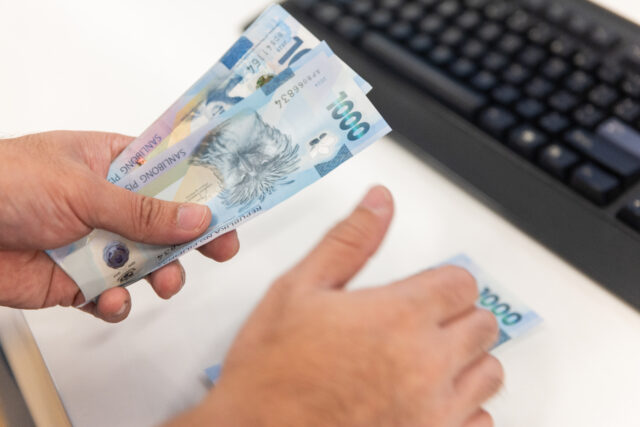
An employee counts Philippine peso banknotes at a Rizal Commercial Banking Corp. branch in Manila, the Philippines, on July 11, 2025. Credit: GERIC CRUZ/BLOOMBERG
The Philippine peso fell to its weakest level ever against the US dollar in late October. While it’s since regained some ground, officials have signaled a tolerance for further depreciation and traders are keeping a close watch for any signs of central bank intervention.
A weak peso is a double-edged sword for the Philippines. It could boost remittance flows from the millions of Filipinos who live overseas and send money home, potentially encouraging higher spending in the consumption-driven economy. But it could also cause inflation to spike again as imports become more expensive. In addition, the Philippines is one of the most active sovereign bond issuers in Asia and prolonged peso weakness would drive up government borrowing costs and risk further inflating the national debt.
The peso has fallen more than 2% since July when President Ferdinand Marcos Jr. revealed during his State of the Nation address that many of the government’s flood infrastructure projects — in what is one of the world’s most typhoon-hit nations — were money-making schemes.
Congressional hearings uncovered allegations of collusion among lawmakers, public works officials and contractors to divert billions of pesos of government funds meant for those projects. That ignited mass protests and a broad exit by foreign investors in the equities market. Global investors pulled out a net $127 million from the local stock market between July 29 — the day after Marcos’ speech — and Oct. 29, according to data compiled by Bloomberg. Foreign investors account for more than 40% of the Philippines’ stock market turnover.
The Philippine central bank in October said that the outlook for domestic economic growth had weakened due to dampened business confidence over concerns about public infrastructure spending.
Also weighing on the peso are expectations of further interest rate cuts, as the central bank moves to cushion the economic fallout from the graft scandal, with flow-on effects expected to persist until the end of 2026. The Bangko Sentral ng Pilipinas has already reduced the benchmark rate by 175 basis points since August last year. Monetary Board member Benjamin Diokno told Bloomberg Television that another 25-basis-point cut is likely in December and more downward adjustments are possible “maybe sometime next year.”
There are other headwinds for the economy beyond the corruption scandal. The 19% tariff the US imposed on imports of Philippine goods from August has slowed factory activity. The Bangko Sentral has warned of weaker investment inflows and softer growth in key service exports.
Prior to the corruption scandal, the government cut its economic growth target for 2025 to 5.5%-6.5% from a previous goal of 6%-8% amid the US tariff risks and some economists revised down their own growth projections as the graft controversy unfolded.
WHAT ARE THE PROS AND CONS OF WEAK PESO?
More than 10 million Filipinos live and work abroad, and many of them send money home to help their families. These remittance flows reached a record $34.5 billion last year.
A weaker peso makes the remittances more valuable, increasing the purchasing power of this money in the Philippines. This could spur household spending, which would benefit consumer-centric companies. Household consumption accounts for around two-thirds of the nation’s gross domestic product. The currency depreciation could also strengthen the usual seasonal uptick in remittances in the fourth quarter ahead of the Christmas and New Year holidays.
A weaker peso would also make it cheaper and more appealing for overseas businesses to outsource jobs to the Philippines, providing a favorable backdrop for firms to boost hiring or raise salaries, which could in turn support consumption. The Philippines is one of the world’s largest hubs for business-process outsourcing, employing nearly 2 million people in the industry.
A weaker currency also makes a country’s goods more affordable for foreign buyers. The peso’s depreciation could therefore boost the international competitiveness of Philippine manufacturers, potentially leading to an increase in export volumes and revenues. That, in turn, may help to shrink the national trade deficit, which currently averages around $3 billion to $4 billion a month.
On the flipside, a weak peso makes imports more expensive, curbing demand for foreign products while adding to inflationary pressures. The Philippines imports most of its electronic components, as well as industrial machinery, iron and steel, and many meat and dairy products. The country relies on imports for nearly all of its oil requirements, raising the risk of higher fuel prices.
The government’s finances, however, stand to benefit from the peso’s weakness. According to a Department of Budget and Management’s sensitivity analysis, every 1-peso depreciation against the dollar could generate an additional P9.3 billion ($158 million) in tax revenue, including from import duties, in 2026.
WHAT DOES A WEAK PESO MEAN FOR INVESTORS?
A weaker peso makes Philippine assets cheaper for foreign investors, since the same number of dollars is now able to buy more of the local currency. That could encourage overseas investors to invest more in the country and expand their portfolios. That said, the value of any gains or dividends would be worth less in dollar terms.
The appeal of cheaper assets may also be outweighed by what a weaker currency signals — declining investor confidence and broader economic uncertainty. The economic growth of the Philippines, while still among Asia’s fastest, may lose steam if the corruption scandal continues to erode business optimism.
ARE THE CENTRAL BANK AND GOV’T WORRIED?
So far, officials don’t seem to be too concerned about the peso’s recent fall and they haven’t signaled any intent to intervene heavily. That contrasts with other Asian monetary authorities that have stepped in to support their currencies. The Reserve Bank of India, for instance, is prepared to keep selling dollars in both onshore and offshore markets until the rupee stabilizes at a stronger level, Bloomberg reported.
In early October, Bangko Sentral Governor Eli Remolona said authorities would defend the peso if “the depreciation is so sharp, so large that we think it will become inflationary.” Should the downward pressure on the currency intensify, he said that imposing capital controls was “not out of the question, but I think we’d rather not.”
After the slump in late October, the central bank said that it allows market forces to determine the foreign exchange rate and that when it does intervene, it is largely to dampen inflationary swings over time rather than to prevent day-to-day volatility. The Bangko Sentral also said it continues to maintain robust foreign reserves, $109 billion as of September, the highest in almost a year — giving the bank flexibility to sell US dollars if needed to steady the peso.
The Bangko Sentral may be content to let the peso weaken, with inflation still below the central bank’s 2%-4% target range. “Recent statements from central bank officials indicate that supporting growth is a greater priority in the near term,” according to Emilio Neri, chief economist at Bank of the Philippine Islands. — Bloomberg