Home Blog Page 2883

Skills Development in IT-BPM Sector: Learning new languages and big data analytics

FREEPIK

(Part 2)

In the Philippine IT-BPM Sector Roadmap 2022 (there has since been a new roadmap prepared for the duration of the Marcos Jr. Administration), there was already an advisory that the rapidly changing technological trends faced by the sector will result in two opposing forces upon the growth potential and services mix for the information technology and business process management (IT-BPM) industry in the coming years. These forces were iden-tified as: a.) Augmented growth driven by opportunities from new-enabled services that can be offered by the IT-BPM sector; and, b.) Dampened growth due to the automation and streamlining of some services. We have al-ready given examples of both trends in the first article of this series.

As regards augmented growth of the functions or services supported by IT-BPM, we have seen how the outsourcing market continues to grow, as in the case of the EU considering the Philippines for outsourcing their IT-BPM services, thus competing with the North American enterprises. We also saw how many new advanced services are being offered by the sector, such as AI and Big Data. As regards potential dampening of roles due to automation, low-skilled jobs, especially in the contact center sector, are being made redundant through automation. However, for more complex job categories, rather than sheer replacement, there is ample opportunity for upskilling and reskilling.

Based on a paper by two researchers from the Massachusetts Institute of Management (MIT), the 2022 Roadmap used a specific approach to understand the current task/role distribution of the IT-BPM services provided in the Philippines. The approach involved identifying several service categories across five IT-BPM subsectors, and three mutually exclusive categories of skill-based roles were defined. These were:

Low-skilled tasks/roles: Simple entry-level, process-driven tasks that require little abstract thinking or autonomy.

Mid-skilled tasks/role: Complicated tasks that require experience, abstract thinking, and situational response.

High-skilled tasks/roles: Complicated tasks that require specialized expertise, abstract thinking, and autonomy.

In a survey conducted among IT-BPM operators in the Philippines, it was discovered that roughly 45.8% of the IT-BPM workforce in the Philippines in 2016 were involved in low-skilled roles, 39.4% in mid-skilled roles, while 14.7% were working in high-end roles. This distribution of skills is generally aligned with the global IT-BPM sector, except for a slight skew in favor of mid-skilled roles in the Philippines. This can be attributed to the service mix of contact centers (which carried the highest weight by service type) in the Philippines. The Philippines has a competitive advantage in contact services because of its strong base of service-oriented talent (soft skills), affinity to Western (especially US) cultures and established base of BPM operators.

Let me add here that educated Filipinos have a great facility in learning foreign languages, compared to their Asian neighbors, because of the multilingual environment in which they live. Millions of Filipinos who have had at least a high school education have been exposed from childhood to at least three languages on the average, i.e., English, Filipino, and, for the majority outside the Tagalog-speaking regions, to the other languages like Cebuano, Ilocano, Ilonggo, Waray, etc. (these are not dialects but separate languages, more different from one another than Spanish, French, Italian, and Portuguese are different from one another). It is maintained by linguists that those who from childhood have been exposed to different sounds of several languages have greater facility in learning foreign languages than those who have been monolingual during their growing years, such as White Anglo-Saxon Americans. Thus, it will not be difficult for future generations of Filipinos to start servicing the IT-BPM needs of countries in the EU and in Northeast Asia who will surely have labor shortages as their very low fertility rates result in rapidly ageing populations and a lack of young workers.

For this reason, part of the reskilling and retooling efforts of the IT-BPM industry should be the offering of foreign language courses to the employees, especially Spanish, French, German, Japanese, and Mandarin. Already there are manpower recruiting agencies focused on the OFW sector offering these language courses. The experience of some of them, especially among nurses and caregivers, is that Filipino educated workers can learn the fundamentals to speak a foreign language in three months of intensive daily classes in a sort of language “boot camp.”

With its leadership position in the customer service sector (even surpassing India that has a population 10 times that of the Philippines), the country has been attracting a basket of contact center services that are relatively more complex (e.g., in the banking and utility sectors, simple calls would be ones servicing requests on information — such as inquiries on account balances, payment due dates for credit cards and the like; while complex calls could deal with management of complaints and the provision of solutions). For this reason, those who work for contact centers in the Philippines are classified under mid-skilled and are less likely to be completely replaced by AI or robots.

In the 2022 Roadmap, it was found that the propensity to automate is likely to be greater in low-skill-enabled, transactional service roles that are easier for computers, applying even simple constructs of AI and Robotics Pro-cess Automation (RPA) to emulate. It was estimated that in the subsequent three years, one out of three low-skilled IT-BPM tasks have a 40% to 60% likelihood of automation. With further development and willingness to adopt new technologies on the back of established use cases, automation is likely to go up to 80%.

As regards higher-skilled roles, as in game development, animation, system integration services, and infrastructure services, more complex forms of automation enabled through technologies like machine learning and natural lan-guage processing will take effect to replace or augment human jobs.

The dampening effect for mid-skilled roles is expected to be lower while for high-skilled roles, in addition to a lower extent of automation, a greater time lag is estimated. Among those with the highest propensity to be au-tomated are: Medical transcription, simple contact center services (many are already being handled via IVR systems), basic 2D animation services, parts of IT technical support and transactional mid- and back-office processes.

To the millennials and centennials (young professionals still in their twenties or thirties), my advice is for them to consider specializing in the IT needs of the expanding health sector and big data analytics. The evolution of the healthcare industry towards “connected wealth” will be experienced across the entire value chain and business processes. There will be changes in the ways health organizations operate, i.e., from a standalone set-up to more distributed, cloud-connected establishments. The IT-BPM sector is likely to emerge as the key enabler of connected healthcare through the provision of services and intelligence layers riding on core medical products. New service offerings include clini-cal data analytics, remote care enabled through m-health, and unlocking efficiencies in information processing and administrative services.

Considered to be low to non-existent across many business functions at the end of the first decade of this century, big data analytics has seen an almost explosive increase in demand in the last five years. The need for vital health-related information during the pandemic contributed to greater awareness among business, government, and civil society organizations about the value of analyzed data.

As an anecdotical illustration, the first realization that Secretary of Agriculture Francis Tiu Laurel had upon assuming office, was the lack of reliable data on the agricultural sector. His first priority was to build an accurate da-tabase on which to formulate more enlightened policies for the increase of agricultural (and aquacultural) productivity.

Emerging applications of big data analytics have driven dramatic changes across functional areas and have provided opportunities for cost reductions and strategic advantages. This is opening up opportunities across many functions currently serviced by the IT-BPM sector, especially in the areas of customer services, finance, and accounting, and also draw newer functions such as in engineering, design, and supply chain management into its realm. Already as large conglomerates are finally investing large sums of money into food security, this sector, which accounts for some 30% of GDP, will increasingly have need for IT-BPM services. Such enablement of technologically

driven services will inevitably require high-end (and more specialized) skill sets and know-how.

(To be continued.)


Bernardo M. Villegas has a Ph.D. in Economics from Harvard, is professor emeritus at the University of Asia and the Pacific, and a visiting professor at the IESE Business School in Barcelona, Spain. He was a member of the 1986 Constitutional Commission.


A magic spaceship with no brakes

CAST AND CREW celebrate onstage at the end of the Buruguduystunstugudunstuy gala night.

By Brontë H. Lacsamana, Reporter

Theater Review
Buruguduystunstugudunstuy:
Ang Parokya ni Edgar Musical
By Rody Vera
Directed by Dexter M. Santos
Presented by Full House Theater Company

THE TONGUE twisting title of the latest Filipino jukebox musical, Buruguduystunstugudunstuy, first came to public consciousness in 1997, as the name of rock band Parokya ni Edgar’s second album. Invented by the band’s frontman Chito Miranda, the word is enjoying a resurgence today as it confounds and bewilders those who try to say it.

In an attempt to understand what it might mean in the context of Full House Theater Company’s newest production, audiences will find it is but a heartbeat to the confounding and bewildering musical itself. Truly, the Parokyaverse is something that is better experienced than explained.

As the 10th major offering made for the Newport Performing Arts Theater in Newport World Resorts (NWR), it follows the footsteps of its precursor, the Eraserheads musical Ang Huling El Bimbo. This time, it gives its own spin on Parokya ni Edgar’s fun and cheeky spirit.

NWR president Kingson Sian said at the gala night that Buruguduystunstugudunstuy is their most expensive musical to date, proof that the resident theater company is serious about bringing to life more original Filipino productions.

And bring to life they did — with a cast of four lead female characters transported to a fantasy world as they embark on a journey of self-discovery.

The curtain rises to a dark, whirlwind introduction of its leads. Norma (Tex Ordoñez-De Leon) is a heartbroken matron who curses the man that has left her. Girlie (Natasha Cabrera) is a lady guard who can’t seem to find her place in a male-dominated profession. Aiza (Felicity Kyle Napuli) is a high school student who grapples with her weaknesses in the face of bullying. And Jen (Marynor Madamesila) is a street scavenger who hungers for food and a reason to live.

On the sixth of December, their shared birthday, the four strangers start to hear a mysterious beat pounding in their ears. To find out what it means, they run from the real world and into each other — at the doorstep of a strange portal that takes the form of a portalet.

The four (along with Jen’s fellow scavenger brother Tikmol, played by Noel Comia, Jr.) enter the surreal world of Parokya. There, they meet the Bigotilyo, led by Pepe Herrera as Mr. Suave, Nicco Manalo as Mang Jose, and Jasper Jimenez as Tito Ralph.

It’s a lot to take in, with the introduction traversing from gritty realities to mysterious occurrences so quickly. By the time the leads are transported to the bright, psychedelic world of Parokya, the audience is overwhelmed.

Much credit must be given to playwright Rody Vera for creating such a wacky, expansive Parokyaverse inspired by Parokya ni Edgar’s discography. While some songs fit naturally, others require a bit of sewing into the plot to make the cut, but it’s all in good fun, especially if you’re a fan.

The songs “The Yes Yes Show” and “Bagsakan” recur all throughout the musical. The “Halina sa Parokya” medley is a perfect way to introduce the fantasy elements. “Magic Spaceship” and “Mr. Suave” get the audience going amid all the insanity going on. An unexpected take on “This Guy’s in Love with You, Pare,” without spoiling anything, adds a layer of self-discovery to the story.

A funny example of fitting a song in for good fun is “Don’t Play with My Birdie,” prefaced by a conversation about how men think with their “birdies.” Fan favorite love song “Harana” was given a beautiful treatment with characters courting each other.

Meanwhile, “Inuman Na” had a thoughtful set-up, going beyond the typical drinking session as the characters clarify that the point of it is the sense of community, not the booze. As the cast sings the barkada favorite tune, it’s clear that the entire musical is a battle cry against loneliness and isolation.

It’s insane that, just to convey this message, the director Dexter M. Santos and musical director Ejay Yatco used 47 of the band’s songs, handpicked from several albums (though some are just excerpts or woven into medleys). Understandably, a large part of this confidence is being backed by the Manila Philharmonic Orchestra’s lush accompaniment, though they were a touch too loud during the gala show. This made the sometimes confusing sung and rapped Taglish lines a little hard to understand.

On that note, a whimsical story with so many moving parts such as this may need to be reined in just a bit. Parokya ni Edgar’s style is already playful and nonsensical, a combination of rock, hip-hop, and ballads, some songs more earnest and emotional while others more humorous and irreverent, making use of absurd characters and uniquely Filipino situations. Adapting all that to a fantasy musical, of all things, dials up the comic elements to a level not many may have the sensory capacity to comprehend.

While ambitious on the narrative front, it is the visuals and the production design that elevate this crazy musical to an absolute must-watch. The fantasy Parokya world looks like a colorful barangay setting that quickly ascends into amusement park levels of madness. Hats off to scenic designer Lawyn Cruz, video projection designers GA Fallerme and Joyce Anne Garcia, and lights designer Meliton Roxas, Jr. The layered set is clearly high-budget, with details so intricate that the audience can look anywhere and be fed tasty visual morsels — costumes, props (yes, even giant puppets!), videos, stage, actors flying off the ground on cables.

The funny punch lines and the sometimes-dark humor and interactions between struggling characters are all relevant to today’s generation, too. Masked by the fantastical approach are glaring social issues like bullying, gender discrimination, and poverty.

Ordoñez-De Leon as the lovelorn Norma went beyond the comedic rich tita to give insight into her tragic, man-hating personality. Herrera, who must play opposite her, gives a scene-stealing performance as Mr. Suave — bringing to life the iconic character from the song.

Napuli and Comia as Aiza and Tikmol, the two young members of the cast, provide strong vocals for their age all while acting their parts well. Madamesila as Jen is truly sympathetic and Cabrera as lady guard Girlie shows nuance, though their story together could have been fleshed out a bit more. Also, shoutout to the protective dog Murlock, played by Deevo the trained Belgian Malinois!

Parokya ni Edgar frontman Chito Miranda said at the gala that he was overwhelmed by how their songs were given so much color and so much meaning. For many, Act I was trippy and awesome to behold, but Act II presented the musical’s beating heart.

Buruguduystunstugudunstuy can still be streamlined to be more cohesive, and some of its lyrical delivery and sound issues can be solved over the course of its run. But make no mistake: every song and dance number is unique and entertaining, with Easter eggs for major fans. The flashy numbers, folkloric elements, and quintessentially Pinoy punch lines are all pushed forward by the title’s onomatopoeia — the marching beat of a nation’s heart, even amidst its unending struggles.

The musical runs until June 8. Tickets, with prices ranging from P1,105 to P4,420, are available via TicketWorld.

Landbank Q1 profit up 11%, exceeding target

BW FILE PHOTO

LAND BANK of the Philippines’ (LANDBANK) net income went up by 11% to P12 billion in January to March from a year earlier, backed by increased interest income from loans.

The earnings results exceeded the state lender’s target by 6%, it said in a statement on Tuesday.

It did not provide a copy of its financial statement.

LANDBANK’s gross loan portfolio rose by a quarter to P1.5 trillion, spurred by the growth in Treasury and commercial loans primarily to agribusiness, energy, affordable mass housing and infrastructure projects.

Deposits grew by 4% to P2.9 trillion due to increased government and private deposits, it said. Total assets expanded by 5% to P3.3 trillion, driven by the robust loan expansion.

The bank remitted a record P32.119 billion in cash dividends to the National Government. LANDBANK said it paid the dividends to the Bureau of the Treasury (BTr) on April 30.

“The solid performance of LANDBANK in 2023 yielded a record-breaking dividend contribution, which will significantly support our people’s growing needs and further stimulate the country’s economic growth,” Finance Secretary and LANDBANK Chairman Ralph G. Recto said in the statement.

“This unprecedented amount demonstrates the fiscal discipline that we have instilled in LANDBANK. LANDBANK’s unprecedented contribution to the government’s coffers underscores our unwavering commitment to nation-building,” he added.

The lender would provide “ample funding” for the state’s priority infrastructure projects and socioeconomic programs, LANDBANK President and Chief Executive Officer Lynette V. Ortiz said in the same statement.

She added that the bank would also provide loans to the agriculture sector and other key industries. — Aaron Michael C. Sy

Stonebridge buys 9% of RCI,  Leviste increases stake to 10%

STONEBRIDGE Corp. has acquired a 9% stake in listed company Roxas and Co., Inc. (RCI) for P500 million.

Stonebridge bought 250 million treasury shares, equivalent to 9%, the listed company said in a stock exchange disclosure on Tuesday.

The shares were bought at P2 apiece and formed part of the 299.48 million treasury shares sold by RCI on May 3 as part of the company’s fundraising program.

Stonebridge is a company engaged in real estate management.

“The acquisition of the securities of RCI will allow Stonebridge to increase its presence in the real estate sector,” RCI said.

Stonebridge is chaired by Gizela “Ging” Madrigal Gonzalez-Montinola, the wife of former Bank of the Philippines President Chief Executive Officer Aurelio Luis “Gigi” R. Montinola III.  

Mr. Montinola also sits as independent director of RCI.

The move makes the Montinola family the third largest group of shareholders in RCI, after the founding Roxas-Elizalde families and Solar Philippines Power Project Holdings, Inc. Founder Leandro Antonio L. Leviste.

“Stonebridge will seek the election of a nominee to RCI’s board of directors… Stonebridge has the sole power to vote and dispose of the 250 million common RCI shares,” RCI said.

RCI said in a separate disclosure that Solar Philippines’ Mr. Leviste has increased his stake in the company to 10%.

In March, Mr. Leviste bought a 7.55% stake in RCI following his previous move to invest P5 billion in Batangas province for various projects.

On Jan. 30, the Department of Agrarian Reform issued a certificate of finality to end almost 40 years of legal battles between RCI and the recognized and qualified farmer agrarian reform beneficiaries (ARBs). RCI owns 2,941 hectares of land in Nasugbu, Batangas that were placed under the Comprehensive Agrarian Reform Law.

The order mandated the transfer of 2,941 hectares into one title and segregated them into two equal shares. The 50-50 sharing arrangement between RCI and the ARBs apportioned 1,322 hectares to each party.

As a result, RCI secured ownership rights totaling 1,619 hectares, consisting of 1,322 hectares for its 50% share and an additional 297 hectares for areas previously recovered due to cases already resolved in its favor.

RCI is the holding company of the Roxas Group. It has business interests in real estate through Roxaco Land Corp. and sugar milling through a minority interest in Roxas Holdings, Inc.

On Tuesday, RCI shares dropped by 2.13% or eight centavos to P3.67 per share. — Revin Mikhael D. Ochave

Mining is the field for green opportunities

FREEPIK

Part of the world’s response to the climate emergency is to shift to renewable energy, specifically using wind, solar, and geothermal technologies to generate electricity for industries and transportation. But to manufacture these clean energy technologies a steady supply of raw material in the form of metallic minerals must be extracted from the earth. Over three billion tons of minerals and metals will be needed to meet this new and substantially greater demand, according to the World Bank. Indeed, a low-carbon future is a mineral intensive future, it said in its publication, Mineral for Climate Action: The Mineral Intensity of the Clean Energy Transition.

According to the International Finance Corp. in its Climate Smart Mining initiative, the annual nickel supply has to increase by 208% and annual copper supply by 156%, relative to 2020 levels, to meet the needs of clean energy deployment.

The World Bank enumerated the benefits that countries rich in mineral resources can gain — net direct economic benefits such as taxes and royalties, net indirect economic benefits (for example, shared infrastructure development catalyzed through mine investments), climate change benefits, and community development benefits.

For the Philippines, which is rich in nickel, copper, and cobalt, the global shift promises the same benefits. Government revenues will be boosted, livelihoods will be generated, and sustainable economic growth will be catalyzed. Ultimately, people and communities will benefit from the responsible and well-regulated use of resources.

In fact, the Philippine mining industry is expected to perform well in 2024.

But the opportunities can only be realized if there are changes made to the current policy and bureaucratic setup. Only if these roadblocks are addressed can we harness the full potential of our mining resources.

What are these barriers? These are the same barriers that hamper other investments in other industries, but the urgency is great in mining because of the opportunities and potential that may be lost if these are not ad-dressed quickly.

Not surprisingly, the barriers are administrative and bureaucratic in nature. For example, the process of obtaining permits for businesses remains slow and cumbersome. This presents a problem for those who want to establish a presence and begin the work at the soonest possible time. Excessive LGU impositions have to do with having to comply with requirements set by the local government over and above what has been identified in the law. In this, the cooperation of local executives needs to be secured. It is important that they understand that ease of doing business is a critical factor in encouraging business activity in their area and that they have the power to influence such an outcome.

A stable fiscal regime should be implemented in an even and consistent manner. The revenues generated and properly used will greatly improve social services and infrastructure in host communities.

On the national level, experts estimates that if only a few major mining projects, long delayed by regulatory uncertainties, will finally see full operations, these will potentially boost the country’s Gross National Product by at least 1%, which is huge on the macro level.

Harnessing the opportunity requires a stable and conducive policy environment on the part of the government, with the support and input of the private sector. This entails addressing regulatory roadblocks, streamlining permitting and regulation procedures for mining projects, enacting progressive and competitive mining fiscal regimes, harmonizing national and local mining taxation, and fostering an environment that attracts investors, among others.

Fortunately, the potential is not lost on the current administration of President Ferdinand Marcos, Jr. who has expressed a renewed interest in optimizing the country’s mineral resources. The government has been actively working on policy reforms to unlock the potential of the Philippine mining industry to become a key player in the global market for critical minerals and a major economic driver with long-term impact at the local and national levels.

Last year, for instance, President Marcos Jr. declared that mineral exploration and extraction are crucial components of his administration’s economic agenda.

And then, recently, the Department of Trade and Industry announced that the Philippine government is considering acceding to the critical minerals agreement between the United States and Japan. This aligns with the statement made during the inaugural Japan-Philippines-US Trilateral Summit, where the three nations pledged to support their critical minerals industries to promote resilient and reliable global supply chains for critical minerals.

Indeed, there are many encouraging points for conversation and collaboration in this field, which is poised to see significant action in the years to come. We already know that the opportunities are there, but how we can maximize these opportunities for the betterment of our economy and our people remains to be realized.

In doing its part in supporting the country’s drive to seize the enormous opportunities of a global critical mineral boom, the Stratbase ADR Institute, in partnership with the Department of Environment and Natural Resources, is organizing a hybrid event entitled, “Revitalizing the Philippine Mining Industry: A Pillar for Inclusive and Resilient Economic Growth and Development” on Friday, May 10. This event, which will bring together the country’s top government officials, diplomats, and industry experts, envisions increased collaboration with the government on actionable policy reforms that will address regulatory roadblocks in transforming the Philippines into an important player in the green global economy.

We at Stratbase, as always, hope to provide a platform for conversations in which members of all sectors, from the government, business, civil society and the diplomatic community can come together and agree on actionable points to finally dismantle the policy barriers and unleash the full potential of the Philippine’s mineral resources. This week’s forum is one such platform. Through the event, we hope to emphasize how urgent it is to revitalize the mining industry to take advantage of recent trends and developments, and to ensure that ultimately it will be the Filipino people who would benefit from responsible mining.


Victor Andres “Dindo” C. Manhit is the president of the Stratbase ADR Institute.

Arts & Culture (05/08/24)


ARTitude Group of Artists opens exhibit

“CONNECTIONS” at ArtistSpace is a group exhibition by the ARTitude Group of Artists. It is an invitation to experience the artists’ worlds. It features 27 artists contributing a combined 54 artworks. The participating artists are: Annette Aguado, Angela Amor, Isabel Campa, Rene Canlas, Daisy Carlos, Kim Carlos, Kris Ian Carlos, Nida Cranbourne, Eva Millan Dantes, Lourdes Delgado, Rhea Jai Fernandez, Kathy Garrido, Mitz Garrido, Ysa Gernale, Maryrose Gisbert, Joanna Hirsch, Esther Leynes, Chiqui Lizada, Pit Montinola, Clara Mortesen, Marinette Garrido Ortigas, Arianna Quintal, Gigit Sales, Audrey Sin, Patricia Tan, Ottilia Taus, and Annabelle Wisniewski. “CONNECTIONS” is on view until May 21 at the ArtistSpace located at Ayala Museum Annex, Makati Ave. corner De La Rosa St., Greenbelt Park, Makati City.


Botanical printing workshop at Alliance Française

THE ALLIANCE Française de Manille, with Maison Métisse, Kanya, Artifaks, and DoST-PTRI will host Wild Blooms: A Botanical Printing Experience. The sustainable workshop provides a hands-on experience that combines the beauty of nature with the art of eco-printing. Participants are invited to create their own eco-printed apron. Following the workshop, Karla Delgado of Kai Farms will be there for a dialogue on botanicals, permaculture, and the importance of bees. With an entrance fee of P2,900 per person, the workshop takes place on May 11, 2:30 p.m., at the Alliance Française de Manille, 209 Nicanor Garcia, Makati City.


UP, Ateneo thesis collaboration to premiere this May

THE thesis production Walang Biro sa Banyuhay tackles the chaotic life of the Salangsang family. Its breadwinner, call center agent Grenda Salangsang, undergoes a metamorphosis, growing in size and becoming an insect. This adaptation of Franz Kafka’s The Metamorphosis is a thesis collaboration between UP Dulaang Laboratoryo and Ateneo Fine Arts, under the direction of Missy Maramara and Raflesia Bravo. It aims to create a new yet familiar world that touches on Filipino family culture yet remains true to the sense of isolation and alienation in the original work. The play has performances on May 11, at 7 p.m., and May 12, at 3 and 7 p.m., at Teatro Hermogenes Ylagan (THY), Pavilion III, Palma Hall, University of the Philippines Diliman. Admission is free.


Big Bad Wolf Book Sale goes to Clark

THE Big Bad Wolf Book Sale has hit Clark, Pampanga. Touted as the world’s biggest book sale, Big Bad Wolf Books is offering Kapampangans discounts of up to 95% off retail prices. For every five books bought, an extra one will be thrown in for free. Metrobank cardholders can enjoy an exclusive 0% installment promo for three months on purchases worth P3,000 and up. Returning customers also get a 10% discount on their next haul by showing their previous purchase receipt. The Big Bad Wolf Book Sale Pampanga is until May 12 at the SMX Convention Center, Clark. Admission is free.


Ballet Manila brings to life three Lola Basyang stories

BALLET Manila’s newest production is Ang Tatlong Kwento ni Lola Basyang, which unearths old short stories by Severino Reyes, retold by Christine Bellen Ang and published by Anvil Publishing, and adapts them into ballet pieces. Playing the enduring character of Lola Basyang is Mitch Valdes, a performer who has been active in the theater and entertainment industry for over 50 years. The three stories are an engaging mix of romance, adventure and comedy, touching on such universal themes as loyalty and commitment to family, the power of humility, and of course, love conquering all. They are: “Ang Prinsipe ng mga Ibon,” “Ang Kapatid ng Tatlong Maria,” and “Ang Mahiwagang Biyulin.” It will be staged at the Aliw Theater, CCP Complex, Pasay City, on May 11 at 8 p.m. and on May 12 and 18 at 5 p.m. For tickets, visit www.ticketworld.com.ph.


12 receive Gawad CCP Para sa Sining awards

AFTER an intensive selection process and deliberations, the Cultural Center of the Philippines (CCP) has announced the individuals and organizations that will receive the Gawad CCP Para sa Sining 2024 awards. They are Gener Caringal for dance, Joey Ayala for music, Lea Salonga for theater, Jose Lacaba, Jr. for literature, Mike De Leon and Mario O’Hara for film, Julie Lluch for visual arts, and Gino Gonzales for fashion. The Loboc Children’s Choir is also recognized for its performances promoting Boholano heritage. For cultural work, Marilyn Gamboa, Sen. Edgardo J. Angara, and Nedy Tantoco will also be honored. The awardees will receive a citation, a medal, and a cash gift of P50,000 (for living awardees). The ceremony will be held on Sept. 20, at 7 p.m. at the Samsung Performing Arts Theater in Circuit Makati.


Award-winning DLSU professor releases new book

THE DE LA SALLE University Bienvenido N. Santos Creative Writing Center, in cooperation with the Department of Literature, recently launched Weaving Basey: A Poet’s History of Home, the new book of literature professor and author Dinah Roma. Conceptualized following the devastation wrought by Typhoon Yolanda in 2013, the book is the poet’s narrative of home that tells of a journey of recovery, healing, and hope. It features a blend of memoir and local history, poems, as well as visuals and photos that aid in locating her hometown Basey in the physical world. The book received a grant from the National Book Development Board in 2015, and the manuscript was completed in 2018.


VLF19: Pintog to present more human stories

THIS year’s Virgin Labfest (VLF) will feature 12 new scripts promising narratives that deal with the complex layers of human experience. The festival is named for the works coming to full bloom and ready to burst (pintog) onstage. The chosen works are: Vengeance of the Gods by Hans Pieter Arao, Ningas by Lino Balmes, Love on the Brain by Rick Patriarca, Pagkapit sa Hangin by Joshua Lim So, Lipstick at Pulbura by Ara Jenika Vinzon, The Foxtrot by Chesie Galvez-Cariño, Sa Babaeng Lahat by Elise Santos, Ang Munting Liwanag sa Madilim na Sulok ng Serbeserya sa Maynila by Dustin Celestino, Si Hesus Na’a Sa U.S. by Neil Azcuna, Sentenaryo by Herlyn Alegre, The Divine Family by Dip Mariposque, and Identite by Jhudiel Clare Sosa. VLF 19: Pintog runs from June 12 to 30 at the Tanghalang Ignacio Gimenez (CCP Blackbox Theater), CCP Complex, Pasay City. For more details, check out the social media accounts of CCP, Tanghalang Pilipino, and Writers’ Bloc.

US Treasury chief’s intervention remarks spur weak yen bets

THE YEN weakened as US calls for caution on intervention added to expectations that the currency will face continued pressure due to a wide yield gap between the US and Japan.

Some in the market are eyeing a slide back to 160 per dollar after Treasury Secretary Janet Yellen repeated that the US expects “interventions to be rare and consultation to take place.” The yen touched 154.65 a dollar in Tokyo on Tuesday, its low for this week as traders in Japan returned from the holidays.

Japan’s top currency official Masato Kanda declined to comment on Ms. Yellen’s remarks, but said it’s desirable for currency markets to move in line with fundamentals. “If the market is functioning properly, of course there’s no need for the government to intervene,” but if moves are disorderly, “there are times when the government needs to take appropriate action.”

When Japan stepped into the market for the first time in more than a decade in September 2022 to support the yen, that helped spark a double-digit strengthening in the currency against the dollar through mid-January last year. This time around, despite two suspected interventions last week, analysts at firms including RBC Capital Markets and Bank of America Corp. expect the yen to slide back toward 160 per dollar as the yield gap and trade deficits put pressure on the currency to weaken.

“After the 2022 interventions, the yen strengthened smoothly, but it might be more difficult this time,” said Marito Ueda, head of the market research department at SBI Liquidity Market. “Back then there was speculation that US interest rate hikes are ending, and the monetary policy outlook wasn’t unclear like now,” he said, adding that another test of the yen breaking 160 per dollar is possible.

Alvin Tan, head of Asia FX strategy at RBC Capital Markets in Singapore, agrees that the yen may head for 160 due to the yield gap, and “the impact of the interventions will dissipate quite quickly” if US interest rates don’t drop, he said on Bloomberg TV on Monday.

Bank of America Corp. expects the Federal Reserve to cut interest rates in December. “Considering that there likely won’t be any signs of a rate cut until September or so, pressure on the yen to weaken will continue for over a quarter,” said Shusuke Yamada, head of Japan currency and rates strategy at BofA Securities Japan Co. He also expects the dollar to touch 160 yen again this year.

Japan’s reliance on imports for its energy needs is another potential negative for the yen if crude oil prices rise, because that may widen the nation’s trade shortfall. Japan’s seasonally adjusted trade balance has been in deficit for almost three straight years. The yen has in the past gained as a safe haven currency during various disasters and crises, but that hasn’t been the case this year as military tensions rise in the Middle East and the resulting climb in energy prices pressures the currency. Bloomberg News

Pinoy entrepreneurs urged to join, form industry associations

FILIPINO ENTREPRENEURS should join industry groups so they can be part of a strong lobby and get involved in crafting state policies aside from find business solutions, according to a local restaurant association.

“Being a part of a business organization like ours helps you represent your business when it comes to policy making,” Maria Cristina H. Antonio, executive secretary of the San Juan Resort Restaurant Hotel Association, Inc., said in an interview.

“It’s also a mediation if certain policies are inapplicable to your situation. We have had to negotiate, renegotiate, or plan out the working process for something as basic as solid waste management,” she added.

The waste management guidelines issued by the Environment department are “up for translation by your local government unit,” said Ms. Antonio, who owns Urbiz Garden Bed & Breakfast in La Union province in northern Philippines. “How the local government translates it is through grassroots consultancy… and that’s where business organizations like ours come in.”

The restaurant association was founded in 2004 to foster a business climate that encourages investment, stimulates tourism and promotes sustainable development. From just 11 members, the group has grown to more than 90 establishments, most of which are microenterprises with not more than three employees.

The association had lobbied for several local laws and campaigns including one against a coal-fired power plant from 2018 to 2021, and another advocating an environmental fee in San Juan last year.

It is also lobbying for a free market in power distribution and water supply since the province only has one supplier for each.

The group likewise functions as a collective, Ms. Antonio told BusinessWorld.

“We push for each other’s events, especially if it’s on sustainability,” she said. They also direct excess customers to each other when one is fully booked.

Members also get opportunities for free training such as on pollution control and safety.

“Some of them are paid, some of them are funded by the government as part of a certain project, but when it is paid, it’s usually at a lower price,” Ms. Antonio said.

She said the initial purpose of the association was to put San Juan on the tourism map.

Now that establishments have come in to provide tourists with different experiences, the question for each one becomes “How do we keep surviving as a business?,” she added. — Patricia B. Mirasol

APEX Mining reports 55% rise in Q1 income

APEX Mining Co., Inc. announced on Tuesday that it earned a net income of P852.8 million in the first quarter (Q1), up 55% from P548.8 million last year, boosted by increased revenues from gold and silver.

“We are confident that we can sustain our performance throughout the year, barring any major obstacle that may come our way,” Apex Mining President and Chief Executive Officer Luis R. Sarmiento said in a disclosure.

The company said that its revenues increased by 31% to P3.4 billion from P2.6 billion in the same period last year.

“The increase in revenues was driven by the surge in realized price per ounce of gold which stood at $2,149 in Q1 2024 versus $1,929 in 2023,” Apex Mining said.

It added that gold sales increased by 16% to P3.3 billion, while silver rose by 11% to 124.3 million for the three-month period.

According to the company, the total ores milled increased during the period to 204,636 tons, which was 12% higher than the 182,639 tons milled last year.

Its subsidiary Itogon-Suyoc Resources, Inc. saw a jump in milling output to 36,641 tons during the period from 34,221 tons the prior year.

“We shall disclose updates on our exploration activities once the third-party competent report on the results of exploration is completed,” Mr. Sarmiento added.

He added that the company’s acquisition of Asia Alliance Mining Resources Corp. could expand Apex Mining’s gold resources.

Meanwhile, the company said that it had reduced its milling activities for its Maco Mine in Davao de Oro following a landslide last February.

“Milling activities at the time of the landslide were reduced to about 50% to 80% as the company focused on assisting in the search, rescue and retrieval operations by providing resources including the necessary equipment, tools and personnel,” it added.

The landslide was 500 meters away from the company’s gate and three kilometers away from the active operating areas of the Maco mine.

Apex Mining shares went up by 3.6% or 13 centavos to close at P3.7 apiece on Tuesday.—Adrian H. Halili

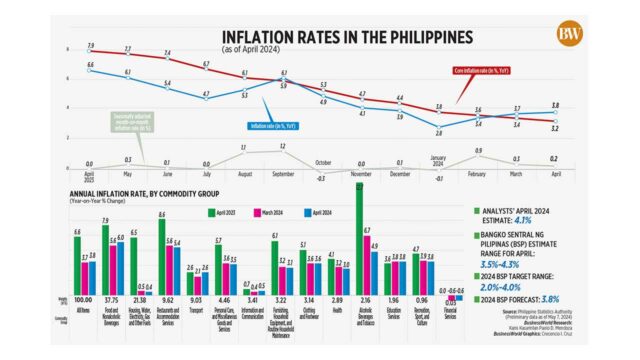
Inflation rates in the Philippines

HEADLINE INFLATION picked up for a third straight month in April amid higher food and transport costs, the Philippine Statistics Authority (PSA) reported on Tuesday. Read the full story.


Inflation rates in the Philippines

If AI wrecks democracy, we may never know

RAWPIXEL/FREEPIK

THIS YEAR promises to be a whopper for elective government, with billions of people — or more than 40% of the world’s population — able to vote in an election. But nearly five months into 2024, some government officials are quietly wondering why the looming risk of artificial intelligence (AI) hasn’t, apparently, played out. Even as voters in Indonesia and Pakistan have gone to the polls, they are seeing little evidence of viral deepfakes skewing an electoral outcome, according to a recent article in Politico, which cited “national security officials, tech company executives and outside watchdog groups.” AI, they said, wasn’t having the “mass impact” that they expected.

That is a painfully shortsighted view. The reason? AI may be disrupting elections right now and we just don’t know it. The problem is that officials are looking for a Machiavellian version of the Balenciaga Pope. Remember the AI-generated images of Pope Francis in a puffer jacket that went viral last year? That’s what many now expect from genera-tive AI tools — which can conjure humanlike text, images, and videos en masse, making it just as easy to spot as previous persuasion campaigns that supported Donald Trump from Macedonia or spread divisive political content on Twitter and Facebook from Russia. So-called astroturfing was easy to identify when an array of bots was saying the same thing thousands of times.

It is much harder to catch someone saying the same thing, slightly differently, thousands of times, though. That, in a nutshell, is what makes AI-powered disinformation so much harder to detect, and it’s why tech companies need to shift their focus from “virality to variety,” says Josh Lawson, who was head of electoral risk at Meta Platforms, Inc. and now advises social media firms as a director at the Aspen Institute, a think tank.

Don’t forget, he says, the subtle power of words. Much of the public discourse on AI has been about images and deepfakes, “when we could see the bulk of persuasion campaigns could be based on text. That’s how you can really scale an operation without getting caught.”

Meta’s WhatsApp makes that possible thanks to its “Channels” feature, which can broadcast to thousands. You could, for instance, use an open-source language model to generate and send legions of different text posts to Arabic speakers in Michigan, or message people that their local polling station at a school is flooded and that voting will take six hours, Lawson adds. “Now something like an Arabic language operation is in reach for as low sophistication as the Proud Boys,” he says. The other problem is that AI tools are now widely used, with more than half of Americans and a quarter of Brits having tried them. That means regular people — intentionally or not — can create and share disinformation too. In March, for example, fans of Donald Trump posted AI-generated fake photos of him surrounded by Black supporters, to paint him as a hero of the Black community.

“It’s ordinary people creating fan content,” says Renee DiResta, a researcher with the Stanford Internet Observatory who specializes in election interference. “Do they mean to be deceptive? Who knows?” What matters is that with the cost of distribution already at zero, the cost of creation has come down too, for everyone.* What makes Meta’s job especially challenging is that to tackle this, it can’t just try to limit certain images from getting lots of clicks and likes. AI spam doesn’t need engagement to be effective. It just needs to flood the zone. Meta is trying to address the problem by applying “Made with AI” labels, this month, to videos, images, and audio on Facebook and Instagram — an approach that could become counterproductive if people begin to assume everything without a label is real.

Another approach would be for Meta to focus on a platform where text is prevalent: WhatsApp. Already in 2018, a flood of disinformation spread via the messaging platform in Brazil targeting Fernando Haddad of the Work-ers’ Party. Supporters of Jair Bolsonaro, who won the presidency, were reported to have funded the mass targeting.

Meta could better combat a repeat of that — which AI would put on steroids — if it brought its WhatsApp policies in line with those of Instagram and Facebook, specifically banning content that interferes with the act of vot-ing. WhatsApp’s rules only vaguely ban “content that purposefully deceives” and “illegal activity.”

A Meta spokesman said that this means the company “would enforce on voter or election suppression.” But clearer content policies would give Meta more authority to tackle AI spam on WhatsApp channels. You need that “for proactive enforcement,” says Lawson. If the company didn’t think that was the case, it wouldn’t have more specific policies against voter interference for Facebook and Instagram.

Smoking guns are rare with AI tools thanks to their more diffuse and nuanced effects. We should prepare ourselves for more noise than signal as synthetic content pours onto the internet. That means tech compa-nies and officials shouldn’t be complacent about a lack of “mass impact” from AI on elections. Quite the opposite.

BLOOMBERG OPINION

*It doesn’t help that Facebook has been actively recommending AI-generated images — including bizarre ones of Jesus fused onto giant shrimp — that getting hundreds of millions of engagements, according to a March re-search paper by DiResta.

Einhorn pioneers new market for solar power

PXHERE.COM

BERLIN-BASED condom producer Einhorn has promoted its mission to protect the environment with products like its vegan, fair-trade rubbers. Now, it’s taking that ambition out of the bedroom and onto the balcony.

In a fundraising video for the company’s solar panels — modules roughly the size of a beach blanket that can be draped like a towel over a railing — bare-chested co-founder Waldemar Zeiler touts the devices and declares his goal to sell enough to replace a coal-fired power plant.

But with a planned retail price of €550 ($588) each, that could be a challenge.

Thanks to cheap Chinese panels flooding the European market after the US stopped imports, the cost of individual solar modules has plunged, to an average of €300. In Germany, affordable balcony panels are now a trend. More than 360,000 have been registered since 2023, according to the national energy regulator, with Berlin as a hot spot.

That’s good news for Europe’s biggest economy, which is still struggling to replace the natural gas supply that was cut off after Russia invaded Ukraine. Germany added 14 gigawatts of solar capacity last year, more than any other country in the region.

Veranda installations represent just 150 megawatts, or one percent of added capacity, but they also signal an important shift. Solar, once the domain of anyone with a rooftop or wide-open fields, is now available to far more urban consumers.

“Solar for the first time affects city dwellers and not only the countryside,” according to Christoph Kost, head of energy systems at Fraunhofer ISE, an industry research group in Freiburg, Germany. “The trend is particularly strong in Germany as the country still has high power prices.”

It was less energy prices than climate consciousness and curiosity that made Stefan Martin, a 53-year-old father and homeowner in Berlin, an early adopter. Almost 100 owners live in his multistory apartment building, and it would have been “endlessly complicated” to convince all of them to install rooftop solar.

That’s one of the reasons why rooftop installations have been dragging in Germany, which needs to nearly triple its solar output to reach its 2030 climate goals. To speed up the process, parliament passed a package last week that also targets balcony solar: such modules can now reach up to 800 watts and be registered more easily. It’s also getting harder for landlords to object to the installations.

After seeing a neighbor put up a balcony panel, Mr. Martin also installed three modules totaling 500 watts from PluginEnergy GmbH, a German startup. “I had to negotiate with my wife, as we had to remove some flower pots,” Mr. Martin said. “We hid the cables inside bamboo, and now it looks quite decent.”

Mr. Martin ordered his solar module in April 2023 for €820, meaning he missed the fall in unit prices. Still, he calculates that the plant covers about 10% of his power consumption, which includes his fridge, standby devices and the two computers he and his wife use to work remotely. “We’ve saved about €115 in the first year on our electricity bill,” Mr. Martin says, “which means the panels will have amortized in seven to eight years.”

The city of Berlin has launched a generous subsidy to encourage people to adopt solar, offering up to €500 for a single plug-and-go panel. Almost 10,000 people have applied for the funding and two-thirds have been approved, according to the agency that oversees it.

“The program is enjoying brisk demand from all target groups,” a city spokesperson said.

Still, it will take a while before demand catches up with the glut of supply. The US banned the import of Chinese solar panels in 2022 on the grounds that some may have been produced by forced Uyghur labor, and even with balcony solar going viral online, Europe still has more panels than it can handle.

Discounters and DIY stores have started to stock them, and even energy utilities are following suit. Sweden-based Vattenfall AB sold 450 balcony power plants last year, and Gasag AG, Berlin’s natural gas provider, sees “a lot of potential” in its new business selling panels.

China’s near-total domination of the solar panel supply chain has been difficult for providers like Einhorn, the condom-to-solar-convert. Zeiler, the co-founder, had to scale back his goal of raising €2.5 million and is now targeting just one-tenth of that amount.

This week, German photovoltaic maker Solarwatt GmbH announced that it would suspend operations at its Dresden site at the end of August until further notice. And last month, Swiss panel maker Meyer Burger Technology AG shut down its nearby module production factory with around 500 staff.

Since August, 12 European photovoltaic manufacturers have filed for bankruptcy or debt restructuring, laid off staff or halted or shifted production amid a flood of cheap Chinese panels, according to SolarPower Europe.

The recent solar reforms may not make a difference. Despite promises to help local producers, the package excluded any such support, which is why the German Renewable Energy Federation (BEE) has called for another reform.

Moreover, said Markus Meyer, the director of regulatory affairs at Berlin-based solar installer Enpal BV, the bill allows for old meters to be dialed backwards, which occurs when unused excess solar power is sent back to the grid. That quirk, he said, could “actually delay the energy transition.”

There’s also a more practical concern — almost no solar buyers opt for battery storage, according to Fraunhofer ISE, as these packs are often more expensive than panels. That means that while the balcony units run smoothly during periods of peak sunlight — which also happens to be when energy is cheapest — users must tap into the grid after sunset, when prices go up.

Despite these challenges, BEE President Simone Peter sees enormous potential in the current trend: “The regulations on balcony solar systems are real participation boosters. They emphasize once again what the energy transition was from the outset: a project for everyone.” — Bloomberg News