Home Blog Page 2828

Bloomberry Resorts’ Q2 income down 61% on weak VIP segment, higher costs

RAZON-LED Bloomberry Resorts Corp. recorded a 61% decline in its second-quarter (Q2) net income to P1.3 billion from P3.4 billion last year due to higher costs and weak VIP segment performance.

Gross gaming revenue (GGR) in the second quarter fell by 4% to P14.5 billion from P15.1 billion a year ago due to “continued weakness in the VIP segment,” Bloomberry Resorts said in a regulatory filing on Wednesday.

Second-quarter total GGR at Solaire Resort Entertainment City shrank by 12% to P13.3 billion due to lower VIP rolling chip and mass table drop volumes, which was partly offset by growth in electronic gaming machine (EGM) coin-in and GGR.

Solaire Resort North logged 37 operating days in the second quarter and recorded total GGR of P1.1 billion from its mass table games and EGM businesses. Non-gaming revenue reached P213 million.

Pre-operating expenses of Solaire Resort North amounted to P764.1 million and P73.8 million in the second quarters of 2024 and 2023, respectively.

Jeju Sun Hotel & Casino in Korea generated P35.7 million worth of GGR in the second quarter, up by 660% from P4.7 million in 2023. Non-gaming revenue rose by 45% to P125.5 million.

For the first half, Bloomberry Resorts reported a 38% drop in net income to P4 billion from P6.4 billion a year ago.

Excluding the impact of gains from the disposal of an asset and the liquidation of a subsidiary, net income would have decreased by 58% in the second quarter of 2024 and by 35% in the first six months.

Consolidated GGR fell by 6% to P29.2 billion from P31.2 billion last year. Nongaming revenue increased by 11% to P4.6 billion.

“In the second quarter and first half of 2024, our mass gaming revenues across two properties increased year over year despite the very high base set in the first half of 2023. However, continued weakness in the VIP segment as well as pre-operating and operating expenses at Solaire Resort North resulted in a decline in consolidated earnings before interest, taxes, depreciation, and amortization (EBITDA) and net income,” Bloomberry Chairman and Chief Executive Officer Enrique K. Razon, Jr. said.

He said that Bloomberry Resorts is expecting a boost from the ramping up of operations at Solaire Resort North, which was opened on May 25.

“Despite our weaker consolidated year-over-year performance, I am pleased to report that Solaire Resort North recorded positive EBITDA of P250 million in its first 37 days of operations. We are in the early stages of the property’s ramp-up and are happy with the pace, especially as we compare it to the ramp of Solaire in Entertainment City over 11 years ago,” Mr. Razon said.

“As revenues at our second property grow, we anticipate further synergies and positive operating leverage to contribute to our group’s profitability in the coming quarters,” he added.

On Wednesday, Bloomberry Resorts shares dropped by 5.84% or 45 centavos to P7.25 per share. — Revin Mikhael D. Ochave 

Surprises at a Spanish food fest

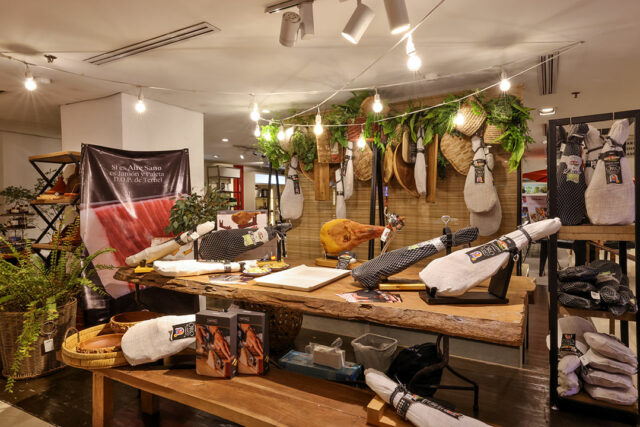
SPANISH restaurants dot the city, thanks to our colonial connection with Spain, and few people can deny knowing about paella, gambas, jamon and all that. Still, the Casa Española food festival at Rustan’s Makati can bring a few surprises to the tongue.

At an opening to the festival on July 30, guests were taken around to view the Spanish crockery, uniquely Spanish kitchen implements (how many people actually need a jamon stand? Lots, going by the sales during the day), but especially food imported from Spain.

Highlights include the cans of higado de bacalao (cod liver), which sounds remarkably unpleasant, but was the best surprise of the evening, melding together creamy and salty flavors in a can that costs about P250 (sold out that evening; ladies were filling baskets to the brim). Another thing to look forward to is the jamon de Teruel.

The fair was organized by Tantoco scion Rica Lopez de Jesus, who told BusinessWorld about the ham. Delightfully salty and with a fatty goodness, she said, “This is in-between,” noting that it occupies a space between jamon serrano and the more special jamon iberico de bellota. “It’s about as good as a bellota,” she said, but with a lower price. It is, of course, available in Rustan’s.

“We want everyone to be able to serve Spanish food in an easy way,” she said. This explained delicacies like Cortijode Sartanejas sauces, Naturel sustainable olive oil, Almoharin figs from Good Fig, and luxury canned seafood from Ubago. But then, there were also paelleras from Garcima, artisanal ceramic cookware from Graupera, and kitchen gadgets from Nerthus.

Casa Española and all its trimmings are available at Rustan’s Makati’s fourth floor until Aug. 31. Meanwhile, the East Cafe at Rustan’s Makati is also serving Spanish treats until Aug. 31, including Crispy Croquetas Ricas (soft Hainanese Chicken Croquetas with Ginger Aioli), garlicky Gambas with Angulas, slow cooked Iberico Shoulder with Korean Barbecue Glaze, and Iberico Burger Loco Moco Don. — JL Garcia

Alliance Global reports slight decline in Q2 net income

ANDREW L. TAN-LED holding company Alliance Global Group, Inc. (AGI) said its second-quarter (Q2) attributable net income declined by 0.04% to P4.569 billion from P4.567 billion a year ago.

Revenue for the second quarter rose by 16.5% to P56.85 billion from P48.81 billion in 2023, AGI said in a stock exchange disclosure late Wednesday.

“Higher interest cost and foreign currency losses constricted profits during the period,” AGI said.

For the first half, AGI recorded a 5% decline in its attributable net profit to P8.79 billion from P9.25 billion last year.

First-half consolidated revenue surged by 8.4% to P107.5 billion from P99.1 billion a year ago.

“The Alliance Global Group mustered a strong recovery in the second quarter of the year despite the generally sluggish global economy, as well as the challenges brought about by elevated inflation, interest rates, and an unstable currency,” AGI President and Chief Executive Officer Kevin Andrew L. Tan said.

“Our performance mirrored the underlying strength of our brands and all our businesses as the Group continued to invest in future capacity expansions and execute our strategies as planned. We also focused on implementing enhancements and innovations of our aspirational products and services to address changes in market preferences,” he added.

On the real estate business, Megaworld Corp. posted a 9% increase in its first-half attributable net income to P8.6 billion from P7.9 billion last year.

First-half revenue rose by 22% to P39.1 billion, driven by the accelerated improvement in residential project completion. Real estate sales increased by 30% to P24.8 billion.

On the liquor business, Emperador, Inc. recorded a 19.2% drop in its first-half attributable net profit to P3.8 billion from P4.7 billion last year. Revenue shrank by 8% to P28.6 billion.

Sales in the second quarter were driven by the recovery in demand for both its brandy and whisky products, particularly in the Asia Pacific region, Latin America, and travel retail.

On the leisure and tourism business, Travellers International Hotel Group, Inc. said its second-quarter attributable income rose by 38-fold to P423 million compared with the previous quarter. Second-quarter gross revenues increased by 17% quarter-on-quarter to P10.9 billion.

In the first half, attributable net income of Travellers International stood at P434 million on gross revenues of P20.1 billion.

Golden Arches Development Corp. saw an 11% increase in its first-half attributable net income to P1.1 billion as total revenue increased by 14% to P23 billion, led by ongoing product enhancements and promotions.

As of end-June, Golden Arches has 755 McDonald’s Philippines stores nationwide.

“We believe that we are in the best position to take advantage of emerging opportunities as the economy continues to recover,” Mr. Tan said.

On Wednesday, AGI shares rose by 0.34% or three centavos to P8.85 per share. — Revin Mikhael D. Ochave

Yields on term deposits slip before BSP review

BW FILE PHOTO

YIELDS on term deposits inched lower on Wednesday as the offer went undersubscribed ahead of the Bangko Sentral ng Pilipinas (BSP) monetary policy meeting.

The BSP’s term deposit facility (TDF) fetched bids amounting to P105.851 billion on Wednesday, well below the P160 billion on the auction block and the P179.018 billion for a P180-billion offer seen a week ago.

Broken down, tenders for the eight-day term deposits reached just P40.096 billion, lower than the P80 billion auctioned off by the central bank and the P90.542 billion in bids seen the previous week.

Banks asked for yields ranging from 6.4875% to 6.5215%, wider than the 6.495% to 6.52% band seen a week ago. This caused the average rate of the one-week deposits to drop by 0.36 basis point (bp) to 6.5119% from 6.5155% previously.

The one-week tenor was adjusted from the usual seven-day maturity as its settlement date was moved to Aug. 22 due to the Ninoy Aquino Day holiday on Aug. 21, the BSP said.

Meanwhile, bids for the 14-day term deposits amounted to P65.755 billion on Wednesday, also below the P80-billion offering and as well as the P88.476 billion in tenders for the P100-billion offer on Aug. 7.

Accepted rates for the two-week tenor were from 6.47% to 6.57%, also wider than the 6.53% to 6.57% margin seen a week ago. With this, the average rate for the term deposits declined by 0.83 bp to 6.544% from 6.5523% logged in the prior auction.

The BSP has not auctioned off 28-day term deposits for more than three years to give way to its weekly offerings of securities with the same tenor.

The term deposits and the 28-day bills are used by the central bank to mop up excess liquidity in the financial system and to better guide market rates.

Term deposit yields slipped ahead of the BSP’s rate-setting meeting on Thursday amid recent signals from the central bank governor on potentially keeping rates steady, Rizal Commercial Banking Corp. Chief Economist Michael L. Ricafort said in a Viber message.

The Monetary Board will hold its third-to-the-last policy review for the year today (Aug. 15).

A BusinessWorld poll showed that nine out of 16 analysts surveyed expect a 25-bp cut, which would bring the target reverse repurchase (RRP) rate to 6.25% from the current over 17-year high of 6.5%.

BSP Governor Eli M. Remolona, Jr. on Tuesday told reporters that there is “more room to stay tight” amid the stronger-than-expected gross domestic product growth seen last quarter.

The Philippine economy grew by 6.3% in the second quarter, its fastest expansion in five quarters or since the 6.4% in the first quarter of 2023.

Mr. Remolona also said that the BSP will have room to ease rates once inflation is back within their 2-4% annual target band.

Headline inflation accelerated to 4.4% in July, the fastest in nine months. It also ended seven straight months of inflation settling within the central bank’s target. — Luisa Maria Jacinta C. Jocson

Dining In/Out (08/15/24)


Shake Shack Philippines debuts Veggie Shack

LAUNCHING on Aug. 15 is the Veggie Shack (P400), a limited-time veggie burger from Shake Shack made from a proprietary blend of 11 plant-based ingredients including mushrooms, sweet potatoes, carrots, farro, and quinoa, seared and served with American cheese, pickles, crispy onions and ShackSauce all on a toasted non-GMO potato bun. Visit your nearest Shake Shack or head to shakeshack.ph for orders and updates.


HeyBo celebrates first anniversary in PHL

THIS August, HeyBo celebrates its first year in the Philippines. HeyBo, created by the same team behind SaladStop! in Singapore, is known for its grain bowls. To mark this first-year milestone, HeyBo announced the upcoming opening of its second store at One Ayala in Makati City. At the heart of HeyBo’s popularity is the Build-Your-Bo! option, where diners can create a bowl that’s uniquely theirs. Customers can start with a base, add a protein, select three sides, garnish it up, pick a dip, and top it off with a sauce. Whether it’s the zest of Spiced Black Beans with tangy Tomato Salad or the crunch of Oriental Cabbage Salad with savory Grilled Mushrooms, each bowl promises a blend of flavors. For a quick snack, HeyBo introduces its baos. These include the Mexican Bao, featuring a zesty Mexican vegan patty, and the Chicken Bao, made with a tender and savory chicken patty. In celebration of their first anniversary, HeyBo is offering a week of exclusive promotions. From Aug. 14-18, diners can enjoy a special treat with every Build-Your-Bo! order for dine-in, takeaway, and delivery. For in-store orders, customers get a freebie for each day: a P100 gift card, a free combo upgrade (Sweet Potato Fries or Chips n’ Dip), free soda, free ice cream, and a free bao respectively. For delivery orders, customers can get a free combo upgrade (Sweet Potato Fries or Chips n’ Dip) for the full duration of the promo.


Discovery Primea presents Beijing X Manila dinners

DISCOVERY Primea will be holding the “Elements of Flavor at Flame: Beijing X Manila,” a culinary event that brings together the best of French and Asian cuisines. This exclusive experience will be held on Aug. 29, 30, and 31, at Flame Restaurant. Discovery Primea’s Executive Chef Luis Chikiamco joins hands with William Mahi, the Chef de Cuisine at the Michelin-starred Jing Restaurant at The Peninsula Beijing. Together, they present a seven-course dinner that marries the elegance of French culinary techniques with the vibrant, diverse flavors of contemporary Asian cuisine. There will be three seating time options on the three days: 6, 7:30, and 8 p.m. The dinner costs P8,500++ per person, with a P4,000++ charge on top for a wine pairing. The menu will include Gillardeau Oysters and Wagyu Beef Tartare, Jade Abalone, Brittany Langoustine, Chilean Sea Bass, French Farmed Pigeon, and A4 Sendai Wagyu Short Rib. For reservations, call Flame at 7955-8888 or e-mail primea.restaurants@discovery.com.ph.


Singapore flavors at Kaokee

Kaokee, a new restaurant offering goodies a la Singapore, has opened two branches — at Belamy House on Jupiter St. in Makati City, and at Corner House at P. Guevarra corner Recto in San Juan City. Kaokee brings a taste of Singapore’s hawker centers to Manila. Its menu features Hainanese Chicken, Roast Hokkien Chicken, Claypot Rice, Singaporean “meat bone tea” or Bak Kut Teh, and Laksa. Kaokee also serves a traditional breakfast of Kaya Toast paired with Kopi, available iced, hot, O, butter, and mocha. Kaokee is the latest offering from the Mc Wilson Corp., the group behind Gringo, Tatatito, Honeybon, and Tokyo Bubble Tea. For updates and more information, follow kaokeeph on Facebook and kaokee.ph on Instagram.


Buy 2 Get 1 Free siopao on National Siopao Day

TO CELEBRATE National Siopao Day, Chowking is offering the Buy 2 Get 1 Free promo on all its siopao varieties, including the Chunky Asado Siopao and the Bola-Bola Siopao Supreme. The promotion starts exclusively on the Chowking Delivery website and app from Aug. 16-17 and will be available in all stores on Aug. 18 via dine-in, takeout, drive-through, and delivery. For more information, visit www.facebook.com/ChowkingPH (Facebook) and @ChowkingPH (Instagram).

Lower revenues lead to 5.1% decline in D.M. Wenceslao’s Q2 income

D.M. WENCESLAO and Associates, Inc. (DMW) saw its attributable net income decline by 5.1% to P367.47 million for the second quarter (Q2) from a profit of P387.29 million last year due to lower revenues for the period.

In a stock exchange disclosure, the company’s gross revenue contracted to P926.32 million for the April-to-June period, lower by 5.2% compared with the P977.04 million a year ago, its financial statement showed.

Its combined expense, however, declined to P383.41 million for the second quarter from P494.83 million.

For the first half, DMW’s attributable net income climbed to P918.18 million, 0.6% higher than the P912.95 million last year due to lower gross expenses for the first six months.

“Our performance in the first half of 2024 highlights the stability and robust foundation of our business model,” said DMW Chief Executive Officer Delfin Angelo C. Wenceslao.

The listed property developer generated gross revenue of P1.89 billion, significantly lower than last year’s P2.1 billion revenue.

DMW’s gross expense for the January-to-June period dropped by 24.2% to P733.65 million compared with the P967.51 million expense from a year ago.

“Our best-in-class anchor locators — including top logistics multinationals, one of the country’s largest malls, major grocery warehouse chains, and the Philippines’ leading healthcare institution — ensure stable, long-term income streams. These partnerships, which extend up to 50 years, offer not only high margins but also significant growth opportunities through percentage-based sales collections,” Mr. Wenceslao said.

The company also attributed its earnings growth for the first semester to its strong leasing operations.

DMW said commercial building revenues posted P669 million due to a higher gross leasable area of 235,846 square meters (sq.m.) in the first half compared with the 162,351 sq.m. last year.

“This growth was fueled by robust leasing activities across the whole portfolio, with marquee logistics and traditional tenants accounting for the majority of commercial occupancy,”the property developer said.

Land rentals rose to P689 million, fueled by lease expansion, while residential revenues were P235 million, it said.

At the local bourse on Wednesday, shares in the company closed 18 centavos or 3.28% lower at P5.31 per share. — Ashley Erika O. Jose

GCash ‘hesitant’ on digital bank license

GCASH is “hesitant” about applying for a digital banking license as the Bangko Sentral ng Pilipinas’ (BSP) regulatory requirements could limit its operations, the top official of G-Xchange, Inc., the e-wallet’s operator, said.

“Truthfully, you’ll get slower as an e-wallet if you get a banking license. Because of all the requirements governance-wise from a regulatory standpoint that they will look at for a bank or a digital bank, a lot of time will be consumed on that rather than growing the market and serving the consumer. So, our focus will be divided. And that’s the reason why we’re hesitant,” G-Xchange President and Chief Executive Officer Oscar Enrico A. Reyes, Jr. told reporters on Tuesday.

G-Xchange handles the mobile wallet operations of GCash. The parent firm of GCash, Globe Fintech Innovations, Inc. or Mynt, is an affiliate of Ayala-led telecommunications company Globe Telecom, Inc.

Bloomberg reported last week that applying for a digital banking license for GCash “is being discussed, although nothing is definite as of the moment,” according to Globe Fintech Innovations CEO Martha Sazon.

GCash currently holds electronic money issuer (EMI) and remittance agent licenses from the BSP. It is classified as an EMI-Non-Bank Financial Institution.

“The moment you get a license, there are so many things that BSP requires you to do. There are more governance measures that you have to take… There are more requirements in terms of financial health, et cetera. And that’s why for us, it will slow us down,” Mr. Reyes added.

EMIs are only allowed to offer e-money issuance and related services, while digital banks can offer a full suite of banking services.

Under the BSP’s regulations, EMIs with monthly outstanding e-money balance of at least P100 million are required to maintain liquid assets in trust accounts equivalent to at least 50% of their outstanding e-money balance and to cover the remaining balance with placements in bank deposits, government securities, or other liquid assets acceptable to the BSP.

EMIs with large-scale operations, or those with a 12-month average value of aggregated inflow and outflow transactions equal to or greater than P25 billion, are required to maintain minimum capital of P200 million, while the minimum capital requirement for small-scale EMIs is P100 million.

Meanwhile, digital banks are required to have a minimum capitalization of P1 billion. Digital banks are also subject to the same prudential, governance, risk management compliance, audit and reporting standards that are applicable to other bank categories.

Mr. Reyes added that acquiring a digital banking license could affect its existing partnerships with online lenders or neobanks like UNO Digital Bank and CIMB Bank PH.

“If we suddenly say that we want [a digital banking license], I think they might view it as competitive to their own offer. It might discourage them from working closely with us. That’s a big consideration for us to say that maybe we do not need a license yet,” he said. “We’re helping them grow their business. So, I think it’s a partnership that we don’t intend to sever. I think it’s something that we intend to nurture.”

He said GCash is presently already able to offer loans and savings products, which are part of a bank’s core businesses.

“If you want to go for digital banking or banking in general, the business model of banking is most primarily on the lending side. But we’re already able to offer lending without the requirements and the governance that you would need to operate a bank,” Mr. Reyes added.

The BSP recently approved the lifting of a moratorium on the grant of new digital banking licenses starting January next year, opening four new slots. In 2021, the central bank capped the number of digital banks at six.

The six online lenders operating in the country are Tonik Digital Bank, Inc.; GoTyme Bank of the Gokongwei group and Singapore-based Tyme; Maya Bank of Voyager Innovations, Inc.; Overseas Filipino Bank, a subsidiary of Land Bank of the Philippines; UNObank of DigibankASIA Pte. Ltd.; and UnionDigital Bank of Union Bank of the Philippines, Inc. — A.M.C. Sy

First Gen awaits regulatory decision on LNG cost recovery

LOPEZ-LED First Gen Corp. said it is awaiting a decision from regulators on the recovery of its costs in using liquefied natural gas (LNG).

“We’re still optimistic that people will get to the table and agree that there’s a reasonableness in what we’re trying to do, what we’re seeking, which is again the recovery of the costs,” First Gen President and Chief Operating Officer Francis Giles B. Puno told reporters on the sidelines of an event organized by Eco-Business on Wednesday.

Mr. Puno said that the investments incurred in operating LNG are “a painful transition because we end up absorbing these costs.”

“But we hope there’s a resolution because the LNG itself is needed,” he said.

LNG is seen as a “transition fuel” towards renewable energy.

In March, the Energy Regulatory Commission (ERC) said that recovery should only be based on the landed cost, subject to verification by the commission.

“Any cost other than the landed cost of LNG (such as the additional fixed costs resulting from storage, testing, and commissioning of LNG facilities) are not contemplated under the PPAs (power purchase agreements),” the ERC said.

The regulator said that allowing these requires an amendment to the PPAs, for which the parties may first seek proper approval from the commission in a separate application to allow recovery from consumers.

“We have defended our case with the DoE (Department of Energy) and with the regulators. They know it’s a project of national significance, but it’s a little strange when… you cannot get the recovery,” Mr. Puno said.

Mr. Puno said that there is a need to “provide the right signals” for investors to continue to grow and invest in new assets.

“I don’t think it’s a lack of investor interest. We want to invest more. It’s a lack of clarity in terms of us being able to predict the revenue we will generate with that investment. Because it’s a big investment,” Mr. Puno said. — Sheldeen Joy Talavera

Banksy frees the animals at London Zoo in mural series finale

INSTAGRAM.COM/BANKSY

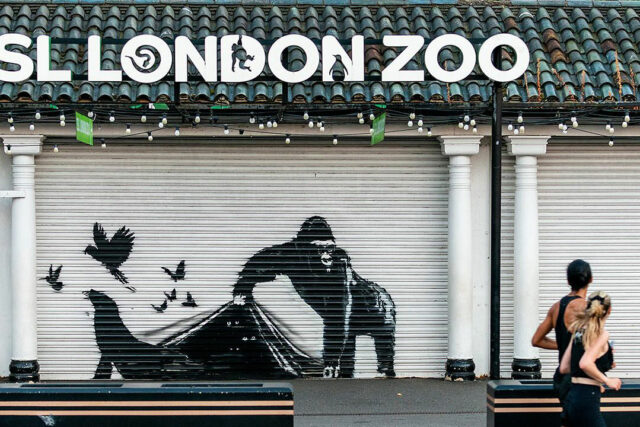
LONDON — Street artist Banksy on Tuesday claimed the ninth — and perhaps final — mural of his animal-themed art trail across London, with a painting on the shutters of the capital’s zoo showing a gorilla freeing a sea lion and birds.

The series began with a mountain goat on Monday and was followed by eight other artworks, including three monkeys hanging from a railway bridge, the silhouette of a wolf on a satellite dish, and two pelicans above a fish and chip shop.

The zoo painting shows a gorilla prizing open a metal shutter to release birds and a sea lion. Banksy has posted pictures of all his murals on his Instagram account.

The BBC, citing Banksy’s team, said the gorilla artwork was the final piece of the series. The artist’s team did not immediately reply to a Reuters request for comment.

London Zoo staff were thrilled to find the latest mural had been painted on their doorstep and many passers-by have been popping over to admire it and take pictures, said zoo media manager Rebecca Blanchard.

“This is bringing so many smiles to people’s faces this morning,” Ms. Blanchard said as she stood in front of the mural. She said the zoo still had to decide what to do with it but they were “definitely keeping it and preserving it.”

Ms. Blanchard said the artwork might be the “grand finale” of what she described as an “incredible series celebrating animals.”

Theories have swirled on social media about the meaning of the works by an artist who has highlighted themes such as war and climate change in his previous work.

Some speculated they could be related to the riots and racist attacks that have swept the country in the past week, others linked them to the idea that humanity is seeding its own downfall. — Reuters

Security Bank Q2 net income up 10%

BW FILE PHOTO

SECURITY BANK Corp. saw its net income rise by 10.19% in the second quarter as it booked higher revenues.

The lender’s net income stood at P2.82 billion in the three months ended June, up from P2.56 billion in the same period last year, its financial statement disclosed to the stock exchange on Wednesday showed.

“Our second-quarter results reflect accelerating velocity for our retail, MSME (micro, small and medium enterprises) and wholesale client teams. We allocated substantial resources to support our clients’ aspirations as indicated in the growth of loans and deposits. Likewise, we continue to invest in technology to improve customer experience, security and agility,” Security Bank President & Chief Executive Officer Sanjiv Vohra said in a statement.

The bank’s second-quarter performance brought its first-half net income to P5.44 billion, up by 10.77% from P4.92 billion in the same period last year, “driven by accelerated growth in business drivers,” it said.

This translated to a return on average assets and return on average equity of 1.2% and 7.94%, respectively.

Net interest income grew by 31.87% to P10.93 billion in the second quarter from P8.29 billion in the same period a year prior, driven mainly by higher interest earnings from loans and receivables and lower interest expenses on deposits.

Net interest margin stood at 5.2% at end-June, up from 4.24% a year ago.

“Total non-interest income was P2.2 billion, up 28% quarter on quarter. Service charges, fees and commissions was P1.8 billion, up 19% year-on-year,” Security Bank said.

As a result, its total operating income rose by 21.77% to P13.18 billion last quarter from P10.82 billion a year prior.

Meanwhile, Security Bank’s operating expenses went up by 25.85% year on year to P9.19 billion from P7.299 billion.

This came as it set aside P1.79 billion in provisions for credit losses in the period, up by 81.54% from P983.4 million a year prior. It also booked higher expenses for compensation and fringe benefits and taxes and licenses, among others.

The bank’s cost-to-income ratio stood at 58.44% at end-June, down from 60.35% a year ago.

Net loans increased by 7.23% to P577.26 billion at end-June from P538.33 billion at end-2023.

“Net loans accelerated to 19% growth rate year-on-year from the 12% posted in the first quarter of 2024,” it said.

Retail and MSME loans grew by 37% year on year as of June, while wholesale loans expanded by 14%.

“The growth in retail and MSME loans was driven by home loans which grew 21%, credit cards which rose 60%, auto loans which grew 50%, and MSME loans which increased 68%… Retail and MSME loans as percent of total loans increased to 32%, up from 31% a quarter ago and 28% a year ago,” the bank added.

Its gross nonperforming loan (NPL) ratio was at 3.31% as of June, and NPL reserve cover was 81%.

On the funding side, total deposits grew by 11.48% to P676.16 billion as of June from P606.53 billion at end-2023.

Of this, 54% were current account, savings account deposits, which grew by 9% year on year.

The bank’s loan-to-deposit ratio stood at 85.37% at end-June, down from 88.76% at end-2023.

Total assets increased by 19% year on year to P948 billion as of June. Shareholders’ capital likewise grew 6% to P138 billion.

Its common equity Tier 1 ratio stood at 13.9% at end-June, while total capital adequacy ratio was at 14.8%. The bank’s liquidity coverage ratio was at 180% and net stable funding ratio was at 133%.

Security Bank has a total of 328 branches and 662 automated teller machines, cash recycler machines and cash acceptance machines to date nationwide.

The listed bank’s shares rose by 20 centavos or 0.32% to end at P62.80 apiece on Wednesday. — A.M.C. Sy

Journey of a thousand miles

VLADISLAV BABIENKO-UNSPLASH

I was bantering with a friend on the merits of reviving mandatory military training for students as a way of instilling patriotism and leadership values, especially at a time of mounting geopolitical tensions and natural calamities.

Now holding a senior management post in a private company, he paused when I pressed him for at least one to three good things he learned under that program in his youth. He cited more reasons against such training.

“Just two things,” he replied after some time. “First, always lead from the front. Second, you never ask subordinates to do anything you yourself would not do.”

His reply reminded me of instances when national officials tried to explain away indiscretions in word or deed by saying that they were just exercising their freedom as citizens to say or do as they pleased (i.e., the expectation that leaders be a good example be damned).

This piece is not about that proposed revival of military training for civilians (maybe another time), but that exchange made me muse about how organizations perform better when their bosses are held to account. And that can be done only when an organizational structure and culture are firmly in place to ensure that decision-making and implementation conform to exacting standards.

Which is what governance is all about.

BUZZWORD
“Good governance” has been promoted for decades now, and it has become a buzzword for those seeking to make organizations — whether government or private — work as they should.

Among others, the United Nations Economic and Social Commission for Asia and the Pacific (ESCAP) defined “governance” as “the process of decision-making and the process by which decisions are implemented.” ESCAP identified eight key traits of “good governance,” namely: it is participatory, consensus-oriented, accountable, transparent, responsive, effective and efficient, equitable and inclusive, and follows the rule of law. In this way, good governance “assures that corruption is minimized, the views of minorities are taken into account… that the voices of the most vulnerable in society are heard in decision-making” and “is also responsive to the present and future needs of society.”

Easily discernible here is the concept of “common good,” which is not the good for the greatest number — which contradicts the Pinoy value of “walang iwanan (no one left behind)” — but more reminiscent of that inclusive point in the Catechism of the Catholic Church that defines it as “the sum… of social conditions which allow people, either as groups or as individuals, to reach their fulfillment more fully and more easily.”

Good governance as a concept has been around since the 1970s and ’80s and is the “G” in the “ESG” (the others here being “environmental” and “social”) standard that became mainstream in the early 2000s. In the Philippines, both the government and private sectors have put in place structures to improve governance. The National Government has been pushing for more accountability and transparency (including through procurement reforms) across its agencies, while the Securities and Exchange Commission (SEC) has been rolling out measures to improve ESG compliance among companies listed at the Philippine Stock Exchange and now looks to encourage similar reporting by large, unlisted firms.

The Philippine Development Plan, which states that “[g]ood governance… fosters participation, ensures transparency, demands accountability, promotes efficiency, and upholds the rule of law in economic, political and administrative institutions and processes,” notes that “[i]t is a hallmark of political maturity but also a requisite for growth and poverty reduction, for there are irreducible minimum levels of governance needed for large-scale investment to occur and for social programs to be supported.”

Yet, ESG remained little more than a good idea for many organizations worldwide as late as 2019, according to one official of the World Economic Forum who spoke in an economic forum BusinessWorld staged at the start of the pandemic in late 2020.

To be sure, compliance with ESG regulatory requirements has been improving. A July 2024 article by the Philippine Daily Inquirer quoted SEC Chairman Emilio B. Aquino as saying that more than 95% of publicly listed firms filed required sustainability reports by the end of last year, compared to 22% before 2019 when the corporate regulator tightened this requirement. At the same time, the quality of reporting remains a hurdle, according to Sustainable Fitch, the ESG unit of the Fitch Solutions group, which said that the SEC itself has admitted that many companies tend to report only gains in their sustainability efforts.

A general picture of governance challenges can be gleaned from the Philippines’ mixed results in 2024 international governance rankings like those of the Bertelsmann Stiftung Transformation Index (where the Philippines placed 83rd out of 137 countries) and the Chandler Good Government Index (67th out of 100 countries).

ONE AT A TIME
Government and private sector efforts to improve governance in order to upgrade performance led to the formation of two related nonprofit advocacies: the Institute of Corporate Directors (ICD, focused on private businesses) in 1999, and the Institute for Solidarity in Asia (ISA, which focuses on government offices) a year later. Both advocacies fall under the Center for Excellence in Governance.

Both groups were founded by Harvard-educated economist Jesus P. Estanislao, who served as Socioeconomic Planning secretary in 1989-1990 and Finance chief in 1990-1992, and was the founding dean of the Asian Development Bank Institute in Tokyo in 1998, and founding president of the University of Asia and the Pacific in 1992-1997, among others.

In a recent chat, Mr. Estanislao explained that both the ICD and the ISA were his personal initiatives as a responsible citizen. “Everybody in the business community told me: ‘Hey Jess, you cannot do just corporate governance; you have to do public governance as well. It takes two to tango,” he recalled.

Writing recently on factors that started him on this journey, he said: “The impetus that led us to this advocacy has been the realization that poverty, corruption, and lack of civic consciousness have been the three endemic ills confronting Philippine society.”

“Moreover, no single silver bullet can fix these problems that have been weighing us down. They are closely interrelated; they reinforce one another, and they would take a long process of transformation to begin to minimize their combined ill effects,” he explained.

“We therefore proposed that nothing less than a long-term, sustained, transformation program through the discipline of good governance should be undertaken.”

Such a protracted struggle would need a “ground-up” strategy, he said, tackling “one corporation at a time, one government agency or local government unit at a time; and then getting them to undertake social outreach programs that push other corporations and government institutions to go on their own transportation journey as well.

“We don’t just give training,” Mr. Estanislao said in our recent chat. “We push the envelope for better practices, rules and regulations in the Philippines… we work with regulators — the Central Bank, the SEC, the GCG (Governance Commission for Government-Owned or -Controlled Corporations)… to bring the standards of corporate governance higher…”

He cited challenges in private sector and government perceptions of governance programs. “In the case of the private sector, they think they already know, but in reality they don’t,” he noted. “In the case of the public sector, they think that they need you, but many times they do not know how to use you properly.”

ICD and ISA initially adapted a globally accepted strategy execution program — the Balanced Scorecard of Harvard Business School — for government agencies and private businesses in the country.

In 2015, the ICD shifted to the ASEAN Corporate Governance Scorecard (ACGS) where the Philippines placed second among the region’s economies. IESE Business School later established a positive correlation between company placement in the ACGS and its premium price, attractiveness to investors, as well as overall financial and economic performance. “The ACGS continues to this very day, with more Philippine publicly listed corporations notching high, commendable scores,” Mr. Estanislao wrote of the biennial ranking.

The ICD also formed the Global Network of Director Institutes (GNDI) together with eight other leading corporate director organizations in order to provide a platform for continuous sharing of best practices in corporate governance and professional director development. GNDI now counts 21 director institutes among its members.

As for government efforts, the Philippine Navy and the Philippine Army, plus four local governments (Iloilo City, Balanga City, San Fernando City in Pampanga, and San Fernando City in La Union) made it in 2019 to the Hall of Fame of Palladium, which originated at the Harvard Business School. Since then, other National Government agencies and local governments have shown that they could cut poverty incidence and corruption, as well as improve public confidence in their services, based on independent public perception surveys.

Like many other outfits, the pandemic forced ICD to move its corporate governance programs online, thus widening its reach.

The ISA worked with public hospitals under the Department of Health. “These public hospitals, by adopting a transformation road map, ended up being able to attend to the demands of the pandemic and, at the same time, build up capacity for the future,” Mr. Estanislao recalled.

The ISA has since reached out to specialty hospitals like the Philippine Heart Center, and close to 80 such establishments are now enrolled in the ISA program. Also in ISA’s sights are public school divisions and public community colleges nationwide.

The Archdiocese of Manila has also adopted ISA’s program and, depending on the outcome of its participation, other dioceses in the Philippines may follow suit.

Both governance advocacies have now identified three core tasks on the road ahead:

* Cascade governance values and best practices down to every individual at work or in school, with outreach to families and local communities.

* Continue the push for higher levels of efficiency, effectiveness, and professionalism within each corporation and agency.

* Encourage private companies and government agencies to undertake solidarity initiatives that address poverty, corruption, and lack of civic consciousness.

“The biggest hurdle,” Mr. Estanislao said, “would be any lack of commitment to really make a difference.”


Wilfredo G. Reyes was editor-in-chief of BusinessWorld from 2020 through 2023.

Shakey’s Pizza posts 14% decrease in Q2 profit

LISTED Shakey’s Pizza Asia Ventures, Inc. (SPAVI) recorded a 14% decline in its second-quarter (Q2) net income to P249.03 million from P288.22 million a year ago amid a soft consumer environment.

April-to-June revenue increased by 9% to P3.43 billion from P3.15 billion last year, SPAVI said in a regulatory filing on Wednesday.

For the first half, SPAVI saw a 14% decline in its net income to P421 million from P489 million last year.

System-wide sales rose by 14% to P10.1 billion amid the continuing inflationary environment.

“Amid a soft consumer environment, the group sustained systemwide sales growth momentum. The growth in system-wide sales was driven by new stores opened during the period and sustained growth in same-store sales,” SPAVI said.

Net revenue increased by 8% to P6.52 billion, while operating expenses surged by 36% to P960 million.

“Given the anticipated improvements in input costs and the respective margin gain, investments were made in the form of demand-generating activities to support topline growth. Coupled with expenditures to grow the organization for both domestic and international expansion, operating expenses rose by 36% year-on-year,” SPAVI said.

For the first half, SPAVI opened 210 new stores, bringing its total network to 2,351 stores and outlets.

Approximately 13% of its network is comprised of international units. Same-store sales growth clocked in at 2%, returning to pre-pandemic levels.

Meanwhile, SPAVI is maintaining its target of growing the company’s earnings by mid-teens amid improving input costs.

“With easing input costs and a better profitability outlook in the second half, we have room to invest in growth and expansion. Hence, we remain cautiously optimistic with our mid-teens growth outlook in both the top and bottom lines,” SPAVI President and Chief Executive Officer Vicente L. Gregorio said.

“Ultimately, at the core of our ambition as a guest-centric organization is the desire to wow our guests by giving them great and unforgettable experiences with our brands, whether in good times or in bad, through thick and thin,” he added.

On Wednesday, SPAVI shares rose by 0.1% or one centavo to P9.59 apiece. — Revin Mikhael D. Ochave

ADVERTISEMENT
ADVERTISEMENT