Home Blog Page 263

Marcos promises affordable homes at 4PH turnover

PHILSTAR FILE PHOTO

PRESIDENT Ferdinand R. Marcos, Jr. on Monday pledged to deliver more affordable houses as he led the turnover of units under the Expanded Pambansang Pabahay Para sa Pilipino (4PH) program in Taytay, Rizal.

“We have come a long way, but we are still working hard to reach our target number of houses in the coming years,” he said in Filipino during the ceremony, which also marked the seventh anniversary of the Department of Human Settlements and Urban Development (DHSUD).

Since Mr. Marcos took office in 2022, the government has built more than 423,000 housing units under the program, according to official data.

The DHSUD is targeting 1.133 million housing units by 2028, with about 90,000 units planned for completion this year.

Mr. Marcos said the government is not only speeding up construction but also making it easier for families to finance their homes.

He cited lower interest rates offered by the Home Development Mutual Fund, also known as Pag-IBIG.

Pag-IBIG is offering a 3% interest rate for the first five years of loans under the Expanded 4PH Program to help keep monthly payments affordable for qualified members.

“With the help of subsidies from the government, more families now have the opportunity to own their own [house],” Mr. Marcos said.

He added that the administration would continue expanding housing production, including through modern construction methods.

The President visited a Megawide Construction Corp. precast plant, saying such facilities would help speed up building and increase output.

“We will do everything we can to not only build this plant that you see today but also to expand and multiply it to speed up construction and increase the number of homes we can provide,” he added.

During the event, Mr. Marcos awarded lot certificates and financial assistance to beneficiaries under the Enhanced Community Mortgage Program. He also handed certificates of entitlement to beneficiaries of longstanding presidential proclamations, granting them security of tenure on land they have occupied for decades.

The President said the government would continue working with private developers to accelerate construction, streamline procedures and widen the program’s reach.

“As long as there are Filipinos dreaming of their own home, the government will continue to act to support this dream,” he said.

The DHSUD, created under Republic Act No. 11201 in 2019, oversees housing and urban development policies nationwide. — Chloe Mari A. Hufana

House to fast-track Marcos priority bills, says majority leader

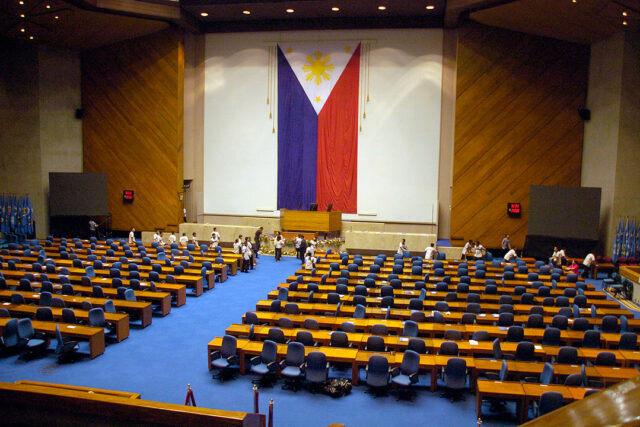
PHILIPPINE STAR/MICHAEL VARCAS

THE House of Representatives is accelerating action on President Ferdinand R. Marcos, Jr.’s priority measures, with several bills now nearing plenary deliberation, the chamber’s majority leader said on Monday.

House Majority Leader and Ilocos Norte Rep. Ferdinand Alexander “Sandro” A. Marcos III said eight measures under the Legislative-Executive Development Advisory Council (LEDAC) priority list are set for discussion at the House floor.

“These committee-level approvals show that the House is doing the hard work earlier under the leadership of Speaker Dy — building consensus, refining policy and making sure the measures we bring to the floor are ready,” he said in a statement.

He was referring to Speaker Faustino “Bojie” G. Dy III, who was elected to lead the chamber in September following leadership turmoil linked to the multibillion-peso flood control controversy.

Mr. Marcos said the House had approved 12 priority bills as of February, including amendments to the bank secrecy law and a measure extending the estate tax amnesty period.

LEDAC recently added four more measures to the administration’s legislative agenda, including proposals to abolish the travel tax and to address the spread of disinformation.

Several other priority bills have cleared their respective mother committees and are awaiting action from the House Appropriations Committee on funding provisions.

These include proposals to establish an independent anti-graft body for public works projects, pass a national land use act, and enact a magna carta for small businesses.

Measures seeking to create a presidential scholarship program, reset elections in the Bangsamoro autonomous region, amend the government’s cash-assistance program for poor Filipinos, expand scholarship support and strengthen the Bureau of Immigration are also pending appropriations clearance.

“Our focus remains on bills that directly affect education, health, food security and social protection — areas where legislation translates into real impact for Filipino families,” the presidential son said.

He added that the chamber aims to ensure measures are thoroughly reviewed before reaching the floor.

“The goal is to pass sound, well-vetted laws that people can actually feel in their daily lives, whether in the classroom, at the health center, or at the dinner table,” he said. “That’s progress, and we intend to sustain it.” — Kenneth Christiane L. Basilio

Dynasty ban seen as move against Duterte clan

BW FILE PHOTO

By Adrian H. Halili, Reporter

THE Marcos administration’s push to ban political dynasties is being viewed by some analysts as an effort to curb the Duterte family’s political ambitions, amid a widening rift between two of the country’s most influential clans.

President Ferdinand R. Marcos, Jr. has included anti-dynasty legislation in the Legislative-Executive Development Advisory Council’s priority measures, reviving a long-debated constitutional provision that prohibits political dynasties “as may be defined by law.”

Hansley A. Juliano, a political science lecturer at the Ateneo de Manila University, said isolating the Dutertes could benefit the Marcos bloc in the short term but might also energize their supporters ahead of the 2028 elections.

“Isolating the Dutertes would be useful in the short term, but also risks consolidating pro-Duterte forces for 2028,” he said in a Facebook Messenger chat.

Ederson DT. Tapia, a political science professor at the University of Makati, said the initiative could be read in two ways.

“Some will see it as an institutional reform measure,” he said via Messenger. “Others will read it as a political maneuver aimed at recalibrating the competitive landscape, particularly in relation to families with strong regional machinery.”

The rivalry between the Marcos and Duterte camps has intensified in recent months. Vice-President Sara Duterte-Carpio, daughter of former President Rodrigo R. Duterte, was once Mr. Marcos’ running mate.

Tensions have since escalated, culminating in Mr. Duterte’s arrest by the International Criminal Court and impeachment moves against Ms. Duterte.

Both families are entrenched political dynasties. The Marcoses have long dominated politics in Ilocos Norte, while the Dutertes have held power in Davao for decades. Both patriarchs have served as President.

Mr. Juliano said Mr. Marcos might gain short-term moral advantage from backing anti-dynasty reform, particularly among civil society groups that have long pushed it.

“Mr. Marcos’ position is likely to capture short-term moral high ground,” he said, though he added that the President’s own dynastic background complicates the optics of the proposal.

Mr. Tapia cautioned that an anti-dynasty law would not target just one family.

“Anti-dynasty legislation would not only affect one family,” he said. “It could potentially reshape the entire electoral map, especially in provinces where local power has been consolidated within extended kinship networks.”

He also noted that banning dynasties would not automatically dismantle patronage politics, weak party structures or the influence of money in elections.

The reform might become symbolic if it is not paired with broader institutional strengthening, including campaign finance regulation, party development and enforcement capacity, he added.

Several bills have been filed in both chambers of Congress seeking to define and prohibit political dynasties, almost four decades after the ratification of the 1987 Constitution. Despite the constitutional mandate, no enabling law has been passed.

Joy G. Aceron, convenor-director of transparency group Government Watch, said a well-crafted anti-dynasty measure could curb the concentration of power that weakens accountability.

“A proper anti-dynasty measure can check concentration of power that undermines accountability,” she said, noting that the reform would affect all major political families, including both the Marcoses and the Dutertes.

She added that limiting dynastic control could improve transparency and widen political participation.

“Political efficacy can increase if people know that the playing field is leveled — if opportunities are not limited to a few families who have been there for a long time,” Ms. Aceron said.

The Senate and House electoral committees are conducting hearings on the m measure, with lawmakers still divided over how broad the ban should be and which relatives should be covered.

House urged to hasten VP ouster

Vice President Sara Duterte arrives at the Department of Justice, May 9, 2025. — PHILIPPINE STAR/RYAN BALDEMOR

A MINORITY lawmaker on Monday urged the House of Representatives majority bloc to begin efforts to secure enough votes to directly transmit the impeachment cases against Vice-President (VP) Sara Duterte-Carpio to the Senate.

House Deputy Minority Leader and Party-list Rep. Antonio L. Tinio said it would be better if the House immediately transmits the complaint to the Senate, which would convene as an impeachment court, so Ms. Duterte could promptly face the allegations against her.

“It’s still better if we fast-track this so we can move straight to trial and finally settle, once and for all, the issue of the Vice-President’s alleged misuse of confidential funds,” he told reporters in Filipino.

Ms. Duterte faces three impeachment complaints alleging the misuse of P612.5 million in confidential and intelligence funds allocated to her office and to the Education department when she was secretary.

Mr. Tinio said the complaints will likely be referred to the House floor for its referral to the Justice committee on Wednesday, which would jump-start her impeachment proceedings and bar more complaints from being filed against her.

“If we go through the Justice committee, that’s fine too, so everyone is refreshed,” he said. “It’s also better that everyone is reminded again why there is a strong basis for impeaching the Vice-President.” — Kenneth Christiane L. Basilio

DoJ issues travel ban vs Estrada, Bonoan

BW FILE PHOTO

THE Department of Justice (DoJ) on Monday said a travel ban has been issued against Senator Jose “Jinggoy” P. Estrada, former Public Works Secretary Manuel M. Bonoan, and four others amid an ongoing investigation into a multibillion-peso plunder and corruption case involving government infrastructure projects.

In an order dated Feb. 10, the Manila Regional Trial Court Branch 52 issued a precautionary hold departure order to the Bureau of Immigration, preventing the respondents from fleeing the Philippines while the case is ongoing.

“There is probable cause to believe that respondents will depart from the Philippines to evade arrest and prosecution of the crimes against them,” the order by Judge Juan G. Rañola, Jr. stated.

The respondents face charges of plunder, graft, and direct bribery for allegedly orchestrating a massive bid-rigging scheme and pocketing kickbacks from fictitious flood control projects. — Erika Mae P. Sinaking

Trimester school system backed

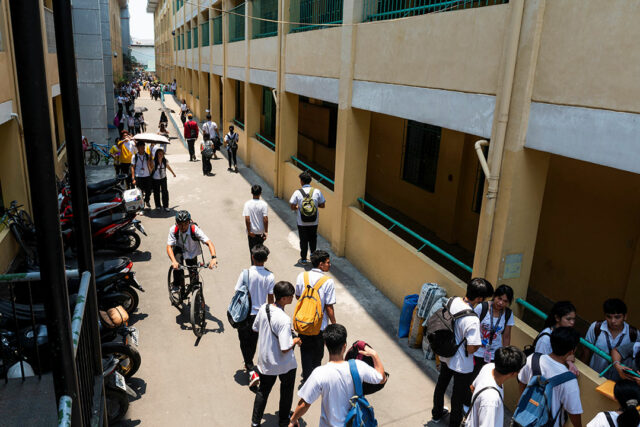
Students walk inside the campus of a high school in Quezon City, April 18, 2024. — REUTERS

THE PALACE on Monday backed the Department of Education’s (DepEd) proposal to implement a trimester school system but noted the proposal is still under review and will go through thorough consultations with stakeholders.

“This is just a proposal, and they are presenting the possible advantages of having a trimester that is being promoted by the DepEd,” Palace Press Officer Clarissa A. Castro told a news briefing in Filipino.

“It is still at the proposal stage, so it is better to do more studies sooner if it should be implemented.”

The DepEd earlier proposed replacing the current quarterly system with a trimester academic calendar to better distribute academic and non-academic activities and help reduce teachers’ workload.

Under the proposed School Year 2026-2027 calendar, the 201 school days would be organized into three terms.

Each term would feature longer teaching periods along with scheduled breaks intended for lesson planning, student assessment and other professional responsibilities.

The Second Congressional Commission on Education has noted that Filipino student proficiency is in critical decline.

Around 30.52% of Grade 3 learners were assessed as barely sufficient in key subjects, with proficiency rates falling to nearly zero by senior high school. — Chloe Mari A. Hufana

Visit Mary Jane Veloso, Marcos urged

PHILIPPINE STAR/MIGUEL DE GUZMAN

AN OVERSEAS Filipino worker advocacy group on Monday called on President Ferdinand R. Marcos, Jr. to personally visit Mary Jane F. Veloso in prison and expedite her clemency, a year after she was transferred to Philippine custody.

In a picket at the Department of Justice, supporters of Ms. Veloso noted that the family has submitted thousands of clemency pleas since 2024, as Migrante International Chairperson Joanna Concepcion said in a statement that Malacañang’s recent suggestion for a personal appeal is “cruel.”

“Marcos has all the power to free Mary Jane. He is heartless for not using it,” Ms. Concepcion said. “It is he who should have the compassion to meet her in prison.”

The group also urged the government to resolve a habeas corpus petition filed on Nov. 14, 2025, which challenges the legality of her continued detention at the Correctional Institution for Women.

Ms. Veloso, who has been incarcerated for over 16 years following a 2010 drug trafficking conviction in Indonesia, recently issued an open letter seeking freedom to care for her aging parents and children. — Erika Mae P. Sinaking

73% say bribery is most common form of corruption

MOST Filipino adults believe bribery is the most common form of corruption in the government, according to a survey by OCTA Research released on Monday.

About 73% of adult Filipinos cited bribery as the most widespread form of corruption, followed by irregularities in the use of public funds at 66%, vote buying at 64%, and slow justice at 54%, based on a non-partisan survey commissioned by the Office of the Ombudsman of 1,200 respondents conducted from Dec. 3 to 11, with a margin of error of ±3 percentage points.

“The prominence of bribery may reflect its visibility in routine transactions with government offices. Many Filipinos may have directly encountered or observed informal payments in frontline services, making it the most immediate and recognizable form of corruption,” the OCTA Research said.

While bribery leads nationally, vote buying emerged as a particularly dominant concern in parts of the Visayas and Mindanao, suggesting that electoral integrity remains a localized flashpoint.

Socioeconomic differences also shaped perceptions. Among higher-income respondents in Class ABC, 78% identified bribery as the top concern, while irregularities in public funds (67%) and slow justice (64%) were cited more frequently than among lower-income groups.

By contrast, respondents in Class E showed the highest sensitivity to vote buying at 69%, while only 47% in this group cited irregularities in public funds as a major concern.

Regionally, vote buying emerged as the dominant concern in Eastern Visayas, the Zamboanga Peninsula, the Davao Region, and Soccsksargen, while irregularities in public procurement were cited more frequently in the National Capital Region at 40%, above the national average of 32%.

“Overall, the results underscore that effective anti-corruption strategies must address both institutional structures and lived public experiences, ensuring reforms are responsive to the everyday realities identified by respondents,” OCTA said. — Erika Mae P. Sinaking

Land lease law may help attract FDI

REUTERS

A SENATOR on Monday urged the government to tap a law allowing foreigners to lease Philippine land for up to 99 years to attract capital, promoting the country as an investment hub to help lift economic performance amid sluggish growth.

President Ferdinand R. Marcos, Jr. last September signed into law a measure that allows foreign investors to lease land to 99 years from 75 years as part of efforts to attract foreign investments.

“The law is already in place,” Senator Francis G. Escudero said in a statement. “What we need now is aggressive promotion and clear messaging to investors that the Philippines is ready for long‑term partnerships.”

He said that foreign direct investments (FDIs) dipped to $7.1 billion from January to November 2025, a 21% decline from the $9.08 billion recorded in the same period in 2024.

The government must “move decisively” to restore investor confidence to allow the Philippines compete more aggressively in attracting foreign capital in the Southeast Asian region, Mr. Escudero said. — Kenneth Christiane L. Basilio

Sandiganbayan grants Revilla leave to file MR

PHILSTAR FILE PHOTO

THE Sandiganbayan has granted former Senator Ramon “Bong” B. Revilla, Jr. leave to file a motion for reconsideration (MR) with the Office of the Ombudsman and entered a not guilty plea for him in a flood control malversation case.

In a resolution promulgated on Feb. 13 and made public on Monday, the anti-graft court’s Third Division gave the Ombudsman a 60-day window to resolve the appeal, clarifying that granting leave to file the motion “does not result in the suspension of the proceedings herein or the quashal of the warrants of arrest issued against them.”

The court also denied Mr. Revilla’s request to consolidate the malversation case with a separate graft case pending in the Fourth Division, saying a merger would introduce “disarray in the entirety of the proceedings.” Justices noted that the two cases involve different legal elements and that a joint trial would likely cause “unnecessary delay” in resolving the graft case.

Following the court’s refusal to suspend proceedings, the Third Division on Monday entered a not guilty plea for Mr. Revilla after he declined to do so personally during arraignment. Co-accused and former Department of Public Works and Highways accountant Juanito C. Mendoza also pleaded not guilty.  Both join five other co-accused who entered not guilty pleas on Feb. 9 on the same malversation charge.

Mr. Revilla remains detained at the New Quezon City Jail in Payatas as his pretrial in the malversation case is scheduled for March 6. — Erika Mae P. Sinaking

Gov’t wraps up 2 Zamboanga infra projects to ease strains, drive growth

THE government is ramping up infrastructure projects in Zamboanga Peninsula to ease logistics bottlenecks and spur regional growth, the Department of Economy, Planning and Development (DEPDev) said.

“By advancing these initiatives, we are improving connectivity, enhancing local productivity, and laying the foundation for inclusive and sustainable development,” Economy Secretary Arsenio M. Balisacan said in a statement on Monday.

DEPDev Undersecretary Carlos Bernardo Abad Santos said two major infrastructure projects were completed in December 2025, including the Governor Camins-Maria Clara Lorenzo Lobregat Highway and the Veterans Avenue Flyover in Zamboanga City.

Updates were also given on works at the Zamboanga Fish Port Complex, Sindangan-Bayog-Lakewood Road, the Improving Growth Corridors in Mindanao Road Sector Project, Daang Maharlika, the Western Nautical Highway Network and more. — Aubrey Rose A. Inosante

Detained journalist in terror financing case denied bail

A TACLOBAN City court has denied the petition for bail filed by detained journalist Frenchie Mae C. Cumpio and lay worker Mariel A. Domequil following their recent conviction for terrorism financing.

Judge Georgina Uy Perez of the Tacloban Regional Trial Court Branch 45 denied the joint motion for bail for lack of merit, according to an order dated Feb. 13. It added that a temporary release creates a “heightened incentive to evade custody.”

“The seriousness of terrorism financing, the substantial penalty imposed, and the accused’s connections to various organizations weigh heavily against the grant of bail pending appeal. These considerations outweigh the interest of the accused in provisional liberty,” the order read.

Ms. Cumpio and Ms. Domequil were sentenced on Jan. 22 to 12-18 years in prison and fined P500,000 each. They sought bail after being cleared of separate explosives charges, saying the law doesn’t bar them from release.

The National Union of Journalists of the Philippines (NUJP) said in a statement that the denial is “unfortunate and unfair,” stating that each day in jail separates Ms. Cumpio from her family and the community whose issues she reported on.

“The National Union of Journalists of the Philippines stands with them through the next stages of this legal battle and until their eventual and much deserved freedom,” the NUJP said. — Erika Mae P. Sinaking