Home Blog Page 2464

Australia proposes ban on social media for children under 16

SYDNEY — Australia Prime Minister Anthony Albanese said on Thursday that the government would legislate for a ban on social media for children under 16, a policy the government says is world-leading.

Australia is trialing an age-verification system to assist in blocking children from accessing social media platforms, as part of a ban that could come into force as soon as the end of next year.

“Social media is doing harm to our kids and I’m calling time on it,” Mr. Albanese told a news conference.

Mr. Albanese cited the risks to physical and mental health of children from excessive social media use, in particular the risks to girls from harmful depictions of body image, and misogynist content aimed at boys.

“If you’re a 14-year-old kid getting this stuff, at a time where you’re going through life’s changes and maturing, it can be a really difficult time and what we’re doing is listening and then acting,” he said.

Legislation will be introduced into parliament this year, with the laws coming into effect 12 months after being ratified by lawmakers, he added.

The opposition Liberal Party has expressed support for a ban.

There will be no exemptions for children who have parental consent, or who already have accounts.

“The onus will be on social media platforms to demonstrate they are taking reasonable steps to prevent access,” Mr. Albanese said. “The onus won’t be on parents or young people.”

Communications Minister Michelle Rowland said platforms impacted would include Meta Platforms’ Instagram and Facebook, as well as Bytedance’s TikTok and Elon Musk’s X. Alphabet’s YouTube would likely also fall within the scope of the legislation, she added.

TikTok declined to comment, while Meta, Alphabet, and X did not respond to requests for comment.

A number of countries have already vowed to curb social media use by children through legislation, though Australia’s policy is one of the most stringent.

France last year proposed a ban on social media for those under 15, though users were able to avoid the ban with parental consent.

The United States has for decades required technology companies to seek parental consent to access the data of children under 13, leading to most social media platforms banning those under that age from accessing their services. — Reuters

Once again, America needs to deal with Donald Trump

RAWPIXEL.COM

DONALD TRUMP wasn’t my choice for president. In fact, I urged Americans to vote for Kamala Harris. But he won fair and square. So let’s get on with it.

Republicans had an exceptionally good night, taking the Senate and likely holding their narrow majority in the House, but their paper-thin majority should not be mistaken for a mandate. The challenges facing the country can only be tackled effectively with bipartisan compromise.

One irony of the outcome is that, on almost every issue that voters identified as a priority, Trump’s proposals would likely make matters worse. The goal for Congress over the next four years should be persuading the president to avoid these bad ideas and offering him better alternatives. Trump himself should recognize that what plays in a campaign is often far different than what works in government.

Take inflation, a top concern for most voters. Trump’s plans for comprehensive tariffs, regressive tax cuts, a devalued dollar, and a newly politicized Federal Reserve seem tailor-made to push prices up, just when the Fed has largely succeeded in getting them under control. Enacting any element of this agenda would be irresponsible, not least because it would worsen the country’s spiraling fiscal problems, to the tune of perhaps $15 trillion in additional debt over a decade.

Lawmakers, including Republicans, should have every interest in averting this course. They could assert Congress’ rightful power to refuse his across-the-board tariffs, for instance, while offering the president more targeted ones focused on national security and market access. A prudent revision of the expiring 2017 tax cuts — one that pairs a higher corporate tax rate with more generous expensing rules, say — might also be feasible. Forming a fiscal commission would be a good way to get on with the hard choices needed to forestall a looming budget crisis.

On immigration, too, Trump’s proposals are hugely misguided. It’s true that the current administration has made a hash of things at the border. But the mass-deportation effort Trump has theorized would be (in addition to cruel) prohibitively costly, while also impeding economic growth and doing little to fix the underlying problem. Legislators should instead revive a bipartisan reform effort, focused on popular policies such as easing the path to citizenship for foreign graduates of US colleges combined with more restrictive enforcement measures. They should also push Trump to focus on the quasi-effective policies from his last term, such as the Migrant Protection Protocols, and avoid needlessly inflammatory rhetoric.

A final priority must be to thwart the corruption that marred Trump’s first term. The president is entitled to his own agenda, but not to his own rules. (The recent Supreme Court ruling granting presidents sweeping immunity could be interpreted to give Trump enormous latitude, but it may be tested in the courts.) Public servants should do their duty while availing themselves of whistleblower protections if asked to engage in misconduct. Reporters and watchdog groups should be on the lookout for Trump’s reflexive financial malfeasance. Congress should pass levelheaded laws that respond to the legitimate concerns of Trump’s voters, while also opposing him as needed, as Mitch McConnell, the departing Republican Senate leader, did during Trump’s first term. Republicans must not allow the president to obliterate norms of American democracy.

Democrats, for their part, might ask themselves how exactly they lost to Trump, an ailing 78-year-old who much of the country despises. It probably wasn’t great to cover up President Joe Biden’s infirmities until they became undeniable on live TV. It wasn’t ideal that party elders replaced him with Harris, a nominee who had received no electoral votes and had failed decisively in a previous presidential run.

But for now, the country will simply need to deal with Trump, and begin to restrain his worst excesses, one more time.

Dealing with a reckless president is an exhausting job, but it can and must be done – and it’s a job for members of both parties.

BLOOMBERG OPINION

Social media’s market influence

In recent years, social media has evolved from a tool for personal connection to a powerful driver of market trends, capable of reshaping industries and altering the trajectories of brands, companies, and entire markets.

The GameStop stock surge in early 2021 is one of the most prominent examples of how social media can exert considerable influence on the stock market. Triggered by discussions on platforms like Reddit, particularly within the subreddit r/WallStreetBets, this phenomenon demonstrated the potential for collective online action to challenge traditional investment strategies. What began as a grassroots movement quickly snowballed as thousands of users united to buy up GameStop stock, aiming to create a “short squeeze” that would drive up its price and inflict losses on hedge funds that had bet against it. Within weeks, GameStop’s stock value skyrocketed from under $20 to a high of $483. This sudden surge caused billions of dollars in losses for established Wall Street firms and underscored how social media could mobilize individual investors in a way that challenges traditional market dynamics.

The GameStop phenomenon highlighted how the democratization of information on social media could disrupt long-standing hierarchies in finance, presenting new opportunities for individuals while posing risks to established institutions.

Another example of social media’s ability to drive market trends is Elon Musk’s influence on cryptocurrency prices, particularly Bitcoin, through his Twitter account (now X). Musk, the CEO of Tesla and SpaceX, has a massive following and often uses his platform to share his thoughts on technology and finance. In 2021, Musk posted several tweets regarding Bitcoin, at times praising its potential and at other times questioning its environmental impact. In one instance, after Musk announced that Tesla would accept Bitcoin as payment, the cryptocurrency’s value surged.

Conversely, when he later expressed concerns over Bitcoin’s energy consumption and stated that Tesla would suspend its use of Bitcoin for purchases, the currency’s value plummeted. This volatility showed how a single influential voice on social media could send shockwaves through the cryptocurrency market. Investors and analysts began to pay closer attention to Musk’s statements, knowing they could significantly impact asset values in real time. Musk’s influence underscores the role of “celebrity CEOs” on social media, where the line between personal opinion and corporate policy can blur, directly impacting market behavior and creating both opportunities and risks for investors.

Similarly, social media has been a critical platform in political campaigns, affecting public perception and even influencing markets by shaping policies and consumer behavior. Donald Trump’s 2016 presidential campaign, fueled in large part by his presence on Twitter, is a prime example. His posts reached millions instantly, often bypassing traditional media channels and directly engaging his followers. His tweets on various policies, tariffs, and trade relations created ripples in markets, with certain sectors benefiting or suffering depending on his statements. During his presidency, Trump’s pronouncements on tariffs with China or on supporting specific industries could lead to rapid stock fluctuations, as businesses and investors anticipated potential impacts on trade and commerce. Social media allowed him to quickly influence public sentiment and set agendas, demonstrating how political figures can sway markets by leveraging online platforms. Trump’s use of Twitter also normalized the practice of real-time policy communication, and today, many political and business leaders use social media to broadcast decisions that can have immediate financial implications.

These instances illustrate how social media’s immediacy and reach have fundamentally altered how market trends are shaped, often with unpredictable outcomes. Businesses now face new pressures to monitor social media closely and respond swiftly to shifts in public sentiment or to statements from influential figures. The virality of social media means that trends can spread far faster than in the past, leading to sudden spikes in demand or, conversely, consumer backlash. A brand can gain popularity overnight if endorsed by a prominent figure, or it can face a PR crisis due to a viral complaint. The speed and unpredictability of these trends require businesses to adopt agile strategies and maintain an active online presence to mitigate risks and capitalize on opportunities.

The implications of social media-driven market trends are profound, affecting industries across the board. In finance, for example, the GameStop event signalled a shift in power dynamics, as individual investors leveraged social media to challenge institutional investors. Hedge funds and large financial institutions, which historically relied on proprietary information and professional analysis, now contend with the influence of online communities. Many are beginning to monitor platforms like Reddit and Twitter as part of their market analysis, recognizing that social media movements can disrupt established models. In response, some investment firms have adapted by incorporating sentiment analysis from social media into their decision-making processes, aiming to better anticipate these collective actions and adjust their positions accordingly.

For companies outside of finance, the influence of figures like Elon Musk exemplifies the need to be attuned to high-profile social media personalities whose statements can affect everything from stock prices to consumer trends. When Musk tweeted favorably about the cryptocurrency Dogecoin, for instance, it spiked in value. Companies in the cryptocurrency industry and beyond are now conscious of how endorsement from a social media influencer can directly translate to financial outcomes. Many companies are even investing in social media listening tools to track mentions of their brand or industry by influential accounts, aiming to act quickly in response to changes in sentiment.

Social media’s impact on politics, as seen in Donald Trump’s campaigns, has also transformed public relations and brand management strategies. Corporations must navigate the politically charged online environment with caution, as an association with a particular figure or issue can sway public perception. Many businesses have found it necessary to establish clear social media guidelines, balancing transparency and engagement while protecting their brand’s reputation. The capacity of social media to drive both positive and negative trends requires that businesses remain vigilant and proactive, prepared to adapt quickly to new realities in a landscape where online influence holds considerable sway.

In a world increasingly shaped by social media, the ability to adapt to rapid changes in sentiment and to respond to the pronouncements of influential figures has become crucial for businesses. Social media has dismantled traditional boundaries, allowing individuals to participate in markets and shape trends in ways previously reserved for institutions.

The views and opinions expressed above are those of the author and do not necessarily represent the views of FINEX.


Reynaldo C. Lugtu, Jr. is the Founder and CEO of Hungry Workhorse, a digital, culture, and customer experience transformation consulting firm. He is a Fellow at the US-based Institute for Digital Transformation. He teaches strategic management and digital transformation in the MBA Program at De La Salle University. The author may be emailed at rey.lugtu@hungryworkhorse.com

Seasonal hiring seen masking job market flaws

PHILIPPINE STAR/ MIGUEL DE GUZMAN

By Chloe Mari A. Hufana, Reporter

THE UPTICK in employment towards the end of the year reflects seasonal hiring for the holidays, masking the problems of precarious employment and poor job quality.

The increase in underemployment in September to 5.94 million from 5.11 million a year earlier indicates dissatisfaction with wages or, Bukluran ng Manggagawang Pilipino National President Renecio S. Espiritu said.

The September underemployment rate — a measure of workers seeking longer hours or extra jobs — rose to 11.9% from 10.7% a year earlier and 11.2% in August, according to preliminary data from the Philippine Statistics Authority (PSA), which issued its Labor Force Survey report Wednesday.

“In other words, one out of 10 Filipino workers cannot meet their needs,” Mr. Espiritu told BusinessWorld via Messenger chat.

The “Christmas rush” driving hiring points to a “very backward economy” because production and economic activity “are not strategically planned but are determined by religious traditions.”

“Instead of promoting meaningful, regular employment, what is being offered are seasonal, temporary jobs based on tradition-determined demand. Such an economic arrangement is very primitive and it does not improve our economy and quality of life in the long term,” he added.

Mr. Espiritu noted the growing gig economy’s role pushing up underemployment in September, particularly food delivery platforms, transport network vehicle services, and online sellers.

Gig economy jobs undermine security of tenure with workers not having an employer-worker relationship with companies, he said.

“It’s not surprising that employment numbers have increased. However, let’s be clear — this does not mean that the lives of ordinary Filipinos have improved,” he added.

University of the Philippines Baguio economics instructor Edgar Antonio C. Suguitan said relying on the boost from holiday hiring is “unsustainable” and a “band-aid solution.”

“There is room for policy to better generate or match jobseekers to decent jobs. But policy takes time and need to start early,” he said via Messenger chat.

In its notes accompanying the September data release, the PSA said many workers entering the labor force were not absorbed as regular workers.

Mr. Suguitan said this meant “a lot of temporary engagements expired within the year” and “many people are still looking for better work conditions.”

He said some reasons for this include cost-cutting by companies and the mismatch between available jobs and worker qualifications.

The unemployment rate fell to 3.7% in September, driven in part by the growing number of female workers joining the workforce ahead of the holidays.

The PSA reported that the jobless rate dropped to 3.7% in September from 4% in August and 4.5% in September 2023.

This was equivalent to 1.89 million unemployed in September, down by 177,000 from August and by 370,000 from a year earlier.

The employment rate rose to 96.3% in September from 95.5% a year earlier. This is equivalent to 49.87 million holding down joba, up 2.2 million from September 2023.

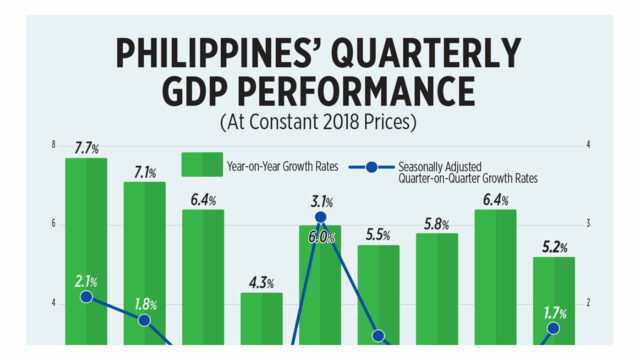
Philippines’ quarterly GDP performance

THE PHILIPPINE economy expanded by a weaker-than-expected 5.2% in the third quarter, as bad weather hurt agricultural output and government spending, the statistics agency said on Thursday. Read the full story.

Philippines' quarterly GDP performance

Cebu Pacific’s direct Manila-Sapporo flights to start in Jan.

PHILSTAR FILE PHOTO

CEBU PACIFIC (CEB) is expanding its services to Japan by starting direct flights from Manila to Sapporo, Hokkaido, in January 2025, the budget airline said on Thursday.

Cebu Pacific, operated by Cebu Air, Inc., will launch flights between Manila and Sapporo on Jan. 16, 2025, thrice weekly — every Tuesday, Thursday, and Saturday — making it the only airline mounting direct flights between the two cities, the airline said in a statement.

The addition of Sapporo flights is part of the company’s overall ambition of expanding its international network, said Alexander G. Lao, Cebu Pacific president and chief commercial officer.

“We are thrilled to be the only carrier to offer nonstop flights between Manila and Sapporo. The launch of this route is a testament to Cebu Pacific’s mission of expanding its international network and making air travel accessible to a wider range of passengers,” he said.

The budget airline said its direct Manila-Sapporo flight will cut travel time to five hours versus the usual up to 10 hours on airlines with layovers.

Currently, Cebu Pacific operates flights to four cities in Japan: Osaka, Tokyo (Narita), Nagoya, and Fukuoka.

The budget carrier operates in 35 domestic and 27 international destinations across Asia, Australia, and the Middle East.

At the local bourse on Thursday, shares in Cebu Air fell by P1.25, or 3.9%, to end at P30.80 per share. — Ashley Erika O. Jose

France’s Believe denies copyright allegation in $500-M US claim by UMG

FRENCH digital music company Believe on Tuesday denied allegations of copyright infringement by Universal Music Group (UMG) which is seeking damages of at least $500 million through a complaint in the United States.

UMG, the world’s biggest music label, alleges in the complaint, a copy of which was seen by Reuters, that Paris-based Believe and its US business TuneCore have profited from the distribution of copies of copyrighted recordings.

“As companies that work with artists and labels around the world, we take the respect of copyright very seriously. We strongly refute these claims, and the statements made by Universal Music Group and will fight them,” said Believe.

UMG alleges that Believe has been distributing copyrighted material by changing the name of the artists or by publishing “sped-up” versions of original songs.

Tracks by Kendrick Lamar, Ariana Grande, Justin Bieber and Lady Gaga are distributed by Believe under names like “Kendrik Laamar,” “Arriana Gramde,” “Jutin Bieber,” and “Llady Gaga,” the plaintiffs said in their court filing.

The complaint by UMG, ABKCO Music & Records, and Concord Music Group has been filed in the United States District Court for the Southern District of New York.

Believe’s music catalogue features on social media platforms and streaming services including TikTok, YouTube, Spotify, and Apple Music.

Founded in 2005 by former Vivendi executive Denis Ladegaillerie and listed in Paris in 2021, Believe operates in 50 countries and has expanded its market share by acquiring other music labels in Europe and the Americas, with the former bringing in most of its revenue.

The company’s initial goal was to shake up the music distribution industry by promoting artists digitally, a strategy that has fueled competition with other mainstream labels. — Reuters

The evolutionary benefits of being forgetful

DARIUS BASHAR-UNSPLASH

Forgetting is part of our daily lives. You may walk into a room only to forget why you went in there – or perhaps someone says hi on the street and you can’t remember their name.

But why do we forget things? Is it simply a sign of memory impairment, or are there benefits?

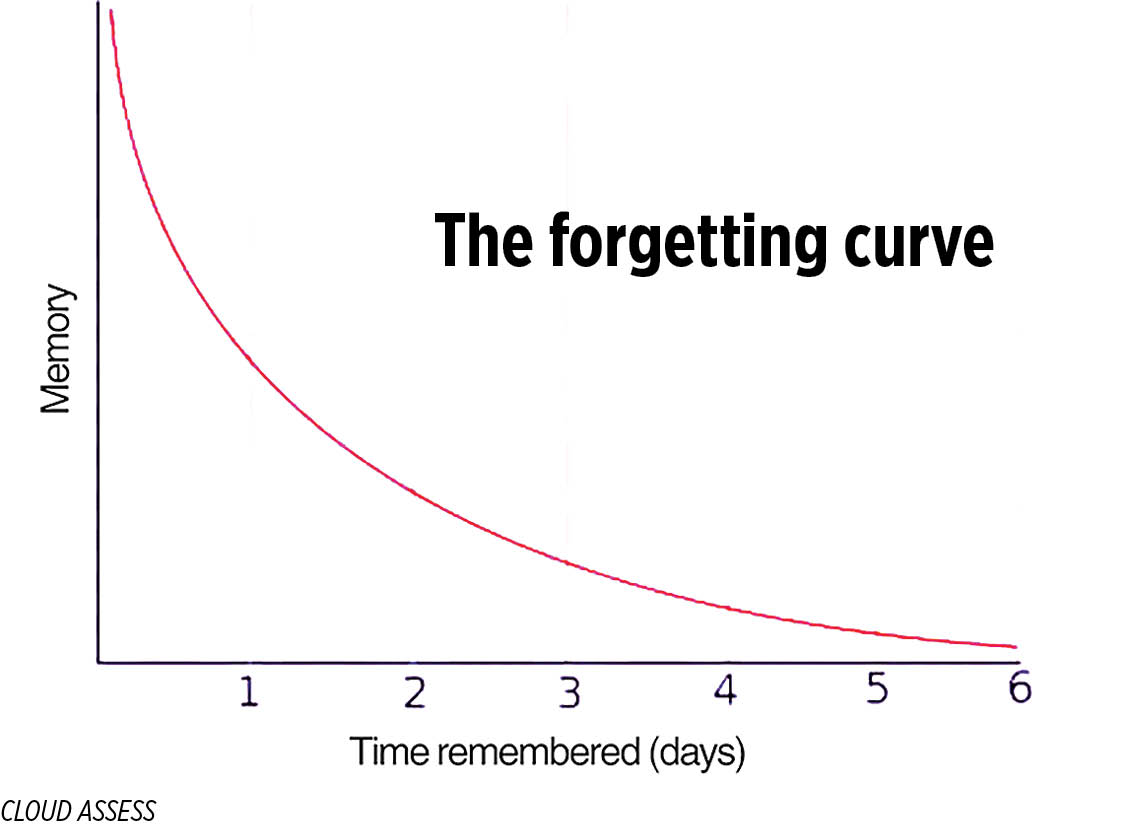
One of the earliest findings in this area highlighted that forgetting can occur simply because the average person’s memories fade away. This comes from 19th century German psychologist Hermann Ebbinghaus, whose “forgetting curve” showed how most people forget the details of new information quite rapidly, but this tapers off over time. More recently, this has been replicated by neuroscientists.

Forgetting can also serve functional purposes, however. Our brains are bombarded with information constantly. If we were to remember every detail, it would become increasingly difficult to retain the important information.

One of the ways that we avoid this is by not paying sufficient attention in the first place. Nobel prize winner Eric Kandel, and a host of subsequent research, suggest that memories are formed when the connections (synapses) between the cells in the brain (the neurons) are strengthened.

Paying attention to something can strengthen those connections and sustain that memory. This same mechanism enables us to forget all the irrelevant details that we encounter each day. So although people show increased signs of being distracted as they age, and memory-related disorders such as Alzheimer’s disease are associated with attention impairments, we all need to be able to forget all the unimportant details in order to create memories.

HANDLING NEW INFORMATION
Recalling a memory can sometimes also lead to it changing for the purposes of coping with new information. Suppose your daily commute involves driving the same route every day. You probably have a strong memory for this route, with the underlying brain connections strengthened by each journey.

But suppose one Monday, one of your usual roads is closed, and there’s a new route for the next three weeks. Your memory for the journey needs to be flexible enough to incorporate this new information. One way in which the brain does this is by weakening some of the memory connections, while strengthening new additional connections to remember the new route.

Clearly, an inability to update our memories would have significant negative consequences. Consider PTSD (post-traumatic stress disorder), where an inability to update or forget a traumatic memory means an individual is perpetually triggered by reminders in their environment.

From an evolutionary standpoint, forgetting old memories in response to new information is undoubtedly beneficial. Our hunter-gatherer ancestors might have repeatedly visited a safe water hole, only to one day discover a rival settlement, or a bear with newborn cubs there. Their brains had to be able to update the memory to label this location as no longer safe. Failure to do so would have been a threat to their survival.

REACTIVATING MEMORIES
Sometimes, forgetting may not be due to memory loss, but to changes in our ability to access memories. Rodent research has demonstrated how forgotten memories can be remembered (or reactivated) by supporting the synaptic connections mentioned above.

Rodents were taught to associate something neutral (like a bell ringing) with something unpleasant (like a mild shock to the foot). After several repetitions, the rodents formed a “fear memory” where hearing the bell made them react as though they expected a shock. The researchers were able to isolate the neuronal connections which were activated by pairing the bell and the shock, in the part of the brain known as the amygdala.

They then wondered if artificially activating these neurons would make the rodents act as if they expected their foot to be shocked even if there was no bell and no shock. They did this using a technique called optogenetic stimulation, which involves using light and genetic engineering, and showed that it was indeed possible to activate (and subsequently inactivate) such memories.

One way that this might be relevant to humans is through a type of transient forgetting which might not be due to memory loss. Return to the earlier example where you see someone in the street and can’t remember their name. Perhaps you believe you know the first letter, and you’ll get the name in a moment. This is known as the tip-of-the-tongue phenomenon.

When this was originally studied by American psychologists Roger Brown and David McNeill in the 1960s. They reported that people’s ability to identify aspects of the missing word was better than chance. This suggested that the information was not fully forgotten.

One theory is that the phenomenon occurs as a result of weakened connections in memory between the words and their meanings, reflecting difficulty in remembering the desired information.

However, another possibility is that the phenomenon might serve as a signal to the individual that the information is not forgotten, only currently inaccessible.

This might explain why it occurs more frequently as people age and become more knowledgeable, meaning their brains have to sort through more information to remember something. The tip of the tongue phenomenon might be their brain’s means of letting them know that the desired information is not forgotten, and that perseverance may lead to successful remembering.

In sum, we may forget information for a host of reasons. Because we weren’t paying attention or because information decays over time. We may forget in order to update memories. And sometimes forgotten information is not permanently lost, but rather inaccessible. All these forms of forgetting help our brain to function efficiently, and have supported our survival over many generations.

This is certainly not to minimize the negative outcomes caused by people becoming very forgetful (for example, through Alzheimer’s disease). Nonetheless, forgetting has its evolutionary advantages. We only hope that you’ve found this article sufficiently interesting that you won’t forget its contents in a hurry.


Sven Vanneste is a professor of Clinical Neuroscience at Trinity College Dublin. Elva Arulchelvan is a lecturer in Psychology and PhD researcher in Psychology and Neuroscience at Trinity College Dublin.


Central bank to issue rules for EMI, OPS co-ops

THE BANGKO SENTRAL ng Pilipinas (BSP) is seeking to issue guidelines for cooperatives in the electronic money and payments systems businesses.

The central bank is looking to issue a joint memorandum circular with the Cooperative Development Authority (CDA) to establish guidelines and regulatory requirements for covered cooperatives to “harmonize existing laws on payments with applicable laws on cooperatives,” based on a draft circular posted on its website.

This comes after the BSP and CDA signed a memorandum of agreement in October to better supervise covered cooperatives. The agreement between the two agencies covered the adoption of a comprehensive regulatory framework on covered cooperatives.

The guidelines aim to “promote inclusive digital payments ecosystem, broader access to digital payments services, and contribute to the development of the Philippine economy.”

The draft rules define covered cooperatives as those that are licensed as electronic money issuer-nonbank financial institutions (EMI-NBFI) and licensed and/or registered as Operators of Payment Systems (OPS) by the central bank.

The circular also “delineates the respective authorities of BSP and CDA with respect to the activities that they respectively supervise and establishes formal lines of communication to facilitate cooperative oversight on covered cooperatives.”

The draft rules detail guidelines for the initial handling and resolution of issues to “prevent forum shopping and duplication of supervisory efforts in the handling of issues concerning cooperatives.” They identify the responsible authority depending on the cooperatives’ registration and kind of issue.

“For covered cooperatives, the primary authority responsible shall be BSP without prejudice to the filing of cases or imposition of administrative sanctions by CDA against Covered Cooperatives; Provided that prior to imposition of applicable administrative actions or initiation of judicial action, the CDA shall coordinate with the BSP.”

The rules also include guidelines on dispute settlements.

“Authorities shall exert their best efforts to amicably settle any dispute arising out of, or in connection with this circular. In case of failure to amicably settle such disputes, the Authorities shall observe the applicable dispute resolution provisions of the Administrative Code of 1987.”

Under the draft circular, covered cooperatives engaged or intending to engage in OPS activities must adhere to provisions such as the adoption by the OPS of a governance structure as well as other requirements for the Board of Directors, among others.

Meanwhile, those covered cooperatives engaged or intending to engage in EMI-NBFI activities must adopt the minimum systems and controls prescribed in the Manual of Regulations for Non-Bank Financial Institutions and ensure e-money is issued and redeemed at face value and strict adherence to BSP regulations, among others. — Luisa Maria Jacinta C. Jocson

Why hire manpower agency workers?

Our factory has more than 200 regular workers. Our chief executive officer (CEO) believes that regular employment is key to sustainable labor productivity. He’s not a believer in hiring contractual workers due to their lack of motivation. As a new human resource (HR) manager, I’m planning to convince the CEO to use contractual workers, at least for limited periods. Please help. — Burning Light.

Sherlock Holmes, the fictional detective created by Arthur Conan Doyle (1859-1930) said: “It is a capital mistake to theorize before one has data.” So, the first thing that you should do is to challenge using diplomatic language the CEO’s claim that regular workers the key to labor productivity. It’s easy to do.

The formula is total output divided by total workers’ input as measured by their salaries and benefits. Get as much data as can, covering at least five years. So, what did you learn? Does it support the CEO’s argument? If not, take a different approach.

Establish a process improvement team to analyze your current work systems and procedures. The goal is to determine and eliminate (or reduce) visible and invisible waste in your operations.

Before assembling the process improvement team, start with 5S implementation. And make everything the responsibility of every department, section, or unit with the help of a monthly audit team composed of members rotated from other departments. This must be done swiftly and systematically using an audit form approved by everyone.

The process improvement team and 5S implementation must be done with the help of training.

But here’s another approach that is arguably better at ensuring sustainable labor productivity. All line executives must be properly trained by the HR department on how to engage their direct reports.

ADVANTAGES OF AGENCY WORKERS
The preceding statements are my top-of-mind solutions for ensuring that your organization gets what it wants in terms of sustainable labor productivity. There are a lot more, except that I don’t want you to be confused with so many details at this point. Do them simultaneously and let me know your challenges via e-mail.

Now that you have other options, let me explore the following benefits of using agency workers, even those who belong to a cooperative.

One, availability. Agencies can immediately send you their workers for interviews at short notice. This happens all the time as many manpower agencies skip a professional process, and don’t have the capacity to vet job applicants. Some don’t have a full-blown HR department that includes a registered psychometrician. Therefore, before signing a contract with an agency, ensure that you understand their recruitment system.

Two, flexibility in disciplining workers. The moment an agency worker displays habitual absences and tardiness or commits a major offense like theft or insubordination, you can immediately secure a replacement worker without the hassle of personally carrying out disciplinary action. This is important. Before signing a deal with an agency, check its integrity and the values of its owners. You’ll be surprised to find that many of them have pending cases at the labor department or in the courts.

Three, short-term benefits. Agency workers are the right solution to temporarily perform the work of regular employees on maternity leave, those with contagious diseases, and even those on prolonged leave of absence due to a foreign scholarship or the need to review for a government licensure examination.

While the agency would be happy to lend you their workers for the long term, they are not appropriate for such employment or assignments that require at least five years of engagement, during which they get to know the pay and benefits given to the principal workers.

Four, four-way employment test. Are you aware of the legal parameters used to determine the existence of an employer-employee relationship? These are selection, payment of wages, power of dismissal, and the power to control. All these requirements are difficult for the principal representative to do because of the very thin line of interpretation that separates its interests and the interests of a manpower agency.  This has been the subject of many Supreme Court decisions in which management lost, including the case of Manggagawa sa Komunikasyon ng Pilipinas vs PLDT, G.R. Nos. 244695 and 244752 promulgated on Feb. 14, 2024.

The lesson from all these is that sooner or later, aggrieved employees will file a case against the principal client and its manpower agencies using labor jurisprudence. And so the big question: can you redefine the employer’s values and make them easy and practical for them?


Bring Rey Elbo’s program, Superior Subordinate Supervision, to your management team and reap the rewards of sustained labor productivity. Contact him on Facebook, LinkedIn, X, or e-mail elbonomics@gmail.com or via https://reyelbo.com

OceanaGold PHL records $3.6M in Q3 earnings

OCEANAGOLD.COM

OCEANAGOLD (Philippines), Inc.’s attributable net income rose to $3.6 million for the third quarter (Q3) amid a double-digit increase in revenues.

In a disclosure to the stock exchange, the gold and copper producer said that its net income grew by over seven times from $500,000 last year.

The increase may be attributed to a 27% surge in revenues to $102.1 million for the three months ended September from $80.4 million a year prior.

Its top line also dampened the impact of the 24% increase in the cost of sales to $62.1 million from $50.1 million last year.

The company’s third-quarter gold production was higher than the second quarter due to 25% higher mill feed volumes, the company said.

However, the company’s gold production was lower by 8% versus last year, which it said was due to 9% lower ore tons mined from underground.

“Gold production increased by 21% compared to the prior quarter, and optimization work to increase mining rates from the underground is on track to achieve two million tons per annum by the end of the year,” OceanaGold President Joan D. Adaci-Cattiling said.

For the first nine months, OceanaGold saw an 11% decline in its attributable net income to $29.2 million from $32.7 million last year.

The company saw a 1% increase in revenues to $263 million.

In a press release, the company announced its second dividend of $31.5 million, or $0.0138 per common share.

“I am very pleased to declare our second dividend since becoming a public company in May. The dividend declared this quarter equates to an annualized yield of over 20%,” said Ms. Adaci-Cattiling.

“We remain focused on safely and responsibly delivering our updated production guidance while generating returns for our shareholders,” she added.

On Thursday, shares in OceanaGold fell by 4.24%, or 66 centavos, to close at P14.90 each. — J.I.D. Tabile

Nintendo’s next console will play current Switch games

NINTENDO CO. said its next console will be compatible with current Switch games, allaying fears about the company’s ability to ride on the aging machine’s past success.

Backwards compatibility in the next-generation console is a key consideration for players trying to decide on further purchases of content in the waning months of the Switch. Nintendo’s next console will also support the company’s online gaming services, it said during a business strategy briefing.

Further information about the upcoming console will come at a later date, Nintendo said. Its stock rose 4.7% after the announcement Wednesday.

“Compatibility with the current Switch is good news for both investors and users,” Toyo Securities analyst Hideki Yasuda said. “Nintendo talking about its next console’s features and specifications suggests an announcement may be coming soon.”

Flagging momentum for the Switch, launched in 2017, forced the Kyoto-based company to cut its full-year profit and sales forecasts below estimates. The company logged its fifth straight quarter of profit declines earlier this week, hurt by weak sales of hardware and software.

Consumers have eagerly awaited an announcement on a successor to the Switch, which faces sleeker and more powerful updates from rivals Sony Group Corp. and Microsoft Corp.

On Tuesday, Nintendo slashed its operating profit outlook by 10% to ¥360 billion ($2.4 billion) and said it now expects to sell only 12.5 million units of the Switch this fiscal year, versus a previously forecast 13.5 million units. For the September quarter, Nintendo’s operating profit fell a bigger-than-expected 29% to ¥67 billion.

Nintendo’s been expanding into new areas to capitalize on its intellectual property and reduce the ups and downs of an industry hostage to gaming hits. That includes Alarmo, a $99 alarm clock featuring Nintendo’s game characters and music, as well as a Nintendo Music smartphone app for online service subscribers. Its affiliate Pokémon Co., meanwhile, released a smartphone app version of its highly popular trading card game.

The company’s also putting more resources behind a push into Hollywood. Encouraged by the blockbuster success of The Super Mario Bros. Movie last year, Nintendo’s working on another animated film based on the franchise, as well as a live-action film based on The Legend of Zelda. — Bloomberg

ADVERTISEMENT
ADVERTISEMENT