Home Blog Page 2399

US firms warn against ‘unprecedented’ Hong Kong cyber rules

US FIRMS have warned that parts of a proposed cyber law could grant the Hong Kong government unusual access to their computer systems, highlighting the latest challenge to Western tech giants in the city.

The Asia Internet Coalition, which includes Amazon.com, Inc., Alphabet, Inc.’s Google, and Meta Platforms, Inc., is among the bodies that have in recent weeks sought changes to parts of the legislation that officials say are designed to protect critical infrastructure from cyberattacks. The government, in response to the Bloomberg story, said 52 of the 53 submissions it received about the legislation, including from the coalition, “supported the legislation and made constructive suggestions.”

Critics argue the proposals give authorities overly broad powers that could threaten the integrity of service providers and rock confidence in the city’s digital economy. The local American Chamber of Commerce and Hong Kong General Chamber of Commerce have also submitted letters over the proposed legislative framework to a public consultation.

Two of the three groups flagged the rules — which some were concerned could apply to computer systems outside Hong Kong — as “unprecedented.” One of their key objections was proposed investigative powers that would let authorities connect their equipment to critical computer systems owned by private firms, and install programs on them.

“Such unprecedented power directly intervenes in, and could have a significant impact on, a CIO’s operation and could harm the users of the services,” AmCham wrote in an Aug. 1 letter, referring to critical infrastructure operators. Such a move “is likely to have a chilling effect” on tech investment in Hong Kong, it added.

The government said in a statement late on Tuesday in response to the Bloomberg News report that its proposal “in no way involves the personal data and business information.” The statement added that “relevant legislation already exists in other jurisdictions, such as the Mainland, Macau SAR, the United States, the United Kingdom, Australia, the European Union, and Singapore.”

Hong Kong will only seek out a court warrant to connect to computer systems or install programs in certain circumstances if operators won’t or can’t respond to potential cyber incidents. And the envisioned legislation won’t have “extraterritorial effect” beyond its jurisdiction, according to the statement.

A Google spokeswoman declined to comment on the concerns raised in the Asia Internet Coalition letter. Amazon and Meta didn’t respond to requests for comment.

Officials have said previously the cybersecurity bill is needed to protect the city’s economy, public safety and national security. They propose establishing a new commissioner’s office to oversee the legislation’s implementation.

Many countries have laws to safeguard strategic infrastructure and access networks — for instance, US law enforcement and counterintelligence agencies can conduct wiretaps with court authorization. But it’s rare for government agencies to try and gain access to private networks or information by directly installing software.

“This initiative is vital to ensuring the resilience and security of Hong Kong’s critical infrastructure,” the internet coalition said in a public letter. “The Government should provide assurance that information provided for investigation will be used only for specific use cases (e.g., for investigating a particular incident) and will not be used for other cases and disclosed to third parties.”

While Hong Kong’s internet remains largely free compared to mainland China’s Great Firewall, the city’s top US diplomat in March sounded the alarm over creeping online controls. President Xi Jinping’s crackdown on freedoms in the former British colony has fanned fears about the city’s reduced appeal as a finance hub.

Hong Kong recently showed its willingness to intervene directly with online content in its clash with Google over the hosting of pro-democracy protest songs on YouTube. The government — armed with a local court injunction — forced the American giant to block the videos, giving the city leaders a potent new tool to order the mass removal of content.

The relatively open flow of information in Hong Kong is a key draw for international businesses. Restrictions on Western tech firms and services could hamper efforts to revitalize the city’s image, which took a hit from years of COVID-19 curbs and a Beijing-imposed security law, also criticized as being vaguely worded and too far-reaching.

Under the proposed new cyber rules, companies would need to secure their computer systems and disclose to the government serious breaches within two hours. Fines for offenses could range as high as HK$5 million ($642,000) and would be determined by a court, according to the proposal.

The legislation is likely to be submitted to the city’s Legislative Council by the end of this year and enacted, legal observers say.

While Hong Kong has a legitimate need for new cybersecurity rules, companies will be worried about protecting user data, said George Chen, co-chair of digital practice at The Asia Group, a Washington-based business and policy consulting firm.

“International platforms, especially cloud service providers, are also naturally concerned about the enforcement,” he added. The question will be “where to draw the line between protecting user data privacy and overall cybersecurity concerns.”Bloomberg

Pilmico, Gold Coin rebrand as Aboitiz Foods

PILMICO Foods Corp. (Pilmico) and Gold Coin Management Holdings, Ltd. (Gold Coin), the agribusiness and food subsidiaries of the Aboitiz Group, announced that they have merged under the new brand, Aboitiz Foods.

“This strategic move leverages the combined strengths of these industry leaders to create an integrated agribusiness and food ecosystem dedicated to nourishing Asia’s future across the entire value chain,” Aboitiz Foods said in a media release on Wednesday.

The company added that this move would integrate the company’s value chains throughout the Asian region and optimize its processes.

“We are committed to optimizing all our processes and businesses, constantly improving as we integrate the value chain across Asia for a more sustainable and food-secure future,” Aboitiz Foods President and Chief Executive Officer Tristan S. Aboitiz said.

Pilmico is a local manufacturer of flour, animal feeds, and meat products, while Gold Coin also produces animal feeds outside of the Philippines. 

The Aboitiz Group initially purchased 75% of Gold Coin in 2018 for $334 million and acquired the remaining stake last year.

The company added that the transition would be seamless, with existing operations remaining uninterrupted and benefiting from “enhanced efficiency and product quality.”

“Combining the resources and expertise of Pilmico and Gold Coin, Aboitiz Foods ensures a consistent and dependable supply of high-quality agricultural and nutritional products tailored to each customer’s unique needs,” the company said.

The company now has 29 facilities across eight countries: the Philippines, China, Vietnam, Malaysia, Indonesia, Singapore, Thailand, and Brunei.

“With combined expertise in trading, feed, specialty nutrition, and food production, Aboitiz Foods is strategically positioned to become a dominant force in the region,” it added. — Adrian H. Halili

Taylor Swift closes European leg of Eras tour with new songs

LONDON — Taylor Swift was joined by surprise guest Florence Welch for her first live performance of “Florida!!!” during the final European date of her Eras tour on Tuesday.

The pop megastar also debuted “So Long, London,” a ballad that fans widely believe is about the end of her relationship with British actor Joe Alwyn, in the acoustic section of the show at Wembley Stadium.

Both tracks feature on Swift’s 11th studio album, The Tortured Poets Department, which was released this year.

Welch, of British indie rock band Florence + the Machine, co-wrote “Florida!!!” and sang on the recorded track.

Ms. Swift drew fans from near and far for the last opportunity to see her critically acclaimed show in Europe.

The US singer-songwriter returned to London’s Wembley Stadium last week for five performances following the cancelation of her shows in Vienna, when a planned attack was foiled by authorities.

Some of the 195,000 disappointed fans in Vienna rushed to buy tickets for the London dates on resale sites, where they were changing hands for up to 10 times face value.

Eras, the first concert tour to surpass $1 billion in revenue, showcases all 11 of Ms. Swift’s studio albums in dedicated sections. Her performances and the show’s staging have been praised by critics.

Fans arriving in Wembley, dressed in sequins, cowboy hats, and forearms covered in friendship bracelets ready to swap with other Swifties, faced tight security checks.

While British police have said there was nothing to indicate the events in Vienna would impact any of the shows at Wembley, there was highly visible security at the stadium.

Tay-gating, the practice of gathering outside a Taylor Swift show without a ticket, as thousands did in Munich last month, has been banned, as authorities try to reduce harder-to-control risks outside the venue.

Marie Wright, aged 48, from Limerick, Ireland, bought tickets on a resale site on Monday evening and flew to London on Tuesday with her daughter’s best friend Aoife McCarthy, aged 15. Her own daughter had already seen the show in Dublin.

“She’s going to leave Europe, so we had to come for the last night,” Ms. McCarthy said. “Her songs have real meaning and there’s a poetry to them,” Ms. Wright added.

The tour returns to the United States in October and ends in Vancouver, Canada, in December. — Reuters

FAO: Nearly 6 in 100 Filipinos are undernourished

There are 6.9 million undernourished Filipinos between 2021 and 2023, according to The State of Food Security and Nutrition in the World 2024 by the Food and Agriculture Organization. This translated to a prevalence of undernourishment (PoU) of 5.9% — the lowest share since 5.8% in 2019–2021. The country’s PoU during the period was the third highest in Southeast Asia. It is also lower than the 6% and 9.1% regional and global averages, respectively.

FAO: Nearly 6 in 100 Filipinos are undernourished

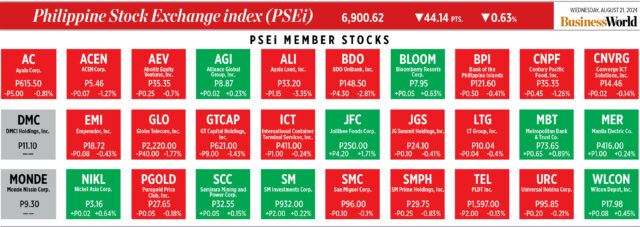
How PSEi member stocks performed — August 21, 2024

Here’s a quick glance at how PSEi stocks fared on Wednesday, August 21, 2024.


Hog farmers press for affordable ASF vaccines

REUTERS

HOG FARMERS are calling for the African Swine Fever (ASF) vaccine to be affordably priced to minimize the impact on their cost of production.

“That’s what we’re asking the Department of Agriculture (DA). In case there is an approved vaccine, we hope the price is not too high,” National Federation of Hog Farmers, Inc. Chairman Chester Warren Y. Tan told reporters on Wednesday.

The DA will conduct a limited rollout of the ASF vaccine procured from Vietnam this quarter, mainly focusing on red zones, or areas with active infections, and pink zones, or those near active areas. A commercial rollout will follow, with official pricing yet to be announced.

It had also procured 10,000 doses of the vaccine for emergency inoculation of hogs after an outbreak in Batangas.

“We hope it will be affordable because it would not only be used by commercial farms but the medium scale, small scale, and even the backyard farmers,” Mr. Tan added.

He said the vaccine should be priced between P20 and P100, which are the vaccine costs hog farmers are accustomed to paying.

“Right now, we don’t have anything yet on how much the net price of this vaccine will be,” he added.

Mr. Tan said a vaccine of P400 per dose will have a major impact on growers’ costs.

“This will not be helpful to the consumer as well. As we have said, if the vaccine is cheaper at least the cost saved by producers will go to the consumers,” he added.

Last year, the Bureau of Animal Industry (BAI) said that the ASF vaccine could be priced at P400 to P600 per dose.

The DA has allocated P350 million for the trial, sufficient to fund about 600,000 vials.

As of Aug. 8, 62 municipalities across 22 provinces had active ASF cases, according to the BAI. — Adrian H. Halili

Sugar millers see higher yields after delay to milling operations

FACEBOOK.COM/VICTORIASMILLINGCOMPANY

THE Philippine Sugar Millers Association (PSMA) said that a delay in the sugar milling season could allow the cane to mature further, possibly raising yields.

“While the association does not have the authority to change the start date (of milling), it will encourage mills to consider the delay,” the PSMA said in a statement.

The Sugar Regulatory Administration (SRA) has ordered the two-week delay to offset the impact of El Niño on the cane crop, saying it was acting at the request of planters and millers.

Last year, the SRA said that the milling season for the 2024-2025 crop year would start on Sept. 15.

“PSMA acknowledges the potential benefits of delaying milling to allow for better cane maturity and possibly higher yields, particularly in light of El Niño,” it added.

SRA Administrator Pablo Luis S. Azcona has said that the peak of the cane harvest could be delayed after El Niño damage forced farmers to replant damaged crops.

The PSMA added that the domestic allocation of sugar for the upcoming season may be justified due to the impact of El Niño.

During the second quarter, cane production dropped 42.3% year on year to 1.63 million metric tons (MT), according to the Philippine Statistics Authority, making sugar the crop most affected by El Niño during the period.

“The full impact of this weather event on the next crop season is still being evaluated by the SRA, as it reviews its pre-milling estimates for Crop Year 2024-2025,” it added.

PAGASA (Philippine Atmospheric, Geophysical and Astronomical Services Administration), the government weather service, declared the end of El Niño in early June, but dry conditions are expected to persist.

“If it is later determined that the crop yield is better than initially projected, PSMA will coordinate efforts to implement programs aimed at accessing the available US market,” it said.

The Philippines is set to export 25,300 MT of raw sugar to the US to fill its quota after three years of staying out of that market to divert more sugar to domestic use.

For the 2024-2025 season, the Office of the US Trade Representative gave the Philippines a quota of 145,235 MT in raw value equivalent. — Adrian H. Halili

PHL pork, beef imports expected to rise in 2025

REUTERS

THE US Department of Agriculture (USDA) said Philippine pork and beef imports are likely to increase in 2025 in line with population growth and its attendant impact on consumption.

In a report, the USDA said that strong economic growth, moderating inflation, and forecast population increases support the case for higher meat imports in 2025.

It reported that pork imports may increase 6% to 510,000 metric tons (MT), with domestic supply continuing to be impacted by African Swine Fever (ASF) even with vaccination efforts starting to roll out.

“While ASF remains present in the Philippines, the animal disease situation should improve in 2025,” the USDA said.

The USDA is estimating Philippine pork production next year of 1.06 million MT (MMT), up 2%.

“While ASF cases decreased from January 2024 to March 2024, cases have spread recently (August 2024) and this will limit the forecast growth in pork production in 2025,” it added.

The USDA said the cost of animal feed next year would likely decline as corn supply normalizes, raising hog growers’ profits.

Pork consumption is forecast to rise 1.9% to 1.58 MMT from 2024 levels.

Additionally, the USDA reported that beef and carabeef imports are expected to rise 3% to 226,000 MT in 2025.

“Population growth and a positive economic outlook buoyed by falling international prices, especially for the Philippines’ main beef suppliers, will push beef imports higher in 2025,” it added.

The USDA said that production would be little changed to 184,000 MT in 2025 due to limited land suitable for raising cattle and high feed prices.

It added that improved cattle genetics and live animal imports have driven the livestock sector to maintain the pace of beef and carabeef production, “but is not resulting in a meaningful increase in herd numbers or overall meat production.”

Beef and carabeef consumption is expected to grow 1.7% to 184,000 MT next year. — Adrian H. Halili

DoT says VAT refund scheme will boost PHL as shopping destination

PHILSTAR FILE PHOTO

A VALUE-ADDED TAX (VAT) refund scheme for tourists will help the Philippines hit its visitor arrivals goal and establish the country as a shopping destination, Department of Tourism (DoT) Secretary Ma. Esperanza Christina G. Frasco said.

On the sidelines of the Metro Manila Business Conference on Wednesday, Ms. Frasco told reporters that the department has supported the measure since the beginning.

“We are glad that this has passed through the lens of the House of Representatives. My understanding is that it is now pending in committee at the Senate. We look forward to its passage into law because the Philippines has much to offer in terms of shopping tourism,” Ms. Frasco said.

“Retailers… are able to offer very competitive pricing as well as quality products. And so we’re looking forward to the passage of the VAT refund scheme to be able to increase our tourism in the Philippines as a very attractive destination for shopping tourism,” she added.

The Philippine Retailers Association has expressed support for the incentives for foreign shoppers proposed in Senate Bill No. 2415, currently pending in the Senate.

The bill aims to provide non-resident tourists with VAT refunds for purchases worth at least P3,000 to encourage more visitor spending.

A counterpart bill to the Senate measure was approved by the House on March 6, 2023.

According to Ms. Frasco, the Philippines has received over 3.8 million international arrivals as of Aug. 21, equivalent to 47.8% of the department’s target for this year.

“We recognize that there are headwinds that continue to pose challenges in terms of arrivals, especially when it comes to our visa policies, and so we are grateful to our President for prioritizing the implementation of the electronic visa system, which we hope to see very soon,” she said.

The target “is achievable, although we are very pragmatic in terms of dealing with the present challenges as far as accessibility and other factors are concerned,” she added.

Ms. Frasco said plans are underway to improve the visitor experience for recreational divers with the Philippines being recognized as a top dive destination.

“We have since increased the number of dive destinations to 120 sites, meaning that there are many opportunities to dive across our islands,” she said.

“It is important to prioritize diver safety; that is why we are going to add five more hyperbaric chambers in addition to the 15 operational chambers in the country,” she added.

The new hyperbaric chambers will be put in place in Cebu, Puerto Galera, Boracay, Palawan, and Negros Oriental.

“As for our target markets, diving is very popular among our South Korean and European tourists. And so the effort really is to expand to these markets as well as to open up new markets,” she said.

BUDGET INCREASE
At a budget hearing on Tuesday, several legislators expressed support for increasing the budget of the DoT from the P3.39 billion it was allocated in the National Expenditure Program (NEP) 2025.

“We are also most grateful for their call to increase the budget of tourism, especially recognizing that it contributes 8.6% to our gross domestic product and employs 6.21 million Filipinos. So, we are hoping and praying for the increase of the DoT budget through our legislators,” Ms. Frasco said.

The DoT had originally proposed a budget of P13.4 billion for 2025, much larger than what the Department of Budget and Management approved for the NEP.

Additional funds will go toward enhancing a broad range of destinations, Ms. Frasco said, with a focus on infrastructure like rest areas and first aid facilities for visitors. — Justine Irish D. Tabile

GOCC transfers seen supporting P203B worth of priority projects

PHILSTAR FILE PHOTO/PHILHEALTH

ELEVEN priority programs that will require P203.1 billion to implement are expected to be supported by “excess funds” taken from government-owned and -controlled corporations (GOCCs), including the Philippine Health Insurance Corp. (PhilHealth), the Department of Budget and Management (DBM) said.

“We’re just following what’s in the General Appropriations Act (GAA). We’re following what’s in the law,” Budget Secretary Amenah F. Pangandaman said at a briefing on Wednesday.

The 2024 GAA includes a special provision which allows the government to tap reserve funds from GOCCs to finance budget items whose sources of funding have yet to be identified — the so-called “unprogrammed appropriations.”

Some P51.7 billion will make up the government’s share in financing foreign-assisted projects, P40 billion will be applied to civil-servant salary increase, P27.6 billion to personnel benefits, and P26.6 billion to various projects of the Department of Public Works and Highways.

The DBM also noted that revised Armed Forces of the Philippines Modernization Program (P10 billion), the National Task Force to End Local Communist Armed Conflict’s Barangay Development Program (P6.5 billion), and the maintenance, repair, and rehabilitation of infrastructure facilities (P6 billion) will also receive funds which are as yet unprogrammed.

The government expects to fund such items through the GOCC transfers, new taxes, loans, and stronger-than-expected tax collections.

Other unprogrammed appropriations include P3.6 billion for the National Economic and Development Authority and the Philippine Statistics Authority’s Community-Based Monitoring System, P3 billion for right-of-way payments, and P415 million for the Fiscal Support Arrears of the Comprehensive Automotive Resurgence Strategy Program.

The funds remitted by PhilHealth in May will go towards P27.7 billion in emergency benefits and allowances of healthcare and non-healthcare workers.

Citing authorization from the GAA, the Department of Finance  issued a circular ordering PhilHealth to transfer P89.9 billion in “idle funds” to the Treasury. 

Following the May transfer, P10 billion was expected by Wednesday, Aug. 21. The third and fourth tranches will consist of P30 billion and P29.9 billion in October and November, respectively.

Finance Secretary Ralph G. Recto has said that PhilHealth would still have over P500 billion after the transfers to support its operations.

On Tuesday, he said the government should mobilize idle funds to support priority measures due to limited fiscal space.

Healthcare workers have expressed opposition to the PhilHealth transfer, saying that the insurer’s funds must solely be used to improve healthcare benefits.

The Supreme Court has yet to receive the response of the government to a petition seeking to block the PhilHealth fund transfers. — Beatriz Marie D. Cruz

PHL urged to explore tech tie-ups in southern China

REUTERS

THE Board of Investments (BoI) said the Philippines should explore possible collaboration in technology and innovation with companies in Hong Kong, Macau, and Guangdong Province.

At the Manila Forum for Philippines-China Relations, BoI Executive Director for Investment Promotions Services Evariste M. Cagatan said that the high-tech industrial capabilities of Hong Kong, Macau, and the Guangdong Greater Bay Area (GBA) present an opportunity for synergy.

“I think we can find complementarities and synergies in the areas of technology and innovation,” Ms. Cagatan said during a panel discussion on Wednesday.

The GBA refers to a cluster of cities in and around the Pearl River Delta being positioned by China for greater economic integration. The Chinese cities taking part in this process are Guangzhou, Shenzhen, Zhuhai, Foshan, Dongguan, Zhongshan, Jiangmen, Huizhou, and Zhaoqing.

“GBA is a global hub for technological development and is perfectly aligned to the Philippines’ expanding information technology and business process management sectors, representing huge growth opportunities,” she added.

She also said that Hong Kong, as a global financial hub, offers significant opportunities for partnerships for Philippine banks.

In advanced manufacturing, she said that the Philippines could partner with Guangdong Province, a leading center for global manufacturing during the outsourcing era.

“By integrating our capabilities in electronics and semiconductors with Guangdong’s high-tech industry, we will foster innovation and enhance productivity,” she said.

She said that GBA is also known for its strengths in logistics and supply chain management.

Other opportunities for collaboration are also present in construction, engineering, and healthcare, Ms. Cagatan said.

According to Jeffrey Ng, vice-president of the Federation of Filipino Chinese Chambers of Commerce and Industry, Inc., the Philippines could also be a market for China’s electric vehicles (EVs).

“With the advent of US and European closures, bans, or impositions of high tariffs on Chinese EVs, I think the Philippines can benefit a lot from importing very inexpensive but high-quality EVs,” Mr. Ng said.

“The GBA can do a lot to spur the development of the Philippines in the years to come,” he added. — Justine Irish D. Tabile

MSMEs urged to raise their game by digitizing, expanding market reach

REUTERS

THE competitiveness of micro, small and medium enterprises (MSMEs) will depend on the pace of their digital transformation and expansion of market access, business groups said on Wednesday.

At the Metro Manila Business Conference, Philippine Exporters Confederation, Inc. President Sergio R. Ortiz-Luis, Jr. said that businesses should be empowered by technology to pursue a path of sustainable economic development.

“Today, more than ever, science and technology play a crucial role in driving business innovation, enhancing productivity, and enabling companies to scale new heights,” Mr. Ortiz-Luis said.

“By harnessing the power of technology, businesses can not only improve their operations but also create new products, services, and markets that address the evolving needs of consumers and communities,” he added.

According to the US Agency for International Development (USAID), e-commerce sales in the Philippines are projected to approach P1 trillion by 2026.

“These numbers underscore the sector’s immense potential to drive innovation and fuel robust growth in the Philippines,” USAID Office of Economic Development and Governance Director Amy Lovejoy said.

She said the results of USAID’s Strengthening Private Enterprises for the Digital Economy project indicate that MSMEs can generate 20% more revenue when they digitize payment platforms and broaden their reach.

In terms of access, Mr. Ortiz-Luis said expanding market access will allow MSMEs to benefit from global opportunities.

“Let us all remember that MSMEs are the backbone of our economy, meaning their successes are crucial to achieving inclusive growth,” he said. 

“Hence, it is imperative that we equip our MSMEs with the tools, skills, and resources they need to thrive,” he added.

Philippine Chamber of Commerce and Industry President Enunina V. Mangio cited the need for the trade system to evolve and meet demands for sustainability.

“We must streamline trade policies that will not only enhance our economic competitiveness but, most importantly, promote fair and equitable growth,” Ms. Mangio said.

“This means that we have to support our MSMEs, ensure that they have access to global markets, and foster an environment where our businesses can thrive while also respecting the principles of social responsibility and environmental stewardship,” she added. — Justine Irish D. Tabile