Home Blog Page 2253

IMF postpones scheduled consultations with Russia, says TASS, citing Russian director

THE International Monetary Fund (IMF) logo is seen outside the headquarters building in Washington, U.S. — REUTERS

The International Monetary Fund has postponed its planned consultation mission with Russia indefinitely because of technical issues, TASS agency cited Alexei Mozhin, Russia’s director at the IMF, as saying on Wednesday.

“The Fund’s management notified the Russian side and the board of directors that the mission’s work would be postponed indefinitely,” Mr. Mozhin said.

“Technical unpreparedness of the mission to conduct consultations was mentioned as the reason for postponing the mission.”

The IMF did not immediately respond to a request for comment.

Ukraine and its Western allies had objected to the mission to Russia on grounds that it would show relations with Russia to have been normalized despite the invasion and occupation of vast tracts of Ukrainian territory.

The IMF’s decision was communicated on Monday, the day the mission had intended to begin online consultations. These were to have been followed by an IMF delegation visit to Moscow for meetings with Russian officials.

It would have meant the IMF becoming the first major international financial body to send its official mission to Russia since the February 2022 invasion of Ukraine.

Mr. Mozhin said the Russian side was “well aware” that many European countries “had spoken out about the unacceptability of the resumption of cooperation between the IMF and Russia and the unacceptability of conducting such consultations”.

Preparations for conducting the consultations at issue had taken place more than a year ago and Russia, while never requesting a mission, was prepared to receive one as part of its obligations under IMF rules, Mr. Mozhin said.

The Russian side hereby again confirms its preparedness,” he added.

The IMF’s last annual mission visited Russia in November 2019, before the start of the COVID pandemic. There have been no IMF missions to Russia since the start of Russia’s war in Ukraine. – Reuters


FBI probing threatening letters sent to election officials in six states

A VIEW shows the seal of the Federal Bureau of Investigation (FBI) outside of the FBI’s Cincinnati Field Office in Cincinnati, Ohio, US, Aug. 11, 2022. — REUTERS

 – The FBI and the U.S. Postal Inspection Service are investigating suspicious packages that were sent to election officials in six states on Monday, the law enforcement agency said in a statement on Tuesday.

Officials in Nebraska, Iowa, Kansas, Tennessee, Wyoming and Oklahoma were targeted.

The FBI said some of the letters contained an unknown substance that was being examined. The sender of the letters identified themselves as the “US Traitor Elimination Army,” Colorado Secretary of State Jena Griswold said in a post on X.

The threats to election officials come just weeks before Americans go to the polls on Nov. 5 to choose between Democratic presidential candidate Kamala Harris and her Republican rival Donald Trump. The country is deeply polarized and on edge amid an increase in political violence and two assassination attempts against Trump.

The FBI said it was working to identify those responsible as well as a motive. It was also working to determine how many letters had been sent in total.

Nebraska Secretary of State Robert Evnen’s office said its elections division had received a “suspicious” envelope with a substance inside. It said the substance had been tested and found to be non-hazardous.

The threats follow similar letters sent to election officials in several states in November. – Reuters

FILRT wins gold for sustainability at 2024 Stevie International Business Awards®

Filinvest REIT Corp. (FILRT) wins anew at the 2024 Stevie International Business Awards®, reaffirming its position as a sustainable REIT. FILRT earned a Gold Stevie® Award in the Sustainability Product of the Year – Asia, Australia, & New Zealand category.

This accolade follows FILRT’s previous achievement in 2023, when it earned a bronze title for Sustainability Leadership in Asia, Australia, and New Zealand at the Stevie International Business Awards (IBA). This consecutive recognition reinforces FILRT’s role as a trailblazer in sustainable office spaces and continues to highlight the Philippines on the global stage.

The International Business Awards (IBAs) are globally renowned for honoring excellence across various industries. This year’s competition attracted over 3,600 nominations from organizations spanning 62 nations and territories, competing in categories such as Company of the Year, Marketing Campaign of the Year, Best New Product or Service of the Year, Startup of the Year, Corporate Social Responsibility Program of the Year, and Executive of the Year, among others.

“We’ve long considered The International Business Awards to be the ‘Olympics for the workplace,’ and this year’s competition is the best-ever proof of that,” said Stevie Awards President Maggie Miller. “The winners have demonstrated that their organizations have set and achieved lofty goals.”

FILRT’s Gold Stevie® Award recognizes its sustainable office spaces, which integrate cutting-edge green technologies and practices. Judges commended FILRT for setting a new benchmark in the real estate sector, applauding its outstanding green initiatives and strong commitment to reducing environmental impact.

“We are always grateful and honored to be recognized. At FILRT, commitment to sustainability is at our core. We are committed to continuing our efforts to create more environmentally responsible and forward-thinking real estate solutions,” said FILRT President and CEO Maricel Brion-Lirio.

This award caps FILRT’s long list of sustainability initiatives. FILRT earned Excellence in Design for Greater Efficiencies (EDGE) certifications for seven of its office buildings and another five due at the end of this year, qualifying FILRT as an EDGE Champion. Earlier this year, FILRT also achieved 94% coverage of its office portfolio that is powered entirely by renewable energy. These milestones contributed to FILRT securing a gold award in its category at this year’s Stevie International Business Awards (IBA).

This recognition underscores FILRT’s progress and strong dedication to continuous improvement. FILRT strengthens its position as a leader in leasing out environmentally responsible and innovative commercial spaces by actively advancing the boundaries of sustainability in real estate that sets new industry standards.

For more information about Filinvest REIT Corp.’s sustainable office spaces and initiatives, please visit www.filinvestreit.com or email info@filinvestreit.com.


Spotlight is BusinessWorld’s sponsored section that allows advertisers to amplify their brand and connect with BusinessWorld’s audience by publishing their stories on the BusinessWorld Web site. For more information, send an email to online@bworldonline.com.

Join us on Viber at https://bit.ly/3hv6bLA to get more updates and subscribe to BusinessWorld’s titles and get exclusive content through www.bworld-x.com.

US decision on Nippon bid for US Steel pushed back until after election

Source: https://www.ussteel.com/media/video-image-library

The U.S. national security panel reviewing Nippon Steel’s $14.9 billion bid for U.S. Steel will let the companies refile their application for approval of the deal, a person familiar with the matter said, delaying a decision on the politically sensitive merger until after the presidential election.

The move offers a ray of hope for the companies, whose proposed deal appeared set to be blocked when the Committee on Foreign Investment in the United States (CFIUS) alleged on Aug. 31 the transaction posed a risk to national security by threatening the steel supply chain for critical U.S. industries.

CFIUS needs more time to understand the deal’s impact on national security and engage with the parties, the person said on Tuesday. Refiling sets a new 90-day clock to review the proposed tie-up and make a decision.

Nippon Steel declined to comment. CFIUS and U.S. Steel did not immediately respond to requests for comment from Reuters.

“Extending the timeline takes some pressure off the parties and, importantly, pushes the decision past the election in November,” said Nick Klein, a CFIUS lawyer with DLA Piper.

The deal has become a political hot potato. This month, Vice President and Democratic presidential candidate Kamala Harris said at a rally in Pennsylvania, the swing state where U.S. Steel is headquartered, that she wants U.S. Steel to remain “American owned and operated.”

The White House said on Tuesday that President Joe Biden and Harris continued to believe that U.S. Steel should remained domestically owned and operated.

Ms. Harris’ Republican rival Donald Trump has pledged to block the deal if elected. Both candidates have sought to woo union votes.

The United Steelworkers Union, which vehemently opposes the deal, said on Tuesday “nothing has changed regarding the risks that Nippon’s acquisition would pose to national security or the critical supply chain concerns that have already been identified.”

CFIUS is concerned Nippon Steel’s merger could hurt the supply of steel needed for critical transportation, construction and agriculture projects, it said in its August letter to the companies, exclusively obtained by Reuters.

It also cited a global glut of cheap Chinese steel, and said that under Nippon, a Japanese company, U.S. Steel would be less likely to seek tariffs on foreign steel importers. It added that decisions by Nippon could “lead to a reduction in domestic steel production capacity.”

In a 100-page response letter to CFIUS, Nippon Steel said it will invest billions of dollars to maintain and boost U.S. Steel facilities that otherwise would have been idled, “indisputably” allowing it to “maintain and potentially increase domestic steelmaking capacity in the United States.”

The company also reaffirmed a promise not to transfer any U.S. Steel production capacity or jobs outside the U.S. and would not interfere in any of U.S. Steel’s decisions on trade matters, including decisions to pursue trade measures under U.S. law against unfair trade practices.

The deal, Nippon added, would “create a stronger global competitor to China grounded in the close relationship between U.S. and Japan.”

The expected demise of the deal in late August prompted an outpouring of support, including a letter from business groups such as the U.S. Chamber of Commerce, raising concerns the transaction was being influenced by political pressure. – Reuters

Biden calls on Sudan’s warring parties to re-engage in negotiations

US PRESIDENT JOE BIDEN/FACEBOOK

 – US President Joe Biden on Tuesday called on Sudan’s warring parties to re-engage in negotiations to end a war that has been ongoing for more than 17 months.

“We call for all parties to this conflict to end this violence and refrain from fueling it, for the future of Sudan and for all of the Sudanese people,” Mr. Biden said in a statement.

“I call on the belligerents responsible for Sudanese suffering—the Sudanese Armed Forces (SAF) and the Rapid Support Forces (RSF)—to pull back their forces, facilitate unhindered humanitarian access, and re-engage in negotiations to end this war.”

More than 12,000 people have been killed across Sudan since the war started on April 15, 2023.

The conflict began when competition between Sudan’s army and the paramilitary Rapid Support Forces (RSF), which had previously shared power after staging a coup, flared into open warfare.

Mr. Biden said the RSF’s assault is disproportionately harming Sudanese civilians and called on the armed forces to stop “indiscriminate” bombings that are destroying civilian lives and infrastructure.

The U.S. previously determined that the two sides committed war crimes and sanctioned 16 individuals and entities tied to the war.

Mr. Biden said the United States will continue to evaluate further atrocity allegations and potential additional sanctions. – Reuters

EV tariffs will damage Germany, China, says Chinese commerce minister

ANDREW ROBERTS-UNSPLASH

 – China’s commerce minister said the European Union’s imposition of tariffs on electric vehicles (EV) will “seriously interfere” with trade and investment cooperation and hurt both China and Germany.

In talks on Tuesday with German Vice Chancellor and Economic Minister Robert Habeck, Wang Wentao said he hoped to reach a solution in line with World Trade Organization rules as soon as possible, and avoid the escalation of China-EU economic and trade frictions, according to a statement released by China’s Ministry of Commerce early on Wednesday.

The European Commission is on the verge of proposing final tariffs of up to 35.3% on EVs built in China, on top of the EU’s standard 10% car import duty.

Mr. Wang is visiting Europe for talks on the EU’s anti-subsidy case against Chinese-made EVs ahead of a vote on more tariffs.

Mr. Wang said it is hoped that Germany will proceed from its own interests and push the European Commission and China to work in the same direction.

Mr. Habeck said that Germany supports free trade, welcomes Chinese auto and parts companies to invest in Europe, and will urge the European Commission to find an appropriate solution with China and make every effort to avoid trade conflicts, according to the ministry statement.

Mr. Wang also met with Wolfgang Schmidt of the German Chancellery in Berlin, according a separate statement issued by China’s commerce ministry on Wednesday, where he told Schmidt China has insisted on properly resolving the anti-subsidy case against the country through dialogue and consultation.

China was deeply disappointed after the EU ignored China’s efforts, insisted on ruling for high countervailing duty rates, and hastily rejected the package solution proposed by the Chinese industry, Wang said in the talks.

Mr. Wang said China would not give up its efforts and will persist in holding consultations “until the last moment.”

“It is hoped that Germany, as a core member of the EU, will take the lead in playing an active role and urge the European Commission to show political will and work together with China to properly resolve the case,” Mr. Wang said, according to a second statement on the talks from the commerce ministry also released on Wednesday. – Reuters


Vehicle sales up by 6.6% in August

CAR ENTHUSIASTS attend the Manila International Auto Show in Pasay City, April 4, 2024. — PHILIPPINE STAR/RYAN BALDEMOR

By Justine Irish D. Tabile, Reporter

PHILIPPINE automotive sales grew by an annual 6.6% in August, despite a decline in passenger car sales, according to an industry report.

A joint report by the Chamber of Automotive Manufacturers of the Philippines, Inc. (CAMPI) and the Truck Manufacturers Association (TMA) showed vehicle sales rose to 39,155 units in August from 36,714 units in the same month last year.

Month on month, car sales inched down by 0.4% from the 39,331 units sold in July.

Auto Sales (August 2024)August sales were dampened by the 5.6% drop in passenger car sales to 9,529 units from 10,094 units sold a year ago.

Month on month, passenger car sales slumped by 12.76% from 10,923 units in July.

However, this was offset by the 11.3% annual jump in commercial vehicle sales to 29,626 units in August from 26,620 a year ago. Commercial vehicles accounted for 75.66% of the industry’s total sales.

Month on month, sales of commercial vehicles increased by 4.3%.

Broken down, light commercial vehicle sales went up by 3.3% year on year to 21,812 units, while sales of Asian utility vehicles (AUV) surged by 53.5% to 6,829 units.

Sales of medium trucks slid by 4.9% to 312, while sales of heavy trucks fell by 64.8% to 45. Light-duty truck and bus sales went up by 5.2% to 628 units.

For the first eight months, vehicle sales went up by 10.3% to 304,765 units from 276,215 units a year ago, CAMPI-TMA data showed.

Passenger car sales jumped by 14% to 80,327 units in the January-to-August period, while commercial vehicle sales increased by 9.1% to 224,438 units.

Rizal Commercial Banking Corp. Chief Economist Michael L. Ricafort said new vehicle launches and improving employment data are driving the growth of car sales in recent months.

“Newer models, more brands, more electric and hybrid vehicles [launches], favorable demographics, and improving employment data in recent months are still driving the demand for vehicles,” Mr. Ricafort said in a Viber message.

“[This was] reflected in the double-digit growth in consumer loans, particularly auto loans, defying relatively higher interest rates,” he added.

A preliminary report from the Bangko Sentral ng Pilipinas showed that consumer loans to residents grew by 24.3% to P1.42 trillion as of end-July, with motor vehicle loans going up by 19.9% to P424.93 billion.

“For the coming months, lower Federal Reserve and local policy rates could increase demand for auto loans and also vehicle purchases,” Mr. Ricafort said.

In August, the Bangko Sentral ng Pilipinas (BSP) cut policy rates for the first time in nearly four years. The benchmark rate was trimmed by 25 basis points to 6.25%, from the nearly 17-year high of 6.5%.

Toby Allan C. Arce, head of sales trading at Globalinks Securities and Stocks, Inc., said the auto industry’s sales were driven by commercial vehicles.

“These vehicles cater more to businesses, logistics, and transport needs, reflecting a shift towards utility and functionality, possibly in response to increased demand for delivery services, logistics support, or business expansions in the post-pandemic era,” said Mr. Arce via Viber.

“The passenger car segment saw a notable drop in August. However, the continued strong performance in the commercial sector more than offset this decline, suggesting that businesses, rather than individuals, are leading the market’s recovery,” he added.

In the first eight months, Toyota Motor Philippines Corp. remained the market leader with sales of 140,654 units, up by 10.9% from 126,795 units a year ago. Toyota sales accounted for 46.15% of the industry’s total.

Mitsubishi Motors Philippines Corp. ranked second with a market share of 19.2%. Mitsubishi sales jumped by 16% to 58,513 units in the first eight months.

In third spot was Ford Motor Co. Phils., Inc. which saw sales drop by 3.8% to 18,961 units. This accounted for 6.22% of the industry.

Rounding out the top five were Nissan Philippines, Inc., whose sales went up by 2.2% to 18,270, while Suzuki Phils., Inc. posted an 11.7% rise in sales to 13,206 units.

Last month, CAMPI raised its sales target to 500,000, from 468,300 initially. If realized, this will be the industry’s highest annual sales to date and will represent a 16.3% increase from last year’s 429,807 units sold.


Philippine credit rating upgrade possible if GDP grows faster than expected

Consumer spending is expected to accelerate ahead of the holiday season. Christmas decorations are now up at a shopping mall in Antipolo, Rizal, Sept. 16, 2024. — PHILIPPINE STAR/MIGUEL DE GUZMAN

By Luisa Maria Jacinta C. Jocson, Reporter

THE PHILIPPINES’ credit rating may be upgraded if the economy grows faster than expected, S&P Global Ratings said.

“On the upside for us, the Philippines’ ratings could be raised if the economic recovery is even faster than what we currently project and if the government achieves even faster fiscal consolidation,” YeeFarn Phua, director at S&P Global Ratings, said in a webinar on Tuesday.

The Philippines currently holds a “BBB+” rating with a “stable” outlook from the debt watcher.

“The outlook on the sovereign ratings remains stable. Basically, this stable outlook reflects our expectation that the economy will continue to grow healthily,” Mr. Phua said.

The credit rater expects Philippine gross domestic product (GDP) growth to average 5.8% this year and 6.1% in 2025. These are both below the government’s 6-7% and 6.5-7.5% growth targets for this year and next, respectively.

In the second quarter of the year, Philippine GDP grew by 6.3%, the fastest since 6.4% in the first quarter of 2023. This brought the first semester growth to 6%.

Mr. Phua said the outlook is also “balanced by the fact that we believe fiscal performance will also improve over the next 24 months.”

The National Government’s (NG) budget deficit widened by 7.2% to P642.8 billion in the January-to-July period, latest data from the Treasury showed.

Mr. Phua also flagged potential risks, such as an economic slowdown, that could hinder a credit upgrade for the Philippines.

“On the downside, however, we believe that if economic recovery were to weaken, leading to the long-term growth rates below its peers, this will also lead to an associated weakening of the government’s fiscal and debt positions,” he said.

He also noted risks to external settings, such as the current account deficit.

“If we see that the (current account deficit) starts to get persistently large, this will actually lead to a structural weakening of the Philippines’ external balance sheet. And we believe this could exert downward pressure on the ratings.”

In the second quarter, the current account deficit reached $5.1 billion, which accounts for 4.6% of GDP. The BSP projects a $4.7-billion current account deficit for 2024, equivalent to 1% of GDP.

Meanwhile, Mr. Phua noted that S&P Global’s lower-than-expected growth forecasts for the Philippines are due to still-elevated interest rates.

“So far, the BSP has only cut once. Therefore, our expectation is that we expect the cutting phase to be done gradually over the next year or so. And therefore, monetary policy will still remain tighter than normal for a while more,” he said.

Last month, the Monetary Board delivered a 25-basis-point (bp) rate cut and brought the key rate to 6.25% from the over 17-year high of 6.5%. This was the first time the central bank cut rates since November 2020.

Prior to this, the central bank raised borrowing costs by a cumulative 450 bps from May 2022 to October 2023 to tame inflation.

“At the same time, we are also seeing the consumption and investments are also showing slowing momentum than usual,” Mr. Phua said.

“We believe this could last for some more time, given as the central bank moves tend to be a bit more long and variable lags before they can start to impact the real economy.”

BSP may cut RRR this year — Metrobank

BW FILE PHOTO

THE BANGKO SENTRAL ng Pilipinas (BSP) could reduce local banks’ reserve requirement ratio (RRR) to as low as 7% this year, Metropolitan Bank & Trust Co. (Metrobank) said.

“While we expect the central bank to continue cutting rates in the coming months, we believe BSP Governor Eli M. Remolona, Jr. is also planning to reduce banks’ reserve requirements, as he previously hinted,” Metrobank Chief Economist Nicholas Antonio T. Mapa said in a commentary.

“We think (Mr.) Remolona might lower (RRR) by 250 basis points (bps) or 2.5 percentage points before the end of the year, with the first reduction likely to happen soon.”

The RRR is the percentage of bank deposits and deposit substitute liabilities that banks cannot lend out and must set aside in deposits with the BSP.

In June last year, the BSP reduced the ratio for big banks and nonbank financial institutions with quasi-banking functions by 250 bps to 9.5%.

The central bank has brought down the RRR for universal and commercial banks to a single-digit level from a high of 20% in 2018.

“Since RR changes are not considered policy moves, we believe the upcoming RR reduction could happen on any Thursday (when the Monetary Board meets weekly),” Mr. Mapa said.

The BSP chief earlier said they are seeking to bring down the banks’ RRR to as low as 5%, but added the timing is yet to be decided.

“Adjustments to the RR were once considered a policy adjustment. However, with the advent of the BSP’s interest rate corridor system and its accompanying liquidity management facilities, any RR reduction has been relegated to a simple operational adjustment,” Mr. Mapa said.

The start of RRR cuts “may not necessarily be announced during the regular policy cycle,” he added.

“With the BSP in easing mode, we expect RR reductions to be announced shortly after the Fed policy meeting or perhaps after the Philippines’ September inflation data is released, which could show inflation drop to around 2.3%.”

The Federal Open Market Committee (FOMC) is having its meeting from Sept. 17-18.

Philippine headline inflation eased to 3.3% in August from a nine-month high of 4.4% in July, latest data from the local statistics authority showed.

The BSP earlier said it expects inflation to ease further from August onwards. It expects full-year inflation to settle at 3.4%.

“Now that the BSP is looking to bring down its borrowing costs from elevated levels to more normal and supportive levels, the time appears ripe for another round of RR reductions,” Mr. Mapa added.

Mr. Remolona earlier signaled the possibility of another 25-bp cut before the year ends.

The Monetary Board cut benchmark interest rates by 25 bps to 6.25% at its Aug. 15 meeting, the first rate reduction in nearly four years.

However, Mr. Mapa said that it is still uncertain if slashing the RRR while interest rates are still elevated would lead to higher bank lending.

“Banks that have more funds available for lending might choose to deposit this money back with the central bank, where they can earn attractive interest rates of about 6.25%.”

Metrobank expects the central bank to reduce the RRR by 150 bps first, followed by another 100-bp cut within the year.

“As such, should the BSP carry out a 150-bp RR reduction in the near term, banks may become attractive again in the near term. However, caution about its impact on bank lending and overall growth momentum is warranted.”

Data from the central bank showed that outstanding loans of universal and commercial banks rose by 10.4% year on year to P12.14 trillion. This was the fastest growth since 13.7% in December 2022. — Luisa Maria Jacinta C. Jocson

Filipino youth worry about climate change, education — survey

Students wade through floods along Taft Avenue in Manila, Aug. 31, 2023. — PHILIPPINE STAR/MIGUEL DE GUZMAN

AROUND 44% of young Filipinos expect future generations to be “worse off than today,” amid rising concern over climate change, education and lack of jobs, according to a survey by the United Nations Children’s Fund (UNICEF).

Results of the U-Report survey also showed 37% of Filipino youth think the next generations will be “better off than today” while 19% believe conditions will be the same.

“While youth are split on whether the future generation is “worse off” or “better off” (44% vs 37%) they do see the value that rapid technological innovations and democratic access to information can bring,” UNICEF said in a statement.

According to the survey, 26% of young Filipinos see climate change, including natural disasters, as the biggest problem they will face in the future.

Also, 23% of respondents are concerned they will not be able to finish their education, while 22% are worried about finding a job and about their health (both physical and mental).

The results of the survey were released ahead of the Summit of the Future 2024 in New York on Sept. 22-23.

“The U-Report findings reveal the sobering, yet hopeful outlook young people have about their prospects for the future,” UNICEF Representative to the Philippines Oyunsaikhan Dendevnorov was quoted in a statement.

“We should listen to what they have to say and work together to address these issues so that every child is cared for, protected, and given a fair chance in life,” she added.

The U-Report poll was conducted online from June 13 to July 14, 2024. Of the 3,109 respondents, 44% were aged 15-19 and 37% were aged 20-24.

Asked what the biggest obstacle will be to getting their dream job or starting a business in the future, 33% of respondents were worried about the lack of jobs for people without experience.

Another 26% were concerned about the economic situation, while 20% said access to a good education is hampering their prospects.

Asked what they will do if given a chance to be the Philippine president, respondents said they will prioritize education, health and the economy to build a better future. They also want to address corruption as well as issues related to agriculture, poverty, and the environment.

“New generations are bringing a reinvigorated sense of solidarity and a compelling call for collective action. Both are essential to build the future we want,” UN Philippines Resident Coordinator Gustavo González was quoted as saying.

The survey also showed the majority, or 69%, of respondents said the United Nations (UN) is “very important’ in creating a better future for them as well as for future generations.

“Every young person’s concern has always been to finish their studies and find a job good enough to support their families. This is a fundamental aspiration, as quality education has a real corresponding impact on the quality of jobs offered to the youth in the future,” Terry L. Ridon, a lawyer and former party-list lawmaker, said in a Viber message.

The Philippine government should address climate-related challenges, Mr. Ridon said. It must also bolster measures to boost job generation and expand access to quality education. — Beatriz Marie D. Cruz

Developers confident in PHL tourism with P250-B investment — report

JBDODANE-FLICKR

DEVELOPERS have committed about P250 billion to construct 158 accommodation projects, totaling 40,084 room keys, signifying strong confidence in the tourism sector, according to the 2024 Philippine Accommodation Pipeline Report.

“That 40,000 room keys equate to approximately P250-billion commitment over the following years,” Alfred Lay, director for hotels, tourism, and leisure at Leechiu Property Consultants, said during the launch of the 2024 Philippine Accommodation Pipeline Report on Tuesday. The study was conducted in partnership with the Philippine Hotel Owners Association, Inc. (PHOA).

The developers include Megaworld Corp., Double Dragon Properties Corp., SM Prime Holdings, Inc., the Hann Group in Clark, Ayala Corp., Cebu Landmasters, Inc., Filinvest Development Corp., AppleOne Properties, Inc., and Robinsons Land Corp.

“We released surveys to various brand operators, to developers, to design consultants, to the Department of Tourism (DoT), and local government units… to gather knowledge about upcoming hotels,” Mr. Lay said.

He said that once these keys are completed and operational, they will generate 57,000 direct jobs in the hotel industry.

“Luzon, as we would expect, maintains the largest pipeline that’s sitting at about 50% today, and that’s heavily driven by the economic hub being Manila,” he said, adding that this leads to 85 new accommodations and 20,116 room keys.

Visayas followed with 57 accommodations and 16, 830 room keys, accounting for 42% of the pipeline.

Meanwhile, Mindanao is expected to have 16 new accommodations and 3,138 room keys, or 8% of the total pipeline.

In terms of pipeline keys in the top 10 areas by opening years, Lapu-Lapu City led with 4, 786 keys in the pipeline across 10 projects, averaging 435 keys per accommodation.

Mr. Lay said Panglao Island, a top accommodation investment destination, came in second with 4,401 keys planned across 16 projects. This was followed by Boracay with 3, 625 keys in the pipeline.

“But it’s interesting to see that there are still quite a lot of keys coming into Boracay. Despite various infrastructure issues they may have, it still sits very much at the forefront of our development pipeline,” Mr. Lay said.

Cebu City (1,929 keys), New Clark City (1,550 keys), and Clark (2,098 keys) are also significant, with Clark’s growth attributed to its international airport and the increasing influx of Korean arrivals.

“In Clark, we’ll be driven by a lot of gaming-related keys. There are quite a lot of casino announcements lately and all of those have to be supported by a good number of room keys,” Mr. Lay said.

He also said that outside of Metro Manila, the real growth story sits in Panglao and Mactan Island due to being coastal destinations and served by international connectivity.

“This information becomes especially crucial as our hotel rules inventory is invariably compared to our competitors in the region and is often used as a gauge of our competitiveness,” PHOA President Arthur M. Lopez said.

From January to August 2024, the Philippines welcomed more than four million international visitors and generated visitor receipts amounting to approximately P362.58 billion, the Tourism department reported. — Aubrey Rose A. Inosante

Design appreciation: Hangeul reinterpreted in the modern era

BRONTË H. LACSAMANA

AT THE HEART of Taguig stands a curious exhibit that presents modern-day interpretations of a very old language system.

The Korean Cultural Center of the Philippines (KCC) has welcomed the National Hangeul Museum’s timeless tribute to Hangeul, the Korean language alphabet. By showcasing its design in various art forms, Hangeul’s adaptability in conveying ideas in modern times is highlighted, despite being created way back in 1443.

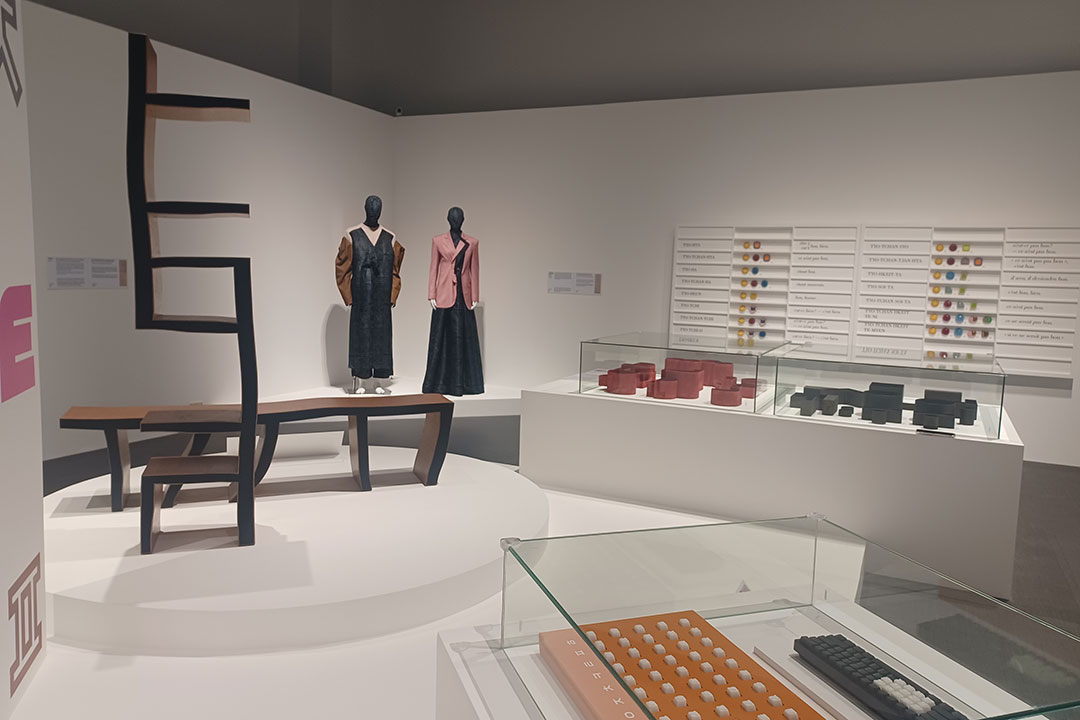
The items in the exhibit, Hangeul Design Project: Reinterpreting Hangeul in the Modern Era, are of different mediums, from traditional calligraphy displays to contemporary art, fashion, and furniture mimicking the alphabet’s style.

“Language is constantly changing, sometimes becoming something new, sometimes disappearing. It can be called an intangible cultural heritage,” National Hangeul Museum of Korea curator Kim Eun-jae said at the exhibit’s launch on Sept. 5.

Inside the hall on the 5th level of KCC, visitors are able to see how the language system can be integrated into other objects and art forms. The exhibit offers “an engaging and accessible perspective on the Korean alphabet,” according to Ms. Kim.

Designed by King Sejong of Joseon in the 15th century, Hangeul utilizes a simple form to convey the sound of each letter within the parameters of a square. Each letter differs in sound depending on their change in location.

Some of the objects in the exhibit are 3D-printed works, furniture, and hanbok (traditional clothing) following the figurative characteristics of Hangeul.

“Its main visual feature is its use within a square frame. Various combinations can be created within, which is why it is highly efficient when used in visual and digital media,” Ms. Kim said.

On the walls are Hangeul typography, some stylized and some placed in contrast with other languages. A notable display is the video projection of words from an old novel, animated to move as if being written onscreen.

Ms. Kim noted that, from eight basic letters, Hangeul is able to expand to 28 letters based on form and location within the square frame format. Further nuances can transform these consonant and vowel sounds to include hundreds more letters.

“King Sejong may have been a king, but I also want to express his mastery of design,” she said.

In addition to the exhibit, KCC will be organizing a series of performances and workshops to enhance the experience, including a calligraphy workshop series to begin in October. More details will be posted on KCC’s social media.

Hangeul Design Project: Reinterpreting Hangeul in the Modern Era runs until Feb. 28, 2025 at the Korean Cultural Center of the Philippines in Bayani Road, Taguig City. The exhibit is free and open to the public. — Brontë H. Lacsamana