Home Blog Page 2247

Phil Donahue, pioneer of the daytime talk show, 88

PHIL DONAHUE in the 2016 documentary The Eighties. — IMDB

PHIL DONAHUE, who changed the face of United States daytime television with a long-running syndicated talk show that highlighted topical and often provocative social and political issues, has died at age 88, NBC’s Today show reported on Monday, citing a statement from his family.

Mr. Donahue died surrounded by his family on Sunday following an illness, the Today show reported.

Debuting in 1970 when daytime television offered its mostly female viewers a diet of soap operas, game shows, and homemaking programs, Mr. Donahue’s show tackled subject matter once considered taboo for television — including abortion, the sexual revolution, and race relations.

With his boyish charm, irrepressible energy and thick white hair, Mr. Donahue was known for aggressively questioning his guests and bounding through the studio to give his audience a chance to be heard.

The success of his show paved the way for other daytime talk-show hosts, most notably Oprah Winfrey, whose program eventually eclipsed Mr. Donahue’s in the ratings.

“If it weren’t for Phil Donahue, there never would have been an Oprah show,” Ms. Winfrey has said.

Among the proliferation of daytime shows following in Mr. Donahue’s wake were a number that became known for sensationalism and occasional violence.

Such programs, hosted by personalities including Jerry Springer, Geraldo Rivera, Sally Jessy Raphael, and Maury Povich were his “illegitimate children,” Mr. Donahue told interviewers, adding he loved them all.

With the daytime talk field becoming increasingly crowded, loud, and rude, Mr. Donahue’s program slid in popularity, leading to its cancelation in 1996 after 26 years and thousands of shows on national television, the longest run for a syndicated US talk show.

HOUSEWIVES’ FORUM
At its height, Mr. Donahue’s show was acclaimed by People magazine in 1979 as “a national forum for America’s housewives.”

“I think they appreciate the issues the show raises and enjoy the challenge of getting emotionally and intellectually involved in what’s happening,” Mr. Donahue told People that year.

“There are no prizes and nobody screams, we put on an honest sharing of ideas,” he said of his show, which generally tackled one topic per hour-long episode.

Mr. Donahue, who often spoke of his Roman Catholic upbringing, was one of the first television personalities to forcefully address sexual abuse of children by clergy in the Catholic Church, bringing the topic to national attention.

He first dealt with the sex abuse scandal in a 1988 episode and revisited it in later seasons of his show, giving victims a chance to tell their stories.

His later projects included hosting a talk show from 2002 to 2003 on the cable network MSNBC and co-directing the 2006 documentary film Body of War that took a critical view of the US invasion of Iraq, focusing on an American soldier who was paralyzed in the war.

In addition to hot-topic issues, Mr. Donahue occasionally devoted time to lighter fare like misdiagnosed allergies and traded quips with celebrity guests from comedian Jerry Lewis to shock rocker Marilyn Manson. For an episode on cross-dressing, Mr. Donahue wore a skirt.

He won nine Daytime Emmys for best talk-show host.

Born on Dec. 21, 1935, in Cleveland and raised in that Ohio city, Mr. Donahue was the son of a furniture salesman and a department store clerk.

After graduating from the University of Notre Dame, he worked his way up in broadcasting until he was given the chance in 1967 to host his own program, The Phil Donahue Show, on a Dayton, Ohio, television station. He caused a stir with some viewers by inviting an atheist as his first guest.

The show gained national syndication in 1970. He moved the show to Chicago in 1974 and then to New York in 1984 to be closer to his second wife, actress Marlo Thomas, the daughter of actor-comedian Danny Thomas.

Mr. Donahue’s first marriage to Marge Cooney ended in divorce in 1975. They had four sons and a daughter. He married Ms. Thomas in 1980. — Reuters


CREC projects sixfold growth in RE capacity by 2025

SAAVEDRA-LED Citicore Renewable Energy Corp. (CREC) expects its gross installed capacity for renewable energy (RE) to grow up to six times as it aims to add 1,000 megawatts (MW) of capacity per year over the next five years.

“From a growth perspective, this year, we’ll end the year with gross installed capacity of 285 [MW]. Next year, we should grow by six times…so from 285 [MW], it will be almost 1,300 MW,” CREC President and Chief Executive Officer Oliver Tan said in an interview.

CREC currently has a combined gross installed capacity of 285 MW from its 10 solar power facilities in the Philippines.

The company is constructing eight projects worth approximately one gigawatt (GW), underway to achieve its goal of five GW of capacity by 2028.

In June, CREC listed its P5.3-billion initial public offering on the Philippine Stock Exchange, which included a $12.5-million investment from the United Kingdom’s MOBILIST program.

“The full impact of the power generation revenues will be felt next year since projects currently under construction will start to be energized by then. We will focus on adding solar capacity and looking at other opportunities that take us closer to our five-GW-in-five-years goal,” Mr. Tan said in a statement last week.

For 2024, the company has allocated P35 billion in capital expenditure for its renewable energy projects.

CREC, directly and through its subsidiaries and joint ventures, manages a diversified portfolio of renewable energy generation projects, power project development operations, and retail electricity supply services. — Sheldeen Joy Talavera

PHL, Cambodia central banks seek to enhance cooperation

THE BANGKO SENTRAL ng Pilipinas (BSP) and National Bank of Cambodia (NBC) have partnered to boost both countries’ cooperation on central banking and payment connectivity, among other areas.

Both regulators signed a memorandum of understanding (MoU) on Monday to “foster closer cooperation between the two central banks,” the BSP said in a statement on Tuesday.

“The MoU signifies the willingness and commitment of both the BSP and NBC to provide a clear framework for the facilitation of bilateral ties and the enhancement of cooperation between the two central banks which have had a history of collaboration in both bilateral and regional fronts,” it added.

The BSP and NBC also held a high-level bilateral meeting to discuss latest macroeconomic and financial developments.

The central banks are eyeing further cooperation on the areas of payment system developments, artificial intelligence, cybersecurity, and sustainable finance. The agreement is also seen to “encourage more collaboration particularly in the areas of central banking, payment connectivity and innovation, digital financial innovation, banking supervision, human resource development, and other areas of mutual interest,” the BSP added.

The Philippine central bank has been ramping up its initiatives to enhance cross-border payments with other countries.

The BSP last month said the blueprint for instant cross-border payments under Project Nexus has been completed, which would pave the way for its live implementation

In March 2023, the BSP and four other central banks in the region announced they will connect their domestic instant payment systems through the Bank for International Settlements’ (BIS) Project Nexus.

The project has the capacity to connect 1.7 billion people globally, the BIS earlier said. — L.M.J.C. Jocson

Albertsons sued for allegedly copying startup’s software

ALBERTSONS COS. was sued by an e-commerce software maker that claims the grocery chain conducted trials with its product for three years only to steal its trade secrets to build its own system.

The Seattle startup Replenium, Inc. said in the lawsuit that it entered into an agreement with Albertsons in 2020 to deploy software that lets online shoppers subscribe to have their frequently purchased items automatically replenished. Albertsons pledged to begin trials using the software in a limited number of locations and then roll out the service at more than 2,000 stores in more than 30 states, according to the lawsuit, filed on Monday in federal court in Seattle.

Replenium claims it negotiated in good faith with Albertsons, sharing details of its software so it could be integrated into the grocery chain’s systems and deployed nationally, with payments to Replenium based on revenue. But Albertsons abruptly ended the relationship in November, the startup alleges.

“Albertsons’ calculated maneuver cost Replenium millions of dollars that it invested in implementation and operation, tens of millions of dollars in anticipated revenue … and a massive loss in Replenium’s enterprise value,” the software company claims, saying the chain “acted in bad faith by repeatedly squeezing and ultimately discarding Replenium.”

Replenium accuses Albertsons of misappropriating trade secrets, breach of contract and unjust enrichment, and is seeking an unspecified monetary award to be determined at trial.

Through a spokesperson, Albertsons declined to comment on the suit.

Founded in 2015, Replenium has raised $18 million and has 22 employees, according to Pitchbook. Chief Executive Officer Tom Furphy previously worked for Amazon.com, Inc., as did Replenium Chief Technical Officer Umair Bashir.

Albertsons is the second-biggest grocery chain in the US. It is in a merger deal with Kroger Co. currently being scrutinized by regulators.

The case is Replenium, Inc. v. Albertsons Companies, Inc., 24-cv-01281, US District Court, Western District of Washington (Seattle). — Bloomberg News

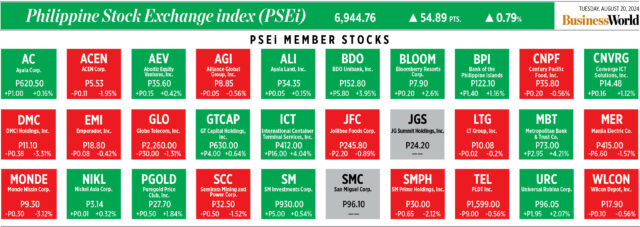
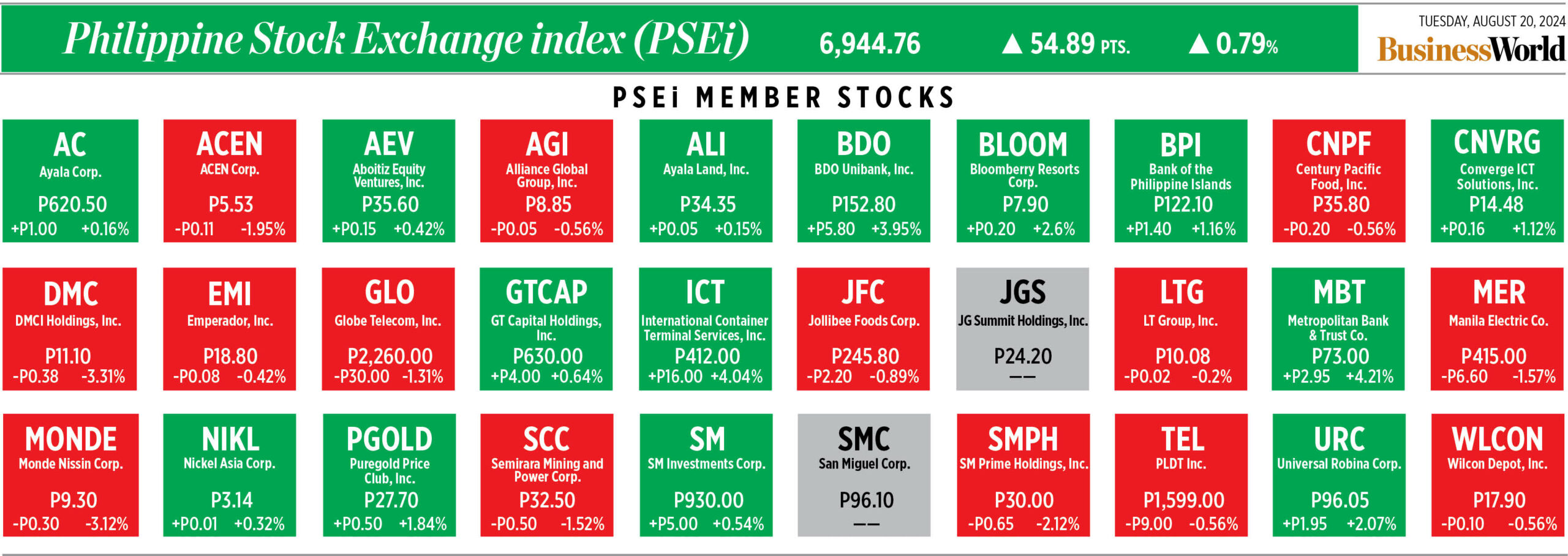
How PSEi member stocks performed — August 20, 2024

Here’s a quick glance at how PSEi stocks fared on Tuesday, August 20, 2024.


Real GDP per person employed in the Philippines (as of Q2 2024)

The country’s labor productivity — as measured by gross domestic product (GDP) per person employed — picked up by 4.6% year on year to P112,542 in the second quarter of the year. This was a reversal from the 0.6% decline in the April-to-June period last year but slower than the 6.3% growth in the first quarter of 2024.

Real GDP per person employed in the Philippines (as of Q2 2024)

PSE index climbs to 6,900 level on rate cut hopes

BW FILE PHOTO

THE BELLWETHER INDEX climbed for a third straight day on Tuesday to end above the 6,900 mark on expectations of continued monetary policy easing by the Bangko Sentral ng Pilipinas (BSP).

The Philippine Stock Exchange index (PSEi) rose by 0.79% or 54.89 points to finish at 6,944.76 on Tuesday, while the broader all shares index climbed by 0.61% or 22.64 points to end at 3,729.09.

This was the PSEi’s highest close in over four months or since it ended at 6,960.43 on April 2.

The index also breached the 7,000 level intraday, logging a high of 7,005.27 during the session.

“The local market climbed further this Tuesday… Expectations that the BSP will continue with its monetary policy easing moving forward, and positive cues from Wall Street continued to lift sentiment,” Philstocks Financial, Inc. Senior Research Analyst Japhet Louis O. Tantiangco said in a Viber message.

“Philippine shares broke into the 6,900 level and now is just a stone’s throw away from the 7,000 level, with investors continuing to buy into strong earnings and the recent 25-basis-point (bp) cut…,” Regina Capital Development Corp. Head of Sales Luis A. Limlingan said in a Viber message.

The BSP on Thursday cut benchmark interest rates for the first time in almost four years amid an improving inflation and economic outlook, with its governor signaling at least one more reduction before the end of the year.

The Monetary Board reduced its policy rate by 25 bps to 6.25%, as expected by nine out of 16 analysts surveyed in a BusinessWorld poll.

BSP Governor Eli M. Remolona, Jr. said at a briefing that they could cut rates by another 25 bps within the year. The Monetary Board’s remaining policy-setting meetings this year are scheduled for Oct. 17 and Dec. 19.

Analysts expect the BSP’s easing cycle to continue until next year amid stabilizing inflation, with at least 100 bps in cuts seen in 2025.

“Investors also cheered the balance of payment (BoP) surplus posted by the Philippines in July and the strengthening of the local currency,” Mr. Tantiangco added.

The country’s BoP position swung to a $62-million surplus in July from a $53-million deficit in the same period last year, BSP data showed.

Meanwhile, the peso closed at an over four-month high of P56.55 per dollar on Tuesday, up by nine centavos from Monday’s finish.

Sectoral indices were split. Financials rose by 2.54% or 51.84 points to 2,091.92; services increased by 2.13% or 46.57 points to 2,227.19; and holding firms went up by 0.22% or 13.12 points to 5,853.17. Meanwhile, industrials fell by 0.83% or 77.13 points to 9,194.85; property dropped by 0.83% or 23.39 points to 2,765.09; and mining and oil went down by 0.25% or 21.41 points to 8,236.19.

Value turnover rose to P8.09 billion on Tuesday with 673.38 million issues changing hands from the P7.64 billion with 625.66 million shares traded on Monday.

Decliners outnumbered advancers, 120 versus 89, while 51 names closed unchanged.

Net foreign buying surged to P2.06 billion on Tuesday from P1.41 billion on Monday. — RMDO

DBM sees no diversion from unfunded 2025 budget items

BW FILE PHOTO

THE budget will govern where funding raised for unprogrammed appropriations will be used, with no wiggle room to steer the funds towards other purposes, the Department of Budget and Management (DBM) said.

“We stick to the very nature of unprogrammed appropriations — (they are a) standby fund,” Budget Secretary Amenah F. Pangandaman said on the sidelines of a hearing.

“The bulk of the unprogrammed appropriations is for foreign-assisted (projects) subject to approval of the NEDA (National Economic and Development Authority) Board.”

Next year’s P6.352-trillion national budget contains as-yet unfunded items of P158.67 billion, 78.31% lower than this year’s P731 billion. The government has not yet sourced the funds for these items and can resort to loans, new taxes, or stronger-than-expected revenue collections.

The standby funds include P78.36 billion for the Strengthening Assistance for Government Infrastructure and Social Programs, P26.27 billion in budgetary support to government-owned and -controlled corporations, and P25.46 billion for support to foreign-assisted projects.

Next year’s unprogrammed appropriations also include half of the total allocation for the Revised Armed Forces of the Philippines Modernization Program at P25 billion.

“I think there’s no agreement yet about their other equipment and projects” of the AFP, Ms. Pangandaman said.

Also to be funded on an as-available basis are the Marawi Siege Victims Compensation Program (P2 billion), the Risk Management Program (P1 billion), Fiscal Support Arrears for the Comprehensive Automotive Resurgence Strategy Program (P364.1 million), and the service development fee refund for the right to develop the Nampeidai property in Tokyo (P210.58 million).

The unprogrammed appropriations have been reduced after the bulk of government projects were classified as backed by programmed funds, Ms. Pangandaman has said.

The status of monthly releases charged against unprogrammed appropriations will be posted on the DBM’s website, according to the 2025 National Expenditure Plan.

Zy-za Nadine M. Suzara, public budget analyst at the Institute for Leadership, Empowerment, and Democracy, said legislators must ensure that unprogrammed appropriations for next year do not breach the budget ceiling. 

“Congress is allowed to move things around in the proposed version of the budget for as long as they do not violate the constitutional prohibition on increasing the total budget ceiling. The increase in the unprogrammed appropriations for the past three fiscal years since the 2022 GAA (General Appropriations Act) was passed had the effect of increasing the total budget ceiling,” she said via Viber.

In January, minority legislators questioned before the Supreme Court the constitutionality of the P450 billion in unprogrammed appropriations inserted by the bicameral conference committee shortly before the passage of this year’s P5.768-trillion budget.

Meanwhile, Ms. Pangandaman said the P89.9 billion in requested fund transfers from the Philippine Health Insurance Corp. (PhilHealth), will be used for social services and infrastructure, and not necessarily for health-related projects. — Beatriz Marie D. Cruz

Zero-tariff EV imports bill hurdles committee

REUTERS

A HOUSE of Representatives committee approved on Tuesday a bill proposing to exempt imported electric vehicles (EVs) from tariffs, in order to promote wider adoption.

The measure which passed the House ways and means committee would grant tariff-free treatment on EV and charging-station equipment imports until 2028.

Imported completely built units of EVs “shall be subject to a tariff rate of zero percent for a period of five years,” according to the text of the unnumbered substitute bill.

President Ferdinand R. Marcos, Jr. last year signed Executive Order (EO) No. 12, which temporarily removed tariffs on electric vehicles and their components for five years.

The tariff-free treatment was expanded in May by the National Economic and Development Authority Board, which conferred the tariff exemption to electric motorcycles, tricycles, and hybrid electric vehicles.

“(Electric vehicles) will have zero tariff until 2028, in line with EO No. 12. We are just making it perfect by making it into law,” Albay Rep. Jose Ma. Clemente S. Salceda told BusinessWorld.

It also clarifies the definition of an EV, he added, noting the absence of a government specification. “(The measure) defines what an electric vehicle is… right now we don’t know if an electric vehicle is two-wheeled, three-wheeled, or four-wheeled.”

According to the bill, any vehicle with at least one electric motor is classified as an electric vehicle.

The Metropolitan Manila Development Authority (MMDA) in February banned light electric vehicles, such as electric bikes and tricycles, from plying national roads in Metro Manila, citing safety concerns. 

“What we’re trying to say is that many electric vehicles are currently being charged as if they were ordinary cars, when they are not even allowed to use the same routes as regular cars,” Mr. Salceda said.

“How can we promote electric vehicles if they are not allowed to use regular routes?” he added.

Electric vehicles are currently not allowed to traverse Epifanio de los Santos Avenue (EDSA), South Luzon Expressway (SLEX), and Katipunan Avenue, among other major Metro Manila thoroughfares, according to MMDA. — Kenneth Christiane L. Basilio

PCCI ‘wish list’ for DepEd includes amending Enhanced Education Act

PHILIPPINE STAR/ MIGUEL DE GUZMAN

THE Philippine Chamber of Commerce and Industry (PCCI) urged the Department of Education (DepEd) to work on better aligning the curriculum with industry demand to raise the competitiveness of the workforce.

It also recommended amendments to Republic Act (RA) No. 10533, or the Enhanced Education Act, with the aim of harmonizing the higher education curriculum to be more attuned to workplace needs.

RA 10533 expanded the basic education program by two years to include at least one year of kindergarten, six years of elementary education, and six years of secondary education.

The group also recommended the enhancement of Science, Technology, Engineering, and Mathematics programs, strengthening partnerships between schools and businesses to foster on-the-job training, and to promote micro-credentialing.

PCCI Human Resource Development Foundation, Inc. President Alberto Fenix, Jr. said the organization is proposing more work immersion components and to include basic higher education subjects in senior high school (SHS).

“Part of our recommendation to the new Secretary (former Senator Juan Edgardo M. Angara) is to have more work immersion not only in the technical-vocational-livelihood track, but even in the academic track, especially those in business,” Mr. Fenix told BusinessWorld by phone.

“A lot of the academic subjects in the first two years (of tertiary education) should be tackled in SHS, like Mathematics, Literature, and English,” he added.

He noted the shortage of teachers in SHS qualified to offer such university-level classes.

“On the other end, we were hoping that the degree courses would now take three years rather than four or five,” he added.

The PCCI also urged the government to invest in teacher training, digital learning platforms, and infrastructure, especially in underserved and rural areas.

“These measures are essential to creating a pipeline of talent that will meet the evolving needs of industries and drive long-term economic growth,” it added. — Justine Irish D. Tabile

BIMP-EAGA deemed critical for kick-starting halal export trade

FREEPIK

CROSS-BORDER investment within the Brunei Darussalam-Indonesia-Malaysia-Philippines East ASEAN Growth Area (BIMP-EAGA) will be key to the future success of the Philippine halal industry, the head of an industry association said.

At a conference on Tuesday, PCCI President Enunina V. Mangio said collaboration within BIMP-EAGA will help the Philippine halal industry prove its global competitiveness.

“We believe that halal is a key area where our cultural and economic commonalities offer unique opportunities for partnership and innovation,” Ms. Mangio said.

“Investment flows across our borders will drive the development of infrastructure, enhance technological capabilities, and create new industries that can thrive within our integrated regional economy,” she added.

She said other areas ripe for collaboration are agriculture, manufacturing, services, and tourism.

During a panel discussion, Brunei Darussalam Ambassador Megawati Manan said that her country has a skilled workforce and imports raw materials in volume.

“Brunei’s niche is our highly educated human resources … We can always see that there are opportunities there in terms of exporting our talent within the BIMP-EAGA region,” she said.

“In terms of halal, we are importing a lot of raw materials, especially (farm products), and we have our eyes on the Philippines right now,” she added.

She said that Brunei could also help bring Philippine halal products to the Middle East.

“We are looking at a third-party manufacturer that will bring agricultural produce into Brunei to be manufactured … which will be packaged with the Brunei halal brand to help the products go up to the Middle East,” she said.

Malaysian Ambassador Dato Abdul Malik Melvin Castelino said that the key focus for the BIMP-EAGA should be the regions’ natural resources.

“The Philippines is one of the key players in the BIMP-EAGA region. It has a lot of resources, including copper, gold, nickel, and, of course, many agricultural products like bananas, pineapples, and coconut,” he said.

“These resources complement the industrial and manufacturing needs of the region, with countries importing and exporting raw materials and semi-processed goods,” he added.

He also added that other significant areas of cooperation include the cross-border trade in fisheries, textiles, automotive, electronics, and semiconductors.

Indonesian Ambassador Agus Widjojo said that since the BIMP-EAGA countries have much in common in terms of natural resources.

“That poses a challenge when we have to look for opportunities, but we also have differences, which is why we belong to different countries,” he said.

“We have different political systems, characteristics of society, and characteristics of the state. So, I think it is within those realms that we have to find opportunities,” he added.

He said that the focus should be on small and medium enterprises (SMEs) to generate employment.

“This is very important to build the economic structure of each country, increase participation in productive sectors of the economy, and fill domestic demand,” he said.

“However, to strengthen those SMEs, we need to be equipped with good infrastructure, including modes of transportation and logistics services,” he added.

On Tuesday, business chambers from Brunei Darussalam, Indonesia and Malaysia joined the PCCI in signing a memorandum of cooperation to expand the flow of goods and services and generate more investment within BIMP-EAGA. — Justine Irish D. Tabile

Pangasinan solar project ruled eligible for green lane — BoI

TRINA SOLAR FB PAGE

THE Board of Investments (BoI) said it granted green-lane certification to Spotlight Power, Inc.’s (SPI) P1.9-billion solar power plant in Pangasinan.

In a statement on Tuesday, BoI said that it issued a green lane certificate to the 49.9-megawatt Mabini Solar Power Plant, which is expected to commence operations by the second quarter of 2026.

The project will occupy 41.25 hectares in Mabini, Pangasinan, and is projected to generate 150 jobs from pre-development until operations begin.

SPI, a renewable energy (RE) development company backed by Trina Solar Investment Pte. Ltd., said the green-lane route, which expedites the approval stages of power development, enhances “transparency and accountability” in all government agencies that issue permits and licenses for power projects.

“This government initiative truly delivers on the promise of easing the process of doing business, especially regarding highly complex requirements that are time-sensitive,” it added.

Green lanes were created through Executive Order No. 18 and are intended to ease the path for projects deemed strategic from proposal stages to operational status.

The BoI tallies 102 projects involving investments of P3 trillion which have been certified to go the green-lane route, following the endorsement of its One-Stop Action Center for Strategic Investments.

The majority of the projects endorsed for green-lane treatment are RE projects.

The government took in increased RE investments after full foreign ownership in the industry was allowed. Foreign ownership was previously limited to 40%.

“As an RE developer, (the green lane) enhances our efficiency and increases our capability to deliver projects in a timely and effective manner,” the company said.

“Because of this, our investors are more confident than ever that we can deliver more projects this year and in the years to come,” it added. — Justine Irish D. Tabile