Home Blog Page 2069

What do you do?

FREEPIK

A JOB TITLE that is easy to explain, like the owner and CEO even of an obscure company dealing with fire extinguishers, satisfies the curiosity of a querying acquaintance. But titles today are getting more complicated and harder to describe. That’s why status symbols are sought, requiring no further elaboration.

When asked what we do, we usually provide a job description, not necessarily the position printed on our calling card. Seldom do we answer that question with activities we do on weekends or at our leisure. (I attend to my bonsai garden at home.)

What we enjoy doing is not always related to our job, or what we do to meet our daily expenses, although the latter helps to support the former. A job with its deliverables, quotas, difficult clients, and bossy superiors, can even be a source of anxiety and pain. And yet it’s something we do again and again.

Of course, if one doesn’t currently have a job, the question of what one is doing becomes problematic. It can result in a short response — I retired last year. Worse, if a person is not yet of retireable age and is simply “between jobs,” how does he answer the question? (Right now, I’m working from home.)

Occupations (as opposed to preoccupations) are limited to activities that are compensated, never mind if adequately. Activities that may absorb us like conversations with friends, meditations on stoic philosophy, or attention to hobbies, are seldom used to describe what we do.

Antoine de Saint-Exupery’s Little Prince, published in 1943, has become a small cult work for looking at life differently: “What is essential is invisible to the eye.” The Little Prince from Asteroid B-612 may well wonder how a person can possibly be defined only by his job and how much money he makes, rather than whether he wears a hat or collects butterflies. The portrayal of a businessman as somebody who counts stars and claims them as his own gives a context of what the Little Prince thinks of the activity of making money.

Leisure, as a worthwhile activity that we do, may be a clearer way to define us and what we consider important. Anyone not hurrying off to a business meeting but to an art gallery or museum must have another kind of priority that absorbs him.

Ideally what we do for a living is enjoyable enough to spend time and effort on. The workplace can offer recognition and promoting the values one espouses. Work and play can be combined to promote a healthy life balance.

Industrialization and the dominance of economic activity (measured in the nation’s GDP) has sanctified work as a means for self-actualization, power, status, and measuring one’s contribution to the common good.

In contemporary thinking, the pursuit of leisure as a goal in itself seems too self-indulgent, permissible only upon retirement. But here again, it is one’s declining contribution and productivity that leads to the end of work, rather than the beginning of leisure. Retirement pay is intended to finance the non-productive and uncompensated joblessness, not to promote the enjoyment of leisure.

Why is ancient Greece remembered not for its workers who may have toiled to build the Parthenon but only for the product of their efforts? If any personalities survive history and are remembered for what we would now consider a leisure activity, it is the Greek philosophers like Socrates, Plato, and Aristotle who are remembered for ideas that shaped our humanitarian view of life. Was it their leisure activity which dealt with the meaning of life that defined what they did? Was that work as we know it? Did they get compensated for their aphorisms? And did they have a day job that enabled them to philosophize?

Work and its demands should not define what we are, or even what we do. It is our legacy and maybe the eulogies that follow us that in the end define who we are… and what we used to do for others.


Tony Samson is chairman and CEO of TOUCH xda
ar.samson@yahoo.com

BDO partners with Ashikaga Bank to support Japanese companies in PHL

BW FILE PHOTO

BDO UNIBANK, Inc. has inked a memorandum of understanding (MoU) with Japan’s Ashikaga Bank, Ltd. (ABL) to support Japanese businesses looking to establish or expand their presence in the Philippines.

“In a significant move, BDO Unibank, Inc. and Japan’s Ashikaga Bank, Ltd., signed a business alliance agreement through a memorandum of understanding (MoU) to foster partnership that enables Japanese companies to thrive in the Philippines’ diverse markets,” the listed Sy-led lender said in a statement on Wednesday.

The MoU was executed on Dec. 23. It “aims to further strengthen the relationship between these two banks as BDO provides banking support services to Japanese business entities who are ABL customers and have existing operations or plan to build or expand their business in the country,” it said.

ABL is the 17th Japanese bank that has partnered with BDO. It is based in Japan’s Tochigi Prefecture and has 134 branches, including satellite offices and commercial banking services.

“Incorporated in 1895 with over 70,000 corporate clients, ABL expects to grow its roster of customers in the Philippines with new investments and business matching deals,” BDO said.

BDO’s Japan Desk was established in 2007 and has Japanese-speaking personnel to help market and service Japanese companies operating in the Philippines as well as cater to the retail needs of Japanese customers.

The bank’s net income rose by 12.47% year on year to P60.62 billion at end-September 2024.

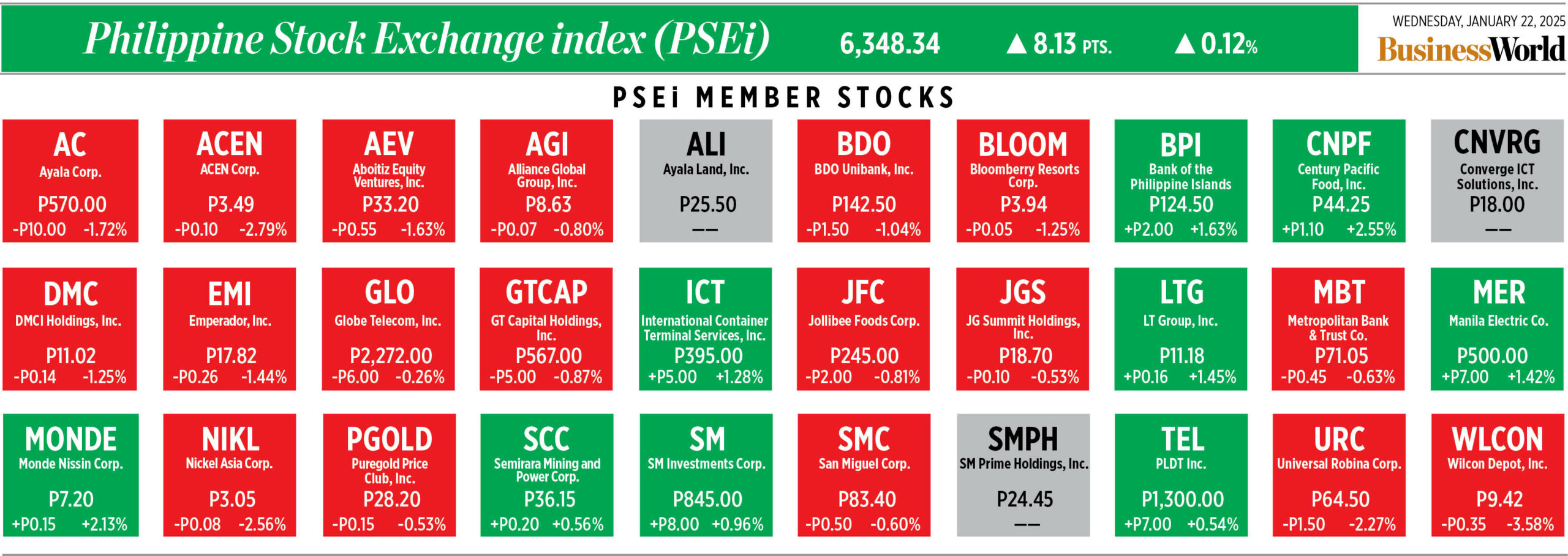
Its shares dropped by P1.50 or 1.04% to close at P142.50 apiece on Wednesday. — A.M.C. Sy

PLDT Home rolls out speed add-on promo

PLDT HOME

PLDT HOME Fiber customers can now upgrade their speeds to up to 1 Gigabit per second (Gbps) for an extra P500 monthly under a limited offer that runs until Jan. 31.

To avail of the PLDT Home Speed Add-On upgrade, customers must text “PLDT BOOST” to 225687 and add P500 to their monthly bill. Users can also inquire via PLDT Home sales channels online and in-store or visit http://pldthome.com/speedaddon.

“This new year, elevate your digital experience at home and be among the first to experience gigabit internet with PLDT Home’s limited time offering. As a special treat, PLDT Home is letting customers on Fiber Plans 1699 and higher enjoy speeds of up to 1Gbps until Dec. 31,” the company said in a statement.

PLDT Home said gigabit speeds are up to 10 times faster than the average household connection, enabling better connectivity for multiple users and across multiple and high-bandwidth smart home devices.

“Back in 2013, PLDT Home was the first telco in the country to provide 1 Gbps fiber-to-the-home broadband service. In early 2024, PLDT Home ushered the Philippines into a full-scale Gigabit era with Gigabit Fiber broadband plans that can deliver speeds of up to 10 Gbps. Only a handful of developed countries, including South Korea, Japan, and the United States, are offering these speeds,” it said.

PLDT Home in November launched its “Always On” add-on broadband service for its PLDT Home Fiber customers, which provides a hybrid modem that automatically switches a customer’s connection from fiber to LTE in case of service interruption.

Hastings Holdings, Inc., a unit of PLDT Beneficial Trust Fund subsidiary MediaQuest Holdings, Inc., has a majority stake in BusinessWorld through the Philippine Star Group, which it controls. — BVR

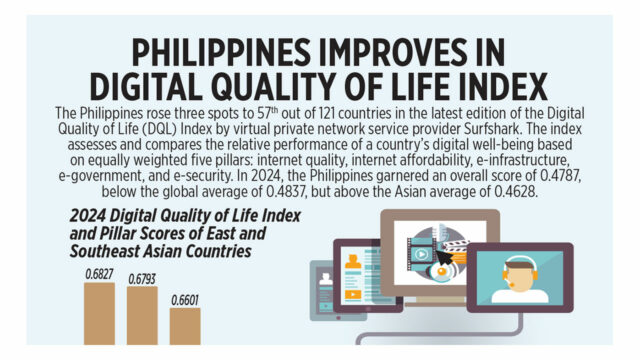
Philippines improves in Digital Quality of Life Index

The Philippines rose three spots to 57th out of 121 countries in the latest edition of the Digital Quality of Life (DQL) Index by virtual private network service provider Surfshark. The index assesses and compares the relative performance of a country’s digital well-being based on equally weighted five pillars: internet quality, internet affordability, e-infrastructure, e-government, and e-security. In 2024, the Philippines garnered an overall score of 0.4787, below the global average of 0.4837, but above the Asian average of 0.4628.

Philippines improves in Digital Quality of Life Index

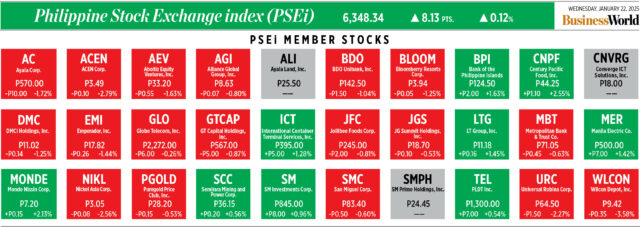
How PSEi member stocks performed — January 22, 2025

Here’s a quick glance at how PSEi stocks fared on Wednesday, January 22, 2025.


PSEi inches up, tracks Trump-driven Wall St. rally

REUTERS

THE MAIN INDEX inched up on Wednesday as the market continued to digest US President Donald J. Trump’s policy comments following his inauguration and amid the ASEAN+3 Macroeconomic Research Office’s (AMRO) bullish view on the Philippine economy.

The benchmark Philippine Stock Exchange index (PSEi) rose by 0.12% or 8.13 points to close at 6,348.34 on Wednesday, while the broader all shares index slipped by 0.04% or 1.71 points to 3,698.53.

“The local market bounced back as investors hunted for bargains. Helping in today’s session were the positive cues from Wall Street as well as AMRO’s projection of the Philippines being the second-fastest growing economy in Southeast Asia this 2025,” Philstocks Financial, Inc. Senior Research Analyst Japhet Louis O. Tantiangco said in a Viber message.

“Philippine shares climbed quietly as investors began to assess the market effects of President Trump’s executive orders. Overnight, US stocks rose on Tuesday as Wall Street viewed President Trump’s trade remarks as softer than expected,” Regina Capital Development Corp. Head of Sales Luis A. Limlingan said in a Viber message.

AMRO said in its Regional Economic Outlook quarterly update report released on Tuesday that the Philippine gross domestic product is projected to expand by 6.3% this year, unchanged from the forecast in December.

This is the second-fastest among Association of Southeast Asian Nations members, behind Vietnam’s 6.5%.

Meanwhile, Wall Street’s main indexes rose on Tuesday, with the S&P 500 and the Dow closing at their highest levels in more than a month as investors assessed Mr. Trump’s first actions as US president and were encouraged that he did not start his second term with blanket tariff increases, Reuters reported.

The Dow Jones Industrial Average rose 537.98 points or 1.24% to 44,025.81; the S&P 500 gained 52.58 points or 0.88% to 6,049.24; and the Nasdaq Composite gained 126.58 points or 0.64% to 19,756.78 to close near its highest level since Jan. 6.

Back home, almost all sectoral indices closed in the red on Wednesday. Mining and oil lost 0.53% or 41.83 points to end at 7,720.43; holding firms decreased by 0.12% or 6.82 points to 5,336.45; financials retreated by 0.07% or 1.67 points to 2,178.87; property inched down by 0.05% or 1.17 points to 2,336.03; and industrials slipped by 0.04% or 3.55 points to 8,918.23.

Meanwhile, services went up by 0.71% or 14.83 points to end at 2,095.79.

Value turnover went up to P4.68 billion on Wednesday with 862.32 million issues changing hands from the P3.87 billion with 1.01 billion shares traded on Tuesday.

Decliners beat advancers, 103 versus 73, while 65 names were unchanged.

Net foreign selling increased to P404.25 million on Wednesday from the P173.15 million on Tuesday. — Revin Mikhael D. Ochave with Reuters

Peso slips as markets await clarity on Trump tariffs

STOCK PHOTO | Image by iiijaoyingiii from Pixabay

THE PESO slipped against the dollar on Wednesday as markets continue to react to US President Donald J. Trump first wave of policy announcements.

The local unit closed at P58.51 per dollar on Wednesday, down by two centavos from its P58.49 finish on Tuesday, Bankers Association of the Philippines data showed.

The peso opened Wednesday’s session stronger at P58.35 against the dollar, which was also its intraday best. It dropped to as low as P58.605 versus the greenback.

Dollars exchanged inched down to $1.59 billion on Wednesday from $1.6 billion on Tuesday.

“The dollar-peso traded cautiously as players awaited announcements on Trump’s policies,” a trader said in a phone interview.

The dollar was moving higher early on Wednesday as markets assessed the potential economic impact of Mr. Trump’s policies, Rizal Commercial Banking Corp. Chief Economist Michael L. Ricafort likewise said in a Viber message. However, the greenback dropped anew later in the day.

For Thursday, the trader expects the peso to move between P58.30 and P58.60 per dollar, while Mr. Ricafort sees it ranging from P58.40 to P58.60.

The dollar struggled to regain ground against major currencies on Wednesday, hovering close to two-week lows as a lack of clarity on Mr. Trump’s plans for tariffs kept financial markets guessing, Reuters reported.

Mr. Trump said late on Tuesday that his administration was discussing imposing a 10% tariff on goods imported from China on Feb. 1, the same day that he previously said Mexico and Canada could face levies of around 25%.

He also vowed duties on European imports, without providing further details.

Despite those threats, a lack of specific plans from Mr. Trump’s first day in office saw the dollar start the week with a 1.2% slide against a basket of major peers. It stabilized on Tuesday, ending flat after an attempted rebound fizzled, with US officials saying any new taxes would be imposed in a measured way.

The dollar index, which tracks the currency against six top rivals, eased 0.1% to 108 on Wednesday, not far from the two-week low of 107.86 it touched on Tuesday.

Mr. Trump on Monday signed a broad trade memorandum, ordering federal agencies to complete comprehensive reviews of a range of trade issues by April 1.

The greenback rose 0.13% to 155.715 yen, edging up slightly from the one-month low it touched the day before. — A.M.C. Sy with Reuters

Philippine Coast Guard issues radio challenge to newly sent China ship

A SCREENSHOT of Chinese Coast Guard vessel 3103 (right) with the Philippine Coast Guard’s BRP Suluan in the South China Sea on Jan. 21, 2025. — PHILIPPINE COAST GUARD

THE Philippine Coast Guard (PCG) on Tuesday issued a radio challenge asking another Chinese vessel to leave its waters near the coast of Zambales province in the country’s north.

In a statement on Tuesday evening, the PCG said BRP Suluan, which replaced BRP Gabriela Silang which had been monitoring Chinese presence within its exclusive economic zone (EEZ) in the South China Sea, issued the radio challenge to China Coast Guard (CCG) vessel 3103.

China Coast Guard 3103 replaced CCG 3304 on Tuesday morning, the Philippine Coast Guard said.

“Despite challenging sea conditions with wave heights of two to three meters, BRP Suluan has maintained close monitoring of CCG-3103, effectively preventing the larger vessel from approaching the Zambales coastline,” it said.

“Furthermore, the PCG vessel has aggressively radio-challenged CCG-3103, asserting that its illegal presence violates the Philippine Maritime Zones Act, the United Nations Convention on the Law of the Sea (UNCLOS) and the 2016 arbitral award,” it added.

The Chinese vessel is one of several ships sent near the Philippine coast and close to the disputed Scarborough Shoal, which China has controlled since 2012.

Philippine authorities have said the Chinese ships had been sent to intimidate Filipino fishermen from entering the shoal.

China claims almost the entire South China Sea, one of the world’s busiest sea lanes. A United Nations-backed tribunal based in the Hague in 2016 voided its claim for being illegal, as it ruled Scarborough Shoal is a traditional fishing ground for Filipino, Chinese and Vietnamese fishermen.

The Philippine Coast Guard replaced BRP Gabriela Silang, which had been monitoring Chinese presence in the area, with the 44-meter multi-role and response vessel BRP Suluan.

The new Chinese ship deployed within the Philippines’ EEZ in the South China Sea is way larger than BRP Suluan, the PCG said.

“Although this new vessel is smaller than its predecessor, it measures 77.7 meters in length and 10.4 meters in width,“ it added.

It said CCG-3304 was about 194.46 kilometers from the Zambales coast as of 9 p.m. on Tuesday. CCG-3103 was conducting illegal patrols off the coast of Zambales, and was 140.752 km from Pundaquit, Zambales it added.

Meanwhile, CCG-5901, which Manila calls the “monster ship,” was 209.3 km away from Zambales but remained within the Philippine EEZ. It was 35.188 km away from Scarborough Shoal.

Manila has accused China of intimidating Filipino fishermen near the shoal and normalizing its “illegal presence” after Beijing sent the monster ship, the world’s biggest coast guard vessel, into the Philippine EEZ on Jan. 4.

Scarborough shoal, which the Philippines calls Bajo de Masinloc, is 241 kilometers off Zambales and is within its 200-nautical mile (370.4 km) EEZ.

“The Philippine Coast Guard remains steadfast in its commitment to safeguarding the country’s maritime interests and upholding international law without escalating tensions,” it said.

The PCG was under the Department of National Defense before it was transferred to the Office of the President in March 1998 through an order issued by the late President Fidel V. Ramos. Less than a month later, he transferred the PCG to the Department of Transportation and Communications, which was split into two into separate agencies in 2016 through a 2015 law signed by the late President Benigno S.C. Aquino III.

The PCG has since been under the Transportation department.

The agency should require its 4,000 new recruits to undergo a crash course on the newly enacted Philippine Maritime Zones Act “for a deeper understanding of current issues, particularly the conflict in the West Philippine Sea,” Senator Francis N. Tolentino said in a statement on Wednesday.

“This would help them better understand the metes and bounds of our territorial sea, international waters, exclusive economic zone, and so on,” said the senator, who heads the Senate Special Committee on Philippine Maritime and Admiralty Zones. “These are basic knowledge but very important, especially when there are challenges.”

Mr. Tolentino said the PCG has 35,000 personnel. The Senate recently passed a bill setting a three-year fixed term for the coast guard commandant.

The measure, which the House of Representatives has passed, allows the coast guard leadership to carry out its plans and programs for the long term, “which would benefit maritime safety and security,” according to PCG spokesman Commodore Algier D. Ricafrente. — K.A.T. Atienza

Senate urged to raise taxes to cut Filipinos’ tobacco use

DON-DELFIN ALMONTE-UNSPLASH

THE GOVERNMENT should raise taxes on tobacco and vape products to cut their use by Filipinos, according to the Action on Smoking & Health (ASH) Philippines.

“The buying capacity of Filipinos has increased and it will be wise to increase taxes on tobacco products to keep up with the changing times,” ASH Philippines Director-General Maria Encarnita B. Limpin told a Senate hearing looking into tobacco smuggling.

“We recommend unitary taxes on electronic smoking devices and increases to rates equal to tobacco products since electronic smoking devices are equally harmful as smoking tobacco products,” she added.

She also said the government should set up a tracking system on all standard tobacco products and e-cigarettes to monitor the movement of smuggled products.

The Philippines imposes a tax of P57 per milliliter (ml) on salt nicotine products, P6.30/ml on freebase nicotine products and P65/10 ml on classic nicotine products, according to the excise tax rates prescribed by the Bureau of Customs for 2024.

Last week, the Department of Finance pushed a single tax rate on all types of nicotine and vapor products to ease the collection burden on the Bureau of Internal Revenue (BIR).

Finance Secretary Ralph G. Recto said his agency is open to discussions on raising excise taxes on tobacco products but warned that continuous tax increases could also worsen smuggling.

Ms. Limpin, a pulmonologist, recommended a tax stamp on all tobacco products and e-cigarettes to track sales.

At the same hearing, Philippine Tobacco Institute President Jericho B. Nograles sought the establishment of a law enforcement group similar to the US Bureau of Alcohol, Tobacco, Firearms and Explosives to go after tobacco smuggling.

“They have a specific law enforcement group composed of multiple groups that are focused precisely on that (going after smuggled goods),” he said. “Unfortunately, there’s no such single law enforcement agency (in the Philippines).”

Mr. Nograles said the Philippine National Police’s Criminal Investigation and Detection Group is often overwhelmed since it has to divide its efforts between multiple operations such as large-scale estafa and tobacco smuggling, making it difficult to cut the illegal trade.

The BIR said it collected P130.91 billion in tobacco excise taxes in the first 11 months of 2024, well behind its full-year target of P185.34 billion.

In September, President Ferdinand R. Marcos, Jr. signed into law a measure classifying agricultural smuggling, hoarding, profiteering and financing as economic sabotage.

Republic Act No. 12022 or the Anti-Agricultural Economic Sabotage Act imposes a fine equivalent to five times the value of smuggled or hoarded agricultural products, with violators also under threat of life imprisonment.

“We are still seeing a lot of people dying from cancer,” Ms. Limpin said. “Lung cancer is now the number two cause of cancer deaths in the country.” — John Victor D. Ordoñez

DBM outlines coverage of 2nd tranche of state salary hikes this month

PHILIPPINE STAR/BOY SANTOS

THE Department of Budget and Management (DBM) has clarified the coverage of the second tranche of salary increases for government workers this month.

National Budget Circular No. 597 lays down the implementation of the updated salary schedule for civilian workers based on Executive Order (EO) No. 64, which was signed in August 2024.

“In continuation of the promise of our President, we will implement this January 2025 the second part of the salary increase for our government employees,” Budget Secretary Amenah F. Pangandaman said in a statement on Wednesday.

The circular was applied to government workers in the Executive, Legislature and Judiciary; constitutional commissions and offices; state universities and colleges; and government-owned or -controlled corporations (GOCC) not covered by the GOCC Governance Act of 2011 and EO No. 150.

Military and uniformed personnel and government agencies that are exempted from the Revised Compensation and Position Classification System will not be covered by the pay increase.

It also excludes workers without an employer-employee relationship and funded by nonpersonnel service budgets.

“The amounts required for the salary adjustment of the civilian government personnel in fiscal year 2025 shall be charged against the miscellaneous personnel benefit fund and any available appropriations under the 2025 General Appropriations Act, subject to budgeting, accounting and auditing rules and regulations,” the DBM said.

For state-run companies covered by the circular, the amount for the salary increases will be provided by their operating budgets.

“Conversely, the DBM wishes to highlight that the guidelines applicable to local government units shall be covered by a separate circular,” it said.

The circular noted that the updated salary schedule for civilian personnel will be enforced in four tranches from 2024 to 2027. — Aubrey Rose A. Inosante

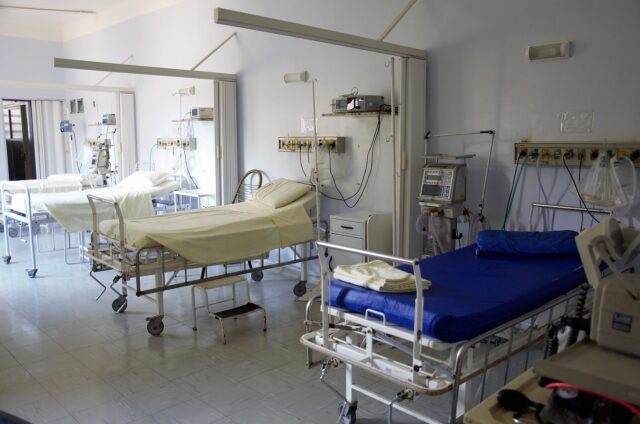
House bill grants amnesty to hospitals amid P59.6-B unpaid PhilHealth claims

STOCK PHOTO | Image by Silas Camargo Silão from Pixabay

A BILL granting amnesty to hospitals with denied reimbursement claims, embroiled in legal disputes with the Philippine Health Insurance Corp. (PhilHealth), has been filed at the House of Representatives.

The state health insurer has P59.6 billion in unpaid claims to hospitals, which it accumulated from 2018 to 2024, PhilHealth Senior Vice-President Renato L. Limsiaco, Jr. told lawmakers during a House hearing on Wednesday.

“I have filed a House bill giving amnesty to these denied claims because of late submissions and return-to-hospitals [claims] because of small discrepancies [in reimbursement forms],” Party-list Rep. Wilbert T. Lee said during the same hearing.

House Bill (HB) No. 11298, filed on Monday, aims to ease the strain experienced by hospitals amid “legal battles resulting from payment delays, disparities in claims processing, and other compliance difficulties,” the bill’s explanatory note read.

Philippine hospitals file reimbursement claims to PhilHealth for the accrued costs of medical services provided to Filipinos, which is then deliberated by the state health insurer to determine its validity for compensation.

Processed claims which PhilHealth finds worthy of repayment are tagged as a “good claim,” according to a 2021 PhilHealth memorandum; while reimbursement requests seen as “deficient” are categorized into return-to-hospital (RTH) and denied claims, which leads to it being unpaid.

The Health department last week noted that most claims are denied as hospitals exceed the 60-day deadline for filing reimbursement claims.

HB No. 11298 proposed to automatically dismiss year-old pending cases against hospitals filed by PhilHealth for “suspected fraudulent activities.” The state health insurer should also reassess claims due to late form submissions prior to 2018, provided that hospitals demonstrate their delays were caused by “circumstances beyond their reasonable control.”

“[Granting] amnesty by facilitating the payment of denied claims due to late filing will help healthcare providers recover from financial strains and ensure continued operation and the availability of services to the public,” the proposed law stated.

Mr. Lee’s amnesty bill is “untenable,” Iloilo Rep. Janette L. Garin said. “It will be very difficult for PhilHealth to do that because they will now be the subject of a lot of cases,” she told lawmakers during the same House hearing.

PhilHealth should instead fast-track its digitization efforts to curb denied and RTH claims to hospitals, she said. The state health insurer started automating its claims system in 2018.

Reimbursement claims are often returned or denied for minor documentary discrepancies due to manual processes, PhilHealth Senior Vice-President Israel Francis A. Pargas said in the same hearing.

The state health financier has received more than 101 million reimbursement claims amounting to P985 billion since 2017. Of this, it has settled 93 million claims worth P899 billion, according to its presentation during the House hearing. — Kenneth Christiane L. Basilio

House OKs bill overhauling Philippine education system

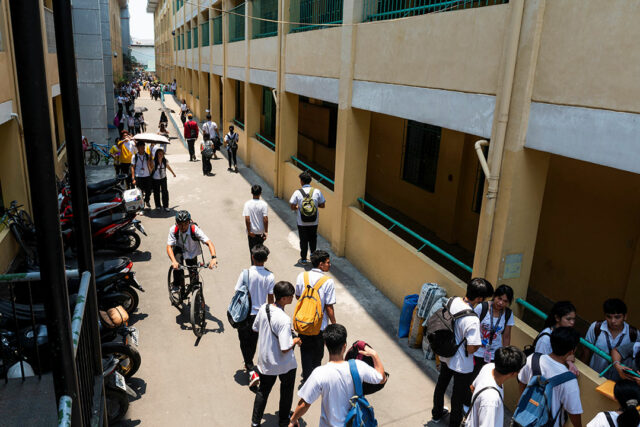
Students walk inside the campus of a high school in Quezon City, April 18, 2024. — REUTERS

THE House of Representatives on Wednesday approved on second reading a bill that seeks to overhaul the Philippine education system by dividing the tertiary education pipeline and aligning it with industry standards.

In a voice vote, congressmen approved House Bill No. 11213, which gives students the option to pursue a college education or learn a trade.

After junior high school, students will choose between two education pathways — the university preparatory program under the Department of Education (DepEd) or the technical-vocational program under the Technical Education and Skills Development Authority (TESDA), according to the bill.

The Philippines in 2013 adopted the K-12 program, which meant to enhance the quality of basic education and the competencies of Filipino students and equipping them with the skills to enter the workforce without going to college.

But Pasig Rep. Roman T. Romulo told the House plenary that senior high school graduates find it challenging to find employment as companies continue to favor college graduates.

“The reality of the job market has not aligned with these expectations,” he said in his sponsorship speech on the measure.

Also on Wednesday, the House approved on third and final reading a measure that would let the National Housing Authority (NHA) restructure housing loans.

For a period of two years after the issuance of the implementing rules of the proposed law, all socialized and low-cost housing loans with the NHA and Social Housing Finance Corp. that have at least three months of unpaid monthly amortizations will be covered by loan restructuring and condonation program, according to the bill.

A housing loan must be under P1.8 million to be covered. “All existing interests on principal, penalties and surcharges shall be condoned upon approval of the restructuring application. — Kenneth Christiane L. Basilio