Home Blog Page 1989

Bain & Co. names Manny Maceda as chair

EMMANUEL P. “MANNY” MACEDA — BAIN.COM

GLOBAL management consulting firm Bain & Co. has named Emmanuel P. “Manny” Maceda as its new chair, bolstering its leadership.

Mr. Maceda replaces long-time chair Orit Gadiesh, who has been appointed as the management consulting firm’s chair emeritus, Bain & Co. said in a statement.

Ms. Gadiesh served as chair of Bain & Co. for more than 30 years after being appointed in 1993.

Mr. Maceda was previously Bain & Co.’s Worldwide Managing Partner and Chief Executive Officer from 2018 until June 30, 2024, when he was succeeded by Christophe De Vusser.

“I’m energized by the exciting future for Bain, and I’m looking forward to supporting Christophe and our extraordinary people worldwide in delivering even more inspiring success stories with our clients,” Mr. Maceda said.

Mr. Maceda holds a Master of Science in Management from the Massachusetts Institute of Technology Sloan School of Management, a Bachelor of Science in Chemical Engineering from Illinois Institute of Technology, and an honorary Doctorate in Business Administration from De La Salle University.

Bain & Co. has a presence in 65 cities across 40 countries. The company specializes in various fields, including customer strategy, marketing, organization, operations, and information technology. — Revin Mikhael D. Ochave

AI-generated content raises risks of more bank runs, UK study shows

RAWPIXEL.COM-FREEPK

PARIS — Fake news generated by artificial intelligence (AI) and spread on social media is heightening the risks of bank runs, according to a new British study that says lenders must improve monitoring to detect when disinformation risks impacting customer behavior.

Generative AI can be used to create fake news stories saying that customer money is not safe, or memes appearing to joke about security issues, which can be spread on social media using paid adverts, said the study, published by UK research company Say No to Disinfo and communications firm Fenimore Harper.

Banks and regulators are increasingly concerned about the risks of bank runs fueled by social media, following the collapse of Silicon Valley Bank in 2023, in which depositors withdrew $42 billion in 24 hours.

Advances in AI have supercharged these risks. The G20’s Financial Stability Board warned in November that generative AI “could enable malicious actors to generate and spread disinformation that causes acute crises,” including flash crashes and bank runs.

Say No to Disinfo showed sample AI-generated content to UK bank customers and found that a third were “extremely likely” to move their money after seeing it, with a further 27% “somewhat likely.”

“As AI is making disinformation campaigns easier, cheaper, quicker and more effective than ever before, the emerging risk to the financial sector is rapidly growing but often overlooked,” the report said, noting that online and mobile banking meant people can move money in seconds.

The study estimated that for every 10 pounds ($12.48) spent on social media adverts to amplify the fake content, as much as 1 million pounds of customer deposits could be moved.

The estimate was calculated by using average deposits held by UK customers, the cost of social media adverts, and estimates for how many people would see them.

Banks need to monitor media and social media mentions, and such monitoring must be integrated with withdrawal monitoring systems to identify when malicious information is affecting customer behavior, the researchers said.

Asked about the study, Revolut’s head of financial crime, Woody Malouf, said the London-based fintech conducts real-time monitoring for emerging threats among its customers and “across the broader ecosystem.”

“Whilst we believe an industry event like this is unlikely, it is still possible, so it’s essential that financial institutions are prepared,” he said, adding that social media platforms must play a bigger role in stopping threats.

Other financial institutions contacted by Reuters, including NatWest and Barclays, declined to comment or did not respond to requests for comment.

While regulators have expressed concern about AI’s overall impact on financial stability, banks are broadly optimistic about the technology’s impact. — Reuters

Premium real estate booms in Makati despite Metro Manila market trends

PHILSTAR FILE PHOTO

Conclusion

THIS is the conclusion of my piece on Makati Central Business District (CBD). It appears that the premier financial hub is isolated from the condominium oversupply plaguing some sub-markets in Metro Manila. Makati CBD remains the preferred hub for major business process outsourcing (BPO) firms and large multinational corporations (MNCs), which is why it is no surprise that the area registers the lowest office vacancy rate in the capital region.

Makati CBD is also home to the most expensive condominium units in Metro Manila, ranging from upper mid-income to ultra-luxury residential developments. Investors in Makati CBD prefer larger unit cuts, open spaces, world-class architectural designs, top-notch concierge services, and high-end amenities. For this reason, we believe residential developers will continue launching projects with these features well beyond 2025.

HIGHER-PRICED CONDOMINIUMS PREFERRED BY AFFLUENT MARKET
In Metro Manila, demand for premium residential units is not only making a comeback but is also rebounding significantly. Luxury and ultra-luxury condominium projects typically start at P20 million ($357,000) per unit. Over the past 12 to 24 months, we have seen condominium units breaking price barriers. Some are priced between P700,000 and P900,000 per square meter ($12,500 and $16,100 per square meter), with total contract prices (TCP) ranging from P200 million to about P300 million ($3.6 million to $5.4 million) per unit. Despite these prices, projects in primary business hubs, including Makati CBD, continue to record strong take-up rates. We attribute this demand to an affluent and discerning market seeking residential units with top-tier amenities and strong capital appreciation potential.

Colliers believes the high-end market in Metro Manila remains strong, as it attracts a cash-rich consumer base. During the height of the pandemic in 2020 and 2021, while prices in the affordable to lower mid-income residential segments of the secondary market declined, demand and prices in the upper mid-income to ultra-luxury segments remained stable. As the Philippine economy rebounds and Filipino investors’ affluence and purchasing power improve, we expect even greater interest in these high-priced residential units, especially in key business districts that continue to attract large Filipino and multinational firms as locators.

UPGRADED AMENITIES TO STOKE DEMAND FROM A DISCERNING MARKET
As more upscale projects launch in Metro Manila, Colliers sees a rise in more discerning buyers. Beyond capital appreciation potential, investors and end users are drawn to upscale facilities, high-quality concierge services, and the advantage of being in a master-planned community. Colliers encourages developers to further innovate and differentiate their amenities to gain a competitive edge in the thriving luxury residential segment.

We also encourage developers to integrate sustainable features such as sensor lighting, solar panels, occupancy sensors, LED lights, and rainwater harvesting systems. In our view, adopting green and sustainable features will be a key factor in attracting consumers to invest in a condominium project.

In addition to round-the-clock security, these properties offer well-equipped gyms, resort-style pools, ample parking spaces, and high-quality interiors. These high-end residences are also within walking distance of major shopping hubs, which house a mix of popular local and global retail brands catering to residents’ refined preferences.

LIVE-WORK-PLAY-SHOP LIFESTYLE AND THE 15-MINUTE COMMUNITY RULE
Overall, we see continued demand for prime residential projects due to the convenience, accessibility, and exclusivity they provide to unit owners and renters. These are some of the reasons why business districts like Makati CBD continue to attract consular officials and high-ranking expatriates employed by multinational and foreign outsourcing firms. Upper mid-income, upscale, luxury, and ultra-luxury residential units in Metro Manila’s primary business hubs remain a cut above the rest.

I want to highlight that these residential projects are well-maintained, have occupancy rates higher than the Metro Manila average, and offer hotel-like amenities and services — major factors driving strong take-up rates, whether for lease or for sale.

WHAT’S IN STORE FOR MAKATI CBD INVESTORS?
With premium office buildings, new and upscale residential units, expansive parks, and refurbished retail spaces, there is no doubt that Makati CBD remains a top investment destination for both local and foreign investors. With residential, retail, and office vacancies below the Metro Manila-wide average, Makati CBD continues to be a business hub worth watching in the coming years. Notably, new projects are already lined up, which should further excite investors.

Makati CBD is an attractive business destination poised for redevelopment — one that will further transform the district’s property landscape.


Joey Roi Bondoc is the director and head of Research of Colliers Philippines.

joey.bondoc@colliers.com

3 statistical stuff-ups that made everyday items look healthier (or riskier) than they really are

FREEPIK

Conducting scientific studies is never easy, and there are often major disasters along the way. A researcher accidentally spills coffee on a keyboard, destroying the data. Or one of the chemicals used in the analysis is contaminated, and the list goes on.

However, when we read the results of the study in a scientific paper, it always looks pristine. The study went smoothly with no hiccups, and here are our results.

But studies can contain errors, not all of which independent experts or “peer reviewers” weed out before publication.

Statistical stuff-ups can be difficult to find as it really takes someone trained in statistics to notice something wrong.

When statistical mistakes are made and found, it can have profound impacts on people who may have changed their lifestyle as a result of the flawed study.

These three examples of inadvertent statistical mistakes have had major consequences for our health and shopping habits.

1. DID YOU THROW OUT YOUR BLACK PLASTIC SPOONS?
Late last year, I came across a news article about how black plastic kitchen utensils were dangerous as they could potentially leak toxic flame-retardant chemicals into your food.

Being a natural sceptic, I looked up the original paper, which was published in the journal Chemosphere. The article looked genuine, the journal was reputable. So — like perhaps many other people — I threw out my black plastic kitchen utensils and replaced them with silicone ones.

In the study, the authors screened 203 household products (about half were kitchen utensils) made from black plastic.

The authors found toxic flame retardants in 85% of the products tested, with levels approaching the maximum daily limits set by the Environmental Protection Agency in the United States.

Unfortunately, the authors made a mistake in their calculations. They were out by a factor of 10. This meant the level of toxic chemicals was well under the daily safety limits.

In recent weeks, the authors apologized and corrected their paper.

2. DID YOU AVOID HRT?
A landmark study raised safety concerns about hormone replacement therapy or HRT (now also known as menopausal hormone therapy). This highlights a different type of statistical error.

The Women’s Health Initiative (WHI) study involved 10,739 postmenopausal women aged 50-79 recruited from 40 clinical centers in the US. It compared the health of women randomized to take HRT with those who took the placebo. Neither the researchers nor the women knew which treatment had been given.

In their 2002 paper, the authors reported higher rates of invasive breast cancers in the HRT group. They used a unit called “person-years.” Person-years is a way to measure the total time a group of people spends in a study. For example, if 100 people are in a study for one year each, that makes 100 person-years. If someone leaves the trial after only six months, only that half-year is counted for them.

The authors showed a rate of 38 invasive breast cancers per 10,000 person-years in the HRT group, compared to 30 per 10,000 person-years in the placebo group. This gives a rate ratio of 1.26 (one rate divided by the other).

This fairly large increase in breast cancer rates, also expressed as a 26% increase, caused widespread panic around the world, and led to thousands of women stopping HRT.

But the actual risk of breast cancer in each group is low. The rate of 38 per 10,000 person-years is equivalent to an annual rate of 0.38%. With very small rates like this, the authors should really have used the rate difference rather than the rate ratio. The rate difference is one rate subtracted from the other, rather than divided by it. This equates to an annual increase of 0.08% breast cancer cases in the HRT group — much more modest.

The authors of the 2002 paper also pointed out that the 26% increase in the rate of breast cancer “almost reached nominal statistical significance.” Almost is not statistical significance, and formally, this means there was no difference in breast cancer rates between the two groups.

In other words, the difference between the two groups could have happened by chance.

The authors should have been more careful when describing their results.

3. DID POPEYE’S SPINACH CHANGE YOUR MEALS?
Cartoon character Popeye is a one-eyed, pipe-smoking sailor with mangled English, in love with the willowy Olive Oyl. He is constantly getting into trouble, and when he needs extra energy, he opens a can of spinach and swallows the contents. His biceps immediately bulge, and off he goes to sort out the problem.

But why does Popeye eat spinach?

The story begins in about 1870, with a German chemist, Erich von Wolf or Emil von Wolff, depending on which version of events you read.

He was measuring the amount of iron in different types of leafy vegetables. According to legend, which some dispute, he was writing the iron content of spinach down in a notebook and got the decimal point wrong, writing 35 milligrams instead of 3.5 milligrams per 100 gram serve of spinach. The error was found and corrected in 1937.

By then the Popeye character had been created and spinach became incredibly popular with children. Apparently, consumption of spinach in the US went up by a third as a result of the cartoon.

This story had gained legendary status but has one tiny flaw. In a 1932 cartoon, Popeye explains exactly why he eats spinach, and it’s nothing to do with iron. He says in his garbled English:

“Spinach is full of Vitamin A. An’tha’s what makes hoomans strong an’ helty!”

THE CONVERSATION VIA REUTERS CONNECT


Adrian Esterman is a professor of Biostatistics and Epidemiology at the University of South Australia. He receives funding from the NHMRC, MRFF, and ARC.


Timothée Chalamet channels Bob Dylan with warning about cult-like figures

Timothée Chalamet in a scene from The Complete Unknown

BERLIN — Timothée Chalamet learned from his roles as Bob Dylan in A Complete Unknown and Paul Atreides in Dune that cult-like figures should be approached with caution, the Oscar-nominated actor said at the Berlin Film Festival on Friday.

“It’s in the nature of his music, the warnings against cult-like figures,” Mr. Chalamet told journalists when asked what he learned from the US singer-songwriter about how to deal with the current state of the world.

“My interpretation is just be wary of any savior-like figures,” said Mr. Chalamet, whose Dylan biopic was being shown in the festival’s non-competition Special section.

“That’s honestly the warning in Frank Herbert’s Dune, which was written in the same period in American history,” added Mr. Chalamet.

“Granted, Frank Herbert was on the West Coast, probably doing acid at a typewriter, and Bob Dylan was on the East Coast, but the messaging was still similar,” Mr. Chalamet said.

The 29-year-old actor starred in both parts of Denis Villeneuve’s science-fiction epic Dune, based on author Mr. Herbert’s highly acclaimed 1965 novel of the same name.

Mr. Chalamet, a frontrunner in the race for best actor at next month’s Oscars for his turn as Dylan, said he was grateful for his chance to play the artist.

A Complete Unknown, which also stars Edward Norton, Elle Fanning and Monica Barbaro, chronicles Dylan’s arrival in New York in 1961, his rapid ascent in folk music circles, and his divisive turn to electric rock music in 1965.

“We (the cast) know these projects are few and far between now,” he said.

“I was looking at the Berlinale film program, you guys have a lot of really intellectually driven, artistically driven projects, but I guess we do in the States too, but… these things are harder to come by.” — Reuters

ACMF eyes capital markets improvements with new 5-year strategy

BW FILE PHOTO

THE ASEAN Capital Markets Forum (ACMF) is looking to release a five-year roadmap by October this year aimed at improving the region’s capital markets.

The roadmap, called the ACMF Action Plan 2026-2030 (AP2026), will replace the current ACMF Action Plan 2021-2025 (AP2021).

“The new AP2026 will build on the successes of the AP2021 and will be developed in collaboration with member states, seeking feedback and views from a range of stakeholders, and leveraging subject-matter resources. This will ensure that the action plan is comprehensive and keeps pace with capital market trends,” ACMF said in a statement.

AP2021 sought to foster growth and recovery with sustainability, promote and sustain inclusiveness, and strengthen and maintain orderliness and resilience.

The ACMF held its 42nd Chairs’ Meeting on Feb. 13 in Penang, Malaysia, which saw the endorsement of the strategic thrusts and a set of key principles for the upcoming AP2026.

The ACMF Chairs also forged a technical assistance collaboration with the Economic Research Institute for ASEAN and East Asia to craft a carbon market ecosystem roadmap.

To boost the ASEAN region’s climate adaptation finance measures, the ACMF is also considering a technical assistance collaboration to establish a mitigation, adaptation, resilience, and sustainable finance framework.

Meanwhile, the ACMF said the meeting also saw the approval of planned technical training and initiatives to widen the understanding of how to measure and disclose greenhouse gas emissions, as well as the implementation of disclosure requirements in the International Sustainability Standards Board Standards.

The ACMF is a group of capital market regulators from all ASEAN jurisdictions, including the Philippine Securities and Exchange Commission. It is currently chaired by the Securities Commission Malaysia.

Established in 2004, the ACMF seeks to develop a deep, liquid, and integrated regional capital market. — Revin Mikhael D. Ochave

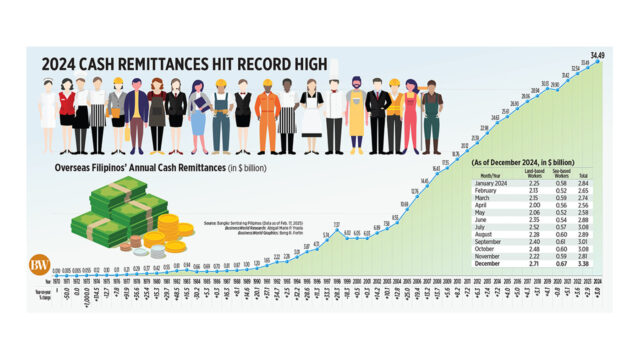
2024 cash remittances hit record high

CASH REMITTANCES from overseas Filipino workers (OFWs) hit an all-time high of $34.49 billion in 2024, data from the Bangko Sentral ng Pilipinas (BSP) showed. Read the full story.

2024 Cash Remittances Hit Record High

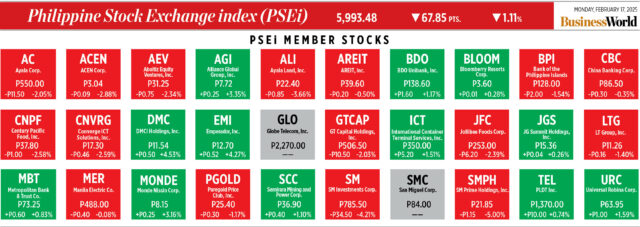
How PSEi member stocks performed — February 17, 2025

Here’s a quick glance at how PSEi stocks fared on Monday, February 17, 2025.


House think tank seeks oversight over PHL Armed Forces defense spending

REUTERS

By Kenneth Christiane L. Basilio, Reporter

PHILIPPINE lawmakers should allot enough defense budget and legislate reforms within security agencies to advance the military’s modernization program amid worsening tensions with China, according to a congressional think-tank.

Lawmakers should also exercise their oversight powers over the Armed Forces of the Philippines’ (AFP) upgrades by checking if their planned purchases are in line with the country’s “strategic needs” to prevent wasteful spending, the Congressional Policy and Budget Research Department (CPBRD) said in a February paper.

“Increasing funding is not enough to ensure the success of the AFP’s modernization program,” CPBRD authors Byron M. Bicencio, Arsenia S. Gonzales, Prince Louie B. Mamhot and Noel H. Sempio said in the 23-page discussion paper.

“What are simultaneously necessary are the pursuit and enactment of internal reforms by the AFP to be… responsive to the challenges of the times and to ensure that they spend on and acquire the right equipment,” they added.

Manila and Beijing have been at loggerheads over disputed features in the South China Sea, which Beijing claims almost in its entirety. A United Nations-backed tribunal based in The Hague in 2016 voided China’s claim for being illegal.

The Philippines is at the tail-end of its military modernization program called “Horizon,” which began in 2012 when tensions with China flared after a naval stand-off at Scarborough Shoal in the South China Sea. Manila has earmarked about $35 billion for military upgrades in the next decade.

The Philippine government has incurred a P2.1-trillion funding shortfall for the modernization effort as of August 2024, according to the House of Representatives think-tank. About P348 billion has been spent on military hardware upgrades since 2002, it added.

“It is imperative that the AFP modernization program receive adequate funding to enable the AFP to acquire the necessary capabilities to defend the country from both internal and external threats,” it said.

But lawmakers should ensure that public funds are “spent wisely” on military hardware, the think-tank added, urging them not to take proposed upgrades at face value.

“It must be ensured that vital budgetary resources are spent wisely on the right arms, equipment and hardware in the first place,” the think tank said. “The AFP’s modernization should not be hinged on a mere ‘wish list of equipment,’ but on a proper decision-making process… that would identify their strategic needs.”

“Reforms of the defense establishment must lean towards effective communications between high military staff command and political leaders across the board,” Joshua Bernard B. Espeña, an international relations lecturer at the Polytechnic University of the Philippines, said in a Facebook Messenger chat.

“Congress must review how each section of the bureaucracy delivers its mandate with efficiency and coordination, especially in safeguarding against corruption and red tape on spending concerns such as acquisitions, logistical management, intelligence operations, training and international engagements,” he added.

“This is crucial given how defense missions require a delicate balance between swiftness and caution in the avenue of decision-making.”

AFP Chief of Staff Romeo S. Brawner, Jr. last week said the military is eyeing additional BrahMos anti-ship missiles from India and at least two submarines.

Congress should also amend the 1935 National Defense Act, which laid the foundation for the Philippines’ military structure and defense policies, the CPBRD said.

“Faced with a maritime issue, the Philippines would have to move from being essentially ‘army-centric’ and urgently improve the capabilities of both its navy and air force in order to defend its seas,” it added.

There’s also a need to craft a law that would harmonize and streamline the Defense department’s policymaking authority for a more coordinated defense posture, the CPBRD said.

“New defense policies, principles and concepts have also been introduced and adopted over the years… substantially changing the structure, powers and functions, operations, and accountability of the various defense institutions,” it added.

The think-tank also said the government should spur the development of domestic defense industries by supporting them under a law mandating a self-reliant defense posture.

“This may entail the establishment of special defense economic zones and the further development of the shipbuilding industry, key measures which may be pursued by Congress,” it added.

CIDG chief files inciting to sedition complain at DoJ vs ex-President Duterte

SCREENSHOT FROM HOUSE OF REPRESENTATIVES FACEBOOK

By John Victor D. Ordoñez, Reporter

THE CHIEF of the Philippine police’s investigation arm has filed a complaint for inciting to sedition against former President Rodrigo R. Duterte over his kill remarks against sitting senators.

Brigadier General Nicolas D. Torre III, head of the police’s Criminal Investigation and Detection Group (CIDG), said he filed the case against the tough-talking leader at the Department of Justice (DoJ) as CIDG chief and as a citizen “to make sure that we protect the citizenry from criminal activities like this.”

At the Partido Demokratiko Pilipino Laban (PDP-Laban) proclamation rally in Manila last week, Mr. Duterte suggested killing incumbent senators in a bomb blast to make room for his preferred candidates.

Former presidential legal counsel Salvador S. Panelo called the complaint “foolish,” saying Mr. Duterte was just joking.

“Unlike Torre, the senators have the common sense and the humor to see the Duterte joke as an amusing and laughable remark,” he told reporters in a Viber group message.

But Mr. Torre said the ex-President’s remarks are inexcusable.

“This is a new Philippines,” he told reporters in mixed English and Filipino, based on a voice recording sent to reporters via Viber. “These kinds of statements that are passed off as jokes the next morning are no longer allowed.”

He said the complaint would be used to build a criminal case against the Mr. Duterte.

Under a 2023 DoJ circular, government prosecutors must only file cases that would lead to a “reasonable certainty of conviction” instead of a previous requirement of finding “probable cause.”

Lawmakers have called on the National Bureau of Investigation (NBI) to probe his remarks.

Last week, the NBI filed a complaint for inciting to sedition and grave threats against the former President’s daughter, Vice-President Sara Duterte-Carpio, over her statement last year threatening to have Philippine President Ferdinand R. Marcos, Jr., his wife and cousin Speaker Martin G. Romualdez assassinated.

“The challenge to our institutions is to clearly respond to whether they abet this, or whether they should finally be made liable for it on political and constitutional law standards,” Hansley A. Juliano, who teaches political science at the Ateneo de Manila University, said in a Facebook Messenger chat.

“This happened before already, right?” Mr. Torre said. “He said that some people — addicts — should be killed. And it happened. There was a lot of killing,” he added, referring to the ex-President’s deadly drug war.

The government estimates that at least 6,117 people died in Mr. Duterte’s anti-illegal drug campaign between July 1, 2016 and May 31, 2022, but human rights groups say the death toll could be as high as 30,000.

“There is a basis to investigate Rodrigo Duterte,” Ephraim B. Cortez, president of the National Union of Peoples’ Lawyers, said in a Viber message. “In this case, he proposed to kill the senatorial candidates through the use of a bomb.”

“Killing or inflicting bodily harm on a group of persons is an element of sedition, and using a bomb indicates the tumultuous nature of what he planned to do. It’s time to hold him accountable for this kind of remark,” he added.

Philippine Health department flags worrisome uptick in dengue cases in Luzon

PUBLIC HEALTH IMAGE LIBRARY/US CENTERS DISEASE FOR CONTROL AND PREVENTION

PHILIPPINE health authorities on Monday flagged a “concerning rise” in dengue cases in Luzon, with eight more local governments there likely to declare an outbreak after Quezon City.

In a statement, the Department of Health (DoH) cited an uptick in dengue cases in nine local government units across  Metro Manila, Calabarzon and Central Luzon. It did not disclose the names of the cities and the number of infections.

This comes after Quezon City Mayor Maria Josefina “Joy” Tanya G. Belmonte declared a dengue outbreak in the country’s largest city, where at least 10 people have died from the disease spread by mosquitoes and more than 1,700 cases have been posted this year.

The Health department has reported 28,384 dengue cases as of Feb. 1, a 40% increase from a year earlier.

The agency said regional epidemiology and surveillance units have been advising their local government counterparts about the cases, adding that the declaration of a local dengue outbreak may only be done by a local government official.

The Philippine Health department last declared a national dengue epidemic in 2019.

The eight localities other than Quezon City are likely to declare a dengue outbreak due to an uptick in cases, DoH spokesman Albert Francis E. Domingo told DZBB radio.

Dengue is the most common mosquito-borne disease worldwide, typically found in tropical and sub-tropical climates.

Common symptoms include high fever, severe headaches, nausea, vomiting, rashes and muscle pain, according to the World Health Organization’s website.

If left untreated, dengue can progress to a severe stage, which may involve intense stomach pain, vomiting, bleeding of the gums or nose, blood in urine or stools, difficulty breathing and bleeding under the skin. — John Victor D. Ordoñez

About 80% of crimes in Southeast Asia linked to drugs, says BuCor chief

PHILIPPINE STAR/ MIGUEL DE GUZMAN

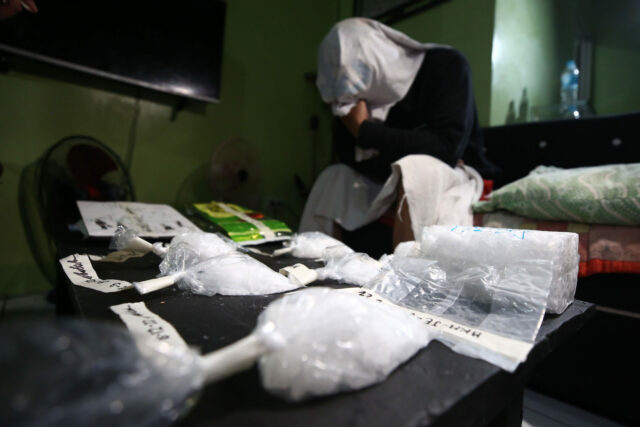
AROUND 70-80% of crimes in Southeast Asia are linked to drugs, Bureau of Corrections (BuCor) Director General Gregorio Pio P. Catapang, Jr. said on Monday, following the conclusion of the Association of Southeast Asian Nations (ASEAN) Regional Correctional Conference (ARCC).

Drugs emerged as the common problem during high-level discussions among correctional leaders, he told reporters on the sidelines of the ARCC in Puerto Princesa City, Palawan.

“Seventy to eighty percent of crimes committed were under the influence of drugs,” Mr. Catapang said in mixed English and Filipino. “That’s the similarity among ASEAN countries; drugs were always highlighted as a problem.”

Mr. Catapang said that to address prison overcrowding over drug-related cases, he aims to revitalize the underused Mega Drug Abuse Treatment and Rehabilitation Center in Palayan City in Nueva Ecija, built during former President Rodrigo R. Duterte’s administration.

“If possible, with the help of the Department of Health (DoH), since this is a whole-of-government approach involving DoH, Department of Social Welfare and Development, Technical Education and Skills Development Authority and others—the individual can first be confined [in the rehabilitation center],” he said in Filipino.

This aligns with the home imprisonment mechanism for minor crimes, which was shared during ARCC discussions. This mechanism will also cover smaller drug-related crimes after undergoing rehabilitation.

“Once it is proven that they are no longer addicted and have overcome their addiction, they can be reintegrated with their family,” he added. “Their family, along with the community and the village, will then monitor and support them.”

The event also concluded with an emphasis on aligning ASEAN correctional policies with global trends, including the potential establishment of a regional prisoner transfer agreement after the transfer of Mary Jane F. Veloso to Manila from Jakarta in December 2024.

Once approved at the executive level, this agreement would enable countries to repatriate inmates to their home nations to serve their sentences, improving rehabilitation outcomes and reducing the burden on host countries.

Mr. Catapang, however, emphasized that this agreement should reach the treaty level, which would take years to accomplish.

Moving forward, ASEAN leaders agreed to hold the ARCC every two years, with Thailand set to host the next conference in 2026 and two years moving forward.

To ensure meaningful discussions, ASEAN officials plan to strengthen the ARCC Secretariat to maintain continuity and clear objectives for future conferences. — Chloe Mari A. Hufana