Home Blog Page 1932

New LTO rules need reconsideration

PHILIPPINE STAR/RUSSELL PALMA

For as long as I’ve been buying and selling cars, I’ve followed what a number of secondhand car owners know as the “30-day rule”: complete all the necessary paperwork, notarize the deed of sale, and submit the documents to the Land Transportation Office (LTO) within 30 days of purchase. It’s a process I first encountered almost 30 years ago when buying my first car, and it’s one I’ve continued to observe out of habit and practicality.

Over the years, I’ve seen the challenges of this bureaucratic maze firsthand. A single transfer of ownership involves multiple steps: securing a police clearance, undergoing stenciling for verification, and lining up at the Highway Patrol Group clearance center and the LTO district office. These steps alone require considerable time and patience.

Yet, the importance of ownership transfer hit me even harder when some years back I received in the mail a traffic ticket for a car I had already sold. The new owner hadn’t yet registered the vehicle in his name, leaving me in a tangled web of responsibilities for a car I no longer owned. It was not a major violation — driving on coding day — but I had to pay a hefty fine just the same.

To avoid future issues, I included a clause in every deed of sale I signed, requiring the buyer to complete the ownership transfer within what I felt was a “reasonable” timeframe, typically that familiar 30-day period. However, with the issuance of a new LTO Administrative Order, these expectations may soon shift for everyone in the pre-owned car market.

Under Administrative Order No. VDM-2024-046, the LTO has adjusted its expectations, now requiring that all ownership transfers be reported within a tighter 20-day period. This move is part of LTO’s mandate to enforce two significant laws: the Motorcycle Crime Prevention Act (Republic Act No. 11235) and the new anti-carnapping law (Republic Act No. 10883).

The Motorcycle Crime Prevention Act sets an even shorter timeframe, demanding that ownership of motorcycles be registered within five days of sale. The Anti-Carnapping Law, meanwhile, mandates that all vehicle sales, including those involving engine or chassis replacements, be registered within 20 days.

The penalties for failing to comply are steep. Buyers and sellers alike face fines ranging from P20,000 to P40,000, and both the vehicle and relevant driver’s licenses can be flagged. However, while the spirit behind the Administrative Order (AO) is understandable, certain aspects of its implementation deserve scrutiny. The LTO should recognize the barriers to swift compliance, and as it stands, this AO could place undue burdens on law-abiding vehicle owners navigating a system already rife with challenges.

Around the world, regulations on pre-owned vehicle ownership transfers are designed with both security and practicality in mind. In Singapore, for instance, ownership transfers are handled through an efficient online system managed by the Land Transport Authority, requiring only a few days for complete processing. Transfers must be completed in seven days.

The United Kingdom’s Driver and Vehicle Licensing Agency (DVLA) allows 30 days to register ownership changes, giving buyers and sellers ample time for due diligence while avoiding penalty traps.

An extended timeframe, paired with accessible online options, will be the best approach, I believe. Such not only streamlines ownership transitions but also helps create a fair system for all parties. Without overly rigid requirements, these frameworks acknowledge the logistical demands on individuals, recognizing that compliance cannot rely on speed alone.

While I support the LTO’s intention behind this order — encouraging timely ownership transfers and upholding accountability — I also see the need for a more practical approach. The requirement to report a sale online within five days raises significant barriers, especially given the gaps in access to the Land Transportation Management System (LTMS).

Not all Filipinos, especially those in remote areas, have easy access to online platforms. The hurdles extend to the paperwork as well; under the AO, sellers must upload notarized deeds, original registration documents, and identification within the five-day period — a time crunch that may prove unmanageable for many.

Compounding the problem is the AO’s treatment of liability. Under the new regulations, if the buyer fails to initiate the transfer process after the seller reports the sale, the seller could be flagged and potentially penalized. This asymmetry unfairly burdens sellers, who lose control over a vehicle yet remain liable for its infractions until the ownership is fully transferred.

Moreover, the requirement that liability remains with the seller until the registration is completed poses a serious problem. The UK and Singapore, for instance, treat a notarized bill of sale or official notification of transfer as sufficient to release a seller from further responsibility. This is a sensible approach, as it recognizes the reality that, once the keys change hands, the vehicle is out of the seller’s control.

While RA No. 11235 and RA No. 10883 clearly underscore the need for accurate and timely transfer reporting, the LTO can exercise more flexibility in implementing these laws. Extending the timeframe to 30 days, as practiced in other countries, would not dilute the law’s intentions but would instead provide a more realistic window for compliance.

In fact, considering bureaucratic issues here, this can perhaps be extended to a couple of months. Equally important is the matter of retroactivity; applying these new requirements to all past transactions could create unnecessary confusion and penalize those with limited access to previous buyers or sellers. The AO should be prospective, in my opinion, and should not cover past transactions.

Another consideration involves the inspection requirements. The AO demands that buyers submit a Private Motor Vehicle Inspection Center (PMVIC) Report before the transfer is complete. Although safety checks are essential, the limited availability and sometimes lengthy waiting periods at PMVICs may stretch beyond the AO’s current 20-day limit. An adjustment here could prevent bottlenecks while ensuring compliance.

I cannot help but recall the Non-Contact Apprehension Program (NCAP), which used camera-based surveillance to detect traffic violations, when it faced its own set of challenges in execution. The program saw widespread opposition due to concerns over privacy, transparency, and implementation.

It was ultimately suspended pending Supreme Court deliberation, with a crucial lesson: hasty policies without sufficient stakeholder engagement can lead to widespread pushback and policy reversals. As it stands, the LTO’s AO may encounter similar resistance if it fails to account for the concerns of the public, including both buyers and sellers.

The LTO’s intentions are commendable, but a practical framework that aligns with global best practices would make this AO a valuable step forward. Online reporting systems, liability guidelines, and transfer timeframes need to be realistic for both buyers and sellers. A 20-day period may work well on paper, but in practice, 30 days, as seen in the UK, or an extended transition period of maybe three months, might be more suitable given the current infrastructure. Stakeholder engagement, transparency, and fairness should guide this AO’s future.

I believe it’s essential for the LTO to actively involve the car-buying public and heed their suggestions. Otherwise, the AO risks ending up in the same legal limbo as the NCAP, leaving us with unclear regulations that ultimately create more challenges than solutions. Until this order is reviewed, those in the pre-owned car market will need to navigate these new waters with caution — because, as it stands, the AO’s demands are as rigorous as they are unforgiving.

A fine of P20,000 to P40,000 is a lot of money for most people. Almost the cost of an old car. And an alarm tag — akin to what is slapped on a stolen vehicle — on the vehicle subject of sale, as well as the license of both seller and buyer, for failure to follow an administrative requirement smacks of unconstitutionally treating ordinary citizens as criminals, guilty until proven innocent.


Marvin Tort is a former managing editor of BusinessWorld, and a former chairman of the Philippine Press Council

matort@yahoo.com

Adidas reaches out-of-court settlement with rapper Ye

THE YEEZY Boost 350 V2

LONDON — Adidas has reached an out-of-court settlement with rapper Ye to end all legal proceedings between them, the sportswear brand said on Tuesday, adding that no money changed hands in the agreement.

Adidas and Ye had been embroiled in multiple lawsuits for the past two years, since the German company ended a partnership with the rapper previously known as Kanye West over antisemitic comments he made.

“There isn’t any more open issues, and there is no… money going either way, and we both move on,” CEO Bjorn Gulden told reporters on a conference call, declining to give further details of the deal.

“There were tensions on many issues, and… when you put the claims on the right side and you put the claims on the left side, both parties said we don’t need to fight anymore and withdrew all the claims,” Mr. Gulden added. — Reuters

EastWest Bank books higher Q3 net income

PHILSTAR FILE PHOTO

EAST WEST Banking Corp. (EastWest Bank) saw its net income grow by 49% year on year to P2.3 billion in the third quarter, it said on Wednesday.

In the first nine months, EastWest Bank’s net profit climbed by 20% to P5.8 billion on the back of “higher income-generating capacity, boosted by favorable securities trading in the third quarter,” it said in a disclosure to the stock exchange,

“Our September results reflect our sustained momentum across key segments. While we benefited from the trading environment, it’s the strength of our core businesses that continues to drive our overall performance,” EastWest Bank Chief Executive Officer Jerry G. Ngo said.

Its quarterly report was unavailable as of press time.

The Gotaniun-led bank’s net interest income rose by 23% year on year to P25.1 billion in the first nine months boosted by its consumer lending business, which it said now accounts for 83% of its credit portfolio.

“This focus helped maintain a strong net interest margin of 8.1%, well above the industry average,” it said.

Its non-interest income likewise increased by 39% to P7.1 billion at end-September on the back of fee earnings related to consumer lending and other sources.

“Securities trading income, which amounted to P1.4 billion, also benefitted from the easing interest rate environment,” EastWest Bank said.

As a result, the lender’s net revenues jumped by 26% to P32.2 billion in the period. Excluding trading income, its topline increased by 23%.

Meanwhile, EastWest Bank’s operating expenses went up by 23% to P17.9 billion.

This resulted in a cost-to-income ratio of 55%.

The bank’s loans and receivables expanded by 13% year on year to P321.3 billion at end-September following a 17% growth in consumer loans.

“Personal loans grew by 52%, credit card loans by 35%, and auto loans by 11%,” it added.

On the funding side, deposits with the bank rose by 10% to P371 billion, with current and savings account or CASA deposits making up 79% of the total.

EastWest Bank assets expanded by 12% year on year to P497 billion at end-September.

Its capital adequacy ratio was at 13.7%, while common equity Tier 1 ratio was at 12.9%.

EastWest Bank shares closed at P10.24 apiece on Wednesday, up by 37 centavos or 3.75% from the previous day’s finish. — A.M.C. Sy

Hotel101 aims for 1 million app users by yearend

HOTEL101 Global Pte. Ltd., a subsidiary of property developer DoubleDragon Corp. (DD), expects its hotel application to have one million registered users by yearend as the company expands its customer base.

The property developer announced the forecast as the Hotel101 global (HBNB) app exceeded 500,000 registered users on Wednesday.

Over the near term, the HBNB app is expected to have at least one million users each from the Philippines and its first three overseas projects, DD said in a statement to the stock exchange.

The first three overseas projects are in Niseko, Japan; Madrid, Spain; and Los Angeles, United States, which are expected to generate $471 million in foreign currency revenues to DD.

“Hotel101 adopts dynamic pricing on its room rates via the HBNB app where its room price moves up and down depending on the real-time supply and demand on the chosen date of booking,” it said.

According to DD, the HBNB app is projected to have 25 million registered users across citizens of 25 different countries over the medium term.

The app is expected to have over 100 million users from the citizens of 100 countries over the long term.

Hotel101 Global Chief Executive Officer Hannah Yulo-Luccini said the app, which has a self-check-in feature, allows a seamless customer experience. The app can cater to room booking, check-in, check-out, and payment.

“The HBNB app is expected to become the most efficient and easiest to use hotel app globally. The Hotel101 Global hotel chain seeks to delight its customers by providing them with a completely predictable and consistent one room concept anywhere it locates around the world,” she said.

DD Chairman Edgar “Injap” J. Sia II said the plan for the HBNB app is to have over one million registered users in every country where the company operates.

Aside from its first three overseas projects, Hotel101 has plans to expand into United Kingdom, United Arab Emirates, India, China, Thailand, Malaysia, and Vietnam.

The company is also eyeing to enter Indonesia, Singapore, Cambodia, Bangladesh, Mexico, South Korea, Australia, Canada, Switzerland, Turkey, Italy, Germany, France, and Saudi Arabia.

DD is targeting to have one million operating hotel rooms globally by 2050, of which 50,000 are in the Philippines.

Within the fourth quarter, Hotel101 is expected to list on NASDAQ in the US via a merger with JVSPAC Acquisition Corp. The combined entity will trade under the ticker symbol “HBNB,” making Hotel101 the first Philippine company to list in the US.

On Wednesday, DD shares dropped by 0.99% or 10 centavos to P10 per share. — Revin Mikhael D. Ochave

PLDT Home rolls out 5G+ prepaid Wi-Fi

PLDT HOME has rolled out its latest prepaid Wi-Fi product that promises speeds of up to 1.5 Gigabits per second (Gbps).

PLDT Home Wi-Fi 5G+, available at an introductory price of P1,495 until Dec. 31, offers unlimited data for 15 days without any speed cap upon successful registration of the SIM card that comes with the plug-and-play device. Customers can top up their data with several promo load options.

“PLDT Home has always been at the forefront of driving innovations in broadband technologies in the country. Backed by our robust network, our fixed wireless access (FWA) has the capability to deliver up to 1.5 Gbps. With an advanced device that connects to the 5G (fifth-generation) and 4G (fourth-generation) network, our PLDT Home Wi-Fi 5G+ is changing the game in the wireless segment,” Jeremiah M. de la Cruz, PLDT Inc. senior vice-president and head of Consumer Business – Home, said.

“As we continue to expand our network nationwide, our customers on 4G can already enjoy its benefits now and look forward to the 5G experience with our continuous 5G rollout. With the continued demand for fixed wireless solutions in the country, our focus remains — to deliver reliable connectivity for our customers’ better digital experiences at home,” he said.

PLDT Home Wi-Fi 5G+’s device is a dual-band Huawei Wi-Fi 6 AX3000 router, which connects up to 15 devices.

“In today’s digital world, a strong internet connection is essential for work, school, and staying connected with loved ones. PLDT Home Wi-Fi 5G+ features Wi-Fi 6 technology that addresses these needs head-on, capable of speeds of up to 1.5 Gbps,” PLDT Home said.

“Wi-Fi 6… technology supports faster data transfer and higher bandwidth compared to earlier standards other internet providers still use. This enhances speed, range, and performance, ensuring seamless 4K streaming, smooth online gaming, and uninterrupted video calls for remote work or online classes,” it added.

PLDT Home Wi-Fi 5G+ can be purchased at PLDT and Smart’s physical stores and retailers, SM malls as well as PLDT Home’s Lazada and Shopee stores.

Hastings Holdings, Inc., a unit of PLDT Beneficial Trust Fund subsidiary MediaQuest Holdings, Inc., has a majority stake in BusinessWorld through the Philippine Star Group, which it controls. — BVR

GDP expansion and PhilHealth’s excess P90 billion

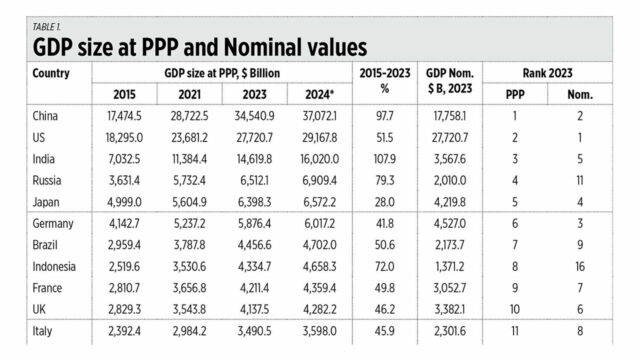
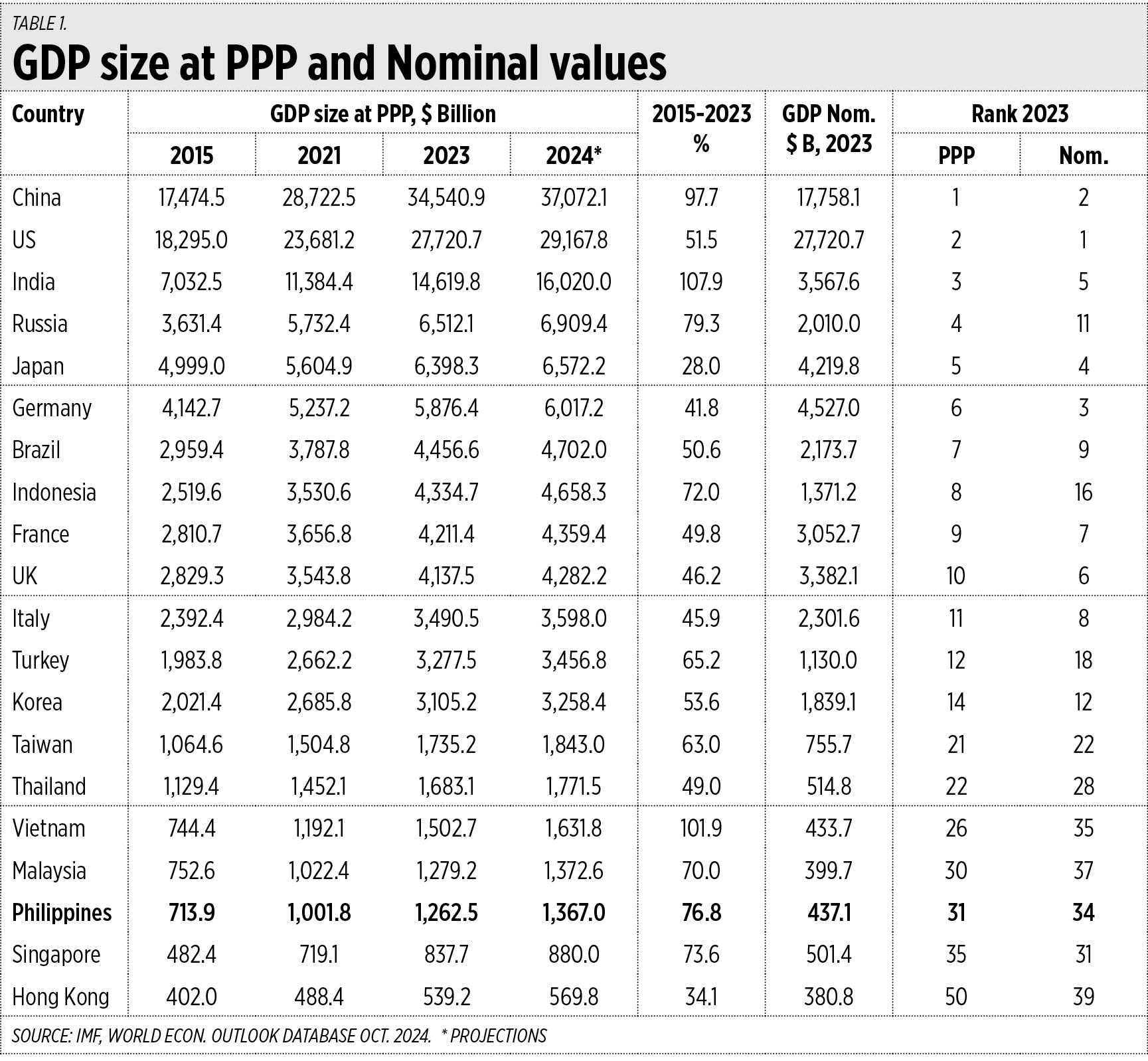
In 2023, the Philippines was the 31st largest economy in the world in GDP size at purchasing power parity (PPP) values, and the 34th largest economy at current or nominal values. Our GDP size of $1.26 trillion was not far behind our neighbors: Malaysia with $1.28 trillion, Vietnam with $1.5 trillion, Thailand with $1.68 trillion, and Taiwan with $1.74 trillion.

The expansion of the Philippines’ and other East Asian economies was fast. From 2015 to 2023, Vietnam’s economy expanded by 102%, China’s by 98%, the Philippines’ by 77%, Singapore’s by 74%, Indonesia’s by 72%, and Malaysia’s by 70%. In contrast, G7 countries have expanded between Japan’s 28% to the US’ 52% (see Table 1).

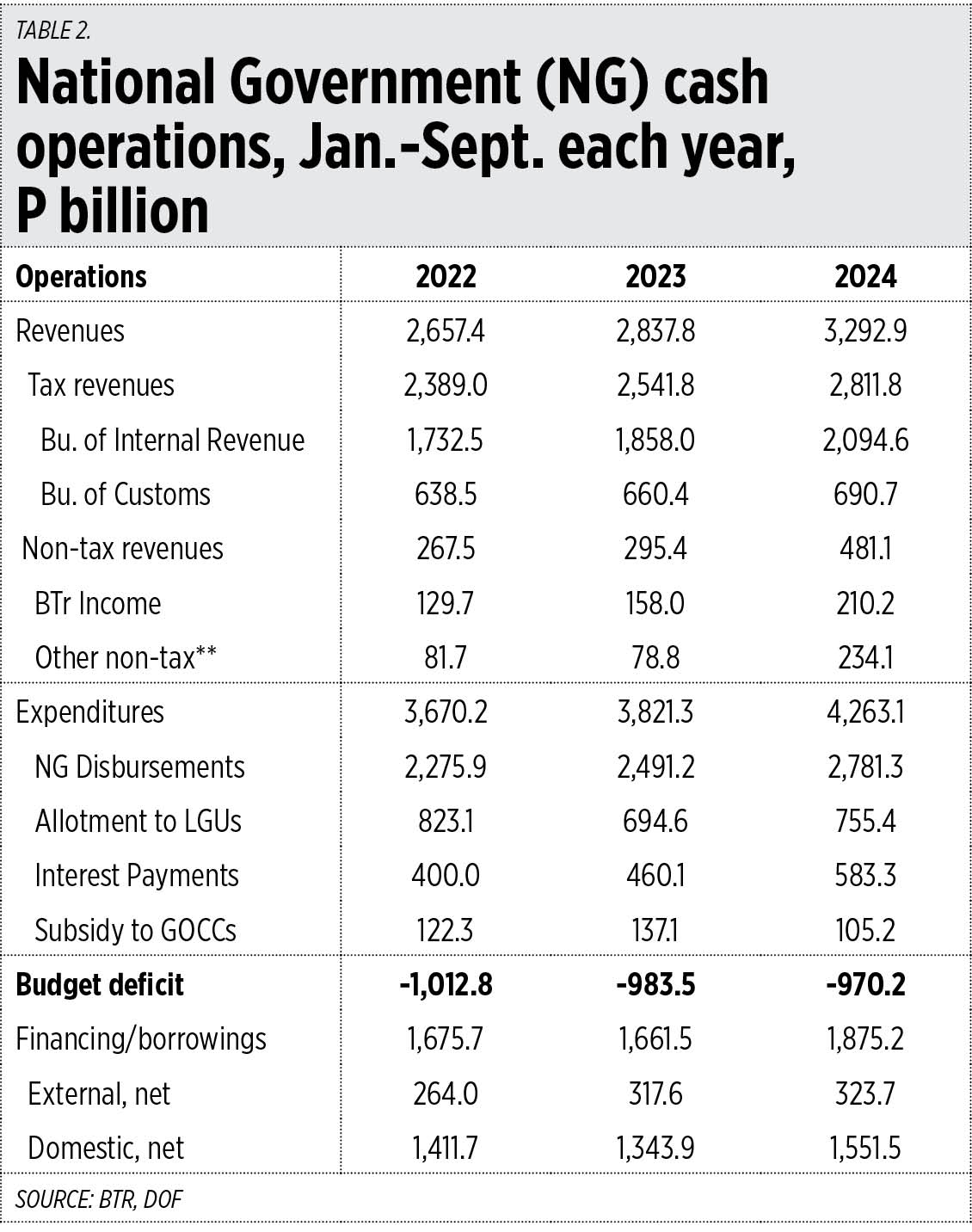
Last week the Bureau of the Treasury (BTr) released the government’s cash operations report for September. In my second table, I compared the January to September data on public finance over three years, 2022 to 2024.

The good news is that the budget deficit is declining, from P1 trillion in 2022 to P984 billion in 2023 and P970 billion in 2024.

There are two notable things in the report this year. One is the big expansion of “Other non-tax” revenues, from P82 billion in 2022, to P79 billion in 2023, and P234 billion in 2024. The other is the fast expansion of interest payment of our public debt, from P400 billion in 2022, to P460 billion in 2023 and P583 billion in 2024. If this trend continues, the full year 2024 interest payment may reach P875 billion (see Table 2).

That is a huge increase in interest payment — no thanks to the Bangko Sentral ng Pilipinas’ high interest rate policy,  supposedly to control inflation, and the ever-rising expenditures of national agencies, including the military and uniformed personnel pension (which should be zero if only they would pay for their own pension) to around P164 billion a year.

The transfer to the National Treasury of P60 billion out of the P89.9 billion in idle funds of the Philippine Health Insurance Corp. (PhilHealth) has greatly contributed to the expansion of “Non-tax revenues.”

TRO ON PHILHEALTH’S EXCESS
Last Tuesday, the Supreme Court issued a temporary restraining order (TRO) on the transfer of the remaining P29.9 billion (round this off to P30 billion). This means either P30 billion in unprogrammed expenditures in the national budget will not be implemented, or the Department of Finance (DoF) will borrow P30 billion at an interest rate of 6% (government bond 10-years) and pay P1.8 billion in interest alone plus principal amortization.

The petitioners and the Supreme Court wrote in largely legal arguments, which is not my field. But if they considered the economic arguments of the DoF and the economic team on why the P90 billion in excess PhilHealth funds — which come not from members’ contributions but from portions of the tobacco and alcohol tax and portions of the remittances from the Philippine Amusement and Gaming Corp., better known as PAGCOR, and the Philippine Charity Sweepstakes Office, meaning money from the pockets of gamblers, drinkers, and smokers — has been tapped to fund certain unprogrammed appropriations, they should have seen the logic and virtue of this move.

I hope that the TRO will be lifted soon, and the remaining P30 billion released so it can be used for certain programs and projects with unfunded appropriations.

Meanwhile, the beautiful musical I watched last year will be showing again — Silver Lining Redux, with music and lyrics written by my friend and fellow alumnus of UP School of Economics, Jack Teotico. It is a nostalgic musical, a retro trip down memory lane for the Baby Boomer generation, which tackles life in high school and UP circa the 1970s, and on to today’s issues of the Millennial and Gen Z generations. It will run from Nov. 8 to 10, then again from Nov. 15 to 17 at the Carlos P. Romulo Auditorium of the RCBC Plaza, Ayala Ave. corner Gil Puyat Ave., Makati City. Tickets are available at Ticket2me.net or through Dayana at 0917-174-6755.


Bienvenido S. Oplas, Jr. is the president of Bienvenido S. Oplas, Jr. Research Consultancy Services, and Minimal Government Thinkers. He is an international fellow of the Tholos Foundation.

minimalgovernment@gmail.com

Christopher Reeve’s children want to honor his honesty in Super/Man film

IMDB
IMDB

LONDON — What makes a hero? Super/Man: The Christopher Reeve Story seeks to address that question by looking at the life of the late actor who once played the Man of Steel but was paralyzed following a horse-riding accident.

The documentary, released in UK cinemas on Friday, charts Mr. Reeve’s rise to stardom thanks to the 1978 film Superman as well as his activism and quest to find a cure for spinal cord injury after becoming a quadriplegic.

It features interviews with his three children, Matthew, Alexandra, and William, and a rich archive of home footage before and after the avid sportsman’s 1995 accident, showing both tender moments as well as more challenging times.

Mr. Reeve, who starred in four Superman films and other movies, died in 2004 of heart failure, aged 52. His wife Dana died 17 months later of lung cancer. She was 44.

“It was a huge leap of faith, we decided to sit for interviews and hand over our films and trust that (the directors) would do justice to our dad and Dana’s story, which they did,” Alexandra Reeve told Reuters.

“But it’s also a total gift. We sat there in the screening room (after first seeing the film)… and I remember the lights coming up at the end and… one of the first things I said was: ‘You just gave us two hours with our parents again.’”

Mr. Reeve’s children and co-directors Ian Bonhote and Peter Ettedgui said the film seeks to strike a balance, showing both Mr. Reeve’s strengths and weaknesses. He is heard talking about his struggles with fame and life after his accident.

“He was always honest and he was always very open and candid … after the accident, he was very forthright about… any medical setbacks, about his hopes for research in the future,” Matthew Reeve said, adding the film wanted to “honor that aspect of his honesty.”

Christopher and Dana Reeve campaigned heavily to advocate for people living with paralysis and their carers, raise awareness and fund research.

“My father and mother placed very little, if any, weight on fame or public success. They cared most about the health and love within a family,” Will Reeve said.

“They didn’t see themselves as anything more than two human beings just trying get through life as best they could.” — Reuters

Semirara Mining and Power profit down 8% on lower coal contributions

PHILSTAR FILE PHOTO

SEMIRARA MINING and Power Corp. (SMPC) posted an attributable net income of P3.1 billion for the third quarter (Q3), down 8% due to lower contributions from its coal business amid stabilizing market prices and higher operating expenses.

“As anticipated, stabilizing market prices exerted pressure on our margins,” SMPC President and Chief Operating Officer Maria Cristina C. Gotianun said in a statement on Wednesday.

“Our third-quarter results also reflect the seasonal impact of the rainy season on coal shipments and electricity prices, both of which we were able to partially offset through focused cost management and operational efficiency initiatives,” she added.

Revenues grew by 10% to P13.08 billion, fueled by higher coal and electricity sales but tempered by lower selling prices, according to the company’s quarterly report.

Operating expenses, on the other hand, rose by 28% to P1.2 billion, due to plant maintenance, higher taxes, insurance premiums, and office renovation costs.

From the coal segment, the company was able to produce three million metric tons (MT), higher by 7% on a low-base effect following the near-depletion of the Molave mine and pre-stripping activities in the Narra mine last year.

Total shipments climbed by 16% to 2.9 million MT on stronger export demand. Foreign shipments more than doubled to 1.1 million MT, driven by higher sales to China.

SMPC’s coal average selling price, however, dropped by 15% to P2,811 per MT due to the normalization of coal indices and increased shipments of lower-grade coal.

In its power business, the total average capacity during running days rose by 23% to 755 megawatts (MW), following the restoration of SEM-Calaca Power Corp. Unit 2’s dependable capacity to 300 MW on May 27, along with reduced deration in Southwest Luzon Power Generation Corp. plants.

The total gross generation climbed by 12% to 1,308 gigawatt-hours. More than half of the generated electricity was sold to the spot market, with the remainder sold under bilateral contract quantities.

The overall average selling price of electricity was relatively flat, from P4.81 per kilowatt-hour (kWh) to P4.80 per kWh, due to the combined effect of better selling prices from bilateral contracts and weaker spot market prices.

For the six months ending in September, SMPC booked a net income of P15.71 billion, marking a 31% decline due to weaker selling prices and higher total cash and non-cash costs. This was attributed to increased coal and power sales volume.

Revenues during the period fell 12% to P49.67 billion, while operating expenses jumped by 16% to P3.41 billion.

“For the remainder of the year, we expect coal and electricity prices to remain stable. Our focus is on meeting our coal production target of 16 million metric tons and achieving a balance in our contracted generation capacity mix,” Ms. Gotianun said.

At the local bourse on Wednesday, shares in the company fell 0.78% to close at P31.70 each. — Sheldeen Joy Talavera

Trader’s $10,000 spoofing profit haunts Nomura

AT 8:45 AM on a spring day in 2021, a Nomura Holdings, Inc. trader began a series of complex transactions over five hours on the Osaka Exchange that would earn Japan’s largest securities firm next to nothing but cost it dearly.

Using a tactic called layering, a version of spoofing, the trader offered to sell derivatives linked to more than a billion dollars worth of Japanese government bonds only to subsequently cancel the positions. As rivals cut their own prices in response, the trader snapped up the cheaper contracts and then resold them.

The profit from the flurry of trades was just ¥1.5 million ($10,000).

The repercussions are only now becoming clear. Last month, Japan’s Securities and Exchange Surveillance Commission (SESC) recommended a ¥21.8-million fine as punishment for the trade, following an investigation. In quick succession, a slew of clients took the firm off of debt underwriting deals, and the broker lost its primary dealer privileges at government debt auctions for about a month as Nomura admitted it had manipulated the market.

In addition to the financial penalties, Tokyo-based Nomura is suffering a fresh blow to its reputation following various scandals over recent years — including several data leaks and a multibillion-dollar loss in the collapse of Archegos Capital Management.

The firm’s problems are deepening as Nomura’s rivals double down on efforts to poach clients. Faced with a wave of public criticism, the firm is hunkering down and some staff have been encouraged to avoid meals with people from outside the company, according to people familiar with the situation. Human resources have gone so far as to call new recruits scheduled to join the company next year or their parents to offer explanations about the setback as well as reassurance about starting their careers at Japan’s biggest brokerage.

“The damage is done,” said Hideyasu Ban, an analyst with Bloomberg Intelligence. “The firm will need to explain how it changed and reinforced the system and monitoring to prevent similar events in the future. Whenever firms and the industry face these issues, they need to work hard to regain the market participants’ confidence and trust.”

The latest setback marred what has otherwise been a very good year for Nomura. Chief Executive Officer Kentaro Okuda has led a revival in earnings with trading surging in Japan’s domestic markets. The company is forecast to show an 79% increase in net income when it reports its financial results on Nov. 1. That would mark the third straight quarter of expansion, the longest period of growth in nearly a decade, based on filings. The company’s performance has helped shield its stock from the scandal, with its shares gaining 3.8% since Sept. 25 when news of the scandal first broke, compared with a 1.2% gain in the benchmark Topix.

The company has also focused on improving internal controls. Christopher Willcox, who took the helm of Nomura’s wholesale business of trading and investment banking in the aftermath of both the Archegos losses and the layering trades, has based his tenure on achieving “stability.” He cited the word six times in a May 14 presentation.

Mr. Willcox’s division has thrived in recent years, generating increases in revenue from both fixed-income and equities trading amid the heightened volatility. There are few better examples than its domestic market: hedge funds have flocked to the market for Japanese sovereign debt as a shift in central bank policy stimulated trading in the country.

Still, he has little room for error. Costs at the wholesale division account for more than 90% of revenue, compared with 70% at Morgan Stanley’s institutional securities unit and less than 60% at Goldman Sachs Group, Inc.’s global banking and markets business

That progress is now threatened by the scandal. At least 10 firms, which include major life insurers, trust banks and asset management firms, have temporarily suspended some business activities with Nomura because of the breach, according to people familiar with the matter. Additionally, other clients have taken the company off of underwriting Japanese debt. That’s damaged Nomura’s ranking in the corporate debt market, where it dropped to fifth place in October from No. 3 the previous month, according to data compiled by Bloomberg. The bonuses for many bankers are tied to the company’s ranking in the market.

Rivals are also trying to take advantage of Nomura’s woes by aggressively pitching deals to Nomura’s clients. Most market participants are trying to grab market share from Nomura, according to executives at both domestic and international rivals, who asked not to be named discussing their companies’ strategies. The firm takes the situation seriously and has asked employees based in Japan to refrain from internal and certain external social gatherings, a spokesman said, declining to comment on the actions of the company’s competitors.

“Even if the law was broken by an employee, the problem lies with the organization that allowed it to happen,” said Yumiko Miwa, a professor at Meiji University, who studies corporate governance and is a former employee of the brokerage. “Nomura needs to improve its internal control systems and manage risks specific to financial firms.”

Nomura is the latest Japanese financial institution to admit to breaking the law. In 2018, Mitsubishi UFJ Morgan Stanley Securities Co., MUFG’s majority-owned brokerage, faced a similar manipulation charge and the company announced voluntary pay cuts by top executives in response. SMBC Nikko Securities Inc. was found guilty last year of market manipulation, which dragged the brokerage to a record loss.

The Nomura trades under scrutiny occurred on March 9, 2021 in the market for 10-year Japanese government bond futures, a contract to buy or sell the assets at a future date, according to Japan’s SESC. It was the day after a senior Bank of Japan official indicated that the central bank would loosen its control of the bond market, which was welcome news for debt traders.

The volume of orders placed by the Nomura employee dominated the market. At times, they accounted for about 70% of the top bids and offers in the market, the commission said. Nomura ended up placing and canceling 2,466 units of sell orders and 1,619 units of buy orders during the five-hour spree. Each unit has a face value of ¥100 million.

Regulators in the US have clamped down on the practice of spoofing, defining it through the 2010 Dodd-Frank Act and making it illegal. Bank of America Corp. paid a $24-million fine last year to settle allegations that two former employees spoofed the market for US Treasuries hundreds of times. In 2021, NatWest Group Plc pleaded guilty to fraud in the US and paid about $35 million in fines while Toronto-Dominion Bank agreed to pay more than $20 million to resolve similar claims in September. 

If the fallout from the market manipulation drags on, it will likely besmirch Nomura’s 100-year anniversary next year. The company was founded in 1925 in Osaka by Tokushichi Nomura as a specialist for public and corporate bonds with 84 staff. In the intervening century, the company survived the Second World War and boomed during Japan’s bubble era in the 1980s. It has swelled to more than 27,000 employees and has operations worldwide. The scandal should serve to remind the company how it became successful, according to Meiji University’s Ms. Miwa.

“Nomura needs to return to the spirit of its founder, who preached putting the customer’s interest before your own,” Ms. Miwa said. “Nomura needs to straighten up its act.” — Bloomberg

Inside Intel, CEO Pat Gelsinger fumbled the revival of an American icon

Intel Corp. Chief Executive Officer (CEO) Pat Gelsinger. — IMAGE VIA INTEL CORP.

PAT GELSINGER took the reins as Intel chief executive officer (CEO) three years ago with hopes of reviving the American industrial icon. He soon made a big mistake.

Intel had a sweet deal going with Taiwan Semiconductor Manufacturing Co. Ltd. (TSMC), the giant manufacturer of semiconductors for other companies. TSMC would make chips that Intel designed but could not produce. And it was offering deep discounts to Intel, say four people with knowledge of the agreement.

Instead of nurturing the relationship, Mr. Gelsinger — who hopes to restore Intel’s own manufacturing prowess — offended TSMC by calling out Taiwan’s precarious relations with China. “You don’t want all of your eggs in the basket of a Taiwan fab,” he said in May 2021, using industry jargon for a chip fabrication plant. That December, encouraging US investment in US chipmakers, he said at a tech conference: “Taiwan is not a stable place.”

In public, TSMC downplayed the comments, with its founder calling Mr. Gelsinger “a bit rude.” Privately, TSMC said it would no longer honor the discount, the sources said: about 40% off the $23,000, three-nanometer wafers on which TSMC would print chips for Intel. Intel had to pay full price, shrinking its profit margin on the deal.

Asked about the previously unreported episode, Intel said TSMC is an important partner with which it has a “healthy business relationship today.” TSMC told Reuters Intel is an important customer.

Mr. Gelsinger’s affront to Taiwan was part of a series of missteps during his time as Intel CEO. He inherited a troubled company that had lost its edge in manufacturing skills and had ceded to rivals the hugely lucrative markets for chips used in mobile phones and artificial intelligence (AI). But Mr. Gelsinger compounded those problems.

This account of his rocky tenure is based on interviews with about four dozen current and former Intel employees and executives, as well as internal company videos, supplier documents, and regulatory records.

Mr. Gelsinger set sky-high expectations for Intel’s manufacturing and AI capabilities among major clients but fell short, losing or canceling contracts or unable to deliver the promised products. He issued optimistic public projections for AI-chip deals that were far higher than Intel’s own internal sales forecasts, company insiders say.

And like TSMC, Mr. Gelsinger sought to transform Intel into a “foundry,” an operation that makes chips designed by other companies. But Intel’s efforts to regain manufacturing leadership with a chip-production process called 18A have faced delays and technical problems, with some customers so far declining to use it.

Intel declined to make Mr. Gelsinger available for an interview.

“Pat is leading one of the largest, boldest, and most consequential corporate turnarounds in American business history,” Intel said in a statement. “3.5 years into the journey, we have made immense progress — and we’re going to finish the job.”

Intel’s revenue shriveled to $54 billion in 2023, down nearly one-third from the year Mr. Gelsinger took over. Analysts expect Intel to lose $3.68 billion this year, its first annual net loss since 1986. Its shares closed at $22.92 on Monday, off 66% from a peak hit in Mr. Gelsinger’s first months as CEO.

The crash in Intel’s share price has sparked takeover interest, Reuters has reported. Intel has vowed to restructure and to cut more than 15,000 jobs.

Intel said it won’t let merger speculation distract it from executing its five-year turnaround plan. Under Mr. Gelsinger, Intel said, it has revamped its operations, secured up to $45 billion in US support, led the market for AI PC chips, and “achieved a historic pace” of innovation.

Intel told Reuters its 18A fabrication technologies are yielding good-quality chips and that it “expects to return to process leadership in 2025” with their formal launch. The company said it objects to the “usage of rumors, leaked materials, half-truths and interviews based on the widest net that can be cast for ‘sources’ to gain negative commentary on Intel.”

Customers have little incentive to bet on Intel’s manufacturing when TSMC continues to serve them well, said Goldman Sachs analyst Toshiya Hari. “If you care about performance today, tomorrow, next year, over the next couple of years, you are not making that bet,” Mr. Hari said.

Still, Commerce Secretary Gina Raimondo said in September US manufacturing represents a supply-chain “insurance policy” that major chip designers would pay for. “They should want US-made leading-edge chips,” she said.

Intel’s stumbles have implications for US industrial policy. Mr. Gelsinger’s vow to create a foundry raised hopes in the Biden administration that Intel would help bring chip production back under US control on US soil.

A White House spokesperson said that a bill championed by President Joseph R. Biden, the CHIPS and Science Act, aims to invest in not one but dozens of companies strengthening the semiconductor supply chain. Intel has won more than $11 billion in proposed funding under the act.

Mr. Gelsinger’s journey at Intel started in 1979 when he was 18. He stayed for 30 years, coming under the tutelage of Andy Grove, Intel’s legendarily demanding former CEO, which Mr. Gelsinger likened to “going to the dentist and not getting Novocaine.” Mr. Gelsinger became Intel’s first chief technology officer but left in 2009 around a restructuring.

Intel changed while he was away. Its so-called “Grovian” culture of constructive confrontation — one that encouraged peers to challenge each other with data — faded away. Intel also missed huge market opportunities. It stuck to its strengths, chips for desktop computers and servers. But it passed on a chance to produce semiconductors for the iPhone and declined to fund breakthrough artificial-intelligence company OpenAI.

His return in February 2021 gave a boost to Intel. Investors cheered his appointment, sending shares up nearly 7% on the day of the January announcement. Employees said they celebrated having a technologist back in charge.

Intel, in Mr. Gelsinger’s view, needed to execute at a “torrid” pace. He at times wore a black T-shirt, available to buy at Intel’s company store, with the word “torrid” emblazoned on it. The energetic CEO did push-ups and jumping jacks before speaking at Intel events, a witness said.

The bet on which Mr. Gelsinger staked Intel’s future came less than two months into his tenure: a global foundry that could vie with TSMC. In March 2021, he promised to invest $20 billion in two Arizona factories. That July, he said Intel also would develop five manufacturing processes in four years. Among them was 18A, a bundle of technologies under development that he hoped would restore Intel’s manufacturing excellence.

Mr. Gelsinger pushed for Congress to subsidize American chip manufacturing. In January 2022, he stood with Mr. Biden to announce another $20 billion for two factories in Ohio. Mr. Gelsinger told Reuters at the time that Intel’s commitment in the state might reach $100 billion to create “the largest semiconductor manufacturing location on the planet.”

‘FIVE REASONS TO BELIEVE’
Chip sales boomed in the COVID-19 pandemic, when consumers gobbled up tech gadgets. By the spring of 2022, with product prices spiking and workers returning to offices, a glut emerged. Intel’s revenue from personal computer chips dropped 25% in the second quarter of 2022. And it lost market share for chip sales in data centers to Advanced Micro Devices, while companies such as Amazon.com and Google increasingly designed silicon in-house.

Mr. Gelsinger called on staff to keep the faith. In regular video dispatches, he set out “five reasons to believe” in Intel, say four people who saw them. In an early video, seen by Reuters, he urged employees to “believe deeply in your heart and soul Intel’s best days are ahead.”

Intel said Mr. Gelsinger “consistently balanced his optimism with a clear-eyed view of the challenges inherent in getting there.”

Mr. Gelsinger was optimistic with clients, too. He oversaw a deal to build custom chips for Alphabet’s growing fleet of Waymo self-driving taxis, set to roll out across the US, three people familiar with the previously unreported plans told Reuters. Mr. Gelsinger personally discussed the deal with Sundar Pichai, Alphabet’s CEO, two of the people said.

But after Intel’s outlook worsened in 2022, the company canceled the Waymo deal, the two people said, and paid a fee to Alphabet after Alphabet threatened legal action.

Sandra Rivera, who formerly ran Intel’s data center group and is now CEO of Intel-owned Altera, said in an interview that her team cut the Waymo project after a corporate reorganization required her to make “decisions about the entire portfolio.”

Intel said it has a strong partnership with Alphabet and declined to discuss the project. Alphabet declined to comment on the matter.

Mr. Gelsinger announced cost cuts in October 2022 to bolster Intel while he continued to pour money into factories. The company said it would save $3 billion starting the following year from steps such as business exits and layoffs.

Under his watch, Intel’s headcount had risen to some 132,000 employees by the end of 2022 from about 111,000 when he joined. In its statement, Intel said the “unprecedented pace” at which it developed technology and capacity necessitated such hiring.

CHATGPT MOMENT
Nvidia’s graphics processing units, or GPUs, posed a new challenge in November 2022. That month, OpenAI launched ChatGPT, an AI chatbot that could conjure human-like prose on command. It became history’s fastest growing software application at the time. Nvidia’s chips power the data centers behind ChatGPT.

Originally designed for video games, researchers discovered years ago that GPUs are useful for AI applications. They could handle vast numbers of simultaneous calculations better than central processing units, or CPUs, from Intel.

Nvidia saw its stock triple in eight months, notching a $1-trillion valuation. Intel’s stock saw choppy trading; it cut base pay for mid-level workers and restricted promotions and bonuses.

Mr. Gelsinger too would take a salary cut, Intel said. Still, his total compensation, including stock awards, rose to $16.9 million in 2023 from $11.6 million the year before, a proxy filing shows.

Around this time, Mr. Gelsinger had high hopes for Intel’s Gaudi chip, a so-called AI accelerator — a processor that improves the performance of artificial intelligence applications. Intel touted the chip – designed in-house and made by TSMC — as an alternative to Nvidia’s often scarce GPUs.

Teams at Intel estimated it could sell at most $500 million in AI chips, three people familiar with the forecast said. In a meeting with executives in the second quarter of 2023, Mr. Gelsinger said this number was not high enough. Intel needed to tell Wall Street it could hit at least $1 billion at a time when Nvidia’s comparable sales were far higher, one of the people cited Mr. Gelsinger as saying.

Mr. Gelsinger touted the $1-billion figure in public. On Intel’s July 2023 earnings-results call, he told analysts of “surging demand for AI products.” He added: “Our pipeline of opportunities through 2024 is rapidly increasing and is now over $1 billion and continuing to expand with Gaudi driving the lion’s share.”

According to one of these sources and another person briefed on the matter, Intel at the time of Mr. Gelsinger’s announcement had not secured anything near the supply needed from TSMC to sell $1 billion in AI-accelerator chips. After Mr. Gelsinger demanded the billion-dollar target, Intel tweaked its math to justify it, lumping in chips unrelated to its marquee AI offering, two sources said.

Intel said Mr. Gelsinger’s comments accurately reflected prospective deals, not sales. “No company converts 100% of its pipeline into revenue,” Intel said. “We make no apologies for setting ambitious internal targets for our teams — and we will always try to exceed the goals we set for ourselves.”

As recently as January of this year, Intel told investors it had more than $2 billion in possible AI chip deals in the pipeline. In April, Mr. Gelsinger revealed to analysts a much lower AI revenue goal for this year: more than $500 million.

At times, Mr. Gelsinger has told leaders at major clients that Intel could furnish alternatives to Nvidia’s GPUs, said three people familiar with the talks — including for Microsoft and Amazon Web Services, two of them said. When customers sought details, Intel managers had little to show and some deals didn’t happen, the sources said.

Microsoft declined to comment. Amazon referred Reuters to recent news about its work with Intel.

Intel has struggled to pick an AI-chip strategy. It funded three projects simultaneously by 2019: a GPU of its own, and two other chips designed to perform AI calculations from a pair of companies it acquired. None of the three made significant inroads against Nvidia or AMD, Reuters has reported.

On Intel’s GPU efforts, Ms. Rivera, the former data center chief, told Reuters: “It’s a journey, and everything looks simpler from the outside.”

Intel said the strategy anticipates how businesses will want to run AI more cheaply and how it alone can serve AI chip-design and manufacturing needs.

MANUFACTURING WOES
Mr. Gelsinger kept pushing ahead despite setbacks, with Intel trumpeting factory expansions that would cost more than $60 billion. Then, this summer, he hit the brakes on some of these construction plans.

Intel’s ambitious new process for making chips for other firms — 18A — also remains a question mark.

Some customers have been disappointed by what they’ve seen of 18A.

When one big prospect, chip and software company Broadcom, sent foot-wide wafers through Intel’s 18A process, the process was not ready for high-volume production for external customers, Reuters reported in September. No more than 20% of the chips printed via 18A passed Broadcom’s early tests, two people briefed on the results said. That is low compared to TSMC’s early-stage yields.

Broadcom told Reuters it has “not concluded” its evaluation of whether to use Intel’s foundry.

On the day of the Reuters report in September, Intel issued a statement saying it was on track to launch 18A in 2025 and had released tools for partners and customers to plan chips for the process.

A recent planning document produced by an Intel supplier indicates delays, however. The document, seen by Reuters, noted the supplier is still waiting to receive another digital design kit it needs to push ahead. It also lacked access to Intel factories, a person with knowledge of the situation said. Customers have little prospect of making chips in high volume with the 18A process until 2026, two people said.

Apple and Qualcomm, among other potential clients, have passed on 18A for technical reasons, three people with knowledge of their decisions said. Both companies declined to comment.

Intel said it expects to reclaim leadership in chip-manufacturing processes in 2025 by launching 18A.

Mr. Gelsinger said in mid-September Intel had a “lot of work ahead,” but he continues to project confidence in his turnaround plan.

“I’m very confident that we’re going to pull it off,” Mr. Gelsinger told Reuters in August. “Three years in, yeah. This one’s going to happen, baby.” — Reuters

Food cycle

A TURNTABLE, or lazy susan, surrounded by diners holding chopsticks in a restaurant in China, 1987, with food and drinks. — WIKIPEDIA.ORG

FOOD is an ever-present part of our culture. Where else in the world do people have five meals a day in the workplace? Snacks between breakfast and lunch and right before going home for the day for those who work in the office are served at the office canteen. So, if the etiquette of waiting for your turn can use a paradigm, why not go for a foodie application?

The Chinese Lauriat is a big improvement over the traditional buffet table in terms of queuing. There’s no falling in line. The food is delivered in sequence to the table for 10 or 12 as the seated guests wait for their turn at the wheel. It is the food that moves as the diners stay stationary and seated. They are not allowed to stand and reach for a dish, out of their turn.

The circular revolving tray on top of the table is called a Lazy Susan. Who was Susan? Was she even Chinese?

At a table of strangers with no hierarchy like a wedding party, the first stop is random. The person (usually the oldest lady) nearest the spot where the waiter sets down the dish gets the first serve. She then turns the rotating platform clockwise towards the person to her left. An acceptable exception occurs when the first taker gives a helping to her seatmate on the right, who may be related.

The waiter’s own random setting of the subsequent offerings can change the sequence, especially when the rotating tray is getting filled up. Thus, the first serve can change with every new dish, depending on the available space and where the contraption has stopped. No music accompanies these stops and starts.

Rare offerings like crabs with semi-broken shells or whole grilled prawns may disrupt the flow of the table. Grabbers are known to jump the queue by reaching out to the crab claws two seats away. It is considered rude to take more than one piece of such prized items if one is the first served. Second helpings can follow less sequential stops after everyone has already taken a turn.

When a VIP (someone ushered by the host to his seat) is at the table, the sequence does not follow the waiter’s serving caprices. The table leader (usually the host or a designated proxy) twirls the platform so the new dish stops in front of the VIP who is invited to take the first helping.

Before a guest turns the Lazy Susan towards himself, he must ensure that no diner is currently digging into a dish. An inconsiderate turning of the tray while another person across the table is transferring noodles to her plate can cause “noodle confetti,” an unwelcome food splatter, staining the shirts and blouses of two or more diners. Add to this interruption the possibility of knocking down drinking glasses and serving spoons and you have the equivalent of an embarrassing “tripping of an elderly man with a walking stick” situation.

The anxiety level increases when the number of dishes is lower than the number of guests at the table. Thus, with 10 seats to a table, the number of dishes must equal if not exceed that number. The unfavorable ratio of dishes-to-diners can shorten the attention span of those waiting their turn, especially when a ravenous boor is twirling away with wild abandon.

One used to solo meals or sit-down plated dinners lack the coping skills for a food cycle. He takes his time in the roulette of the shared meal and then loses his turn to another while chatting up his neighbor, ending up with near empty plates before him.

Unfortunately, there is no referee with a whistle to impose proper rules of behavior for the Lazy Susan. The aggressive poacher is free to turn the table towards himself at any time, especially when all the dishes have been laid out.

These social aggressors ignore baleful looks in their direction — that was a tasty, steamed fish, but a bit too small. The picked bones and head with full cheeks continue their circular trip — as the conversation dies down.

The cake in the last portion of the meal is not part of the rotating show as the servers distribute the pieces to each guest who may not be too keen to eat outside the food cycle.


Tony Samson is chairman and CEO of TOUCH xda

ar.samson@yahoo.com

How PSEi member stocks performed — October 30, 2024

Here’s a quick glance at how PSEi stocks fared on Wednesday, October 30, 2024.