Home Blog Page 1830

Ayala Land shares dip despite developments
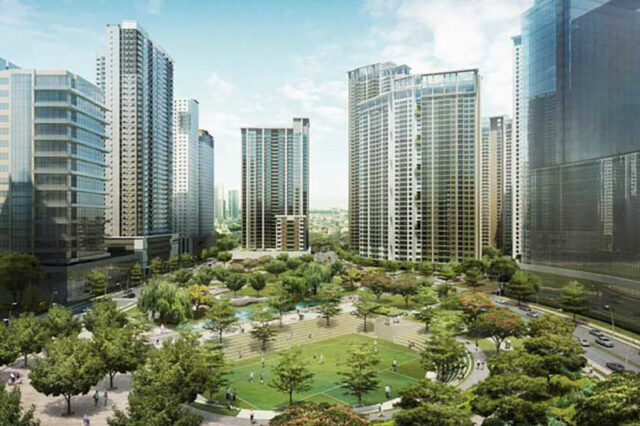
AYALALAND.COM.PH

SHARES in Ayala Land, Inc. (ALI) fell last week despite news of the property giant raising P2.78 billion by selling 75 million shares of AREIT, Inc.

Data from the Philippine Stock Exchange showed a total of 68.61 million ALI shares worth P1.88 billion were traded from Dec. 9 to 13, making it the fourth most actively traded issue based on value turnover during the week.

The listed property developer’s shares closed at P26.60 each on Friday, 6.3% lower than its Dec. 6 close of P28.40. Year to date, the stock declined by 22.8%.

Alexandra Margaux Denise G. Yatco, equity analyst at Regina Capital Development Corp., said that several key factors may have influenced the price action movement of Ayala Land. These include recent project kick-offs, higher completion rates, and residential and commercial bookings.

Additionally, Ms. Yatco also said that company-specific developments, such as receiving approval to gain full control of Cebu District Property Enterprise and plans to use Gatewalk Central as a strategic asset to enhance its presence in the Visayas region, could also be a factor.

“However, factors such as potential tariff adjustments and higher operating costs brought about by mall renovations could continue to weigh upon the firm,” she said in an e-mail.

For Aniceto K. Pangan, equity trader at Diversified Securities, Inc., the downtrend of Ayala Land may be due to “negative sentiments” regarding the latest economic developments.

The central bank, he said, may choose to maintain overnight lending rates given the rise in local inflation, and additionally, the peso depreciated last week, which further supports the case for keeping the overnight lending rates steady.

Headline inflation in November accelerated to 2.5% year on year from 2.3% in October, settling within the Bangko Sentral ng Pilipinas’ (BSP) 2.2%-3% forecast for the month. However, this was slower than the 4.1% posted a year earlier.

For the 11 months to November, inflation averaged 3.2%, slightly higher than the BSP’s 3.1% full-year baseline forecast.

Moreover, the BSP began its easing cycle in August with a 25-bp rate cut and then proceeded to deliver another 25-bp rate cut in October, which brings the key rate to 6%. BSP’s Monetary Board will hold its final policy meeting for the year on Dec. 19.

Last week, Ayala Land raised P2.78 billion by selling 75 million shares of AREIT, Inc., its real estate investment trust, at a price of P37 per share. The sale was done through a placement agreement with BPI Capital Corp., the investment banking division of the Bank of the Philippine Islands, and global financial services firm UBS AG Singapore Branch. These offered shares were sold to qualified institutional buyers both within and outside the United States, the company said.

The property developer added that the proceeds from the block sale will be settled on Dec. 12, which is subject to the terms and conditions of the placement agreement.

“This move could hold several meanings for the company’s outlook,” Ms. Yatco said, highlighting that the latest development of Ayala Land may post mixed sentiments from the market.

She noted that by selling AREIT shares, the property developer is reallocating its resources, which could help support its other business ventures. This move, she said, could signal confidence in AREIT’s projected profitability.

“If the market views the sale as a positive, then the stock could see a short-term boost,” she added. However, she also cautioned that if the sale is seen negatively, it could raise concerns over Ayala Land’s long-term strategy, which could potentially lead to a drop in stock price.

“The sale of their AREIT shares was mainly for fundraising to boost their capital expenditure for expansion,” Mr. Pangan said in a Viber message. He added that the company’s outlook remains positive, given the overall trend indicating a decrease in overnight lending rates, where notably, the offering was oversubscribed.

Mr. Pangan also said that with the continued lowering of overnight lending rates, this could sustain Ayala Land’s growth momentum at double-digit rates.

Ayala Land’s consolidated revenues increased by 24.4% year on year to P40.94 billion in the third quarter. This brought its nine-month top line to P125.21 billion, rising by 26.6%. During the July-September period, its attributable net income went up by 14.7% to P8.03 billion. The property developer’s nine-month attributable bottom line rose by 15% to P21.16 billion.

“Overall, [Ayala Land] has generally seen stable residential bookings, lot sales, and enhanced operational procedures, with its [third quarter] earnings seeing an increase in [net income] and revenues,” Ms. Yatco said.

She added that the bulk of its top line growth could be due to real estate revenues, which continue to advance its operations.

Additionally, investors who are looking to expand their property portfolio might consider adding the Ayala-led property developer given its historical performance, as well as upcoming launches and plans for mall and hotel renovations, Ms. Yatco said. She placed Ayala Land’s support levels at P26.30, while its resistance levels are at P28.

“There is a notable downward trend filled with several red candles, with the stock closing in the oversold region,” she said. Ms. Yatco added that selling pressure continues to persist, yet a potential reversal may be seen in the upcoming weeks.

For Mr. Pangan, he pegged immediate support at P26.40 per share, while immediate resistance is at P27.35 per share. — Abigail Marie P. Yraola
Analysts’ Expectations on Policy Rates (December 2024)

THE BANGKO SENTRAL ng Pilipinas (BSP) is expected to continue its rate-cutting cycle at its last policy review for the year on Thursday, analysts said. Read the full story.

Analysts’ Expectations on Policy Rates (December 2024)

How PSEi member stocks performed — December 13, 2024

Here’s a quick glance at how PSEi stocks fared on Friday, December 13, 2024.


Volatility likely as market eyes Fed, BSP reviews

REUTERS

THE STOCK MARKET may see heightened volatility this week as investors await the policy meetings of the US Federal Reserve and the Bangko Sentral ng Pilipinas (BSP).

On Friday, the Philippine Stock Exchange index (PSEi) declined by 0.37% or 24.84 points to close at 6,616.51, while the broader all shares index increased by 0.08% or 3.34 points to 3,752.73.

Still, week on week, the PSEi climbed by 1.67% or 112.63 points from its 6,729.14 close on Dec. 6.

“The local market is still moving sideways with a bearish bias as investors maintain a cautious stance, dealing with lingering headwinds while waiting for positive leads,” Philstocks Financial, Inc. Senior Research Analyst Japhet Louis O. Tantiangco said in a Viber message.

“Chart-wise, the market has so far been unable to get past its 10-day exponential moving average. On a positive note, the market is holding its position above the 6,600 level,” Mr. Tantiangco said.

For this week, the Fed and BSP meetings will be the main trading drivers for the market, he said.

“Investors are expected to look forward to the policy rate decisions of the Federal Reserve and the Bangko Sentral ng Pilipinas. A rate cut from the two as well as hints of further easing are expected to give a boost to sentiment which in turn could help the market achieve a positive close,” he added.

“We expect heightened trading activity and price movement this week as investors anticipate and react to the upcoming policy rate decisions of the Federal Reserve and BSP. Both are expected to cut their respective interest rates by 25 basis points (bps), which should encourage some bullishness,” Juan Paolo E. Colet, managing director at Chinabank Capital Corp., said in a Viber message. “Investors, however, will be keeping a very close eye on each institution’s outlook for rate cuts next year. Any hint of fewer, slower, or no rate cuts could trigger stock market volatility.”

Mr. Colet put the PSEi’s immediate support at 6,550 and resistance at 6,750-6,850.

The Fed will hold its last policy meeting for the year on Dec. 17-18, while the BSP’s Monetary Board is scheduled to have its own review on Dec. 19. Markets widely expect both central banks to continue their respective easing cycles and cut benchmark interest rates by 25 bps this week.

Mr. Tantiangco added that investors will also monitor the peso’s performance against the dollar this week.

“A further depreciation of the local currency may weigh on the bourse,” he said.

He placed the PSEi’s immediate support at 6,600 and major resistance at 6,000.

“From a valuation standpoint, the local market remains at attractive levels and is hence good for bargain hunting. However, investors are expected to continue waiting for positive catalysts before getting into the market strongly,” Mr. Tantiangco added. — Sheldeen Joy Talavera

Cautious trading seen before central bank policy decisions

MARI GIMENEZ-UNSPLASH

THE PESO is seen trading sideways against the dollar this week as the Bangko Sentral ng Pilipinas (BSP) and US Federal Reserve hold their last policy meetings for 2024.

The local unit closed at P58.47 per dollar on Friday, weakening by 23 centavos from its P58.24 finish on Thursday, Bankers Association of the Philippines data showed.

Week on week, the peso likewise depreciated by 73.5 centavos from its P57.735 finish on Dec. 6.

The peso declined on Friday amid a stronger dollar following the release of key US inflation reports that could affect the Fed’s rate-cut cycle, a trader said by phone.

The move of Indonesia’s central bank to defend the rupiah also affected regional currencies on Friday, Rizal Commercial Banking Corp. Chief Economist Michael L. Ricafort said in a Viber message.

The dollar headed for its best weekly performance in a month on Friday, as investors priced in the possibility of the Federal Reserve cutting rates more slowly next year, Reuters reported.

The US currency also rose against the yen after reports that the Bank of Japan could forgo a rate hike at its meeting this week.

The dollar index, which measures the currency against six others, was up 0.037% at 107, set for a weekly gain of nearly 1%, its biggest in a month.

US data on Thursday showed the job market is gradually cooling in line with expectations, while producer price inflation helped reinforce the market’s current scenario of a Fed cut on Dec. 18, but a slower pace of reductions in 2025.

Markets fully expect a cut at the upcoming meeting, but only price a roughly 24% chance of another one in January, with March the most likely point for another move, according to CME’s FedWatch tool.

The dollar rose 0.69% to 153.695 yen, its highest since late November.

Meanwhile, Indonesia’s central bank has intervened in the foreign exchange (FX) market in what it called a “bold” way to maintain market confidence in the rupiah, which fell to a four-month low against the dollar earlier on Friday.

“We entered the market with a quite bold triple intervention,” Bank Indonesia’s head of monetary management department, Edi Susianto, told Reuters.

The triple intervention is referring to interventions the central bank conducted in the spot FX market, domestic non-deliverable forwards and buying of government bonds in the secondary market.

For this week, the trader said the peso’s movement against the dollar will depend on the policy decisions of the Fed and the BSP.

The trader sees the peso moving between P58.25 and P58.75 per dollar this week amid “cautious trading” before the central banks’ reviews, while Mr. Ricafort expects the local unit to range from P58.15 to P58.65.

The Fed will hold its last policy review for the year on Dec. 17-18. Investors bet that Fed Chair Jerome H. Powell will signal a pause in policy easing after a widely expected 25-basis-point (bp) rate cut this Wednesday, Reuters reported.

The US central bank started its easing cycle in September with a 50-bp cut and followed it up with a 25-bp reduction at its November review, bringing the fed funds rate to the 4.50%-4.75% range.

Meanwhile, a BusinessWorld poll conducted last week showed that 13 out of 16 analysts expect the BSP Monetary Board to reduce benchmark rates by 25 bps at its policy meeting on Dec. 19 (Thursday), which would bring the target reverse repurchase rate to 5.75% from the current 6%.

The BSP kicked off its rate-cut cycle in August with a 25-bp reduction and slashed borrowing costs by another 25 bps in October. — A.M.C. Sy with Reuters

Proposed 2025 national budget may need to be vetoed, analysts say

BW FILE PHOTO

By Kenneth Christiane L. Basilio and Kyle Aristophere T. Atienza, Reporters

PRESIDENT Ferdinand R. Marcos, Jr. should veto the budget bill approved by Congress as it may be in violation of the 1987 Philippine Constitution and various laws, analysts said over the weekend.

“The veto must apply to the whole budget. The PhilHealth problem is inextricably connected to the corruption or bastardization of the whole budget,” Filomeno S. Sta. Ana III, coordinator of Action for Economic Reforms, said in a Viber message. “The whole budget violates several laws and ultimately, the Constitution.”

Their decision to cut the proposed P74-billion subsidy for the Philippine Health Insurance Corp.’s (PhilHealth) for next year violated the 2019 Universal Healthcare Act and the 2012 Sin Tax Reform Law, according to Mr. Sta. Ana.

“Mr. Marcos must immediately order Congress to legislate a new budget bill. Ensure that the budget for PhilHealth will cover the correct premiums of all indirect contributors and restore the budget cuts that Congress did to essential services like education,” he added.

Mr. Sta. Ana was referring to the P10-billion budget cut made to the education sector and funding for the Public Works department that led to a 29.7% increase to P1.1 trillion.

This dwarfed the total allocations for the education sector with the Education department’s budget inching down by 1.47% to P737 billion from P748 billion. The Commission on Higher Education was allocated P33.3 billion from P60.2 billion, while state universities and colleges were given P122 billion from P114 billion, initially.

The budget of the Technical Education and Skills Development Authority was not indicated in the bicameral conference committee report of the budget, a copy of the approved committee report of the budget bill showed.

The Philippine Constitution states that the education sector should receive the “highest budgetary priority.”

“The 1987 Constitution mandates… that the State should give priority to education,” National Union of Peoples’ Lawyers President Ephraim B. Cortez said in a Viber message.

“Taken from this perspective, this imposes a duty on the government to prioritize education in its plans and therefore should also be given priority in the allocation of the budget,” he added. “From this point… giving a higher budget to public works is unconstitutional.”

The Office of Party-list Rep. Elizaldy S. Co, who heads the House appropriations committee, did not immediately respond to a Viber message seeking comment. Marikina Rep. Stella Luz A. Quimbo and Party-list Rep. Raul Angelo D. Bongalon, members of the House contingent for the 2025 budget bill’s joint panel, have also yet to respond to Viber message.

Mr. Cortez, however, said in a Viber message that while the Philippine president is vested with the power to veto any measures passed by Congress, the said authority is limited to vetoing specific line-items within budget bills.

“The Constitution is silent as to whether he can veto an appropriations bill in its entirety. Though he has a general veto power, this particular provision in the Constitution, the line-item veto, is made specifically applicable to an appropriations bill,” he said.

A general veto of the budget bill would result in the reenactment of the 2024 spending plan, according to Hansley A. Juliano, who teaches political science at the Ateneo de Manila University. 

“A veto simply means the reuse of the 2024 budget. We have built in structures to ensure the government never shuts down.”

Senator Mary Grace Natividad S. Poe-Llamanzares, who led the Senate contingent of the Bicameral Conference Committee, had explained last week that PhilHealth could tap P600 billion in its reserve funds.   

Advocates have however flagged PhilHealth’s fiscal health as its reserve fund is not enough to shoulder projected liabilities beyond two years, urging the President to return the budget to Congress. 

“The President can return the budget to Congress and ask for funding for PhilHealth and while at that, fix the national budget to reflect the national agenda of prioritizing education and health,” said former Finance Undersecretary Cielo D. Magno, who teaches at the University of the Philippines School of Economics.

The post-dictatorship 1987 Constitution gives the President the power to exercise line-item veto in an appropriation, revenue, or tariff bill “but the veto shall not affect the item or items to which he does not object.”

But Congress may reconsider the veto by a vote of two-thirds of all the members of the House.

Health advocate Anthony C. Leachon, who advised the Department of Health during the pandemic, said removing the government’s subsidy for PhilHealth would violate the Sin Tax Law and the Universal Health Care law “since lawmakers have not allocated funds to reduce the out-of-pocket expenses of Filipino patients.”

The Sin Tax Reform Acts of 2012 and 2019 mandated the government to allocate 80% of revenues from tobacco products and sugar-sweetened beverages for PhilHealth to fund the country’s universal health care program.

“If the President signs the proposed budget, he will go down in history as one of the misinformed presidents who don’t value the health of the people,” he said in an X message.

Failing to cure the contentious budget will “push us again in the dark ages begging for funds from politicians” through dole-outs, he added, citing substantial increases in the cash subsidy programs of the Department of Social and Welfare Development and the Department of Labor and Employment.

Financial expert Enrico P. Villanueva, who teaches money and banking at the University of the Philippines Los Baños, said while PhilHealth may have enough reserve fund to pay for net expenses for two years, “its reserve fund is way below the required provision for projected liabilities beyond two years.”

“PhilHealth has passed on reserve deficiency to the members and charged it against members’ equity,” he said in an X message.

“So paying members are already paying for the mismanagement of the fund. Member’s equity is in fact already negative, rendering PhilHealth as a balance sheet insolvent, with member’s effectively thrust into debt.”

Section 11 of the Universal Health Care Act of 2019 mandated Philhealth to have a reserve fund enough to cover their operations for two years, Ms. Magno also noted.

The law ordered the agency to use its excess reserve fund to enhance program benefits for and reduce the contributions of its members.

In its Statements of Changes in Equity, as of December 31, 2023, PhilHealth booked a reserved fund of P464.2 million.

Its provision for insurance contract liabilities stood at P1.127 trillion, while its total members’ equity reached P663.7 billion.

The agency logged P89.9 billion in unused subsidies in the past three years, P38.8 billion of which was in 2023 and P24 billion in 2022.

“If you look at the financial documents of PhilHealth, if we consider its insurance contract liability, we can see that the fiscal position of PhilHealth is actually negative,” Ms. Magno said.

The health insurer transferred P20 billion and P10 billion of its unused funds to the Bureau of the Treasury on May 10 and Aug. 21, respectively, in compliance with a Department of Finance circular.

The move is now challenged by members of civil society and former government officials before the Supreme Court.

“Reserves are not surpluses. Reserves are contingent funds needed to provide for expanded healthcare services,” Mr. Leachon said. “Any preneed fund manager knows that a fund must always be larger than current demand.”

“The fund transfer out of PhilHealth this year and the non-payment by the government of PhilHealth subsidy for the non-paying members weakens not only the cash position of PhilHealth but also its reserve level and equity. In computing the insurance reserves, PhilHealth assumes government subsidy,” Mr. Villanueva said.

“Taking the subsidy away increases the required provision for liabilities. The government, unintentionally or deliberately, is screwing the corporation and the Filipino people several times over,” he added.

Reduced DepEd budget could hurt initiatives to address learning crisis

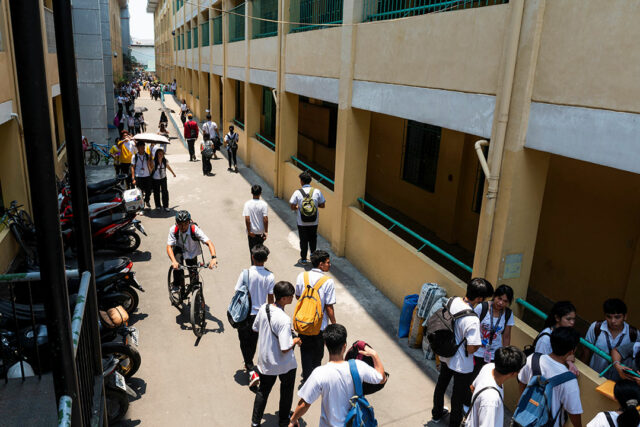
Students walk inside the campus of a high school in Quezon City, April 18, 2024. — REUTERS

By John Victor D. Ordoñez, Reporter

PHILIPPINE lawmakers’ move to cut the Department of Education’s (DepEd) 2025 budget by P12 billion will likely stall efforts to address the country’s learning crisis and poor student performance, analysts said at the weekend.

“The P12-billion cut in the DepEd budget is concerning especially in the context of the learning crisis that the Philippines faces,” John Paolo R. Rivera, a senior research fellow at the Philippine Institute for Development Studies, said in a Viber message.

“With the country ranking poorly in global assessments, such a reduction may hinder the implementation of critical programs, including the enhancement of basic education facilities, teacher training, and curriculum reforms.”

He said the lack of funding could worsen problems such as overcrowding in classrooms and a lack of reforms in teacher training and curricula.

The P6.352-trillion national budget, as approved and ratified by Congress, earmarked some P737.08 billion for the Education department, which is lower than the P748.65 billion proposed by the House.

In the Organization for Economic Cooperation and Development’s (OECD) 2022 Programme for International Student Assessment (PISA) published on Nov. 14, Filipino students showed among the highest levels of mathematics anxiety among 15-year-old students globally.

Previously, 16% of Filipino students attained at least Level 2 proficiency in mathematics, significantly lower than the 69% average across OECD countries.

Filipino students were also among the world’s weakest in mathematics, reading and science as the Philippines ranked 77th out of 81 countries in all categories, performing worse than the global average in another PISA 2022 assessment.

The Philippines also ranked 63rd out of 64 countries in the OECD’s global assessment that ranked 15-year-old students worldwide in producing and evaluating original ideas that would translate into effective solutions.

In a statement on December 12, Education Secretary Juan Edgardo “Sonny” M. Angara said the budget cut was meant for computers and gadgets for public school use.

“That could have funded thousands of computers/gadgets for our public school children,” he said. “Infrastructure is important but so is investing in our people and human capital. The digital divide will widen.”

The House contingent to the Bicameral Conference Committee on Sunday justified the P10-billion budget cut, pointing out the agency’s glaring inefficiency and alleged fund mismanagement.

“Secretary Angara may argue that education funding is sacrosanct, but Congress cannot keep throwing good money after bad. This is not about depriving education; it’s about ensuring proper fund use and accountability,” Party-list Rep. Ramon Rodrigo L. Gutierrez said in a statement.

“As former Senate Finance Committee chair, Sec. Angara knows that the law is clear: unused funds must be accounted for before new allocations can be made. Now that he’s education secretary, he should focus on fixing DepEd’s internal mess. Congress cannot turn a blind eye to these issues” he said.

Mr. Gutierrez cited the Commission on Audit report which revealed that DepEd disbursed only P2.075 billion of its P11.36-billion budget for information and communication technology equipment in 2023.

“DepEd will have little resource to implement strategic projects to address the learning crisis,” Zy-za Nadine M. Suzara, a public budget analyst and former executive director of policy think tank Institute for Leadership, Empowerment and Democracy.

The Second Congressional Commission on Education (EDCOM II) and the Philippine Institute for Development Studies (PIDS) said in a report in May that there is a “severe underinvestment” in the welfare of very young children in the Philippines, causing their early education to suffer.

The Southeast Asian nation also placed 22nd out of 111 countries in the 2022 English Proficiency Index by Education First.

Senator Sherwin T. Gatchalian, who heads the basic education committee, earlier lamented a P4-billion reduction in spending plan for free college education programs

State universities and colleges will get P122.16 billion under the reconciled budget bill.

“The country may not reap the demographic dividend of a young population if the youth are unskilled and ill-equipped for the knowledge economy,” Enrico P. Villanueva, a senior lecturer at the University of the Philippines Los Baños Economics Department, said in an X message.

“The supposed demographic dividend may morph into a societal burden, trapped in low-paying, low value-added job in agriculture, basic industries or tourism services.” with a report from Kenneth Christiane L. Basilio

Securing cybersecurity deals could boost pool of experts

REUTERS

By John Victor D. Ordoñez, Reporter

THE PHILIPPINE government should secure more deals with cybersecurity industry players and international universities to boost Manila’s pool of cybersecurity experts as it tries to beef up defenses before the midterm elections next year.

“To boost its pool of cyber experts, the government should prioritize partnerships with Academia and Industry: Foster collaborations between government, universities, and industry leaders to align cybersecurity education with market needs,”  Dominic Vincent D. Ligot, founder of CirroLytix Research Services and a consultant for the Information Technology (IT) and Business Process Association of the Philippines, told BusinessWorld in an e-mail.

This comes after the Marcos administration added a bill that seeks to strengthen Philippine cybersecurity to its list of priority measures.

“The law should provide funding for research and development in cybersecurity and support training programs for cybersecurity professionals. It should also encourage public education campaigns to promote cyber hygiene,” Ronald B. Gustilo, national campaigner for Digital Pinoys, said in a Viber message.

Department of Information and Communications Technology (DICT) Undersecretary Jeffrey Ian C. Dy earlier told reporters the National Cybersecurity bill would include fines and administrative penalties against groups that operate critical information infrastructure that fail to report cyberattacks to the government.

In 2022, the Philippines only had about 200 cybersecurity professionals compared with 2,000 in Singapore, DICT Secretary Ivan John E. Uy earlier said, noting that 80% of Filipino cyber experts work overseas.

Mr. Uy said the government is finding it hard to attract more cybersecurity experts due to lower pay at about P50,000 a month, compared with about P200,000 in the private sector.

Mr. Ligot also cited the need to invest in robust technology to reduce the likelihood of human error in maintaining critical state infrastructure.

“This includes better identity management solutions, secure authentication methods, and user training that emphasizes the importance of cybersecurity in everyday activities,” he said.

Last year, the Philippine Health Insurance Corp. was hit by Medusa ransomware, with more than 600 gigabytes of data stolen by hackers.

The DICT has identified and addressed more than 20,144 vulnerabilities in state cybersecurity systems this year, DICT Undersecretary David L. Almirol, Jr. told a Senate hearing in October.

“The law should ensure regular updates and reviews to keep pace with technological advancements and establish a monitoring body to ensure compliance and effectiveness of the law,” Mr. Gustilo said.

Groups renew call for labor reforms amid faster inflation

PNA PHOTO BY JOEY O. RAZON

By Chloe Mari A. Hufana, Reporter

PHILIPPINE labor groups cited an across-the-board wage increase and the end of contractualization as their top wish list for the upcoming holidays, emphasizing these measures as essential to addressing the rising cost of living and improving job security for millions of Filipino workers.

Trade Union Congress of the Philippines (TUCP) Legislative Officer Carlos Miguel S. Oñate urged the House of Representatives to pass the proposed P150 legislated wage hike, complementing the Senate’s earlier initiative for a P100 minimum wage increase.

“Amid token increases by the regional wage boards, the TUCP’s P150 wage hike proposal should be recognized for what it truly is: an urgent and priority measure that the House of the People must pass,” Mr. Oñate told BusinessWorld in a Viber message over the weekend.

University of the Philippines Diliman School of Labor and Industrial Relations Assistant Professor Benjamin B. Velasco noted that high prices and low wages top workers’ grievances, adding a reform on the wage fixing mechanism is urgently needed.

“The regional wage system — called provincial rates by some — is an epic failure. Minimum wages are poverty wages, even below [the] official poverty threshold per region,” he told BusinessWorld in a Facebook Messenger chat over the weekend.

“It is high time to consider the call for a national minimum indexed to inflation and anchored on the living wage mandate of the Constitution.”

Twelve regions have so far issued wage orders, including National Capital Region, Cordillera Administrative Region, I, II, III, IVA, MIMAROPA, VI, VII, VIII, IX and XII.

Regions X (Northern Mindanao) and XIII (Caraga) are in the final stages of the minimum wage determination process after completing their November and December 2024 public hearings.

Region XI (Davao Region) is scheduled to start in January 2025, while Region V (Bicol Region) is still assessing its conditions and recovery after the devastating effects of typhoons on communities and businesses.

Federation of Free Workers (FFW) President Jose Sonny G. Matula, likewise, emphasized that an across-the-board entry-level wage hike is essential for addressing the higher cost of living and advancing towards a living wage nationwide.

In November, headline inflation picked up to 2.5% year on year from 2.3% in October, but it was slower than 4.1% in the same month a year ago. This brought average inflation to 3.2% in the 11 months.

‘REAL’ SECURITY OF TENURE
Mr. Matula also cited in a Viber message to BusinessWorld the abolition of contractualization, more popularly known as endo (end of contract) in the Philippines, as one of the group’s wishes for the upcoming year.

Endo schemes terminate employment before a worker’s tenure hits six months, the period which by law triggers regular employee status.

He added to ensure job security, workers must have a legal framework through “a real Security of Tenure Act.”

For Mr. Oñate, the Security of Tenure Bill of the previous administration must also be revisited.

“Fixed-term contracts continue to be weaponized to evade employer obligations, fueling cyclical unemployment that often worsens after this holiday ‘Ber Months’ season,” he said.

“Not only in the private sector through our TUCP Security of Tenure Bill but also in the public sector through the TUCP bill on civil service equivalency providing for automatic civil service eligibility and plantilla positions for all our government job orders and contracts of service who have served at least 3 years.”

National President of  Bukluran ng Manggagawang Pilipino Renecio “Luke” S. Espiritu said the labor movement next year will continue to campaign for living wages, anti-contractualization, lower prices and public services for Filipinos.

His proposed reforms with the initials “PSST!” (Presyo, Sahod, Serbisyo at Trabaho), pushed for a P750 across-the-board legislated wage hike with the abolition of provincial rate and end of contractualization among others.

Meanwhile, social protection for informal workers in the digital economy — such as app-based and web-based workers — needs urgent attention, according to Mr. Velasco.

“Treating them as independent workers — that is, with social security and other types of social protection, like health and accident insurance, by their putative employers — the apps and platforms — is an improvement over their current status as freelancers,” he said, noting that Mexico recently joined the growing list of countries regulating app workers to improve conditions.

For traditional informal workers, such as street vendors and jeepney drivers, Mr. Velasco emphasized that the 2022 Department of Labor and Employment-International Labour Organization social protection floor study must move from planning to action.

“There is money to subsidize social protection. Just look at the proposed 2025 General Appropriations Act — in which there are billions for Ayuda sa Kapos ang Kita Program (AKAP), Assistance to Individuals in Crisis Situation (AICS) and Tulong Panghanapbuhay sa Ating Disadvantaged/Displaced Workers (TUPAD). But these are full subsidies for [traditional politicians] facing electoral contests.”

Probe on PhilHealth transfer eyed

PNA/JOAN BONDOC

A CONGRESSMAN on Sunday said he would file a resolution at the House of Representatives to investigate state-run Philippine Health Insurance Corp.’s (PhilHealth) investment and reserve funds.

The proposed congressional inquiry comes after lawmakers decided to cut PhilHealth’s 2025 subsidy for accumulating billions worth of reserve funds.

Party-list Rep. Raul Angelo D. Bongalon, a vice-chairperson of the House appropriations committee, said PhilHealth failed to expand its health benefits or reduce its premiums despite having over P700 billion in reserve funds, with P500 billion in investment funds.

“At just a conservative 4% annual interest, P500 billion could yield P20 billion in income. How much does PhilHealth really make from its investments? Where do they place the funds, and who decides where it’s invested? Most importantly, what’s the criteria for these investments?” Mr. Bongalon asked.

PhilHealth did not immediately respond to an e-mail and Facebook Messenger chat seeking comment. — Kenneth Christiane L. Basilio

DoJ, DILG expand GCTA benefits

BUCOR

THE Department of Justice (DoJ) and Department of Interior and Local Government (DILG) has revised the Implementing Rules and Regulations (IRR) of the penal code, allowing prisoners convicted of heinous crimes to benefit from Good Conduct Time Allowance (GCTA).

In his remarks, Justice Undersecretary Raul T. Vasquez conveyed Secretary Jesus Crispin C. Remulla’s message, emphasizing that the 2024 revised IRR of Republic Act 10592, the Revised Penal Code, as amended, is part of the government’s efforts to decongest correctional facilities and jails.

Mr. Vasquez said that about 8,000 prisoners under the Bureau of Corrections (BuCor) and 1,000 under the Bureau of Jail Management and Penology are expected to benefit from this policy change.

The BuCor last year freed over 8,000 prisoners, more than double its original commitment to the United Nations Human Rights Council to release 300 convicts monthly.

BuCor Director-General Gregorio Pio P. Catapang, Jr. also reported progress in reducing the congestion rate of the New Bilibid Prison from 350% to 250%, with further reductions expected as new facilities across the country are completed. 

These developments align with BuCor’s modernization initiatives under the Philippine Development Plan, which include: expanding the e-dalaw system, livelihood programs, and rehabilitation mechanisms for prisoners; streamlining processes for parole and probation to facilitate the release of qualified prisoners; and constructing and repairing penal facilities nationwide. — Chloe Mari A. Hufana

Fund wage hikes, not AKAP — group

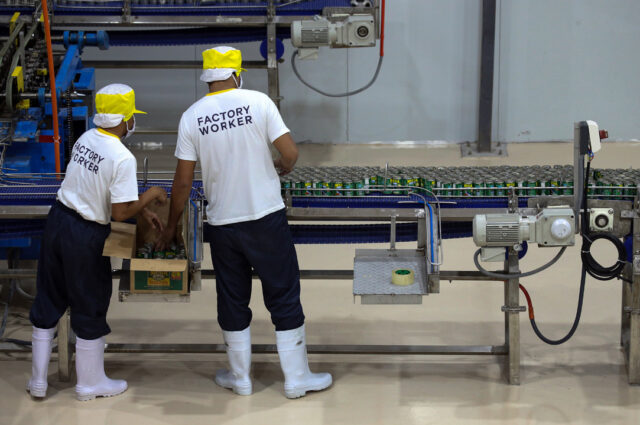
Workers are at an assembly line in a canned goods manufacturing facility. — PHILIPPINE STAR/KJ ROSALES

A POLITICAL GROUP on Sunday called on lawmakers to legislate a wage hike instead of allocating funds to a Social Welfare department’s indigent aid program for next year, which it said is a “band-aid solution” to the inadequate salary levels of ordinary Filipinos.

Philippine lawmakers last week opted to provide P26 billion to the Ayuda Para sa Kapos ang Kita Program (AKAP), which is 29.4% lower than the initial P39-billion funding proposed by the House of Representatives.

The AKAP is a Department of Social Welfare Development (DSWD) program that provides financial assistance to workers whose income falls below the poverty threshold. It provides one-time cash assistance between P3,000 to P5,000 to eligible beneficiaries.

“The P26.159 billion allocated for AKAP in the 2024 budget would be better spent on implementing substantial wage increases for both public and private sector workers. What our people need is not temporary ayuda but a living wage that can sustain their families,” Neri J. Colmenares, one of Bayan Muna party-list’s nominees in the midterm elections next year, said in a statement.

“We demand that instead of temporary dole-outs, the government should legislate substantial wage increases and implement genuine economic reforms that will benefit workers and their families,” he added. — Kenneth Christiane L. Basilio