Home Blog Page 1830

Winds, warmth and relentless drought fueled Los Angeles fires, scientists say

A woman reacts as she evacuates following powerful winds fueling devastating wildfires in the Los Angeles area, at the Eaton Fire in Altadena, California, U.S. Jan. 8, 2025. — REUTERS

SCIENTISTS said the wind-whipped wildfires tearing across the arid Los Angeles landscape mark the latest in climate-fuelled weather extremes that are likely to escalate further as global temperatures continue to climb.

Erupting well outside of the traditional wildfire season, the California blazes were spreading quickly on Wednesday.

For California, scientists now consider fire to be a yearlong risk. The western US state has also seen increasingly massive conflagrations in recent years, with more acreage burned amid drying conditions and shifting weather trends.

“Climate change is reshaping the regimes – the characteristic patterns of wildfire in a region,” said Kimberley Simpson at the School of Biosciences at the University of Sheffield.

Within hours of weather alerts warning of extreme winds and dry conditions in the L.A. area Tuesday night, parts of the iconic desert city were ablaze.

Sparks jumped highways and set rooftops alight. Palm trees flared up like matchsticks against the night sky. By Wednesday morning, tens of thousands of people were fleeing their homes as the fires burned out of control.

Los Angeles, spanning a corner of the Southern California desert, is no stranger to wild winds and warm, dry weather, with its famed Santa Ana winds blowing regularly across the landscape toward the coast. Amid dry winter conditions, it is not uncommon for rapid winds to develop, said Brent Walker with Britain’s Met Office.

However, the atmospheric event fuelling the L.A. fires isn’t a typical Santa Ana downslope event. Instead, anomalously strong winds are blowing off the back of a strangely shaped storm system over the lower Colorado River Valley and being amplified by what scientists call a “mountain wave” event.

A mountain wave phenomenon occurs when there are certain temperatures above a mountain range and particular winds passing over those mountains.

“When those conditions line up perfectly, it does behave just like a wave in the ocean, when the winds flow over the mountains and then come crashing down on the other side,” said scientist Paul Schlatter with the National Weather Service in Boulder, Colorado.

“Just the strength of those (storm system) winds and a little bit of the mountain wave enhancement is really what’s fuelling those fires,” Mr. Schlatter said.

A similar mountain wave occurred around Colorado’s fast-moving Marshall Fire on Dec. 30, 2021, which was fanned by downslope winds gusting at up to 115 mph and wiped out thousands of homes and businesses before being snuffed out by snowfall the following night. “Any fire under those conditions is going to go quickly out of control,” Mr. Schlatter said.

This week’s snowstorms over the San Bernardino Mountains, roughly a two-hour drive from Los Angeles, could also be contributing to the regional wind dynamics.

Meanwhile, area forecasters expect a Santa Ana wind event later this week.

FUEL MATTERS
Ahead of the fires, the US National Weather Service issued several alerts for the heavily populated region — warning of the fire risk and “critically dry fuels,” meaning the arid landscape of shrubs, palms, grasses and hardwoods was ready to burn.

As California’s average temperature has warmed by roughly 1 degree Celsius (2.5 degrees Fahrenheit) since 1980, the number of days with dry vegetation – vulnerable to fire – has doubled, said fire management expert Lindon Pronto at the European Forest Institute.

“Eventually you have a compounding effect where you see much more extreme fire behaviour at different times of the year … whether it’s in December or January,” he said.

Beyond the chaparral and eucalyptus trees, Los Angeles’ densely populated urban landscape also includes flammable material with hanging power cables, wooden telephone poles and homes built with wood in accordance with earthquake codes.

Wood construction was also a major factor in the rapid spread of the 2023 fire in Hawaii’s historic city of Lahaina and the massive destruction in its wake.

Scientists warned of other hazards amid the fire, including the risk of rockslides from steep slopes after vegetation burns away, or exploding propane tanks, gas lines or other hazardous material as fire moves into people’s storage spaces and industrial areas.

“There’s, there’s a massive amount of just hazardous material in all of these homes which are on fire,” Mr. Pronto said. — Reuters

Several celebrities lose their homes as wildfires rage on

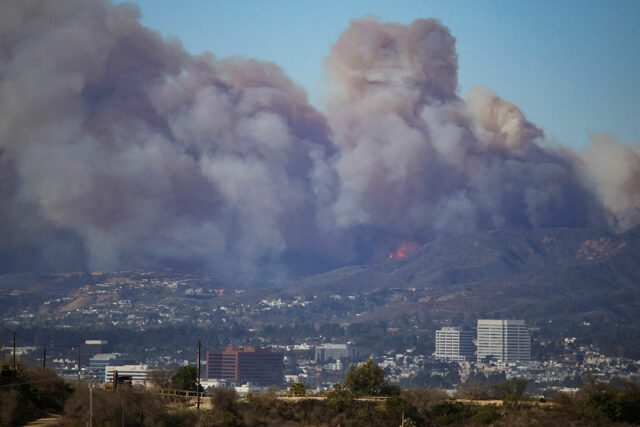
SMOKE rises from a wildfire burning near Pacific Palisades on the west side of Los Angeles during a weather driven windstorm, in Los Angeles, California, Jan. 7, 2025. — REUTERS

A HOME reportedly belonging to Hollywood actors Leighton Meester and Adam Brody was one of more than 1,000 buildings destroyed by wildfires raging across Los Angeles, including a blaze that started on Wednesday in the Hollywood Hills.

Jamie Lee Curtis, Mandy Moore, Maria Shriver and other celebrities were among more than 100,000 people forced to evacuate their homes to escape the out-of-control fires burning in some of Los Angeles’ most desirable areas.

The largest blaze consumed nearly 12,000 acres (4,856 hectares) in Pacific Palisades, a picturesque neighborhood between the beach towns of Santa Monica and Malibu that is home to many film, television and music stars.

Mr. Brody, best known for his roles in TV series The O.C. and Nobody Wants This, and Mr. Meester, who starred in Gossip Girl, bought their Pacific Palisades home in 2019 for $6.5 million, according to real estate and entertainment websites.

Ms. Shriver, a journalist and the former first lady of California when she was married to former Governor Arnold Schwarzenegger, said the destruction in the upscale enclave was devastating.

“Everything is gone. Our neighborhood, our restaurants,” she wrote on X on Wednesday.

“The firefighters have and are doing their best,” Shriver added, “but this fire is massive and out of control.”

The day after actor James Woods evacuated his house in Pacific Palisades, he said “every house around us was on fire.”

“We were literally in the exact epicenter of the fire as it started,” Mr. Woods, known for roles in Ghosts of Mississippi and Any Given Sunday, said on CNN on Wednesday. “There was so much chaos. It was like an inferno.”

HOLLYWOOD HILLS BURN
On Wednesday evening, a fire erupted in the Hollywood Hills and quickly doubled in size, forcing further evacuations in an area synonymous with the entertainment industry

Though relatively small compared to the others, the Sunset Fire burned just above Hollywood Boulevard and its Walk of Fame. It would need to cross the 101 Freeway to endanger the Hollywood sign and Griffith Observatory further up in the hills.

Within that area is the Dolby Theater, where the Oscars are held. Next week’s Oscar nominations announcement was already postponed by two days because of the fire, organizers said.

This weekend’s Critics Choice Awards was also delayed by two weeks, organizers said.

With a median home price of $4.5 million, Pacific Palisades is home to celebrities as well as the Getty Villa, one of the most popular museums in Los Angeles.

Oscar winner Jamie Lee Curtis said she was safe but “my community and possibly my home is on fire.”

“It is a terrifying situation,” Curtis wrote on Instagram.

“Pray if you believe in it and even if you don’t, pray for those who do.”

Mandy Moore, known for television series This is Us, said she and her family had evacuated because of the proximity of the flames.

“So gutted for the destruction and loss,” she wrote on Instagram. “Don’t know if our place made it.”

Media personality Paris Hilton’s beachfront mansion in Malibu, bought for $8.4 million according to media, was among the homes burned down.

She said she was “heartbroken beyond words.”

“Sitting with my family, watching the news, and seeing our home in Malibu burn to the ground on live TV is something no one should ever have to experience,” Ms. Hilton wrote on X.

Several other fires were burning around the city. Film permits were revoked in Pasadena and other areas east of Los Angeles at the request of fire officials, according to permitting organization FilmLA.

Production of TV shows including Jimmy Kimmel Live and Grey’s Anatomy was halted on Wednesday, and several film premieres were called off.

Actor Mark Hamill, known for playing Luke Skywalker in the Star Wars films, said the blaze was the “most horrific” since 1993.

He said on Instagram that he evacuated his home in Malibu on Tuesday evening with his wife and dog.

“There (were) small fires on both sides of the road as we approached,” the Pacific Coast Highway, he said. — Reuters

China discovers cluster of new mutated mpox strain

AN ILLUSTRATION of mpox virus particles. — FRED HUTCH CANCER CENTER/HANDOUT VIA REUTERS

HONG KONG — Chinese health authorities said on Thursday they had detected the new mutated mpox strain clade Ib as the viral infection spreads to more countries after the World Health Organization (WHO) declared a global public health emergency last year.

China’s Centre for Disease Control and Prevention said it had found a cluster outbreak of the Ib subclade that started with the infection a foreigner who has a history of travel and residence in the Democratic Republic of the Congo.

Four further cases have been found in people infected after close contact with the foreigner. The patients’ symptoms are mild and include skin rash and blisters.

Mpox spreads through close contact and causes flu-like symptoms and pus-filled lesions on the body. Although usually mild, it can be fatal in rare cases.

WHO last August declared mpox a global public health emergency for the second time in two years, following an outbreak in the Democratic Republic of Congo (DRC) that spread to neighboring countries.

The outbreak in DRC began with the spread of an endemic strain, known as clade I. But the clade Ib variant appears to spread more easily through routine close contact, including sexual contact.

The variant has spread from DRC to neighboring countries, including Burundi, Kenya, Rwanda and Uganda, triggering the emergency declaration from the WHO.

China said in August last year it would monitor people and goods entering the country for mpox.

The country’s National Health Commission said mpox would be managed as a Category B infectious disease, enabling officials to take emergency measures such as restricting gatherings, suspending work and school, and sealing off areas when there is an outbreak of a disease. Reuters

In first, Cuba leases farmland to foreign firm

JCOMP-FREEPIK

HAVANA — Cuba said on Wednesday it had leased farmland to a Vietnamese company to grow rice, a first since the 1959 revolution which kicked all foreign landowners out.

The Communist Party daily, Granma, said a state agricultural company had partnered with the unnamed firm for three years to cultivate the grain on 3,000 hectares (7,413 acres) in western Pinar del Rio province, hinting the lease and acreage would be extended.

“For the first time, a process of handing over land to a foreign company is being carried out to take charge of its cultivation,” engineer Jorge Feliz Chamizo, who is the deputy director of the Granos de Los Palacios agroindustrial company, was quoted as stating.

Cuba consumes up to 700,000 metric tons of rice annually, most imported from Vietnam.

But the import dependent county’s main staple has been in short supply in recent years due to an economic depression sparked by a lack of convertible currency to import food, fuel, spare parts, raw materials and agricultural inputs.

Local rice production peaked at around 250,000 metric tons of consumable rice in 2018 before the crisis began, and has fallen more than 80% since then, the National Statistics Office has reported.

Granma also reported the venture would be the first to hire labor directly, instead of through a state-run hiring hall.

Many investors complain they are forced to hire labor through the hiring halls in hard currency which then pay their employees in pesos and in general make managing their labor force more difficult.

Foreign investment has declined in recent years due to tougher U.S. sanctions, according to the government, though no statistics are available.

Western diplomats and businesses also report difficulties repatriating profits due to the country’s cash shortage.

Prime Minister Manuel Marrero said in December the government would change the labor practice as part of reforms this year to the foreign investment law. — Reuters

Musk discussed ways to oust British PM Starmer before next election, FT reports

DANIEL OBERHAUS-FLICKER

Billionaire Elon Musk has held private discussions with allies about removing British Prime Minister Keir Starmer from his position before the next general election, the Financial Times reported on Thursday.

Musk, the world’s richest person and a close ally of U.S. President-elect Donald Trump, last month endorsed a German anti-immigration party ahead of elections slated in February, and has repeatedly commented on British politics, demanding Prime Minister Keir Starmer resign.

Musk has been weighing how he and his allies can destabilise the Labour government and has sought information about building support for alternative British political movements to force a change in government, the report said, citing people familiar with the matter.

Musk didn’t immediately respond to a Reuters request for comment, outside regular business hours.

“His view is that Western civilization itself is threatened,” one of the people was quoted as telling the FT.

Musk earlier accused Mr. Starmer of what he said was a failure to prosecute gangs of men who raped young girls when he was director of public prosecutions between 2008 and 2013. Starmer subsequently defended his work as Britain’s top prosecutor.

Separately, Mr. Musk is scheduled to host Alternative for Germany party leader Alice Weidel in a live interview on X on Thursday. The Musk-endorsed German party has been labelled as right-wing extremist by the German security services.

Earlier this week, Norwegian Prime Minister Jonas Gahr Stoere expressed his concern over Musk involving himself in the political issues of countries outside of the United States. — Reuters

Taiwan, China trade barbs over undersea cable damage

CHINESE AND TAIWANESE flags are seen in this illustration, Aug. 6, 2022. — REUTERS

TAIPEI/BEIJING — Taiwan and China traded barbs over what the government in Taipei suspects was a Chinese-linked ship’s damage to an undersea communications cable off the island’s coast, an incident that has raised alarm bells on the island.

The ship owner, speaking to Reuters on Wednesday, said there was no evidence the ship was involved. Taiwan’s coast guard suspects the ship damaged the cable off the island’s northern coast late last week, but was unable to board it to investigate due to bad weather.

The coast guard said it “cannot rule out the possibility” the ship, registered both in Cameroon and Tanzania but owned by a Hong Kong company, was engaged in “grey zone” activities. However, it has not provided any direct evidence of this.

Taiwan, which China claims as its own territory, has repeatedly complained about “grey zone” Chinese activities around the island, designed to pressure it without direct confrontation, such as balloon overflights and sand dredging.

Late Wednesday, China’s Taiwan Affairs Office said damage to undersea cables are “common maritime accidents” and Taiwan was making accusations “out of thin air” and intentionally hyping up the “so-called grey zone threat from the mainland”.

Responding to that statement, Taiwan’s China-policy making Mainland Affairs Council said the case was being investigation and would proceed based on the evidence.

“Internationally, mainland Chinese ships flying flags of convenience have the mark of evil about them,” it said, pointing to investigations in Baltic states about Chinese ships suspected of damaging undersea cables there.

Taiwan has previously experienced damage to cables to the Kinmen and Matsu islands, the council said, referring to territories that sit right next to the Chinese coast but are controlled by Taiwan.

“Of course the government must be cautious in handling this,” it added.

China detests Taiwan President Lai Ching-te, calling him a “separatist” and has rebuffed his repeated calls for talks. Mr. Lai and his government reject Beijing’s sovereignty claims, saying only Taiwan’s people can decide their future. — Reuters

US weekly jobless claims at 11-month low amid labor market stability

FREEPIK

WASHINGTON — The number of Americans filing new applications for unemployment benefits fell to an 11-month low last week, pointing to a stable labor market, though a slowdown in hiring has led some laid-off workers to experience long bouts of joblessness.

Signs of a steadily cooling labor market could allow the Federal Reserve to keep interest rates unchanged in January against the backdrop of still high inflation.

The US central bank last month projected a shallower path of rate cuts this year than had been forecast in September, when it launched its policy easing cycle.

Fed Governor Christopher Waller said on Wednesday that he expected further rate cuts, adding that the pace of the reductions “will depend on how much progress we make on inflation, while keeping the labor market from weakening.”

“The Fed says rate cuts from here on out will be gradual,” said Carl Weinberg, chief economist at High Frequency Economics. “Today’s claims data say that they need not be in a rush to ease monetary conditions. Fed policy is aimed at supporting the economy and the job market before a recession shapes up.”

Initial claims for state unemployment benefits dropped 10,000 to a seasonally adjusted 201,000 for the week ended Jan. 4, the lowest level since February 2024, the Labor Department said on Wednesday. Economists polled by Reuters had forecast 218,000 claims for the latest week.

The report was published a day early as federal government offices are closed on Thursday in honor of former President Jimmy Carter who died on Dec. 29 at the age of 100.

Though claims tend to be volatile at the turn of the year, they have bounced around levels associated with low layoffs that are underpinning the labor market and broader economy. The four-week average of claims, which strips out seasonal fluctuations from the data, dropped 10,250 to 213,000 last week.

“The low level of claims is consistent with a labor market that continues to be characterized by a low pace of layoffs,” said Nancy Vanden Houten, lead US economist at Oxford Economics. “The initial claims data will be subject to seasonal noise for at least a few more weeks, but we don’t expect claims to fall much below current levels.

Minutes of the Fed’s Dec. 17-18 meeting published on Wednesday showed policymakers viewed labor market conditions as “gradually easing,” and saw “no signs of rapid deterioration.”

They, however, noted “that labor market indicators merited close monitoring.”

STABLE LABOR MARKET
Labor market stability was underscored by government data on Tuesday showing an increase in job openings in November, with 1.13 vacancies for every unemployed person, up from 1.12 in October. Uncertainty over the impact of proposed policies from President-elect Donald Trump’s incoming administration is also seen causing the Fed to pause rate cuts this month.

Mr. Trump has pledged to cut taxes, impose or massively raise tariffs on imports and deport millions of undocumented immigrants, plans which economists warned would stoke inflation.

Those concerns are weighing on investor sentiment.

US Treasury prices fell, with the yield on the 10-year note rising to the highest level since April. Stocks on Wall Street declined in response, while the dollar gained versus a basket of currencies.

The central bank lowered its benchmark overnight interest rate by 25 basis points to the 4.25%-4.50% range last month.

The Fed, however, projected only two rate cuts this year compared to the four it had forecast in September. The policy rate was hiked by 5.25 percentage points in 2022 and 2023 to tame inflation.

While layoffs have remained low by historical standards, hiring has slowed, with the ADP National Employment on Wednesday showing private payrolls increased by 122,000 jobs in December after rising 146,000 in November. Economists had forecast private employment rising by 140,000.

Sluggish hiring means some out-of-work people are facing long spells of unemployment. The number of people receiving benefits after an initial week of aid, a proxy for hiring, increased 33,000 to a seasonally adjusted 1.867 million during the week ending Dec. 28, the claims report showed.

Part of the elevation in the so-called continuing claims has been attributed to difficulties stripping out seasonal fluctuations. With the median duration of unemployment nearing a three-year high in November, economists will be hoping for an improvement when the government publishes its closely watched employment report for December on Friday.

Nonfarm payrolls likely increased by 160,000 in December, a Reuters survey showed, as the boost from the end of disruptions from hurricanes and strikes by factory workers at Boeing and another aerospace company faded.

The economy added 227,000 jobs in November. The unemployment rate is forecast to be unchanged at 4.2%.

“A low hiring environment continues to pose upside risk to continuing claims,” said Gisela Hoxha, an economist at Citigroup. Reuters

China’s consumer prices stall in 2024 on feeble demand

YOGURT-YOGURT —UNSPLASH

BEIJING — China’s consumer prices barely rose in 2024 while factory-gate prices extended into a second straight year of declines, official data showed on Thursday, weighed by persistently weak domestic demand.

A combination of job insecurity, a prolonged housing downturn, debt and tariff threats from the incoming administration of US President-elect Donald Trump has hit demand, even as Beijing ramps up stimulus.

The full-year consumer price index (CPI) rose 0.2%, data from the National Bureau of Statistics showed, in line with the previous year’s pace and well below the official target of around 3% for last year, suggesting inflation missed annual targets for the 13th straight year.

In December, the CPI crept up 0.1% year on year, slowing from November’s 0.2% increase and the weakest pace since April. That was in line with forecasts in a Reuters poll of economists.

However, core inflation, which excludes volatile food and fuel prices, nudged up slightly to 0.4% last month from 0.3% in November, the highest in five months.

Upstream, the producer price index fell 2.3% year-on-year in December, slower than the 2.5% fall in November and an expected 2.4% decline. Factory-gate prices have remained deflationary for 27 straight months.

The pickup in core consumer prices and the slower pace of factory deflation suggested “policy stimulus is providing some support to demand and prices,” said Julian Evans-Pritchard, Head of China Economics.

“But with the prop from stimulus likely to be short-lived, we think underlying inflation will drop back again later this year.”

In addition to an electric vehicle price war that is entering its third year, discounting is now broadening across the retail sector to include bubble tea shops and other discretionary items.

Cautious consumers are increasingly opting to rent items, such as cameras and handbags, instead of buying them.

“The deflationary pressure is persistent,” said Zhang Zhiwei, president and chief economist at Pinpoint Asset Management.

“The property sector downturn has not ended, which continues to weigh on consumer sentiment,” he said. “The inflation outlook to a large extent depends on the effectiveness of the fiscal policy.”

In late December, the World Bank upgraded its forecast for China’s economic growth in 2024 and 2025 but warned that subdued household and business confidence, along with property sector headwinds, would remain a drag.

China has agreed on a record $411 billion worth of special treasury bond insurance, Reuters reported, as Beijing cranks up fiscal stimulus to revive a faltering economy.

Beijing will sharply increase funding from ultra-long treasury bonds in 2025 to spur business investment and consumer-boosting initiatives, the state planner said last week.

Authorities have earmarked $41 billion in funds from government bonds in July to finance equipment upgrades and trade-ins of consumer goods including autos. Reuters

Biggest Philippine fintech company GCash is said to pick banks for IPO

BW FILE PHOTO

GCash, the biggest fintech platform in the Philippines, has picked banks to work on an initial public offering that could take place this year, according to people familiar with the matter.

GCash has selected JPMorgan Chase & Co., Morgan Stanley and UBS Group AG to work on the potential share sale, the people said, asking not to be identified because the matter is private. Other banks that may also help to arrange a deal include HSBC Holdings Plc and Jefferies Financial Group Inc., the people said.

Considerations are ongoing and no final decisions have been made, the people said, adding that more banks could be added for the IPO.

Representatives for the banks declined to comment. GCash, which is controlled by Globe Fintech Innovations Inc., or Mynt, said it had nothing to disclose at the moment.

Bloomberg News reported in November that GCash had invited banks to pitch for a role in an IPO in Manila to raise $1 billion to $1.5 billion, possibly in the second half of 2025.

GCash’s app can be used for services such as paying bills and sending and receiving money throughout the Philippines, according to the company’s website, which says 94 million Filipinos have used GCash.

Last year, Mitsubishi Corp. bought a 50% stake in AC Ventures Holding Corp., which owns 13% of Globe Fintech. That followed Mitsubishi UFJ Financial Group Inc. acquiring an 8% stake in GCash in August, in a transaction that lifted the valuation of the company to $5 billion. Jack Ma’s Ant Group is another backer. — Bloomberg

Chinese money rushes offshore via Hong Kong mutual funds

PRESSFOTO-FREEPIK

 – Chinese investors are buying up large amounts of Hong Kong mutual fund products that invest overseas, particularly bonds, after authorities expanded a cross-border trading channel this month and opened for them an avenue to get better yields.

Several mutual funds that are registered in Hong Kong and allowed to market products to mainland investors were sold out with 24 hours of opening for subscription at the beginning of the year, fund statements show.

The funds had reopened for subscription in the past week after China relaxed limits for Hong Kong funds that are approved to sell on the mainland under the Mutual Recognition of Funds (MRF) scheme. It lifted the sales quota to a maximum of 80% of the funds’ total assets from Jan. 1 from the previous 50% limit.

The investment frenzy points to pent-up demand in China for overseas investments at a time when bond yields are hitting record lows at home, the yuan is at 16-month lows and the stock market is struggling.

“We’ve seen robust demand for overseas fund allocations, given the outperformance of overseas markets in the past two years,” said Niki Wu, senior research analyst at Morningstar, based in Shenzhen.

Funds that focus on U.S. Treasuries and other bonds seemed most popular with investors.

Two bond funds run by JPMorgan – JPMorgan Global Bond Fund and JPMorgan Asian Total Return Bond Fund, had to suspend subscriptions by mainland investors this week after nearing their limits.

Last week, ChinaAMC’s Select Fixed Income Allocation Fund and E Fund (HK)’s Select Bond Fund found their new quotas were used up on the first day of resuming subscriptions.

Wu said the recent rapid decline in bond yields has led to the clamor for assets.

The yields on China’s 10-year government bonds have dropped more than 100 basis points in a year, and are below 1.6%, with the gap between them and U.S. Treasuries the widest in 24 years.

“It’s really hard to find assets with relatively high yield and low risks,” she said.

First introduced in 2015, the MRF has long been a relatively niche scheme due to restrictions on fundraising.

By the end of November, there were a total of 41 Hong Kong funds participating in it, official data shows, with aggregated sales amounting to 41.5 billion yuan ($5.66 billion), a 138% jump compared to that at the end of 2023.

Ivan Shi, head of research at fund consultancy Z-Ben Advisors, described the MRF as a “release valve”, given the scarcity of quotas in the Qualified Domestic Institutional Investor (QDII) program, which is China’s key outbound investment channel.

With an overall fund sales quota of 300 billion yuan available to mainland investors, the MRF scheme is poised to attract more global funds.

“Some global firms, which have hitherto not been interested in this scheme at all, have started to work on it,” said Sally Wong, chief executive officer of Hong Kong Investment Funds Association. – Reuters

Hyundai Motor Group to invest record $16.7 billion in South Korea this year

 – South Korea’s Hyundai Motor Group said on Thursday it planned to boost domestic investment by 19% to a record high of 24.3 trillion won ($16.65 billion) this year to secure future growth even as it grapples with economic and political uncertainties.

Hyundai Motor Group, including Hyundai Motor and Kia Corp, ranks third in global vehicle sales behind Toyota Motor and Volkswagen.

The planned investment by Hyundai Motor Group includes 11.5 trillion won in research and development for next-generation products, electrification, software-defined vehicles, hydrogen-fueled products and other technology.

It will also spend 12 trillion won on ordinary investments such as adjusting production lines to make electric vehicles and new models and about 800 billion won on strategic investments such as for autonomous driving, the statement said.

“Hyundai Motor Group is making the largest investment ever in South Korea this year because it believes that continuous and stable investments are essential to overcome the crisis and secure future growth engines in the face of growing uncertainties,” the group said, without directly describing the crisis it faced.

Hyundai Motor Group Executive Chair Euisun Chung last week referred to a recession and global conflicts as external risks for the company.

Shares in Hyundai Motor and Kia were up 2.3% and 3.8% respectively in early trade after the news, while the broader market .KS11 was up 0.1%.

Hyundai and Kia said last week they aimed to grow their combined global sales by 2% to 7.39 million vehicles in 2025, after reporting a dip in 2024 sales and missing their targets.

South Korea’s consumer sentiment dropped the most since the 2020 pandemic in December, hit by political uncertainty following President Yoon Suk Yeol’s declaration of martial law and his impeachment.

In the United States, President-elect Donald Trump has threatened to impose universal 10% tariffs on imported goods.

Hyundai Motor started production at a new factory in the U.S. state of Georgia last year to make its vehicles eligible for the Biden administration’s tax credits, which Trump threatened to scrap. – Reuters

Fed officials worry Trump policies may lengthen inflation fight

REUTERS

WASHINGTON – The reality of President-elect Donald Trump’s election victory on a platform of aggressive tariffs and deportation of some immigrants landed hard at the Federal Reserve’s meeting last month, with U.S. central bank officials raising new inflation concerns and staff suggesting the incoming administration’s plans may slow economic growth and raise unemployment.

Amid an otherwise sanguine outlook of continually slowing inflation, participants at the Dec. 17-18 meeting “noted that recent higher-than-expected readings on inflation, and the effects of potential changes in trade and immigration policy, suggested that the process could take longer than previously anticipated,” according to minutes of that session released on Wednesday.

That uncertainty, along with the full percentage point in interest rate cuts delivered by the central bank’s policy-setting Federal Open Market Committee in 2024, added to arguments for pausing further reductions in borrowing costs.

“Most participants remarked that … the Committee could take a careful approach in considering” further cuts, the minutes said in language that suggested a relatively high bar to further rate cuts for now.

In comments this week, U.S. central bank officials, including Fed Governor Christopher Walleron Wednesday, said that while they expected more rate cuts this year, the pace and extent would depend on upcoming inflation data showing a further turn toward the central bank’s 2% target.

“I believe that inflation will continue to make progress toward our 2% goal over the medium-term and that further reductions will be appropriate,” Waller said.

But the minutes reflected tangible concern at the central bank even as much about the incoming administration’s agenda remains in flux.

Fed staff, whose top members present an economic review and outlook as part of each policy meeting, “highlighted the difficulty” of gaming out what lay ahead.

But “after incorporating the recent data and preliminary placeholder assumptions about potential policy changes, real GDP growth was projected to be slightly lower than in the previous baseline forecast, and the unemployment rate was expected to be a bit higher,” the minutes said of staff assessments of the policies that Trumphas pledged to pursue after his return to power on Jan. 20.

‘TRUMP-DEPENDENT’ FED
The Fed still proceeded with a quarter-percentage-point rate cut at its meeting last month, though the minutes described the decision as “finely balanced,” with some participants noting the “merits” of not reducing borrowing costs in light of what some saw as stalled progress in lowering inflation as well as rising inflation risks that may lay ahead.

“Several observed that the disinflationary process may have stalled temporarily or noted the risk that it could,” the minutes said.

After the release of the minutes, interest rate futures markets continued to reflect bets that the Fed would keep its policy rate steady in the current 4.25%-4.50% range at its next couple of meetings, with the first reduction coming in May at the earliest, and the odds of a second cut in 2025 only at 50%.

“Everyone’s in wait-and-see mode over the next few weeks,” said David Russell, global head of market strategy at TradeStation. “The Fed is no longer data-dependent. It’s now Trump-dependent.” — Reuters