Home Blog Page 1752

Canadian Mining firm B2Gold plans to expand operations in PHL — DTI

B2GOLD.COM

CANADIAN gold mining company B2Gold Corp. plans to expand its operations in the Philippines, according to the Trade department.

In a statement, the Department of Trade and Industry (DTI) said that it met with officials of B2Gold and its local partner, Filminera Resources Corp., to discuss B2Gold’s plans to expand in the Philippines and its project in Aroroy, Masbate.

“B2Gold’s decision to expand its operations here reflects the confidence that global investors have in the robust policies, strategic reforms, and highly skilled workforce,” said DTI Secretary Ma. Cristina A. Roque.

“We warmly welcome this development as it highlights the Philippines’ commitment to building partnerships that promote sustainable economic growth and inclusive regional development,” she added.

The company is currently operating a gold mine in Masbate, which is about to reach its end of life. The company acquired its stake in the Masbate mine through a merger with CGA Mining Ltd. back in 2013.

“In mining, for you to determine if you can continue mining and expand or look for additional sites to mine, you need to have extensive research and analysis,” said Mario C. Tani, commercial counselor and trade commissioner at the Philippine Consulate General of Toronto, Canada, in a Viber message on Thursday.

“Usually, this entails a lot of hiring of local geologists and spending,” he added.

According to the Trade department, the opening of the company’s exploration office was formally announced during the Team Canada Trade Mission last week.

B2Gold has cited the country’s strategic location and skilled workers as among the reasons for the company’s success in the Philippines, as well as six consecutive years of operation without workplace injuries or accidents.

“B2Gold has invested in expanding skills and livelihood training programs for local residents while providing employment to nearly 2,000 direct and contract workers,” the DTI said.

“These efforts have contributed to Aroroy’s development from a fourth-class to a first-class municipality,” it added. — Justine Irish D. Tabile

FWD Life Philippines, Security Bank extend bancassurance partnership

Officials of FWD Life Insurance Corp. and Security Bank Corp. were present at the contract signing for the extension of their bancassurance deal.

FWD LIFE Insurance Corp. (FWD Life Philippines) and Security Bank Corp. have extended their bancassurance partnership amid a positive outlook for the insurance industry.

The companies’ partnership began in October 2014.

“After a decade of trust, shared values, and mutual commitment to empower Filipinos to achieve their financial aspirations, we are continuing our partnership with Security Bank and remain dedicated to delivering accessible consumer-focused products. We will push reshaping the industry by changing the way people feel about insurance,” FWD Group Managing Director Binayak Dutta said in a statement on Thursday

FWD Life Philippines is banking on the country’s rising income per capita, digital- and internet-literate population, and the large underserved market for growth.

According to data from the Insurance Commission, insurance penetration was at 1.74% as of the third quarter.

“This renewed partnership with Security Bank is a significant step in our shared goal of nation-building. Combining our expertise in insurance with Security Bank’s trusted banking services, we hope to empower more Filipinos to achieve financial independence and to celebrate living the best way they know how,” FWD Life Philippines President and Chief Executive Officer Antonio Manuel “Jumbing” G. De Rosas said.

“Our partnership with FWD Life Insurance has always gone beyond business. It is a bond rooted in our shared vision of empowering Filipinos with the tools and protection to lead worry-free, fulfilling lives. Together, we have not only introduced innovations but also touched lives — helping families build a stronger future for themselves and the generations to come,” Security Bank President and Chief Executive Officer Sanjiv Vohra said.

FWD Life Philippines booked a premium income of P24.3 billion in 2023, ranking fourth in the sector. Its net income was at P1.22 billion.

Meanwhile, Security Bank’s net income rose by 13.58% year on year to P3.01 billion in the third quarter, bringing its nine-month net profit to P8.45 billion, up by 11.62% from a year ago. — A.M.C. Sy

The scourge of celebrities in politics

With elections looming in 2025, this writer is amazed at the audacity of celebrities and movie/TV personalities who have signified their intent to run for senator position, no less. The problem is that as a people, we tolerate and even vote these people into office. Because these celebrities calculate good probabilities of winning, they run the course with confidence, even if lacking the necessary competence. One wonders if the real reason for running for office is not public service but some other agenda.

Competence refers to the ability to perform a task successfully due to skills, knowledge and experience, while confidence is the belief in one’s abilities to perform effectively. Ideally, confidence should stem from genuine competence, creating a positive feedback loop. But confidence without competence, if tolerated, can spell disaster for the nation.

Confidence without competence — sometimes referred to as the Dunning-Kruger Effect — occurs when individuals overestimate their abilities despite lacking the necessary skills. David Dunning and Justin Kruger’s 1999 study demonstrated that people with low competence in specific areas often fail to recognize their deficiencies, leading them to display unwarranted confidence. For example, in their experiments, participants with the lowest scores in logic, grammar, and humor rated their performance as above average, significantly overestimating their abilities.

Overconfidence can manifest in various harmful ways, including poor decision-making, risk-taking, and alienation of others. Research by Barber and Odean (2001) on financial markets found that overconfident investors traded excessively, leading to subpar returns. Their confidence in their judgment blinded them to the risks and lead to irrational behavior.

This phenomenon can have real-world implications. For instance, in medicine, healthcare providers who overestimate their abilities may misdiagnose a condition, putting a patient’s life at risk. In the political arena, leaders lacking expertise may struggle to address complex issues, resulting in ineffective policy-making and governance. Decision-making may prioritize popularity and public appeal over long-term societal benefits. This can exacerbate problems such as corruption, inefficiency, and policy inconsistency.

In extreme cases, overconfidence can erode trust and damage reputations when promises or claims fail to materialize. The effects of overconfidence are particularly troubling in the high stakes environment of politics and good governance. The inability of such leaders to perform can tarnish the image of democratic institutions, reducing public trust. Critical sectors like the economy, education and healthcare may face neglect or mismanagement.

Is this phenomenon as sign of weakness in our democratic system? Democracy, particularly in its electoral form, often rewards visibility and emotional connection rather than competence and experience. Modern democracies are heavily influenced by media platforms where celebrities dominate the narrative due to their visibility. Voters who lack the tools or awareness to evaluate candidates based on their qualifications are led to choose based on personality or fame. With critical thinking out of the way, name recall and reliance on superficial narratives dominate the landscape.

The way out of this vicious cycle of putting in position incompetent and over-confident personalities is for our people to wake up, realize the big mistake and make the correct choice. This starts by reducing the glamour of politics that makes it seem as if it is a convenient career move. Media and civil society should critically evaluate and publicize the consequences of incompetence in governance. Expose the failures. Deter opportunistic entrants. Media outlets should avoid giving disproportionate attention to celebrity candidates based on their fame. It is time to focus on substance.

But the root cause must be addressed, and this refers to the standards for political candidacy. Our legitimate lawmakers must introduce basic educational, professional or public service aptitude tests or competency examinations to deter unqualified individuals. This is a difficult ask, but it is a procedure worthy of study and consideration. Applicants to corporations and other formal organizations require some pre-qualification. But in the Philippines, it is easier to apply to be a senatorial candidate, provided one has the name and the money.

The biggest hurdle remains voter education and awareness. For as long as our electorate allows fame and name to be the primary consideration for election choice, this rut will remain. Civic education should start in school and with the masses to introduce critical thinking and in-depth introspection for their candidate choices.

Discouraging incompetent celebrities from our political landscape requires systemic reforms, voter education and shifts in perspective. Society should create an environment where political participation is guided by genuine public service rather than popularity alone. We can all do our share, starting with our individual decisions to not elect these celebrity candidates while explaining in our small circles why this makes sense. It is high time we restore the quality, prestige and honor of our upper chamber to assure well-crafted laws for the country’s development.

The views expressed herein are the author’s own and do not necessarily reflect the opinion of his office as well as FINEX.


Benel Dela Paz Lagua was previously EVP and chief development officer at the Development Bank of the Philippines.  He is an active FINEX member and an advocate of risk-based lending for SMEs. Today, he is independent director in progressive banks and in some NGOs.

Fujii Kaze proves J-pop can fill arenas in Manila

By Brontë H. Lacsamana, Reporter

Concert Review
Best of Fujii Kaze 2020-2024
Dec. 10
Mall of Asia Arena

THE popularity of Fujii Kaze shows that Japanese music — besides that of animé and pop idol groups — has found a place in other countries. A 27-year-old singer-songwriter and pianist known for catchy hooks and R&B and jazz inflections, Mr. Fujii reached global fame when his 2020 song “Shinunoga E-Wawent viral on TikTok early last year.

Aside from this seemingly lucky break, the rest of his music spoke for itself. Singles like “Kirarifrom 2021 and the more recent “Michiteyukuhave charted on Billboard’s Global Top 200.

It is in this context that the Best of Fujii Kaze 2020-2024 Asia Tour came about, consisting of performances in arenas and stadiums in eight Asian cities: Singapore, Kuala Lumpur, Bangkok, Taipei, Jakarta, Hong Kong, Manila, and Seoul.

The Manila leg, being the penultimate one, was held at the Mall of Asia Arena, which has a seating capacity of 15,000. On Dec. 10, a random Tuesday night, a decently sized crowd filled the venue — not to the brim, but enough to say that there is an audience for J-pop in the Philippines.

GETTING IN THE GROOVE
For this tour, Fujii Kaze was joined by Japanese R&B artist TAIKING on guitar, Kobayashi Naoki on bass, Sabi Norihide on drums, and Japanese music producer Yaffle on keyboards. Respected musicians in their own right back in Japan, their combined talent truly elevated Mr. Fujii’s concert.

He started off with songs from his 2020 album HELP EVER HURT NEVER, which was great for this writer. Being familiar with that album thanks to an extreme J-pop phase during the COVID-19 pandemic, all those songs felt as comforting as they were back in that uncertain time in life.

Yasashisa (Kindness)” saw Mr. Fujii singing the heartfelt song with a strong voice, his hood over his head concealing his face.

Then, he sat down for the groovy “Nan-Nan (What Is It?),” a song that made waves in Japan during its release in 2019 for being sung in the artist’s native Okayama dialect. This song was my introduction to Fujii Kaze, so it is a favorite, and it’s a tune that’s impossible not to dance to. An awesome moment was his smooth piano playing and transition to the next song, “Mo-Eh-Wa (It’s Enough),” which also has an infectious rhythm.

Mr. Fujii’s dance moves emerged in “Kiri Ga Naikara (Because It’s Endless),” with a grittier yet still groovy feel. From then on, with back-up dancers blending well with the performances and the stage lighting bathing the arena in deep colors (red for “Hedemo Ne-Yo” and blue for “Seishun Sick,” for example), the atmosphere of the entire show really shifted to match each song.

Perhaps the highlight of the choreography was during “Hana (Flower),” with Mr. Fujii and his backup dancers coming out in floral colors and hyping up the crowd for the lighthearted tune. The stage lighting was beautiful here, giving off a rainbow of its own as well.

“Garden” brought out the enthusiasm of the Kazetarians (the term for Fujii Kaze’s fanbase). Before the concert, core members of their group roamed the stands and the floor below, giving out green stickers to audience members. They explained that by placing the sticker over their phone’s flashlight, the phone would emit a bright green light during the song.

When “Garden” started playing, most of the arena was filled with the green lights from the crowd’s phones, essentially making the venue look like a garden. The stunt was a success and a touching sight to behold.

Another high point in terms of choreography was “Workin’ Hard,” which had really intense bass drops and dance breaks that Mr. Fujii and his dancers did with such energy. Perhaps the only thing that would have made it better would be to not have the music video playing behind it, because the video’s goofy tone — with Fujii Kaze dancing with cleaning equipment — didn’t match the intensity of what was going on onstage.

Vocally, “Kirari” and “Tabiji (Journey)” were pleasant to listen to, the audience clapping along in parts as Mr. Fujii rode on the rhythm of the songs and hit his high notes. But his steady playing on the piano during “Michiteyuku (Overflowing)” as the lights turned a starlit blue and filled the arena with a wondrous vibe, was easily a crowd favorite.

FOR FILIPINOS
Fujii Kaze’s hit “Shinunoga E-Wa (I’d Rather Die)” began with a memorable introduction — he played the notes to Whitney Houston’s “I Have Nothing,” a popular karaoke tune among Filipinos — and sure enough, the crowd erupted in song. Launching into the hit, the audience was charmed, many standing up by this point to sway to the music.

“Matsuri (Festival)” closed the concert — but it was also not straightforward. In previous stops in the tour, keyboardist Yaffle would start with a classic or traditional song from the country they were performing in before segueing to Fujii Kaze’s song. For the Philippine leg, the chosen song was “Manila” by Hotdog, causing fans to again sing along or cheer.

The theatrics of “Matsuri (Festival),” with the other performers onstage giving the song the bravado it is known for, made it a highlight. The show concluded triumphantly, the arena filled with the clapping and screaming of fans.

Of course, there was an encore — but it turns out that Manila was only the second city he graced with one, the first being Jakarta (perhaps fans from other countries lacked Filipinos’ and Indonesians’ energy). He serenaded the audience with an acapella version of “Sayonara Baby,” getting carried away in his ad libs towards the end as the crowd went wild.

The Filipinos that night had infectious enthusiasm. Those familiar with various fanbases can trace a crossover of sorts with K-pop, since Fujii Kaze has a handsome image, with music that lies squarely in pop and ranges from emotional to upbeat, not to mention the TikTok virality. There was also fan merch sold at the arena, like stickers and headbands with the artist’s face.

Notably, there were a lot of foreigners at the concert. The main group were Japanese nationals, who flew from their home to see what Mr. Fujii’s show is like elsewhere. But there were also a lot of audience members from different parts of the world, ranging from the United States to Africa to nearby Asian countries.

While not as explosively profitable among Filipinos as Korean Hallyu or big-name Western artists, music tourism centered on Japanese musicians does have a place in the Philippines every now and then, and Fujii Kaze’s concert was proof of it.


The employment certificate: Issues and answers

I’m a human resource (HR) manager puzzled by constant complaints on social media about the delay in the issuance of their certificate of employment (CoE), or even the rejection of their request by management. Why are employers doing this? — Blue Light.

This issue has been going on for years despite the issuance of the Labor Department of Labor Advisory No. 06 Series of 2020, which requires employers to issue a CoE within three days from the date of a worker’s request. The only exception is when an existing Collective Bargaining Agreement requires that its release be shorter than three days.

While the advisory does not specify if it’s to be done verbally or in writing, employees should do it formally so that they can establish proof of their request. Failure on the part of any employer to comply is grounds for legal action. The trouble is the amount of time, money, and effort required of an aggrieved employee to force an employer to issue a CoE.

​Generally, workers have no choice but to wait until their patience wears thin or an employer gives in, whichever comes first.

Usually, a CoE is requested by workers who are planning to move to another organization. It proves a worker’s employment history, status, job title, and relevant compensation details.

Those who are unable to provide a CoE run the risk of not getting a new job. So, how do workers try to trick unprincipled employers into issuing a CoE? Some workers claim they need it for a bank loan, buy a car or motorcycle in installments, or apply for a foreign visa.

That’s why some organizations insist on knowing the purpose of a CoE so they can input it as part of the contents, like specifically addressing it to a bank, product dealer, or utility company.

COE ELEMENTS
If you’re an employee, you might think such conditions are rigid and unreasonable. If an employee is no longer interested to continue working for a company, then why would an employer make it difficult for them? One reason is that they don’t like ugly surprises. They want reasonable lead time to appoint a replacement.

That’s why they’re asking you to telegraph your intentions so they can predict if you might be resigning. It is improper to ask directly. Besides, there are many ways to predict if employees are no longer interested in pursuing a long-term relationship with the company.

One indicator is frequent absenteeism and habitual tardiness. Another sign is poor productivity or substandard work. These are clear warnings and yet some employers continue to remain blind by making it difficult to issue a CoE. Many of them are assisted by incompetent HR managers known for their “yes” mentality and unquestioning attitude even if the circumstances are illegal, unethical and immoral.

Based on my experience, the CoE should contain the following information, unless the organization offers a self-service HR kiosk where employees can download an on-the-spot CoE or its equivalent document. If not, the HR department can issue a CoE manually:

One, issue a basic and generic CoE. This avoids undue conflict and at the same time fast-tracks the issuance of the document, regardless of its purpose. Then in the last paragraph include a statement that reads: “This certificate of employment is being issued for whatever legal purpose it may serve the above-named employee.”

Two, specify the worker’s full name and complete home address. The employee’s full name (not nickname) must be the same name as that indicated on the birth certificate. This avoids potential mistakes when the name is different from the worker’s passport or other documents. Also, the complete last known home address must be included. If the employee has changed address, request them to submit an update.

Three, the CoE must contain only basic information. These include the inclusive dates of employment — If the worker is currently employed, simply say “to date.” It must be followed by the employee’s job title, a brief statement about their job, and their employment status. If requested by the employee, the salary package may be indicated to include base pay, allowances, and fringe benefits.

Four, the CoE’s signatory must include anyone from HR. However, that person must be at least one pay grade higher than the employee being certified. Otherwise, the HR department head may sign the CoE of other department heads, regardless of their job title, including members of the senior management team.

A caveat. The issuance of a CoE is an important document for any worker. HR must avoid holding the document hostage, which runs the risk of destroying work relations. The HR profession does not deal with inanimate objects. It deals with human beings, many of which have feelings, values, and attitudes.

No HR manager can succeed if they’re poor in this basic skill.


Bring Rey Elbo’s leadership program called “Superior Subordinate Supervision” to your teams. Contact him on Facebook, LinkedIn, X or e-mail elbonomics@gmail.com or via https://reyelbo.com

Gerasimov and China’s ‘Three Warfares’

FRANK SINATRA in The Manchurian Candidate (1962)

The Manchurian Candidate was a 1959 novel by Richard Condon (later made into a classic movie with Frank Sinatra) that involved a communist conspiracy to install an unwitting puppet of theirs in the White House as an elected president. The premise, obviously, is decades old and yet one wonders if real life has finally overtaken fiction.

Something that has been going around national security circles for some time now is the so-called “Gerasimov Doctrine,” ostensibly a military doctrine which calls for “a 4:1 ratio of non-military to military action.” The doctrine emphasizes “the importance of controlling the information space and the real-time coordination of all aspects of a campaign, in addition to the use of targeted strikes deep in enemy territory and the destruction of critical civilian as well as military infrastructure” (see Wikipedia).

Now seen as a reimagining of “unconventional warfare” or “nonlinear” warfare (as per Russian military terminology), the point is “to achieve the desired strategic and geopolitical results, using a wide toolbox of non-military methods and means: explicit and covert diplomacy, economic pressure, winning the sympathy of the local population, etc.”

In short, to win a war without bloodshed, without the necessity of launching military forces in direct combat with the armed might of another country. If one can actually take over another country, using that country’s media, erroneous beliefs about free expression, weakened national character, immature voter base, so that one can actually install various public officials in key government offices or even a Head of State completely beholden to you, then such is a victory achieved at far less cost and with greater resource efficiency.

There is doubt, of course, about the Gerasimov Doctrine, named after “Russia’s Chief of the General Staff, General Valery Gerasimov… and is a supposed plan for combined psychological, political, subversive, and military operations to destabilize the West. Or perhaps just covert operations and disinformation, without the shooting. Or maybe the aim is to destroy the whole architecture of the global order. The very confusion about what exactly this ‘doctrine’ entails betrays the basic point: it doesn’t exist.”

So writes British historian and security expert Mark Galeotti. In essence, the “doctrine” was based on “cunning Western — American — campaigns of covert destabilization.” In other words, when Gerasimov talked of a “blurring of the lines between the states of war and peace” in which “the role of non-military means of achieving political and strategic goals has grown, and, in many cases, exceeded the power of force of weapons in their effectiveness,” he was merely recognizing a new Western way of war (“The Gerasimov Doctrine,” Berlin Policy Journal, May/June 2020).

Nevertheless, there are “two Chinese military theorists, Qiao Liang and Wang Xiangsui, whose Unrestricted Warfare, published in 1999, who first asked the very same questions and presaged Gerasimov by more than 10 years.” For them, the “world had entered into a new era of ‘unrestricted warfare,’ one in which the network hacker, financial and trade transactions (or lack thereof), and the media have all become weapons of modern war.”

Thus, the “future battlefield” is an “extended domain,” not a “battlefield where lethality took precedence, but one in which the goal of any nation-state (or sub-state actors) is to ‘paralyze and to undermine the enemy’ by degrading the will of its people and the state to wage an armed conflict in the first place. The ‘extended domain’ is what we today refer to as cyberspace, but which they referred to as the electromagnetic spectrum. The modern warriors are the banks, and anybody whom the state can enlist or coerce to use to advance the state’s self-interest (think of all Chinese companies, whatever their public declarations of independence.) Not to be overlooked is the media or as they write ‘The information-sharing world creates the media as an integral and immediate part of war’” (“The Chinese Roots of Hybrid Warfare,” Mark Thomas, Center for European Policy Analysis, August 2022).

Notably, around 2003, China’s People’s Liberation Army (PLA) adopted a strategic framework known as the “Three Warfares”: psychological, media, and legal. In its 2011 annual report to Congress on military and security developments in the People’s Republic of China (PRC), the Department of Defense defined each area:

• Psychological Warfare seeks to undermine an enemy’s ability to conduct combat operations aimed at deterring, shocking, and demoralizing enemy military personnel and supporting civilian populations.

• Media Warfare is aimed at influencing domestic and international public opinion to build support for China’s military actions and dissuade an adversary from pursuing actions contrary to China’s interests.

• Legal Warfare uses international and domestic law to claim the high ground or assert Chinese interests. It can be employed to hamstring an adversary’s operational freedom and shape the operational space. Legal warfare is also intended to build international support and manage possible political repercussions of China’s military actions. China has attempted to employ legal warfare in the maritime domain and in international airspace in pursuit of a security buffer zone. (“China’s Three Information Warfares,” US Naval Institute, Major Morgan Martin, US Army, March 2021).

What’s also further interesting here is that the “Three Warfares” doctrine arises partly out of an insecurity: “The PLA spends a lot of energy examining its capabilities against its objectives and competitors, and they have been found wanting,” concluding that “there are big gaps between the level of our military modernization compared to the requirements for national security. [Thus], if the PLA cannot be relied upon to fend off military threats, then those threats must be preempted in the minds of foreign policymakers who might choose to compete, contain, or attack China.” (“China’s ‘Three Warfares’ in perspective,” Peter Mattis, https://warontherocks.com, January 2018).

The implications of such are, of course, truly disconcerting. Imagine a country in conflict with China and the latter invested humongous amounts to build troll armies to influence national discourse; co-opted local commentators by inviting them to Beijing, wining and dining them, providing substantial fees, making them eager to spread Chinese propaganda; subverted mainstream news media so that only China friendly news is reported and contrary information labeled “Sinophobic”; persuaded that country’s government to avail of large loans from China ostensibly for public works and other economic “growth” programs; urged the allowing of Chinese investments (such as online gambling) that could serve as entry points for criminal or espionage activities; all the foregoing to weaken that country’s resolve to defend its sovereignty; and, finally, helped elect as Head of State an individual stupidly enamored and devoted to China, whose idea of foreign policy is based on personal likes and dislikes, mood, and insecurities.

Then you have an instance of China having won a conflict, in fact invaded another country, without even having fired a single shot.

Thank God, of course, that such a thing never happened.


Jemy Gatdula is a lawyer specializing in international economic law and the law of armed conflict, as well as constitutional philosophy and jurisprudence.

https://www.facebook.com/jigatdula/

Twitter  @jemygatdula

PHL office market to recover in 2025, residential to stay sluggish — Colliers

PHILSTAR FILE PHOTO

THE PHILIPPINE office market is seen to recover next year, but the residential market in the capital region will still see tempered development launches amid the full exit of Philippine offshore gaming operators (POGOs), according to property consultancy firm Colliers Philippines.

“While we saw sustained recovery for retail, hotel, and industrial segments, we continue to see setbacks for office and residential. Unabsorbed office and residential stock still linger, and developers should be more cautious of their new launches moving forward,” Joey Roi Bondoc, associate director at Colliers, said in its 2025 Philippine Property Market Outlook Report.

“2025 is a year where we will likely see the full impacts of policy changes implemented in 2024,” Colliers said.

For next year, the office market is expected to recover in terms of net take-up, following sluggish net demand in 2024, Colliers said.

Traditional and outsourcing firms are expected to be the main drivers of office space demand.

Colliers expects a 22% vacancy rate in the office sector, with a net take-up of 150,000 square meters (sq.m.) and a supply of 571,600 sq.m.

“We see record-high vacancy with the POGO exodus, but not all CBDs (central business districts) are the same, with Makati CBD, Fort Bonifacio, and Ortigas CBD faring better,” it said.

Office space demand is likely to be sustained in Pampanga, Cebu, Davao, Bacolod, Iloilo, and Davao, it also said.

Colliers also noted that occupants, including government agencies, prefer high-quality office spaces offered at a discounted price.

It cited higher take-up for green and sustainable office spaces across the country. There are around 722,000 square meters of green-certified space from 2025 to 2027, according to Colliers data.

For 2025, Colliers expects “tempered” condominium launches in Metro Manila, noting that unsold inventory has reached 75,300 units as of the third quarter of this year.

“It will take about 5.8 years to fully sell out all these unsold condominium units, about five times longer compared to the pre-pandemic period,” it said.

The POGO exodus will significantly impact the residential leasing market, especially in the Bay Area and in Makati, according to Colliers.

Property developers are also seen shifting into suburban areas with lots-only and house-and-lot projects outside of Metro Manila.

Focus on leisure property will also continue, while the demand for golf communities within and outside Metro Manila will also rise.

In the retail sector, major developers have been redeveloping their existing retail spaces.

The property consultancy firm also expects the “aggressive entry of foreign retailers in physical malls.”

Colliers also noted the focus on “experiential retail and special products and services.”

Trends seen in the retail sector include more immersive experiences, as well as more family entertainment centers, food halls, cinemas, and pop-up stores.

Lastly, the eventual take-up of ready-for-occupancy units in Metro Manila would also help support foreign retailers expanding in the home furnishing segment.

The property firm also sees the potential for foreign brands to expand in the Philippines’ hospitality sector, following the expected rise of tourists.

“Colliers believes that now is an opportune time for foreign brands to expand their presence in the Philippines given the planned modernization of the country’s international airports and the projected rise in international arrivals.”

The government’s push to become a regional manufacturing hub also bodes well for the industrial sector. The cold chain sector is also seen enjoying sustained demand for industrial and warehouse assets, it said.

“Colliers sees semiconductors, food and beverage manufacturers, as well as sunshine industries including electric vehicles, likely propelling industrial space absorption across the country.”

Moving forward, property developers are expected to reassess their strategies, identify growth opportunities, and know how to recalibrate, Colliers said. — Beatriz Marie D. Cruz

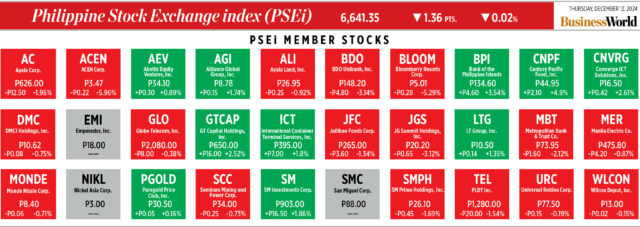
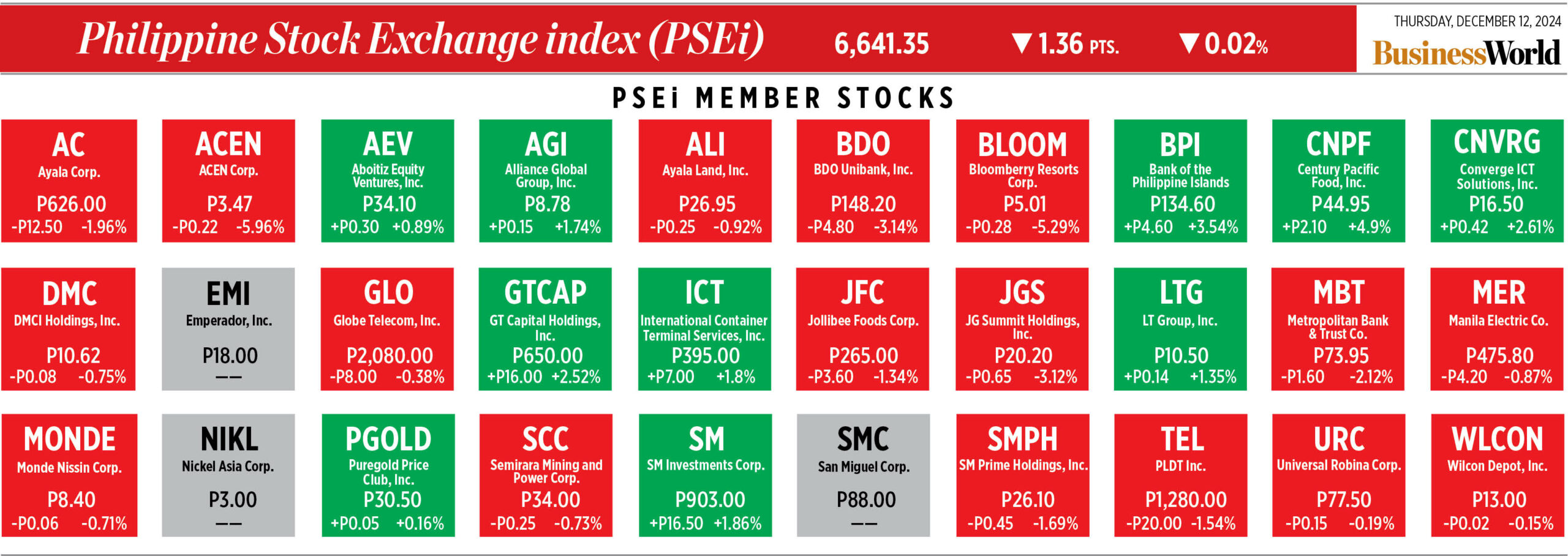
How PSEi member stocks performed — December 12, 2024

Here’s a quick glance at how PSEi stocks fared on Thursday, December 12, 2024.


Manila climbs in Smart Centers List

Manila inched up a notch to 65th out of 77 centers in the 10th edition of the Smart Centers Index (SCI) by Long Finance Initiative. The index rates the innovation and technology offerings of commercial and financial centers. Despite an improvement in rankings, the Philippine capital remained one of the laggards in the region after getting an overall rating of 631.

Manila climbs in smart centers list

Shares inch down as market eyes Fed decision

BW FILE PHOTO

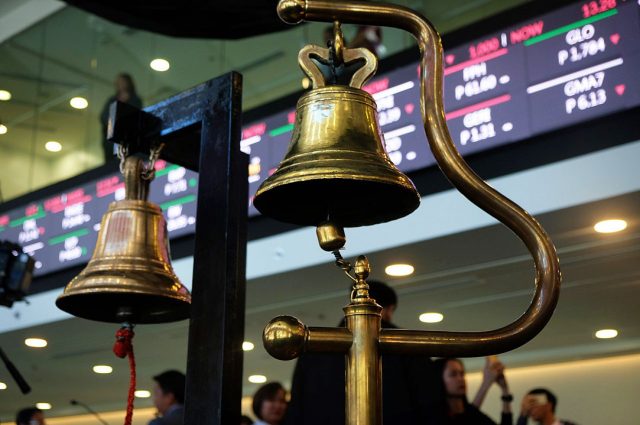
STOCKS inched lower on Thursday as investors digested the latest US consumer inflation data and their potential impact on the US Federal Reserve’s policy decision next week.

The Philippine Stock Exchange index (PSEi) slipped by 0.02% or 1.36 points to end at 6,641.35 on Thursday, while the broader all shares index dropped by 0.06% or 2.48 points to close at 3,756.07.

“Philippine shares mirrored the mixed results of the US markets as investors processed the latest CPI (consumer price index) figures. November’s CPI report matched economists’ expectations, fueling optimism for another rate cut from the Fed during its policy meeting next week,” Regina Capital Development Corp. Head of Sales Luis A. Limlingan said in a Viber message.

Wall Street’s benchmark S&P 500 index rose on Wednesday and a rally in tech stocks lifted the Nasdaq above the 20,000-point milestone for the first time, after a US inflation report boosted expectations of a Federal Reserve interest rate cut, Reuters reported.

The Dow Jones Industrial Average fell 99.27 points or 0.22% to 44,148.56; the S&P 500 gained 49.28 points or 0.82% to 6,084.19; and the Nasdaq Composite gained 347.65 points or 1.77% to 20,034.90.

The consumer price index rose 0.3% last month, the largest gain since April after advancing 0.2% for four straight months, the Labor department’s Bureau of Labor Statistics said. In the 12 months through November, the CPI climbed 2.7% after increasing 2.6% in October. The rise in the CPI was in line with economists’ expectations.

Financial markets have almost fully priced in a quarter-percentage-point rate cut at the Fed’s Dec. 17-18 policy meeting, according to CME Group’s FedWatch Tool. Before the release of the inflation data, the odds were roughly 86%.

The Fed kicked off its monetary policy easing cycle in September. Its benchmark overnight interest rate is now in the 4.5%-4.75% range.

“The PSEi was slightly lower after the dollar-peso exchange rate was slightly higher earlier during the day,” Rizal Commercial Banking Corp. Chief Economist Michael L. Ricafort said in a Viber message. The local unit closed at P58.24 per dollar on Thursday, rising by four centavos from its P58.28 finish on Wednesday, Bankers Association of the Philippines data showed.

Majority of sectoral indices declined on Thursday. Property dropped by 0.98% or 24.18 points to 2,436.95; industrials went down by 0.46% or 42.50 points to 9,124.67; mining and oil retreated by 0.12% or 9.05 points or 7,534.62; and financials declined by 0.03% or 0.75 point to 2,253.29.

Meanwhile, services rose by 0.72% or 15 points to 2,085.54, and holding firms went up by 0.59% or 33.78 points to 5,683.06.

Value turnover went up to P6.18 billion on Thursday with 589.05 million shares exchanged from the P5.23 billion with 905.03 million issues traded on Wednesday.

Decliners outnumbered advancers, 96 versus 82, while 70 names were unchanged.

Net foreign selling went down to P381.81 million on Thursday from P497.83 million on Wednesday. — Ashley Erika O. Jose with Reuters

Peso inches up on Fed cut bets after US CPI

PHILIPPINE STAR/WALTER BOLLOZOS

THE PESO rebounded against the dollar on Thursday as the November US consumer price index (CPI) was within market expectations, boosting bets of another US Federal Reserve rate cut next week.

The local unit closed at P58.24 per dollar on Thursday, strengthening by four centavos from its P58.28 finish on Wednesday, Bankers Association of the Philippines data showed.

The peso opened Thursday’s session sharply weaker at P58.40 against the dollar. Its intraday best was at P58.21, while it dropped to as low as P58.42 versus the greenback during the session.

Dollars exchanged decreased to $1.34 billion on Thursday from $1.81 billion on Wednesday.

“The dollar-peso initially traded higher due to overnight dollar strength after the release of US inflation data. However, there was profit taking as the US inflation data came out within market expectations,” a trader said in a phone interview.

The peso also continued to be propped up by the seasonal remittance inflows, Rizal Commercial Banking Corp. Chief Economist Michael L. Ricafort said in a Viber message.

For Friday, the trader sees the peso moving between P58.10 and P58.50 per dollar, while Mr. Ricafort said the local unit could range from P58.15 to P58.35.

The US dollar traded in a narrow range on Thursday even as investors ramped up bets that the Federal Reserve will cut interest rates next week, Reuters reported.

Markets are also pondering how President-elect Donald J. Trump’s proposed tariff and tax cut policies, which are expected to be inflationary, could impact the Fed’s outlook.

A rise in US Treasury yields offered support for the dollar.

The dollar index, which measures the greenback against six major peers, was mostly unchanged at 106.580 after rising to its highest since Nov. 27 at 106.81 on Wednesday.

The dollar rose 0.17% to 152.72 yen, after hitting a two-week high of 152.845 yen the previous day as market players trimmed back bets for a rate hike in Japan next week.

US consumer prices increased in November by the most in seven months, but the Federal Reserve was still expected to deliver a third consecutive interest rate cut next week to support a labor market that has been cooling.

Progress in lowering inflation toward the US central bank’s 2% target has virtually stalled, with the report from the Labor department on Wednesday also showing no improvement in the measure of underlying price pressures over the past four months.

The consumer price index rose 0.3% last month, the largest gain since April after advancing 0.2% for four straight months, the Labor department’s Bureau of Labor Statistics said.

In the 12 months through November, the CPI climbed 2.7% after increasing 2.6% in October. The rise in the CPI was in line with economists’ expectations.

The annual increase in inflation has slowed considerably from a peak of 9.1% in June 2022. The Fed’s focus has shifted more toward the labor market. Though job growth accelerated in November after being severely restricted by strikes and hurricanes in October, the unemployment rate ticked up to 4.2% after holding at 4.1% for two consecutive months.

Excluding the volatile food and energy components, the CPI increased 0.3% in November, rising by the same margin for the fourth consecutive month.

In the 12 months through November, the so-called core CPI gained 3.3%, matching the advance in October. Over the past three months, the core CPI averaged a 3.7% annualized rate.

Based on the CPI data, economists estimated that the core personal consumption expenditures (PCE) price index rose 0.2% in November after advancing 0.3% in October. Core inflation was forecast increasing 2.9% year on year after gaining 2.8% in October, in part because of unfavorable base effects.

These estimates could change after November’s producer price data due for release on Thursday.

Despite the lack of progress in the inflation fight, investors took comfort from the moderation in the cost of rent and the fact that core inflation had not deteriorated.

Financial markets have almost fully priced in a quarter-percentage-point rate cut at the Fed’s Dec. 17-18 policy meeting, according to CME Group’s FedWatch Tool. Before the release of the inflation data, the odds were roughly 86%.

Economists expect policy makers will signal fewer rate cuts in 2025 when they update their summary of economic projections next week. Though slower inflation is forecast next year as rent costs cool further and labor market slack grows, that could be offset by higher prices from tariffs on goods and mass deportations of immigrants that have been promised by Mr. Trump.

The Fed kicked off its monetary policy easing cycle in September. Its benchmark overnight interest rate is now in the 4.5%-4.75% range, having been hiked by 5.25 percentage points between March 2022 and July 2023 to tame inflation. — A.M.C. Sy with Reuters

SC rejects final appeal of Camp John Hay ruling

CAMP JOHN HAY — BW FILE PHOTO

THE Supreme Court (SC) has issued a ruling “deny(ing) with finality” all appeals filed by CJH Development Corp. in connection with the court’s ruling allowing the Bases Conversion and Development Authority (BCDA) to recover a 247-hectare property in the John Hay Special Economic Zone (SEZ).

Citing a resolution dated Oct. 22, the BCDA said that the Supreme Court En Banc ruled to “deny with finality the said motions for reconsideration as no substantial arguments were presented to warrant the reversal of the questioned decision … No further pleadings or motions will be entertained.”

According to BCDA, the decision affirms the 2015 arbitral award and reinstates the writ of execution and notice ordering CJH Development to vacate the leased premises within Camp John Hay, a former recreational area for US servicemen in Baguio.

“The decision in favor of BCDA has become final and executory and has been recorded in the book of entries of judgments,” the BCDA said.

“The BCDA assures the public that businesses will continue to operate in Camp John Hay. The BCDA is closely coordinating with all stakeholders to ensure a smooth transition,” it added.

The BCDA and CJH Development had entered into a lease agreement covering 247 hectares after the conversion of Camp John Hay into the 625-hectare John Hay SEZ.

BCDA administers former military installations being converted into commercial and industrial zones, including bases formerly operated by the US military. — Justine Irish D. Tabile