Home Blog Page 1748

Judge in Citgo share auction rejects bid to block Gramercy fund lawsuits

ESKAY LIM-UNSPLASH

 – Lawsuits by three firms seeking to improve their chances of obtaining proceeds in an auction of shares in Citgo Petroleum’s parent can go ahead, a U.S. judge ruled in an order issued on Monday.

The decision could reduce the proceeds of any sale, the court officer overseeing the auction in federal court in Delaware had said in a motion seeking to block the parallel lawsuits. Shares in Citgo parent PDV Holding are being auctioned to repay $21 billion in claims for debt defaults and expropriations by Venezuela and state oil firm PDVSA.

PDV is a U.S. subsidiary of PDVSA and is the indirect sole stockholder of Citgo.

The three related firms – Gramercy Distressed Opportunity Fund, G&A Strategic and Girard Street Investments – brought parallel lawsuits in other courts after their claims left them unlikely to fully recoup claims in the Delaware court auction.

Gramercy declined to comment.

The court officer overseeing the auction had asked the judge to bar their Texas and New York claims, saying they could reduce bids. He had recommended bids by Elliott Investment Management affiliate Amber Energy that were contingent on an injunction being issued.

Elliott had threatened to quit the auction if the injunction was not issued. A spokesperson declined immediate comment.

U.S. District Judge Leonard Stark, who called rejecting the injunction his “least bad option,” firmly opposed the Special Master’s motion to enjoin. The special master is a court officer overseeing the auction.

The proposed motion lacks a legal basis, and evidence of new bids being prepared show the claims by Gramercy and others “are not nearly as big of a problem as the Injunction Motion portrays them,” Mr. Stark wrote.

The share auction was “never intended” to be free of a risk others might try to seize Venezuela assets. “The fundamental premise of the Special Master’s Motion, that an injunction is necessary, is unproven,” Mr. Stark wrote. – Reuters

Bernard Madoff’s victims collect $4.3 billion as US government fund completes payouts

Bernard Madoff is escorted in a vehicle from Federal Court in New York Jan. 5, 2009. — REUTERS

 – A U.S. government fund to compensate people swindled by Bernard Madoff announced its tenth and final distribution on Monday, saying it will have paid out $4.3 billion to 40,930 of the late Ponzi schemer’s victims.

Richard Breeden, the former U.S. Securities and Exchange Commission chairman who oversees the Madoff Victim Fund, said a final $131.4 million payout will go to 23,408 claimants, and mark the distribution of all available forfeited assets.

Victims including 38,860 individuals, as well as schools, charities and pension plans, will have recouped an average 93.71% of their proven losses when the fund created by the U.S. Department of Justice closes in 2025.

An additional $14.72 billion has been recouped for customers of the former Bernard L. Madoff Investment Securities LLC by Irving Picard, the trustee liquidating that firm following its 2008 bankruptcy.

That boosts the total payout to Madoff victims to about $19 billion. Unlike Mr. Picard, Mr. Breeden also returned money to victims who lost money indirectly, such as through “feeder” funds. Payouts went to claimants in 127 countries.

“Our objective was to find all of the victims, and know what everybody lost, to deploy the assets we had in the fairest and most equitable way,” Mr. Breeden said in an interview. “Nobody got left behind.”

Mr. Breeden also said it was important not to forget Mr. Madoff’s “complete depravity,” though it happened many years ago, and that people “remain wary and careful about how they invest their money and guard their savings.”

The fund was created mainly from settlements between the Justice Department and Mr. Madoff’s former bank JPMorgan Chase, and between the liquidator of Madoff’s former firm and the estate of former Madoff investor Jeffry Picower.

It originally held $4.05 billion, but grew because the Justice Department recovered additional assets.

Mr. Madoff’s fraud was estimated as high as $64.8 billion.

It went undiscovered for many years until Mr. Madoff confessed to his sons in December 2008, one day after his firm’s Christmas party.

Mr. Madoff eventually pleaded guilty to 11 criminal counts. He died at age 82 in April 2021 while serving a 150-year prison sentence. – Reuters

Marcos vetoes P194-B items in budget

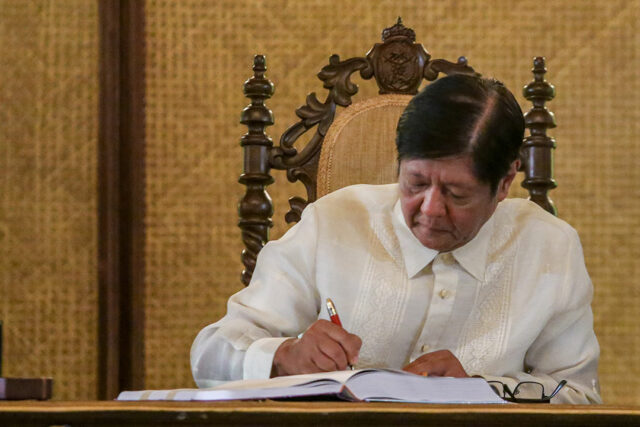
PHILIPPINE President Ferdinand R. Marcos, Jr. signed into law the P6.3-trillion national budget for 2025 in a ceremony in Malacañang, Dec. 30. — PHILIPPINE STAR/NOEL PABALATE

By Kyle Aristophere T. Atienza, Reporter

PHILIPPINE President Ferdinand R. Marcos, Jr. on Monday signed into law the P6.326-trillion national budget for 2025 but vetoed more than P194 billion worth of line items that he said were inconsistent with his administration’s priorities.

These include appropriations for certain programs of the Department of Public Works and Highways (DPWH) and unprogrammed funds that increased four times, Mr. Marcos said during the signing ceremony for the budget at the presidential palace.

“Cognizant that our resources are finite, and our people’s needs are plenty, we need to carefully curate the particulars of the budget, so much so that even grand ambitions and great plans must be tempered,” the president said.

“We must exercise maximum prudence, otherwise we run the risk of increasing our deficit and debt and derailing our development agenda for our country.”

The P6.326-trillion national budget is 0.4% lower than the P6.352-trillion spending plan that the Department of Budget and Management (DBM) submitted to Congress in August. This is equivalent to 22% of the projected gross domestic product (GDP) in 2025.

Mr. Marcos was initially scheduled to sign the budget on Dec. 20, but it was postponed to allow a more “rigorous” review after questions were raised over revisions made by the bicameral conference committee.

The items that have been vetoed by Mr. Marcos included P26.065 billion worth of projects under the DPWH and projects worth P168.24 billion under “unprogrammed appropriations.”

Public Works Secretary Manuel M. Bonoan said the projects that have been vetoed were “not ready for implementation.” “It will take us sometime anyway to make sure that these will be implemented right away,” he said in mixed English and Filipino.

Mr. Marcos also noted that unprogrammed appropriations under the Congress-approved budget bill increased by 300%.

At a briefing after the signing ceremony, Budget Secretary Amenah F. Pangandaman said unprogrammed appropriations now account for 4.7% of the General Appropriations Act of 2025, “consistent” with the standard that standby funds should only be 5% of the total budget.

She said the education sector will still receive the highest allocation with P1.053 trillion, amid questions on the legality of massive budget cuts faced by the Department of Education (DepEd).

The education sector is composed of DepEd, state universities and colleges (SUCs), the Commission on Higher Education (CHED), and the Technical Education and Skills Development Authority (TESDA).

Ms. Pangandaman said the DPWH will now have a P1.007-trillion budget for 2025, lower than the P1.034-trillion funding approved by Congress.

Aside from the vetoed items, Mr. Marcos said there will be “conditional implementation” on certain items to make sure “the people’s funds are utilized in accordance with their authorized and stated purposes.”

This includes the Ayuda sa Kapos Ang Kita Program (AKAP), which was originally implemented by the Department of Social Welfare and Development (DSWD) but will now be co-implemented with the Department of Labor and Employment (DoLE) and the National Economic and Development Authority (NEDA).

The implementation of AKAP, which provides one-time cash assistance of up to P5,000 for workers “will be strategic, leading to the long-term improvement of the lives of qualified beneficiaries, while guarding against misuse and duplication,” Mr. Marcos said.

Executive Secretary Lucas P. Bersamin told reporters that AKAP will have strict guidelines, but did not rule out the possibility of local politicians seeking funding for their constituents.

“Don’t be naive. Don’t be naive,” he said. “Always, in our life here in the Philippines, there must be somebody to initiate.”

He added that the National Government is not fully knowledgeable of local situations. “It should come from lower levels.”

Public finance analyst Zyza Nadine M. Suzara said the direct veto on P168 billion worth of items under unprogrammed appropriations “does not significantly alter the structure of the 2025 national budget,” which means that “pork remains huge in the DPWH budget.”

“In the first place, projects under unprogrammed appropriations cannot be released unless there are certain conditions,” she said in an X message. “The President and the economic managers simply conceded to the decisions of the bicam.”

EDUCATION
Meanwhile, Ms. Pangandaman reiterated that unprogrammed appropriations can be used for DepEd’s computerization program.

“As long as we have additional revenues from the DoF (Department of Finance), we can actually augment or increase the budget of DepEd, especially for its computerization program,” she said.

Members of the bicam had reduced DepEd’s budget by P12 billion, including P10 billion for its computerization program.

Enrico P. Villanueva, who teaches money and banking at the University of the Philippines Los Baños, said bicam members inflated the DPWH budget by P288 billion, but the President reduced this “only by P26.1 billion, which is not even 10% of the Congress-dictated increase.”

“For many Filipinos, that Congress-initiated increase is deemed as pork barrel, because it did not undergo the consultative budgeting process involved in making the National Expenditure Program,” he said in an X message. “People also view infra projects as a source of corruption and possible funding for the 2025 elections.”

“If the President wanted to address the concerns of the people, it should have vetoed the DPWH budget increase substantially if not totally.”

Ibon Foundation Executive Director Jose Enrique “Sonny” A. Africa said the President’s last-minute effort to veto a few items was aimed at averting “an obvious Constitutional challenge where the entire education sector budget is lower than even just the DPWH’s.”

“The tiny P26.1-billion cut in the DPWH budget was just enough to be able to claim that the education sector budget defined as DepEd, SUCs, CHED and TESDA combined is more than DPWH’s P1.007 trillion,” he said in a Facebook Messenger chat.

Mr. Africa also noted the P1.055-trillion allocation for the education sector is less than the P1.13-trillion budget for infrastructure, which includes the P1.007 trillion for the DPWH’s projects and P123.7 billion for the Department of Transportation’s projects.

A reenacted budget should have been used for the first quarter of the year, he said, while constructing “a socially rational people-biased 2025 budget deliberated transparently.”

However, Mr. Marcos said in his speech that a reenacted budget would “delay vital programs and jeopardize targets for economic growth.”

The Marcos administration may have averted operating under a reenacted budget but it disregarded health and other forms of social protection “that can increase the contribution of labor to overall productivity,” Leonardo A. Lanzona, an economics professor at the Ateneo de Manila University, said via Messenger chat.

PHILHEALTH
Another analyst said the President failed to address concerns on the removal of state subsidy for the Philippine Health Insurance Corp. (PhilHealth), the agency responsible for the implementation of universal healthcare.

“It’s frustrating, it’s heartbreaking, and very unheroic on the day of Rizal anniversary,” Health advocate and former Health department advisor Anthony C. Leachon said of the President’s inaction on the defunding of PhilHealth.

Mr. Marcos vowed to expand PhilHealth members’ benefits in his speech, a move that Mr. Leachon said was a mere “lip service.”

“Without the funds, how can you increase the benefits? You cannot increase the benefits by not giving the P74-billion subsidy,” he said in a phone interview.

Mr. Marcos earlier defended the bicam’s move to defund PhilHealth, citing its reserve funds.

PhilHealth’s reserve funds, which are not surplus funds and are meant to decrease the amount of members’ contributions as well as expand services for them, will be eroded in two to three years, Mr. Leachon said.

“And you’re not supposed to spend that because they have a big mistake in saying that the reserve funds are surplus funds. These are contingency funds that should be used to expand the benefit package, reduce the premium, and reduce the out-of-pocket expenses,” he said.

Meanwhile, the President also subjected 11 other items to conditional implementation, such as DSWD’s “PAyapa at MAsaganang PamayaNAn Program, the Rice Competitiveness Enhancement Fund and support for foreign-assisted programs.

The use of excess funds from the annual tariff revenue from rice imports will also be subjected to guidelines of the departments of Finance and Agriculture.

Four items in the 2025 budget were also put under general observation to “clarify changes made by Congress.”  These items include the payment of additional compensation for the organizational structure of the Senate and the House of Representatives, as well as the two chambers’ electoral tribunals and the Commission on Appointments.

NG gross borrowings decline to P65 billion in November

BW FILE PHOTO

By Aubrey Rose A. Inosante, Reporter

THE NATIONAL Government’s (NG) gross borrowings declined in November on lower domestic debt issuances, the Bureau of the Treasury (BTr) said.

Data from the BTr showed that total gross borrowings plunged by 48% to P65.05 billion in November from P125.46 billion in the same month a year ago.

Month on month, gross borrowings went down by 50% from P129.26 billion in October.

Gross domestic borrowings slumped by 60% to P48.88 billion in November from the P121.02 billion seen a year ago.

This included P30 billion in fixed-rate Treasury bonds (T-bonds) and P18.88 billion in Treasury bills (T-bills). In November, T-bond issuances fell by 70% from P100 billion during the same month last year.

On the other hand, gross external debt increased by 263.91% to P16.17 billion in November from P4.44 billion a year ago.

This was made up of P8.7-billion project loans and P7.47-billion program loans.

“The year-on-year decline in gross borrowings, despite the wider budget deficit data for the month, may be largely attributed to the lower amount of matured National Government debt/government securities for the month that fundamentally reduced NG debt servicing costs, particularly on principal payments and necessitated less NG borrowings,”

Rizal Commercial Banking Corp. Chief Economist Michael L. Ricafort said in a Viber message.

In the January-to-November period, BTr data showed gross borrowings jumped by 18.73% to P2.49 trillion from P2.1 trillion in the same period last year.

The bulk or 76.65% of the 11-month gross borrowings were from domestic sources.

Domestic debt went up by 17% to P1.91 trillion in the 11-month period from P1.64 trillion a year ago.

Broken down, fixed-rate T-bonds stood at P1.1 trillion, P584.86 billion in retail T-bonds, and P228.26 billion in T-bills.

Meanwhile, external debt in the first 11 months rose by 24.4% to P582.41 billion from P460.75 billion a year prior.

This was composed of P256.24 billion in global bonds, P223.04 billion in program loans, and P86.97 billion in new project loans.

This year’s borrowing plan is set at P2.57 trillion, with P1.92 trillion coming from domestic sources and P646.08 billion from overseas, according to the latest Budget of Expenditures and Sources of Financing data.

Finance Secretary Ralph G. Recto previously said that the government is looking to issue US dollar- or euro-denominated bonds in the first half of 2025. It aims to raise at least P300 billion from the issuance.

Mr. Ricafort said the government securities (GS) in December were expected to have been lower “given the holiday mode.”

This will be the case “until GS maturities increase around April 2025,” he said.

Philippine contact center industry ends year with $31.5 billion in revenue

FREEPIK

By Justine Irish D. Tabile, Reporter

THE PHILIPPINES’ contact center industry is expected to account for 83% of the total revenues of the information technology and business process management (IT-BPM) industry by end-2024.

Contact Center Association of the Philippines (CCAP) President Mickey Ocampo said that the IT-BPM industry projected a 7% growth in revenues and employment by end-2024 to $38 billion and 1.82 million, respectively.

In 2023, the industry ended with 1.7 million direct jobs and $35.5 billion in export revenues.

“Of the total revenue, the contact center industry covers 83% of total revenue amounting to $31.5 billion and 89% of total workforce headcount equivalent to 1.62 million,” he said.

“These projections are consistent with the growth targets of the Philippine IT-BPM Roadmap for the period of 2022-2028,” he added.

The CCAP’s revenues this year are slightly lower than its earlier target to grow revenues by 9% to $32.16 billion. In 2023, the association’s members booked revenue of $29.5 billion.

Mr. Ocampo said that the growth of the industry is being driven by cost efficiency, availability of high-quality talent, infrastructure, and strong government support.

“The advent of new technologies such as artif icial intelligence, data analytics, cybersecurity, and cloud solutions creates new opportunities for the IT-BPM industry,” he said.

Mr. Ocampo said the contact center workers should be prepared to utilize these new technologies.

“The industry must transition from traditional contact center services to more complex, KPO (knowledge process outsourcing)-based services, and a key factor is the need to upskill our workforce to adapt to these new technologies and maintain our competitive edge,” he added.

Asked how the industry is preparing for the expected protectionist policies under a Trump presidency, Mr. Ocampo said that they are still on a wait-and-see stance.

“The contact center industry in the Philippines has been able to progress through the years despite changes in the administration of the US,” he said.

“It is still too early to determine any effects of the incoming Trump administration, but if we were to review the previous Trump administration, we do not foresee any adverse effects. Realistically, it will be a wait-and-see situation for a few months of the new administration,” he added.

Donald J. Trump will be sworn in as the 47th President of the United States on Jan. 20, 2025. He previously served US president from 2017 to 2021, during which he espoused “America First” policies.

Mr. Ocampo said that the US is still the biggest market of the country for outsourcing services, especially for contact center services.

“While we continue to maintain its position as a destination of choice for contact center service, the industry must increase the availability of the talent pool coming into the industry and the upskilling of existing talent as the adoption of new technologies and the transition to more complex services occur,” he added.

CCAP expects its members to post revenue of $49 billion by 2028, in line with the IT-BPM roadmap 2028, which projects industry revenue of $59 billion by that year.

IC looks to set valuation standards for MBAs’ required policy reserves

BW FILE PHOTO

THE INSURANCE Commission (IC) is looking to set standards for the computation of mutual benefit associations’ (MBA) policy reserves.

“Every MBA supervised by the Insurance Commission shall value their policy reserves for Basic Life Insurance and Optional Life Insurance coverages at the end of each valuation period in accordance with this set of Valuation Standards,” the industry regulator said in a draft circular dated Dec. 26 and posted on its website.

The MBA sector can send their comments on the proposal to the IC’s Actuarial Division until Jan. 6.

Policy reserves are the dues MBAs are required to collect from its members, which are used for the payment of claims or obligations.

The valuation standards will be in line with internationally accepted actuarial standards, as well as the principles of the financial reporting framework promoted by the Actuarial Society of the Philippines, the IC said.

MBAs will be required to compute their required reserves using gross premium valuation.

“This is calculated as the sum of the present value of future benefits and expenses, less the present value of future gross contributions/premiums arising from the policy discounted at the appropriate risk-free discount rate as of the valuation date,” the IC said.

“The MBA shall appropriate from the free and unassigned fund balance an amount equal to the aggregate of the negative reserves calculated on a per-policy basis,” it added.

The valuation will be based on the calculated risk-free discount rate for MBAs’ cash flows to determine a policy’s liability.

The yield curve for the discount rate will be based on the PHP Bloomberg Valuation Service reference rates for peso-based policies and the International Yield Curve from Bloomberg for dollar-based policies.

An MBA’s reserve valuation will also be based on the company’s non-guaranteed benefits, expenses, mortality and morbidity, and lapse or persistency, the IC said.

The MBA industry saw its total contributions or premiums rise by 6.27% year on year to P12.22 billion at end-September, latest IC data showed.

The sector’s total assets stood at P158.23 billion as of September, while its combined liabilities were at P93.23 billion.

The industry also posted a combined total fund balance of P65.01 billion and a net surplus of P4.8 billion in the period, the insurance regulator’s report showed.

A total of 42 licensed companies out of 43 active MBAs submitted financial statements during the period. — Aaron Michael C. Sy

What are you doin’ New Year’s Eve?

CARSON ARIAS-UNSPLASH

Counting down to 2025 in Metro Manila

AS 2024 draws to a close, Metro Manila is gearing up for its biggest New Year’s Eve celebrations yet. From community-led festivities to large-scale concerts to DJ performances in bars, these countdown events promise a night filled with energy, joy, and hope for the year ahead. If you’re still looking for something to do that night, here’s a list of government and privately organized events that you won’t want to miss.

QUEZON CITY’S STAR-STUDDED COUNTDOWN

Quezon City is set to rock the New Year’s Eve Countdown at the Quezon Memorial Circle, featuring some of the country’s most iconic bands and artists. Kicking off at 5 p.m. on Dec. 31, the event promises a night filled with music, entertainment, and celebration.

The musical lineup includes Ely Buendia, Ben&Ben, Kamikazee, Gloc-9, Kean Cipriano, Noel Palomo with the Repakol Band, Shamrock, Mrld, The Juans, Ryannah, Julia Policarpio, and Kenaniah. The night will be hosted by Uma Rojo, MC Muah, Lassy Marquez, Ate Negi, and CJ Villavicencio, ensuring an unforgettable experience for all attendees.

This plastic-free celebration encourages attendees to bring their own tumblers to stay hydrated. Admission is free, making it a perfect gathering for families and friends to ring in the new year together.

GARY V, BINI TOP MAKATI’S COUNTDOWN

Gary V and BINI are just some of many performers in Makati’s New Year’s countdown, titled Radiating on Top. Apart from Gary V and BINI, the countdown headliners include rock band Lola Amour, select cast members from some of the year’s most popular theatrical performances (One More Chance, Bar Boys, Going Home to Christmas, etc.), drag queen Marina Summers, rapper Gloc-9, and rock icon Bamboo. The event also boasts a pre-show with DJs Brian Cua and Mike Lavet performing sets and with hosts Ai dela Cruz and Justin Quirino leading the event.

The celebration will be held at Ayala Avenue starting at 6 p.m., with the Main stage at the corner of Ayala and Makati Avenues. Admission is free but tickets will be sold for VIP seats (with cocktails and dinner) and a Standing Room Mosh Pit Area (with cocktails) Tickets are available at Ticketworld
https://premier.ticketworld.com.ph/shows/show.aspx?sh=RADIATE24. Gates and food booths will be open by noon and the concert proper will start at 6 p.m.

Parking will be available at several carparks in the area namely the Valero Carpark, the Dela Rosa Carpark 1, Paseo Center Carpark, Greenbelt 2, 3, 4, and 5, and Glorietta 1, 2, 4, and 5.

ITZY HEADLINES COUNTDOWN AT BGC

Get ready for a K-Pop takeover as ITZY — with members YEJI, LIA, RYUJIN, CHARYEONG, and YUNA — headlines the BGC “ILoveTaguig New Year’s Eve Countdown” at Bonifacio High Street on Dec. 31, starting at 7 p.m. Presented by BGC, Taguig, and Coke Studio, the event will also feature local stars Sarah Geronimo, Rico Blanco, and Juan Karlos.

General Admission is free on a first-come, first-served basis. VIP Standing access details will be announced soon.

BRIDGETOWNE’S NEW YEAR COUNTDOWN AND FIREWORKS

The Bridgetowne “Countdown to 2025” promises an unforgettable New Year’s Eve celebration on Dec. 31, starting at 9 p.m., with performances by SpongeCola, Yeng Constantino, Janine Berdin, Orange and Lemons, and DJ Jimmy Jocon, along with a stunning fireworks display. Hosted by Macoy Dubs and MJ Lastimosa, this free admission event at Bridgetowne, Pasig offers the perfect opportunity to welcome the new year with family and friends.

SB19 AT MOA’S #KAPUSOCOUNTDOWNTO2025

SB19, one of the most successful P-Pop groups, will take the stage at the “#KapusoCountdownTo2025” on Dec. 31 at the Mall of Asia (MOA) Seaside Boulevard. Gates open at 6 p.m. and the show kicks off at 8:30 p.m. The celebration will also be broadcast live on GMA and Kapuso Stream starting at 10:30 p.m.

NE-YO HEADLINES AT SOLAIRE RESORT NORTH

Grammy Award-winning artist NE-YO headlines the Ultimate New Year’s Eve Party at the Grand Ballroom of Solaire Resort North in Quezon City. The event promises a night of stellar performances, free-flowing drinks, and an unforgettable party atmosphere starting at 9:30 p.m. on Dec. 31. Early Bird tickets are available for P4,400, available at ticketworld.com.ph.

Meanwhile, the casino’s Skybar is set to ring in 2025 with a New Year’s Eve countdown on Dec. 31, starting at 9 p.m. The event will feature live DJ performances from Kat DJ, Mars Miranda, Brenda Munoz, and Renee Rosete, offering an unforgettable experience with stunning views and non-stop music. General admission is priced at P2,500 and above, with table reservations starting at P10,000. For bookings, call 8888-8888.

OKADA HOSTS STAR-STUDDED COUNTDOWN

Okada Manila will welcome 2025 with a grand New Year’s Eve celebration featuring top artists like Lani Misalucha, Zsa Zsa Padilla, Daiana Menezes, Christian Bautista, Mitoy Yonting, and DJ Cammy V. The event includes ticketed options such as the Grand Ballroom Dinner Concert and Cove Manila’s Year-End Party. For those looking to join the celebration for free, there will be a live concert and fireworks display at The Fountain, along with a fireworks display at The Garden, which are open to all guests.

To get tickets, visit okdmnl.ph/GrandBallroomNYE2025 for the Grand Ballroom Dinner Concert and okdmnl.ph/CoveNYE2025 for Cove Manila’s Year-End Party.

AN ELEGANT COUNTDOWN AT THE PEN

As the year draws to a close, The Peninsula Manila extends an invitation to mark the arrival of 2025 with an unforgettable evening of world-class dining and celebrations.

The Lobby will host a spectacular New Year’s Eve dinner and ball — the All That Glitters New Year’s Eve Ball and Dinner” – at P19,888 for adults and P9,944 for children under 12. As the clock strikes midnight, The Lobby provides the perfect vantage point to view a spectacular light and sound show, ensuring a magical start to the new year.

Michelin-trained Old Manila Chef de Cuisine Gaël Kubler invites guests to indulge in a bespoke tasting menu that showcases the finest Filipino ingredients with French flair. Diners can dine on a lavish five-course menu for P11,888.

Celebrate the New Year with the vibrant flavors of Southeast Asian and Indian cuisine at Spices which will offer an la carte menu featuring signature dishes, each prepared with authentic techniques and the finest ingredients. Minimum consumption per diner is P3,888 for adults and P1,944 for children under 12.

For inquiries and restaurant reservations, call 8887-2888, extension 6694. Or visit the official hotel website at peninsula.com/manila/special-offers for more details.

TOP STARS AT SOLAIRE

Celebrate in grand style at Solaire Resort Entertainment City’s The Grand Ballroom, where a spectacular New Year’s Eve awaits featuring top singers Lea Salonga, Martin Nievera, and Bituin Escalante, under the musical direction of Gerard Salonga. While the stars shine on stage, an international buffet will be served, paired with unlimited beverages. The festivities kick off at 7:30 p.m. Secure a spot at https://sec.solaireresort.com/offers/ entertainment/stars-collide-the-solaire-nye-party.

Outside the ballroom, New Year’s celebrations continue with the tasting menus available at Solaire’s acclaimed dining venues. Finestra Italian Steakhouse will be serving a six-course menu. Yakumi will also be serving a six-course menu. Red Lantern will offer a lavish spread. Over at Waterside, a five-course feast will be served, and guests can dance the night away to the Latin beats of the Belissima Party Band. At the Oasis Garden Café, a relaxed festive afternoon tea will be served with Filipino-inspired savory bites. Usher in the New Year with hits performed by The Company.

Beyond dining, entertainment awaits for New Year’s Eve. The Shoppes at Solaire will host jazz performances from bands like the Aristocrats, a Crystal Ball magician in the Main Lobby, and the music of violinist Justerini Brooks.

For reservations and information, call 8888-8888 or e-mail restaurantevents@solaireresort.com.

CITY OF DREAMS MANILA RINGS IN 2025

City of Dreams Manila is hosting a grand New Year’s Eve Countdown at The Grand Ballroom on Dec. 31, starting at 8:30 p.m. The event will feature live performances by the Mifan band and acoustic favorite MYMP at 10:30 p.m., and powerhouse vocalist Gigi De Lana with the Gigi Vibes Band at 11:20 p.m. to lead the countdown.

Guests can enjoy a buffet spread and unlimited drinks, along with a raffle offering spa treatments and hotel stays. Tickets are priced at P8,000 (Silver) and P10,000 (Gold), with discounted table rates available. Hotel packages, which include tickets to the New Year’s Eve Countdown, complimentary breakfast, and additional perks, are available starting at P25,888. Reservations can be made until Dec. 30. For inquiries, contact City of Dreams Manila.

The contemporary entertainment bar CenterPlay is also partying for the occasion, with local artists Eye Candies, Part 3 Band, and Zyncxation Band. Revelers can choose from three countdown packages, which include a media noche platter: P10,000 net for a VIP table for four inclusive of a bottle of sparkling wine and P6,000 consumables from the regular menu; P20,000 net for a table with couch seating for eight persons, inclusive of two bottles of sparkling wine and P12,000 consumables; and a single-seat package for P2,500 net inclusive of a glass of sparkling wine, and P1,500 consumables from the regular menu, for three or less persons.

Meanwhile, Nobu Manila has a five-course New Year’s dinner tasting menu (priced at P6,653.57 net per person) exclusively available on Dec. 31 and Jan. 1.

Haliya, City of Dreams Manila’s modern Filipino restaurant, will be serving a Filipino media noche with the exclusive ala carte choices available for dinner on Dec. 31 and Jan. 1. Meanwhile, Cantonese restaurant Crystal Dragon will have a five-course season set menu available for lunch and dinner until Jan. 1. The menu is offered for P6,000++ per person for a minimum order for two persons.

HYATT REGENCY MANILA’S NYE COUNTDOWN

Hyatt Regency Manila’s interactive show-kitchen restaurant, The Café, has a special holiday buffet spread of local and international cuisine available for lunch and dinner on Dec. 31. Lunch service is P2,499 net. There will be two dinner seatings: from 5:30 to 8 p.m. for P3,199 net, and from 8:30 to 11 p.m., for P3,999 net. The latter package features entertainment with alternating performances from the Alley Cats Band and a DJ starting at 9:30 p.m. until the countdown to 2025 at midnight. An extended service from the pastry and dessert buffet station in addition to unlimited alcoholic and non-alcoholic beverages is offered from 11 p.m. to 1 a.m.

PARTIES AT NEWPORT WORLD RESORTS

As 2024 draws to a close, Newport World Resorts sets the stage for an unforgettable New Year celebration, with grand countdown parties and lavish spreads in its various hotels and restaurants.

The Marriott Grand Ballroom will be the venue for The Grand Countdown to 2025 from 7:30 p.m. There will be performances by Angeline Quinto, Jed Madela, Bamboo, and BINI. Limited tickets are available across several tiers, ranging from SVIP (P25,000) to Bronze (P15,000), with Kids’ Zone tickets also available (P3,500) via 7908-8888 and info@fhtcentertainment.com.

Usher in 2025 at The Whisky Library with the “Bold Beginnings” new year party from 8 p.m. to 1:30 a.m. For P1,800 nett, indulge in endless pours, a curated tapas, and mark the midnight moment with champagne and Dalmore 12 years toasting. For more information, contact 0917-844-6158 or 7908-8080.

The Hilton Manila will host a “New Year’s Eve Salubong 2025” with a dinner buffet at the Ballroom priced at P5,500 net from 6:30 to 9:30 p.m. inclusive of access to the Vega Poolside Countdown with F&B credits and party favors. The Vega Poolside Countdown is an outdoor pool party featuring performances by Tirso Cruz IV, the TAC4 Band, and DJ Kai Emmanuelle. Priced at P2,500 net for walk-in guests and P1,500 net for outlet guests, the party will be held from 10 p.m. until 1 a.m. For ticket reservations and inquiries, contact 7239-7788, loc. 7096, 0917-848-6404, or e-mail HiltonManila_Events@hilton.com.

Dance the night away ‘til the year ends at Marriott Manila’s “So Bright We Gotta Party Countdown to 2025” at The Greatroom. DJs take the deck from 7 p.m. onwards starting with DJ Cyme, DJ Yuuna, and the Rhythm and Groove Band. Bar top is priced at P2,000 net per seat while table consumables start at P4,000 net for one to two persons. For inquiries and reservations, contact 0917-800-2393.

Celebrate at the SORA Rooftop of Hotel Okura Manila with live music, a DJ, and a buffet meal. The celebration starts at 9 p.m., with prices starting at P4,900++ per person. For inquiries or reservations, contact at fb@hotelokuramanila.com or call 5318-2888.

For those seeking a lively celebration that is free to enjoy, there is the New Year Countdown at The Plaza, at the second floor of the Newport Mall. The party starts at 9 p.m. with a DJ performance and a 3D Mapping Display.

Casa Buenas’ Comienzos will be serving a five-course new year set menu, priced at P3,500 net per person. There will be a Festive Set Menu of Hua Yuan Brasserie Chinoise at Hilton Manila available until Dec. 31 for P28,888++ for six persons (0956-134-0501, e-mail MNLPH_F&BInquiries@hilton.com). Hotel Okura Manila’s fine-dining Japanese restaurant, Yamazato will serve a New Year Sushi Omakase by Chef Ikuma Sato features seasonal seafood flown directly from Japan. Available from Dec. 31 to Jan. 1 for lunch and dinner, the sushi counter course is priced at P15,000++ per person and includes a complimentary bottle of Yamazato’s signature sake (contact fb@hotelokuramanila.com or 5318-2888). The S Kitchen of Sheraton Hotel Manila welcomes the new year with a set dinner priced at P3,900 net per person (for reservations call 7902-1800, 0917-859-7496 or visit https://tinyurl.com/HolidaysAtSheratonManilaHotel). Marriott Manila’s Marriott Café will have a special buffet on New Year’s Eve and New Year’s Day from 6-9 p.m. at P3,800 net, and New Year’s Day Lunch from noon to 3 p.m. at P3,888 net (contact 0917-584-9560, 0917-825-2896, or visit www.manilamarriott.com for reservations).

There will be raffle prizes, DJ performances, and a live band at Sheraton Hotel Manila’s Countdown to 2025 New Year’s Eve Party at 3F Sheraton Ballroom from 8 p.m. to 1 a.m. There will be a dinner buffet, free-flowing drinks, and surprises. Price starts at P1,500 net per person. For inquiries, contact 7902-1800 or 0917-859-7496.


Capital access and financial management for sustainable MSMEs

FREEPIK

How to manage finances and where to access capital, which are critical for sustainability, are questions often asked by business owners and leaders. In an earlier article featured in a MAP column, entitled “The Journey of MSMEs: Are we there yet?,” I cited limited financing and accessibility to affordable and reasonable sources of funds as one of the challenges faced by micro, small, and medium enterprises (MSMEs). This was the topic I spoke about on Oct. 29 at the Management Association of the Philippines (MAP) – Philippine Trade Training Center (PTTC) MSME Business Clinic with the theme, “Stronger MSMEs for a Sustainable Future Building Collaborative Ecosystems,” organized by the Department of Trade and Industry-PTTC and the MAP.

FINANCIAL MANAGEMENT FOR MSMES
Financial management is basically about controlling the flow of money in and out of an organization. Some key components of financial management that MSMEs as well as larger businesses should focus on are:

Budgeting. This includes allocating resources efficiently and monitoring financial performance against set targets. Given that funding sources are limited, it is important that you use these with good judgment and common sense.

• Cash flow management. Understanding and tracking cash inflows and outflows is essential to avoid a liquidity crisis; thus, you need to maintain a reasonable amount of “working capital” to meet the day-to-day operating requirements of your business.

• Record keeping. Maintaining accurate and systematic financial records, which can be facilitated by digital tools, is fundamental for decision-making and compliance with tax regulations.

• Financial analysis. Regularly interpreting, analyzing, summarizing, and reporting data in financial statements can help you identify trends, measure profitability, and assess the financial health of the business.

SOURCES OF CAPITAL FOR MSMES
Fund requirements of MSMEs, whether for loans and capital/equity, can be provided by various sources:

Personal savings. The easiest and most accessible source, especially when starting a business; using your own money also makes leaving a business easier if things do not work out.

Friends and relatives. A common source for aspiring entrepreneurs of startup businesses as they are frequently more ready to invest than formal lenders. While these can work well, often these arrangements are informal and based purely on trust and verbal assurances.

Partnership. Where two or more individuals, yourself and friends and/or relatives, share ownership, with each partner contributing money, property, labor, or skill and in return, each partner shares in the profits and losses of the business. The documentation of the terms of the partnership in a legal document is recommended.

Venture capital. Venture capital funds, which generally come from investors, investment banks, and financial institutions, are aimed at startups and early-stage companies with high growth potential and a proven track record. These sources provide substantial funding in exchange for equity and often take an active role in guiding and scaling the business.

• Private equity. Private equity, typically sourced from large institutional investors, pension funds, sovereign funds, endowment funds, and high net worth individuals, are invested in more mature private companies, for expansion, restructuring and transformation.

Government grants and subsidies. Government financial institutions, such as the Small Business Corp. (SB Corp.) and the Development Bank of the Philippines (DBP) offer financial assistance to promote entrepreneurship and business growth, to support SMEs and startups usually through debt financing and, in some instances, equity. Other government agencies offer grants and subsidies to promote specific industries, for innovation, and development.

PRACTICAL TIPS FOR SUSTAINABILITY
Regardless of the stage of development of the business, there are basic financial management practices which are critical for sustainability:

Create a budget to plan and control your finances as this helps you track income and expenses, ensuring that the business operates within its means. Further, regular review of the budget can help identify where costs can be reduced and investments made to support growth.

Manage your cash flows. With the budget as your guide, you should track incoming revenues and outgoing expenses. It is good business practice to maintain a certain amount of cash or working capital at all times to cover for the lag in the timing of collections and disbursements. You may also maintain an emergency fund in the case of unforeseen financial challenges, such as an economic downturn.

Separate personal and business funds. Open separate bank accounts and credit cards for business operations. Segregation simplifies accounting and helps track business performance separately. Don’t use business funds to support your personal and non-business activities. You may consider giving yourself a fair salary as an officer/manager of the business to support your personal expenses.

Maintain a good business credit score, which means paying your bills on time, managing debt responsibly, and avoiding over-extending credit. Having a track record of being a responsible borrower will be an advantage when seeking external sources of funds.

Invest in growth. Set aside funds for growth opportunities to invest in technology, expansion of product and service lines, and entering into new markets.

Keep your accounting books and records up to date to help track the income and expenses of the business, minimize errors, and support decision-making.

Review, monitor and analyze your financial performance so you can get insights on how to make better business decisions, detect any anomalies, and adapt your business plans to the ever-changing environment.

Sound financial management, supported by the right funding sources, is key to ensuring the sustainability and growth of MSMEs. While challenges persist, government and non-government initiatives can pave the way for a stronger MSME sector. By understanding and committing to sound financial practices, MSMEs will continue to thrive and contribute to economic development. 

May we all aspire for businesses that are resilient against market challenges and adept at seizing opportunities; thereby ensuring a meaningful contribution to sustainable economic growth.


Ma. Aurora “Boots” D. Geotina-Garcia is a member of the MAP Diversity, Equity, and Inclusion Committee. She is the founding chair of the Philippine Women’s Economic Network (PhilWEN) and chair of the Governing Council of the Philippine Business Coalition for Women Empowerment (PBCWE). She is the first female chair of the Bases Conversion and Development Authority (BCDA). She is president of Mageo Consulting, Inc., a company providing corporate finance advisory services.

map@map.org.ph

magg@mageo.net

Bankruptcies, suicides rise as Japanese struggle with debt

PERSONAL DEBT is overwhelming an increasing number of Japanese as higher interest rates and the rising cost of living bite.

Consumer loans are rising at the highest rate in 16 years. Household borrowing exceeded incomes for the first time last year. And government officials are worried that many people accustomed to rock-bottom rates will struggle with their mounting loans.

While Japan is by no means alone in confronting a debt problem, salaries are the lowest of Group-of-Seven countries, and the central bank is raising borrowing costs while its peers cut them.

Lawyers estimate that personal bankruptcies — already the highest since the pandemic — are on track to reach the most since 2012 this year. And in a tragic turn, suicides related to debt are also climbing.

The problem is all the more remarkable given that the country is better known for savers stashing cash under the mattress rather than piling into debt.

Yet average household debt rose to ¥6.55 million ($42,000) in 2023, higher than incomes, government data showed.

Take the case of a Tokyo-based medical worker who filed for personal bankruptcy last year after her consumer loans reached about ¥11 million.

The woman in her early 60s said she fell into a spiral of paying back debt, borrowing money from one lender in order to return money to a previous one, and then taking out another loan to pay that back. She asked not to be identified given the social stigma of bankruptcy.

Most consumer loans outstanding have an interest rate of 14%-16%, according to Japan’s Financial Services Agency (FSA). The woman said she was paying as much as 18% on some of her borrowings.

The surge in consumer debt underscores Japan’s delicate balancing act as the world’s fourth-largest economy emerges from decades of deflation and economic stagnation. While people are getting more confident about the future and receiving loans for house purchases and other spending, in some cases they’re borrowing as inflation drives up prices.

The ratio of household debt over average disposable income in Japan hit a record 122% in 2022, according to the latest comparative figures compiled by the Organisation for Economic Co-operation and Development (OECD). That’s in contrast to the US and the UK where it’s fallen over the past decade.

HUGE WAGE GAP
People are borrowing more in some of the world’s largest economies, but Japan’s relatively low salaries make the issue particularly acute. Average wages in Japan were about $47,000 in 2023, vastly behind around $80,000 in the US, according to OECD data in dollar terms.

“There are still companies where wages remain low, and these companies are unable to keep up with rising prices,” said Takuya Hoshino, chief economist at Dai-ichi Life Research Institute, Inc. 

More than 70,000 people had filed for individual bankruptcy in 2023, according to a government report. Shigeki Kimoto, an attorney at Shinwa Law Office in Tokyo, said that January-October court data indicate the figure may rise to between 75,000 and 80,000 this year.

The Bank of Japan also flagged rising household debt in its bi-annual financial system report in October, saying that increasing home ownership among young people exposes them to bigger interest payments.

Debt problems from multiple borrowings have been blamed as a major factor causing more people to take their own lives, with such suicides jumping to 792 in 2023. The last time the figure was this high was in 2012, in the aftermath of a government crackdown on consumer lending that led to the shuttering of thousands of moneylenders, and choked off credit.

Consumer lending has grown by 8% or more every month through September this year, according to year-on-year data from an industry group. That’s the highest since it started compiling the statistics in 2008.

Yoshimasa Morikawa, a spokesman at SMBC Consumer Finance Co., one of four big Japanese lenders in the sector, said that post-COVID consumption has boosted borrowing. It’s seeing rising demand from people in their 20s due to ads on social media such as TikTok, he said.

GEN Z BORROWERS
Japan’s vast pool of household savings — which amounted to more than ¥1,100 trillion as of the end of September — may provide a cushion against rising debt for some people. But younger households have far less saved than older ones.

The country lowered the age of adulthood to 18 from 20 in 2022, increasing the pool of potential borrowers. The average amount of debt at households led by individuals up to 29 years old almost tripled to ¥9.92 million in 2023 from a decade earlier.

Officials from the FSA have warned that young people without stable incomes are vulnerable and can fall into arrears for years, especially if they take on debt without planning.

Poor financial literacy adds to the problem. The country’s citizens had lower scores to common questions about money than people in the US and major European nations, such as the definitions of inflation and diversified investment, according to a 2022 survey from a Bank of Japan-backed industry group.

“Some people are probably getting loans to cover the part of their living expenses that their wages can’t cover,” adding to the pressure of mortgage payments, said Nana Otsuki, a senior fellow at Pictet Asset Management Japan Ltd. As the economy improves, borrowers may be hoping rising incomes will allow them to pay back debt, she said. — Bloomberg

Digitalization may boost telco growth in 2025

UNSPLASH

By Ashley Erika O. Jose, Reporter

THE SURGING demand for connectivity, digitalization, and data center expansion would continue to boost growth, though muted, in the telecommunications and information and communications technology (ICT) sector in 2025, analysts said.

“We may see only single-digit revenue and earnings growth for the industry as a whole in 2025,” Juan Paolo E. Colet, managing director at Chinabank Capital Corp., said in a Viber message on Sunday. “Rising demand for data, expansion of product offerings and contributions from segments like fintech and data centers are favorable drivers for positive performance, though at varying extents across the major players.”

Jayniel Carl S. Manuel, a Seedbox Securities, Inc. equity trader, expects surging demand for robust connectivity and cloud-based services to drive the ICT sector’s profitability.

“Consumers and enterprises alike are gravitating toward data-intensive applications ranging from high-speed internet and 5G (fifth generation)-enabled solutions to more sophisticated digital finance and cybersecurity offerings, and this trend should underpin revenue growth for major players,” he said in a Facebook Messenger chat on Dec. 27.

“The profitability outlook for Philippine telecommunications and ICT companies in 2025 appears promising but faces several challenges that could impact growth prospects,” Toby Allan C. Arce, head of sales trading at Globalinks Securities and Stocks, Inc., said in a Viber message on Friday.

PLDT Inc. posted a 2.4% increase in its attributable net income in the third quarter, driven by higher revenue that rose 1.98% to P53.36 billion from a year earlier. This brought its nine-month income to P28.07 billion, a 0.68% increase.

Listed fiber internet provider Converge ICT Solutions’ attributable net income in the third quarter climbed 40.4% to P2.92 billion from a year earlier, while Globe Telecom, Inc.’s net income climbed 21.1% to P6.02 billion.

Meanwhile, DITO CME Holdings Corp., which operates DITO Telecommunity Corp., posted an attributable net income of P998.05 million during the period from a net loss of P4.29 billion a year earlier.

Sam Jacoba, founding president of the National Association of Data Protection Officers, said cyberattacks would continue to threaten ICT companies and their financial technology arms. “Cyberattacks will continue and will focus on where the online assets are managed,” he said in a Viber message on Sunday.

“Cyberattacks will continue to be a major hindrance in the public’s acceptance of digitalization,” Ronald B. Gustilo, national campaigner for Digital Pinoys, said in a Viber message.

Electronic wallet giant GCash earlier reported missing funds and unauthorized transactions for some of its users. GCash said these were due to its system reconciliation process.

Mr. Gustilo said hacking and data breaches hinder digitalization growth because many still view it as a risky path.

Mr. Arce said the continued digital transformation across sectors and the evolving consumer preference for digitalization suggest steady revenue streams for telecommunication and ICT companies.

PLDT through its wireless unit Smart Communications, Inc. and Globe have been expanding their 5G coverage in the country.

“Globe Telecom, for instance, is poised to benefit from ongoing 5G network expansion and its deepening investments in digital platforms,” Mr. Manuel said.

But intense competition and technological evolution could be a problem for many companies. “Keeping pace with global technology trends requires significant capital investment, which could strain profitability,” Mr. Arce said.

Mr. Manuel said PLDT should focus on further modernization of legacy infrastructure and leverage its fiber enterprise segments to sustain steady revenue, while DITO Telecommunity has an optimistic outlook driven by the expansion of its subscriber base.

“Converge ICT Solutions stands to remain a key contender in the fiber broadband space, especially in underserved regions, although high capital expenditures for network rollouts will pose a challenge to profit margins,” he said.

“Stringent data privacy regulations and heightened consumer awareness around cybersecurity will compel telecommunication and ICT firms to invest heavily in compliance measures and digital safeguards,” Mr. Manuel said.

Mr. Colet said data centers would be a key driver for companies’ positive performance in 2025.

PLDT through unit ePLDT, Inc. plans to build its next data center in Southern Luzon to position its 11th and largest data center, VITRO Sta. Rosa, as a data center hub while also maintaining a strong market presence in the data center business.

Meanwhile, ST Telemedia Global Data Centres Philippines has completed the structural framework of its 124-megawatt (MW) data center in Fairview, Quezon City, paving the way for its initial activation by the second quarter of 2025.

Converge ICT is also planning to open two data centers with a combined capacity of 13 MW in 2025.

Your guide to pet safety this New Year’s Eve

FREEPIK

AS New Year’s Eve approaches, Filipinos are preparing for their signature loud and vibrant celebrations, featuring dazzling fireworks, firecrackers (despite many being banned), and lively gatherings. While these festivities bring joy to many, they can cause significant distress for household pets like dogs and cats, whose heightened sensitivity to noise, light, and smells makes the celebration particularly overwhelming.

Studies show that humans can hear sounds up to 20 kilohertz, but dogs can hear sounds almost two to three times higher (up to 35-60 kilohertz depending on the breed). Cats are even more sensitive, detecting sounds up to three times higher (around 65 kilohertz).

This heightened sensitivity can trigger fireworks anxiety in pets, a condition where they experience stress or fear due to the loud, unpredictable noises, flashes, and even the smell of fireworks and firecrackers.

“Add all of those, and our pets tend to be very stressed during festivities, particularly during New Year,” Dr. Ross Antonio Banayo, a veterinarian and a technical manager for parasiticides at Boehringer Ingelheim said in an interview.

Mr. Banayo said that pets showing fireworks anxiety may exhibit a fight-or-flight reaction, either attempting to flee or becoming highly agitated. Other common stress behaviors may include hiding, panting, trembling, and seeking comfort.

Large crowds, typically present during Media Noche or New Year’s Eve dinner, could also exacerbate pets’ stress, especially for pets not accustomed to such gatherings.

Mr. Banayo told BusinessWorld that if fireworks anxiety is left unaddressed or unmanaged, it could lead to other physiological and behavioral problems, such as destructive chewing, where pets excessively chew on their owners’ belongings, the development of other anxieties like separation anxiety, and even an increase in parasites.

To help pets prepare for fireworks anxiety, Mr. Banayo suggests gradually conditioning them to the sounds of fireworks using audio recordings. Start with a low volume and slowly increase it.

Pets should have access to food and water before the festivities, as anxiety may cause them to refuse eating or drinking. A walk before the celebration can also help calm them down. 

Owners can consult their family veterinarian for tailored advice on managing their pet’s anxiety prior to the celebration.

During the festivities, owners could create a safe space for their pets, such as a room, and soundproof it with fabric or sheets. Playing calming music or using a white noise machine can also help distract them from outdoor noise. Mr. Banayo stressed that during this time, owners should stay calm and present to reassure their pets that they are safe.

After the festivities, owners should check their pets. While fireworks anxiety usually subsides once the event is over, some pets may take longer to recover. If sudden behavioral changes persist, it is advisable to consult a veterinarian.

To help pet owners stay informed about responsible care, including how to protect pets from firework anxiety and other health issues like parasites, Mr. Banayo said that Boehringer Ingelheim has been hosting various pet-focused events.  One of their recent initiatives was a webinar held last December, in collaboration with the country’s esteemed veterinarians. They discussed ways to protect pets from parasites and the potential effects if left untreated. Also, Boehringer Ingelheim continues to work closely with veterinarians to elevate their services through the company’s latest pet care innovations. — Edg Adrian A. Eva

BSP extends transitory period for consumer redress standards adoption

BW FILE PHOTO

THE BANGKO SENTRAL ng Pilipinas (BSP) has extended until end-March the transitory period for banks’ adoption of consumer redress mechanism standards for electronic payments.

“The transitory period, previously set to end on Dec. 31, 2024, has been extended by three months. The new deadline for compliance with BSP Circular No. 1195 is now set on March 31, 2025,” it said in a memorandum posted on its website.

“The BSP remains committed to supporting the payments industry throughout this transition,” the central bank added.

The memorandum was signed by BSP Governor Eli M. Remolona, Jr. and was dated Dec. 27.

BSP Circular No. 1195 Series of 2024 dated June 1 or the consumer redress mechanism standards aim to ensure the timely resolution of issues encountered in the use of online transactions, such as failed fund transfers.

These cover account-to-account electronic transfers under the National Retail Payment System framework.

The standards apply to all clearing switch operators and automated clearing house participants that provide domestic account-to-account electronic fund transfers, including person-to-person, person-to-merchant, and person-to-biller payments.

It includes guidelines on the necessary notifications for real-time or batched electronic fund transfers, the return of funds, collection and return of electronic fund transfer fees, the disruption of services and operations, and consumer protection. — Luisa Maria Jacinta C. Jocson