Home Blog Page 1723

Weak consumer confidence slows solar adoption — study

With some of the most expensive power rates in Southeast Asia, the Philippines stands to benefit immensely from rooftop solar power installations in urban areas like Metro Manila. However, adoption is hampered by a lack of public awareness and the need for more government support. — ROSALINA PALANCA-TAN

MANY households are interested in adopting rooftop solar power systems, but concerns about provider trustworthiness and high costs hinder their adoption, according to a study from Ateneo de Manila University.

Homeowners recognize that solar energy contributes to environmental protection by reducing greenhouse gas emissions and air pollution, helping combat the effects of climate change, according to a study by Department of Economics Professor Rosalina Palanca-Tan, published in the journal Challenges in Sustainability.

In a survey of 143 respondents, 82% expressed some interest in adopting solar panels, but only 20% had firm intentions to do so.

Despite the economic and environmental benefits, respondents were reluctant to invest due to the upfront cost needed for installation.

According to the study, a home rooftop solar power setup costs approximately $1,700 (₱100,000), equivalent to more than half a year’s salary for minimum wage workers.

“Many households are unsure if this initial expense is justified by long-term financial and environmental returns,” it said.

The survey found that, aside from costs, trustworthiness of providers, clarity on warranties, and perceived installation quality were equally important considerations.

The study found that while most respondents understood renewable energy’s role in combating climate change, few knew the specific benefits of rooftop solar power or how to find reliable installation services.

“Thus, the study urges stronger government intervention and public education campaigns. In particular, the study suggests improving net metering rates, expanding access to financing options, and accrediting trustworthy RTSP (rooftop solar power) providers to build consumer confidence,” the study said. — Sheldeen Joy Talavera

Stanley Philippines unaffected by product recalls

THE distributor of drinkware brand Stanley in the Philippines, Chris Sports, said that the local stores are “not affected by the recall” of defective products made by Stanley in the US. In a reply to BusinessWorld, the company said that the defective items are not currently sold in the Philippines.

Stanley issued the recall on approximately 2.6 million of its Switchback and Trigger Action stainless steel travel mugs due to a potential burn hazard. It has received 91 reports of the mugs’ lids detaching during use, 16 of which occurred in the US. These incidents resulted in 38 burn injuries worldwide. Eleven cases required medical attention.

The recall includes the two double-walled products, sold in white, black, and green, in 12 oz., 16 oz., and 20 oz. sizes, and with a polypropylene lid. The company said that the threads of the mug’s lid shrank due to exposure to heat and torque, causing the lid to detach during use. Consumers were advised to stop using the recalled travel mugs and to contact Stanley to receive a replacement lid for free.

Stanley recently opened its first two stand-alone stores in the Philippines, at SM Mall of Asia and SM North EDSA. — BHL

Surging global tourism emissions are driven by just 20 countries

ANTONIO ARAUJO-UNSPLASH

Surging global tourism emissions are driven almost entirely by 20 countries, and efforts to rein in the trend aren’t working.

That is the main finding of our new research, published in Nature Communications on Dec. 10. It represents the most rigorous and comprehensive analysis of tourism emissions yet conducted.

The study draws together multiple datasets, including those published directly by 175 governments over 11 years (2009-2020). It uses the United Nations-endorsed “measurement of sustainable tourism” framework and draws on tourism expenditure and emissions intensity data from national accounts.

The findings reveal serious challenges ahead, given the wider context. The UN Environment Programme reports a 42% reduction in current global emissions overall is needed by 2030 (and 57% by 2035). If not, the Paris Agreement goal of limiting warming to 1.5 degrees will be lost.

But global tourism emissions have been growing at double the rate of the global economy. Our study reveals that between 2009 and 2019, emissions increased by 40%, from 3.7 gigatons (7.3% of global emissions) in 2009 to 5.2 gigatons (8.8% of global emissions) in 2019.

While global tourism emissions fell dramatically in 2020-2021 due to COVID-19, the rebound to pre-pandemic levels has been rapid.

MASSIVE GROWTH WITHOUT A TECHNOLOGICAL FIX
Tourism-related emissions increased at a yearly rate of 3.5% from 2009 to 2019. By comparison, global economic growth in general over that period was 1.5% per annum. If this growth rate continues, global tourism emissions will double over the next two decades.

The carbon intensity of every dollar of tourist spending is 30% higher than the average for the global economy, and four times higher than the service sector.

The primary driver of rising emissions is high growth in tourism demand. The rapidly expanding carbon footprint is predominantly from aviation (21%), use of vehicles powered by petrol and diesel (17%), and utilities such as electricity supply (16%).

Slow efficiency gains through technology have been overwhelmed by this growth in demand.

Aviation accounted for half of direct tourism emissions, making it the Achilles heel of global tourism emissions. Despite decades of promises, the global air transport system has proved impossible to decarbonize through new technologies.

20 COUNTRIES DOMINATE EMISSIONS
Our research revealed alarming inequalities in emissions growth between countries. The United States, China, and India accounted for 60% of the growth in tourism emissions between 2009 and 2019. By 2019, these three countries alone were responsible for 39% of total global tourism emissions.

Three-quarters of total global tourism emissions are produced by just 20 countries, with the remaining 25% shared between 155. Remarkably, there is now a hundred-fold difference in per-capita tourism footprints between countries which travel most and those which travel least.

Of the top 20, the US (as a foreign destination, as well as its citizens traveling) had the largest tourism carbon footprint in 2019 — nearly 1 gigaton. It was responsible for 19% of the total global tourism carbon footprint, growing at an annual rate of 3.2%.

In 2019, the US tourism carbon footprint was equivalent to 3 tons per resident, ranking 12th globally among countries with the highest per-capita tourism emissions.

As a destination, the United Kingdom ranked 7th globally, at 128 megatons (2.5% of the total). In 2019, UK residents produced 2.8 tons of emissions per person, ranked 15th globally.

Australia’s tourism carbon footprint ranked 14th globally (82 megatons). Its resident per-capita tourism carbon footprint in 2019 was 3.4 tons (8th globally). This underscores the high emissions being driven by long-haul air travel for inbound and outbound international trips.

In 2019, New Zealand’s per-capita tourism carbon footprint was 3.1 tons per resident (10th globally). Like Australia, dependence on long-haul international travel is a problem that cannot be ignored.

4 PATHWAYS TO DECARBONIZING TOURISM
For the first time ever, this year’s UN Climate Change Conference of the Parties (COP29) included tourism. UN Tourism endorsed our study and acknowledged tourism now contributes 8.8% of total global emissions.

It reported that COP29 “marks a turning point, when ambition meets action, and vision transforms into commitment […] to positive transformation for a better future for our planet.”

But our research shows the combination of tourism demand growth on one hand, and the failure of technology efficiency gains on the other, present enormous barriers to tourism carbon mitigation.

Despite this, we have identified four pathways towards stabilizing and reducing global tourism emissions:

1. Measure tourism carbon emissions to identify hotspots. Our research provides evidence of the tourism sub-sectors driving high emissions growth, including aviation, energy supply, and vehicle use. These hotspots must move onto a 10% annual emissions reduction pathway to 2050.

2. Avoid excessive tourism development and identify sustainable growth thresholds. National tourism decarbonization strategies must now define and implement sustainable growth goals, most urgently in the 20 highest-emitting tourism destinations.

3. Shift focus to domestic and short-range markets, and discourage long-haul markets. Actively managing growth in demand for air travel is the most obvious first step, which might involve regulating long-haul air travel demand.

4. Address inequality between countries by factoring in the social costs of carbon emissions. Controlling current patterns of relentless growth in long-haul air travel aligns with a more socially equitable approach to tourism, which is needed to address these inequalities.

The fundamental purpose of our research is to give policymakers and industry leaders greater clarity about tourism’s impact on global emissions. The challenge then is to develop evidence-based policy and regulation to achieve urgent tourism decarbonization.

THE CONVERSATION VIA REUTERS CONNECT

The authors acknowledge the contributions of Stefan Gössling, Manfred Lenzen and Futu Faturay who were part of the research team on this project, and who coauthored the Nature Communications paper on which this article is based.


James Higham is a professor of Tourism, Griffith University while Ya-Yen Sun is an associate professor at the School of Business, The University of Queensland. Mr. Higham receives funding from the NZ Ministry of Business, Innovation and Employment Endeavour Program. Ya-Yen Sun receives funding from the Australian Research Council to support this project.

IKEA Philippines says middle-class growth to drive expansion plans

BW FILE PHOTO

IKEA Philippines, the local operator of the Swedish furniture maker, said its future expansion plans would likely hinge on the country’s anticipated increase in the middle-class population.

“We’re looking forward to expanding in the Philippines, no doubt. There are no signed plans yet, but that was the intent ever since we started here,” Max von Bodungen, the store marketing and communications manager of IKEA Pasay City, told reporters last week.

He added that the Philippines’ prospects of reaching upper middle-income status would drive the company’s growth.

“With this upgrade, the middle class getting richer and richer…, we’re looking forward to seeing the growth,” he said.

“Also, the announcement that the Philippines is going to be upgraded to higher middle (income) class, it’s really exciting. Of course, we need a lot of consumers,” he added.

According to the World Bank, an upper middle-income status means having an income per capita range of $4,466 and $13,845, while becoming a middle-class society requires the creation of better-quality jobs, controlled inflation levels, and stimulated economic growth.

“In Europe, we need about 1.5 million people per store, but of course that’s with the (gross domestic product) and the disposable income that Europeans have, and you need something similar in the Philippines to be able to fuel an IKEA store,” Mr. Bodungen said.

He added that IKEA is also planning to expand its delivery service to other areas in the country.

“We’re expanding so you can get delivery and more services, assembly service and installation services in more areas and of course that’s a crucial part to be able to reach the customer better. But as I said, there are no stores within the next year,” he said.

Last year, IKEA Philippines saw revenues increase by 28.3%, driven by a turnover amounting to P8.7 billion. It also reported 17 million visits at the IKEA Pasay location.

The IKEA store in the Philippines is operated by Ikano Retail, one of the 12 IKEA franchisees globally. It also operates in Singapore, Malaysia, Thailand, and Mexico. — Adrian H. Halili

Designer John Galliano leaves Maison Margiela after 10 years

MILAN — Fashion brand Maison Margiela has parted ways with its artistic director John Galliano after 10 years, its parent company OTB said on Wednesday last week, without giving any reason for the decision.

OTB founder Renzo Rosso hired the ex-Christian Dior designer in 2014 after he was sacked in 2011 by Dior owner LVMH over a video showing him making anti-Semitic comments in a Paris bar.

Mr. Rosso, whose OTB — which stands for Only the Brave — also owns the Diesel, Marni, and Jil Sander labels, said Mr. Galliano had “laid the foundations for the future of Maison Margiela,” adding that he was confident there would be opportunities for further collaboration.

After his firing from Dior, Mr. Galliano acknowledged having undergone treatment for drugs and alcohol and he briefly worked as a designer for New York fashion house Oscar de la Renta in 2013.

For now, I want to express my immense gratitude. I continue to atone, and I will never stop dreaming,” Mr. Galliano said in a statement.

“Gratitude to Renzo Rosso, who (…) gave me the greatest, most precious gift, allowing me the opportunity to once again find my creative voice when I had become voiceless,” he said. — Reuters

Regulator to intervene in sugar market to prop up millgate prices

PHILSTAR FILE PHOTO

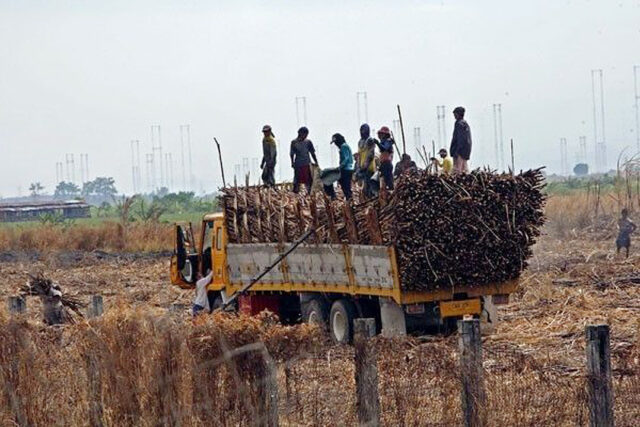
THE Sugar Regulatory Administration (SRA) said that it is considering a sugar purchase program to prop up declining millgate prices.

SRA Administrator Pablo Luis S. Azcona said that the direct purchase of sugar from farmers is one of the options to address the recent drop in the millgate price of raw sugar.

“We just have to find a way to ensure stable supply to keep millgate prices steady,” Mr. Azcona told reporters.

Mr. Azcona said that three sugar producer groups have called for intervention in light of the low millgate price.

The SRA had called on traders to voluntarily purchase domestically produced sugar to stabilize farmgate and retail prices. Participants will be eligible for allocations in a future sugar import program.

“We will talk with the Department of Agriculture on the possible (solutions). Voluntary purchase and putting sugar in reserve is of course one of the things that we are thinking about,” he added.

Mr. Azcona said that producers are breaking even at the current millgate price or could be suffering losses.

“As I said, we no longer follow supply and demand. The supply numbers are far behind, the supply numbers have a bigger difference than the demand difference,” he added.

He said that sugar supply has declined in response to the drop in production.

According to the SRA, as of Dec. 1, the raw sugar inventory was 171,736 metric tons (MT), while refined sugar stocks totaled 308,554 MT.

The SRA has estimated that sugar production this crop year will drop 7.2% to 1.78 million MT. — Adrian H. Halili

Pambababoy! Pambabastos!

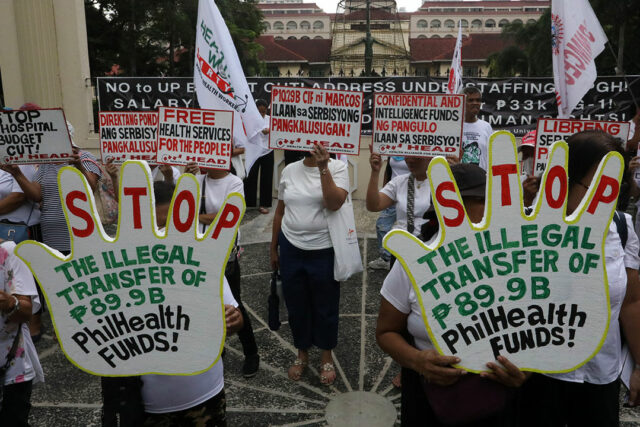
HEALTH ALLIANCE FOR DEMOCRACY holds a protest rally infront of the Philippine General Hospital over the PhilHealth funds. — PHILIPPINE STAR/EDD GUMBAN

These are terms in Tagalog — that mean being boorish or uncouth and being insulting or insolent, respectively — to describe the action of Congress with respect to the 2025 budget. Gross as they are, the Tagalog words offer the exact words that convey Congress’s disgraceful behavior.

In a statement being circulated through the petition platform called Change.org, citizens call the 2025 budget as the “most corrupt budget in Philippine history.”

The most egregious feature of the 2025 General Appropriations Act (GAA) that Congress approved is the budget of zero for the Philippine Health Insurance Corp. (PHIC) or PhilHealth. This is a blatant violation of the Universal Health Care Act (UHCA) and the Sin Tax Law.

To enable universal healthcare and social health insurance, the law obliges the government to allocate premiums for those who are financially incapable — the poor or indigents, senior citizens, and persons with disabilities as well as all their dependents. A zero budget strips the premiums of indirect contributors. Worse, the zero budget makes the direct contributors including the working class, kasambahays (household workers), overseas Filipino workers, and self-earning individuals bear the sole burden of financing PhilHealth. The unfairness or injustice is intensified when the government allocates nothing for PhilHealth but increases the premium contributions of the direct contributors. Funds are pooled within PhilHealth to enable risk sharing — by removing premiums for indirect contributors, government is blatantly abandoning its commitment to social solidarity in working towards universal healthcare.

Congress also violates the earmarking of excise tax revenues from tobacco and sweetened beverages to PhilHealth, as mandated by the Sin Tax Law.

Moreover, Congress flouts the Constitution’s provisions. The GAA cannot amend statutes like the UHCA and the Sin Tax Law. The bicameral conference committee cannot overreach and insert provisions that were not part of the bill approved by either the House of Representatives or the Senate.

And Congress has rejected the Constitution’s right to health. The right to health is concretely expressed in a commitment that retrogression does not happen in the provision of essential healthcare and that maximum available resources are used for the progressive realization of universal healthcare. Obviously, giving PhilHealth a budget of zero breaks such a principle.

The loud apologists for the corrupt 2025 GAA are the garrulous Senate President Chiz Escudero and the seemingly immaculate Senator Grace Poe, who employ the duplicitous argument that PhilHealth does not need a budget allocation, for it has P600 billion in reserve funds.

Senators Escudero and Poe and their colleagues in both chambers of Congress are contemptuous of the law. First, they reject the UHCA that mandates the government to provide the premiums for indirect contributors. Using the reserve funds to cover the premiums of indirect contributors is treachery, as the reserve funds actually constitute the previously paid premiums of members.

Second, they again violate the UHCA that unequivocally states that any excess in reserve funds must be used to increase PhilHealth benefits and decrease the premiums of direct contributors. The so-called excess funds must be used to fund the expansion of benefits (like the 30% increase in benefit packages, which adjusts for inflation over the years), the rollout of new benefits that PhilHealth promised in the face of legislative and public pressure, and the implementation of the much-delayed outpatient benefits (Konsulta program).

Worse, Senators Escudero and Poe dismiss the fact that PhilHealth’s insurance contract liabilities (ICL), per its latest financial statements, already exceed P1 trillion. It goes without saying that the ICL far outstrips PhilHealth’s reserve funds. It would behoove an insurance company, a social health insurance at that, to have the reserve funds adequately cover insurance contract liabilities. The PhilHealth budget of zero will exacerbate PhilHealth’s financial stress.

Thus the insensitivity, the callousness, and the deception displayed by Senators Escudero and Poe have incurred the anger of citizens. They have earned the disreputable monikers of “Heartless Chiz” and “Disgraced Grace”

But we should not forget that the pambababoy or the pambabastos was an act of both the Senate and the House of Representatives. The House Speaker, Martin Romualdez, let “Heartless Chiz” and “Disgraced Grace” be the voice of the pambababoy.

Only Senators Risa Hontiveros and Koko Pimentel resolutely and courageously stood up and opposed this dastardly act.

PhilHealth’s zero budget, severe in itself, is inextricably linked to a larger problem that makes the GAA 2025 the “most corrupt.” While Congress has degraded PhilHealth by giving it a budget of zero, it has substantially increased the budget for the medical assistance for indigents — the type of ayuda that is prone to corruption and arbitrariness and serves patronage politics.

Although the act of giving a budget of zero for PhilHealth is the most brazen, Congress has also slashed the budget for basic education by P12 billion, state colleges and universities by P30 billion, science and technology by P20 billion, poverty alleviation and nutrition (the 4Ps or Pantawid Pamilyang Pilipino Program), and active transportation.

The funds taken away from essential economic and social services have been transferred to the politically motivated ayuda like the medical assistance for indigents and the AKAP (Ayuda para sa Kapos ang Kita) for the “near poor,” for which a P26-billion budget was approved.

Further, some critics point out that the 2025 GAA violates Article XIV, Section 5(5) of the Constitution. Said Section provides that “The State shall assign the highest budget priority to education.” They observe that education has been replaced by public works, where the bulk of pork barrel funds are parked, as having the biggest allocation in the 2025 GAA. A total of P1.114 trillion has been allocated to public works. Critics have likewise exposed the trick where Congress includes programs or items under education like schools of national security agencies to give the pretense of a budget prioritizing education.

Mark our words: the 2025 GAA is a budget for the electioneering of the incumbents in the ruling political coalition. Ultimately, it is a budget for the preservation and extension of their power through Charter Change.

How then can we overturn the GAA that debases universal healthcare and other public goods, abets corruption, and serves patronage politics? Will the President heed the public call for a veto? Likely not; after all, his most loyal allies, led by his relative, the Speaker, are the ones responsible for the pambababoy.

Let’s listen to a global expert in universal healthcare, whom we cannot name, for we haven’t asked permission. Said she: “I did not believe it was possible to do this. I would be the last one to suggest a decrease in premium but — I think direct contributors should start insisting to decrease their premium or the government pays their share. Just for fairness. The technical approach is not working. Perhaps big voting constituencies like GSIS or SSS members with the employers’ confederations can muscle up.”

Another technocrat, the economist and former Finance Undersecretary Cielo Magno echoes the same sentiment that “the technical approach is not working.” In her social media video, which gained three million views, she championed the call for direct contributors not to pay premiums or for their payments to be refunded. Again, it is about fairness.

The experts and the technocrats feel the popular sentiment and the explosion of anger in the face of government’s heartlessness and harshness. “Remove #PhilHealth in our pay slips!!!” has become a call of citizens that has gone viral.

The transfer of PhilHealth funds to the National Government and the latest development of giving a zero budget to PhilHealth, together with the ineptness and inefficiency of its leadership, have damaged universal healthcare. Government has broken its commitment to social solidarity. The administration’s irresponsible, malicious, and flagrant actions have fired up the people. And the consequences are terrifying: the destruction of institutions like PhilHealth, the beginning of a fiscal crisis, and the inevitability of political turmoil.


Filomeno S. Sta. Ana III coordinates the Action for Economic Reforms.

Pia Rodrigo is strategic communications officer at Action for Economic Reforms.

www.aer.ph

MPIC, Maynilad commit to reforesting 25 hectares annually in Ipo Watershed

JUNE CHERYL CABAL-REVILLA, MPIC’s chief finance, risk, and sustainability officer (Left) and Roel Espiritu, vice-president and head of quality, sustainability, and resiliency division of Maynilad (Right), formalized the Plant for Life partnership.

METRO PACIFIC Investments Corp. (MPIC) and Maynilad Water Services, Inc. are ramping up their sustainability initiatives by partnering to launch a reforestation project within the Ipo Watershed.

The partnership aims to reforest and care for 25 hectares per year within the Ipo Watershed over the next three years, MPIC said in a statement over the weekend.

“By the end of 2026, the project will restore 75 hectares of forest, contributing to the sustainability of the watershed, creating livelihood opportunities, and enriching biodiversity,” MPIC said.

MPIC said it will provide the manpower, funding support, and logistical assistance for the reforestation project, while Maynilad is tasked with the technical know-how for the implementation of the project, such as identifying optimal planting sites, sourcing native seedlings, and monitoring the project.

The Ipo Watershed was declared a protected area by the Department of Environment and Natural Resources. It is considered an important source, serving as a vital link in the Angat-Umiray-Ipo watersheds system, which supplies about 96% of Metro Manila’s water demand.

The reforestation initiative of MPIC and Maynilad was formalized through a memorandum of understanding on Nov. 8. The project also aims to provide an additional source of income for the Dumagat community living within the watershed by having them as the project’s reforestation partners.

“[The program] actively engages local volunteers, generates livelihood opportunities, and raises awareness about the importance of environmental protection in surrounding communities,” MPIC said.

Maynilad serves certain portions of Manila, Quezon City, and Makati. It also operates in Caloocan, Pasay, Parañaque, Las Piñas, Muntinlupa, Valenzuela, Navotas, and Malabon.

It also supplies the cities of Cavite, Bacoor, and Imus, and the towns of Kawit, Noveleta, and Rosario, all in Cavite province.

MPIC is one of the three key Philippine units of Hong Kong-based First Pacific Co. Ltd., the others being Philex Mining Corp. and PLDT Inc.

Hastings Holdings, Inc., a unit of PLDT Beneficial Trust Fund subsidiary MediaQuest Holdings, Inc., has a majority share in BusinessWorld through the Philippine Star Group, which it controls. — Ashley Erika O. Jose

BYD widens metro network with new dealership

At BYD Greenfield Mandaluyong are (from left) ACMobility Head of Automotive Retail and Distribution Antonio ‘Toti’ Zara III; BYD Philippines Country Head Aiffy Liu; BYD Philippines, Singapore, and Brunei General Manager James Ng; BYD Asia-Pacific Auto Sales Division General Manager Liu Xueliang; Mandaluyong City Mayor Benjamin Abalos, Sr.; Mandaluyong City Vice-Mayor Menchie Abalos; ACMobility Chief Executive Officer Jaime Alfonso Zobel de Ayala; BYD Cars Philippines Managing Director Bob Palanca; and Iconic Dealership, Inc. Chief Operating Officer for BYD Dennis Salvador. — PHOTO FROM ACMOBILITY

Strategically located facility affirms ACMobility’s commitment to BYD customer service

By Joyce Reyes-Aguila

BYD Philippines official distributor ACMobility concludes 2024 with an additional dealership location in Metro Manila. The facility in Mandaluyong City is described by the company as “strategically located” specifically in the Greenfield district, and is the second location of the brand that is managed by Iconic Dealership, Inc., ACMobility’s dealer arm.

In a statement, company Chief Executive Officer Jaime Alfonso Zobel de Ayala said the move is a “steadfast representation of ACMobility’s commitment to establishing BYD as a brand Filipinos can trust, as well as approach with confidence. Beyond just sales, this dealership serves as a beacon of ACMobility’s dedication to reliable, first-class customer service, ensuring that BYD owners receive the best support for their electric vehicles.”

BYD Greenfield Mandaluyong’s 1,642-sq.m. space houses a six-car showroom, an 85-sq.m. customer lounge, and an open workshop. Dedicated negotiation areas and two-car releasing spaces will “ensure a seamless and comfortable experience for every customer,” a company statement added. All features of the new facility are aligned with BYD’s global dealership standards and is now part of the 25-strong BYD dealership network in operation here.

A total of 310 sq.m. is occupied by a service area that provides general repairs, preventive maintenance, diagnostics, and battery replacement. This also serves as a drop-off and pickup point for body and paint services provided by the Central Body Shop in Alabang. According to the company, BYD Greenfield Mandaluyong is outfitted with a full set of original BYD diagnostic equipment and specialized service tools — all operated by a dedicated team of BYD-certified technicians and service advisors.

“We are thrilled to open the doors of BYD Greenfield Mandaluyong, bringing a modern, customer-centric facility to a key business district in Metro Manila,” joined BYD Philippines Country Head Aiffy Liu. “Honed by BYD’s 30 years of experience as a technology leader, this dealership is designed to provide a seamless experience for all our customers, offering world-class sales and after-sales services for the growing number of BYD EV owners in the Philippines.”

BYD Cars Philippines Managing Director Bob Palanca described the location as “crucial” to the brand’s expansion strategy in the Philippines. “We aim to bring electrification closer to businesses and communities in this important district central to Metro Manila and nearby provinces, making it easier for customers to transition to sustainable transportation solutions,” he stated about the location’s thrust to serve professionals working in business hubs in its proximity. BYD Cars Philippines offerings include the BYD Seal 5 DM-i compact sedan, BYD seal mid-compact sedan, BYD Seagull mini hatchback, BYD Sealion 6 DM-i compact sport utility vehicle (SUV), BYD Atto 3 compact SUV, BYD Tang performance SUV, BYD Han sports sedan electric vehicle (EV), and the BYD Dolphin hatchback.

BYD Greenfield Mandaluyong underscores the new-energy vehicle brand’s commitment to expand its presence in the Philippine EV market and offer top-tier service to EV owners across the country. Aside from its Metro Manila dealerships in cities like Makati and Quezon City, BYD Philippines is also present in the provinces of Cebu (Mandaue City), Pampanga (San Fernando City), Negros Occidental (Talisay City), Davao (Davao City), and Iloilo (Iloilo City).

The newest location is at Unit 5, 833 Sheridan Street, Greenfield District, Highway Hills, Mandaluyong. Showroom hours are from Monday to Sunday, 8 a.m. to 7 p.m., while after-sales services are available from Monday to Saturday, 8 a.m. to 5 p.m. For more information, visit BYD Cars Philippines’ website at www.bydcarsphilippines.com and its social media accounts on Facebook, Instagram, and YouTube.

Yields on Treasury bills may be mixed before Fed, BSP meetings

BW FILE PHOTO

RATES of Treasury bills (T-bills) to be offered on Monday may be mixed as players await the US Federal Reserve and Bangko Sentral ng Pilipinas’ (BSP) monetary policy decisions this week.

The Bureau of the Treasury (BTr) will auction off P15 billion in T-bills on Monday, or P5 billion each in 91-, 182-, and 364-day papers. This is the last offering of government securities (GS) for 2024.

T-bill yields could track the mixed movements in secondary market rates on Friday, Rizal Commercial Banking Corp. Chief Economist Michael L. Ricafort said in a Viber message.

“The recent increase in short-term peso interest rates could be partly attributed by crossing-the-year premiums on peso funds amid some window-dressing activities as the accounting year-end draws closer, a consistent pattern seen for many years already,” he added.

At the secondary market on Friday, yields the 91- and 182-day T-bills went up week on week by 14.49 basis points (bps) and 8.47 bps to end at 5.8404% and 6.0571%, respectively, based on PHP Bloomberg Valuation Service Reference Rates data as of Dec. 13 published on the Philippine Dealing System’s website.

Meanwhile, the 364-day paper inched down by 0.65 bp week on week to yield 6.0739%.

“The GS market saw two-way interest [on Friday] on a relatively quiet market following mixed US economic data overnight,” a trader said in an e-mail.

Secondary market yield movements were mostly driven by anticipation for this week’s monetary policy meetings, the trader added.

The Fed will hold its last policy review for the year on Dec. 17-18. Markets fully expect a cut at the upcoming meeting, but only price a roughly 24% chance of another one in January, with March the most likely point for another move, according to CME’s FedWatch tool, Reuters reported.

The US central bank started its easing cycle in September with a 50-bp cut and followed it up with a 25-bp reduction at its November review, bringing the fed funds rate to the 4.5%-4.75% range.

Meanwhile, the BSP will meet to discuss policy on Dec. 19 (Thursday). A BusinessWorld poll conducted last week showed that 13 out of 16 analysts expect the Monetary Board to reduce benchmark borrowing costs by 25 bps for a third straight meeting, which would bring the policy rate to 5.75%.

The BSP kicked off its rate-cut cycle in August with a 25-bp reduction. It cut borrowing costs by another 25 bps in October to bring the target reverse repurchase rate to 6%.

Last week, the BTr raised P15 billion as planned from the T-bills it auctioned off as total bids reached P56.463 billion or almost four times as much as the amount on offer.

Broken down, the Treasury borrowed the programmed P5 billion from the 91-day T-bills as tenders for the tenor reached P13.973 billion. The three-month paper was quoted at an average rate of 5.774%, up by 14.4 bps from a week prior, with accepted bids yields ranging from 5.629% to 5.82%.

The government likewise made a full P5-billion award of the 182-day securities, with bids reaching P16.38 billion. The average rate of the six-month T-bill stood at 5.922%, up by 1.7 bps week on week, with accepted rates at 5.875% to 5.94%.

Lastly, the Treasury raised P5 billion as planned via the 364-day debt papers as demand for the tenor totaled P26.11 billion. The average rate of the one-year debt increased by 3.1 bps to 5.968%, with tenders accepted having rates ranging from 5.938% to 5.988%.

The government borrows to help fund its budget deficit, which is capped at P1.52 trillion or 5.7% of gross domestic product this year. — Aaron Michael C. Sy with Reuters

Mango fashion tycoon Andic dies in mountain accident

MADRID — The founder and owner of fashion empire Mango, Isak Andic, died on Saturday in a mountain accident, police said. He was 71.

The businessman slipped and fell over 100 meters from a cliff while hiking with relatives in the Montserrat caves near Barcelona, a police spokesperson said.

“His departure leaves a huge void but all of us are, in some way, his legacy and the testimony of his achievements. It is up to us… to ensure that Mango continues to be the project that Isak was ambitious and proud of,” Mango’s chief executive officer, Toni Ruiz, said in a statement.

Born in Istanbul, Mr. Andic moved with his family to the northeastern Spanish region of Catalonia in the 1960s and founded Mango in 1984. He was worth $4.5 billion, according to Forbes. He was a non-executive chairman of the company when he died.

He was seen as a rival to Amancio Ortega, the owner of Inditex, the world’s largest fast-fashion retailer.

Mango had a turnover of €3.1 billion in 2023 with 33% of its business online and a presence in more than 120 markets. — Reuters

Meat imports up 16.8% in 10 months to October

REUTERS

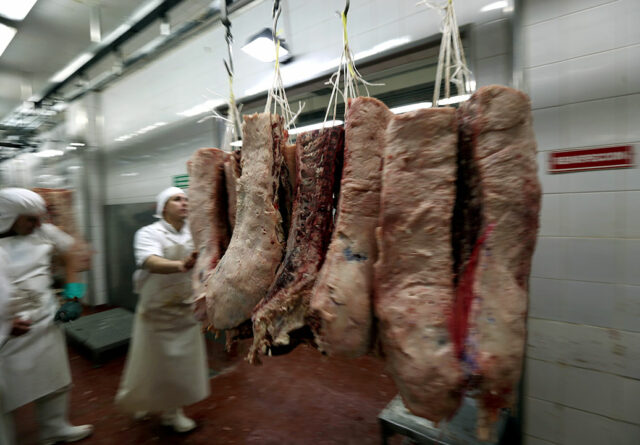
THE volume of meat imports increased 16.8% in the 10 months to October, driven by higher beef and pork shipments, according to the Bureau of Animal Industry (BAI).

The BAI tallied imports of 1.19 billion kilograms of meat during the 10 months, against 1.02 billion kilos a year earlier.

Meat Importers and Traders Association President Emeritus Jesus C. Cham said that imports continue to grow are on track to breach the 1.2 billion kilos of meat imports last year.

“All this has happened despite the volatility of the exchange rate, whose effect will be felt in the new year. With imports still arriving as seen from the utilization rate of the container yards and the slow rate of return of empties, the importers will take stock of the remaining inventory after the Christmas sales and hope the market will remain exuberant,” Mr. Cham said via Viber.

Making up 14% of total imports, beef shipments increased 38% during the period to 51.53 million kilos.

“Beef may end the year with a 50% increase. Clearly, we see the markets appreciating more the value of this red meat,” Mr. Cham added.

Beef from Brazil amounted to 70.86 million kilos, followed by Australia (44.02 million), and Ireland (14.5 million).

Shipments of pork rose 18.6% to 598.28 million kilos during the 10 months, accounting for about 50.2% of all meat imports during the period.

“With the exception of carcasses, all pork items performed strongly with pork meat growing at 25% but offal registering smaller growth at 12%,” he said.

He added that African Swine Fever continues to impact domestic pork production while the lower duty on pork meat is making offal less attractive.

Brazil supplied around 154.51 million kilos of pork, followed by Spain (144.45 million) and Canada (85.82 million).

Shipments of chicken totaled 389.95 million kilos during the period, up 8.6%. They accounted for 32.6% of meat imports.

Mr. Cham said that poultry imports could post an overall increase of 30%, amid higher shipments of chicken leg quarters and mechanically deboned meat.

Brazil remained the top supplier of chicken with 195.32 million kilos, followed by the US (126.91 million) and Canada (14.49 million).

Turkey imports more than tripled to 1.16 million kilos during the period, accounting for 0.10% of the total.

Shipments of buffalo, duck, and lamb continued to decline during the 10-month period.

Imports of duck fell 21.5% to 198,339 kilos, while lamb dipped 9.7% to 603,906 kilos, and buffalo fell 1.9% to 33.01 million. — Adrian H. Halili