Home Blog Page 1717

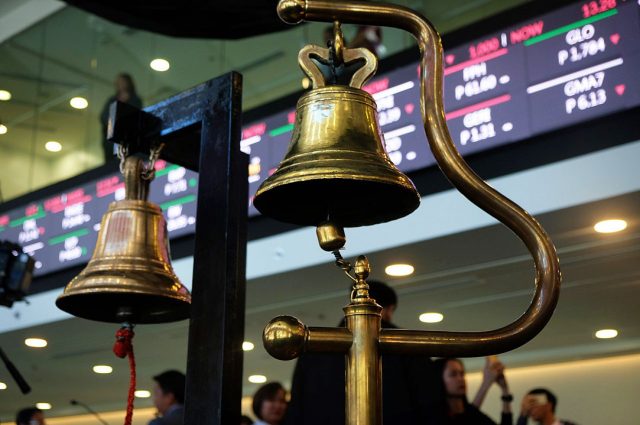
PSEi inches up on bargain hunting after break

BW FILE PHOTO

THE MAIN INDEX inched higher on Monday as investors picked up bargains and repositioned after the Lenten break.

The Philippine Stock Exchange index (PSEi) went up by 0.05% or 3.38 points to close at 6,138, while the broader all shares index declined by 0.31% or 11.68 points to 3,645.31.

“The local market edged higher this Monday as investors resumed their bargain hunting,” Philstocks Financial, Inc. Senior Research Analyst Japhet Louis O. Tantiangco said in a Viber message. “Appreciation of corporate fundamentals and hopes that the local economy will weather the storm caused by the United States’ tariff policies helped the market in its climb.”

“Also aiding was the hopes of further monetary policy easing by the Bangko Sentral ng Pilipinas (BSP). Finally, the strengthening of the local currency against the US dollar also gave the market support,” Mr. Tantiangco added.

Finance Secretary Ralph G. Recto last week said that Philippine gross domestic product may have expanded by 6% in the first quarter. National Economic and Development Authority Secretary Arsenio M. Balisacan also said he is hopeful the economy grew by at least 6% in the quarter as rate cuts and cooling inflation likely drove domestic consumption.

The BSP on April 10 cut benchmark interest rates by 25 basis points (bps) to bring the policy rate to 5.5%, putting its easing cycle back on track after an unexpected pause in February.

The central bank has now slashed borrowing costs by a cumulative 100 bps since it kicked off its rate-cut cycle in August last year. BSP Governor Eli M. Remolona, Jr. has said that they are considering further reductions this year.

“Philippine shares started off tepidly as investors remain on the sidelines after the Holy Week break to gauge the price action movement of the market at the beginning of the week,” Regina Capital Development Corp. Head of Sales Luis A. Limlingan said in a Viber message.

Majority of sectoral indices closed in the red on Monday. Property declined by 0.91% or 20.20 points to 2,193.08; industrials retreated by 0.59% or 52.19 points to 8,706.64; services went down by 0.57% or 11.13 points to 1,917.04; and holding firms dropped by 0.07% or 3.92 points to 5,063.35.

Meanwhile, mining and oil rose by 3.16% or 304.83 points to 9,944.92 and financials climbed by 1.44% or 34.55 points to 2,426.10.

“Bank of the Philippine Islands was the day’s index leader, climbing 2.35% to P135.10. SM Prime Holdings, Inc. was the main index laggard, falling 3.1% to P21.90,” Mr. Tantiangco said.

Value turnover rose to P4.56 billion on Monday with 1.05 billion shares exchanged from the P4.21 billion with 951.74 million issues traded on Wednesday.

Decliners outnumbered advancers, 109 versus 93, while 51 names were unchanged.

Net foreign selling increased to P46.86 million on Monday from P11.66 million on Wednesday. — Revin Mikhael D. Ochave

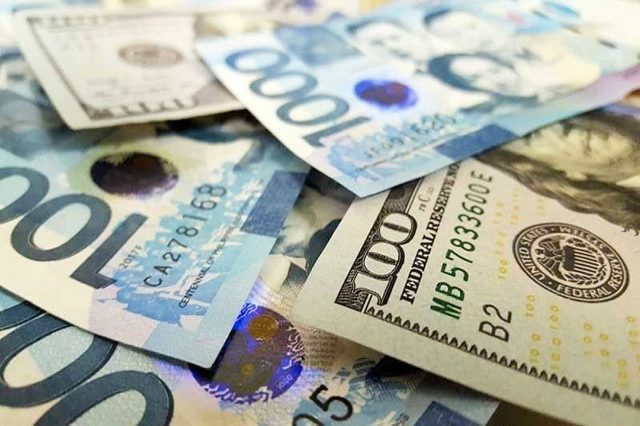
Peso surges to near 7-month high as dollar extends slide

BW FILE PHOTO

THE PESO jumped to a near seven-month high on Monday as the dollar continued to reel amid tariff concerns and US President Donald J. Trump’s threats to fire US Federal Reserve Chair Jerome H. Powell.

The local unit closed at P56.61 per dollar on Monday, surging by 19 centavos from its P56.80 finish on Wednesday, Bankers Association of the Philippines data showed.

This was the peso’s best finish in nearly seven months or since its P56.295 close on Oct. 4, 2024.

The peso opened Monday’s session sharply stronger at P56.64 against the dollar. It traded better than Wednesday’s close for the entire session as its weakest was at just P56.65, while it climbed to its intraday best of P56.48 versus the greenback.

Dollars traded fell to $1.46 billion on Monday from $2.3 billion on Wednesday.

“The pair closed higher on broad dollar weakness amid the intensifying trade war and concerns over Fed Chair Powell’s position following Trump’s criticisms. The dollar extended its losses,” a trader said in a phone interview.

The peso was also supported by remittances following the long weekend, Rizal Commercial Banking Corp. Chief Economist Michael L. Ricafort likewise said in a Viber message.

For Tuesday, the trader sees the peso moving between P56.40 and P56.70 per dollar, while Mr. Ricafort said it could range from P56.50 to P56.70.

The dollar tumbled on Monday as investor confidence in the US economy took another hit over Mr. Trump’s plans to shake up the Federal Reserve, which would throw into question the independence of the central bank, Reuters reported.

White House economic adviser Kevin Hassett said on Friday that the president and his team were continuing to study whether they could fire Mr. Powell, just a day after Mr. Trump said Mr. Powell’s termination “cannot come fast enough” as he called for the Fed to cut interest rates.

Against the Swiss franc, the dollar sank more than 1% to a 10-year trough of 0.80695, while the euro peaked at $1.153525, its highest since November 2021.

The dollar also hit a seven-month low of 140.615 yen.

Against a basket of currencies, the dollar slid to a three-year low of 98.164 on Monday. The New Zealand dollar jumped more than 1% to $0.6013.

Mr. Trump’s sweeping tariffs and uncertainty over his trade policies have sent global markets into a tailspin and darkened the outlook for the world’s largest economy, in turn weakening the dollar as investors pull money out of US assets. — Aaron Michael C. Sy with Reuters

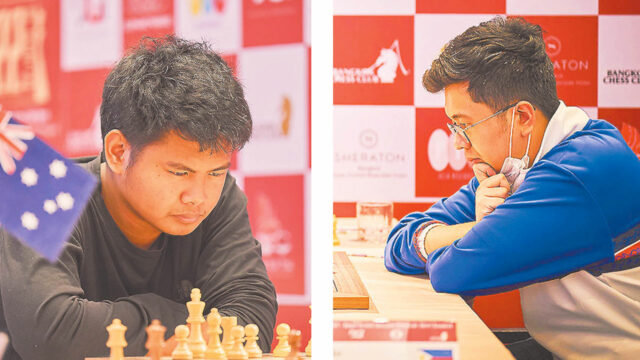
Concio, Bersamina remain in title contention in Bangkok chessfest

MICHAEL CONCIO, JR. (left) and Paulo Bersamina. — BANGKOKCHESS.COM

THE PHILIPPINES’ Michael Concio, Jr. and Paulo Bersamina hurdled their respective assignments in the eighth and penultimate round to remain in title contention in the Bangkok Chess Club Open in Thailand on Sunday night.

Both the Filipino International Masters (IMs) relied on their superb endgame technique to eke wins — one by Mr. Concio over Australian IM James Morris in 66 moves of a Bogo Indian encounter and the other by Mr. Bersamina in a marathon 83-move triumph over Latvian Arsens Batashevs of an English clash.

Their wins catapulted them straight to a three-player logjam at third with 6.5 points each that included Indian Grandmaster (GM) Babu Lalit.

They were also half a point behind the pace-setting Macedonian GM Evgeny Romanov and Malaysian FIDE Master (FM) Ang Ern Jie Anderson, both owning seven points apiece.

For them to have a chance for the title they would need to win their final round assignment by all costs and hope Messrs. Romanov and Ang drew theirs.

Mr. Concio was battling Mr. Lalit while Mr. Bersamina Ukrainian GM Vitaliy Bernardskiy.

Another Filipino, FM Christian Gian Carlo Arca, went for the win but ended up splitting the point with Indian GM Surya Shekhar Ganguly via perpetual check.

The standoff, however, sealed the 16-year-old Panabo, Davao del Norte pride, the third of three required IM norms to become an IM.

All Mr. Arca, who has six points, needs to do now is to reach the 2400-rating plateau to become a full-pledge IM.

His current live rating is 2311.2.

Mr. Arca is also in contention of claiming his first GM norm if he beats former world challenger GM Nigel Short of England in the last round. — Joey Villar

Hoey shares 12th place in PGA Tour Corales Puntacana golf fest

RICO HOEY — PGATOUR.COM

THE PHILIPPINES’ Rico Hoey fired a closing one-under 71 to finish tied for 12th in the Corales Puntacana Championship on Easter Sunday in the Dominican Republic.

Mr. Hoey displayed resilience in the challenging layout, thrice rebounding with birdies after each bogey before knocking a crucial chip-in birdie on the par-3 17th.

The Fil-Am ace assembled a 10-under 278 card over four rounds in the $4-million PGA Tour and Korn Ferry Tour event to post his second-best finish of the season.

Mr. Hoey, whose highest placing so far in 2025 was 11th in the Texas Children’s Houston Open in late March, banked $77,000 (around P4.37 million) for his performance at the Puntacana Resort and Club.

The ICSTI-backed golfer wound up four strokes behind South African winner Garrick Higgo’s 274.

Mr. Higgo submitted an even 72 in the fourth round but it was enough to ease past overnight leader Joel Dahmen of the US, who faded big time in the final push.

Mr. Dahmen kissed his championship bid goodbye when he bogeyed the last three holes for a 76, which ultimately allowed Mr. Higgo to snatch the crown and the $720,000 top purse and sent him down to a share of second place at 275. — Olmin Leyba

Undermanned Rain or Shine splits first two games of eliminations

RAIN OR SHINE’S (ROS) depleted frontline embraces a bigger responsibility while Beau Belga and Keith Datu are still on the path to recovery and Luis Villegas is out for the season.

Veteran Mr. Belga is recovering from vertigo, Mr. Datu is sidelined by calf strain and Mr. Villegas is rehabbing from ACL surgery, leaving the likes of Caelan Tiongson and Leonard Santillan to man the fort.

Still, the Elasto Painters managed to split their first two assignments in the PBA Philippine Cup eliminations, scoring a 113-96 bounceback win over Arvin Tolentino-less NorthPort after opening with a 95-109 dud.

“That’s a testament to how hard our bigs play,” said coach Yeng Guiao of the efforts of ROS’ bigs who are forced to play “out of position” due to their manpower shortage.

Mr. Guiao hopes to get at least one of them back in harness before they clash with teams powered by towering bigs.

Mr. Belga, who’s having trouble with his balance, said he’ll be out for one month. — Olmin Leyba

Ostapenko books Stuttgart final spot against top seed Sabalenka

STUTTGART, GERMANY — Latvia’s Jelena Ostapenko powered into the Stuttgart Grand Prix final on Sunday with a 6-4, 6-4 victory over fellow unseeded player Ekaterina Alexandrova.

The 27-year-old will meet world number one Aryna Sabalenka, who was made to work hard for a 7-5, 6-4 win over Italy’s Jasmine Paolini to reach her fourth final in five years.

Ostapenko, who stunned five-time Grand Slam champion Iga Swiatek in the last eight to improve her lifetime mark to 6-0 against the Pole, got off to a strong start with a break in the first game.

She was broken straight back but earned another one quickly to go 4-2 up.

Alexandrova, who upset sixth seed Mirra Andreeva and world number three Jessica Pegula at the tournament to take her tally to five top-10 wins during the season, struggled with her opponent’s thundering groundstrokes, and especially her forehand.

A finalist in Qatar this year, Ostapenko kept up the pressure and cruised to victory after an early break in the second set.

“I don’t know but I feel amazing playing here,” Ostapenko said. “So pumped up. Those kinds of matches, winning three sets, gives you confidence,” she said.

Sabalenka, a three-time losing finalist in Stuttgart between 2021-23, looked to be powering through the first set after taking a 3-0 lead, but Paolini fought back to cut the deficit before losing it 7-5.

The tables were turned in the second with the diminutive Italian punishing a sloppy Sabalenka, who was rushing to finish the points with her trademark power but seeing errors pile up, and earning a 3-0 lead.

Paolini lacked a bit of precision, however, and Sabalenka grabbed her chances to claw her way back to 3-3. — Reuters

Real Madrid wins over Athletic Bilbao, keeps title hopes alive

MADRID — Real Madrid’s Federico Valverde netted a superb late volley to secure a 1-0 home win over Athletic Bilbao on Sunday that keeps them within four points of LaLiga leaders Barcelona.

A heavily rotated Athletic side had kept the hosts at bay until Valverde scored the winner three minutes into stoppage time, pouncing on a poor clearance to fire a volley into the far top corner.

Vinicius Junior thought he had handed Real the lead with a low shot, but the 79th-minute effort was disallowed by the VAR for an Endrick offside in the build-up. 

Real bounced back after their midweek Champions League exit at the hands of Arsenal to move up to 69 points, six clear of third-placed Atletico Madrid, who suffered a shock 1-0 loss at Las Palmas on Saturday.

Athletic sit fourth with 57 points. — Reuters

Mitchell, Jerome power Cavaliers past Heat

DONOVAN MITCHELL scored 30 points and Ty Jerome scored 16 of his 28 points in the fourth quarter as the top-seeded Cleveland Cavaliers pulled away for a 121-100 victory over the visiting Miami Heat in Game 1 of their Eastern Conference first-round series on Sunday.

Jerome, a backup point guard, was making his playoff debut in his sixth season. He also dished three assists in the final period after being named a finalist for the Sixth Man of the Year award earlier in the day. He made 10 of 15 field-goal attempts, including 5 of 8 on 3-pointers.

Mitchell, a six-time All-Star, posted his seventh straight 30-point performance in a series opener, tying Michael Jordan for the NBA record. Jordan accomplished it twice in his legendary playoff career with the Chicago Bulls.

Jarrett Allen had 12 points, 11 rebounds and three steals for Cleveland, which outscored the Heat 34-21 in the fourth. Its largest lead was the final score, courtesy of Mitchell’s two free throws with 1:23 remaining.

Bam Adebayo had 24 points and nine rebounds, and Tyler Herro scored 21 points for the Heat, who were playing their third game in five days. Miami needed play-in tournament wins at Chicago on Wednesday and Atlanta on Friday to become the first 10th seed to qualify.

The Cavaliers won two of the teams’ three regular-season games, their only loss coming in Miami. This is the first time they have met in the playoffs. — Reuters

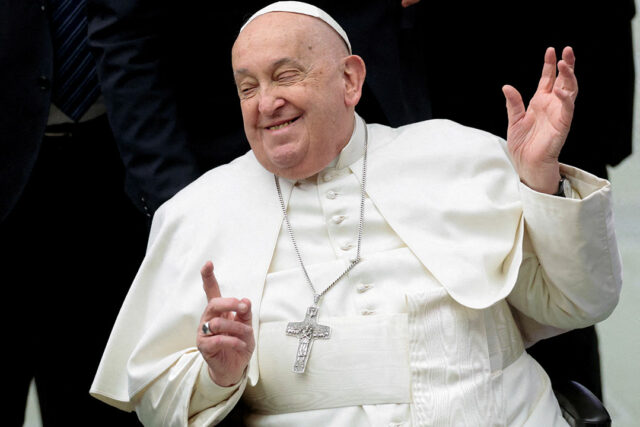
Pope Francis: the pontiff who shook up the Catholic Church

POPE FRANCIS reacts as he attends the weekly general audience in Paul VI Hall at the Vatican, Feb. 5, 2025. — REUTERS FILE PHOTO

VATICAN CITY — Pope Francis changed the face of the modern papacy more than any predecessor by shunning much of its pomp and privilege, but his attempts to make the Catholic Church more inclusive and less judgmental made him an enemy to conservatives nostalgic for a traditional past.

The Vatican said on Monday in a video statement that he had died.

Francis inherited a deeply divided Church after the resignation in 2013 of his predecessor, Benedict XVI. The conservative-progressive gap became a chasm after Francis, from Argentina, was elected the first non-European pope in 1,300 years.

The polarization was fiercest in the United States, where conservative Catholicism often blended with well-financed right-wing politics and media outlets.

For nearly a decade until Benedict’s death in 2022, there were two men wearing white in the Vatican, causing much confusion among the faithful and leading to calls for written norms on the role of retired popes.

The intensity of conservative animosity to the pope was laid bare in January 2023 when it emerged that the late Australian Cardinal George Pell, a towering figure in the conservative movement and a Benedict ally, was the author of an anonymous memo in 2022 that condemned Francis’ papacy as a “catastrophe.”

The memo amounted to a conservative manifesto of the qualities conservatives will want in the next pope.

Francis appointed nearly 80% of the cardinal electors who will choose the next pope, increasing, but not guaranteeing, the possibility that his successor will continue his progressive policies. Some Vatican experts have predicted a more moderate, less divisive successor.

Under his watch, an overhauled Vatican constitution allowed any baptized lay Catholic, including women, to head most departments in the Catholic Church’s central administration.

He put more women in senior Vatican roles than any previous pope but not as many as progressives wanted.

Francis was 76 when he was elected to the post and his health was generally good for most of his papacy. He recovered well from intestinal surgery in 2021 but a year later a nagging knee problem forced him to slow down. He was never keen on exercise and the restriction of a wheelchair and a cane led to a visible increase in his weight.

His inability to help bring an end to the war in Ukraine was a great disappointment. From the day of Russia’s invasion in February 2022, he made appeals for peace at nearly every public appearance, at least twice a week.

The conflict brought relations between the Vatican and the Russian Orthodox Church to a new low in 2022 when Francis said its Patriarch Kirill, who supported the conflict, should not act like “Putin’s Altar Boy.”

He made frequent appeals for the release of hostages taken by Hamas militants but increased criticism of Israel’s military campaign in Gaza ahead of the January 2025 ceasefire agreement in the Israel-Hamas war that erupted in October 2023.

FROM BUENOS AIRES TO THE VATICAN
Jorge Mario Bergoglio was born on Dec. 17, 1936 into a family of Italian immigrants who had settled in Buenos Aires.

He attended a technical high school and worked for a while as a chemical technician at a food laboratory. After he decided to become a priest, he studied at the diocesan seminary and in 1958 entered the Jesuit religious order.

At about that time, when he was 21, he caught pneumonia and had to have the top part of one lung removed because of cysts.

While still in the seminary, his vocation was thrown into crisis when he was “dazzled” by a young woman he met at a family wedding. But he stuck to his plans and after studies in Argentina, Spain and Chile, he was ordained as a Jesuit priest in 1969, rapidly rising to head the order in Argentina.

That coincided with the 1976-1983 military dictatorship, during which up to 30,000 suspected leftists were kidnapped and killed.

The Vatican has denied accusations by some critics in Argentina that Francis stayed silent during the human rights abuses or that he failed to protect two priests who challenged the dictatorship.

As archbishop of Buenos Aires from 2001-2013, he clashed frequently with the Argentine government, saying it needed to pay more attention to social needs.

A SIMPLE START
Francis endeared himself to millions with his simplicity when he spoke minutes after his election as pope on March 13, 2013.

“Brothers and sisters, good evening,” were his first words from the balcony of St. Peter’s Basilica, departing from the traditional salutation “Praised be Jesus Christ!”

The first pope from Latin America and the first Jesuit to hold the post, Francis was also the first in six centuries to take over the Church after the resignation of a pope.

He took the name Francis in honor of Francis of Assisi, the saint associated with peace, concern for the poor, and respect for the environment.

In that first appearance, the new pope shunned the crimson, fur-trimmed “mozzetta,” or cape, and also did not wear a gold cross but kept around his neck the same faded silver-plated one he used as archbishop of Buenos Aires.

Gone too were the plush red “shoes of the fisherman” used by his predecessors. He kept the same simple black shoes he always used and wore $20 plastic watches, giving some away so they could be auctioned off for charity.

In his first meeting with journalists three days later, Francis said: “How I would like a Church that is poor and for the poor.”

MODEST LIVING
Inside the tiny city-state, where some cardinals lived like princes in frescoed apartments, Francis renounced the spacious papal apartments in the Apostolic Palace and never moved out of the Vatican hotel where he and the other cardinals who entered the conclave of 2013 were billeted in simple rooms.

The Santa Marta residence, a modern building with a common dining room, became the nerve center of the more than 1.3 billion-member Roman Catholic Church.

“It (the decision to stay in Santa Marta) saved my life,” he told Reuters in an interview in 2018, explaining that apartments used by his predecessors were like a “funnel” isolating inhabitants.

The bulletproof papal limousine was dispatched to the Vatican Museums and Francis took to being driven around Rome in a blue Ford Focus with no security features.

His first trip outside Rome was to the tiny Italian island of Lampedusa to pay tribute to the thousands of migrants who had drowned in the Mediterranean while trying to reach Europe and a better life.

“In this globalized world we have fallen into the globalization of indifference. We have become used to the suffering of others. It doesn’t regard us. It doesn’t interest us. It’s not our business,” he said.

WORLDWIDE PRESTIGE
Francis enjoyed considerable prestige internationally, both for his calls for social justice as well as for risky political overtures.

He made more than 45 international trips including the first by any pope to Iraq, United Arab Emirates, Myanmar, North Macedonia, Bahrain and Mongolia.

In 2014, secret contacts mediated by the Vatican resulted in a rapprochement between the long-hostile United States and Cuba.

In 2018, he led the Vatican to a landmark deal on the appointment of bishops in China, which conservatives criticized as a sell-out by the Church to Beijing’s communist government.

Under his watch, the Vatican and the United Nations teamed up to hold international conferences on climate change and in June 2015 he issued an encyclical in which he demanded “action now” to save the planet.

In the 2018 interview with Reuters, he said then US President Donald J. Trump’s decision to pull out of the 2015 Paris climate agreement had pained him “because the future of humanity is at stake.” The pope and Trump were at odds over many issues, mostly immigration.

Throughout his pontificate, Francis spoke out for the rights of refugees and criticized countries that shunned migrants.

He visited the Greek island of Lesbos and brought a dozen refugees to Italy on his plane, and asked Church institutions to work to stop human trafficking and modern slavery.

He ordered his charity arm to help the homeless in the neighborhood around the Vatican, opening a shelter and a place for them to have baths and haircuts and see foot doctors. He gave the homeless a private tour of the Sistine Chapel.

During a trip to Sicily in 2018, he appealed to “brothers and sisters of the Mafia” to repent, saying the island needed “men and women of love, not men and women ‘of honour,’” using the term mobsters apply to themselves.

After a wave of Islamist militant attacks in France in 2015-2016, including the killing of an elderly priest who was saying Mass, the pope called on all religions to declare that killing in God’s name was “Satanic.”

THE FRANCIS EFFECT
Although his style was not welcomed by all members of the Church hierarchy, some of whom had become accustomed to the luxury of stately mansions and palaces, the “Francis Effect” began trickling down the ranks.

His desire to connect extended to telephone calls. He became known as the “cold call pope” for phoning people unannounced, usually after they had written to him about a problem or he had heard that they had been touched by tragedy.

“This is Francis,” were the words incredulous people heard on the other end of the line. “Really, this is Pope Francis.”

He also sought more openness with journalists. On one freewheeling encounter on the way back from Brazil in 2013, the pope, responding to a question about gay priests, offered an answer that made world headlines.

“If a person is gay and seeks God and has good will, who am I to judge him?”

The comment did not mark a change in Church teaching that calls homosexual acts sinful, but it became emblematic of his preference for mercy over condemnation.

A CHURCH FOR THE POOR
From the start, Francis sent clear signals to priests and bishops about the type of Church he wanted.

He said there was no room for “careerists or social climbers” among the clergy, told cardinals they should not live “like princes,” and said the Church should not “dissect theology” in lush salons while there were poor people around the corner.

“If investments in banks fall, it is a tragedy and people say ‘what are we going to do?’ but if people die of hunger, have nothing to eat or suffer from poor health, that’s nothing. This is our crisis today. A Church that is poor and for the poor has to fight this mentality,” he said early in his papacy. 

Even as pope, Francis remained an ardent fan of the Buenos Aires San Lorenzo soccer team.

In the 2018 interview with Reuters, Francis said he did not miss Argentina. “I only miss the street. I am a ‘callejero’ (a man of the streets). I really would like to be able to do that again, but I can’t now.” — Reuters


What happens now, after the death of Pope Francis

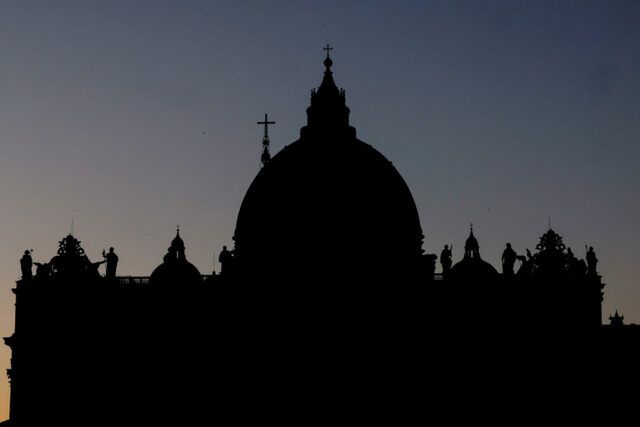
SAINT PETER’S BASILICA is silhouetted in this photo taken at the Vatican, Dec. 16, 2023. — REUTERS

VATICAN CITY — Here is what happens next in the Roman Catholic Church following the death of Pope Francis, which was announced by the Vatican on Monday. The rituals mark the end of one papacy and the start of the next:

• The pope’s camerlengo (chamberlain), Cardinal Kevin Farrell, officially confirms the death. He then seals the pope’s private apartment and prepares the funeral.

• The camerlengo and three assistants decide when the pope’s coffin will be taken into St. Peter’s Basilica for public viewing. They also make sure the pope’s “Fisherman’s Ring” and his lead seal are broken so they cannot be used by anyone else. No autopsy is performed.

• Mourning rites last nine days, with the date of the funeral and burial to be decided by the cardinals. The funeral would normally be held four to six days after the death, in St. Peter’s Square. Francis had said that unlike many predecessors, he would not be laid to rest in the crypt of St. Peter’s Basilica, but in Rome’s St. Mary Major Basilica. He also asked to be buried in a simple wooden casket.

• The College of Cardinals oversees day-to-day business during the interregnum. They have limited power and much of the central Church administration grinds to a halt.

• The conclave to elect a new pope starts in the Vatican’s Sistine Chapel between 15 and 20 days after the death. The cardinals, who are confined to the Vatican for the duration of the conclave, decide the exact day.

• All cardinals under the age of 80 can take part in the secret ballot. They need a majority of at least two-thirds plus one to elect the new pope, so the voting can take several rounds spread over numerous days. When the election is concluded, the new pope is asked if he accepts and what name he wishes to take.

• The world learns a pope has been elected when an official burns the paper ballots with special chemicals to make white smoke pour from the chapel’s chimney. They use other chemicals to make black smoke indicating an inconclusive vote.

• The dean of the College of Cardinals steps onto the central balcony of St. Peter’s Basilica to announce “Habemus Papam” (We have a pope). The new pope then appears and gives the crowd in the square his blessing. — Reuters

China warns countries against striking trade deals with the US at its expense

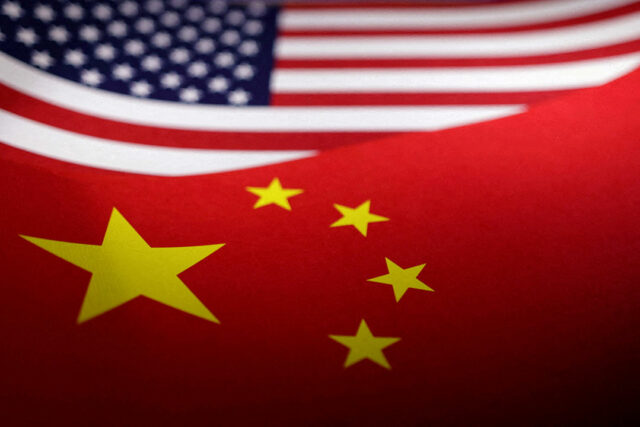
U.S. and Chinese flags are seen in this illustration taken, April 24, 2024. — REUTERS

BEIJING — China on Monday accused Washington of abusing tariffs and warned countries against striking a broader economic deal with the United States at its expense, ratcheting up its rhetoric in a spiraling trade war between the world’s two biggest economies.

Beijing will firmly oppose any party striking a deal at China’s expense and “will take countermeasures in a resolute and reciprocal manner,” its Commerce Ministry said.

The ministry was responding to a Bloomberg report, citing sources familiar with the matter, that the Trump administration is preparing to pressure nations seeking tariff reductions or exemptions from the US to curb trade with China, including imposing monetary sanctions.

President Donald J. Trump paused the sweeping tariffs he announced on dozens of countries on April 2 except those on China, singling out the world’s second largest economy for the biggest levies.

In a series of moves, Washington has raised tariffs on Chinese imports to 145%, prompting Beijing to slap retaliatory duties of 125% on US goods. Last week, China signaled that its own across-the-board rates would not rise further.

“The United States has abused tariffs on all trading partners under the banner of so-called ‘equivalence,’ while also forcing all parties to start so-called ‘reciprocal tariffs’ negotiations with them,” the ministry spokesperson said.

China is determined and capable of safeguarding its own rights and interests, and is willing to strengthen solidarity with all parties, the ministry said.

“The fact is, nobody wants to pick a side,” said Bo Zhengyuan, partner at China-based policy consultancy Plenum.

“If countries have high reliance on China in terms of investment, industrial infrastructure, technology know-how and consumption, I don’t think they’ll be buying into US demands. Many Southeast Asian countries belong to this category.”

Pursuing a hardline stance, Beijing will this week convene an informal United Nations Security Council meeting to accuse Washington of bullying and “casting a shadow over the global efforts for peace and development” by weaponizing tariffs.

Earlier this month, US Trade Representative Jamieson Greer said nearly 50 countries have approached him to discuss the steep additional tariffs imposed by Mr. Trump.

Several bilateral talks on tariffs have taken place since, with Japan considering raising soybean and rice imports as part of its talks with the US while Indonesia is planning to increase US food and commodities imports and reduce orders from other nations.

CAUGHT IN CROSSFIRE
Mr. Trump’s tariff policies have rattled financial markets as investors fear a severe disruption in world trade could tip the global economy into recession.

On Monday, Chinese stocks inched higher, showing little reaction to the commerce ministry comments, though investors have generally remained cautious on Chinese assets due to the rising growth risks.

The Trump administration also has been trying to curb Beijing’s progress in developing advanced semiconductor chips which it says could be used for military purposes, and last week imposed port fees on China-built vessels to limit China’s dominance in shipbuilding.

AI chip giant Nvidia said last week it would take $5.5 billion in charges due to the administration’s curbs on AI chip exports.

China’s President Xi Jinping visited three Southeast Asian countries last week in a move to bolster regional ties, calling on trade partners to oppose unilateral bullying.

Beijing has said it is “tearing down walls” and expanding its circle of trading partners amid the trade row.

The stakes are high for Southeast Asian nations caught in the crossfire of the Sino-US tariff war, particularly given the regional Association of Southeast Asian Nations (ASEAN) bloc’s huge two-way trade with both China and the United States.

ASEAN is China’s largest trading partner, with total trade value reaching $234 billion in the first quarter of 2025 and accounting for over 16% of China’s overall foreign trade, China’s customs agency said last week.

Trade between ASEAN and the US totaled around $476.8 billion in 2024, according to US figures, making Washington the regional bloc’s fourth-largest trading partner.

“There are no winners in trade wars and tariff wars,” Mr. Xi said in an article published in Vietnamese media, without mentioning the United States. — Reuters

FNG reports strong uptake for commercial lots

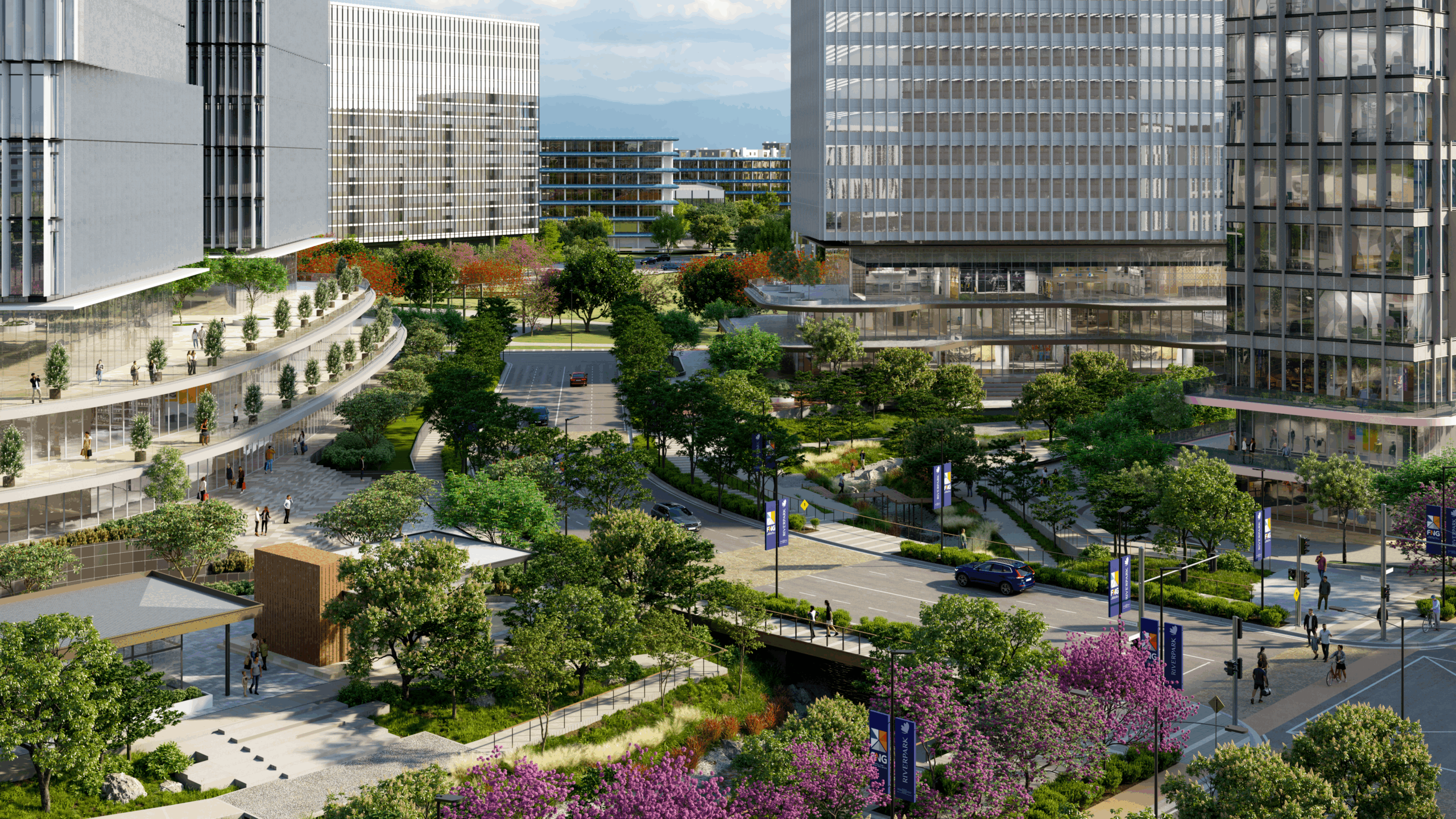
The young developer expands business opportunities in General Trias with its Riverpark North Commercial Lots

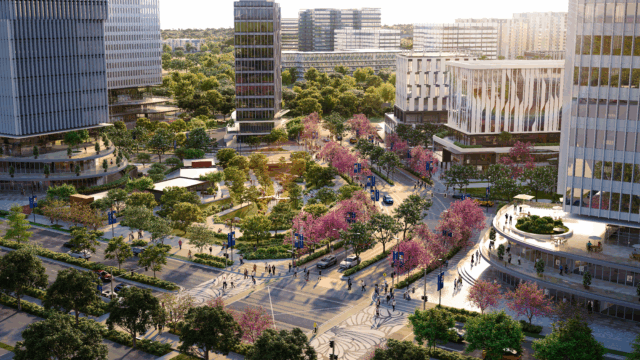
Cavite is poised for continued economic growth, with rising strategic developments like Riverpark driving new opportunities in the province.

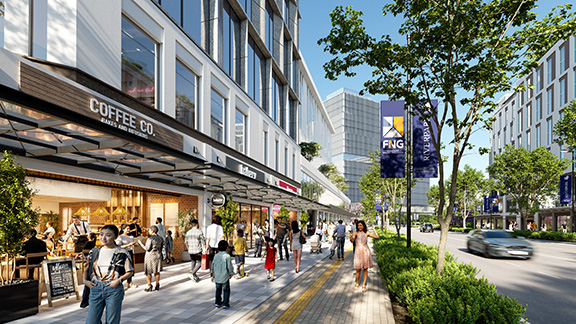
A key indicator of this momentum is the 90% sellout of Riverpark North Commercial Lots by Federal Land NRE Global, Inc. (FNG) on its exclusive launch. The joint venture between the Philippines’ Federal Land, Inc. and Japan’s Nomura Real Estate Development Co., Ltd. sold parcels ranging from 1,000 to 2,600 square meters, soon to be developed into various businesses.

Reservations are also in place for the remaining 1,000 to 1,500 square meter lots.

FNG also reports that the next tranche of commercial lots is underway, signaling confidence in Cavite’s upward trajectory.

“We are thrilled to see such strong interest in Riverpark’s Central Business District,” said FNG President Thomas F. Mirasol. “We share the vision of our clients in the vast potential of General Trias and Cavite as a growth hub and commercial center, and we are already preparing to deliver more innovations within the township.”

This milestone marks not only a significant achievement for FNG and Riverpark but also underscores the demand for well-planned business spaces in the dynamic region. It also adds to the recognitions of the developer and the 600-hectare mixed-use development. In 2024, FNG was named as the Best Breakthrough Developer in the Philippines and Asia by PropertyGuru, while Riverpark was awarded Best Township Development and Best Township Masterplan Design at the 12th PropertyGuru Philippines Property Awards.

In 2024, Riverpark saw major developments, including the groundbreaking of the human-centric UNIQLO Logistics Facility in partnership with Fast Retailing Philippines, the up-and-rising SM City General Trias — SM’s eighth mall in Cavite — and FNG’s award-winning Japan-inspired horizontal residential community, Yume at Riverpark. The township is also expected to be more accessible with the CALAX interchanges in Riverpark North and South. The Laguna segment is completed and operational, while the Cavite segment’s target completion is by the fourth quarter of 2025.

For more information, visit https://fng.ph/projects/riverpark-north-central-business-district/.


Spotlight is BusinessWorld’s sponsored section that allows advertisers to amplify their brand and connect with BusinessWorld’s audience by publishing their stories on the BusinessWorld Web site. For more information, send an email to online@bworldonline.com.

Join us on Viber at https://bit.ly/3hv6bLA to get more updates and subscribe to BusinessWorld’s titles and get exclusive content through www.bworld-x.com.