Home Blog Page 1717

NU Lady Bulldogs vs lowly UE Lady Red Warriors at UAAP women’s volleyball

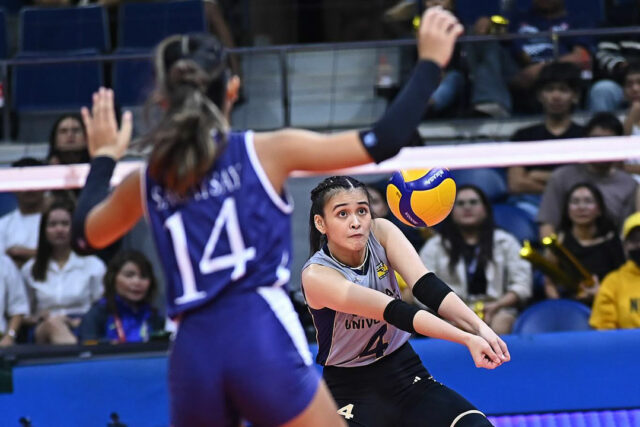
NATIONAL UNIVERSITY tasted its first defeat against host University of the Philippines in five sets then got humbled by Adamson University over the weekend in four, thanks to the 32-point eruption of super rookie Shaina Nitura. — UAAP/NEO GARCIA

Games on Wednesday
(PhilSports Arena)
9 a.m. – UE vs NU (men)
11 a.m. – ADMU vs FEU (men)
1 p.m. – UE vs NU (women)
3 p.m. – ADMU vs FEU (women)

IT’S TIME to stabilize the ship for National University (NU) after losing twice in the last three matches that may derail its title retention drive in the UAAP Season 87 women’s volleyball.

The NU Lady Bulldogs swept the first round but absorbed stinging defeats since then at the hands of lower-ranked opponents, causing an alarm entering the homestretch of the eliminations against the top contenders.

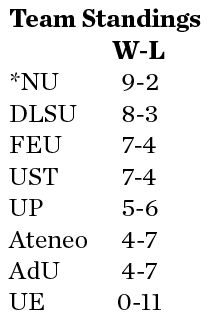
“It’s alarming for us,” said reigning MVP Bella Belen as NU (9-2) eyes a quick payback against the winless University of the East (UE) (0-11) at 1 p.m. on Wednesday at the PhilSports Arena after the 3 p.m. duel of Ateneo de Manila University (4-7) and Far Eastern University (7-4).

NU tasted its first defeat against host University of the Philippines in five sets then got humbled by Adamson University over the weekend in four, thanks to the 32-point eruption of super rookie Shaina Nitura.

Despite the defeat, the Lady Bulldogs clinched a seat in the Final Four owing to UP’s sixth loss against FEU but the goal is securing the No. 1 seed and the twice-to-beat incentive.

But with two costly losses, NU’s once wide gap after an 8-0 start from challengers De La Salle University (8-3), University of Santo Tomas (7-4) and FEU (7-4) for that bid has been reduced to a striking distance.

Meanwhile in the men’s play, four-peat champion NU (9-2) shores up its win-once bonus as well against also-ran UE (0-11) at 9 a.m. while FEU (10-1) tries to bolster its top-seed bid over semis hopeful Ateneo (6-5) at 11 a.m. — John Bryan Ulanday

Florida overcomes Houston to claim third NCAA title

FLORIDA came back from a 12-point second-half deficit to beat Houston 65-63 in a nail-biting thriller, claiming its third national championship in NCAA men’s basketball on Monday.

Senior Will Richard led the scoring for the Gators with 18 points in Florida’s first trip to the title game since it last won in 2007, while Australian forward Alex Condon came up with the game-clinching loose ball.

Houston appeared well on its way to its first-ever title as its smothering defense neutralized Florida’s best weapon Walter Clayton Jr. through the first half but it could not hang on against an energized Gators offense.

“We did what we did all year — we stayed the course,” said head coach Todd Golden, 39, the youngest head coach to win the NCAA title since 1983. “Like we did all year, we made plays when we needed it the most.”

Florida appeared off-kilter at the start with a flurry of early turnovers while sharpshooter Clayton went scoreless through the first half.

The Houston fans inside San Antonio’s Alamodome went wild as guard LJ Cryer hit a three from deep to kick off a 8-0 run for the Cougars in the last six minutes of the half, and it went into the locker room with a three-point lead.

Houston amassed a 12-point head start within the first five minutes of the second half with a pair of three pointers from Cryer, but the Florida offense quickly fought back, leveling it with less than eight minutes left on the clock.

Guard Alijah Martin gave the Gators the lead with a pair of free throws with 46 seconds left before Houston turned the ball over in the chaotic final moments of the game.

“It’s a feeling I can’t even explain,” said the Gators’ Clayton, who finished the night with 11 points, seven assists and five rebounds. — Reuters

Scheffler eyes Masters repeat; McIlroy primed for another Grand Slam

AUGUSTA, GEORGIA — Defending champion Scottie Scheffler is the man to beat at this week’s Masters where Rory McIlroy, oozing confidence after a marvelous start to the year, makes his 11th and perhaps best shot at completing the career Grand Slam.

Played amidst the blooming azaleas, towering pines and flowering dogwoods at Augusta National, the Masters may be the most anticipated of golf’s four majors and this year’s edition is no exception given a plethora of compelling storylines.

Not even the absence of Tiger Woods, a five-times champion and golf’s top attraction who is recovering from surgery to repair a ruptured left Achilles tendon, can dampen enthusiasm for an event that marks the spiritual start of spring.

Much of the excitement ahead of this year’s Masters revolves around Scheffler and McIlroy, the two best players in the world, who are in great form and could deliver a final-round duel for the ages if they are both in contention on Sunday.

World number one Scheffler, whose season debut was delayed by about a month after hand surgery following a December cooking accident, finished runner-up at his Masters tune-up in Houston for his third top-10 in six starts on the year.

A win for Scheffler, who first triumphed at Augusta National in 2022 and has a game that appears to be a perfect fit for the layout, would make him only the fourth golfer to retain a Masters title and first since Woods in 2001-02.

McIlroy is eager to become the sixth player to complete a career Grand Slam of golf’s four majors this week but to join that exclusive club he will need to overcome an Augusta layout that has been the site of several frustrating moments for him.

But, in a sign that this could finally be his year, McIlroy has enjoyed a superb start to the year and lifted two PGA Tour titles before April for the first time in his career — at Pebble Beach and The Players Championship. 

“There’s never been a better week for him to win the Masters. Never,” said Chamblee.

Perhaps the only question mark for McIlroy is that after finishing in a share of fifth at Houston, the Northern Irishman said his right elbow had been bothering him “a little bit” and he may seek treatment.

The Masters will also provide a brief respite from the ongoing divide in the sport given it will be the first time since last July’s British Open that players from the PGA Tour and Saudi-backed LIV Golf will compete against each other.

A dozen LIV players, including 2023 champion Jon Rahm and fan favourite Bryson DeChambeau, are among those in the field this week.

Rahm had his worst-ever result at Augusta National last year as he finished in a share of 45th place but the Spaniard cannot be overlooked given he has five top-10 finishes in eight career Masters starts.

Twice major champion DeChambeau will be eager to get another crack at a Green Jacket having finished in a career-best tie for sixth place last year when he sat alone atop the first-round leaderboard and held a share of the halfway lead.

The only guarantee this week is that Augusta National will present challenges at every turn given the pristine course is known for small landing zones on speedy and undulating greens that put a premium on course management and accuracy.

Twice champion Bernhard Langer, 67, is in the field for what is expected to be his final Masters, while 2009 champion Angel Cabrera returns for the first time since serving a 30-month prison sentence for domestic abuse.

The opening round is scheduled to begin on Thursday. — Reuters

Lakers’ strategy

It’s hard to blame the Lakers for entertaining the possibility of punting their match against the Thunder on Wednesday. The injury report heading into their road outing lists just about all their vital cogs, providing the brain trust with ample leeway to make a decision on their active roster closer to tipoff. Rui Hachimura will definitely be sidelined due to left patellar tendinopathy, while LeBron James, Luka Dončić, Austin Reaves, Dorian Finney-Smith, and Gabe Vincent are listed as “questionable” for a variety of reasons.

Certainly, the Lakers are looking at their second set-to versus the Thunder in three days with a one-step-back-two-steps-forward mindset. Their immediate past victory, juxtaposed with losses by the Nuggets and Warriors, gives them some breathing room insofar as securing the third spot in the West is concerned. And because they have the cushion, they can inject strategy into their schedule — especially since the injury report of the preemptive conference top seeds indicates the availability of a complete lineup.

Perhaps the Lakers would be predisposed to taking the full measure of the Thunder on Wednesday were they not likewise slated to meet the Mavericks on Thursday. And, make no mistake, the encounter with the latter is one they truly want to win. The 23-and-a-half-hour turnaround between contests all but places an either-or situation on the table, and the bias is clear given Dončić’s impending return to the American Airlines Center for the first time since the very franchise that picked him third overall in the 2018 draft let him go in a trade deadline shocker.

True, the conference is so bunched up that the Lakers are taking no small measure of risk by entertaining the notion of resting today. That said, they may deem it a no-brainer all the same in the face of their advantage; they need only prevail in two of their last four stops to claim the third seed, with one of those four against the lowly Blazers. In any case, it bears noting that the purple and gold do not have losing records against the rest of the West’s Top 10. In other words, they’ll be ready any which way when the playoffs arrive — but are no less motivated to avail of the opportunity to tilt the odds in their favor en route.


Anthony L. Cuaycong has been writing Courtside since BusinessWorld introduced a Sports section in 1994. He is a consultant on strategic planning, operations and human resources management, corporate communications, and business development.

China vows ‘fight to the end’ as Trump threatens 50% extra tariff

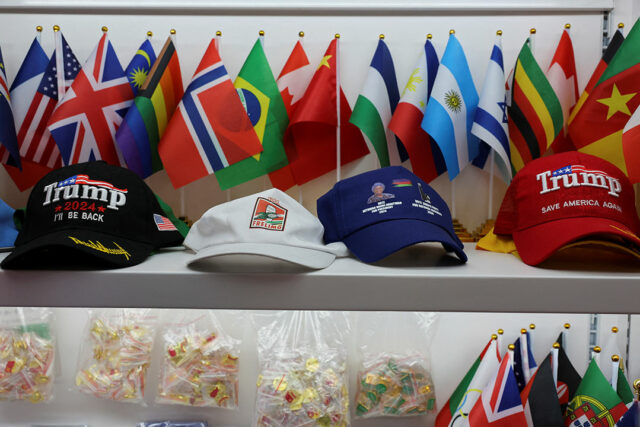
TRUMP hats are displayed at a flag store at the Yiwu International Trade Market in Yiwu, Zhejiang province, China on Feb. 9, 2025. — REUTERS

BEIJING/SHANGHAI — China vowed on Tuesday to “fight to the end” against US tariffs as some citizens railed against President Donald Trump after he singled out Beijing for further levies, setting the stage for a standoff between the world’s two largest economies.

If Mr. Trump sticks to his plan for an additional 50% tariff on China unless it withdraws its retaliatory levies on the US, total new US duties on Chinese goods this year could rise to 104% by Wednesday.

With global supply chains in jeopardy, Beijing is under pressure to respond ahead of a meeting between President Xi Jinping and Spain’s prime minister and a tour of Southeast Asia.

But with Mr. Trump’s previous tariff increases already squeezing Chinese exporters’ margins to the point of suffocation, further hikes would only serve to underscore Washington’s appetite for brinkmanship and its desire to cut China out of the world’s biggest consumer market as a matter of principle, analysts say.

“The US side’s threat to escalate tariffs against China is a mistake on top of a mistake, once again exposing the American side’s blackmailing nature,” the commerce ministry said in a statement.

“If the US insists on having its way, China will fight to the end.”

Mr. Trump said he would impose the additional 50% duty on US imports from China on Wednesday if Beijing did not withdraw the 34% tariffs it had imposed on US products last week.

The Chinese levies had come in response to 34% “reciprocal” duties announced by Mr. Trump, on top of tariffs of 20% imposed earlier this year, lifting to 76% the average US tariff on Chinese goods.

“If the tariffs keep going up and up, it becomes a battle of wills and principles rather than economics,” said Xu Tianchen, senior economist for China at the Economist Intelligence Unit.

“Since China already faces a tariff rate in excess of 60%, it doesn’t matter if it goes up by 50% or 500%,” he added.

China has stepped up efforts to shield its economy from global market turmoil following Mr. Trump’s announcement.

Several state holding companies have committed to increase share investment, a slew of listed companies unveiled buybacks, and the central bank pledged liquidity support for fund Central Huijin after it intervened to support sinking stocks.

But there is no escaping the fact that Mr. Trump’s affinity for tariffs risks derailing China’s largely export-led economic recovery that followed the end of the COVID-19 pandemic, unless exporters can pivot quickly to other markets.

TARGETING CHINA
Mr. Trump’s tariffs will be felt particularly keenly as they target the two main strategies Chinese exporters have used to blunt the impact of the trade war: shifting some production abroad and boosting sales to non-US markets.

Ordinary people have also started to voice opposition, accusing the tariff-touting president of wanting to suppress the United States’ rival.

“The tariffs on China were set too high, too high, and ordinary Chinese people just can’t accept that,” said Qi Xiushun, a 58-year-old resident of the commercial hub of Shanghai.

“(The tariffs) are suppressing China’s economic development — these tariffs were mainly pushed by Trump, right?”

Dan Wang, a China expert at Eurasia Group, said Mr. Trump had effectively already wiped out Chinese exporters’ profits once US import duties passed the 35% mark.

“After that, China shouldn’t export to the US at all. It could be 1,000%, but since there is no trade, there is no harm.”

“Europe is and will be the most profitable market for China now,” she added.

Mr. Xi is expected to meet Spain’s Prime Minister Pedro Sanchez on Friday, with the agenda likely to cover finding a resolution to trade tension with Brussels over China’s electric vehicle exports, as well as Mr. Trump’s broader tariff onslaught.

The Chinese leader will then visit Malaysia, Vietnam and Cambodia, three economies that gained from relocation by Chinese manufacturers to avoid US sanctions during Mr. Trump’s first term, but which now face steep levies of their own.

“I think (Trump’s) targeting us, targeting China,” said Wu Xing, a 34-year-old sales person, also from Shanghai, adding that she expected the tariffs would have a big impact on her.

“As for the United States, I think it’s targeting the whole world.” — Reuters

Vietnam to buy US defense and security products to address trade gap

A VIETNAM DONG note is seen in this illustration photo May 31, 2017. — REUTERS

HANOI — Vietnam will buy more American goods, including defense and security products, and has asked for a 45-day delay in the imposition of US tariffs, Prime Minister Pham Minh Chinh said in a statement issued late on Monday.

Hanoi will also seek faster deliveries of commercial planes that Vietnamese airlines have ordered from the US, Mr. Chinh said at a cabinet meeting late on Monday.

The Southeast Asian country, a major regional manufacturing base for many Western companies, last year had a trade surplus of more than $123 billion with the US, its largest export market.

Mr. Chinh said Vietnam had asked the US to delay the 46% tariff rate that US President Donald Trump announced last week to allow time for negotiations.

Vietnam was seeking to “negotiate with the US side for balanced and sustainable trade, in line with the interests of the two sides,” the statement said.

White House trade adviser Peter Navarro highlighted major concerns on Monday, including transhipping from China, the dumping of seafood and other goods, and intellectual property issues.

“They engage in intellectual property theft,” Mr. Navarro told CNBC, regarding Vietnam. “They have the biggest number of cases aside from China at the Department of Commerce on the dumping.”

In Monday’s statement, Mr. Chinh said Vietnam would review issues such as its monetary policy, exchange rate, non-tariff barriers and ensuring the correct origin of goods, in line with the concerns aired by Mr. Navarro.

In a statement on Tuesday, following a tariff task force meeting, the government said Vietnam was also considering adjustments to its current bilateral trade agreement with the United States, adding content on tax and intellectual property.

The country’s benchmark stock index has fallen nearly 14% since Mr. Trump’s announcement of the tariffs on April 2. The index fell 6.26% to 1,135 in early trade on Tuesday.

On Friday, Mr. Trump and Vietnam’s leader To Lam agreed to discuss a deal to remove tariffs, both leaders said after a telephone call that Mr. Trump described as “very productive.”

Since an arms embargo was lifted in 2016, US defense exports to Vietnam have been largely limited to coastguard ships and trainer aircraft.

Last year sources said there were talks on sales of Lockheed Martin C-130 Hercules military transport planes to Hanoi. — Reuters

JPMorgan’s Dimon warns of economic impact of trade war, sees possible recession

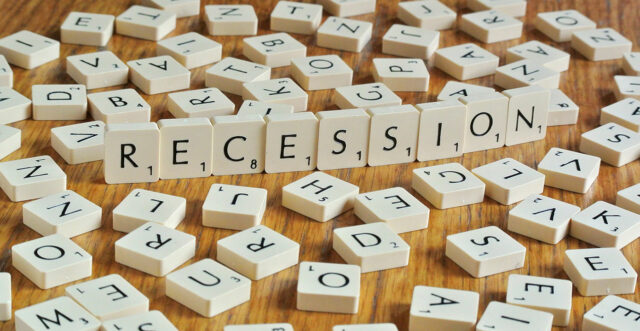
THE WORD RECESSION, made from letters of a scrabble game, is seen in this illustration picture. — REUTERS

NEW YORK — JPMorgan Chase CEO Jamie Dimon on Monday warned that trade wars could have lasting negative consequences, days after he and other US bank CEOs met with Commerce Secretary Howard Lutnick to discuss the administration’s sweeping tariffs.

“The economy is facing considerable turbulence,” Mr. Dimon wrote. “We are likely to see inflationary outcomes … Whether or not the menu of tariffs causes a recession remains in question, but it will slow down growth.”

Mr. Dimon’s annual letter to shareholders followed a rout last week that wiped trillions of dollars off global stock markets in the wake of President Donald Trump’s new tariffs.

Mr. Dimon and other bank chiefs met with Mr. Lutnick in Washington on Thursday, a day after the tariffs were announced, to discuss the levies and ask questions, a source familiar with the meeting said.

The session was hosted by the Financial Services Forum, an industry lobby group, an administration official and the lobby group confirmed.

Mr. Dimon, 69, is one of the most prominent voices in corporate America and has regularly been consulted by administrations during times of crisis. His name was floated for senior economic roles in government during the 2024 presidential campaign, including Treasury secretary, but he stayed put at the bank.

Other Wall Street leaders also raised alarm as markets slumped. BlackRock CEO Larry Fink said on Monday stocks could extend their decline by 20%, noting views among his peers that the US economy is probably already in a recession.

Billionaire fund manager Bill Ackman, who supported Mr. Trump in his presidential bid, said the tariffs could lead to an “economic nuclear winter,” while hedge fund founder Boaz Weinstein told Bloomberg an economic “avalanche” has just begun.

Mr. Ackman urged the president to pause the tariffs while renegotiating trade deals. He said on X the tariffs would stymie business investment and consumer spending and “severely damage” the United States’ reputation for years, he wrote.

Credit spreads could easily widen as economic uncertainty potentially leads to a severe recession, Mr. Weinstein said. “I’m very concerned about a crash,” he said.

Investor Stanley Druckenmiller said in a post on X that he did not support tariffs exceeding 10%. Hedge fund manager James Chanos said, “This escalation threat is a very big deal,” after Mr. Trump said the US could impose more tariffs on China.

JPMorgan’s economists raised the risk of a US and global recession this year to 60% from 40% after Mr. Trump unveiled the trade barriers.

“The quicker this issue is resolved, the better because some of the negative effects increase cumulatively over time and would be hard to reverse,” Mr. Dimon wrote.

He said the risks from the tariffs and trade war included persistent inflation and high fiscal deficits. He also saw risks of damaging economic confidence, investments, capital flows, corporate profits and the dollar.

Separately, major bank CEOs including Mr. Dimon and Bank of America CEO Brian Moynihan held a call on Sunday to discuss the tariffs, sources familiar with the matter said. The call was convened by the Bank Policy Institute, an association representing large US lenders, they said.

JPMorgan will report its first-quarter results on Friday. It earned a record annual profit last year.

Mr. Dimon warned that expectations the US will avoid slipping into recession could be derailed.

“Markets still seem to be pricing assets with the assumption that we will continue to have a fairly soft landing. I am not so sure,” Mr. Dimon wrote. — Reuters

Study strengthens link between maternal diabetes and autism

STOCK PHOTO | Image by Vanessa from Unsplash

A LARGE new study adds to evidence that diabetes during pregnancy is linked with an increased risk of brain and nervous system problems in children, including autism, researchers say.

Whether diabetes actually causes those problems remains unclear. But when mothers have diabetes while pregnant, children are 28% more likely to be diagnosed with a neurodevelopmental disorder, according to an analysis of data pooled from 202 earlier studies involving more than 56 million mother-child pairs.

The risks for children of mothers with diabetes during pregnancy were 25% higher for autism, 30% higher for attention deficit hyperactivity disorder and 32% higher for intellectual disability. They were also 20% higher for trouble with communication, 17% higher for movement problems and 16% higher for learning disorders than in children whose mothers did not have diabetes while pregnant.

Diabetes diagnosed before pregnancy appeared to confer a 39% higher risk for one or more of these neurodevelopmental disorders compared with gestational diabetes that begins in pregnancy and often resolves afterward, the researchers reported in The Lancet Diabetes & Endocrinology.

Diabetes affects up to 9% of pregnancies in the United States, with the incidence rising, according to the US Centers for Disease Control and Prevention.

Seven of the earlier studies compared affected children with siblings. These analyses did not find an effect from mothers’ diabetes, which suggests that shared genetic or familial factors might be contributing to the increased risk, the authors noted. 

The findings emphasize the importance of medical support for women at risk of developing diabetes and the continuous monitoring of their children, the researchers said.

The association of maternal diabetes with autism in offspring is well known, said Dr. Magdalena Janecka of NYU Grossman School of Medicine, who studies links between in utero exposures and child development but was not involved in the new research.

A large “meta-analysis” like this one allows for analyses of subgroups, such as mothers with pre-existing vs gestational diabetes, or children with autism vs those with ADHD or movement disorders, but it cannot prove cause and effect, Ms. Janecka said.

“Meta-analyses allow us to compare groups more precisely. At the same time, they are not bringing us any closer to understanding the causes or the underlying mechanisms.”

The study comes as Trump administration health officials have called for further research into whether vaccines are a cause of autism, a claim long championed by new Health Secretary Robert F. Kennedy, Jr. that has been debunked by established science. — Reuters

Tariff-whipped Wall Street wonders: will Trump blink?

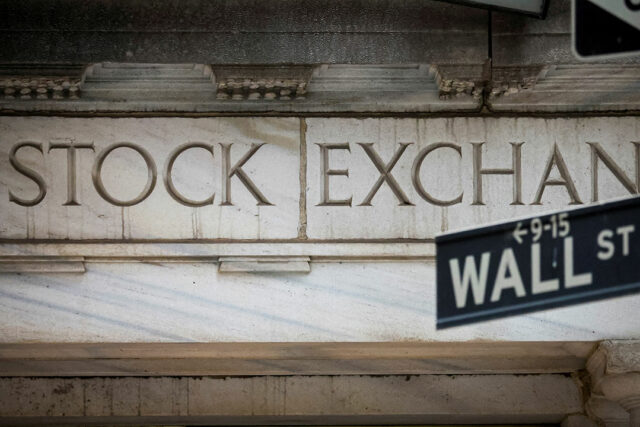
The Wall Street entrance to the New York Stock Exchange (NYSE) is seen in New York City, US, Nov. 15, 2022. — REUTERS

NEW YORK — Investors are trying to game out how much tolerance US President Donald Trump has for stock market losses after his latest tariff policies ignited a more than 10% wipeout on Wall Street, with some still holding out hope of eventual relief.

A so-called “Trump put” — the option market equivalent of a presidential backstop for equities — underpinned Mr. Trump’s first term, as he frequently cited stock market strength as proof his policies were working. Over the course of his first presidency the S&P 500  benchmark rose 68% and scaled record highs, while Mr. Trump cheered its progress, tweeting more than 150 times about the stock market.

This time around, hope that such a Trump put still exists is evaporating, or at the least, investors are coming around to the view that Mr. Trump is much more inclined to ride out sharp falls. The S&P and Nasdaq are down over 15% and 20% since his inauguration in January respectively.

“The whole notion of tariffs and trade policy has been such an integral part of Donald Trump’s psyche, I don’t see it abandoned,” said Michael Rosen, chief investment officer at Angeles Investments, who said any pain level likely to cause Mr. Trump to change course remained a long way away.

Previous assumptions that Mr. Trump’s pro-business agenda would buoy risk assets similarly had already been fading as his trade policies rattled investors over the past few weeks.

But the more-aggressive-than-anticipated tariffs unveiled on April 2 deepened the market selloff, leaving investors questioning whether the Trump put was gone, or might eventually reappear through tariff rollbacks after any trade deals.

For Bob Elliott, chief executive officer and chief investment officer of Unlimited Funds, the selloff still had a long way to go before any policy turnaround.

“It takes 20-30% declines in stocks to get there. So the decline so far is not big enough,” he said.

Some were more hopeful the market fall could eventually induce a change of course.

“I don’t think (Trump) is going to be highly tolerant of massive stock market declines — he’ll see his popularity tank, and it will endanger his whole agenda,” said Kevin Philip, partner at Bel Air Investment Advisors. “I don’t see any way out of this if he doesn’t come up with deals or reasons to change course.”

The huge market falls — not seen since the beginning of the COVID-19 pandemic in 2020 — even caused speculation online that Mr. Trump was intentionally “crashing” the market to force the US Federal Reserve to lower interest rates while making stocks more affordable to middle-class investors.

Mr. Trump on Friday retweeted a social media post bearing the caption “Trump is Purposely CRASHING The Market” and featuring images of the president pointing at a large downward red arrow and of him signing executive orders at the White House.

Speaking to reporters aboard Air Force One on Sunday, Mr. Trump said he was not intentionally engineering a market selloff and the rout was the result of a “medicine” needed to fix the US trade deficit.

Mr. Trump and his team have said their policies may cause short-term pain but will eventually revive manufacturing and spur growth. On Friday he told investors pouring money into the United States that his policies would never change.

White House spokesman Kush Desai said in a statement to Reuters: “Just as it did during President Trump’s first term, the administration’s America First economic agenda of tariffs, deregulation, tax cuts, and the unleashing of American energy will restore American Greatness from Main Street to Wall Street.”

PAIN LEVEL
Some investors fear that weakening consumer confidence, an escalating trade war, and rising price pressures could deal a harsh and lasting blow to the economy, regardless of any potential economic upside down the line.

For Brian Bethune, an economist at Boston College, the disruption caused by the tariffs was too abrupt to allow US businesses to soften the blow, despite their resilience.

“You’re putting so many sandbags on the balloon, it’s going to come back down to earth with a thud,” Mr. Bethune said.

In the two sessions after the tariff decision was unveiled on Wednesday, the S&P 500 has tumbled 10.5%, erasing nearly $5 trillion in market value, marking its most significant two-day loss since March 2020.

Hopes that the market could be propped up by actions by the US Federal Reserve have also taken a knock.

Mr. Trump on Friday called on Federal Reserve Chairman Jerome Powell to cut interest rates, saying it was the “perfect time” to do so. But stock losses deepened past 5% after Mr. Powell on Friday warned that the new tariffs would likely push inflation higher while slowing economic growth, suggesting the Fed was unlikely to rush in to cut rates.

“The market is still digesting the great deal of uncertainty and I think it’s also digesting the fact that both Trump and Powell have made it clear that the cavalry is not coming to immediately cause things to bounce back up,” said David Seif, chief economist for developed markets at Nomura in New York.

Rising prices could reduce the Fed’s ability to take supportive actions as it has in previous market downturns or if economic conditions deteriorated significantly, analysts said. This could take off the table a so-called “Fed put,” or a perceived tendency of the central bank to run to the aid of financial markets.

“Who blinks first? The Fed or President Trump? The Fed has made it clear that with inflation where it is and unemployment where it is, (they’re) comfortable without doing anything right now,” said Ryan Detrick, chief market strategist at Carson Group in Omaha. “We think Washington likely has to blink first to present some type of positive news.” — Reuters


Pioneer Insurance, BYD La Union partner to offer specialized electric vehicle insurance

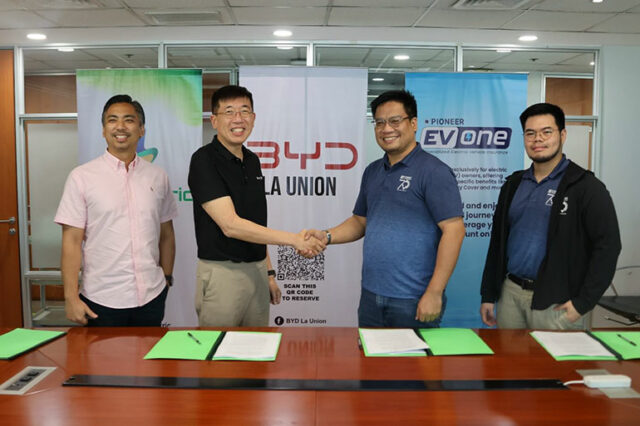
L-R: SEA Electric Philippines (BYD La Union) Vice-President for Energy Transition & Infrastructure Paolo Bugayong and CEO Glenn Yu; Pioneer Insurance Motor Department Head Iluminado Garcia III, and Assistant Manager for Motor Accounts Carl Zeus Corral

Pioneer Insurance’s EV One, a specialized electric vehicle insurance, is now available directly to BYD customers through the Pioneer-BYD La Union partnership.

Pioneer Insurance’s Motor Department Head Iluminado Garcia III said the collaboration aims to give BYD customers easy access to Pioneer’s EV One insurance.

“EV (Electric Vehicle) owners have unique needs that require tailored insurance solutions. With Pioneer EV One, more EV drivers can hit the road with confidence and fully enjoy the benefits of going electric,” Mr. Garcia said.

Present at the contract signing with BYD La Union were Mr. Garcia, Pioneer Insurance Assistant Manager for Motor Accounts Carl Zeus Corral, along with representatives from SEA Electric Philippines, a distributor of BYD in La Union, CEO Glenn Yu and Vice-President for Energy Transition & Infrastructure Paolo Bugayong.

Meanwhile, Mr. Garcia explained that the total cost of ownership is lower thanks to stable energy prices and up to 50% lower maintenance cost versus traditional vehicles. EV owners also enjoy number-coding exemptions, registration discounts, and flexible bank financing options.

“Aside from facing the same risks as regular car owners, EV owners grapple with unique challenges. That’s why having reliable and responsive insurance coverage is more important than ever,” he said.

Pioneer EV One

Pioneer Insurance launched Pioneer EV One as a comprehensive insurance solution designed to address the specific concerns of the growing EV market in the Philippines.

The policy covers a wide range of EV types, including hybrids, plug-in hybrids, and battery electric vehicles.

Traction batteries are also covered with no hidden deductibles.

Mr. Garcia shared the key benefits of this new innovative insurance product, including the Range Anxiety Cover which provides towing services to the nearest charging station or back to the point of origin if the vehicle runs out of power, and the Advanced Driving Assistance System (ADAS) which secures EV technologies such as adaptive cruise control, lane-keeping assistance, and emergency braking.

He added that the policy also comes with the Charging Equipment Cover, which safeguards private EV charging accessories against loss or damage; and Enhanced Battery Coverage, covering repair or replacement costs for battery-related issues.

Furthermore, in the event of vehicle downtime due to repairs, the Loss of Use benefit will provide reimbursement for transportation expenses of up to P500 per day for 15 days.

“In addition to these specialized benefits, Pioneer EV One includes standard comprehensive motor policy coverages, including own damage, third-party liability, acts of nature, and theft,” he said.

“With its extensive coverage, Pioneer EV One not only empowers EV owners to hit the road in their EVs with peace of mind, but it also makes electric adoption easier, more convenient, and more practical,” Mr. Garcia noted.

How to avail EV One

As a key innovator in the insurance industry, Pioneer recognizes the growing demand for EVs and the unique coverage they require.

“By offering EV One at a BYD dealership, Pioneer not only enhances the customer experience for BYD owners but also reinforces its leadership in providing forward-thinking insurance solutions,” Mr. Garcia shared.

“With the shift toward sustainable transportation, Pioneer is well-positioned to support EV owners with comprehensive and convenient insurance options,” he concluded.

To avail of Pioneer EV One, interested customers can inquire through BYD La Union or Pioneer’s website at https://pioneer.com.ph/motor.


Spotlight is BusinessWorld’s sponsored section that allows advertisers to amplify their brand and connect with BusinessWorld’s audience by publishing their stories on the BusinessWorld Web site. For more information, send an email to online@bworldonline.com.

Join us on Viber at https://bit.ly/3hv6bLA to get more updates and subscribe to BusinessWorld’s titles and get exclusive content through www.bworld-x.com.

Challenges in hiring PWDs

One of the challenges in hiring a person with a disability (PWD) is the language barrier, said Harl’s founder Harley Dave B. Beltran. Despite the challenge, he noted that the willingness to make adjustments that cater to everyone’s needs and capabilities can overcome this roadblock.

“The challenges (in) hiring a person with a disability starts from you, you as a person who hired them,” Mr. Beltran said in an interview. “The willingness to accept a person or someone in your house if you’re not comfortable, that’s the challenge. How are you going to hire them?”

Interview by Almira Martinez
Video editing by Jayson Mariñas

Taiwan says China using generative AI to ramp up disinformation and ‘divide’ the island

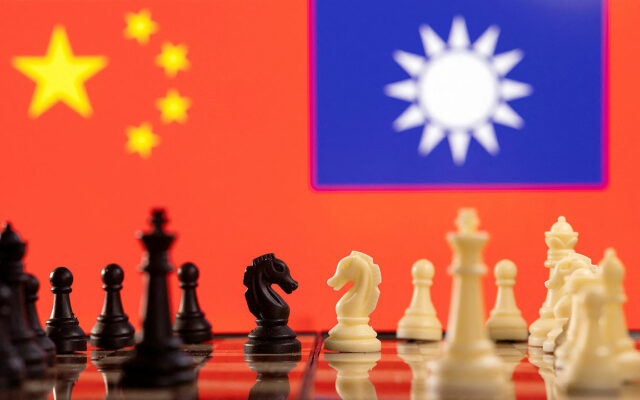
CHESS PIECES are seen in front of displayed China and Taiwan’s flags in this illustration taken Jan. 25, 2022. — REUTERS

TAIPEI – China is using generative artificial intelligence (AI) to ramp up disinformation against Taiwan to “divide” Taiwan’s public, the island’s National Security Bureau said.

Taiwan has accused China of stepping up military drills, trade sanctions and influence campaigns against the island in recent years to force the island to accept Chinese sovereignty claims. Taiwan strongly rejects China’s sovereignty claims.

China staged two days of war games and live-fire drills near the democratically governed island this month, triggering concern by the United States and many of its allies.

In a report to parliament, a copy of which was reviewed by Reuters, the security bureau said it had detected more than half a million pieces of “controversial messages” so far this year, mostly seen on social media platforms including Facebook and TikTok.

Beijing has targeted sensitive moments such as President Lai Ching-te’s speech on China last month or chipmaker TSMC’s announcement of new U.S. investment to launch what the report said was “cognitive warfare”, adding such efforts were “designed to create division among our society.”

“As the application of AI technology becomes more widespread and mature, it has also been found that the Chinese Communist Party has been using AI tools to assist in the generation and dissemination of controversial messages,” the report said.

China’s Taiwan Affairs Office did not respond to a request for comment.

The report said China has also ramped up its “grey-zone” tactics against Taiwan, with a sharp increase so far this year in the number of Chinese coast guard incursions as well as air balloons in Taiwan’s waters and airspace.

Those moves have forced Taiwan to dispatch its own forces in response and depleted its resources, the report said.

Mr. Lai, who says only Taiwan’s people can decide their future, in March labelled China a “foreign hostile force”.

China has never renounced the use of force to bring Taiwan under Chinese control. — Reuters