Home Blog Page 1571

Netflix expands toy business with Stranger Things licensing deal


NETFLIX is expanding its presence in the toy business, striking its first master licensing deal with the company behind the popular Squishmallows plush toys to develop a product line inspired by its hit science-fiction series Stranger Things.

The streaming giant granted toymaker Jazwares the right to develop a Stranger Things collection — including figures, play sets, toy vehicles, costumes and stuffed toys — based on the series, which returns for its fifth and final season later this year. The licensing deal builds on Netflix’s relationship with the toymaker, which last year introduced its first Stranger Things-themed Squishmallows.

“The Duffer Brothers have created such an incredibly rich world that’s packed with ’80s nostalgia and pop culture references and great characters,” said Josh Simon, Netflix vice-president of consumer products, referring to Matt and Ross Duffer who created the series. “From a merchandise standpoint, and a product-creation standpoint, we really want to deliver that same level of storytelling and attention to detail to the fans.”

Netflix, which ignited the streaming video revolution that upended Hollywood, has adopted a time-honored entertainment industry strategy of selling consumer products and experiences based on its most popular series. Its first franchise hit, Stranger Things, served as the model.

Stranger Things is set in the Midwestern town of Hawkins, Indiana, where a supernatural mystery lurks below the surface. Its nostalgic references to 1980s food, music, and fashion launched it into the cultural zeitgeist, making it one of Netflix’s most popular series. That led to a range of consumer products deals, such as Scoops Ahoy ice cream, Surfer Boy frozen pizza, and retro footwear from Clarks.

The series also has inspired spinoffs including a series of books, an Olivier Award-winning stage play, Stranger Things: The First Shadow, which opens on Broadway in March, and an animated series in the works.

Netflix has applied its Stranger Things merchandising strategy to other entertainment franchises, including Squid Game and Bridgerton. At the Nuremberg Toy Fair on Jan. 23, it announced a partnership with the LEGO Group to develop new play sets based on One Piece, Netflix’s live-action adaptation of Eiichiro Oda’s manga series.

The company does not disclose how much money it makes from merchandise sales or the live experiences it creates based on its popular characters and stories, such as Stranger Things: The Experience, which brought the story’s “upside-down” world to New York City and Los Angeles.

“It really kind of strengthens the brands and strengthens the excitement about the things people are watching on Netflix and falling in love with,” Netflix Co-Chief Executive Officer Ted Sarandos told investors in October 2023.

At Walt Disney, the entertainment company whose namesake founder made merchandising an integral part of its corporate strategy, consumer product sales accounted for 14% of the company’s operating income in its fiscal fourth quarter.

The popularity of Stranger Things is what attracted Jazwares, a Berkshire Hathaway-owned company that makes products inspired by other popular entertainment brands, including Pokémon, Hello Kitty, Star Wars.

“We’re well aware of how big Stranger Things is,’ said Gerhard Runken, executive vice-resident of brand and marketing at Jazwares. “Obviously, we’re all in it to make sure we can mirror the success they’ve had in the show, through consumer products.” — Reuters
BDO’s first ASEAN sustainability bond issuance finances green, social projects

BW FILE PHOTO

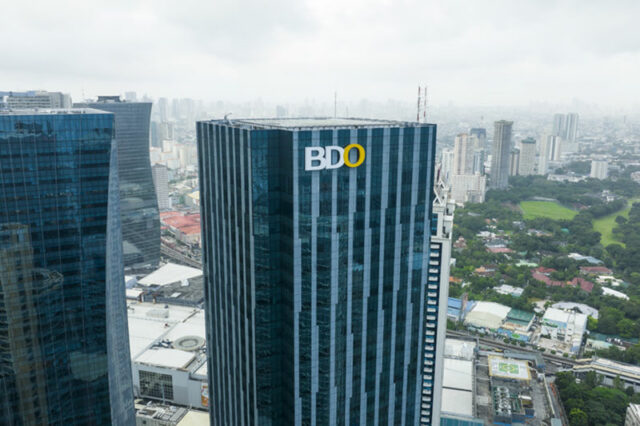
PROCEEDS from BDO Unibank, Inc.’s first ASEAN sustainability bond (ASB) issuance in 2022 financed projects that aim to mitigate the impact of climate change on the country and generate employment in underserved communities, it said on Thursday.

The allocation of the P52.7 billion raised by the bank via two-year sustainability bonds issued in January 2022 was part of its second ASEAN Sustainability Bond Impact Report released recently, the listed bank said.

“BDO’s second ASEAN Sustainability Bond Impact Report underscores our dedication to financing projects that create measurable, meaningful, and long-term outcomes for both the environment and society. This bond reflects our commitment to fostering sustainable growth and inclusive development across various key industries for the nation,” BDO Senior Vice-President and Chief Compliance Officer Federico P. Tancongco said in a statement on Thursday.

The bank said that P38.4 billion of the total amount raised from the issue financed environmental projects “aimed at mitigating climate change and promoting renewable energy.”

“These investments supported solar and wind energy installations, which have significantly reduced greenhouse gas emissions and contributed to the Philippines’ transition to cleaner energy sources,” BDO said.

“The funds also financed energy-efficient infrastructure, such as green buildings, resulting in measurable reductions in energy consumption and promoting sustainable urban development.”

Meanwhile, the remaining P14.4 billion of the total went to social projects for underserved communities, BDO said.

Broken down, P8.802 billion went to microfinance services and P5.621 billion went to the  agriculture, fisheries, and food security sectors.

“The projects funded under BDO’s first ASB issuance align with the 17 United Nations Sustainable Development Goals (SDGs), particularly SDG 7 (Affordable and Clean Energy), SDG 11 (Sustainable Cities and Communities), and SDG 13 (Climate Action). By focusing on these global priorities, BDO continues to play a vital role in mobilizing capital for sustainable development in the country,” BDO said.

“Looking ahead, BDO is committed to expanding its sustainable finance initiatives to address a broader range of environmental and social challenges. By leveraging partnerships with governments, nongovernment organizations, and private sector entities, the bank aims to further accelerate the transition to a sustainable low carbon economy.”

BDO’s net income grew by 13.26% to P21.18 billion in the third quarter of 2024. For the first nine months, its net profit went up by 12.47% to P60.62 billion.

Its shares declined by 50 centavos or 0.35% to end at P141.50 each on Thursday. — AMCS

Trump’s Colombia warning is China’s window of opportunity

ANTONELLA VILARDO/LEANDRO LOUREIRO/UNSPLASH/FREEPIK

COLOMBIA’s run-in with Donald Trump is a warning to other countries trying to decipher the US president’s haphazard decision-making process. As Asian nations realize that Trump’s second term could be even more erratic than his first, China is ready to take advantage of the chaos.

Trump’s latest move to impose 25% tariffs on an ally for not complying with his deportation demands should serve as a wake-up call. Even though the levies were quickly reversed, he achieved what he presumably set out to do: Show the world who’s boss.

“This reminds governments that this is a president that behaves on a whim,” Deborah Elms, head of trade policy at the Hinrich Foundation in Singapore, told me. “You never would have imagined before that the US would impose immediate harsh penalties on a really important ally, in a really important region. If you can do it to Colombia, you can do that to anyone.”

China will take every opportunity to step in. Beijing was already cozying up to Bogotá before the spat with Washington, but has been accused of exploiting the situation further. Zhu Jingyang, China’s ambassador to Colombia, told the local newspaper El Tiempo that relations between the Asian and Latin American countries were “at the best moment” since establishing diplomatic ties 45 years ago, adding they “are global cultural powers.” He went even further, saying that their differences, “far from creating obstacles, bring us closer and enrich us.”

Losing a key US ally to China’s influence is a reckless move at best, foolish at worst. Historical ties to Washington have meant that Colombia has in the past approached Beijing with a greater degree of caution than many of its neighbors. South American, North American, and European companies have typically won contracts and gained market access over Chinese ones, with some exceptions.

So when Colombian President Gustavo Petro visited Beijing in 2023, elevating ties to a strategic partnership, observers saw it as a notable win for China, and part of the nation’s greater economic engagement with the region. China’s trade with Latin America — including imports of raw materials and food supplies, and exports of manufactured goods — grew to over $450 billion in 2022 from around $18 billion in 2002. The closer ties with Beijing coincided with a perceived rift between Bogotá and Washington over issues critical to the relationship, such as counter-narcotics, peace, and security.

For Asian nations, Colombia’s experience is a chilling reminder that they better get their Trump 2.0 plans in order. It’s hard to predict which countries are most at risk, but one good gauge might be to look at who has a trade imbalance with the US.

China is the most high-profile country at risk. Trump began his targeting of Beijing for unfair-trade-related issues in his first term, and slapped tariffs on the world’s second-largest economy. The stance is a central plank of his engagement with trade partners, and he announced that he’s mulling a 10% tariff on Chinese imports, potentially set to take effect Feb. 1. Recently though the US president talked about using them as a last resort, a move that suggests yet again, anything can be traded to make a bargain.

Still, a 10% tariff carries heavy consequences for Beijing. Bloomberg Economics estimates that it could knock out 40% of China’s goods exports to the US, putting 0.9% of gross domestic product at risk. Beijing would likely retaliate with duties of its own, ensuring that the world’s two superpowers end up in a protracted trade battle.

Outside of China, tariff risks are highest for Vietnam, Japan, and South Korea. Priyanka Kishore notes in her Asia Decoded Substack that each reported more than a $40-billion trade surplus with the US in 2023. The entire region could be in the firing line, except perhaps tiny Singapore, which has an overall trade deficit with the US. Even so, certain sectors could be at risk — the city-state recorded a close to $9-billion trade surplus with the US in pharmaceutical products in 2023, Kishore writes.

Southeast Asian nations, in particular, have long resisted the narrative of having to choose between the US and China, as the former Singapore Prime Minister Lee Hsien Loong told me in an interview in 2021. “I hope the time does not come,” he said.

Governments in the region should think about what they can offer Trump if they end up attracting his attention. Capitulating the way that Colombia did may not be an option. But Washington should also be wary that in the strategic competition between China and the US, the superpower that isn’t pointing a gun at a partner’s head may be more appealing as an ally in the future.

The US’ allure over China is that it has always been able to offer a stable, reliable business and policymaking environment, one that could be depended on to follow the rule of law. Under Trump, that’s not so certain anymore.

BLOOMBERG OPINION

E-gaming drives PAGCOR income to P16.76 billion

THE Philippine Amusement and Gaming Corp. (PAGCOR) said it more than doubled its net income for 2024 to P16.76 billion from P6.81 billion in 2023, driven by growth in the e-gaming sector.

“The continuous growth of the e-games sector is the key driver of PAGCOR’s record-breaking performance,” PAGCOR Chairman and Chief Executive Alejandro H. Tengco said in a statement.

“It reflects the increasing popularity of digital gaming platforms and the transformative impact of technology on the industry.”

PAGCOR data showed gaming operations and license fees stood at P97.52 billion.

The e-games and e-bingo sectors accounted for 50.03% of gaming revenues, equivalent to P48.79 billion.

Meanwhile, PAGCOR revenues jumped by 41% to a record-high P112 billion in 2024 from P79 billion a year ago.

“Although the Philippine Offshore Gaming Operations (POGOs) ceased in December 2024 on orders of the President, the sector still contributed P2.99 billion, or 3.07%, to gaming revenues.”

During his State of the Nation Address in July, President Ferdinand R. Marcos, Jr. ordered that all POGOs be shuttered by end-2024.

“Our 2024 revenues allowed us to support more government programs and other nation-building initiatives,” Mr. Tengco said.

PAGCOR’s contribution to nation-building also rose by 37.61% to P68.2 billion from P49.56 billion in 2023.

It also remitted P46.32 billion to the Bureau of the Treasury, which was 33.39% higher than its remittance in 2023. — Aubrey Rose A. Inosante

Renée Zellweger celebrates ‘old friend’ Bridget Jones

LONDON — Renée Zellweger said her character Bridget Jones “feels like an old friend” as she and the cast of Bridget Jones: Mad About the Boy attended the film’s world premiere in London on Wednesday.

Over two decades after Bridget Jones’s Diary came out, the fourth movie in the series finds Bridget now a single mother of two after the death of her husband Mark Darcy.

Bridget’s friend and former lover Daniel Cleaver, played by Hugh Grant, also makes an appearance in the romantic comedy.

As Bridget juggles a career, parenting, seeing friends, and starting to date again, Ms. Zellweger says it is the character’s vulnerability that connects with audiences.

“I think a lot of people relate to the challenges that she finds her way through, her vulnerability,” Ms. Zellweger said on the red carpet.

She praised writer Helen Fielding for creating a character that many people find endearing, as well as “moments that seem universally and cross-generationally relatable.”

Bridget Jones and her romantic adventures first made their mark on pop culture in Ms. Fielding’s London-set 1996 hit novel Bridget Jones’s Diary.

The character’s entries listing her weight, her alcohol and cigarette consumption, and details of her love life, struck a chord with audiences. Three more books followed, and a series of movie adaptations — Bridget Jones’s Diary (2001), Bridget Jones: The Edge of Reason (2004), and Bridget Jones’s Baby (2016).

In the latest big screen adaptation, the now 51-year-old Bridget decides to try dating again and ends up meeting 29-year-old Roxster, played by Leo Woodall.

“I felt a lot of pressure going into it. But then I met her (Zellweger) and she is just joyous and generous and kind and… a wonderful actor. I knew… it was going to be relatively easy-going forward,” Mr. Woodall said.

The movie also features Chiwetel Ejiofor, who plays one of Bridget’s children’s teachers. Known for films including 12 Years a Slave and Children of Men, Mr. Ejiofor said joining the franchise was the “easiest yes.”

Renée has done an amazing job of creating this character. There are very few things that have lasted for 25, 30 years,” he said.

Film director Michael Morris did not rule out further movie adventures for Bridget, but said that was ultimately up to Ms. Fielding.

Bridget Jones: Mad About the Boy, released by Universal Pictures, will open in the Philippines on Feb. 12. — Reuters

Work permit rules for foreigners overhauled

MORE THAN 160 Chinese nationals who worked for POGO Zun Yuan Techonology, Inc. were deported on May 14, 2024. — PRESIDENTIAL ANTI-ORGANIZED CRIME COMMISSION

THE Department of Labor and Employment’s (DoLE) plan to revise the guidelines for issuing Alien Employment Permits (AEPs) is seen as a response to the loosely-regulated entry of Philippine Offshore Gaming Operator (POGO) workers, labor analysts said.

“The revision is welcome reform. Obviously, it was a response to the POGO controversy. Rationalizing the entry of foreign workers is good policy,” University of the Philippines School of Labor and Industrial Relations Assistant Professor Benjamin B. Velasco told BusinessWorld via Messenger.

“We should refrain, however, from othering or discriminating against foreign workers who simply want to have a decent job. Which is also what motivates overseas Filipino workers when they seek jobs abroad,” he added. “Mobility for labor, not just capital, should be a right of workers.”

Federation of Free Workers President Jose G. Matula said Articles 40 to 42 of the Labor Code about AEPs and the Economic Needs Test (ENT) are the basis for issuing permits.

He noted such measures protect Filipino workers and have the potential to be “highly effective” in safeguarding job opportunities for workers by ensuring that labor market conditions are considered before allowing the employment of foreign workers.

“By carefully assessing whether there is a genuine shortage of skills or manpower in specific industries, the ENT prioritizes hiring Filipino workers, thus protecting their access to available jobs. However, its effectiveness will depend largely on proper implementation, transparency, and regular updates to reflect current labor market realities,” he said via Viber.

He noted that industries reliant on local labor, such as manufacturing, agriculture, construction and services, are likely to benefit most from the ENT.

“These sectors often have a large pool of Filipino workers who can be tapped if supported with appropriate training and upskilling programs,” he noted.

Industries requiring specialized skills or advanced technology, such as information technology and engineering, could face challenges if the ENT creates hiring bottlenecks, preventing the recruitment of foreign talent to fill gaps that Filipino workers are not yet prepared to meet, he said, adding: “Striking a balance between protecting Filipino workers and addressing skill gaps will be critical.”

Department Order No. 248 simplifies and integrates the labor market test and will require hiring needs to be advertised in a newspaper of general circulation.

An AEP is a work permit granted to foreign nationals seeking employment in the Philippines. According to DoLE data, 192,573 AEPs were issued over the past three years.

The DoLE said that the new rules will require employers hiring foreign workers to facilitate skills transfer and knowledge-sharing between foreign nationals and their Filipino counterparts through the Understudy Training Program and Skills Development Program.

President Ferdinand R. Marcos, Jr., in his State of the Nation Address last July 2024, banned all POGOs, also known as Internet Gaming Licensees, due to the illicit activities connected to them, such as human trafficking and scams. The ban took effect on Dec. 31. — Chloe Mari A. Hufana

AI wars’ impact on the future of business

The recent emergence of DeepSeek, a Chinese artificial intelligence (AI) platform, has ignited a fresh wave of competition in the AI sector. Its rise has challenged established norms, particularly those upheld by American leaders in the field, such as OpenAI and its flagship product, ChatGPT. The DeepSeek phenomenon signals more than just a technological milestone; it embodies a potential paradigm shift in the global AI landscape, bringing significant implications for businesses and consumers alike.

At its core, DeepSeek’s achievement lies in its cost efficiency. While ChatGPT, backed by OpenAI’s vast resources, represents the pinnacle of high-budget innovation, DeepSeek claims to have developed a competitive model at a fraction of the cost — less than $6 million compared to the over $100 million reportedly spent on OpenAI’s most advanced models. This disparity is profound. If accurate, it challenges the long-held belief that state-of-the-art AI requires massive infrastructure, top-tier microchips, and vast energy reserves. The implications for businesses, especially small- and medium-sized enterprises, are enormous: the cost barrier for adopting advanced AI solutions could drastically lower, fostering broader accessibility.

From a performance perspective, DeepSeek appears comparable to ChatGPT in delivering accurate and contextually nuanced responses. However, the competition is not solely about accuracy or conversational fluency. DeepSeek’s innovation underscores a shift toward resource-efficient AI development, leveraging ingenuity over brute computational force. This has rattled industry giants like Nvidia, whose stock value has experienced significant volatility due to fears of reduced dependency on high-performance chips.

The geopolitical dimension of this rivalry is equally compelling. For years, American dominance in AI has seemed secure, underpinned by unparalleled investment and innovation. Yet DeepSeek’s emergence, despite China’s restrictions on accessing cutting-edge chips, highlights how limitations can spur creativity. This aligns with historical patterns where resource constraints drive disruptive solutions. Nevertheless, questions linger about DeepSeek’s ability to sustain its momentum, particularly under the weight of geopolitical tensions, export restrictions, and skepticism about its transparency and data ethics.

For businesses, the implications of intensifying AI competition are multifaceted. On one hand, the potential democratization of AI — fueled by cost-effective models like DeepSeek — could empower companies across industries. Smaller firms, previously priced out of integrating sophisticated AI, might now have access to tools that enhance efficiency, improve customer service, and drive innovation. Cheaper AI could also reduce software costs, as enterprise solutions incorporate generative AI into their platforms without passing exorbitant expenses to users. This shift would level the playing field, enabling businesses to compete on creativity and execution rather than budgetary constraints.

Conversely, the AI wars may introduce new challenges. The rapid proliferation of AI solutions could overwhelm businesses, complicating decisions about which technologies to adopt. Concerns about data privacy, intellectual property, and ethical standards may deter companies from engaging with unproven or less transparent platforms. For Western businesses, partnering with a Chinese AI provider like DeepSeek might involve navigating geopolitical sensitivities, raising questions about trust and regulatory compliance.

For consumers, the stakes are equally high. The integration of AI into everyday applications promises transformative experiences, from hyper-personalized services to enhanced accessibility for marginalized communities. However, the environmental cost of AI expansion cannot be ignored. Generative AI models demand immense computational resources, driving up energy consumption and, consequently, electricity costs. This has broader implications for sustainability and affordability, especially in regions where data centers dominate energy grids.

Looking ahead, the trajectory of AI development will likely hinge on two competing scenarios. In one, uncertainty stemming from disruptions like DeepSeek could stifle investment, leading to stagnation in innovation. In the other, these disruptions act as a catalyst, accelerating advancements and reducing costs. History suggests that competition, particularly on a global scale, tends to spur progress. This is evident in past technological races, such as the space race and the development of the internet, which yielded groundbreaking innovations.

For business leaders, the emergence of DeepSeek serves as a reminder to focus on adaptability and the human edge. While AI continues to evolve, it is the uniquely human qualities — curiosity, creativity, and emotional intelligence — that will differentiate successful organizations. Companies must invest in upskilling their workforce, fostering a culture where AI complements rather than replaces human effort. Collaboration between humans and AI can unlock new possibilities, enabling businesses to navigate complexity with agility and insight.

Ultimately, the AI wars between platforms like ChatGPT and DeepSeek are not just about technological supremacy but about shaping the future of work, consumption, and innovation. As these tools become more powerful and accessible, they hold the potential to transform industries, enhance quality of life, and drive economic growth. Yet, their impact will depend on how responsibly they are developed and deployed. By striking a balance between efficiency, ethics, and human-centered design, businesses can harness the promise of AI while mitigating its risks.

The views expressed herein are his own and do not necessarily reflect the opinion of his office as well as FINEX.


Reynaldo C. Lugtu, Jr. is the founder and CEO of Hungry Workhorse, a digital, culture, and customer experience transformation consulting firm. He is a fellow at the US-based Institute for Digital Transformation. He is the chair of the Digital Transformation: IT Governance Committee of FINEX Academy. He teaches strategic management and digital transformation in the MBA Program of De La Salle University.

rey.lugtu@hungryworkhorse.com

Peso depreciation: The culprit driving up Philippine inflation?

BW FILE PHOTO

IN RECENT YEARS, the Philippines has experienced a sharp rise in inflation and fluctuating exchange rates. The peso depreciated by 10.5% against the US dollar in 2022, briefly recovered with a 1% appreciation in 2023, but fell again by 4.2% in 2024. Meanwhile, inflation reached 5.8% in 2022 and 6% in 2023, before moderating to 3.2% in 2024 — a trend largely aligned with shifts in international commodity prices.

The relationship between exchange rate fluctuations and inflation has long been a subject of economic scrutiny. Many assume that a weaker currency inevitably fuels inflation, as the depreciation directly raises the cost of imports and ultimately drives consumer prices higher. It is essential to look deeper into the data and understand the dynamics between exchange rate and inflation in the Philippines.

To what extent does the peso’s depreciation impact inflation, and how should policymakers navigate the associated challenges?

LIMITED EXCHANGE RATE PASS-THROUGH, MORE FACTORS IN PLAY
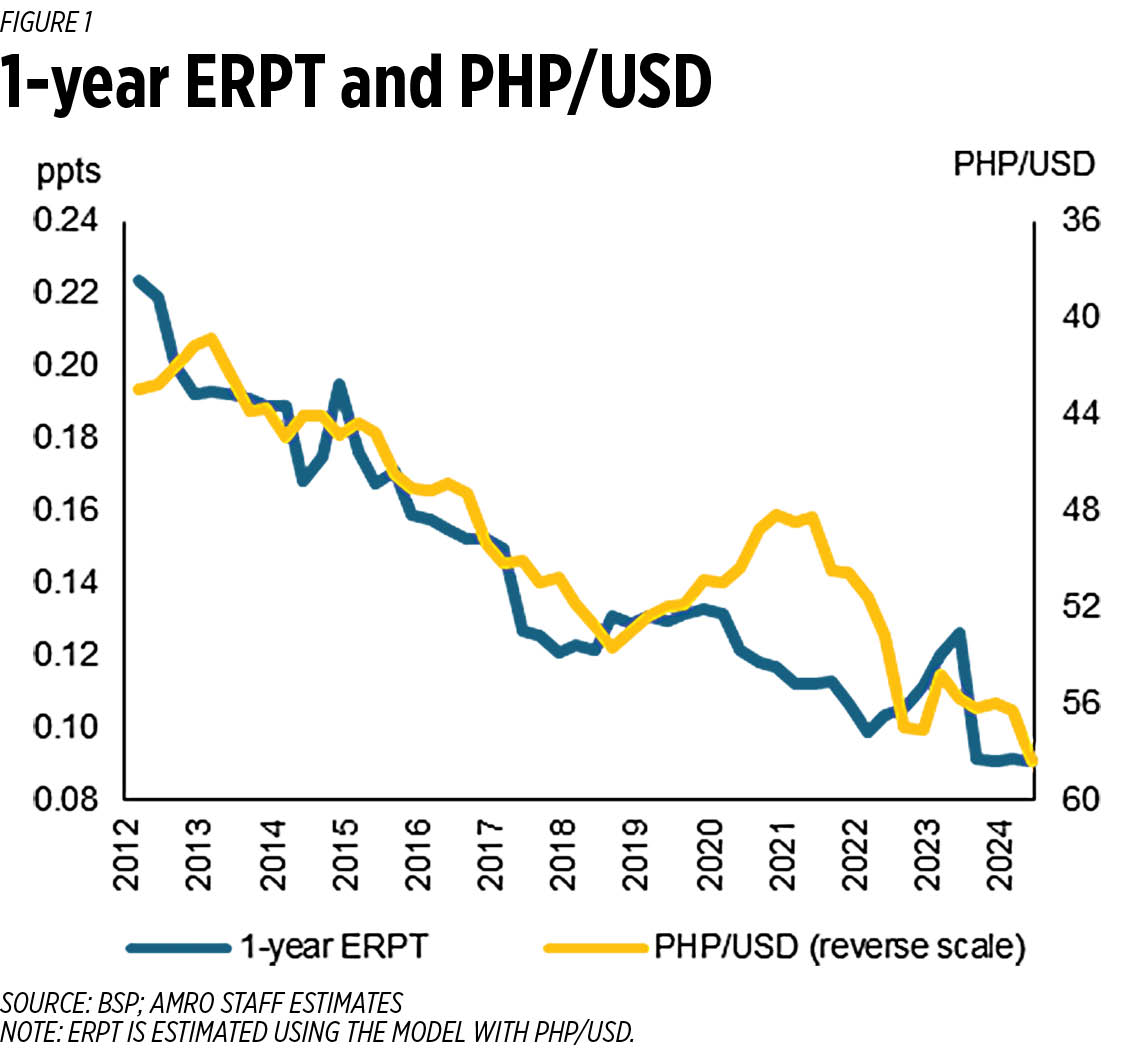
A recent study by the ASEAN+3 Macroeconomic Research Office (AMRO) suggests that the impact of peso depreciation on inflation is modest. The study quantifies the exchange rate pass-through (ERPT) — the degree to which exchange rate fluctuations affect domestic inflation. The findings reveal that a 1% depreciation of the peso against the US dollar raises quarterly consumer price inflation by just 0.046 percentage point, with a cumulative one-year effect of only 0.091 percentage point.

When benchmarked against a broader basket of foreign currencies using the nominal effective exchange rate (NEER), the impact is slightly higher but still limited — 0.071 percentage point in the short term and 0.147 percentage point over a one-year period. This subdued pass-through highlights the credibility of the central bank in anchoring inflation, and the influence of other factors, such as firm pricing behavior, administrative price measures, and domestic demand, on inflation.

Interestingly, the ERPT has declined over the past decade, even as the peso has trended weaker. The AMRO study further indicates a diminishing marginal impact of a 1% peso depreciation on CPI inflation as the currency weakens (see Figures 1 and 2). Reduced exchange rate pass-through to consumer prices could be attributed to a credible monetary policy framework, which has anchored inflation expectations, and other structural improvements related to external trade. The evolving dynamics underscores the reduced sensitivity of Philippine inflation to exchange rate movements.

INFLATION OUTLOOK
Looking ahead, the peso is expected to remain volatile in 2025 and 2026, influenced by both domestic and external factors. Global uncertainties, including monetary policy shifts in major economies, geopolitical tensions, and the outlook for global growth, will weigh heavily on the currency. On the domestic front, market expectations of a policy rate cut by the Bangko Sentral ng Pilipinas (BSP) could add to the peso’s fluctuations.

Given that there is room to adjust the policy rate to a less restrictive stance in light of easing inflationary pressures, the BSP is expected to gradually cut rates toward a more neutral stance, targeting a nominal rate of around 4.6% by the end of 2025.

Amid these conditions, the peso should remain market-driven, acting as a shock absorber for the economy. Strategic foreign exchange interventions by the BSP should continue to be deployed judiciously to manage excessive volatility.

Despite the peso’s expected fluctuations, inflation in the Philippines is projected to stay within the BSP’s target range of 2-4%. The moderation of global commodity prices and targeted administrative measures, such as tariff cuts on food items — particularly the reduction in imported rice tariffs introduced in July 2024 — will help alleviate inflationary pressures.

Market concerns about the peso’s impact on inflation should not be overstated, given the limited pass-through effect and the credibility of the BSP in containing inflation within its target band. Policymakers must remain vigilant, striking a balance between supporting economic growth and maintaining price stability, while ensuring that the peso remains a stabilizing force in an uncertain global environment.


Dr. Andrew Tsang joined AMRO in September 2021. He is a senior economist of AMRO focusing on economic surveillance on the Philippines. He is also a backup economist for Cambodia.

Concepcion Industrial earnings up 83%

CONCEPCION.PH

LISTED appliance retailer Concepcion Industrial Corp. (CIC) saw an 83% increase in its unaudited consolidated earnings for the full year 2024 to P1.2 billion.

The company recorded a 23% improvement in its 2024 net sales to P18.1 billion, CIC said in a regulatory filing on Thursday.

Including associate company, Concepcion Midea, Inc. (CMI), CIC said its net sales rose by 29% to P23.5 billion.

“2024 was a year of significant growth for CIC. Strong customer demand for our brand translated into remarkable growth. We met this opportunity with preparation, a deep understanding of customer needs and our commitment to delivering exceptional value,” CIC Chief Executive Officer Isaias Ariel P. Fermin said.

For the fourth quarter, CIC saw a 57% increase in consolidated earnings to P278.7 million, fueled by market demand. Consolidated net sales climbed 17% to P4.5 billion.

Together with the revenue of CMI, the company saw a 22% increase in net sales to P5.7 billion.

“The consumer business segment led the charge with a remarkable 26% increase, fueled by robust performance in the refrigeration and other appliance categories,” CIC said.

“Meanwhile, the commercial segment delivered a steady growth in the aftermarket services and elevator installation categories,” it added.

CIC shares rose by 1.47% or 20 centavos to P13.78 per share on Thursday. — Revin Mikhael D. Ochave

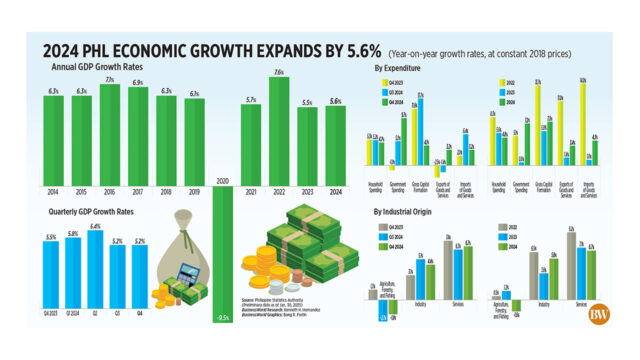
2024 PHL Economic Growth Expands by 5.6%

THE PHILIPPINE ECONOMY expanded by a weaker-than-expected 5.2% in the fourth quarter, bringing full-year growth to below the government’s target amid subdued consumption and lower farm output. Read the full story.

2024 PHL Economic Growth Expands by 5.6%

France’s Macron announces renovation to expand capacity of Louvre museum

LOUVRE Museum — WIKIPEDIA

PARIS — France will launch a six-year renovation of the Louvre in Paris, enlarging the world’s most-visited museum to make room for the huge crowds who now cram inside the palace on the banks of the Seine, President Emmanuel Macron said on Tuesday.

A new entrance will make it easier to get in and out, and a dedicated space with a separate entrance will house the art museum’s prize attraction, Leonardo da Vinci’s Mona Lisa, Mr. Macron said during a visit to the museum.

Starting next year, the museum will also charge a higher entry fee for visitors from outside the European Union, he said.

Louvre President Laurence des Cars warned last week that the centuries-old building — once a lavish palace for French kings —was in a dire state, with leaks and temperature swings that could endanger the conservation of works of art.

A visit has become “a physical ordeal,” with artwork hard to find in a confusing layout and too little space for visitors to take a break, eat, or use the toilet, Mr. des Cars said.

The Louvre now receives 9 million visitors a year, more than double the 4 million it was designed to handle when it was modernized in the 1980s. The renovation will increase capacity to 12 million, Mr. Macron said.

He did not say how much the renovation would cost but said it would be financed through the Louvre’s own funds, ticket sales, sponsorships, and earnings from its sister museum in Abu Dhabi, and thus “will not weigh on the taxpayer.”

Big civic projects in the capital have traditionally been a way for French presidents to burnish their legacies. Last month, Macron reopened Notre-Dame cathedral, meticulously restored five years after it was damaged by fire.

“While Notre Dame was the architectural catalyst of our craftsmanship, this project for the Louvre must be for art, art history and its transmission a new step in the life of the nation,” Mr. Macron said. — Reuters

Stress interview or plain bullying?

Two of our managers did a panel interview of an applicant with a perfect professional background. Manager A was professional and pleasant while Manager B came in abrupt and harsh to the applicant during the interview. After that, the candidate informed us he’s no longer interested in pursuing his application citing the rude treatment he got from B. He asked: “How could someone work peacefully with that person?” I was at a loss and did not answer. Any advice? — Rocky Road.

Are you sure Manager B is not conducting a stress interview? You’ve got to understand this very well. Many jobs require people to handle pressures and difficult scenarios arising from working with equally difficult colleagues or customers, even on trivial matters. This is the reasoning behind the stress interview.

If you’re not sure, better check with Manager B, who may have pulled off the greatest acting job of his life, baffling both you and the applicant. Even if you were not informed beforehand, the next best thing for Manager B is to explain the process to the applicant immediately after the interview.

He should have issued a disclaimer right away. However, much depends on the quality of questions that were raised. One irritating question is: “All managers in this organization are graduates of high-end universities. How can you compete with them as a graduate of a provincial university?”

This question is out of bounds.

Also, the timing of the interview is important. Stress interviews should be done only during the second round when you’re ready to finalize a shortlist of the top three candidates.

Whether or not it’s a stress interview, we must accept the fact that we cannot avoid interacting with people with abrasive personalities.

Therefore, the best approach is for you and the applicant to trust the process. Manage the situation well. If it’s part of the process, it’s better to conduct a debriefing immediately after the interview to avoid misinterpretation.

However, conducting a stress interview requires careful formulation of questions to help assess how candidates handle themselves in real, work-life scenarios. It might involve having to work to tight deadlines with minimal resources, managing conflict with colleagues, correcting critical mistakes with customers, and so on. The list goes on and on.

Flowers that bloom beautifully in the mountains often perish if they’re planted down the plains. We human beings are just like that. It’s important to understand this.

QUESTIONS
The first thing to do is to inventory all the difficult situations that may come up on the job. Then, create a list of questions and give them specific weight in percentages starting from the most important down to the least important.

For example, if you’re looking for a production manager, define the most critical qualities of applicants that you may want to consider. Use the job description as the basic reference. From there, you can formulate interview questions like the following:

Supervising the entire production work process. “Eight out of the 10 machines conk out. Workers can resort to a manual process with a 20% defect rate. How would you handle the situation only three days before the promised delivery date, with a $1,000 penalty for every day of delay?”

Managing production schedules and resource allocation. “Employee absences and tardiness are common issues in this organization. We have reasonable disciplinary rules against it, yet workers who belong to a militant union continue to violate them. Our line leaders are helpless. What’s the best approach to resolving this issue?”

Implementing cost-saving strategies and techniques. “The organization is losing money. The former production manager has tried multiple approaches to minimizing the losses. It includes the application of Six Sigma in our operations. And yet, the problems continue to linger. What would you do?”

TRAP
Are these questions stressful for you? Maybe not. At least, not yet. That’s because some interviewers who are fond of stress interviews can make their first two questions friendly to the applicant. The objective is to make them feel at home.

It is situations like these that could applicants at risk of unwittingly revealing their true character. In other words, it’s a trap. Take question no. 3 above.

An applicant giving an instant answer without understanding the situation is putting themselves at risk with the interviewer who can raise the following stinging questions in a loud, booming, and insulting voice. “How can you give me that kind of (four-letter word) without knowing the full context? Is that the way you solve problems? That’s careless, to say the least!”

The best answer to question no. 3 is another question: “Would you like to elaborate on the efforts of the former manager? What makes his effort inadequate in solving the issue?”

Stress is an inevitable part of most jobs. Interviewers use stress interviews to avoid bad hires.

Employers know the risk because if they’re not careful in vetting applicants, that will cost them a lot of time, money, and effort.


Attend Rey Elbo’s public program on “Lean HR: Finding the Best Way of Doing Things” on March 7, 2025. E-mail elbonomics@gmail.com or register via https://reyelbo.com/contact-us