Home Blog Page 1495

US will spend up to $1B to combat bird flu

REUTERS

WASHINGTON — The US will invest up to $1 billion to combat the spread of bird flu, as well as increase imports of eggs in an effort to drive down high prices, Agriculture Secretary Brooke Rollins said.

A three-year bird flu outbreak in US poultry has killed 166 million chickens since 2022, according to the US Department of Agriculture (USDA) data.

The virus has also infected nearly 1,000 dairy herds and almost 70 people, including one who died, since early 2024.

The USDA will spend up to $500 million to provide free biosecurity audits to farms and $400 million to increase payment rates to farmers who need to kill their chickens due to bird flu, Ms. Rollins said at a conference of state agriculture officials.

In a Wednesday Wall Street Journal column, Ms. Rollins said some of the money will come from cuts to USDA spending by Elon Musk’s Department of Government Efficiency. But on a call with reporters later in the day, Ms. Rollins’ chief of staff, Kailee Tkacz Buller, said the money was coming from the USDA’s Commodity Credit Corp., a discretionary pool of funding available to the secretary.

The agency did not immediately clarify the discrepancy.

The USDA is exploring vaccines for chickens but is not yet authorizing their use, Ms. Rollins said. The poultry industry is divided on whether to vaccinate chickens because of potential trade implications.

“It could be a solution, but to push that out now and require it, we’re just not ready,” Ms. Rollins said of vaccines when speaking to reporters at the White House on Wednesday.

Some industry groups expressed relief that the agency did not move to require vaccines, said Rick Phillips, director of poultry professional services veterinarians for drugmaker Boehringer Ingelheim, who was on the call.

“There was a little bit of a sigh that they didn’t move fast on certain things like immediately going to vaccination until we better understand the nature of what we’re dealing with,” he said.

The administration plans to increase imports and decrease exports of eggs to boost domestic supply and combat record high egg prices, Ms. Rollins said. Turkey has said it will export 15,000 tons of eggs to the US through July.

This year, Turkey is expected to supply about 420 million eggs to the US, up from about 70 million normally, Ms. Buller said.

Egg prices have nearly doubled since last year. Scant supply is leading some consumers to “panic buy,” said Virginia Tech economist Jadrian Wooten in an e-mail.

In May, the administration of President Joseph Biden allocated more than $800 million to combat bird flu in livestock. About $450 million of that money is still available, a USDA official said Tuesday at the National Association of State Departments of Agriculture conference. — Reuters

Style (03/03/25)


ArteFino returns for resort season

LIFESTYLE fair ArteFino is coming back on March 6 to 9 at the North and South Court of Powerplant Mall in Rockwell, Makati. The lifestyle fair is jumping on the Resort Collection bandwagon with wares designed for the coming summer months. Brands include Pinas Sadya, Barba, R. Filart, del, Maison Métisse, Farah Abu, Golden Monstera, Good Luck Humans; Coco & Tres, Jhaz Footwear, Arao, and Jor-El Espina Swim, among others. Admission is free.


Estancia Mall has summer sale

FOR VACATION essentials and refreshments, Estancia’s mallwide three-day Summer Fab Sale from March 14 to 16 has you covered. Enjoy up to 70% off on several brands and restaurants at Estancia Mall. Shop breezy outfits to prepare for the sunny season, and stock up on sunscreen and swimsuits. Ortigas Community Card members get free parking when they present a single or accumulated receipt worth P3,000 from any Estancia store during the Summer Fab Sale. Sign up via the OrtigasMalls+ app or go to the concierge to get an Ortigas Community Card, and get access to events and exclusive perks across all Ortigas Malls. Drop by Estancia Mall’s 3-Day Summer Fab Sale from March 14 to 16, from 10 a.m. to 10 p.m. For more information, check out the mall’s Facebook page and Instagram page.


Pop Mart in SM Makati

POP MART opened a pop-up store at SM Makati earlier this month, and is staying open throughout March. Known for its collectible blind box figures, Pop Mart offers popular characters including Labubu, Crybaby, Hirono, Molly, Skullpanda, and Dimool, among others. Asian celebrities are known to lug around the charms and toys. The brand innovates with original IPs and exclusive collaborations. The pop-up is at the 3rd Floor Concourse of SM Makati.

Vietnam’s olive branch to Elon Musk sets a bad precedent

VIETNAM was often viewed as a winner during the first US-China trade war. This time around, such a victory looks less certain as it faces the threat of tariffs. But the Southeast Asian nation appears to be trying to come out on top again by opening itself up to business with Elon Musk.

Last week, Vietnam approved new regulations that would allow Musk’s Starlink to provide satellite internet services in the country and maintain full ownership over any subsidiary — an abrupt reversal of the local rules that had previously barred overseas companies from fully owning satellite internet providers. Talks between regulators and the company have been going on for years, sputtering in 2023 after lawmakers signaled they would not make an exception to the domestic partnership policies. The government said last September that SpaceX, Starlink’s parent company, had plans to invest $1.5 billion in Vietnam, but it still didn’t give details on its potential entry into the market.

So, what’s behind the sudden reversal now? Apparently, the threat of tariffs spurred Vietnamese lawmakers to extend an “olive branch” to the business owned by Donald Trump’s close ally.

The move exposes a new reality: Musk’s proximity to the US president, known for his transactional approach to foreign policy, is impacting how countries are writing regulations — and in ways that stand to further enrich the billionaire. Musk’s pseudo-government role is already causing consternation in Washington over a slew of potential conflicts of interest. Vietnam’s change of heart reveals how this new era of techno-imperialism is quietly reshaping policy in developing countries.

Vietnam isn’t alone in its efforts to court the world’s wealthiest man and his political clout. Bangladesh’s interim leader recently invited Musk to visit the country and launch Starlink.

It’s true that expanding access to satellite internet has upsides in both countries; the service can help boost connectivity across harder-to-reach mountainous and rural regions. And these nations have nothing to gain by trying to separate Musk’s business empire from US foreign policy. Vietnam, meanwhile, is going through its own government overhaul. Leaders recognize that tariffs would devastate their export-driven economy. Opening its tech savvy market up to Musk’s business, even without a domestic partner, still seems like a wiser option. And it’s an attention-grabbing way to chip away at its trade surplus with the US.

But is Vietnam setting up a bad precedent? Should the personal business interests of Trump’s “first buddy” be enough to alter US trade policy? Is opening up your marketplace to Musk a sufficient reason to avoid the president’s long-promised tariffs?

Other jurisdictions will be watching closely how this plays out. China, the prime target of the new trade war, will especially be taking notes. Beijing has reportedly mulled using Tesla, Inc., the electric-vehicle maker deeply intertwined with its domestic market, as a potential bargaining chip in negotiations. Musk stands out among Trump allies with his softer stance toward America’s top geopolitical rival, likely because of his business interests there. Chinese policymakers recognize they can exploit their control over his company to further their own interests and catch the attention of the president.

It is said that no one is a winner from a trade war. Time will ultimately tell if that holds true in this new era of the Trump’s broligarchy, or if it will end up growing the power and influence of America’s tech elite. Vietnam may have prematurely capitulated to Musk, but leaders in other jurisdictions are responding to the threat of US tariffs by pre-emptively targeting his firms.

As Musk injects his global businesses in more countries across Asia, it could potentially give governments bargaining chips as the trade war heats up — but being a political pawn could also backfire on his companies. It’s no guarantee these unevenly gained business wins so far are sustainable.

BLOOMBERG OPINION

CAMPI, TMA sell 37K units in January

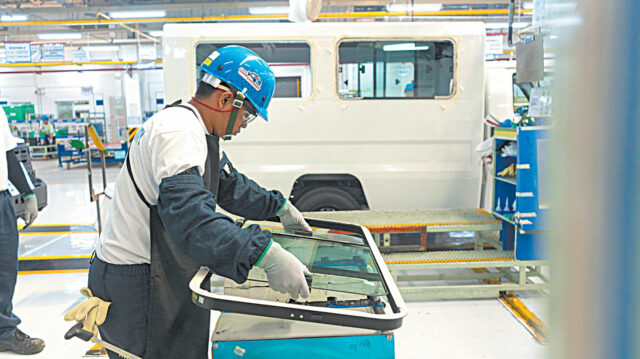
Assembling a Toyota Tamaraw in Santa Rosa, Laguna — PHOTO BY KAP MACEDA AGUILA

APPARENTLY SUSTAINING the momentum of their best-ever sales performance last year, the Chamber of Automotive Manufacturers of the Phlippines, Inc. (CAMPI) and Truck Manufacturers Association (TMA) reported sales of 37,604 vehicles in January. The consolidated sales total of their member companies surpassed the 34,060 units moved in the same month in 2024. In January 2023, the two organizations jointly reported sales of 29,499.

Broken down into vehicle segments, the 2024 total is led by commercial vehicle sales, which grew 16.6% year-on-year to 29,875 units, then passenger cars which accounted for 7,729 units (declining by 8.5% year-on-year).

Said CAMPI President Atty. Rommel Gutierrez in a release, “CAMPI is confident in setting the aspirational figure of 500,000 units in sales as its target for this year. Newly rolled-out models and the anticipated introduction of new models are some of the factors that will contribute to achieving this target.”

Leading the sales charge anew is Toyota Motor Philippines Corp. (TMP), which sold a total of 18,078 vehicles and accounts for nearly half (48.07%) of the market. TMP is followed by Mitsubishi Motors Philippines Corp. (MMPC), selling 7,374 vehicles and cornering 19.61% of the industry. In third place is Nissan Philippines, Inc. (NPI) with a total of 2,366 units moved and 6.29% of the market; fourth is Suzuki Philippines, Inc. (SPH) with 1,781 vehicles sold and 4.36% market share. Completing the top five is Ford Motor Company Philippines, Inc. with 1,577 units sold and 4.19% share of market.

The biggest month-on-month mover in terms of percent growth is Velocita Motors Philippines, Inc. (Ferrari), with sales of its ultra-premium super cars jumping by 100% from two units in December 2024 to four in January. Changan Auto Philippines (IC Automotive) made the largest jump in year-on-year sales — growing its 52-unit tally in January 2024 to 118 vehicles (or a spike of 126.9%) last month. — Kap Maceda Aguila

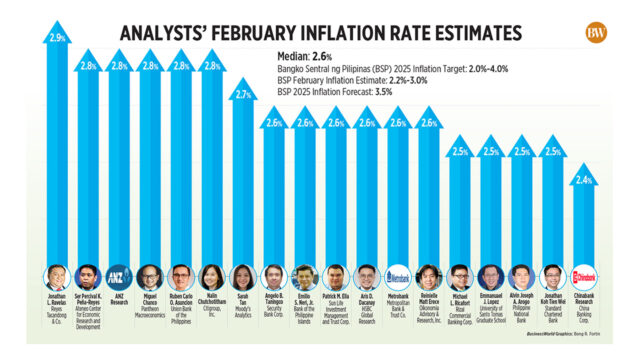
Analysts’ February inflation rate estimates

HEADLINE INFLATION likely slowed in February amid the decline in prices of rice and other key commodities, analysts said. Read the full story.

Analysts’ February inflation rate estimates

SLIMTC expects AUMs to reach about P450 billion this year

SUN LIFE Investment Management and Trust Corp. (SLIMTC) expects its assets under management (AUM) to reach P440 billion to P450 billion this year as it plans to launch retail products.

“The bulk of it will come from the insurance assets. But for retail alone… we’re launching the unit investment trust funds (UITFs) by April. We have them already, but for institutional clients. So, we’re targeting an ambitious goal of at least P10 billion in AUMs for the UITFs alone, for the year,” SLIMTC President Michael Gerard D. Enriquez told reporters on Friday.

SLIMTC’s AUMs almost doubled to around P220 billion in 2024 following the transfer of insurance assets to the trust company.

“We just completed that transfer…  That’s why the AUMs significantly grew. We just had to do it in phases because the AUMs are huge. It was really mainly coming from the institutional client base,” Mr. Enriquez said.

SLIMTC also hopes to become part of the top three standalone trust corporations in the Philippine in terms of AUMs in the next few years, he added.

SLIMTC is now moving into the retail segment to complement its current offerings to institutional investors and select high net worth individuals, Mr. Enriquez said in a separate speech on Friday.

Aside from the launch of retail UITFs by next month, it is also rolling out an online platform to tap the retail segment.

“We’re excited about that because now we will have a chance to help our financial advisors expand their product suite to also offer UITFs to their individual clients. Our primary point of distribution, at least for the first few years, would be through our financial advisors. We would like to complete that product suite and for them to be able to offer a holistic solution for their clients,” Mr. Enriquez said.

Appetite for UITFs among the public has been low as consumers prefer to put their money in banks instead of investing, he said.

“I think there should be more communication and marketing towards how easy it is to invest. Accessibility now has been addressed with digital means,” Mr. Enriquez added. — AMCS

Italpinas signs five new joint ventures 

Moena Mountain Estate, a mixed-use development in Bukidnon is one of IDC’s projects — PHILSTAR FILE PHOTO

REAL ESTATE developer Italpinas Development Corp. (IDC) has entered into five new joint venture (JV) agreements for real estate development projects.

In a media release on Sunday, IDC said three of the five new ventures are in Puerto Princesa, while the other two are for projects in Boracay and Pampanga.

“Each of the new JVs has been entered into by IDC with the Co family, who recently joined IDC as a key equity partner upon their acquisition of 15% of IDC shares last November,” IDC said.

In November last year, IDC signed an agreement with businessman Benjamin Tan Co, who purchased 15% of the company’s primary shares at P1.99 each, totaling P187.93 million through a private placement.

IDC said one of the JVs is for Parco Leonardo in Mexico, Pampanga, which will be a premier residential community featuring green and state-of-the-art amenities.

The project, to be developed by the company’s subsidiary IDC Homes, will rise on a 15-hectare site.

IDC, through its unit IDC Prime, is also set to develop Miramare Residences on Boracay Island. The project will be a branded condotel and a collection of branded residences comprising 140 apartments.

The listed real estate developer is also set to build Verona Princesa, which will be developed by IDC Homes on a 2,000-square-meter lot in Bancao-Bancao, Puerto Princesa City, Palawan.

This mixed-use development will feature condominium living, commercial areas, and retail spaces.

Additionally, IDC, through IDC Homes, is developing Verona Puerto and Verona Costa Verde, located in Tagburos and Tiniguiban, Puerto Princesa City, respectively.

Verona Puerto will rise on a 5,400-square-meter lot and will be a mixed-use development featuring retail spaces, while Verona Costa Verde will be a walk-up condominium community spanning 7,600 square meters, featuring sustainable building designs and living spaces.

“IDC looks forward to progressing these joint venture agreements and the opportunities they present to bring contemporary Italian design and sustainable development to Palawan, as well as other promising growth areas in the Philippines,” IDC said.

In 2024, IDC and the Co family entered into a JV for the development of a two-property project on Mitra Road, Puerto Princesa, Palawan.

At the local bourse on Friday, IDC shares closed unchanged at P1.13 apiece. — Ashley Erika O. Jose

US beef prices could rise as Canada ranchers reduce cattle herds, fearing Trump tariffs

REUTERS

WINNIPEG, Manitoba — Canadian farmer Jon Vaags quit buying beef cattle in November after the election of US President Donald Trump made tariffs on Canadian exports seem like a serious risk.

Now there are more than 1,000 empty spaces on his feedlot, where cattle are fattened on grain before being slaughtered for beef.

“We stopped buying feeder cattle altogether,” said Mr. Vaags, whose family’s feedlot has room for 3,000 cattle and is usually full from November until the summer.

After years of drought raised feed costs, North American farmers culled animals and did not rebuild their herds, so the beef cattle population on both sides of the border had been declining even before the threat of US tariffs on Canadian exports.

Canada, the world’s No. 8 beef exporter and 10th largest cattle producer, exports more than half its beef production, with 75% going to the US.

The Trump administration has repeatedly listed lower food prices as a major objective. But at US grocery stores, beef prices have already risen due to the smallest US cattle herd in 74 years and the smallest Canadian herd in 36 years.

The average price of ground beef in US cities has risen 43% since the beginning of 2020, according to the US Bureau of Labor Statistics. Global beef prices are up 34% according to the International Monetary Fund.

Historically, cows, calves, breeding stock, slaughter animals and beef-in-boxes have flowed across the US-Canada border as if it were not there. Canada imports many young cattle from the US, fattens them, slaughters them, then sends the meat back to the US. Tariffs would upend this process.

Mr. Trump has threatened 25% tariffs on most imports from Canada and Mexico.

The US cannot easily replace Canadian beef. It is already in a beef deficit and importing from as far away as Australia. Canadian beef fills in where there is not enough US beef.

Canada’s government-backed lender Farm Credit Canada would like farmers to expand their herds to grow the country’s beef industry, but says tariffs are discouraging ranchers.

Some Canadian cattle ranchers “might sit this one out for 12 months, sit this one out for six months,” said Farm Credit Canada’s chief economist JP Gervais of Mr. Trump’s tariff threats.

The impact of a declining cattle herd is trickling down to other agricultural businesses in North America, including the sale of grains purchased up to a year ahead of time to fatten cattle.

“It’s killing the business,” said Jim Beusekom, president of Market Place Commodities, a feedgrains trader in Alberta’s “feedlot alley.”

Without looming tariffs, high meat prices may have encouraged some Canadian farmers to replenish their herds.

Instead, prices are prompting many to cash out by sending all the animals they can, including aging cows and young female breeding stock, into the meat market.

Canada’s cow and calf herd at the start of 2025 was 0.7% lower than in January 2024, which was 2.1% lower than in 2023. At 10.9 million head it is the smallest since 1988, according to Statistics Canada.

Curtis Vander Heyden, who runs three feed lots with his two brothers in Alberta, estimates one truckload of fattened cattle would face a $28,000 bill due to tariffs. US buyers will balk at the price jump, either refusing to pay more than they would for US cattle, or just not buying Canadian animals at all, he thinks. But Mr. Vander Heyden wants to retain his workforce, so he is not reducing his cattle-feeding operations.

“I can’t stop. We have employees. There are a lot of families depending on us,” said Mr. Vander Heyden. — Reuters

First Gen to supply Cebu’s Oakridge Business Park with renewable energy 

THE agreement for the solar facility was signed by (from left) Mark Malabanan, Pi Energy customer progress partner; Carlo Vega, chief engagement officer of First Gen; Anne Liu, president, Oakridge Realty Development Corp.; and Reina Tano-Bello, ORDC business development director.

OAKRIDGE Realty Development Corp. (ORDC), the developer of Oakridge Business Park in Cebu, has renewed its partnership with Lopez-led First Gen Corp. for the construction of a rooftop solar system in the premier development.

Under the deal, First Gen will install solar panels totaling 638 kilowatts atop Oakridge Business Park, the company said in a media release over the weekend.

Situated in Mandaue City, Cebu, the 4-hectare Oakridge Business Park is the first mixed-use property in Cebu to be 100% powered by renewable energy and to install charging stations for electric vehicles, as well as solar-powered charging stations for mobile devices.

“Since we started Oakridge Business Park in 2009, we have gradually made it part of our mission to push for sustainable solutions to help the environment,” said ORDC President Anne Liu.

“We would like to believe that the impact of our initiatives has not only led to an improved carbon footprint but has also significantly influenced lifestyles and, more importantly, instilled a more conscious mindset in the communities we serve,” she added.

The two companies initially entered into an agreement in 2021 to directly supply the business park with electricity from a natural gas-fired power plant. In 2023, ORDC signed another contract with First Gen to shift its energy source to geothermal power as part of its sustainability program.

Under their renewed power supply deal, First Gen and its sister company, Pi Energy, Inc., will also provide the business park with a remote energy monitoring system that allows for real-time electricity usage tracking.

The system will also generate regular energy audit reports, which include an analysis of the business park’s energy consumption and costs to identify the need for additional intervention measures and efficiency projects.

ORDC is the real estate development arm of Cebu-based LH Paragon Group, Inc., a diversified holding company with domestic and overseas business operations, including the fashion retail powerhouse Golden ABC, Inc. The group also has businesses in wood distribution, healthcare and diagnostic services, and food retailing.

Meanwhile, First Gen holds a total of 3,668 megawatts (MW) of combined capacity, with 1,651 MW coming from its renewable energy portfolio and 2,017 MW from its natural gas-fired plants. — Sheldeen Joy Talavera

Gamaba awardee Magdalena Gamayo weaves Philippine cotton again

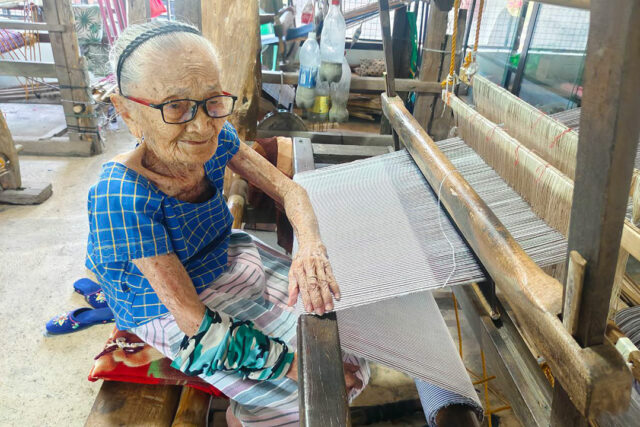
IN PINILI, Ilocos Norte, National Living Treasure Magdalena Gamayo is once more weaving with Philippine cotton. At the age of 100, her hands remain steady, creating swathes of inabel, a traditional Ilocano textile.

This return to Philippine cotton — after a long period when weavers had to make do with imported cotton or synthetic thread — marks a blend of heritage and innovation.

On Feb. 12, in celebration of National Arts Month, the Department of Science and Technology-Philippine Textile Research Institute (DOST-PTRI), provided nine kilos of brown and six kilos of white ring-spun Philippine cotton yarns to the Gamaba Weavers Association, an association of weavers who have been awarded the Gawad sa Manlilikha ng Bayan (Gamaba) or National Living Treasures Award. This initiative is meant to revive Philippine cotton in order to boost local textiles, cut imports, and promote sustainability, providing weavers with quality, sustainable yarns.

The Gamaba Weaving Association, based at the Gamaba Cultural Center, is one of the first communities selected for DOST-PTRI’s yarn deployment. The field trials allow weavers to assess the yarn’s quality, ensuring alignment with traditional techniques before commercialization.

For generations, inabel weaving has featured patterns like binakol, inuritan, kusikos, and Inubon a Sabong. Using the DOST-PTRI-developed cotton yarn, Ms. Gamayo is now weaving inunsoy, a stripe-patterned weave.

“This is a weaving movement in which we ask communities to validate with us whether cotton can be used for weaving. We seek feedback as it allows us to adjust the specifications of the cotton yarns,” DOST-PTRI Director Julius L. Leaño, Jr., was quoted as saying in a press release.

The weavers will help refine the DOST-PTRI-developed yarns, ensuring that they align with traditional weaving standards. By actively weaving with these new yarns and providing feedback, they contribute to R&D, bridging innovation and heritage.

Preventing and confronting liver cancer together

FREEPIK

Liver cancer in the Philippines holds a staggering mortality rate of 11.6 out of 100,000 individuals, compared to the global death rate of 7.8/100,000. This reflects the significant impact of liver cancer on the public health of our country, highlighting the need for a multi-faceted approach that encompasses patient education, screening and diagnosis initiatives, and access to appropriate medicine.

Liver cancer also ranks as the 4th most common type of cancer diagnosed in the Philippines next to breast, lung, and colon, and the 3rd most common cause of death. Statistics from the Global Cancer Observatory show that as of 2022, the Philippines had 12,544 new cases of liver cancer and 11,653 deaths annually.

With these, one of the diseases that deserves our attention is liver cancer and its most common variant, hepatocellular carcinoma (HCC). This, as the country commemorates World Cancer Day and the National Cancer Awareness Month every February.

As Hepatitis B infection is a major risk factor for developing HCC, increasing vaccination coverage among the population is important. This is more crucial for high-risk populations such as healthcare workers, people with chronic liver disease, individuals with multiple sexual partners, and immunocompromised patients. While the government has implemented national vaccination programs to reduce the incidence of hepatitis B, this remains to be the most common cause for hepatocellular carcinoma.

The US Centers for Disease Prevention and Control (CDC) noted that in its early stages, liver cancer may not have symptoms that can be seen or felt. On the other hand, people may notice one or more of the common symptoms as the cancer grows larger.

The CDC said that liver cancer symptoms may include discomfort in the upper abdomen on the right side; a swollen abdomen; a hard lump on the right side just below the rib cage; and pain near the right shoulder blade or in the back. Also among the symptoms are jaundice (yellowing of the skin and whites of the eyes); easy bruising or bleeding; unusual tiredness; nausea and vomiting; loss of appetite; and weight loss for no known reason.

The CDC added that a person may reduce the risk of getting liver cancer by keeping a healthy weight and getting enough physical activity. Also, one is encouraged to get tested for hepatitis C and get medical care if one has it. Finally, quit smoking and avoid drinking too much alcohol.

As with most cancers, detecting liver cancer in its early stages gives patients the best chance for successful treatment. Early diagnosis means more treatment options, better outcomes, and higher chances for survival.

The Philippine Clinical Practice Guidelines (CPG) for the Diagnosis and Management of Hepatocellular Carcinoma in 2021 recommend the semi-annual screening of patients identified to be at higher risk to develop HCC. Screening would benefit patients who are diagnosed to have late-stage liver damage or cirrhosis, and patients with hepatitis B who have a family history of HCC. For this patient group, tools like ultrasound and alpha-fetoprotein (AFP) testing can help in early detection of liver cancer.

Access to effective treatment is an important factor in cancer care, as the availability of medications directly impacts patient outcomes. In the Philippines, there is a comprehensive range of treatment options for liver cancer. Localized therapies such as interventional radiology and transarterial chemoembolization procedures are available for earlier stage disease. These allow for targeted treatment of liver tumors while minimizing damage to surrounding healthy tissue.

Beyond localized treatments, systemic medications like immunotherapy and targeted therapy are also available for more advanced diseases. These therapies work by either disrupting cancer growth at the molecular level or by enhancing the immune system’s ability to fight cancer, leading not just to prolonged survival, but also a better side effect profile.

By integrating these innovative treatments into clinical practice, physicians can now tailor HCC management to each patient’s disease stage and overall health status, ultimately leading to better disease control, extended survival, and an improved quality of life. It is important for liver cancer patients to speak with their physicians for the most appropriate treatment plan for them.

Despite these advancements, however, there is a need for healthcare programs to be in place to provide financial support for these life-saving medicines. With funding mechanisms, more Filipino patients will be able to access the therapies they need, increasing their chances of receiving optimal cancer care.

Co-creation of strategies from the government, medical experts, and the biopharmaceutical industry is crucial to pivot the condition of HCC in the country. This starts with the swift inclusion of necessary medicines into the Philippine National Formulary, followed by the development of health programs such as PhilHealth’s Z Benefits packages to ensure that medicines get into the hands of patients who need them the most.

Finally, public awareness of liver cancer and HCC is important. Increasing awareness about liver health and the signs and symptoms of liver cancer is crucial to encourage people to seek medical advice promptly.


Teodoro B. Padilla is the executive director of Pharmaceutical and Healthcare Association of the Philippines which PHAP represents the biopharmaceutical medicines and vaccines industry in the country. Its members are in the forefront of research and development efforts for COVID-19 and other diseases that affect Filipinos.


Limited Mazda MX-5 35th Anniversary Edition now available

Limited to just 15 units in the country, the Mazda MX-5 35th Anniversary Edition is priced at P2.49 million. — PHOTO FROM MAZDA PHILIPPINES

THE MAZDA MX-5 35th Anniversary Edition recently made its Asian debut outside Japan in the Philippines at the Sports Cars for a Cause (SCFC) charity event in Bonifacio Global City. First shown at the Mazda Fan Festa last November in Fuji Speedway, the iteration was produced to celebrate the roadster’s 35th year since its introduction at the 1989 Chicago Auto Show.

The SCFC featured more than 200 sports cars, along with the Mazda MX-5 35th Anniversary Edition, that converged along 4th Avenue and 27th Street in Bonifacio Global City last Feb. 23.

“Mazda Philippines is one with the BGC Car Club and Neo in supporting this wonderful event,” said Mazda Philippines President Steven Tan. “The strong sense of charity and compassion among the sports car community in Manila made it the perfect venue to show the MX-5 35th Anniversary Edition. Like the people behind Sports Cars for a Cause, the MX-5 is a car that has enjoyed a strong, dedicated following that has made it the world’s best-selling sportscar since its inception in 1989.”

Limited to just 15 units in the country and priced at P2.49 million, the Mazda MX-5 35th Anniversary Edition features upscale touches such as Artisan RedPremium Metallic paintwork, which is Mazda’s fourth Takuminuri special color. A three-layer finish produces a deep, dark red hue that complements the tan soft top and bright-silver 17-inch aluminum alloy wheels. A serialized badge on the driver’s rear fender completes the exterior highlights.

Inside, the upper door panels and AC vents are color-matched to the exterior so that customers can appreciate the rich, color-shift properties of Artisan Red Premium Metallic. The roadster gets a classic sports car interior with its heated tan Nappa leather seats embossed with exclusive “35th Anniversary” logos, and matching tan carpeting and floor mats.

Mirroring the high level of equipment found in other Mazda MX-5 soft-top models, the MX-5 35th Anniversary Edition comes standard with an 8.8-inch infotainment screen powered by the latest-generation Mazda Connect with wireless Apple CarPlay and Android Auto, dual USB Type-C ports, automatic climate control, rain-sensing wipers, and a nine-speaker Bose sound system.

Powering the Mazda MX-5 35th Anniversary Edition is a high-revving 2.0-liter Skyactiv-G engine delivering 184ps at 7,000rpm and 205Nm at 4,000rpm. This is paired exclusively to a six-speed manual. Like other 2025 MX-5 MT variants, the MX-5 35th Anniversary Edition amplifies Mazda’s “Jinbai-Ittai” philosophy of “horse and rider as one” with two new circuit-developed technologies: DSC-Track mode and Asymmetric Limited Slip Differential. This is on top of sport-tuned Bilstein dampers.