Home Blog Page 1480

Barry Humphries’ personal items, including Dame Edna props, head to auction

AMONG the items up for auction are a pair of diamante-encrusted pink-lacquered spectacles, with an estimated price of £1,000 to £1,500. — CHRISTIES.COM

LONDON — From Dame Edna Everage’s outlandish dresses and snazzy spectacles to paintings and books, items from the personal collection of late Australian comedian Barry Humphries head to auction this week in a sale estimated at up to around $5 million.

A household name in Britain and Australia, Mr. Humphries, who died in 2023 aged 89, was best known for his persona Dame Edna Everage, an instantly recognizable character with lilac hair, curly or diamante glasses, and zany frocks.

Mr. Humphries’ other well known characters was drunk and coarse diplomat Les Patterson and the elderly, rambling Sandy Stone.

As well as Dame Edna’s glasses and outfits, the Feb. 13 “Barry Humphries: The Personal Collection” sale includes a variety of artwork, lead by Charles Conder’s painting Sand dunes, Ambleteuse with an estimate of £200,000-£300,000.

Also on offer are plenty of books, including a first edition copy of The Importance of Being Earnest signed by Oscar Wilde to his publisher. It has an estimate of £100,000 – £150,000.

“Barry Humphries was obviously best known for his comedic personas but behind that was a really passionate, intelligent and curious man,” Benedict Winter, associate director, private & iconic collections at Christie’s London, told Reuters.

The total sale was estimated at £2 million – £4 million.

“He was a passionate art collector who collected throughout his life, and this auction is around 240 lots of works of art and books that he lived with, he loved and he really cherished.”

Proceeds from the sale of some Dame Edna items will go to Britain’s Royal Variety Charity, which helps those who have worked in the entertainment industry.

A pre-sale exhibition is open to the public at Christie’s London showrooms until Feb. 12. — Reuters

PHL hotels may see revenue boost in 2025 — SiteMinder

REY MELVIN-CARAAN-UNSPLASH

PHILIPPINE HOTELS are projected to see revenue growth this year, driven by demand from international visitors, according to hotel e-commerce platform SiteMinder.

“The rise in room rates, fueled by strong international bookings, provides a solid foundation for Philippine hotels to maximize revenue in 2025,” Bradley Haines, regional vice-president for Asia-Pacific at SiteMinder, said in an e-mail.

Philippine hotels saw a 2.91% uptick in their average daily rate (ADR) to $125.03 in 2024 from $121.49 in 2023, according to SiteMinder’s Hotel Booking Trends Report. The ADR for local hotels peaked at $144 in December.

Last year, the Philippines was the only country to post double-digit growth in international hotel bookings at 13.6%, rising to 54.44% from 47.94% in 2023.

“Our data show a strong upward trend in international arrivals at Philippine hotels, with their share of bookings rising steadily from 16.54% in 2021 to 54.44% in 2024 — a notable 229% increase. This momentum suggests continued growth this year.”

Local hotels have been an attractive choice for foreign travelers as they offer both year-round appeal and experience-driven stays, according to Mr. Haines.

Foreign tourists booked their stays at Philippine hotels an average of 25 days in advance last year, up from 23 days in 2023. This was the second-highest lead time in Asia, behind Thailand (27 days).

About 89% of 2024 stays at Philippine hotels averaged up to two nights, while 11% lasted three nights or more, surpassing most Asian markets.

SiteMinder data showed a “less pronounced” gap in bookings between the December peak (9.73% of total bookings) and the September low (7.34%), suggesting that hotel bookings are more consistent throughout the year than seasonal.

However, around 16% of bookings at local hotels were canceled, a slight (2%) uptick from last year.

To sustain growth momentum, Philippine hotels must focus on data-driven strategies and respond to changing traveler preferences, according to Mr. Haines.

“Local hotel operators that leverage market intelligence to understand when and where guests are booking, along with dynamic pricing to capture demand more effectively, will be better positioned for growth.”

In its latest Changing Traveller Report, SiteMinder expects the continued boom of event travel and “workcations” this year.

Data showed that 65% of global travelers said they are likely to travel for concerts, sports tournaments, and festivals. Likewise, 41% plan to work during their stay.

SiteMinder also reported that 36% of travelers globally look up hotels via search engines, followed by online travel agencies (18%), online forums (11%), social media (11%), friends or family (7%), travel fairs (5%), and online travel blogs (5%).

According to the report, 46% plan to book a standard room for their 2025 stays, followed by a superior room (33%), deluxe room (14%), executive room (4%), and suite (3%). About 24% return to hotels for loyalty benefits.

Booking.com and Agoda were the top booking platforms for Philippine hotels last year, according to SiteMinder. Direct bookings remained strong, being the third-largest source of revenue for local properties.

Other popular booking platforms for foreign tourists include Expedia Group, Trip.com, Hotelbeds, Klook, DidaTravel, WebBeds, Tiket.com, Traveloka, and MG Bedbank. — Beatriz Marie D. Cruz

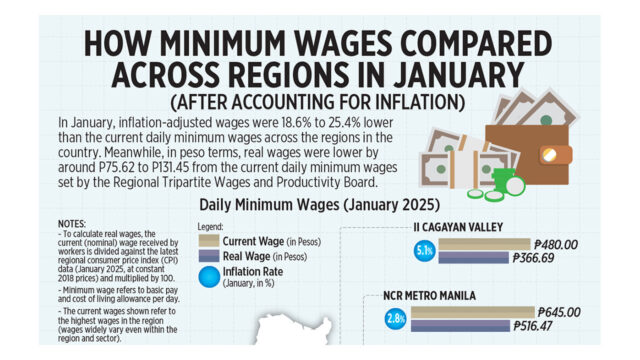
How minimum wages compared across regions in January

(After accounting for inflation)

In January, inflation-adjusted wages were 18.6% to 25.4% lower than the current daily minimum wages across the regions in the country. Meanwhile, in peso terms, real wages were lower by around P75.62 to P131.45 from the current daily minimum wages set by the Regional Tripartite Wages and Productivity Board.

How minimum wages compared across regions in March

On the ERC rates reset and nuclear energy

Last week, on Feb. 3, the House Committee on Energy held a public hearing about a Meralco refund and an investigation on the absence of a rate reset in the last decade for Meralco and the National Grid Corp. of the Philippines (NGCP).

The main issues were previously reported here: “ERC amends resolution to keep Meralco regulatory reset on track” (BusinessWorld, Dec. 29, 2024), “Senate bill extending Meralco franchise OK’d on 2nd reading” (BusinessWorld, Jan. 29), and “Meralco to refund P19 billion to consumers” (Philippine Star, Jan. 29).

This column and reactions in BusinessWorld also discussed the same topic two years ago: “Low power supply and Meralco distribution cost” (April 3, 2023), “Response to Bienvenido S. Oplas, Jr.’s April 3 piece, ‘Low power supply and Meralco distribution cost’,” by Alfredo Non (April 7, 2023), “More on Meralco distribution charges and energy transition” (April 13, 2023).

The representatives at the House Committee hearing last week focused their questions on former Energy Regulatory Commission (ERC) Commissioner Alfredo Non, who led the ERC for seven years (July 2011 to July 2018) when the scheduled fourth reset was not made. He said, among others, that the reset computation is very complicated, and a correction was needed in the third reset.

So far Meralco has refunded P48 billion to the consumers and is scheduled to refund another P19 billion. Public assumption was that Meralco’s distribution rate was bloated but when I checked the numbers from 2011 to 2018, this is not the case.

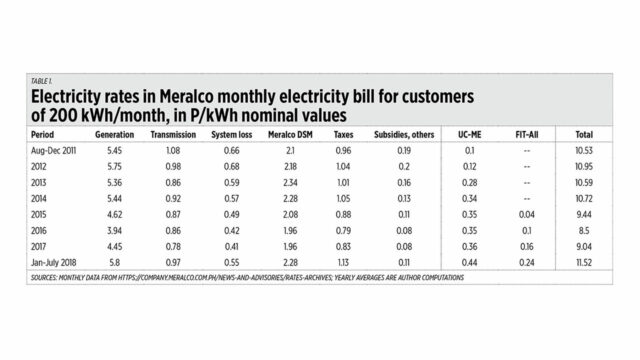
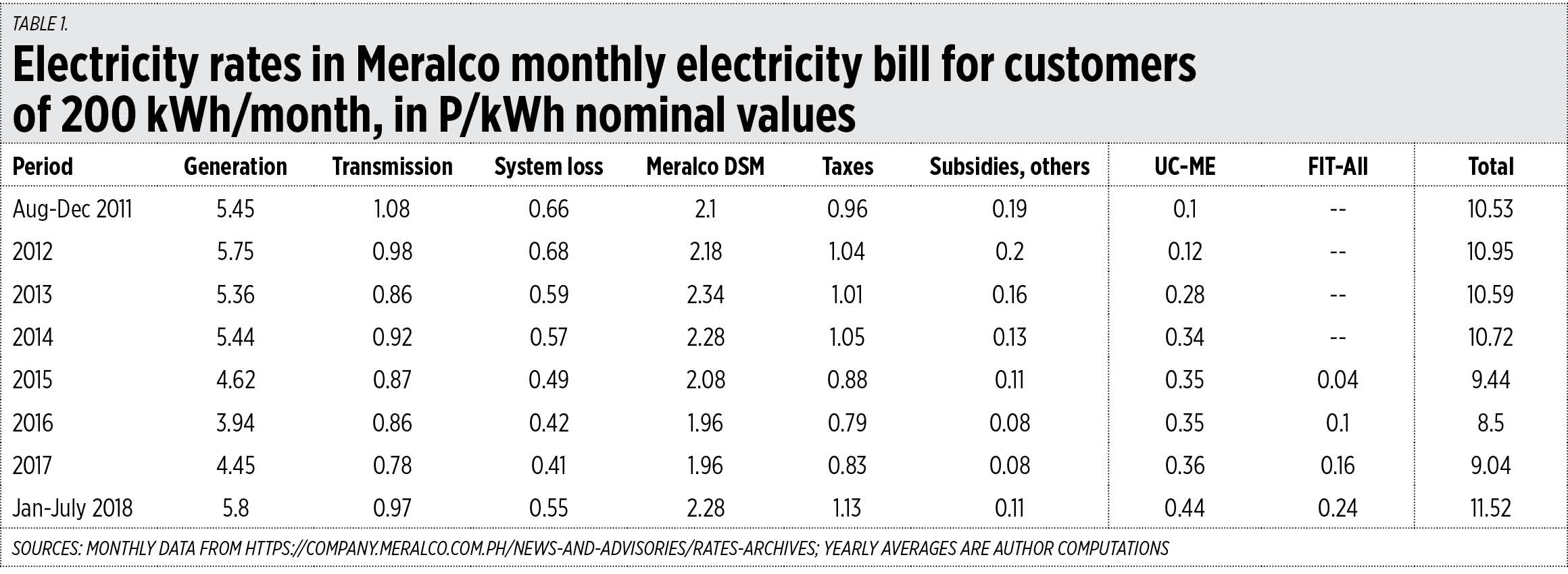
I checked the Meralco website and disaggregated the total charges from August 2011 to July 2018. I chose this period because this is the time that Mr. Non was ERC Commissioner, and he had oversight function for Universal Charge in Missionary Electrification (UC-ME) and Feed-in Tariff Allowance (FIT-All). UC-ME is a subsidy to customers of off-grid islands and provinces while FIT-All is subsidy to renewable energy (RE) companies that provide intermittent power like solar and wind under the RE law of 2008 (RA 9513).

I found that the generation rate by generation companies (gencos), the NGCP’s transmission rate, Meralco’s distribution-supply-metering (DSM) rate, system loss, government taxes, and subsidies to lifeline customers were generally flat over those seven years.

But the UC-ME rate increased significantly, from only 10 centavos in 2011 to 44 centavos in 2018; and the FIT-All rate increased from four centavos in 2015 to 24 centavos in 2018 (see Table 1).

So three narratives are debunked or belied by the above numbers. The first being that electricity prices “keep rising,” since the prices in 2016-2017 were even lower than the prices in 2011-2012. Secondly, that gencos of conventional power plants like coal and gas, the NGCP, and private distribution utilities like Meralco are to blame for the refund — which is a far out idea. And third, that the ERC leadership in that period were blameless — it was they, especially Mr. Non, that allowed the big jump in the UC-ME and FIT-All.

RPA ENERGY LECTURE
Also last week, on Feb. 7, the 3rd Ruperto P. Alonzo (RPA) Annual Memorial Lecture was held at the UP School of Economics (UPSE) in Diliman, Quezon City. The lecture, organized by the UPSE Program in Development Economics Alumni Association (PDEAA), was titled “Energy Trilemma: An Analysis of Philippines Situation.”

The four speakers were House Committee on Nuclear Energy Chairperson Representative Mark Cojuangco, Department of Energy Undersecretary Rowena Guevarra, ACEN President Eric Francia, and Institute of Climate and Sustainable Cities Advisor Albert Dalusung. It was moderated well by energy lawyer Jay Layug. I will discuss in another column the discussions that afternoon. For now I want to highlight the potential role of nuclear energy in helping reduce inflation.

Countries with a declining share of nuclear power over total generation from 2003 to 2023 have experienced generally high or rising inflation rates, and vice versa. Significant declines in nuclear/total generation were seen in Sweden, the UK, Germany, and Japan and their inflation rates increased.

In contrast, Asian nations that have a generally flat share of nuclear/total generation, or have increased it over the same period have experienced low or declining inflation rates — like China, India, South Korea, and the United Arab Emirates (see Table 2).

Mr. Cojuangco is correct in consistently and passionately advocating that the Philippines resume the operation of the nuclear plant in Bataan, and the construction of large nuclear plants in Pangasinan and other provinces in the country.

Meanwhile PDEAA officers and organizers want to thank the following who gave donations for the alumni homecoming that followed after the RPA lecture. Donations, mostly in kind, were used for raffle prizes and giveaways: Ferdinand Constantino, Jack Teotico of Galerie Joaquin, Aboitiz Power, GSIS, Meralco, the Metrobank Foundation, and Robinsons Retail. Thank you.


Bienvenido S. Oplas, Jr. is the president of Bienvenido S. Oplas, Jr. Research Consultancy Services, and Minimal Government Thinkers. He is an international fellow of the Tholos Foundation.

minimalgovernment@gmail.com

ACEN secures A- rating for climate action from CDP

ACEN Corp., the listed energy platform of the Ayala group, has obtained “Leadership” level and an A- rating for its climate actions from CDP, a global non-profit that assesses corporate environmental transparency and performance in climate change, deforestation, and water security.

“Achieving CDP Leadership status reflects ACEN’s disciplined approach to integrating sustainability into our business strategy. Transparency and strong climate governance are key to ensuring long-term value for our stakeholders while accelerating the energy transition,” Jonathan Back, ACEN’s group chief finance officer and chief strategy officer, said in a media release on Monday.

“Our improved rating reinforces our commitment to responsible growth and scaling renewable energy investments that drive both financial and environmental impact,” he added.

To achieve Leadership status, companies must demonstrate “best practices in climate action, environmental governance, transparency, risk management and target setting.”

CDP scores organizations from A as the highest to D- as the lowest, based on the comprehensiveness of their disclosures, awareness of environmental issues, management strategies and progress toward sustainability goals.

ACEN’s A- rating is an improvement from its previous B rating.

The company has joined CDP’s climate disclosure in 2022, along with over 24,800 organizations, in contributing to the “world’s largest and most comprehensive” dataset on environmental action.

“CDP’s insights empower investors, companies, cities and governments to make informed, sustainability-driven decisions,” ACEN said.

In November 2022, ACEN completed the world’s first market-based Energy Transition Mechanism (ETM), which involved divesting a 246-megawatt coal plant in Batangas and committing to its early retirement by 2040. This is ahead of the typical coal plant lifespan of 40-50 years.

This initiative is projected to reduce up to 50 million tons of carbon emissions.

“Building on this momentum, ACEN’s ETM project is now serving as a pilot for Transition Credits, with the goal of accelerating the plant’s retirement to 2030 — ten years earlier than planned — cutting carbon emissions by an additional 19 million tons,” the company said.

To date, the company holds about 6.8 gigawatts of attributable renewable energy capacity in operation, under construction, and committed projects.

It operates across a diverse range of markets, including the Philippines, Australia, Vietnam, India, Indonesia, Laos, and the US. — Sheldeen Joy Talavera

CIMB Bank PH books higher profit in 2024

CIMB.COM

CIMB BANK Philippines, Inc. (CIMB Bank PH) saw its profit before tax last year grow by 45 times from the 2023 level as it continued to expand its customer base.

“This is a reflection of the growing demand of Filipinos for our innovative banking solutions, which in turn addresses our customers’ needs. This truly keeps us driven to continue delivering products and offers that empower them to achieve their financial goals.” CIMB Bank PH Chief Executive Officer Vijay Manoharan said in a statement on Monday.

CIMB Bank PH’s financial statement was unavailable as of press time.

The digital-only commercial bank said its customer base is now at over nine million following six years of operations in the Philippines.

This puts it on track to reach its target to exceed 10 million new customers by this year, CIMB Bank PH said.

“When we first established CIMB in the Philippines back in 2018 as the pioneer all-digital banking services provider, our mission was and still is to give every Filipino access to banking and provide effortless banking with real value passed on to the everyday consumer. This promise was meaningful yet challenging, but in just six short years, we are proud to be the trusted partner of over nine million Filipinos and counting,” Mr. Manoharan said.

Meanwhile, the bank’s loan customers stood at nearly four million, it said. Transactions also climbed past P800 billion at end-2024.

“More great things are in store for the bank this year as well, as it is poised to launch more trailblazing products, enter new market segments, and form new strategic partnerships which will surely delight its nine million customers and counting,” it added.

Mr. Manoharan previously said the bank expects faster income growth this year as they plan to expand their offerings for underserved sectors.

Loans are expected to grow by 35-40% this year, he said.

CIMB Bank PH broke even in 2023, based on the CIMB Group’s annual report posted on its website. It had more than 7.4 million customers at end-2023, up from 6.5 million at end-2022.

It posted an annual loan growth of 89% in 2023, while deposits increased by 2024 year on yer.

“CIMB Philippines is expected to continue operating on a robust growth trajectory as the leading digital bank in the market. We will continue to scale on acquisitions, deposits and loans at manageable credit risk costs while seeding new growth for the business,” CIMB Group said in its 2023 annual report.

CIMB Group is based in Malaysia and offers consumer, commercial, wholesale, and Islamic banking, as well as wealth management and digital payment products and services across Southeast Asia. CIMB Bank is the group’s commercial bank in Malaysia, which has subsidiaries in Thailand, Cambodia and Vietnam and branches in the Philippines, China, Singapore, and London. — AMCS

George Clooney admits to nerves ahead of Broadway debut

GOODNIGHTGOODLUCKBROADWAY.COM

NEW YORK — Acclaimed film and television actor George Clooney previewed his upcoming Broadway debut in Good Night, and Good Luck on Thursday and admitted that he feels nervous to step on the stage.

Mr. Clooney, a two-time Oscar winner, said he has not done a live theater show since 1986.

“I haven’t done a play in 40 years… so it’s terrifying,” the actor told reporters in New York. “Yes, George Clooney gets nervous.”

Mr. Clooney is the co-writer and star of Good Night, and Good Luck, a play adapted from his 2005 film of the same name about broadcast news legend Edward R. Murrow and his work during the witch hunts of Senator Joseph McCarthy in the 1950s.

“The fun part about this is we get to do a play about a subject matter that’s very close to our hearts… which is telling the truth,” Mr. Clooney said.

Good Night, and Good Luck runs on Broadway from March 12 to June 8. — Reuters

Radisson targets to finish Makati serviced apartments by 2027

PHILSTAR FILE PHOTO

RADISSON Hotel Group expects to complete its new upscale serviced apartments in Makati City by 2027, a company official said.

“Radisson Serviced Apartments Salcedo Makati is a conversion project involving a full-scale renovation of the existing serviced apartments currently operating as One Pacific Place Serviced Apartments,” Ramzy Fenianos, chief development officer for Asia-Pacific, said in an e-mail.

The renovation will be carried out in phases, Mr. Fenianos said.

“However, we anticipate opening select sections as key milestones are achieved, targeting an official launch by 2026.”

The renovation is intended to align the property with Radisson’s latest global standards and design guidelines, he added.

“The updates will include enhancements to design, service, and overall functionality, making the apartments distinctly different from their current form and delivering an elevated guest experience,” Mr. Fenianos said.

The project will be Radisson Hotel Group’s first branded hotel and upscale serviced apartment in the capital region and its 16th property in the Philippines.

Located in Salcedo Village, Makati City, Radisson Serviced Apartments will feature around 162 spacious, contemporary units for corporate and long-stay guests.

It boasts proximity to Makati’s financial and entertainment districts, as well as major banks, embassies, multinational headquarters, shopping centers, and popular entertainment venues.

The property will also offer a wide selection of local and international cuisines. Guests will have access to flexible meeting spaces for business and social gatherings, as well as corporate events.

Other amenities include a state-of-the-art gym and a pool.

Cactus Realty Corp., the flagship company of the ACI Group, was tapped as a partner for the project.

“The signing of this hotel management agreement represents a new chapter in our journey, and we are excited to embark on this venture with Radisson Hotel Group,” Cactus Realty Corp. Vice-President Denise Lieuson said in a statement last week.

“Radisson’s expertise and global reach will undoubtedly elevate our property’s standards and enable us to tap into new markets, explore fresh opportunities, and create lasting value for our stakeholders,” she added.

Radisson Hotel Group currently operates 1,460 hotels, both in operation and under development, across more than 100 countries in the Asia-Pacific, Europe, the Middle East, and Africa. — Beatriz Marie D. Cruz

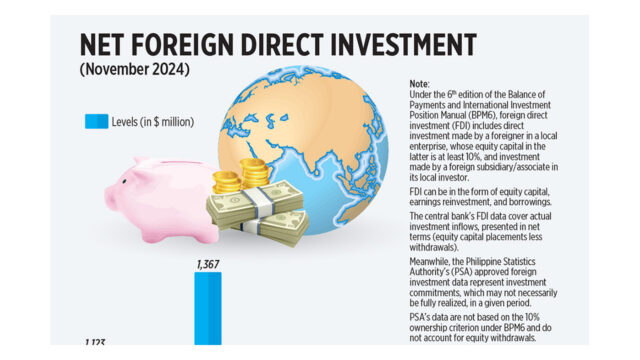
Net Foreign Direct Investment

NET INFLOWS of foreign direct investment (FDI) into the Philippines slumped in November, preliminary data from the central bank showed. Read the full story.

Net Foreign Direct Investment

The 2016 Arbitral Ruling: Why institutions and resolve matter

CHRISTIAN LUE-UNSPLASH

Heading into the new year, Philippines-China relations have been marked by increasing tension, with China intensifying its aggressive actions targeting Philippine-claimed reefs, including Bajo de Masinloc (BDM) or Scarborough Shoal, which is 124 nautical miles west of Zambales and within the Philippines’ 300 nautical mile exclusive economic zone (EEZ). Located at the center of the South China Sea, control of Bajo de Masinloc would grant China greater access to Luzon Island, reinforcing a “strategic triangle” that links the shoal with Woody Island and the Spratlys — enhancing its ability to control the South China Sea. Additionally, the shoal is abundant in fishery resources and is the source of livelihood for Filipino fisherfolk.

China has effectively controlled the shoal since 2012. The 2016 Arbitral Ruling declared that BDM is a rock above water at high tide, entitled to a territorial sea. Still, this ruling did not include whether China or the Philippines exercised sovereignty over the shoal. Accordingly, the ruling did not prohibit fishing activities by either party; i.e., both Chinese and Filipino fishers have the right to fish in the area. However, the arbitral ruling also affirms that China’s blockage of the shoal has unlawfully prevented Filipino fishers from pursuing their livelihood.

While the ruling favored the Philippines, China has ignored it, and the international community lacks the means to enforce it. In 2024, the China Coast Guard (CCG) has conducted “dangerous maneuvers” in the waters off BDM, including firing water cannons at a civilian food and supply mission for Filipino fishers under the “Atin ’to” (“This is ours”) transparency initiative launched to shame and expose China’s intimidation. The most recent of these aggressions occurred between Jan. 3-9, on the 13th, and then again on Feb. 2, when China’s “monster” ship, a 12,000-ton, 165-meter CCG 5901 vessel, together with other CCG vessels, was identified patrolling waters some 65-70 nautical miles off Zambales, concerningly close to the Philippine coastline and well within its EEZ.

Analysts argue that this recent deployment serves as reconnaissance, surveillance, and intelligence-gathering, supporting China’s strategy to revise the South China Sea status quo and to shape domestic perceptions of its control over maritime territories within the nine-dash line.

Taiwan international relations specialist Dr. Ronan Tse-min Fu views it as a test of the Philippines’ resolve, especially as China escalates its moves. Recently, China deployed a sonic device against the Philippine Coast Guard (PCG), signaling a new tactic compared to the previous use of lasers, water cannons, shadowing, and ramming.

However, Dela Salle University international relations Professor Renato de Castro describes this as a mere continuation of China’s illegal, coercive, and deceptive, or gray zone strategies. China’s use of gray zone strategies is often intertwined with influence operations framed around narratives of “sea control” against perceived violations of its sovereignty.

Furthermore, China reinforces its cognitive warfare tactics by integrating them with lawfare. In November 2024, following President Ferdinand “Bongbong” Marcos, Jr.’s signing of the Philippine Maritime Zones Act and the Philippine Archipelagic Sea Lanes Act, China, while invoking the UNCLOS, illegally established baselines around BDM, aiming for air control over the reef.

Under Marcos Jr.’s presidency, the Philippines has focused more intently on enforcing the South China Sea arbitration ruling. Previously, advocates urged China to recognize its legitimacy. However, enforcing the ruling actually relies heavily on our own initiatives, making autonomy an essential element of our external action.

While many of the Coast Guard’s assets are acquired through soft loans and grants from Japan and international assistance, a national prioritization for Coast Guard modernization has enabled the Philippines to act independently and reclaim Bajo de Masinloc. The Coast Guard modernization bill has already reached its second reading in the Senate, which has also approved a bill granting the Coast Guard chief a fixed term. Meanwhile, institution building, a key to autonomy, is further strengthened by the Maritime Zones Act or Republic Act No. 12064, which provides a concrete operationalization of the ruling.

The PCG plays a lead role in countering China’s gray zone tactics. It uses law enforcement to assert sovereignty while avoiding the escalatory signal that naval deployment would send. The PCG refers to this as “presence,” which forms part of the post-appeasement approach, following former president Rodrigo Duterte’s administration, as actively responding to China’s harassment in the Philippines-claimed Ayungin, Sabina, and BDM shoals.

Since 2024, the PCG’s rotational patrols, in coordination with the Bureau of Fisheries and Aquatic Resources, have aimed to protect the fisherfolk’s livelihoods. This effort is integral to President Marcos Jr.’s decision to push back against China’s coercion despite the significant damage sustained by the Coast Guard’s vessels and the injuries suffered by its personnel.

Early this year, the PCG deployed the country’s newest and biggest (97-meter) vessel, the BRP Magbanua, to ward off a CCG vessel. The PCG reported that it remained “undeterred,” pushing back the monster patrol from 54 nautical miles to 120 nautical miles. The agency aired continuous radio challenges to the CCG and enhanced monitoring of the monster ship, through an aircraft-supported vessel identification. It leveraged the Canadian Dark Vessel Detection system to spot Chinese vessels intruding into Philippine waters, with the most recent one being detected within 34 nautical miles off the coast of Pangasinan. This capability was bolstered by a Philippines-Canada 2023 agreement that gave the Philippines’ US-supported National Coast Watch Center access to the maritime domain awareness-enhancing platform.

As tensions with China rise, the Philippines is strengthening its maritime defense, reflecting its resolve, amid China’s aggression, to enforce the 2016 arbitral ruling and reinforce its territorial rights under international law.


Alma Maria O. Salvador, PhD is an associate professor of Political Science at Ateneo de Manila University.


Yuchengco firm secures grid approvals for Isabela solar project

STOCK PHOTO | Image from Pixabay

YUCHENGCO-LED BKS Green Energy Corp. has secured approval from the National Grid Corp. of the Philippines (NGCP) for the transmission connection of its Limbauan Solar Power Project (LSPP) in Isabela province. 

NGCP granted approval for the grid connection of the second phase of LSPP, which has a capacity of 33.831 megawatt-peak (MWp), the project developer said in a media release on Monday.

This follows the approval of the project’s system impact study in September last year. These studies assess the adequacy and capability of the grid to accommodate new connections. 

The two approvals confirm the technical feasibility of connecting LSPP-2 to NGCP’s Tuguegarao-Cabagan 69-kilovolt transmission system.

LSPP-1, with a capacity of 5 MWac, had previously secured approvals for its distribution impact study, distribution asset study, and connection agreement with Isabela II Electric Cooperative, Inc. (ISELCO-II).

A power supply agreement for LSPP-1 was signed between BKS Green Energy and ISELCO-II and was jointly filed in June 2021, pending approval from the Energy Regulatory Commission.

BKS Green Energy is a unit of Rizal Green Energy Corp., a joint venture between PetroGreen Energy Corp. (PGEC) and Japan’s Taisei Corp.

Maria Victoria M. Olivar, vice-president for business development at PGEC, said the buildout would allow BKS Green Energy to fast-track the development and completion of the solar project.

The Isabela solar power project has been certified by the Department of Energy as an energy project of national significance, qualifying it for expedited permit processing. — Sheldeen Joy Talavera

Thailand to start selection process for next central bank governor in March, minister says

BANGKOK — Thailand will start the selection process for a new central bank governor in March to replace incumbent Sethaput Suthiwartnarueput, whose five-year term ends in September, the finance minister said on Monday.

Pichai Chunhavajira, who did not provide details on the process, made the remark while announcing the government had nominated for another post, chair of the Bank of Thailand, former Finance ministry permanent secretary Somchai Sujjapongse.

The nomination of Somchai comes after a failed effort to appoint a ruling Pheu Thai Party loyalist and former finance minister in the chair post, which met resistance last year from hundreds of economists and several former central bank governors concerned about government interference in the independent Bank of Thailand.

The central bank board chair, a post currently vacant, has no direct say in monetary policy but heads the board which picks four members to sit on the monetary policy committee with the governor and two deputy governors.

The government’s nominations have been the subject of media interest and scrutiny after its frequent clashes with the central bank over monetary policy and its repeated calls for rate cuts.

The government has insisted it is not seeking to apply pressure and respects the central bank’s independence.

Under selection rules, the government is allowed to nominated one individual while the central bank may put fourth two names for chair. The selection committee for the chair position expects to pick a candidate at its meeting on Feb. 28, committee head Sathit Limpongpan said last week.

Central bank governor Sethaput, 60, a former World Bank economist was appointed in 2020 under a military-backed government and cannot seek a second term as he has reached retirement age.

After the populist Pheu Thai party took office in 2023, he disagreed with some of its policies and long resisted calls for a cut in interest rates, while frequently giving speeches that stressed the need for central banks worldwide to be remain independent. — Reuters