Home Blog Page 1303

Towards a flat income tax of 10% to 15%
An interesting study was released recently by the Congressional Planning and Budget Research Department (CPBRD) of the House of Representatives entitled “Progressivity, Fairness, and Efficiency: An Evaluation of the Impact of the TRAIN Law on the Distribution of the Income Tax Burden,” CPBRD Policy Brief No. 2025-04. The authors were David Joseph Emmanuel Barua Yap, Jr., Edrei Y. Udaundo, and Jubels C. Santos.

The old name of the CPBRD was the Congressional Planning and Budget Office (CPBO) and I worked there from 1991-1999.

Among the study’s findings were that the tax share of the top earners — those who earned at least P1.35 million in 2017 and P1.43 million in 2023 — increased from 72.4% (P183 billion) to 88.1% (P258 billion) under the Tax Reform for Acceleration and Inclusion (TRAIN) Law of 2017. See this report about it in BusinessWorld by Kenneth Basilio, “Flat tax seen easing burden on top earners — think tank” (March 18).

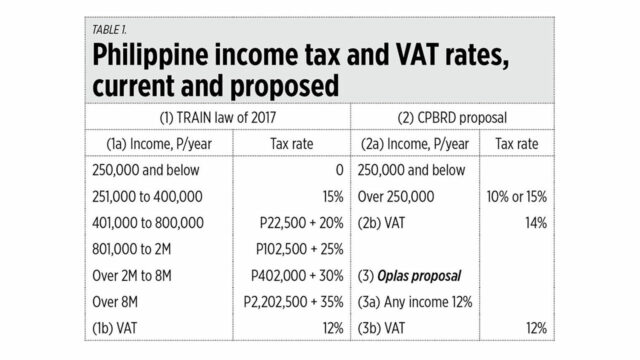
Among the recommendations of the CPBRD paper are that there should be a flat income tax of 10% to 15%, VAT should be hiked from 12% to 14%, and that there be a 10% reduction in government bureaucracy.

I support these suggestions except the value-added tax (VAT) hike to 14%. Currently our 12% VAT is among the highest in Asia, with most of our neighbors having VAT or sales taxes of 7-10%.

In the accompanying table I summarized the existing and proposed tax rates, including my own proposal. An income tax cut often leads to a broader tax base because those who evade paying income taxes at 20% to 35%, or who downscale their declared income to avail of lower tax rates, will be encouraged to declare their real income and pay only 10% to 15%.

I think a flat 12% national income tax regardless of income level will attract more people to be more honest about their real income. Then we can allow the local government units (LGUs) to impose their own income tax.

The CPBRD paper also proposes a spending cut, which is among my favorite advocacies. They estimate that a 10% reduction in the government payroll would save taxpayers some P160 billion, equivalent to half of the 2023 income tax take.

I checked the reactions to the report of two officials in charge of taxation and spending. Department of Finance (DoF) Secretary Ralph G. Recto said that: “We are committed to maximizing tax administration efficiency and ensuring a progressive tax system. Right now, our priority is to collect what is already on the table by accelerating digitalization and closing tax loopholes. By doing so, we can maximize revenue collections without placing an additional burden on our people through new taxes.

“One of the critical mandates of the DoF is to ensure that economic growth is inclusive and equitable by providing more government assistance to those who are in greater need. This can only be done through a progressive tax system, wherein higher-income brackets can contribute more, enabling the government to provide more public services and support to vulnerable sectors.”

Meanwhile, Budget Secretary Amenah F. Pangandaman was happy that the National Government Rightsizing Program (NGRP) was mentioned in the study as they really intend to streamline and make public spending more efficient and not wasteful.

OK then, Secretaries Recto and Pangandaman.

I hope that some legislators someday will be bold enough to push for a flat income tax 10% to 15%. My idea is to have a flat 12% national income tax, then allow the LGUs to impose their own income tax, encourage more devolution of functions to LGUs and then they will have social services competition, infrastructure competition, and peace and order competition among themselves.

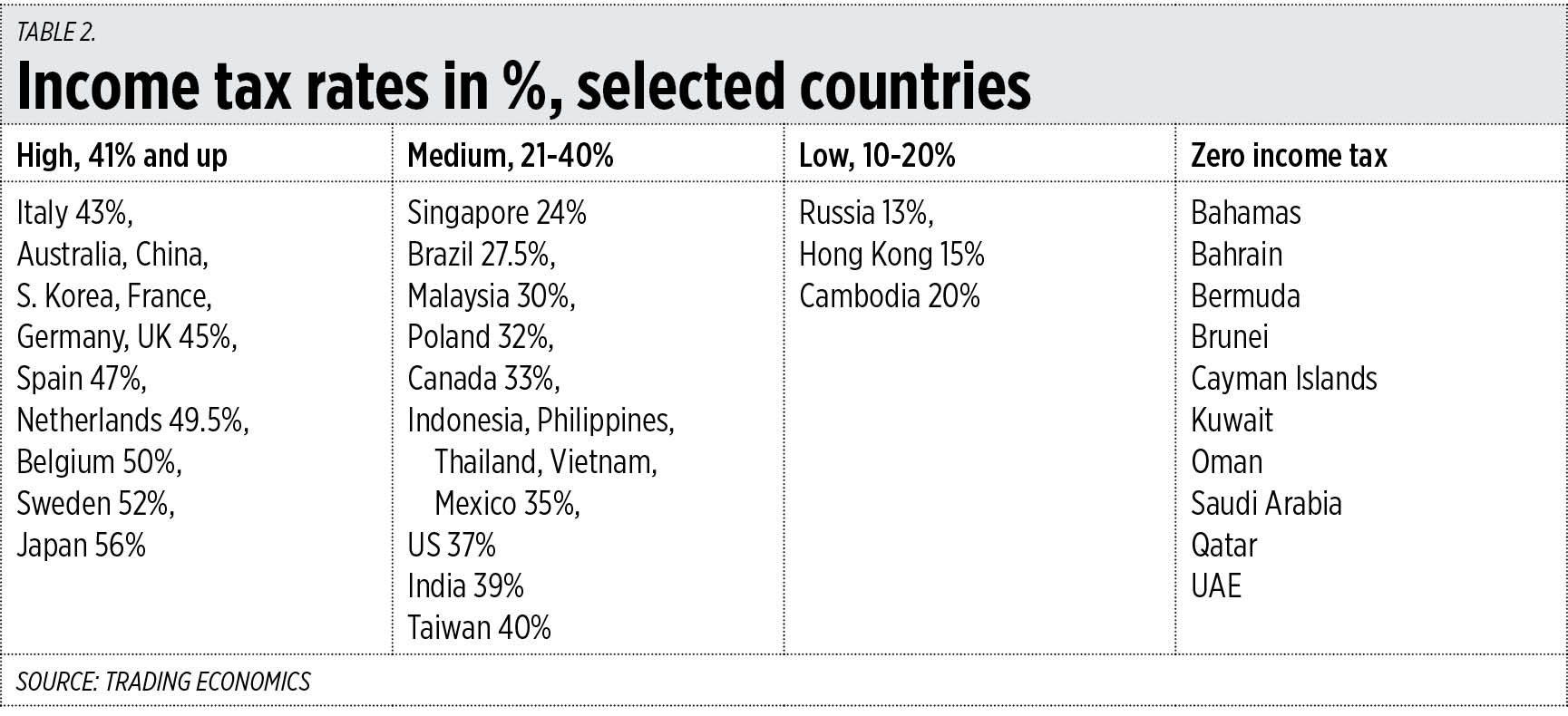
Currently 10 countries and territories have zero income tax. Bless them (see Table 2).
 

Bienvenido S. Oplas, Jr. is the president of Bienvenido S. Oplas, Jr. Research Consultancy Services, and Minimal Government Thinkers. He is an international fellow of the Tholos Foundation.

minimalgovernment@gmail.com

Vitarich partners with NOVOGEN for NOVOgen White hen distribution

VITARICH CORPORATION FACEBOOK PAGE

LISTED feed manufacturer Vitarich Corp. (VITA) has partnered with French breeding company NOVOGEN for the exclusive distribution of NOVOgen White hens.

VITA said it finalized the partnership in Clark, Pampanga, on Monday.

NOVOGEN’s products are sold in more than 50 countries, with global sales increasing annually, particularly in Asia.

“We use various tools to select and improve the products generation after generation: a mix of traditional and innovative environments, genomic research, RFID technology, and artificial intelligence,” NOVOGEN Chief Executive Officer Mickael Le Helloco was quoted as saying in a statement.

“Thanks to the implementation of these tools in research and development, we have been able to speed up yearly genetic progress by 2.5 times compared to the rate observed 10 years ago,” he added.

VITA said NOVOgen White hens can lay efficiently for over 100 weeks, producing up to 470 eggs per cycle — extending laying cycles beyond other breeds.

Compared to other breeds, NOVOgen White hens have better feed conversion, requiring less feed per egg, reducing production costs, and maximizing profits, the company added.

The hens also produce strong, uniform eggshells with a gradual increase in egg weight until the end of the production cycle, minimizing losses from breakage.

“They perform well and can realize their production potential under the most varied conditions, including the tropical climate of the Philippines,” VITA said.

VITA said customers will receive expert technical and marketing support, including guidance on housing, nutrition, and layer business management, as well as supply chain support for sourcing high-quality feeds and medications.

“They can also get assistance with laboratory tests for the quality of water, feeds, and raw materials,” the company said. — Kyle Aristophere T. Atienza

Auto Sales (February 2025)

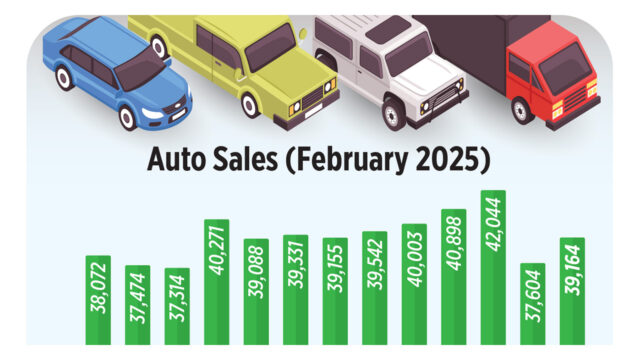
NEW VEHICLE SALES jumped by an annual 2.9% in February, the slowest growth in five months amid a decline in passenger car sales, according to a joint report by the Chamber of Automotive Manufacturers of the Philippines, Inc. (CAMPI) and the Truck Manufacturers Association (TMA). Read the full story.

Auto Sales (February 2025)

‘Digital dollar’ now available on GCash crypto trading platform

PHILSTAR FILE PHOTO

STABLECOIN USD Coin (USDC) is now available on GCrypto, the cryptocurrency trading platform of electronic wallet giant GCash.

This allows GCrypto users to receive, buy, hold, or transact the cryptocurrency stablecoin, which is issued by Circle.

“The integration of USDC is a significant step in enhancing financial inclusion in the Philippines. By offering easy access to digital dollars, we empower our users with a stable and globally recognized financial asset,” GCash Group Wealth Management Head Arjun Varma said in a statement on Wednesday.

Stablecoins are pegged to a fiat currency or commodity to give it a stable value, unlike other cryptocurrencies like Bitcoin or Ethereum, which have volatile prices as they are not backed by assets.

USDC is held at a stable value of one-to-one to the dollar and backed by cash and cash equivalents stored in regulated financial institutions.

“With USDC, GCash users can access a stable digital dollar that helps provide stability while facilitating seamless and cost-effective transactions in an evolving digital economy,” the company said.

To acquire USDC, GCash users must select USDC on GCrypto via the GCash app and complete the conversion with their GCash balance.

“At Circle, we believe expanding access to digital financial tools drives economic empowerment. We are excited that GCash is enabling millions of Filipinos to participate in the digital economy with confidence and security,” Circle Asia-Pacific Vice-President Yam Ki Chan said. — AMCS

US appeals court rejects copyrights for AI-generated art lacking ‘human’ creator

WORKERS around the world fear they may be displaced by artificial intelligence (AI). — REUTERS/DADO RUVIC/ILLUSTRATION

A FEDERAL appeals court in Washington, D.C., on Tuesday affirmed that a work of art generated by artificial intelligence (AI) without human input cannot be copyrighted under US law.

The US Court of Appeals for the District of Columbia Circuit agreed with the US Copyright Office that an image created by Stephen Thaler’s AI system “DABUS” was not entitled to copyright protection, and that only works with human authors can be copyrighted.

Tuesday’s decision marks the latest attempt by US officials to grapple with the copyright implications of the fast-growing generative AI industry. The Copyright Office has separately rejected artists’ bids for copyrights on images generated by the AI system Midjourney.

The artists argued they were entitled to copyrights for images they created with AI assistance — unlike Thaler, who said that his “sentient” system created the image in his case independently.

Mr. Thaler’s attorney Ryan Abbott said he and his client “strongly disagree” with the ruling and intend to appeal. The Copyright Office said in a statement that it “believes the court reached the correct result.”

Mr. Thaler, of St. Charles, Missouri, applied for a copyright in 2018 covering “A Recent Entrance to Paradise,” a piece of visual art he said was made by his AI system. The office rejected his application in 2022, finding that creative works must have human authors to be copyrightable.

A federal district court judge in Washington upheld the decision in 2023 and said human authorship is a “bedrock requirement of copyright” based on “centuries of settled understanding.” Mr. Thaler told the D.C. Circuit that the ruling threatened to “discourage investment and labor in a critically new and important developing field.”

US Circuit Judge Patricia Millett wrote for a unanimous three-judge panel on Tuesday that US copyright law “requires all work to be authored in the first instance by a human being.”

“Because many of the Copyright Act’s provisions make sense only if an author is a human being, the best reading of the Copyright Act is that human authorship is required for registration,” the appeals court said. Reuters

On the side

FREEPIK

IT’S TRUE that fans do not buy tickets for a ballgame to watch those on the side like the coaching staff, the referees, and even the bench players. They just look at the game and how the players on the court are competing. And yet the seemingly peripheral characters influence how the game is played and what the outcome of the contest is likely to be.

Those on the side are not given much attention.

Inattentive participants at meetings ignore the speaker and quietly amuse themselves by offering comments, now usually by text messages, to other inattentive colleagues. (How many more slides does he have?)

More indiscreet are side conversations at a conference. Even whispered comments not meant to be overheard by the one presenting can still be distracting. (How many times has he said “at the end of the day”?)

Side comments are annoying to a presenter, and those trying to follow him. They are irrelevant and do not relate to the subject at hand. Calling attention to such inattentiveness (Can you please stop yapping there at the back?) only invites the rude chatterer to be even more pugnacious: “Why? Is your presentation worth listening to?”

Giving opinions on the side is a habit quelched from childhood — stop butting in, can’t you see that the grown-ups are having a heated debate here? In school, chatty classmates not called for recitation are quickly punished — write “I will not be a chatterbox” 50 times on the blackboard. (Ma’am, can you spell the last word?)

Still, side comments can be amusing in a social context. Is it related to freedom of expression? Digressions can provide comic relief and lessen tension when the discussion gets heated — let’s settle this outside.

Even in chat groups when political or religious beliefs cause clashes, the irrelevant comments of those on the side can diffuse tension — what’s the temperature in Baguio at this time?

In literature, parenthetical remarks are revered.

The open and close parentheses are paired to provide an enclosure for a humorous phrase or footnote to support or divert from a too-serious narrative. The etymology of “parenthesis” gives a clue to its function. In Greek, the original word pertains to “inserting.” Insertions may be part of an intimate act as well as a way to introduce pork in the legislative debates.

In theater, side comments (or “asides”) allow a character to step forward and share his thoughts with the audience. A character expresses his feelings aloud, as the other actors on stage pretend not to hear his comments about them — they’re clueless about the plot against them.

This theatrical convention is called a “stage whisper” to signal that it is intended only for the “fourth wall” of the audience. A conniving Iago in Shakespeare’s Othello recites his evil intent to be taken as a thought balloon as far as the intended victims beside him are concerned.

This invitation of the viewer as participant is employed by Alfred Hitchcock in his movies, like Psycho where the audience sees a killer about to plunge a knife into his heedless target seen through a translucent curtain taking a shower, just before she is repeatedly stabbed to jarring syncopated music. It is Hitchcock too who likes to make cameo appearances in all his movies, crossing a street or buying some cough drops from the drugstore. It’s a visual side comment.

Isn’t small talk before a formal meeting also a form of distraction on the side?

Just before the discussion on past due loans from a big bank client, there is chitchat about the volatile crypto market and how a known associate forgot his 20-digit password to access his account. Other topics intrude and set the mood for the main agenda to follow — okay, can we start now?

Side comments distract from the topic at hand. Is that its true value? The presenter, especially if he has no prepared slides, can digress from his assigned topic on why he did not meet his budget targets for the quarter. He makes comments on the change of management in other companies, then rambles along on how the new American tariffs can affect agricultural products, before going back to the subject at hand — where were we?

The penchant to change the topic with side remarks is a diversionary tactic.

Still, the one presiding over the meeting tries to maintain order when there are too many side comments going on loudly and distracting the official presentation — Wait, can we just have one conversation please? Someone on the side may well ask which one.


Tony Samson is chairman and CEO of TOUCH xda

ar.samson@yahoo.com

Dining In/Out (03/20/25)


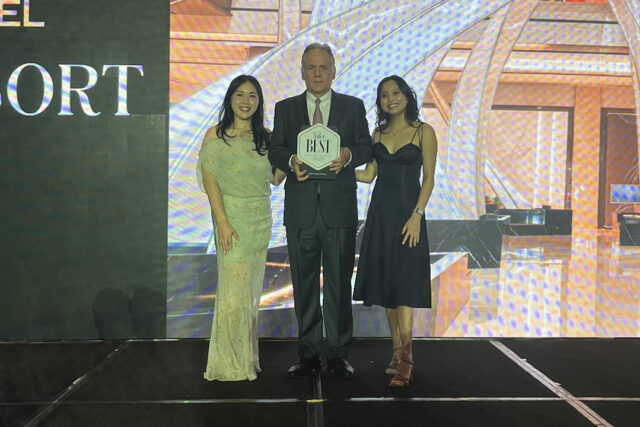
Tatler awards Solaire Resort North, Skybar

SOLAIRE RESORT NORTH received the Best-in-Class New Hotel award by Tatler Best Philippines, while the hotel’s Skybar, got awards for Best-in-Class Best Design and Top 20 for Bars. Tatler Philippines recently celebrated the Philippines’ top 100 hotels, restaurants, and bars of the country. Through each category, nominees are deliberated upon by a panel of over 500 industry critics, journalists, and professionals chosen by Tatler, alongside a team of Tatler’s own constituents. For more information about Solaire Resort North and its restaurants, visit its website at sn.solaireresort.com, call 8888-8888, or e-mail sn.reservations@solaireresort.com.


Jollibee’s cooling summer line

JOLLIBEE has come out with its newest lineup of Summer Delights: the new Mango Jelly Sundae, the Cookies & Cream Sundae, and the Iced Mocha Float. The Mango Jelly Sundae is made with vanilla soft serve ice cream topped with real mango and layered with chewy jelly. The Cookies & Cream Sundae blends a chocolate coating with crushed Oreo cookies with vanilla soft serve ice cream. The Iced Mocha Float is made with freshly brewed from 100% Arabica beans, and combines coffee and chocolate flavor with vanilla ice cream. Jollibee’s Summer Delights start at P55 for solo orders and are available in all Jollibee branches nationwide for dine-in, take-out, drive-through, and delivery.


Chef Nobu Matsuhisa comes to Nobu Manila

AS PART of City of Dreams Manila’s year-long 10th anniversary celebration, world-renowned chef Nobu Matsuhisa returns to Nobu Manila after his last visit in 2019, to host a two-night intimate dinner affair on March 25 and 26, 5 to 10 p.m. His fifth visit to Manila follows close on the heels of Nobu Restaurants’ global 30th anniversary celebration in October 2024. Mr. Matsuhisa and his visiting will serve a curated six-course “Art of Omakase” dinner menu on March 25, and a Canapé Night on March 26. The Omakase menu includes: a Nobu Sashimi Selection; a Nobu Chef Sushi Selection; Wagyu with ponzu, toro (tuna) yuzu miso with caviar, and kinmedai (golden eye snapper) Matsuhisa style; Chilean sea bass jalapeño miso; Wagyu beef with shiitake millefeuille; and Matcha Coconut. The menu is offered at P8,500 net per person. The Canapé Night at P5,000 net per person on March 26 features an array of various Nobu signatures served canapé style, including passed options and live stations. Highlights include Yellowtail Jalapeño, Salmon Karashi Su Miso, and Kinmedai Tiradito, and Nobu Style Lapu-Lapu Sisig. Live stations include Gallagher Oysters paired with custom Nobu sauces at the Fresh Oyster Bar; Wagyu with spicy ponzu, and salmon with spicy miso at the Nobu Tacos Station; and Wagyu beef chahan, Tiger prawn teppanyaki with miso yogurt, at the Teppan and Robatayaki Grill Stations. A selection of alcoholic and non-alcoholic beverages including Nobu signature mocktails and cocktails is offered for a package price of P1,500 net. Guests will have the chance to meet and have a photo opportunity with Mr. Matsuhisa, and can learn more about his inspiring story and recipes through his books, World of Nobu and Nobu: The Cookbook, which will be exclusively available at the events, at P5,500 and P3,500, respectively, while supplies last. For inquiries and reservations, call 8800-8080 or e-mail noburestaurant@cod-manila.com or guestservices@cod-manila.com. For more information, visit www.cityofdreamsmanila.com.


Happy summers with Discovery Group resorts

MAKE THE MOST of summer with a stay at Discovery Boracay. Enjoy the comfort of a Junior Suite starting at P14,488 net per night or the luxury of a Signature One-Bedroom Suite from P26,488 net per night, both inclusive of roundtrip land and boat transfers from Caticlan Airport, daily breakfast at Sands Restaurant, and a Happy Summer Drink for two at Bogart’s Bar. Guests staying on Fridays and Saturdays can enjoy a dinner buffet at Sands, while those seeking relaxation can take advantage of Terra Wellness Spa’s special promo rate for the Natural Skin Cooler Body Wrap. In Palawan, Discovery Coron on Dimakya Island is now part of the Luxury Hotels Collection of Condé Nast Johansens. Stay in a Garden Suite or Oceanview Suite, with rates starting at P14,488 net per night, inclusive of roundtrip land and boat transfers from Busuanga Airport, daily breakfast at the Firefish Restaurant, a weekend Boodle Fight, and a Happy Summer Drink at the Dugong Bar each night, all for two guests. Beyond relaxation, every booking supports a cause — a portion from each stay contributes to the Cheers for Chairs initiative, helping provide school chairs to students in nearby communities. Down south, Discovery Samal near Davao City, has summer room rates that start at P8,037 per person per night, ideal for a group of three persons. The Stay package is inclusive of complimentary roundtrip airport and boat transfers, breakfast at the Morning Catch, a bucket of local beer at the Haribar Lounge, and 20 tokens for indoor activities and three hours use of karaoke rooms at Mindanao Pavillion. Finally, the Manami Resort in Sipalay offers stays starting at P16,500 net per night, with inclusions covering two persons. For guests coming in as a group of four, the Two-Bedroom Villa can be availed at P65,000 net for a two-night stay, which comes with roundtrip airport transfers via Bacolod or Dumaguete. Other treats include daily breakfasts at Lingaw Restaurant; P1,000 food and beverage credits at selected rooms; in-room Linong Head, Neck, and Shoulder Massage; a spelunking trip in the property cave; and daily complimentary poolside refreshments. For more information on, visit discoveryhotels-resorts.com. The booking period is from March 1 to May 31.


Watch out for the Goodday milk machine

THE Goodday Cultured Milk Drink is rolling out its “YUMimmunity Machine” in select areas in Metro Manila and Cebu City. The Goodday YUMimmunity Machine is a way to get a free 350ml bottle of any of the three flavors of Goodday Cultured Milk Drink – Original, Strawberry, or Mango. Approach the interactive bottle-dispensing machine and scan the QR code to register, then take a photo at the machine before getting a free Goodday bottle. Made with Japanese technology, Goodday Cultured Milk has LAC-Shield, or paraprobiotics Lactobacillus paracasei MCC1849 that helps boost immunity. Visit Goodday’s Facebook to learn the machine’s next location and get a free drink. Goodday Cultured Milk is officially distributed by Universal Robina Corporation (URC). To learn more about URC, visit its website (www.urc.com.ph), Facebook page (@URCPhilippines) and TikTok account (@URCPhilippines).

Forever 21 Philippines unaffected by US parent’s 2nd bankruptcy filing

SM MEGAMALL OFFICIAL FACEBOOK ACCOUNT

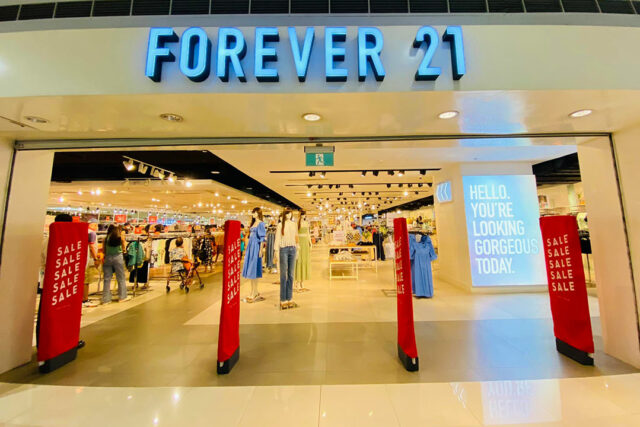
FOREVER 21’s stores in the Philippines will continue operations despite the Chapter 11 bankruptcy filing of its US retail operator, F21 OpCo LLC, marking its second bankruptcy since 2019.

F21 OpCo filed for Chapter 11 protection on March 17 with approximately $1.58 billion in funded debt, according to a Bloomberg report.

In a statement, the company said that “Forever 21’s locations outside of the United States are operated by other licensees and are not included in the Chapter 11 filings.”

Forever 21 has more than 540 locations globally and online, according to the company’s website.

The Forever 21 trademark and intellectual property are owned by Authentic Brands Group, which licenses the brand to the operating company undergoing the bankruptcy process.

A notice to US customers posted on Forever 21’s website from Brad Sell, chief financial officer of F21 OpCo, attributed the bankruptcy to inflation and increased competition. “Rising costs and competition from abroad have made our current business model unsustainable,” Mr. Sell said.

The filing only affects US operations, and international franchisees will continue business as usual.

Founded in 1984 by Korean-American entrepreneurs Do Won and Jin Sook Chang, Forever 21 built its reputation on affordable, trend-driven fashion.

The retailer first filed for bankruptcy in 2019, leading to the closure of several international stores, including locations in Tokyo and Portugal.

Subsequently, the brand was acquired by Simon Property Group, Brookfield Properties, and Authentic Brands Group, which later established SPARC, a joint venture managing Forever 21’s operations.

In the Philippines, Forever 21 operates under a joint venture with SM Retail Inc., which brought the brand into the country in 2010 with its first store at SM Megamall. Philippine stores were not affected by the 2019 bankruptcy and continue to operate in multiple SM malls, including SM Mall of Asia, SM North EDSA, SM Clark, SM Baguio, SM Cebu, and SM Lanang in Davao.

“Our stores in the Philippines remain open and continue to serve our customers. We are closely monitoring developments regarding Forever 21’s US operations and will provide updates as necessary,” Joan Grace T. del Rosario, head of operations for Forever 21 Philippines, said in a text message on March 18.

According to the US company’s statement, liquidation sales will be conducted while a court-supervised sale and marketing process for assets is underway. As of writing, the US website advertises discounts of up to 80%. The company will honor gift cards and store credits until April 15, but has ceased issuing new gift cards or store credit.

Forever 21’s international e-commerce and non-US stores remain unaffected and will continue operations as usual, the company said. — Joseph L. Garcia

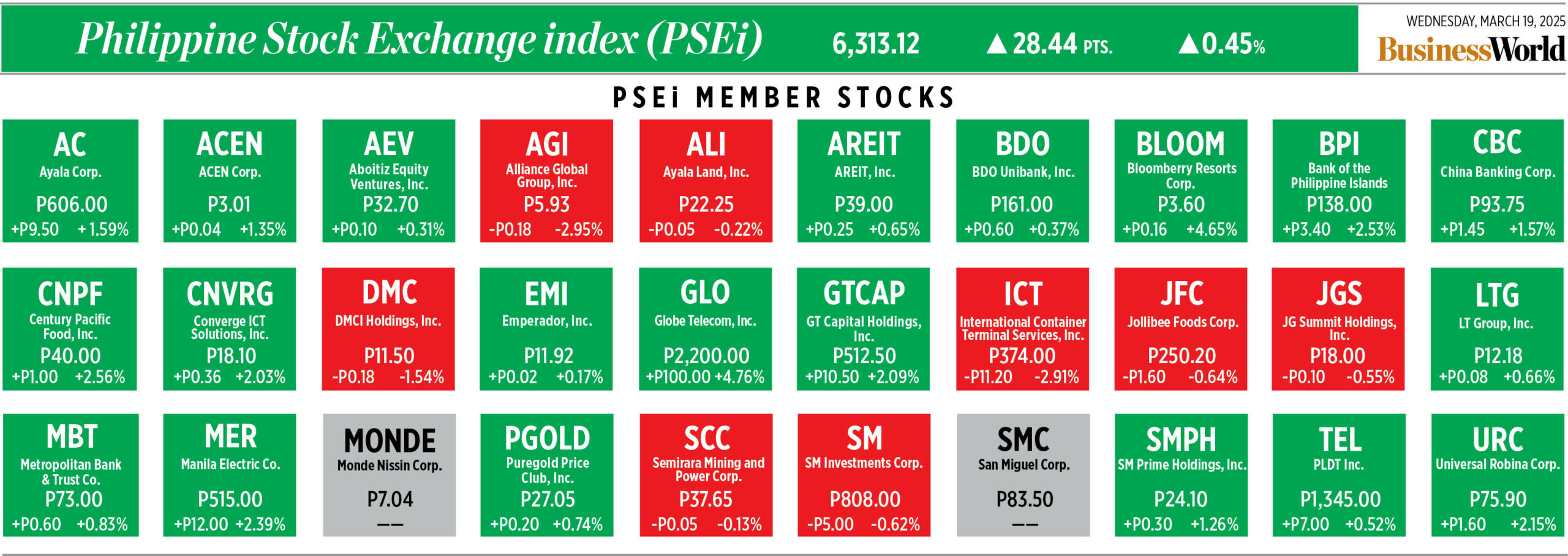
How PSEi member stocks performed — March 19, 2025

Here’s a quick glance at how PSEi stocks fared on Wednesday, March 19, 2025.


Peso moves sideways as market eyes Fed, BSP

BW FILE PHOTO

THE PESO was mostly flat against the dollar on Wednesday before the US Federal Reserve’s policy decision announcement and amid rate-cut signals from local monetary authorities.

The local unit closed at P57.30 per dollar on Wednesday, weakening by half a centavo from its P57.295 finish on Tuesday, Bankers Association of the Philippines data showed.

The peso opened the session stronger at P57.25 against the dollar. Its worst showing was at P57.32, while its intraday best was at P57.17 versus the greenback.

Dollars traded climbed to $1.72 billion on Wednesday from $1.11 billion on Tuesday.

“The dollar-peso closed a tad lower, still on cautious trading ahead of the Federal Open Market Committee meeting. It initially went up to P57.17 on growing recession fears because of the recent weak data releases in the US and uncertainties over US President Donald J. Trump’s tariff policies,” a trader said in a phone interview.

The Fed will release its latest policy statement on Wednesday, where the central bank is widely expected to keep interest rates unchanged for a second straight meeting, along with its updated summary of economic projections, Reuters reported.

Markets are currently pricing in about 60 basis points (bps) of cuts from the Fed this year, although several US central bank officials have cautioned against the Fed moving too quickly on rates and said they would wait to see the impact of tariffs in economic data before making any policy shifts.

The market also digested fresh signals about the Bangko Sentral ng Pilipinas’ (BSP) next move, Rizal Commercial Banking Corp. Chief Economist Michael L. Ricafort said in a Viber message.

There is a “high probability” that the BSP will deliver a rate cut at its April 10 meeting, Finance Secretary Ralph G. Recto, who is also a Monetary Board member, told Bloomberg TV on Wednesday.

Mr. Recto added that the BSP could reduce benchmark borrowing costs by 50-75 bps this year, which could boost economic growth.

BSP Governor Eli M. Remolona, Jr. last week also said that a rate cut is “on the table” at the Monetary Board’s review next month.

Mr. Remolona said the Philippine central bank’s rate-cut cycle remains underway, signaling up to 50 bps in reductions for the year.

The BSP unexpectedly paused its easing cycle last month, keeping its policy rate at 5.75% after cutting rates by 25 bps for three straight meetings last year.

For Thursday, the trader expects the peso to move between P57.10 and P57.50 per dollar, while Mr. Ricafort sees it ranging from P57.20 to P57.40.

PESO LIKELY TO WEAKEN
The peso could breach the weaker end of the Development Budget Coordination Committee’s (DBCC) assumptions in 2025 and 2026 with the Fed expected to conduct its easing cycle gradually, the BSP said in a report.

“The exchange rate is projected to settle above the DBCC’s assumptions for 2025 and 2026,” the central bank said in its latest Monetary Policy report.

The currency could be “influenced by a slower pace of monetary policy easing by the US Federal Reserve and recent exchange rate movements,” the BSP said.

“The baseline forecasts incorporate market expectations of a 50-bp reduction,” it added.

Under the DBCC’s macroeconomic assumptions, the peso is expected to range between P56 to P58 per dollar this year and from P55 to P58 in 2026.

ING Bank Regional Head of Research for Asia-Pacific Deepali Bhargava said the peso is seen to weaken further this year amid the dollar’s surge on safe-haven demand. 

“We believe the US dollar is currently factoring in numerous negative elements, and the balance of risks for the coming weeks has shifted to the upside,” she said in a report.

“As we move into the second quarter and tariffs are implemented, we maintain a bullish outlook on the US dollar, anticipating a setback for global activity,” she said. “Concurrently, weaker external balances and real effective exchange rate overvaluation indicate that the Philippine peso is likely to depreciate against the US dollar in 2025,” she added.

ING forecasts the currency to weaken to P58 against the greenback next quarter.

The peso has been trading at the P57 range since late February amid the dollar’s recent slide due to US President Donald J. Trump’s tariff policies, which has raised concerns of a recession in the world’s largest economy.

“Since October 2024, the Philippines’ overall balance of payments has been deteriorating, marked by a widening current account deficit, weak foreign direct investment, and stagnant personal remittance inflows,” Ms. Bhargava said.

“Unlike some of its Asian peers, the Philippines has not significantly benefited from supply chain diversification and the China+1 strategy, particularly in the electronics sector, where countries like Vietnam, India, and Malaysia have gained global export market share,” she added. — Aaron Michael C. Sy and Luisa Maria Jacinta C. Jocson

PHL stocks rise as market expects April BSP cut

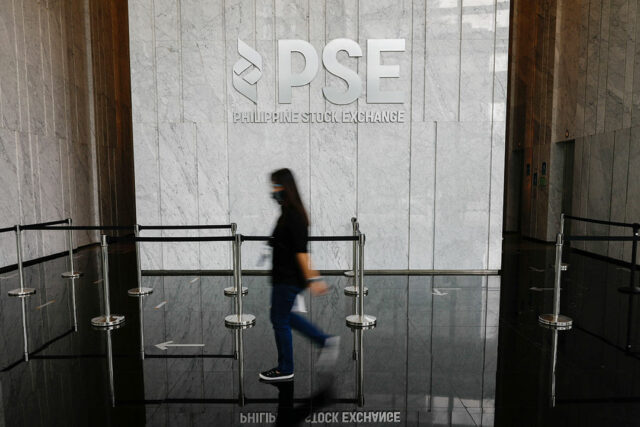
The lobby of the Philippine Stock Exchange in Taguig City, Sept. 30, 2020. — REUTERS

PHILIPPINE STOCKS rose on Wednesday on expectations of a rate cut from the Bangko Sentral ng Pilipinas (BSP) next month and as players picked up bargains.

The benchmark Philippine Stock Exchange index (PSEi) increased by 0.45% or 28.44 points to end at 6,313.12, while the broader all shares index climbed by 0.70% or 26.26 points to close at 3,749.35.

“The PSEi resumed gains after the latest dovish signals from local monetary officials…,” Rizal Commercial Banking Corp. Chief Economist Michael L. Ricafort said in a Viber message.

There is a “high probability” that the BSP will deliver a rate cut at its April 10 meeting, Finance Secretary Ralph G. Recto, who is also a Monetary Board member, told Bloomberg TV on Wednesday.

Mr. Recto added that the BSP could reduce benchmark borrowing costs by 50-75 basis points (bp) this year, which could boost economic growth and investments.

BSP Governor Eli M. Remolona, Jr. last week also said that a rate cut is “on the table” at the Monetary Board’s review next month.

Mr. Remolona said the Philippine central bank’s rate-cut cycle remains underway, signaling up to 50 bps of reductions for the year.

The BSP unexpectedly paused its easing cycle last month, keeping its policy rate at 5.75% after cutting rates by 25 bps for three straight meetings last year.

“The local market bounced back as investors hunted for bargains supported by appreciation for corporate fundamentals,” Philstocks Financial, Inc. Senior Research Analyst Japhet Louis O. Tantiangco said in a Viber message.

He added that foreign buying supported the market’s climb. Net foreign buying went up to P392.22 million on Wednesday from P337.16 million on Tuesday.

Majority of sectoral indices closed in the green on Wednesday. Financials climbed by 1.34% or 32.60 points to 2,451.02; industrials went up by 0.99% or 86.64 points to 8,789.29; property increased by 0.41% or 9.21 points to 2,240; and holding firms inched up by 0.01% or 0.54 point to 5,221.70.

Meanwhile, mining and oil slumped by 1.26% or 114.92 points to 9,001.98 and services declined by 0.80% or 16.76 points to 2,053.78.

“Globe Telecom, Inc. was the day’s index leader, jumping 4.76% to P2,200. Alliance Global Group, Inc. was the day’s main index laggard, falling 2.95% to P5.93,” Mr. Tantiangco said.

Value turnover dropped to P7.84 billion on Wednesday with 966.38 million shares traded from the P8.47 billion with 1.30 billion issues that changed hands on Tuesday.

Advancers bested decliners, 93 versus 88, while 63 names were unchanged.

Mr. Ricafort put the market’s support at 6,000 and minor resistance at 6,400-6,530. — Revin Mikhael D. Ochave

Rice imports fall 46% as MSRP, food emergency deter traders

BW FILE PHOTO

RICE IMPORTS fell 46% year on year to 641,000 metric tons (MT) in the year to date ending March 13, which industry representatives attributed to trader reluctance to import in the face of a maximum suggested retail price (MSRP) scheme.

Agriculture Assistant Secretary Arnel V. de Mesa said at a briefing that 96,260 MT of the shipments arrived in March, 267,114 in February, and 277,540 in January.

The Department of Agriculture (DA) said the equivalent year-earlier volumes are 429,260 MT in January 2024, 341,585 in February 2024, and 415,764 in March 2024.

Federation of Free Farmers Director Raul Q. Montemayor said the imposition of the MSRP in January may have caused the significant decline in imports.

The DA first implemented the MSRP for imported rice on Jan. 20, setting it initially at P58 per kilo. It has since been lowered to P52 on Feb. 15, and to P49 on March 1.

The DA over the weekend said if the current trend in world rice prices persists and the peso remains strong, “we might lower the MSRP for imported rice to around P45 per kilo by March 31.”

“Importers may be hedging and adopting a wait and see stance because of the successive decline in the MSRP,” Mr. Montemayor said.

“There could also still be residual stocks from 2024 imports,” he added.

He said the declaration of a food security emergency could have also spooked importers because under a 2024 anti-agricultural economic sabotage law, “the government can embargo stocks on the mere suspicion of smuggling, hoarding or profiteering.”

Danilo V. Fausto, president of the Philippine Chamber of Agriculture and Food, said via Viber:

“While rice imports might have decreased, this is still not a welcome development since first quarter is rice harvest season.”

“Any imports during this time will affect palay farmgate prices to the detriment of the rice farmers,” he added.

The Philippine Statistics Authority (PSA) recently reported that a kilo of regular-milled rice fetched P46.30 on average at retail in early March, a period it calls the first phase of March, against the last reading of P47.19 a little past mid-February.

“Similarly, this was lower relative to its price level in the first phase of February 2025 at P47.77 per kilogram,” it added.

The farmgate price of palay, or unmilled rice, fell 18.9% year on year in February to an average of P20.29 per kilogram, after rice imports hit record levels last year.

Month on month, the palay farmgate price fell 1.9%, the PSA reported.

Inflation eased to 2.1% in February from 2.9% in January as rice inflation dropped to 4.9%, the sharpest decline since April 2020.

The DA in January said it was expecting the palay harvest to exceed 20 million MT (MMT) this year.

In 2024, rice imports hit a record 4.68 MMT, against 3.6 MMT a year earlier. — Kyle Aristophere T. Atienza