Home Blog Page 1290

Trump’s 19% tariff on the Philippines is a clarion call for structural reform

STOCK PHOTO | Image by Pch.vector from Freepik

By Jam Magdaleno

DONALD TRUMP’s threatened 20% tariff on Philippine exports — now negotiated down to 19% — has landed with painful clarity. Even more striking, the Philippines has accepted this steep tariff while keeping a zero percent duty on specific US imports such as automobiles. For a country that counts the US as among its top export markets, this is an incontestable gut punch. It is a reminder of how fragile our position is in global trade. But more than that, it reveals a deeper and older problem: that decades of economic growth have not insulated us from shocks, nor have they delivered the competitiveness we need.

The country’s vulnerability to external shocks is not new. In fact, we’ve lived with it for decades. What’s troubling is that even after multiple periods of incremental growth, we remain uncompetitive, under industrialized, and overly reliant on labor exports, foreign aid, and preferential trade agreements. Rather than fostering resilience, our policy posture has too often favored political caution over structural reform.

Consider the 1987 Constitution’s economic restrictions — caps on foreign ownership on land, public utilities, education, and mass media — that stand out as archaic even by Southeast Asian standards. In contrast, Vietnam, despite its nominally socialist framework, allows 100% foreign ownership in key industries and consistently ranks higher in FDI inflows. Indonesia has revised its Negative Investment List to open more sectors to foreign participation. Even Myanmar, before its democratic backsliding, liberalized its telecoms sector and saw rapid infrastructure investments.

While our neighbors embraced globalization, we remained hesitant, clinging to an inward-looking economic nationalism that has made us less competitive in a world increasingly driven by capital, technology, and talent mobility. The Philippines still bars foreign ownership of land and restricts equity in higher education and mass media at a time when knowledge economies are thriving precisely because of global partnerships.

To be fair, reforms have happened. The Corporate Recovery and Tax Incentives for Enterprises (CREATE) Act restructured the tax system for investors. Amendments to the Foreign Investment Act, the Retail Trade Liberalization Act, and the Public Service Act have opened up sectors like telecommunications, airports, and shipping. These were long-overdue reforms that finally signaled a shift toward a more open, investment-friendly economy.

According to the OECD’s 2020 FDI Regulatory Restrictiveness Index, the Philippines ranked as the third most restrictive country to foreign direct investment out of 84 economies surveyed — behind only Libya and Palestine. In contrast, Vietnam ranked among the least restrictive in Southeast Asia, with full foreign ownership allowed in most sectors, including education, manufacturing, and IT.

In agriculture, the Rice Tariffication Law (RTL) of 2019 replaced quotas with a 35% tariff (now relaxed to 15%), created a P10-billion annual fund for farmer modernization, and lowered rice prices for consumers. Despite early hiccups, such as drops in farmgate prices and delays in support services, there is evidence of impact: from 2019 to 2023, average dry-season yields rose from 3.63 to 4.34 metric tons per hectare, and farm incomes increased by P9,000 per hectare. The Department of Economy, Planning, and Development (formerly known as the National Economic and Development Authority or NEDA) projects a 1.2 percentage-point drop in poverty by 2025, largely due to cheaper rice.

What this shows is that even controversial reforms can deliver when they focus on improving factor productivity in land, labor, capital, and energy.

This is where the future lies. We can no longer rely solely on remittances from overseas Filipino workers or cyclical BPO earnings as economic crutches. The pandemic made this clear, and rising global protectionism only underlines it.

Trump’s tariff impositions are indicative of a global shift towards reshoring and friend-shoring, as multinational firms reconfigure supply chains to reduce dependency on China. Southeast Asia has emerged as a major alternative production base amid the US-China trade war. Vietnam alone has attracted over $20 billion in foreign investment relocating from China since 2018. In Indonesia, a consortium led by LG Energy Solution committed roughly $9 billion to build an end-to-end electric-vehicle battery ecosystem, while China’s CATL recently broke ground on a $6-billion plant for integrated battery production. Malaysia is also riding the wave, Penang drew in $13.1 billion in FDIs in 2023, with semiconductor giants like Intel wiring in $7 billion for advanced chip packaging.

By contrast, the Philippines ranked only 9th in ASEAN FDI inflows in 2022, attracting just $9.2 billion — anemic compared to its neighbors.

This is a watershed moment. With a well-educated, English-proficient workforce and strategic geography, the Philippines has every trait needed to ride this shift, but only if we urgently liberalize investment, upgrade infrastructure, and eliminate outdated constitutional and regulatory constraints.

The next round of reforms must go deeper. A shortlist of priorities includes:

• Amending the Constitution to remove the remaining foreign equity restrictions in utilities, land, education, and media, thereby unlocking long-term capital flows and knowledge transfers;

• Modernizing land governance by completing the digitalization of land records, accelerating titling, and allowing efficient land markets to emerge, which are critical for rural development, food security, and housing;

• Further liberalizing the energy sector by removing legal barriers to full foreign participation and reforming outdated pricing models to spur investment in renewables and reduce power costs, an area where we lag behind Malaysia, Vietnam, and Thailand;

• Fixing logistics and trade infrastructure by enabling local government units to enter into performance-based PPPs and coordinating port, road, and inter-island connectivity; and,

• Aligning labor supply with industrial policy through greater investment in vocational training, apprenticeships, and STEM education.

Take Vietnam’s success in electronics and garments, now our direct export competitor. Its liberal investment environment, land use reforms, and relentless focus on industrial parks have allowed it to attract major manufacturers like Samsung and Foxconn. The Philippines, despite its talent pool and geographic advantage, remains a second-choice site for multinational firms.

As I earlier mentioned, this is not a problem of labor — Filipino workers are among the most educated and English-proficient in the region. The bottleneck lies in our systems: regulatory uncertainty, infrastructure gaps, high energy prices, and constitutional barriers to capital, issues that only policy reform can fix.

We must move fast. The return of protectionism in the West, driven by domestic politics and geopolitical tensions, means small economies like ours need to cultivate a real industrial base, attract long-term investment, and build a regulatory ecosystem that supports innovation and enterprise. This also requires rejecting populist shortcuts. Protectionism at home, in the form of subsidies or import bans, only deepens inefficiencies. Worse, it isolates us from global value chains. The path forward is through openness, and this requires strong political will.

The 19% tariff should serve as a wake-up call. We can no longer expect benevolence from the global trading system, nor can we expect productivity gains from decades-old laws and institutions designed for a very different world. Building a resilient economy now means embracing the hard reforms that will finally allow the Philippines to compete on its own terms.


Jam Magdaleno is a political and economic researcher, writer, and communication strategist. He is the head of Information and Communications of the Foundation for Economic Freedom, a Philippine-based think tank.

Dining In/Out (07/24/25)

ONE OF the types of lettuce sold by More Veggies Please.

Metro Pacific rolls out vegetables at S&R

IN CELEBRATION of Nutrition Month this July, More Veggies Please (MVP), the consumer brand under Metro Pacific Fresh Farms, announced the start of its retail rollout across Metro Manila, making its debut at S&R Membership Shopping locations. Additional supermarket partners are expected to follow in the coming weeks. Grown and harvested in the largest and most advanced greenhouse facility in the Philippines, More Veggies Please brings a new standard of freshness, safety, and quality to the fresh produce aisle. By combining modern agricultural technology, sustainable practices, and using non-genetically modified organism seeds, MVP ensures that every vegetable is grown with care, producing more consistent and safer harvests than those from traditional farming. The produce is grown in a controlled environment that minimizes the need for pesticides, uses 90% less water and land compared to traditional farming, and is resilient against extreme weather — ensuring steady production all year long. The facility is also vertically integrated, managing every step from seed planting to harvest to delivery. This integration not only guarantees operational efficiency but also significantly reduces food miles, resulting in fresher produce reaching Metro Manila. Now available at S&R are cherry tomatoes (Red Cherry, Yellow Cherry, Chocolate Cherry), cucumbers (Lebanese and Japanese) and different kinds of lettuce (Crystal, Salanova, Batavia, Butterhead, and Romaine). For updates, recipes, and more, follow @moreveggiespleaseph on Instagram, Facebook, and TikTok.


Gateway’s World Kitchens does weekday lunch plates

WORLD KITCHENS in Gateway Mall 2 is launching its Special Culinary Festival — a weekday promo featuring complete lunch sets for P349. Available Monday to Friday from 11 a.m. to 3 p.m., the promo includes meals that combine an appetizer, main course, dessert, and drink in one package. Meal set options include: HK Ma’s Bistro’s Master stock chicken rice with seasonal vegetables, cucumber salad, dumpling soup, red bean dessert soup, and iced tea; The You No Men’s Tonkotsu White Ramen, gyoza, watermelon slice, and Blue pea lemonade or tropical swirl drink; Unagi Yukimitsu’s Pork Katsudon, mixed vegetables, watermelon slice, and Blue pea lemonade or tropical swirl drink; and Prana’s Murgh Makhani (buttered chicken, basmati rice), frontier vegetable samosa, pickled salad, tamarind sauce, and sweet lassi; among others. Several cuisines from Chinese to European will be represented. World Kitchens is located on Level 4 of Gateway Mall 2, Araneta City, Quezon City. For reservations, e-mail wkreservations@aranetagroup.com, call 8860-9799, or message 0918-939-4537.


Monkey Shoulder announces bartender contest winner

MONKEY SHOULDER has announced that David Abalayan, bar manager at OTO Bar in Manila, is the Philippines’ winner of the 2025 Ultimate Bartender Championship (UBC). Mr. Ablayab triumphed over bartenders going head-to-head to test skills in pouring, table service, nosing, the perfect serve and building a round of drinks. He will be going to Tokyo in October to represent his country in the Regional Finals against other UBC finalists from Singapore, Malaysia, Indonesia, Thailand, India, Japan, Taiwan, and South Korea. Monkey Shoulder first launched the Ultimate Bartender Championship in 2015 and it has been held in over 21 countries with over 8,000 participants to date. The first-ever Monkey Shoulder Ultimate Bartender Championship Regional Finals will take place in Tokyo from Oct. 10 to 12, together with the DMC World DJ Championships.


OldTown White Coffee debuts in PHL

OLDTOWN White Coffee transformed Robinsons Magnolia into a slice of Ipoh’s historic kopitiam culture with “Back to Where It All Began,” a five-day immersive showcase that marked the brand’s official Philippine debut. Guests explored the brand’s new look, an homage to Ipoh’s heritage, and sampled two flavor profiles specially selected for Filipino palates: Salted Caramel Flavored White Coffee and 30% Less Sugar White Coffee. Introduced in 1999, OldTown White Coffee brought the nostalgic flavor of kopitiam-style White Coffee into homes, inspired by the slow-roasting Hainanese coffee tradition from Ipoh. OldTown’s signature blend of Arabica, Robusta, and Liberica coffee beans delivers a full-bodied aroma and smooth flavor. It is available in over 30 countries worldwide. OldTown White Coffee is reaffirming its presence in the Philippines by expanding its existing portfolio of Classic and Hazelnut Flavored White Coffee with the two new flavors. OldTown has an exclusive distribution deal with San Miguel Super Coffeemix, Co. Inc. The partnership secures nationwide reach for the portfolio, ensuring every flavor is readily available in all leading supermarkets nationwide and online via the JDE World of Coffee Flagship Store on Shopee and Lazada.

Microsoft knew of SharePoint security flaw but failed to effectively patch it, timeline shows

WIKIMEDIA.ORG

LONDON — A security patch Microsoft released this month failed to fully fix a critical flaw in the US tech giant’s SharePoint server software, opening the door to a sweeping global cyber espionage effort, a timeline reviewed by Reuters shows.

On Tuesday, a Microsoft spokesperson confirmed that its initial solution to the flaw, identified at a hacker competition in May, did not work, but added that it released further patches that resolved the issue.

It remains unclear who is behind the spy effort, which targeted about 100 organizations over the weekend, and is expected to spread as other hackers join the fray.

In a blog post Microsoft said two allegedly Chinese hacking groups, dubbed “Linen Typhoon” and “Violet Typhoon,” were exploiting the weaknesses, along with a third, also based in China.

Microsoft and Alphabet’s Google have said China-linked hackers were probably behind the first wave of hacks.

Chinese government-linked operatives are regularly implicated in cyberattacks, but Beijing routinely denies such hacking operations.

In an e-mailed statement, its embassy in Washington said China opposed all forms of cyberattacks, and “smearing others without solid evidence.”

The vulnerability opening the way for the attack was first identified in May at a Berlin hacking competition organized by cybersecurity firm Trend Micro that offered cash bounties for finding computer bugs in popular software.

It offered a $100,000 prize for so-called “zero-day” exploits that leverage previously undisclosed digital weaknesses that could be used against SharePoint, Microsoft’s flagship document management and collaboration platform.

The US National Nuclear Security Administration, charged with maintaining and designing the nation’s cache of nuclear weapons, was among the agencies breached, Bloomberg News said on Tuesday, citing a person with knowledge of the matter.

No sensitive or classified information is known to have been compromised, it added.

The US Energy Department, the US Cybersecurity and Infrastructure Security Agency, and Microsoft did not immediately respond to Reuters’ requests for comment on the report.

A researcher for the cybersecurity arm of Viettel, a telecoms firm run by Vietnam’s military, identified a SharePoint bug at the May event, dubbed it “ToolShell” and demonstrated a way to exploit it.

The discovery won the researcher an award of $100,000, an X posting by Trend Micro’s “Zero Day Initiative” showed.

Participating vendors were responsible for patching and disclosing security flaws in “an effective and timely manner,” Trend Micro said in a statement.

“Patches will occasionally fail,” it added. “This has happened with SharePoint in the past.”

In a July 8 security update Microsoft said it had identified the bug, listed it as a critical vulnerability, and released patches to fix it.

About 10 days later, however, cybersecurity firms started to notice an influx of malicious online activity targeting the same software the bug sought to exploit: SharePoint servers.

“Threat actors subsequently developed exploits that appear to bypass these patches,” British cybersecurity firm Sophos said in a blog post on Monday.

The pool of potential ToolShell targets remains vast.

Hackers could theoretically have already compromised more than 8,000 servers online, data from search engine Shodan, which helps identify internet-linked equipment, shows.

Such servers were in networks ranging from auditors, banks, healthcare companies and major industrial firms to US state-level and international government bodies.

The Shadowserver Foundation, which scans the internet for potential digital vulnerabilities, put the number at a little more than 9,000, cautioning that the figure is a minimum.

It said most of those affected were in the United States and Germany.

Germany’s federal office for information security, BSI, said on Tuesday it had found no compromised SharePoint servers in government networks, despite some being vulnerable to the ToolShell attack. — Reuters

SSS to lower calamity loan interest rate

BW FILE PHOTO

THE SOCIAL SECURITY SYSTEM (SSS) will lower the interest rate for calamity loans and streamline the program to allow more members to get financial assistance to cope with the impact of natural disasters.

“Following through on the announcement of His Excellency President Ferdinand R. Marcos, Jr. last May 1, 2025 on the reduction of interest rates for salary and calamity loans, we proposed and obtained approval of the Social Security Commission, headed by our Chairperson Finance Secretary Ralph G. Recto, to reduce interest rates for calamity loans to 7% per annum from the current rate of 10%,” SSS President and Chief Executive Officer Robert Joseph M. De Claro said in a statement on Wednesday. “This follows the reduction of interest rate for salary loans to 8% per annum from the previous 10%, which was implemented last month.”

“With the issuance of the revised CLP (Calamity Loan Program) guidelines, SSS will provide emergency financial relief to mitigate impact of natural disasters to members and help get them toward the path of recovery under liberalized terms and conditions,” Mr. De Claro said.

The SSS is earmarking approximately P20 billion for the CLP this year.

The state pension fund disbursed nearly P10 billion worth of calamity loans to over 560,000 affected members in 2024.

The SSS will issue revised guidelines for the CLP to implement the lower rate, which will apply for members who have good credit scores.

“To further enhance financial assistance to members, the revised guidelines have been liberalized to allow calamity loan renewal after six months provided that the existing CLP is not past due,” it added.

“An important improvement in the revised guidelines is the streamlining of the activation process of the Calamity Loan Program, which will allow activation of the program within seven working days from the calamity event date. Previously, activation of the calamity loan program takes about one month,” Mr. De Claro said.

He added that the state pension fund’s Branch Operations Sector and International Operations Group units will endorse State of Calamity declarations to the SSS Member Loans Department within two calendar days from the date of issuance to expedite the process.

Under the revised CLP guidelines, eligible SSS members can borrow up to P20,000 under the program depending on the average of their monthly salary credits in the last 12 months rounded up to the nearest thousand or the amount applied for, whichever is lower.

To be eligible to take out a calamity loan, a member must have at least 36 monthly contributions, with six of these posted within the last 12 months prior to the month of filing.

“For individually paying members, they must also have at least 6 posted contributions under their current membership type (self-employed, voluntary, or land-based overseas Filipino worker),” SSS added.

The new guidelines also include other eligibility requirements.

Members can apply for calamity loans online through the SSS website by accessing their My.SSS account or through the SSS mobile app.

“Loan proceeds shall be released through active Unified Multi-Purpose ID ATM card or active single account in any PESONet participating bank in the name of the member which must be enrolled in the Disbursement Account Enrollment Module of the member-borrower’s My.SSS account,” it said.

The loan is payable within two years in 24 equal monthly amortizations, which will start on the second month after the month of approval.

Members will also be charged a service fee of 1% of the loanable amount, which will be deducted from the loan’s proceeds.

Late payment of loan amortizations will be slapped with a penalty of 1% per month computed and charged for every day of delay. If the loan remains unpaid after two years, a 10% annual interest and 1% monthly penalty will apply until it is fully paid. — AMCS

First Gen eyes more geothermal spending next year

FIRSTGEN.COM.PH

LOPEZ-LED renewable energy firm First Gen Corp. is looking to invest more in its geothermal portfolio next year to upgrade some of its facilities and optimize steam resources, its president said.

“Over the last two years, even up to this year, we’ve made significant investment in drilling as well as new capex (capital expenditure). So that’s all pretty much going to be completed by this year,” First Gen President and Chief Operating Officer Francis Giles B. Puno told reporters on Monday.

“But next year, there’ll be more investment because when you think about it, the assets themselves are over 40 years old… so, we’re in the process of upgrading some of the other facilities and also putting in newer facilities,” he added.

As technology advances and older power plants depreciate, the company is taking the opportunity to rebuild the appropriate facilities to generate more renewable baseload energy from geothermal, he said.

Mr. Puno said the company is currently in the process of upgrading an existing plant in Negros Oriental.

“Our focus right now actually is more on the next phase of geothermal development and that includes ‘yung concessions we have here. We’re also drilling in Mindanao, in Amacan,” he said.

First Gen, via its renewable energy subsidiary Energy Development Corp. (EDC), is also looking to tap its concessions in Indonesia, which are estimated to have a potential capacity of 40 megawatts.

To maintain consistent hybrid support, the company is commissioning 40 megawatt-hours of battery energy storage projects in Negros Oriental, Leyte, and Sorsogon.

At present, First Gen produces over 30% of the country’s renewable energy supply, most of which comes from nearly 1,200 megawatts (MW) of geothermal generation capacity from EDC.

First Gen is aiming to expand its renewable energy portfolio to 13 gigawatts (GW) by 2030. — Sheldeen Joy Talavera

Tweaking financial regulations

STOCK PHOTO | Image by Pikisuperstar from Freepik

For the first time in Philippine banking history, digital bank deposits have breached the P100-billion mark. This, in my opinion, is a significant milestone. Couple this with the increasing usage of e-wallets and digital platforms, these developments seemingly underscore a shift in how Filipinos use, save, and manage their money.

Since the COVID-19 pandemic (2020-2023), digital platforms have gained much traction among the public: shoppers, savers, and small investors alike. And this ever-changing landscape is the backdrop for a new law, the Capital Markets Efficiency Promotion Act (CMEPA) that changes the tax structure for long-term bank deposits and stock market transactions.

Simply put, CMEPA seeks to regulate a financial markets landscape that I perceive to be changing more rapidly than ever before. And while CMEPA seemingly attempts to be a forward-looking reform, I also think it is simply playing catch-up by pushing financial tax reforms that should have been put in place a long time ago.

All told, the law aims to streamline the taxation of deposits and investments by pushing a single 20% rate; and, reducing friction for capital market transactions, and thus leveling the playing field. But, at the same time, it seemingly skews taxes towards encouraging investments in riskier capital markets, in stocks among others, rather than safer havens like long-term bank deposits.

Given the dynamic landscape, in truth, nobody really knows where financial markets will go and how they will further develop, and how depositor and investor behavior will continue to change. In this sense, as a reform, CMEPA is still to prove its worth in terms of real-world impact. As such, I believe policymakers must always be open and ready to recalibrate.

One cannot belittle CMEPA’s intent. By reducing transaction costs in capital markets, and broadening tax incentives for collective investment schemes and retirement accounts, the law seemingly aims to nudge more Filipinos towards putting money in “active” investments like equities and mutual funds. And this means going beyond saving money and keeping it in “passive” bank deposits.

But, at the same time, the law seems to be penalizing long-term depositors by imposing a uniform 20% tax on all peso-denominated deposits when longer-term placements used to be tax-exempt. A similar tax on short-term deposits has been in place for some time. So, in reality, only a small fraction of depositors are hit by the tax.

However, the argument is that while this tax change creates uniformity, it also sweeps away tax incentives that were especially attractive to risk-averse, low- and middle-income savers, even if they account for only a small fraction of depositors. Never mind the wealthy ones — they can easily afford the tax.

But the low- and middle-income savers — who may have neither the appetite nor the resources to actively invest in the stock market — will obviously end up bearing a disproportionate share of the new tax burden. And this, I think, is where the opposition to CMEPA arises. It is not as if these small savers can easily shift to more active types of investments, to benefit from CMEPA.

The wildcard, in my opinion, is the exponential growth in digital bank deposits. To me, this is a strong signal that Filipinos are seeking convenience, flexibility, and better yields in their savings behavior. Digital banks, often offering higher interest rates and seamless access, are bound to prompt changes in saving and investing behavior.

I am sure these digital banks attract mostly young depositors, and therefore a sampling of the banking future. It remains uncertain whether these digital-first savers can be nudged towards riskier assets, to stock investing rather than bank deposits. Also, will the rise in digital banking help foster a culture of investing, or will it inadvertently penalize those who prefer the stability of cash and deposits?

Consumer behavior will surely adapt to the new tax landscape, and only time can tell whether CMEPA is forward-looking enough. In this line, I am cautiously supportive of CMEPA, open to giving it time to gain traction. However, in this sense, CMEPA is not and should not be seen as a finished product.

Lawmakers and regulators, moving forward, should conduct thorough impact assessments after the law’s first year of implementation. They should also continue to simulate and analyze changes in savings and investment behavior, particularly among low- and middle-class depositors and emerging digital bank customers.

And as the financial industry also monitors the landscape, lawmakers and regulators should continuously consult consumer groups, digital banks, traditional lenders, and capital market stakeholders to gather granular feedback on CMEPA’s performance.

This will give policymakers and regulators enough time to revisit and recalibrate the law and its implementing rules if data and evidence show adverse effects on the saving and investing public, especially among low- and middle-income sectors.

Ultimately, as with any law or reform, a growing economy like the Philippines require economic policies that learn. Economic conditions change, technology advances, and so do the needs of the public. Laws that govern particularly personal finance and capital markets must be dynamic and responsive.

Like with all new laws, CMEPA also deserves a fair chance to work. But its authors and implementors must not only monitor outcomes but also act on data and public sentiment. Policies must be updated as soon as real-world data, and behavioral change, justify adjustment.

I truly believe that digital banking will continue to grow, and traditional notions of saving and investing will continue to evolve. Laws regulating saving and investing should always consider evidence-based evolution. Reliable and up-to-date data and analysis are crucial to this.

Any financial system that encourages both saving and investing should benefit not only institutions and big money but should also always protect the interests particularly of ordinary Filipinos. Its rules should always be agile and dynamic, and should adjust as the country’s financial culture matures.


Marvin Tort is a former managing editor of BusinessWorld, and a former chairman of the Philippine Press Council

matort@yahoo.com

UN chief urges tech sector to power data centers with renewables

BW FILE PHOTO

WASHINGTON — United Nations (UN) Secretary General António Guterres on Tuesday called on tech companies to power the build out of data centers with 100% renewable energy by 2030, even as the industry turns to gas and coal-fired power plants to meet surging demand.

The secretary general made his case for why he believes energy-hungry data centers should lock in a future of clean energy, saying the transition to renewable energy is inevitable, even as some countries and companies still embrace fossil fuels.

“The future is being built in the cloud,” Mr. Guterres said in a speech at the UN headquarters in New York. “It must be powered by the sun, the wind, and the promise of a better world.”

His appeal to technology companies comes a day before US President Donald J. Trump unveils his administration’s AI (artificial intelligence) Action Plan, which is expected to contain a number of executive actions aimed at easing restrictions on land use and energy production to unleash AI development.

Mr. Trump has declared a national energy emergency to address the vast amounts of energy needed by data centers to power AI to compete with China and enable him to ease environmental restrictions to build more power plants fueled by gas, coal and nuclear.

Top economic rivals, the US and China, are locked in a technological arms race over who can dominate AI.

At the same time, Trump has issued executive orders and signed the One Big Beautiful Bill Act that curtails the use of incentives for wind and solar energy, which dominate the queue of new power generation waiting to connect to the electric grid.

Guterres also appealed to governments to ready new national climate plans to deliver the goals of the Paris climate agreement by September that will lock-in a transition away from fossil fuels.

He said this moment is an opportunity for governments to meet all new electricity demand with renewables and use water sustainably in cooling systems. Reuters

Ozzy Osbourne, Black Sabbath’s bat-biting frontman, 76

LONDON/LOS ANGELES — Ozzy Osbourne, frontman of 1970s heavy metal band Black Sabbath, earned his infamy biting the head off a bat on stage and pursuing a drug-fuelled lifestyle before reinventing himself as a lovable if often foul-mouthed reality TV star.

Known to fans as “The Prince of Darkness” and the “Godfather of Heavy Metal,” Mr. Osbourne died at the age of 76, his family said in a statement on Tuesday.

“It is with more sadness than mere words can convey that we have to report that our beloved Ozzy Osbourne has passed away this morning. He was with his family and surrounded by love,” they said.

Mr. Osbourne kicked off his career in the early 1970s as singer on Black Sabbath’s hits, from “Paranoid” to “War Pigs” to “Sabbath Bloody Sabbath.” Those plus a string of solo releases saw him sell more than 100 million records worldwide.

The hard riffs and dark subject matter — from depression to war to apocalypse — combined with an instinct for Halloween theatrics. As a performer, Mr. Osbourne sprinkled audiences with raw meat and, in 1982, had his encounter with a bat thrown on stage by a fan.

He always insisted he thought it was a toy until he bit into it, realized his mistake and rushed to the hospital for a rabies shot. He later sold branded bat soft toys with a removable head.

Mr. Osbourne was a regular target for conservative and religious groups concerned about the negative impact of rock music on young people. He acknowledged the excesses of his lifestyle and lyrics — but poured scorn on the wilder reports that he was an actual devil-worshipper.

“I’ve done some bad things in my time. But I ain’t the devil. I’m just John Osbourne: a working-class kid from Aston who quit his job in the factory and went looking for a good time,” he said in a 2010 biography.

REALITY SHOW STAR
John Michael Osbourne was the fourth of six children. Growing up in Aston, Birmingham, in central England, he struggled with dyslexia, left school at age 15, did a series of menial jobs, and at one point served a brief prison sentence for burglary. Then came Black Sabbath.

“When I was growing up, if you’d have put me up against a wall with the other kids from my street and asked me which one of us was gonna make it to the age of 60, with five kids and four grandkids and houses in Buckinghamshire and California, I wouldn’t have put money on me, no fucking way,” he once said.

Britain’s Justice Secretary Shabana Mahmood, a member of parliament representing a Birmingham constituency, wrote on X that she was devastated to hear the news of his death.

“One of the greatest gifts my city gave the world,” Ms. Mahmood said.

In 2002, Mr. Osbourne won legions of new fans when he starred in the US reality TV show The Osbournes.

Cameras followed the aging rock god ambling round his huge house in Beverly Hills, pronouncing on events in his heavy Birmingham accent and looking on bemused at the antics of his family.

Mr. Osbourne’s family included wife and manager Sharon, five children including Jack, Kelly, and Aimee, and several grandchildren.

No cause of death was given, but Mr. Osbourne revealed in 2020 that he had been diagnosed with Parkinson’s disease. The illness made him unable to walk.

In his final concert on July 5 in Birmingham, Mr. Osbourne performed sitting, at times appearing to have difficulties speaking as he thanked thousands of adoring fans, some of whom were visibly emotional.

Mr. Osbourne’s performance followed a number of tributes on stage and on stadium screens from rock and pop royalty including Aerosmith’s Steven Tyler, Metallica’s James Hetfield and Elton John.

“Thanks for your support over the years. Thank you from the bottom of my heart. I love you,” said Mr. Osbourne.

REACTIONS
Musicians turned out on social media with their reactions, giving their condolences and heaping praise on the rock star.

“I am so very sad to hear of the death of Ozzy Osbourne. What a lovely goodbye concert he had at Back To The Beginning in Birmingham,” said the Rolling Stones’ Ronnie Wood.

“So sad to hear the news of Ozzy Osbourne passing away. He was a dear friend and a huge trailblazer who secured his place in the pantheon of rock gods — a true legend. He was also one of the funniest people I’ve ever met. I will miss him dearly. To Sharon and the family, I send my condolences and love,” wrote singer Elton John.

“The Prince of Darkness. A true Birmingham legend. The undisputed king of heavy metal. You didn’t just shape a culture, you defined it. You led from the front and never looked back,” wrote singer Ali Campbell. “My thoughts are with Sharon and the entire Osbourne family during this time.”

Singer Rod Stewart wrote: “Bye, bye Ozzy. Sleep well, my friend. I’ll see you up there — later rather than sooner.” — Reuters

Global central banks told to prepare for climate-driven shocks to labor markets

STOCK PHOTO | Image by Jcomp from Freepik

FRANKFURT — Central banks risk being blindsided by climate-driven shocks to global labor markets unless they overhaul their approach to monetary policy, a report published on Wednesday by the London School of Economics warned.

The study found that, even under relatively optimistic scenarios in which global warming is limited to 1.5-2 degrees, climate change would lower labor productivity, particularly in agriculture, construction and other sectors exposed to heat.

With up to 1.2 billion workers in 182 countries vulnerable to climate disruption, the report by the Centre for Economic Transition Expertise (CETEx) urged monetary authorities to pay greater attention to environmental risks — from natural disasters to the consequences of the green transition.

“Our research shows that central banks should seek to integrate environmental employment risks into their policies and operations,” said Joe Feyertag, senior policy fellow at CETEx and author of the report.

The European Central Bank and the Bank of England have highlighted the dangers stemming from climate change and its potential impact on inflation, growth and banks’ health.

But the US Federal Reserve, in many ways the world’s most influential central bank, withdrew from a climate-focused network of authorities earlier this year, raising questions about the depth of its engagement on these issues.

The report found rich countries were most at risk from the shift away from pollution-intensive industries.

By contrast, poorer regions in Africa, Asia and Latin America faced a bigger threat from physical risk such as floods and droughts.

These divergent pressures, combined with demographic shifts and tighter immigration policies, could further strain labor markets in developed countries while loosening them in emerging ones, the study said.

Feyertag also warned that labor market disruptions could amplify social inequalities, especially in countries with rigid labor markets.

Inflation tends to be higher in a tighter labor market, all other factors being equal. Low productivity can also contribute to high inflation.

Feyertag reviewed 114 central bank mandates and found just 15 of them, including the Bank of England, explicitly reference employment as a main or secondary objective. The Fed and Reserve Bank of Australia include jobs as a core policy goal.

This could give some of these banks cover to take bolder action in order to cushion the labor-market impact of climate change.

“If their mandate allows, (central banks) could even take more active steps to stimulate demand for workers from low-carbon or climate-resilient employment opportunities and thereby smoothen this path,” Feyertag said. — Reuters

ICTSI raises stake in Brazil port property holder to 73%

ICTSI.COM

RAZON-LED International Container Terminal Services, Inc. (ICTSI), through its unit, has raised its stake in Inhaúma Fundo De Investimento Imobiliário – FII (FII Inhaúma), which holds the perpetual rights to a terminal it plans to develop.

In a stock exchange disclosure on Wednesday, ICTSI, through its wholly owned subsidiary ICTSI Americas BV, said it acquired an additional 26% interest in FII Inhaúma, raising its total ownership to 73%.

The company said the property will support the expansion and ongoing operations of ICTSI Rio Brazil, and may also be used for future activities.

ICTSI also said it has obtained and secured all necessary regulatory approvals for the transaction, noting that the total consideration is less than 10% of its total consolidated shareholders’ equity as of December 2024.

In April, ICTSI said it was set to expand its operations and capacity in Brazil after acquiring a 47% interest in FII Inhaúma.

ICTSI said FII Inhaúma’s property is adjacent to its Rio Brazil terminal. The site spans approximately 32 hectares of an inactive shipyard, which will be used by the port operator to expand its capacity for existing operations.

Established in 1987, ICTSI operates 33 terminals in 20 countries across six continents.

For this year, ICTSI has allocated approximately $580 million in capital expenditures, primarily for the development of the Southern Luzon Gateway in the Philippines, as well as for planned expansions at ICTSI Rio in Brazil and at the Mindanao Container Terminal (MCT).

The Razon-led port operator said this year’s capital expenditures will also fund the ongoing expansion of the Matadi Gateway Terminal (MGT) in the Democratic Republic of the Congo, the Phase 3B expansion at Contecon Manzanillo (CMSA) in Mexico, and the acquisition and upgrading of equipment.

ICTSI reported a 14.1% year-on-year increase in its first-quarter net income attributable to equity holders to $239.54 million, supported by higher port revenues and growth in consolidated volume.

At the local bourse on Wednesday, shares in the company rose by P30.60, or 6.91%, to close at P473.60 apiece. — Ashley Erika O. Jose

Monsoon rains, a climate-related budget, and coal energy

The ongoing southwest monsoon or habagat has resulted in a “classless society” — there have been no classes from the elementary level to college for several days now due to the almost nonstop rains (with or without a typhoon). Floods have become a normal sight in many areas of Metro Manila and cities in the provinces. Questions about government “flood control projects” have resurfaced, naturally.

Last week, on July 15, the Department of Budget and Management (DBM) got approval from President Ferdinand R. Marcos, Jr. and the Cabinet for the FY 2026 National Expenditure Program (NEP) that it had prepared. The proposed P6.793-trillion budget is equivalent to 22% of the projected GDP for 2026 and higher by 7.4% from this year’s P6.326-trillion budget.

DBM Secretary Amenah F. Pangandaman said in a press statement that “The President himself sat down with the different agencies to ensure that all our priorities are aligned towards our common goal of achieving our vision of a Bagong Pilipinas.”

One notable thing about next year’s budget is that the combined budget request of all agencies, as of last April, had reached P10.101 trillion. I think it is a horrible desire by many agencies to spend-spend-spend with little or no regard for where the funding will come from.

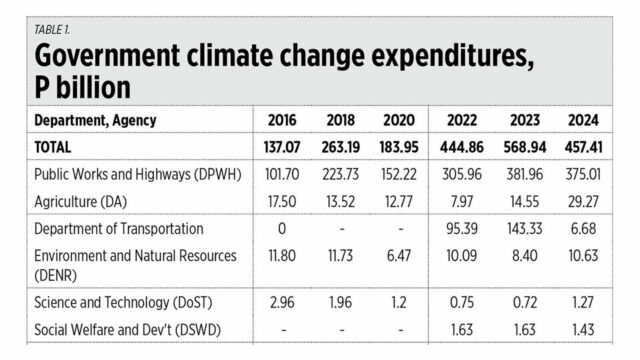
Government spending on climate-related programs and projects, like flood control, is rising. From P127 billion in 2015 and P137 billion in 2016, this jumped to P569 billion in 2023. The bulk of spending went to the Department of Public Works and Highways (see Table 1).

One problem in the Philippines and in many other countries is that whatever the climate or weather — whether there is less rain or more rain, fewer floods or more floods, it is less cold or more cold — these are all taken as “proof” of “man-made climate change” and hence need man-made “solutions.” Meaning that the government, the UN, and multilaterals offer solutions like more climate spending, more climate bureaucracies, and huge meetings.

Among such “solutions” is the long-term shut down of coal plants, especially in smaller countries like the Philippines that can be easily bullied by the multilaterals and big media. For instance, in a report published here in BusinessWorld, “Philippines set for first coal power decline in 17 years amid rising LNG use” (July 22), Reuters explicitly mentioned a “coal phase-out policy.”

Why do they target the Philippines, or sometimes Indonesia and Vietnam, for their anti-coal agenda when other countries have much, much bigger coal consumption than us? In 2024, the Philippines’ coal generation was 79 terawatt-hours (TWh) while China, India, the US, and Japan have generated 5,828, 1,518, 712, and 301 TWh respectively.

The rising use of artificial intelligence (AI) and data centers means even larger power demand as AI is very energy intensive. In 2024, the expansion in power generation was twice or even thrice the average yearly power generation from 2014-2023. The Philippines, for instance, had an average of only 4.7 TWh a year from 2014-2023, but had a 10 TWh increase in 2023 and 2024.

It is notable, too, that countries that have expanded their coal use considerably have also seen a big expansion in overall power generation and high average GDP growth over the last 10 years. Examples are China, India, Indonesia, Malaysia, the Philippines, Vietnam, and Turkey.

And countries with big declines in coal use also have seen slow expansion in total power generation and low average GDP growth. Examples are Japan, South Korea, Australia, Canada, Germany, Spain, and the UK (see Table 2).

We should address rising rivers and creeks, not rising oceans. We should spend public resources on regular, annual dredging of those rivers and creeks to reduce flooding, not on climate meetings and bureaucracies. We should focus on net growth and not net zero. We should focus on developing abundant and stable electricity sources available 24/7, not unstable, intermittent, weather- and battery-dependent energy sources.

Horrible monsoon rains are annual events, with a minimum five days straight during which the sun is hardly visible. We should have electricity available even if the sun is not shining for days, even if the wind is not blowing for days.


Bienvenido S. Oplas, Jr. is the president of Bienvenido S. Oplas, Jr. Research Consultancy Services, and Minimal Government Thinkers. He is an international fellow of the Tholos Foundation.

minimalgovernment@gmail.com

Apple set to stave off daily fines as EU to accept App Store changes, sources say

REUTERS

BRUSSELS — Apple’s changes to its App Store rules and fees will likely secure the green light from European Union (EU) antitrust regulators, people with direct knowledge of the matter said, a move that would stave off potentially hefty daily fines for the iPhone maker.

The company last month said developers will pay a 20% processing fee for purchases made via the App Store, though the fees could go as low as 13% for Apple’s small-business program.

Developers who send customers outside the App Store for payment will pay a fee between 5% and 15%. They will also be able to use as many links as they wish to send users to outside forms of payment.

Apple made the changes after the EU antitrust enforcer handed it a €500-million ($586.7 million) fine in April, saying its technical and commercial restrictions prevented app developers from steering users to cheaper deals outside the App Store in breach of the Digital Markets Act (DMA).

The company was given 60 days to scrap the restraints to comply with the DMA aimed at reining in Big Tech and giving rivals more room to compete.

The European Commission is expected to approve the changes in the coming weeks, although the timing could still change, the people said.

“All options remain on the table. We are still assessing Apple’s proposed changes,” the EU watchdog said.

Apple did not immediately respond to a request for comment. The company earlier this month said it had implemented the changes to avoid punitive daily fines, while criticizing the Commission for mandating how it runs its store.

The company could have been hit with daily fines of 5% of its average daily worldwide revenue, or about €50 million per day. Reuters