Home Blog Page 1285

PHL rice imports to decline 1.9% — USDA

PHILSTAR FILE PHOTO

PHILIPPINE RICE imports will likely decline 1.9% to 5.2 million metric tons (MMT) this year due to an expected increase in domestic production, according to the US Department of Agriculture (USDA).

Milled rice production is expected to increase 2.1% to 12.25 MMT in marketing year (MY) 2025/26 due to favorable weather and increased government intervention backed by an enlarged competitiveness-enhancing budget funded by rice tariffs, the USDA said in a report, citing its Foreign Agriculture Service.

A 2024 law that amended the Rice Tariffication Law of 2019, which deregulated the rice industry by removing the power of the National Food Authority (NFA) to import the commodity, expanded the Rice Competitiveness Enhancement Fund (RCEF) to P30 billion from P10 billion.

Aside from a rebound in production, other factors driving Philippine imports down are stocks carried over from 2024/25 and the imposition of a maximum suggested retail price on imported premium rice, the report said.

Vietnam and Thailand will remain as the key suppliers of rice to the Philippines in MY 2025/26, it said.

“This is due to established trade relationships, competitive prices, and the geographical proximity of Vietnam and Thailand to the Philippines,” the report noted.

However, it forecast “a decrease in supply of imported 5% broken rice in the Philippines in MY 2025/26, given the ongoing implementation of the MSRP on imported premium rice,” it said.

Imported rice is subject to a 15% tariff until 2028 under Executive Order No. 62, which farmer groups said has failed to significantly bring down the retail price of rice.

The Federation of Free Farmers (FFF) is asking the Tariff Commission to restore rice import tariffs to 35% for Southeast Asian grain. The FFF has also asked the commission to impose a 50% tariff on grain from all other countries.

The MSRP for imported rice was set at P45 per kilo beginning March 31. It started at P58 per kilo on Jan. 20, followed by P55 per kilo on Feb. 5, P52 per kilo on Feb. 15 and P49 per kilo on March 1.

The USDA report said the estimated land area to be harvested will also likely increase 2.2% to 4.70 million hectares in MY 2025/26.

It noted that RCEF contributed to production growing by an average rate of 1.9% year on year between MY 2018/19 and MY 2022/23.

Rice imports hit an all-time high of nearly 4.7 MMT in 2024.

Raul F. Montemayor of the FFF said due to excess imports last year, “a lot of rice stocks were not consumed in 2024 and were instead carried over to 2025.”

“That is why the National Economic and Development Authority (NEDA) is estimating that our 2025 beginning stock was equivalent to 3.8 million tons, good for about 108 days,” he said via Viber.

Beginning stock is usually good for 60-70 days’ demand, he noted.

“Whether better production, larger RCEF, and the MSRP will temper imports remains to be seen,” he said.

“If international prices continue to go down, importers will continue to bring in rice and sell imports for less than local rice even if we have sufficient supply,” he added.

The USDA report, meanwhile, noted that Philippine rice consumption will increase 0.6% to 17.30 MMT in MY 2025/26, largely driven by steady population growth, moderating inflation levels, and growing income levels.

It said the Philippine population is projected to grow from 118.28 million to 121.94 million people from 2024 to 2026.

Retail rice prices are gradually declining due to softening global prices, allowing consumers.

National daily demand for rice averages 37,000 MT, according to the DA.

The USDA report also said Philippine rice stocks will rise 4.1% to 3.85 MMT in MY 2025/26, due to an increase in the procurement activities of the NFA, coupled with the ongoing rice imports by private traders.

Meanwhile, “rice stocks held at the household level are forecast to decline in MY 2025/26, as lower prices reduce the need for households to hold excessive stock,” it added.

A food security emergency on rice was declared on Feb. 3, allowing the NFA to release stocks onto the market to tame retail prices and prepare its warehouses for the procurement of the new harvest beginning mid-February.

The NFA is hoping to procure as much as 870,000 MT of palay (unmilled rice) this year.

“With the Philippine Statistics Authority’s updated milled recovery rate at 63%, this would translate to around 550,000 MT of milled rice, leading to the higher forecast of rice stocks in MY 2025/26,” according to the report. — Kyle Aristophere T. Atienza


Recovery seen in wearables exports this year — CONWEP

REUTERS

THE Confederation of Wearables Exporters of the Philippines (CONWEP) is hoping to see a recovery in wearable exports this year amid plans to secure a trade agreement with the US and relaxed requirements for garments in the UK.

“We are trying to mitigate the 4% decline in 2024. We are targeting to raise the bar and break even at least in 2025, just so we can retain jobs,” said CONWEP Executive Director Ma. Teresita Jocson-Agoncillo in a Viber message.

“That will happen if something moves between the Philippine and the US government in the discussion on the trade reference agenda; (exports) could pick up very fast,” she said.

However, she said that without the agreement with the US, the industry can still maintain last year’s export levels and register flat growth.

CONWEP reported that apparel exports declined 6% to $661.75 million last year, while exports of travel goods slipped 4% to $546.62 million.

Meanwhile, textile exports rose 3% to $256.44 million while footwear exports rose 11% last year.

These brought total wearable exports to $1.299 billion in 2024, down 4%.

She said the expected relaxation of requirements in the UK market can also help the industry.

She said that before the pandemic, the industry’s utilization rate of trade preferential schemes was only between 6-7% due to the strict rules of origin.

“That is why our utilization is normally below 10%. But that will rise if the rules are relaxed,” she added.

Last week, the Department of Trade and Industry’s Export Marketing Bureau said that the UK is looking at relaxing some of the rules for industries that are underutilizing the UK’s Developing Countries Trading Scheme. — Justine Irish D. Tabile

Canada targeted for aviation investments

DORNIERTECHNOLOGY.COM

THE Department of Trade and Industry (DTI) is seeking to attract from the Canadian aviation industry as it embarks on a business mission to Toronto on April 25.

Trade Secretary Ma. Cristina A. Roque told reporters on Friday that the particular aviation segments being targeted are “maintenance, repair, and operations (MRO). There are already MROs here, but we want to strengthen them.”

She said that attracting more MRO investment will help address the growing demand for such services as air traffic expands.

“Even Cebu Pacific and AirAsia told me that they are expanding their MROs so they will now repair planes from other airlines,” she said.

“We want to encourage more airline companies to establish MRO (facilities) here,” she added.

The Manila International Airport Authority reported that 114,793 international flights arrived at and departed from Ninoy Aquino International Airport in 2024, up 11.6%.

The Manila gateway also served 178,640 domestic flights last year, up 6.3%.

She said the demand for pilots is also growing.

The DTI is also set to inaugurate a small and medium enterprise hub in Toronto to display Philippine products that are compliant with Canadian rules and ready for export. — Justine Irish D. Tabile

Importer of seized sweetener sought to skirt sugar tariff

PHILIPPINE STAR/MIGUEL DE GUZMAN

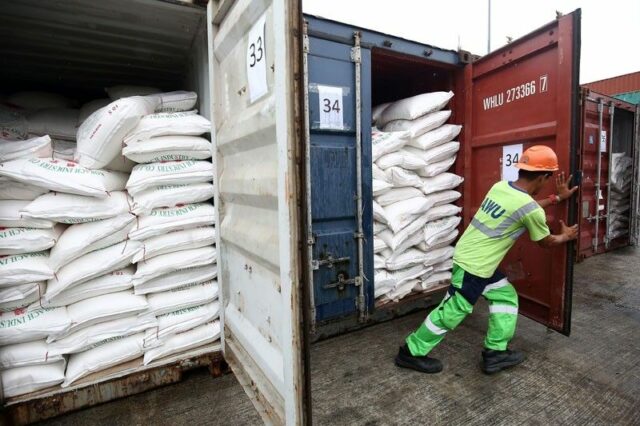
THE Department of Agriculture (DA) said on Monday the importer of sweeteners intercepted by authorities in March declared the shipment using a tariff code that charged less than the rate for sugar and did not require regulatory approval.

In a statement, the DA said the commodity declared by importers as “sweet mixed powder” under Tarriff Code 1702 pays a tariff of 1%, rather than the 5% charged under Tariff Code 1702 for shipments from members of the Association of Southeast Asian Nations Tariff Code 1702 covers “other sugar.” The shipment arrived in 14 20-foot container vans.

“It appears the consignee used the classification under tariff code 1702 since importing sugar requires clearance from the Sugar Regulatory Administration (SRA) and the DA/SRA has not authorized any imports so far,” Secretary Francisco Tiu Laurel, Jr. said.

Each 20-foot van holds approximately 25 metric tons of sugar in sacks, according to the DA. 

“That places the volume of the three shipments at 350 metric tons or 350,000 kilos worth around P30 million.”

Citing a physical inspection by authorities, the DA said the product, labeled as “TTC Sugar,” is manufactured by Vietnam’s Bien Hoa Consumer Joint Stock Co.

“The sweet mixed powder was found to bear a striking resemblance to refined sugar, further deepening suspicions that it may not match the declared classification,” it said.

It added that the product was found to contain 88% white granulated sugar and 12% glucose.

The SRA has collected three sets of samples from the separate shipments for further analysis, according to the DA.

“The outcome of the laboratory tests will be critical in determining whether the shipment was misdeclared and whether further action will be necessary,” the DA said.

“This case highlights the importance of maintaining precise tariff classifications and underscores the vital role of regulatory bodies in protecting the integrity of the domestic sugar market,” it added. 

The SRA has yet to issue a sugar import order for this year, Administrator Pablo Luisa S. Azcona said.

The regulatory body in February said it is enhancing its database of importers as it clamps down on technical smuggling. — Kyle Aristophere T. Atienza

Gypsum board maker seeks definitive anti-dumping duties on Thai imports

KNAUF.COM

KNAUF GYPSUM Philippines, Inc. called for definitive anti-dumping duties against imports of Thai gypsum board in the face of deteriorating capacity utilization in Thailand.

Knauf Managing Director Mark Dewey N. Sergio said that the company believes that the threat from Thai gypsum board imports will continue.

“We have reason to believe that it will continuously cause material injury to the domestic industry because last year, Thailand also saw (declining capacity utilization),” Mr. Sergio said at a public hearing on Monday.

He said that the Philippines “is one of the major destinations” for Thai gypsum board.

According to Mr. Sergio, Thailand’s capacity utilization was only 57% at the end of 2024.

“Outside of that, there is also another gypsum board (plant) opening, which we foresee will further impact their industry’s utilization, thereby increasing the risk of the Philippines being again subject to products from Thailand,” he added.

Knauf said the new plant established by BNBM is expected to worsen Thai utilization to a level not seen in the last decade, which will push Thai manufacturers to seek further export opportunities at dumped prices.

According to Mr. Sergio, Knauf’s capacity increased after the company acquired USG Boral, another plasterboard company.

“In 2021, we started to transition our manufacturing rather than importing from Thailand the Boral-branded products,” he said.

“However, starting in 2023, we also noticed an increase in imported Thai products to the Philippines that resulted in a reduction of 23% in terms of our plant utilization,” he added.

Knauf said imports from Thailand declined from 2019 to 2021 as a result of the acquisition.

“However… starting from 2022 onwards, there was a 41% increase in Thai imports,” Mr. Sergio said.

In November 2024, the Department of Trade and Industry imposed four months of anti-dumping duties on imports of gypsum board from Thailand. — Justine Irish D. Tabile

Vape tax not deterring users — House think tank

PHILIPPINE STAR/ RUSSELL PALMA

LEGISLATORS may need to reassess tax rates on vapes and other e-cigarette products, which are rising in popularity due to their low cost, according to a House of Representatives think-tank.

The Congressional Policy and Budget Research Department (CPBRD) said, however, that higher tax rates could spur the growth of an illicit vape market.

“The continued rise in e-cigarette use… raises concerns about the effectiveness of the current tax policy in curbing e-cigarette consumption. One factor that possibly contributes to this trend is the existing tax disparity between conventional cigarettes and e-cigarettes,” the report’s authors Rutcher M. Lacaza and Edrei Y. Udaundo, wrote.

“Excessively high taxes could push consumers towards the illicit market, leading to tax evasion and potential safety risks associated with unregulated products,” they added.

The Philippines imposes an excise tax of P66.15 per pack of 20 cigarettes, while vape products are taxed at P57.33 per mL for salt nicotine and P66.15 per mL for classic nicotine juices, according to the Bureau of Internal Revenue (BIR).

Vapes are taxed less compared to regular cigarettes, the CPBRD said, with excise taxes making up just 35% to 60% of their floor price, compared to 80% for cigarettes.

“This lower tax share, combined with the aggressive marketing campaigns targeting young consumers, has made e-cigarettes increasingly accessible,” the think-tank said.

A bill seeking to harmonize the tax rates of all tobacco products was approved by the House in early February, setting a P41 tax per package of heated tobacco products and harmonizing the tax on vapes and cigarettes at P66.15. The proposed taxes would increase by 2% in every even-numbered year starting 2026 and 4% in every odd-numbered year starting 2027.

More consumers in the Philippines were aware and were using vape and e-cigarette products in 2021 than in 2015 despite the signing of Republic Act No. 11346, which hiked excise tax rates on smoking products, the CPBRD said, citing the Global Adult Tobacco Survey.

“This trend is particularly pronounced among young adults, males, those with higher education, and current smokers, especially those intending to quit. The significant increase in e-cigarette use among young adults (15-24 years old) is a major public health concern,” the think tank said.

The government should look into targeted tobacco education campaigns for the young and regulate the online sale of vapes to curb their use, the CPBRD said.

Health authorities should also consider imprinting textual and graphic health warnings on vape packages to further discourage e-cigarette use, it added.

“Policymakers must balance fiscal and public health goals, adapting to protect vulnerable groups as the e-cigarette market evolves.” — Kenneth Christiane L. Basilio

New VAT rules for local sales of RBEs

With the components Comprehensive Tax Reform Package (CTRP) gradually unfolding, it can be overwhelming for taxpayers to note the changes directly affecting them. With the signing of the CREATE MORE Act (Republic Act No. 12066), the country moves closer to becoming more competitive by enhancing tax incentives to attract investors. This law aims to expand fiscal incentives, promote ease of doing business, strengthen investment regulations, support regional development, and clarify transitory rules for Registered Business Enterprises (RBEs). These measures position the country as a more attractive investment destination.

Under CREATE MORE, local sales of goods and/or services by an RBE, regardless of the income tax incentives regime and location, are subject to 12% VAT, unless otherwise exempt or zero-rated under the Tax Code. As further defined in the CREATE MORE Act, “local sales” cover sales of goods and services to domestic market enterprises (DMEs) or non-RBEs, regardless of whether the sale occurs within the freeport or economic zones.

The highlight of this amendment is the shift of the liability to the buyers in the filing and remittance of the VAT on local sales. While the effects of this change are yet to be determined, the BIR initially laid out the manner in which this shift will be implemented. To simplify matters, the transactions will first be classified into two (2):

1. Business-to-Business (B2B) transactions — transactions to natural or juridical persons engaged in business located in the Philippines; otherwise,

2. Business-to-Consumer (B2C) transactions

VAT RULES FOR LOCAL SALES OF RBEs
1. B2B Transactions

For this type of transaction, the obligation to file and pay the VAT lies with the buyer. For purchases of goods from economic zones or freeports, these are to be filed and paid per transaction using BIR Form 0605, after which it should be transmitted to the RBE seller for the release of the goods. Meanwhile, for purchases of services from economic zones or freeports and purchases of either goods or services from BoI-registered enterprises, these shall be filed and paid monthly, with a deadline set on or before the 10th day of the month following the month of transaction, using BIR Form 1600-VT. The buyer must then prepare BIR Form 2307 and issue to the RBE-seller either on the aggregated quarterly VAT on local sales payments or upon the latter’s demand.

In filing the quarterly VAT returns, non-VAT registered RBEs are not required to file as compared to VAT-registered RBEs and RBEs with mixed activities, which must declare all B2B local sales supported by BIR Form 2307 or BIR Form 0605 issued by their buyers. Further, non-VAT registered RBEs must only submit the summary list of local sales on a quarterly basis, while VAT-registered RBEs are to continue the regular submission of the same as per existing revenue rules and regulations.

2. B2C Transactions

Since the buyer in a B2C transaction is typically an individual or non-business entity, it is not practical to shift VAT liability to them. Therefore, the RBE seller remains responsible for VAT compliance.

Moreover, the income tax regime must be taken into consideration in the filing and payment of VAT. For RBE-sellers subject to tax under the 5% GIE/SCIT regime, the VAT on local sales must be filed and paid by the 10th of the month following the transaction using BIR Form 0605. For RBE sellers with mixed activities under different tax regimes, the VAT during the first two months must be paid through BIR Form 0605, which will then be reflected as VAT credit upon filing of the quarterly VAT return. If the RBE seller falls under ITH/EDR or the Regular Income Tax Rate, quarterly VAT filing is required in declaring the local sales and its corresponding VAT.

INVOICING REQUIREMENTS
On the invoicing of RBE-seller to the buyer, the invoice should contain a separate line item for the VAT, labeled as “VAT on Local Sales.” Since the buyer in a B2B transaction will file and pay the corresponding VAT, the RBE seller will only receive the purchase price. However, the buyer in a B2C transaction should remit the full amount to the seller.

Considering that the RBEs have yet to secure invoices with the line item of “VAT on Local Sales,” the following are the transitory provisions provided in relation thereof:

• For manual invoices, the term “VAT/VAT Amount” shall be stamped with “VAT on local sales” until fully consumed, with the new layout to reflect on the subsequent applications for Authority to Print Invoices. Exempt/VAT-Exempt invoices must be stamped with “VAT on Local Sales” as an additional term in the breakdown.

• RBEs using Cash Register Machines/Point-of-Sale (CRM/POS) and other registered invoicing systems/software must reconfigure these devices by changing the term “VAT/VAT Amount” to “VAT on Local Sales” or adding the term in case not applicable. The reconfiguration must be done by Dec. 31, 2025, subject to post-verification by the BIR office having jurisdiction over the RBE.

CLAIMING OF INPUT VAT BY VAT-REGISTERED BUYERS
Following the changes in the discussion above, the BIR provides the necessary documents for VAT-registered buyers claiming the input tax on their purchases:

a. Sales invoice issued by the RBE seller showing the amount of VAT on local sales; and

b. Copy of the corresponding duly filed BIR Form 1600-VT or BIR Form 2307, whichever is applicable.

Meanwhile, VAT paid by non-VAT-registered buyers for their purchases must be expensed outright.

CONCLUSION
While the CTRP aims to simplify the tax system, the shift in VAT filing and remittance responsibilities under the CREATE MORE Act adds complexity for taxpayers, who must adapt to the new regulations. The success of these changes will largely depend on how effectively the BIR oversees taxpayer compliance and supports their transition. Without clear guidance and efficient implementation from the BIR, the process could become more burdensome. Ultimately, both the BIR and taxpayers must collaborate to ensure a smooth transition and achieve the CTRP’s goal of creating a simpler, fairer, and more efficient tax system.

Let’s Talk Tax, a weekly newspaper column of P&A Grant Thornton that aims to keep the public informed of various developments in taxation. This article is not intended to be a substitute for competent professional advice.


Clarita C. Afaga is a semi-senior from the Tax Advisory & Compliance division of P&A Grant Thornton, the Philippine member firm of Grant Thornton International Ltd.

pagrantthornton@ph.gt.com

Petro Gazz, Akari eye final slots against Choco Mucho, Creamline

PETRO GAZZ ANGELS — FACEBOOK.COM/PREMIERVOLLEYBALLLEAGUE

Games on Tuesday
(PhilSports Arena)
4 p.m. – Creamline vs Akari
6:30 p.m. – Petro Gazz vs Choco Mucho

PETRO GAZZ AND AKARI look to arrange an interesting title duel while Creamline and Choco Mucho aim to avert it in Tuesday’s resumption of the Premier Volleyball League All-Filipino Conference semifinals at the PhilSports Arena.

The Petro Gazz Angels and the Akari Chargers gained headway early with victories over the Creamline Cool Smashers, 25-23, 25-22, 21-25, 25-16, and the Choco Mucho Flying Titans, 20-25, 25-19, 25-23, 22-25, 16-14, respectively, last Saturday at the Ynares Center Antipolo.

If Petro Gazz beats Choco Mucho at 6:30 p.m. and Akari hurdles Creamline at 4 p.m., it will render the final semis play date on Thursday at the Smart Araneta Coliseum as non-bearing and set up a best-of-three titular showdown unfurling April 8 also at the Big Dome.

Petro Gazz coach Koji Tsuzurabara knows it will not be a walk in the park playing Choco Mucho.

“One more game with Choco Mucho, it’s tough,” said the veteran Japanese mentor.

Same with Akari bench tactician Taka Minowa, another Japanese who is hoping to steer the franchise to a second finals appearance after making it that far in last year’s Reinforced Conference only to succumb to the same team it will face next — Creamline.

“Creamline is tough to beat,” he said.

If both teams end up barging into the finale, it will be the second time in the last 15 conferences that there will be no Creamline in that stage.

Historically, the mighty Cool Smashers have made the finals in 13 of the previous 14 conferences and ended up winning 10 championships including an amazing four-peat feat, both league marks.

Only in the 2022 Reinforced Conference that Creamline did not make the finals in that impressive stretch.

It wound up third in that conference.

Like an eclipse, there’s a chance that it might just happen again if Creamline doesn’t do anything about it. — Joey Villar

Eala leaps from No. 140 to No. 75 in Women’s Tennis Association rank

ALEX EALA — JIMMIE48/WTA

ALEX EALA is officially the first ever Filipina player to barge into the world’s elite Top 100 rankings.

Ms. Eala jumped from No. 140 to now No. 75 in the Women’s Tennis Association (WTA) list after a historic Cinderella run in the Miami Open.

The 19-year-old Filipina sensation leaped 65 rungs, jacking up her total points of 524 before the tournament to now 894 as among the sports’ top guns.

Her previous career-high was at No. 134 after a semifinal finish in Workday Canberra International in Australia. Ms. Eala started at No. 1180 in 2020 when she debuted at the pro level after reaching as high as No. 2 in the world junior rankings.

But more than that, Ms. Eala’s entry to the Top 100 formally clears the path to her long-time dream of becoming the first Filipina player in the main draw of any Grand Slam tournament.

Only the Top 100 players from the women’s pro circuit get to have direct invites to the main draws of majors like the US Open, French Open, Wimbledon and the Australian Open.

Ms. Eala only managed to play in the qualifying rounds of the said majors as a wildcard in the past, having advanced to the finals of the US Open, French Open and Wimbledon but to no avail.

The closest Slam for Ms. Eala is the Roland Garros on May 25 to June 8 in Paris, France.

The lefty wunderkind did it after a herculean semifinal finish in the Miami Open, a WTA 1000 masters just below the ranks of Grand Slam events.

There, she became the first Filipina player to beat three Grand Slam champions, two Top-5 players and the first WTA 1000 semifinalist.

Overall, she’s only the second wildcard to defeat three or more Grand Slam champions in a single tour-level event after Elina Svitolina (Ukraine) at the Wimbledon 2023 as well as the third wildcard semifinalist after Justine Henin (Belgium) in 2010 and Victoria Azarenka (Belarus) in 2018. — John Bryan Ulanday

Teen Menšík stuns Djokovic in Miami Open final

NINETEEN-YEAR-OLD Czech Jakub Menšík beat his childhood idol Novak Djokovic 7-6(4), 7-6(4) in an upset for the ages on Sunday, claiming his first ATP title at the Miami Open as he denied the former No. 1 his bid for a milestone 100th.

The 54th-ranked Menšík faced tough odds in only his second ATP final but harnessed his best weapon to subdue the 24-time major winner with 14 aces and collapsed onto the court, overcome with emotion, after sealing it with an unreturnable serve.

The oldest ever to reach a Masters 1000 final, 37-year-old Djokovic had hoped to join Jimmy Connors (109) and Roger Federer (103) as the only three men in the Open Era with 100 or more titles but ran out of steam in the end.

Djokovic arrived on the court after several hours of rain delays with swelling near his right eye and appeared off-kilter as he handed Menšík a break with a clumsy shot out of bounds in the second game.

He slipped and fell in the fifth game, taking his time to get back up off the court as his legions of devoted fans in Hard Rock Stadium urged him on, and applied eye drops to his afflicted eye during the changeover.

The Serb leveled it in the seventh but boiled over with frustration as Menšík got off to a 5-0 head start in the tiebreak, fuming at his box, where his former rival-turned-coach Andy Murray sat stone-faced.

The Czech held his nerve, meanwhile, and pumped his fist with satisfaction as he clinched the set with an overhead smash.

The two players battled toe-to-toe in a thrilling second set, where Menšík used his speed to his advantage to neutralize Djokovic’s fine drop shots at the net.

Djokovic had his veteran survival instincts on display as he fended off two break points in the fifth game but gradually showed the wear and tear of the match before collapsing from exhaustion after a 21-shot rally in the tiebreak.

The win capped a dream run through the tournament for Menšík, who upset third seed Taylor Fritz en route to the final. — Reuters

Brownlee facing alleged anti-doping violation ahead of FIBA Asia Cup

JUSTIN BROWNLEE’S Gilas Pilipinas stint in the forthcoming FIBA Asia Cup might be in peril.

For the second time around, the Gilas naturalized player is facing an alleged anti-doping violation that could keep him out for the Asian tournament slated on August 5 to 17 in Saudi Arabia.

No less than the Samahang Basketbol ng Pilipinas (SBP) on Monday confirmed that Mr. Brownlee “has received notice of an adverse analytical finding (AAF)” on one of his random tests.

“Mr. Brownlee is currently dealing with the situation aided by his US-based lawyers,” the local federation said.

As per the US Anti-Doping Agency, “an AAF is a report from a World Anti-Doping Agency-accredited laboratory that identifies the presence of a prohibited substance and/or its metabolites or markers in a sample. This is commonly referred to as a positive test.”

Reports surfaced on Mr. Brownlee’s test result on Monday night, days after yet another loss of Ginebra in the PBA Commissioner’s Cup against the TNT Tropang Giga, before SBP released a statement just Monday.

It remains unclear what substance it was, in which tournament Mr. Brownlee got the AAF notice or if he would be handed out another suspension given the multiple games he’s been into with Gilas in the entire FIBA Asia Cup Qualifiers and the PBA with Barangay Ginebra as its resident import.

Mr. Brownlee played in all three windows of the Asia Cup Qualifiers that started in February 2024 until February this year as Gilas advanced to the Asia Cup by finishing second with a 4-2 slate in Group B behind New Zealand.

He also saw action in the FIBA Olympic Qualifying Tournament, putting in yet another heroic performance as Gilas had a stellar semifinal run marked by a stunning upset of world No. 6 Latvia.

Before that, the 35-year-old American-Filipino came off a three-month provisionary suspension he opted to serve instead of requesting for a B-sample after testing positive during the 19th Asian Games in China — where Gilas won a gold medal after 61 years — for Carboxy-THC, a compound linked with cannabis.

It’s not a performance-enhancing drug but still falls under one of the banned substances of the World Anti-Doping Agency.

Still, the SBP cleared that nothing is certain as of now with regards to Mr. Brownlee’s status pending an official verdict from FIBA, whether as a pro in the PBA or as a national team player for Gilas.

“The SBP wishes to clarify that FIBA has not issued any official ruling as of date,” said the SBP. — John Bryan Ulanday

Cleveland Cavaliers knock off Los Angeles Clippers for third 60-win in 2024-25 season

DONOVAN MITCHELL and Jarrett Allen each recorded double-doubles and the Cleveland Cavaliers led the visiting Los Angeles Clippers nearly wire-to-wire en route to a 127-122 win on Sunday.

Mitchell finished with 24 points, 12 rebounds and seven assists for the Cavaliers. Allen scored a team-high 25 points, grabbed 12 boards and made a pair of steals. Evan Mobley added 22 points, seven rebounds, four assists and three blocked shots.

Norman Powell of Los Angeles led all scorers with 34 points. James Harden added 24 points, eight rebounds and eight assists in the loss, the Clippers’ first three games into a four-game road swing.

Cleveland (60-15) secured just the third 60-plus-win regular season in franchise history behind big runs in both halves versus Los Angeles. The Cavaliers went on a 16-0 burst in the first quarter, spanning almost four minutes, to open up a 17-point lead.

The Clippers (42-32) chipped away at the deficit, pulling within early in the third quarter. Cleveland responded with a 16-2 run.

Another Cavaliers answer to a Los Angeles threat came in the fourth quarter when the Clippers pulled to within eight points before Mitchell and Isaac Okoro connected on back-to-back 3-pointers.

Garland scored 19 pts and shot 7-of-8 from the free-throw line, with his work at the charity stripe helping the Cavaliers keep the Clippers at arm’s length. — Reuters