Home Blog Page 127

F-resh Van offers cold-chain solution

PHOTO FROM CENTRO NIPPON FRUEHAUF COOLTECH, INC.

CENTRO NIPPON Fruehauf Cooltech, Inc. (CFCI), in partnership with Sojitz Fuso Philippines Corp., introduced the Fuso F-resh Refrigerated Van, a cold-chain solution born from the fusion of Japanese engineering and Filipino manufacturing expertise. Mounted on the reliable Fuso Canter FE71, the F-resh Ref Van is designed to meet the growing demands of the Philippines’ food, pharmaceutical, and logistics industries with “unmatched efficiency, durability, and sustainability.”

The F-resh Ref Van is a product of the longstanding collaboration between CFCI and Sojitz Fuso, combining Fuso’s trusted chassis platform with the precision-engineered refrigerated body technology of Nippon Fruehauf Japan. Nippon Fruehauf’s design has passed the stringent Japanese Industrial Standard (JIS) tests, ensuring that the F-resh delivers exceptional strength, insulation, and long-term reliability.

The refrigerated body uses eco-friendly, high-quality materials, including Extruded Polystyrene (XPS) known for superior insulation and thermal stability. Lightweight yet durable aluminum sheet panels further enhance cooling efficiency while being fully recyclable — aligning the F-resh with global sustainability practices.

Ensuring steady and efficient cooling performance is the C-Temp refrigeration system, equipped with a Japanese-brand compressor recognized for consistent temperature control and energy efficiency. This guarantees that meats, produce, pharmaceuticals, and other sensitive cargo remain protected even under the Philippines’ harsh tropical climate.

To reinforce customer confidence, the F-resh Ref Van includes a comprehensive two-year/100,000-km warranty, ensuring strong after-sales support and long-term operational value. This warranty, made possible through the CFCI-Fuso partnership, underscores both companies’ commitment to reliability and customer success.

P43 imported rice MSRP to stay even as benchmark price warrants 20% tariff

PHILIPPINE STAR/KRIZ JOHN ROSALES

THE Department of Agriculture (DA) said the P43-per-kilo maximum suggested retail price (MSRP) for imported rice will stay for the moment, even though the designated price benchmark would currently warrant an increase in tariffs to 20%.

The planned increase in rice import duties from 15% to 20% is scheduled to take effect on Jan. 16.

“The January MSRP will stay at P43 because the duty is still 15%,” Agriculture Secretary Francisco P. Tiu Laurel, Jr. was quoted as saying in a statement, adding that the process for tariff adjustment has yet to be finalized.

Executive Order No. 105 calls for rice import tariffs to be adjusted in increments of five percentage points when movements in global rice prices hit certain thresholds.

The benchmark price that will form the basis of tariff adjustments is the monthly average price of Vietnam 5% broken rice, as reported by the Food and Agriculture Organization (FAO).

Vietnam 5% broken rice currently fetches $361.1 per metric ton, according to the FAO, a price level that would cause the Philippines to charge a 20% tariff.

The DA added that it plans to import an initial 500,000 metric tons of rice after the import ban expires on Dec. 31, with some 50,000 metric tons to be allocated to Food Terminals, Inc.

Mr. Laurel said the government will time its announcements on prices to deter speculation.

The DA said keeping the MSRP in place provides consumers with short-term price stability. — Vonn Andrei E. Villamiel

Science still made incredible breakthroughs while under attack

STOCK PHOTO | Image from Freepik

By F.D. Flam

IT WAS a tough year for science in the US. Thousands of research grants, including more than 3,800 from the National Institutes of Health and the National Science Foundation alone, were frozen or canceled. NASA was threatened with sweeping budget cuts. Top scientists are leaving the US in search of better opportunities. And misinformation about vaccines and other important scientific matters continues to spread.

But despite these setbacks, scientists around the world produced amazing discoveries every day — some of which made a big splash while others didn’t get nearly the attention they deserved. Here’s a sample of findings that were perhaps more significant than some of the major headline-makers.

OF DIRE WOLVES AND  BUTTERFLIES
The spring of 2025 brought the attention-grabbing claim from Colossal Biosciences that it had “resurrected” dire wolves — a species that had been extinct for 12,500 years. Around the same time, a group of researchers published a report documenting a rapid decline in global butterfly populations.

The butterfly report matters because it shows that genetic engineering feats such as “de-extinction” are insufficient to stop the rapid decline of wild species of all kinds, because such efforts can’t restore the ecosystems that support them. Butterfly populations have declined by 22% over the past 20 years. Pesticides are wiping out some species, while others are losing habitat and food sources to humanity’s needs for homes and farmland.

This is part of a broader decline in insect populations worldwide, which means plants are losing pollinators and animals are losing an essential source of food.

Meanwhile, biologists continue to debate whether the dire wolves were really just genetically modified gray wolves. Whatever you call the three pups the company produced, they represent an impressive technological achievement and innovative fundraising effort. Imagine what we could accomplish if we put that same effort and brainpower into inventing new, sustainable ways to grow food without crowding out or poisoning the insects we all depend on.

SUPER SMART HUMANS 30,000 YEARS AGO
In 2025, it was hard to avoid gloomy pronouncements about human intelligence — from brain fog to shrinking attention spans to declining IQ scores. But archaeology tells a different story — one of humans possessing similar intellectual abilities for tens of thousands of years.

Here’s an IQ test nature posed to Stone Age humans 30,000 years ago: There’s a vast stretch of rough, cold ocean in front of you with a raging current cutting across it, and a faint outline of land barely visible from your highest peak. You have only stone tools. How do you get to the other side?

Archaeologists know that people must have passed this test to settle the Ryukyu Islands, a chain that stretches from Kyushu, Japan, to what’s now Taiwan. Models published earlier this year indicate that 30,000 years ago, this 137-mile-wide stretch of ocean was driven by the same strong current observed there today. A similar feat of island hopping brought people to Australia around 50,000 years ago, but anthropologist Yousuke Kaifu believes that the Ryukyu Islands trip was the world’s most treacherous Stone Age boating voyage.

The best way to figure out how Stone Age humans might have done it, he reasoned, was to assemble a team of athletic and adventurous modern-day humans to build a boat and attempt the same feat of stellar and solar navigation using nothing but Stone Age technology and local materials.

They built reed and bamboo boats, which either swamped, capsized, or were swept off course by the current. Eventually, they constructed a dugout canoe from a felled cedar tree. After several false starts, a group of paddlers completed the journey in 44 hours and 10 minutes, publishing their findings in Science Advances in June.

Kaifu said he believes people did it for the same reason we build deep-sea submersibles and spacecraft. It’s humbling but also reassuring to realize that humanity has likely always had brainpower and grit — and probably won’t lose these abilities anytime soon.

UNIVERSAL BLOOD AND MORE
If you’re okay with having your organs removed for transplant when you die, how would you feel about doctors implanting organs into your recently deceased body as part of an experiment? That’s what happened earlier this year when doctors in Canada and China collaborated to transplant a kidney into a brain-dead man to test a new way to avoid organ rejection.

For those of us who’ve read Robin Cook’s thriller Coma, this experiment evokes the book’s chilling fictional portrayal of comatose patients being exploited — people who are in no position to advocate for themselves. But in real life, experts say it is relatively easy to distinguish between patients who have been declared brain-dead — and therefore legally considered dead — and those who are comatose or in a persistent vegetative state, said Arthur Caplan, head of the department of bioethics at New York University’s Grossman School of Medicine. Caplan said he was an early advocate of using people who have irreversibly lost all brain function, not just for organ donation, but also as test subjects.

You could think of it as donating your immune system to science. Not everyone who wants to donate their organs will be able to, said Caplan, and the person whose body was used for this kidney transplant experiment probably did more good for humanity than he could have with an organ donation. The technique promises to increase not only the number of available organs but also the blood supply for transfusions.

There are four blood types — A, B, AB, and O — and receiving blood or an organ from a mismatched type can trigger rejection. The one exception is type O, which is universal. However, people with type O blood can only receive type O. So, it was a significant finding when researchers identified an enzyme that can convert type A to O. This enzyme was used on the kidney transplanted into the brain-dead recipient.

Human bodies are likely to be better research models than animals, and using deceased humans makes more ethical sense than killing dogs or monkeys. The finding, published in Nature Biomedical Engineering in October, deserves more attention — both because it’s an impressive achievement and because the ethical questions it raises are worth public discussion.     

DON’T BLAME MOM
It was a rough year for moms. First, President Donald Trump made an unsupported claim that in utero exposure to acetaminophen — the active ingredient in Tylenol — can cause autism. Then, even those debunking the claim pointed out that mothers could harm their kids with other painkillers or just by developing a fever.

However, we paid insufficient attention to several recent findings regarding fathers and sperm. These studies revealed a surprisingly powerful influence a father’s health and environment can have on his offspring. Sperm, despite being tiny, carry more than just a package of genes. They also carry RNA fragments that play a role in fetal development, and these are affected by a wide range of environmental factors, including viral infections and even physical fitness.

In one study, published in October in Nature Communications, scientists infected mice with a virus similar to SARS-CoV-2, then let them mate. They observed that the virus altered RNA in sperm and that the offspring exhibited more anxious behavior.

An even more unusual study in mice — published in November in Cell Metabolism — tested the effects of exercise on their sperm. Researchers put male mice on a regimen of intense treadmill exercise for two weeks before they were allowed to mate.

The result: The offspring of the fit fathers showed better endurance and healthier metabolic markers than the offspring of a control group of sedentary males. The scientists identified a specific RNA molecule, called a microRNA, and found that they could improve the health of mice by injecting it into embryos from sedentary fathers.

While these effects might not translate directly to humans, the findings suggest that a father’s environment, health habits, and drug use can affect his sperm in ways that may affect the health, behavior, and even athletic abilities of his children.

SOME FAT MIGHT BE HEALTHIER
Polls show that more than 13% of Americans are taking Ozempic or other GLP-1 drugs — about twice as many as last year. But doctors still struggle to understand the health implications of fat — especially among people who are overweight by standard BMI charts but not obese.

Some overweight patients are frustrated that they can’t go to a doctor for a rash without being lectured about their weight, even though they show no signs of diabetes or heart disease. Others in the same situation are angry that they can’t get reimbursed for GLP-1 injections.

Americans bring some Puritanical cultural baggage to this topic, making it easy to dismiss findings that seem counterintuitive, such as the striking 2013 study that showed overweight (but not obese) people lived as long as those of normal weight. Americans also tend to be skeptical of the idea that people can be overweight yet metabolically healthy; however, a study published in August, based on more than 21,000 volunteers, found that women with extra weight around the hips and thighs had healthier hearts than slimmer women.

The study, which used multiple types of medical imaging, also reinforced the finding that visceral fat, which surrounds vital organs, is the most dangerous type of fat. From reporting on a column several years ago, I learned that visceral fat is part of the immune system. Those most prone to it are people who had a low birth weight.

Its function is to protect infants’ organs from infection; however, later in life, it can promote chronic inflammation and cause organs to age prematurely.

All this might eventually help explain the many side benefits people are discovering with GLP-1 drugs — protection from cancer, heart disease, and even Alzheimer’s disease — though the latest research says they can’t actually reverse dementia. There’s still much to learn, not just about the drugs but about the human body itself, and why it comes in so many different shapes and sizes.

BLOOMBERG OPINION

Perry Bamonte, keyboardist and guitarist for The Cure, 65

THECURE.COM

LOS ANGELES — Perry Bamonte, keyboardist and guitarist in The Cure, has died at 65, the English indie rock band confirmed through their official website on Friday.

In a statement, the band wrote that Mr. Bamonte died “after a short illness at home” on Christmas Day.

“It is with enormous sadness that we confirm the death of our great friend and bandmate Perry Bamonte who passed away after a short illness at home over Christmas,” the statement said, adding he was a “vital part of The Cure story.”

The statement said Mr. Bamonte was a full-time member of The Cure since 1990, playing guitar, six-string bass, and keyboards, and performed in more than 400 shows.

As per the statement, he rejoined the band in 2022, playing in 90 more shows including The Show of a Lost World concert in 2024 in London.

Mr. Bamonte, born in London, England, in 1960, joined the band’s road crew in 1984, working alongside his younger brother Daryl, who worked as tour manager for The Cure.

Mr. Bamonte first worked as an assistant to co-founder and lead vocalist, Robert Smith, before becoming a full member after keyboardist Roger O’Donnell left the band in 1990.

Mr. Bamonte’s first album with The Cure was Wish in 1992. He continued to work with them on the next three albums.

He also had various acting roles in movies: Judge Dredd, About Time, and The Crow. — Reuters

Security Bank to ramp up digital transformation

PHILIPPINE STAR/DEEJAE DUMLAO

SECURITY BANK Corp. will continue to invest in technology to advance the digital transformation of its services, it said on Sunday.

The bank said that under its multi-year roadmap, it will make more strategic technology investments in artificial intelligence (AI), automation, and cybersecurity, among others.

“Security Bank is building a modern, secure, and customer-centric foundation designed to support sustainable growth while continually improving customer experiences,” Lucose T. Eralil, Security Bank executive vice-president and chief operating officer, said in a statement.

“Our progress reflects disciplined execution and a forward-looking approach, and these recognitions reinforce the strength of the transformation we are delivering,” he added.

The bank has moved to streamline its core systems and processes as part of its digitalization journey as it transitions toward a platform-based, application programming interface (API)-enabled, real-time digital banking environment, it said.

This has been supported by enterprise API deployment at scale, fully digitized branch compliance processing, real-time enterprise data streaming capabilities, and having security and resilience embedded by design.

Under its roadmap, the bank plans to invest more in AI and automation for fraud management, service, and its general operations as it looks to increase digitalization, even at the branch level.

It is also looking to ramp up its cybersecurity measures and real-time threat monitoring.

Security Bank will also continue to modernize its core banking and payments services to enable real-time services.

The bank added that it is working towards increased API monetization and embedded finance partnerships.

“By transforming banking capabilities into secure, reusable API products, the bank now enables faster deployment of new services, more consistent digital experiences, and seamless integrations across channels — supporting growth and market agility while strengthening open banking readiness,” it said.

“Collectively, these deliver BetterBanking experiences for customers, stronger operational performance, and enhanced competitiveness and scalability for future growth… These initiatives strengthen the bank’s operational resilience and scalability delivering faster, safer, and more seamless customer experiences, reinforcing its BetterBanking commitment.”

Security Bank’s net income grew by 6.7% year on year to P3.2 billion in the third quarter, bringing its nine-month profit up by 7% to P9.1 billion.

Its shares climbed by P1.75 or 2.73% to close at P65.95 apiece on Friday. — K.K. Chan

SMC waives expressways toll on New Year’s Eve

PHILSTAR FILE PHOTO

SAN MIGUEL CORP. (SMC) recently waived toll fees on Christmas Eve, and said it will again do so across its expressway network on New Year’s Eve. The annual practice, aimed at easing holiday travel, applies to all SMC-operated tollways including the Skyway System, NAIA Expressway (NAIAX), South Luzon Expressway (SLEX), STAR Tollway, and the Tarlac-Pangasinan-La Union Expressway (TPLEX).

Tolls will be waived from 10 p.m. on Dec. 31 until 6 a.m. on Jan. 1, 2026, the company said. SMC said the toll waiver is intended to benefit motorists traveling late at night to reach their families during the holidays.

SMC Infrastructure said it has placed safety and security personnel on heightened alert and rolled out measures to manage the expected increase in traffic during the holiday period. Additional patrol and security personnel have been deployed in critical areas, while emergency response teams have been placed on standby to quickly clear road obstructions, the company said. Traffic monitoring centers across SMC-operated expressways are staffed around the clock to track traffic conditions and coordinate with emergency responders. Roadworks that may affect traffic flow have been suspended until Jan. 4, 2026 to help ease congestion.

Tow trucks and other emergency vehicles have also been placed at strategic locations to ensure faster response to incidents. SMC Infrastructure advised motorists to plan their trips ahead to allow for extra travel time, and to ensure sufficient balance in their Autosweep accounts to avoid delays at toll plazas. The company added it has coordinated with local government units and national agencies to help manage traffic on public roads connecting to the expressways.

Terra Solar set for first-phase commercial activity in Q1, DoE says

PHILSTAR FILE PHOTO

THE DEPARTMENT OF ENERGY (DoE) said Terra Solar Philippines, Inc. (TSPI) is on track to begin commercial operation of the first phase of its 2,500-megawatt (MW) solar farm in the first quarter (Q1) of 2026, following the energization of its substation.

“The DoE will continue working with NGCP (National Grid Corp. of the Philippines) and the project proponent to ensure that grid interconnection requirements and safety standards are met, and that key commissioning milestones remain on track,” it said in a media release on Sunday.

The first stage of the Terra Solar project has advanced crucial grid interconnection with the NGCP, following the energization of the Terra Solar 500-kilovolt substation on Dec. 21, the DoE said.

The agency added that the first stage will deliver 364 MW of the planned 2,500-MW solar development, complemented by battery energy storage systems.

The Energy department is monitoring the timely completion of 200 power generation projects nationwide, including the Terra Solar project, noting that it is working to fast-track the construction of power generation facilities over the next three years.

It said it is coordinating with project proponents to address challenges such as permitting constraints, right-of-way issues, and equipment delivery delays.

“The DoE continues to track project progress and coordinate closely with stakeholders to ensure that committed capacity is delivered on schedule and in a manner consistent with safety and grid reliability requirements,” the agency said.

As of end-November, a total of 956 MW of new capacity had been added to the power grid from 14 power plants, including 12 utilizing renewable technologies, one oil-based facility, and one natural gas-fired plant.

The Philippines aims to increase the share of renewable energy in the power mix to 35% by 2030 and 50% by 2040.

TSPI is an affiliate of Meralco PowerGen Corp., the power generation arm of Manila Electric Co. (Meralco). Meralco’s controlling stakeholder, Beacon Electric Asset Holdings, Inc., is partly owned by PLDT Inc.

Hastings Holdings, Inc., a unit of PLDT Beneficial Trust Fund subsidiary MediaQuest Holdings, Inc., has an interest in BusinessWorld through the Philippine Star Group, which it controls. — Ashley Erika O. Jose

Timely diagnosis is key to managing hypothyroidism

STOCK PHOTO | Image from Freepik

One in every 40 Filipino adults may have hypothyroidism — most without knowing it. This finding from the Philippine Thyroid Diseases Study by the Philippine Society of Endocrinology and Metabolism underscores a quiet but significant public-health concern. Hypothyroidism is a common, treatable condition that often goes undetected for years.

Hypothyroidism, also known as underactive thyroid disease, occurs when the thyroid gland does not produce enough hormones to meet the body’s needs. The thyroid is a small, butterfly-shaped gland located at the front of the neck, but its impact is far-reaching. It produces hormones, mainly thyroxine (T4) and triiodothyronine (T3), that regulate metabolism, heart rate, body temperature, digestion, and even mood. When hormone levels are low, many body systems slow down.

According to endocrinologist Dr. Erick Mendoza, president of the Philippine Thyroid Association, women are more prone to developing hypothyroidism than men. The most common cause is Hashimoto’s disease, an autoimmune condition in which the body mistakenly attacks the thyroid gland. Hashimoto’s typically develops during a woman’s reproductive years but can begin as early as adolescence. Other causes include thyroiditis (inflammation of the thyroid), congenital hypothyroidism present at birth, surgical removal of part or all of the thyroid, radiation treatment involving the thyroid, and certain medications.

A less common but still important cause of hypothyroidism is iodine deficiency. Iodine is essential for thyroid hormone production. To address this, the Department of Health and the National Nutrition Council promote adequate iodine intake through the ASIN Law (Republic Act 8172), which mandates the use of iodized salt. Experts advise using iodized salt in cooking, consuming iodine-rich foods such as seafood (for those without allergies), and consulting a doctor early when symptoms appear or when there is a family history of thyroid disease.

One of the biggest challenges in diagnosing hypothyroidism is that its symptoms are often vague and develop gradually. Many people dismiss them as part of aging, stress, or a busy lifestyle. Common symptoms include persistent fatigue, feeling cold more than usual, unexplained weight gain, constipation, difficulty concentrating, mood changes or depression, dry skin, hair loss, hoarseness, and irregular or heavy menstruation. Because these symptoms overlap with those of many other conditions, hypothyroidism is frequently overlooked.

“Many hypothyroidism symptoms are the same as those of other diseases,” Dr. Mendoza explained. “This is why doctors may request thyroid blood tests to confirm the diagnosis. Patients diagnosed with anxiety, depression, or other mood disorders, as well as women who have difficulty getting pregnant, should undergo thyroid testing.”

There are several blood tests used to assess thyroid function, including the thyroid-stimulating hormone (TSH) test, T4 test, T3 test, and thyroid antibody tests. Among these, the TSH test is the most important and is relatively inexpensive. In many cases, this single test is enough to detect hypothyroidism early before serious complications develop.

Once diagnosed, hypothyroidism is highly manageable. Treatment involves lifelong hormone replacement therapy using a prescription medication that restores thyroid hormone levels to a healthy range. When taken correctly and monitored regularly, treatment allows most people to live normal, active lives.

However, correct dosing is crucial. The American Thyroid Association cautions that taking too little medication may leave symptoms unresolved, while taking too much can cause side effects such as palpitations, nervousness, heat intolerance, and unintended weight loss. Regular follow-up and blood tests help ensure safe and effective treatment.

If left untreated, hypothyroidism can lead to serious health consequences. These include an increased risk of heart disease, heart failure, and bone disorders such as osteoporosis. In rare but severe cases, untreated hypothyroidism may progress to myxedema coma which is a life-threatening emergency that occurs more often in older adults and requires immediate hospital care.

The risks are especially high for pregnant women. Untreated hypothyroidism during pregnancy increases the likelihood of complications such as pre-eclampsia, miscarriage, premature birth, and impaired brain development in the baby, which can result in lower IQ and developmental delays. Early diagnosis and treatment protect both mother and child.

Beyond individual health, hypothyroidism also has broader social and economic implications. Fatigue, cognitive difficulties, and mood changes can affect work productivity, learning, and overall quality of life. The research-based pharmaceutical industry continues to address hypothyroidism as part of its broader commitment to tackling non-communicable diseases and improving access to essential medicines worldwide.

Hypothyroidism may be silent, but its impact is profound. Raising awareness, encouraging early testing, and ensuring access to affordable treatment can spare countless Filipinos from years of unnecessary suffering. Awareness begins with simple steps: telling your doctor about persistent symptoms, sharing family history of thyroid disease, and encouraging loved ones to seek evaluation when needed.

By talking more openly about thyroid health, we can transform a commonly overlooked condition into one that is recognized early, treated effectively, and managed well, improving lives one diagnosis at a time.


Teodoro B. Padilla is the executive director of Pharmaceutical and Healthcare Association of the Philippines, which represents the biopharmaceutical medicines and vaccines industry in the country. Its members are at the forefront of developing, investing and delivering innovative medicines, vaccines, and diagnostics for Filipinos to live healthier and more productive lives.

India water crunch leaves beverage firms scrambling to manage community fallout

PIXABAY

ALWAR, India — Foreign companies operating in India have long grappled with complex regulations and confusing tax laws.

In the northwestern state of Rajasthan, some of the world’s biggest beverage firms face the additional challenge of securing and managing dwindling water supplies while navigating strict government rules and grievances of some local people who only get the resource piped-in once a week.

Nearly two-thirds of Rajasthan is covered by the Thar Desert, and its groundwater extraction ranks among the highest in India, adding to the economic pressures for the state in balancing the needs of its 85 million people, booming tourism business, industry and its big agricultural sector.

Laws in India, the world’s most populous nation, bar the movement of liquor across state borders without a special permit, effectively forcing companies to set up production in every state they want to sell in despite the water scarcity. So global giants like Diageo, Carlsberg and Heineken have to maintain factories in Rajasthan if they want to distribute their products in the state.

“(Water stress) is a growing issue in India,” said Sonia Thimmiah, senior director of global sustainability at Heineken, the market leader, adding that a few years ago, water demand in some cities had come close to exceeding supply.

Heineken, Carlsberg and Diageo said that they are increasing water efficiency in Rajasthan and other water-stressed regions, have worked to improve communities’ access to water and aimed to replenish 100% of the water their factories use back to its source.

The challenges for the brewers in Rajasthan mirror a wider crisis across India, which holds 17% of the world’s population but just 4% of its freshwater. As the world’s fastest-growing major economy, India’s thirst for growth means more production and more strain on its scarce water resources.

The strain is evident in Rajasthan’s industrial town of Alwar, about 150 kilometers (km) (100 miles) southwest of Delhi, where most of the beverage companies are centered. The wider Alwar district’s groundwater extraction, driven mainly by irrigation, runs at nearly twice the rate its aquifers can recharge, government data show.

Industry users consume just about 2% of Rajasthan’s water, but under Indian law, all industrial and commercial entities seeking groundwater extraction have to install on-site rainwater harvesting and aquifer recharge systems.

In areas such as Alwar that the government classifies as “over-exploited” for groundwater, industries are further required to adopt the “latest water efficient technologies so as to reduce dependence on groundwater resources,” a government order said in 2020, without specifying details.

“The water tables are declining and rains are variable,” Diageo’s Alwar head Sumit Walia told Reuters.

“We have a vision to reduce water consumption by 40% and to ensure that whatever water is withdrawn from the ground, 100% replenishment is there. We are recycling 100% of the wastewater and installing advanced technologies which consume less water,” like using air to rinse bottles instead of water, he said.

Federal authorities have permitted brewers in Alwar to draw up to about 4.6 million liters of groundwater daily under 2025 permits seen by Reuters, based on applications from the companies. The global firms account for around 65% of that with Heineken topping the list at 1.2 million liters.

A typical Indian household uses 500-600 liters a day but even getting that is difficult in Salpur village, next to the Alwar industrial cluster, where water is a luxury.

“The situation is very bad,” said Imran Khan, head of the village of nearly 4,500 residents, who grows wheat and onion on his ancestral land. “We have to give several days of notice to the borewell owner to pump water for us — there’s a queue.”

He says he had to spend about 150,000 rupees ($1,700) to lay a 3-km (2-mile) pipeline from the borewell to his fields, and needs to pay 150 rupees for every hour of water supplied by its owner, a resident of another village.

Some locals blame the scarcity on the brewers.

“They are making alcohol there but locals do not have enough water to drink,” said Alwar resident Haider Ali, who took several global and local alcohol companies to India’s environmental court last year, alleging they were extracting water without permission.

A court-appointed inspection team later found that all factories complied with regulations. But the same court directed authorities in March to actively monitor groundwater abstraction and strictly enforce a 2020 government order prohibiting the issuance of new water permits to large industries in over-exploited areas.

Heineken and Carlsberg said there was no sign of community tension in Alwar beyond this court case, in part thanks to their work with locals on water. Diageo’s Mr. Walia said he was not aware of the court case, but industries making paper, automobiles and other products consumed more water than the liquor companies.

The water problems are not limited to Rajasthan.

Reuters has reported how in the past decade India has lost several days of coal-power supply because water shortages forced plants to suspend generation.

In Coca-Cola’s water security plan for 2023, reviewed by Reuters, the company says it operates nine factories in India in areas of “high or extremely high-water stress” and estimates that its annual costs of procuring water could rise by $180,000 to $2.7 million.

The company, which shut a factory in 2005 in the southern state of Kerala after protests over groundwater depletion, declined to comment.

Drinks makers say they are a small part of the problem in Rajasthan, and their water initiatives have significant positive impact.

Carlsberg’s Vice-President for Sustainability Simon Boas Hoffmeyer said its goals, including replenishing all water used, go beyond regulatory requirements. “If everybody did that, the industry’s share of the issue would be very, very small,” he said.

Diageo’s Global Head of Environment Michael Alexander said that in Salpur, the company has built small dams and planted 10,000 trees, while across Alwar it has desilted ponds, installed rooftop rainwater harvesting and funded boreholes and pipelines for communities.

Similar projects by Heineken had a positive impact in Rajasthan, said Subhransu Kumar Bebarta, partnerships lead at S M Sehgal Foundation, a nonprofit that implements the company’s water projects.

But big companies can go further, he said, adding larger infrastructure projects are needed in a state where some people struggle to find water to drink.

“They have improved the groundwater table. But still, there is always scope for more.” — Reuters

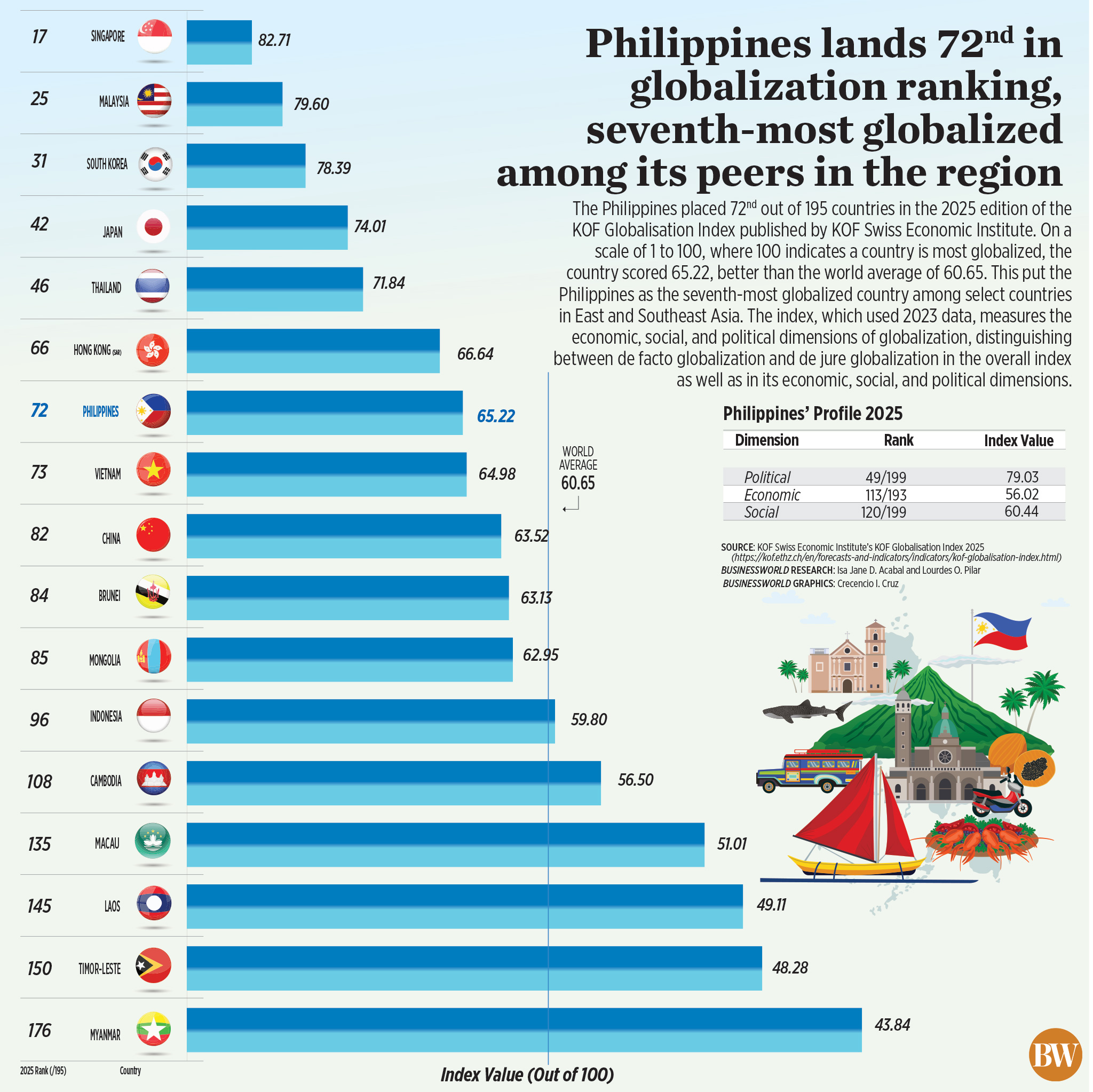
Philippines lands 72nd in globalization ranking, seventh-most globalized among its peers in the region

The Philippines placed 72nd out of 195 countries in the 2025 edition of the KOF Globalisation Index published by KOF Swiss Economic Institute. On a scale of 1 to 100, where 100 indicates a country is most globalized, the country scored 65.22, better than the world average of 60.65. This put the Philippines as the seventh-most globalized country among select countries in East and Southeast Asia. The index, which used 2023 data, measures the economic, social, and political dimensions of globalization, distinguishing between de facto globalization and de jure globalization in the overall index as well as in its economic, social, and political dimensions.

How PSEi member stocks performed — December 26, 2025

Here’s a quick glance at how PSEi stocks fared on Friday, December 26, 2025.


Market to consolidate amid holiday trading break

REUTERS

PHILIPPINE SHARES could end the year on a weak note as trading activity is expected to remain tepid amid this holiday-shortened trading week.

On Friday, the bellwether Philippine Stock Exchange index (PSEi) rose by 0.39% or 23.73 points to end at 6,065.64, while the broader all shares index went up 0.49% or 17.13 points to close at 3,464.66.

Week on week, the PSEi jumped by 144.77 points from its 5,920.87 close on Dec. 19.

“The PSEi ended higher despite a relatively quiet session, with the index trading within a narrow range for most of the day before the yearend,” Regina Capital Development Corp. Head of Sales Luis A. Limlingan said in a Viber message on Friday.

“The local bourse rebounded during the shortened trading week, reclaiming the 6,000 level on holiday optimism and bargain-hunting,” 2TradeAsia.com said in a market note.

Philippine financial markets were closed on Dec. 24-25 for the Christmas holidays.

Philstocks Financial, Inc. Research Manager Japhet Louis O. Tantiangco said the local market closed higher as investors took positions before the yearend.

“However, trading has been anemic, with net value turnover at P2.66 billion. This shows that many investors were staying on the sidelines, focused on the Christmas holidays,” he said in a Viber message.

For this week, activity may remain thin amid the lack of leads and the extended trading break, Mr. Limlingan said. The market will be closed again on Dec. 30 and 31 and Jan. 1 for Rizal Day and the New Year holidays. Trading will resume on Friday (Jan. 2).

“Limited volume and cautious positioning likely suggest investors are waiting for clearer catalysts before making more decisive moves ahead of the yearend,” he said.

“The thin value turnover seen also shows investors’ low confidence towards the local economy’s prospects for 2026, causing them to stay out of the market for the time being,” Mr. Tantiangco likewise said.

2TradeAsia.com said the PSEi is likely to close 2025 “on a whimper” even amid year-end window dressing and as technical indicators and valuations point to a gradual rebound in the first half of 2026.

“Easing inflation, further BSP (Bangko Sentral ng Pilipinas) rate cuts, and improving governance support a base-case rebound, aided by resilient consumption and potential foreign inflows on peso stability,” it said.

A low interest rate environment will be favorable for risk assets, it said.

“However, the delayed signing of the 2026 budget (now expected in early January) risks a brief reenacted regime, potentially delaying infrastructure spending and triggering short-term liquidity squeezes into the first quarter, which we already noted is a component of output that is desperately needed to reaffirm growth trajectory.”

It put the PSEi’s immediate support at 5,800, resistance at 6,000, and secondary resistance at 6,100. — Alexandria Grace C. Magno