Home Blog Page 1220

McIlroy wins Masters in dramatic fashion, completes career Slam

IT WAS FINALLY Rory McIlroy’s time, even if it took a little longer than perhaps was necessary.

McIlroy birdied the first playoff hole with a short putt after missing a chance to win in regulation, capturing the Masters and completing the career Grand Slam on Sunday in Augusta, Georgia.

“This is my 17th time here, and I started to wonder if it would ever be my time,” the Northern Irishman said. “I think the last 10 years coming here with the burden of the Grand Slam on my shoulders and trying to achieve that -— yeah, I’m sort of wondering what we’re all going to talk about going into next year’s Masters.”

McIlroy’s 1-over-par 73 left him tied with England’s Justin Rose, who posted 66 and waited for McIlroy to finish. They both shot 11-under 277 for the week.

Replaying the 18th hole at Augusta National Golf Club, McIlroy’s approach shot rolled back toward the hole and inside Rose’s ball. After Rose missed a birdie attempt and notched a par, McIlroy didn’t flub another chance for a victory.

He dropped his putter, put his hands on his head and fell prostrate on the green, sobbing.

“There was a lot of pent-up emotion that just came out on that 18th green,” McIlroy said. “A moment like that makes all the years and all the close calls worth it.”

It marked the fifth major championship for McIlroy, and his first since capturing the PGA Championship for the second time in 2014.

McIlroy needed par at No. 18 to win in regulation, but after blasting from a greenside bunker on the 18th hole he rolled a 5-foot par putt too far to the left.

It was a starkly different reaction from when he departed the 18th green following Thursday’s first round, which included a pair of backside double bogeys and dodging the media on the way to the practice area.

Rose spoke briefly to McIlroy after the playoff and later added perspective to what just happened.

“This is a historic moment in golf, isn’t it — someone who achieves the career Grand Slam,” Rose said. “I just said it was pretty cool to be able to share that moment with him. Obviously, I wanted to be the bad guy today, but still, it’s a momentous occasion for the game of golf.”

The new champion — who gave away his two-shot lead through 54 holes with a double bogey at No. 1 — also recovered from a disastrous stretch on the back nine to birdie the 17th hole for a brief one-stroke lead. McIlroy’s bogey on No. 11, double bogey on No. 13 and bogey on No. 14 appeared to send him on track for another final-round collapse at a major.

McIlroy said sending his ball into the creek on a wedge shot on the par-5 13th could have doomed his chances.

“I did a really good job of bouncing back from that,” he said.

McIlroy recovered for a birdie on the par-5 15th hole by drawing a tremendous second shot around a tree, over a water hazard and to 6 feet of the pin, where he two-putted for birdie.

Then he stuck his approach on No. 17 and sank the putt to take the lead.

Rose, seeking his first Masters title, had six birdies and two bogeys across the last eight holes, finishing with a 20-foot birdie putt.

“To make the putt on 18, the one you dream about as a kid, to obviously give myself an opportunity and a chance was an unbelievable feeling,” Rose said.

Rose was the leader after the first and second rounds, and after a tough 75 on Saturday he made a major final-round push. He had only four pars on his card — countering four bogeys with 10 birdies.

Patrick Reed (69 on Sunday) was third at 9 under. Defending champion Scottie Scheffler (69) placed fourth at 8 under, giving him four consecutive top-10 finishes at the Masters.

“I was just proud of the way we hung in there and put up a good fight,” Scheffler said.

Bryson DeChambeau, who figured to be McIlroy’s biggest threat and in the final pairing, took the lead after the second hole before stalling with back-to-back bogeys and a string of pars to skid off the path. By the time he double-bogeyed No. 11, he was tied for ninth and seventh strokes back.

DeChambeau’s 75 left him at 7 under, tied for fifth place with South Korea’s Sungjae Im (69).

DeChambeau said his troubles began with a putt on the third hole that scooted well beyond the cup.

“There’s no way that putt goes that far by,” he said. “I just didn’t realize how firm and fast it could get out here. It’s great experience. Won’t let that happen again.” — Reuters
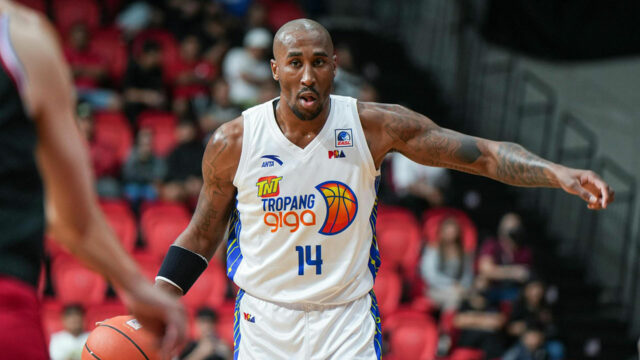

Tropang 5G braces for golden treble sans Hollis-Jefferson

RONDAE HOLLIS-JEFFERSON — EASL

AS THEY GEAR UP for their PBA grand slam bid, the TNT Tropang 5G are drawing extra motivation from the need to prove their worth.

Their big challenge — capture the final piece of a coveted golden treble in the Philippine Cup without Rondae Hollis-Jefferson, the heart and soul of their back-to-back triumphs in the Season 49 Governors’ Cup and Commissioner’s Cup.

“People are saying that, you know, the only reason why we’re winning all these championships is because of Rondae (Hollis-Jefferson). Yes, that’s true, but all this talk has to stop and that these guys are still capable of winning without Rondae,” team manager Jojo Lastimosa said.

“And this is something that they have to prove. They need to come together and talk about it like ‘hey, you know we have to show that we can win without Rondae’ and this is the biggest opportunity for them to show (that).”

One more big shoe to fill is that of ace playmaker Jayson Castro, who sustained a season-ending knee injury in the Commissioner’s Cup semis.

For that, the team is relying anew on Rey Nambatac, who has risen to the occasion and even delivered a Finals MVP-winning performance to help TNT beat Ginebra in seven games.

“If Rey was just a ‘mediocre Rey,’ no way we can win that series,” said Mr. Lastimosa.

Ahead of their All-Filipino campaign, the Tropang 5G signed up free agent Simon Enciso to boost their backcourt.

“Simon’s a hard worker and we know that he can make threes which is really important in our system,” he said.

The Chot Reyes-coached squad opened its training camp on Monday at the Inspire Sports Academy in Laguna, where they will hold six practices over three days.

After a break on Maundy Thursday and Good Friday, the Tropang 5G go back to work to get themselves ready for their Philippine Cup debut on April 23 against NLEX.

Notes: Larry Muyang accepted the indefinite suspension the PBA slapped on him but intends to exercise his right to appeal it before the board of governors. Mr. Muyang was banned for violation of the Uniform Players’ Contract after joining Pampanga in the MPBL amid a live contract with Phoenix until May. According to Pampanga Gov. Dennis Pineda, who accompanied Mr. Muyang in his meeting with commissioner Willie Marcial last Sunday, the 6-foot-5 player will try to mend fences with Phoenix and ask the PBA board to reconsider. — Olmin Leyba

Hunt, Iffland rule Red Bull Cliff Diving World Series in El Nido

EIGHT-TIME CHAMPION Rhiannan Iffland of Australia defies gravity with a stellar dive from the preserved limestone cliffs into the crystal clear waters of El Nido, Palawan to win the opening leg of the 2025 Red Bull Cliff Diving World Series over the weekend. Ten-time champion Gary Hunt of France ruled in the men’s side as the world-class diving event makes its Philippine return for the first time since 2019.

EL NIDO, PALAWAN might become one of the ‘meccas’ for cliff diving from here on.

No less than Red Bull Cliff Diving World Series officials and the divers themselves see that possibility on the horizon after two successful staging of the gravity-defying event at the renowned Lagen Island, Small and Big Lagoons there over the weekend.

“It’s tough climbing up the rocks but when you’re up there (at the El Nido cliffs), it feels like a mecca of high diving,” said 10-time Red Bull champion and two-time world championship king Gary Hunt of France, who has been all over the world for top-tier diving spots.

“It’s been a long time coming for six years. And it’s in El Nido again. I’m so happy to be here. My heart is full of joy and love.”

Mr. Hunt, 40, topped the opening leg with a vintage performance in the final two rounds at the Big Lagoon, boasting the preserved limestone cliffs of Palawan with crystal clear waters below and the scenic sunset behind.

It was also Mr. Hunt who ruled in 2019 when the world series made its Philippine debut, alongside four-time world diving championships queen Rhiannan Iffland of Australia who scored a repeat win in El Nido as well to shore up her nine-peat drive.

While it took six years for the world series to come back to the renowned island, aspiring divers and Filipino fans could expect a staple leg here moving forward with even a possibility of it being an annual thing.

“It’s just beautiful. This is the type of location we like for cliff diving. It’s a lot of places but to find the right spot with perfect technical requirements, these are probably the best places for that,” said Red Bull Sports Director Orlando Duque, a world pioneer for cliff diving.

“This is one of those places you always want to go back to. We went to a few places but it’s always been in the back of our heads to return. The calendar is being worked on as we go through the season. It’s not a yes, it’s not a no but if they ask me, I’ll say ‘Let’s go back to El Nido.’ That will be my vote.”

And for Mr. Duque, the inaugural world series champion in 2009, the next time might be the finale with the King Kahekili trophy at stake.

“The finale will be great. Both times we’ve been here, it’s been opening seasons. The finale is always great. Deciding the title is always a good option so let’s work with the Filipino team and then see if we can make it,” he beamed.

For now, the world series will take a short break before the next stops in Polignano A Mare in Italy on June 28 to 29 and Mostar in Bosnia and Herzegovina on September 5 to 6.

Boston in the United States will host the finale on September 19 to 20 featuring a total of 24 world-class divers led by now season leaders Hunt and Iffland, who will be out to extend their reign. — John Bryan Ulanday

SBA will stage Philippine Open at Sharks Arena

THE National Basketball Association (NBA) of billiards.

That’s how Sharks Billiards Association (SBA) Commissioner Hadley Mariano envisioned his group to be as they will stage another major tournament in the Philippine Open set from April 21 to 27 at the Sharks Arena and Sports Bar in Morato Ave., Quezon City.

“Our vision is for the SBA to become the NBA of billiards,” said Mr. Mariano during their event launch on Monday.

Mr.Mariano said they have partnered with government owned television PTV 4, which was represented by its OIC General Manager Oscar Orbos, as its broadcasting carrier.

The Philippine Open was one among the many events the SBA has organized with more coming in the pipeline.

The weeklong tournament will have at least 128 players, including female participants, with a prize fund of P1 million.

It will be a race-to-7 in the earlier rounds and race-to-13 in the finals, Mr. Mariano added.

Games and Amusement Board Chair Francisco Rivera recognized the growing interest in the sport, which has already staged 15 just in the first quarter of the year from merely seven in 2019 and 35 last year.

“I give the SBA two thumbs up,” said Mr. Rivera. — Joey Villar

Western Conference sorts out playoff bracket on final day

THE Los Angeles Clippers and the Golden State Warriors couldn’t let the chaotic race for Western Conference playoff seedings be unscrambled in regulation of their regular-season finale on Sunday.

They needed five more minutes, with the Clippers (50-32) winning 124-119 in overtime in San Francisco and securing the fifth seed and a playoff series against the fourth-seeded Denver Nuggets (50-32) when the first round begins April 19.

The loss dropped the Warriors (48-34) to seventh place and a date with the eighth-place Memphis Grizzlies (48-34) in the NBA Play-In Tournament on Tuesday in San Francisco. The winner becomes the West’s No. 7 seed in the playoffs.

Entering Sunday as teams played their 82nd games, the Eastern Conference seedings already were determined. Out West, however, only the top three seeds — the Oklahoma City Thunder (68-14), Houston Rockets (52-30) and Los Angeles Lakers (50-32) — had locked in seeding.

Fourth through 10th places were up for grabs, making for a wild day of scoreboard watching. For the first time since conferences were established in the 1970-71 season, three teams from one conference secured playoff berths on the last day of the regular season, according to the Elias Sports Bureau.

The Minnesota Timberwolves (49-33) won 116-105 over the lowly Utah Jazz (league-worst 17-65) on Sunday to avoid the play-in and clinch the sixth spot and a first-round series with the Lakers.

The Dallas Mavericks (39-43), as the 10th and final team to keep playing in the West, visit the ninth-place Sacramento Kings (40-42) in the other play-in game on Wednesday. The loser is eliminated, and the winner plays on Friday against the loser of the Grizzlies-Warriors to determine the West’s No. 8 seed.

The Nuggets, who won their last three games under interim head coach David Adelman, are the West’s fourth seed after beating the Rockets 126-111 on Sunday.

The No. 1 Thunder await the No. 8 play-in winner, and the No. 2 Rockets get the No. 7 winner.

Eastern Conference postseason teams already knew their assignments before Sunday, with the eighth-place Atlanta Hawks (40-42) visiting the seventh-place Orlando Magic (41-41) on Tuesday. The ninth-place Chicago Bulls (39-43) host the 10th-place Miami Heat (37-45) on Wednesday, with the loser eliminated.

The Hawks and Magic have split their four meetings this season, including Sunday when host Atlanta won 117-105 in a game played mainly by reserves.

The winner on Tuesday in Orlando becomes the East’s No. 7 seed and will face the second-seeded Boston Celtics (61-21) in the opening round.

The Hawks-Magic loser will face the winner of Heat-Bulls to advance as the East’s No. 8 seed and meet the top-seeded Cleveland Cavaliers (64-18) in Round 1.

Other Eastern Conference first-round matchups are the No. 3 New York Knicks (51-31) against the No. 6 Detroit Pistons (44-38) and the No. 4 Indiana Pacers (50-32) against the No. 5 Milwaukee Bucks (48-34). — Reuters

Pacers rally from 27 points down to dispatch Cavaliers

THE fourth-place Indiana Pacers rallied from 27 down on the road — the biggest comeback in team history — to beat the first-place Cleveland Cavaliers 126-118 in a battle of Eastern Conference playoff teams on Sunday.

Two-way player RayJ Dennis scored seven straight points in the second overtime and rookie Johnny Furphy added six points in the second extra period for the Pacers (50-32), who reached 50 wins for the first time since 2013-14. Quenton Jackson led Indiana with 21 points and Tony Bradley collected 14 points, 14 rebounds and five blocked shots.

The Cavaliers (64-18) rested nine of their top 10 scorers, including injured Donovan Mitchell (ankle) along with fellow All-Stars Evan Mobley and Darius Garland, but their non-rotation players shined in building a 74-47 lead midway through the third quarter.

Rookie Jaylon Tyson scored a career-high 31 points, Emoni Bates had a career-best 25 points and Nae’Qwan Tomlin had 24 points and 12 rebounds for Cleveland. Tristan Thompson grabbed 20 rebounds in 43 minutes, but was 1 of 6 from the foul line.

Furphy dunked in transition with 10 seconds left in regulation, forcing OT at 105. Indiana ended the fourth on a 32-9 run fueled by 11 points from Jackson.

Furphy finished with 15 points, nine rebounds and five assists.

Tyson scored the first four points in the first extra period, but the Pacers answered with two Jackson free throws and another Furphy dunk to send the game to double-OT at 109. Bradley missed a hook in the lane at the buzzer.

Cleveland will face the No. 8 seed in the East, which won’t be determined until the conclusion of the play-in tournament on April 18. Orlando, Atlanta, Chicago and Miami are their potential foes for Game 1 on April 20.

The Pacers take on No. 5 seed Milwaukee in the opening round. All-Star forward Pascal Siakam (elbow) and point guard Tyrese Haliburton (back) were held out, along with guards Bennedict Mathurin (left calf soreness) and Ben Sheppard (left big toe sprain).

Center Jarrett Allen, who played 41 seconds to accomplish his goal of appearing in all 82 games, finished the season with the seventh-best field goal percentage in NBA history at 70.6%. He is the first member of the Cavaliers to lead the league in the category. — Reuters

Trump says chips from China will face national security probe; further tariffs expected

 – U.S. President Donald Trump on Sunday bore down on his administration’s latest message that the exclusion of smartphones and computers from his reciprocal tariffs on China will be short-lived, pledging a national security trade investigation into the semiconductor sector.

Those electronics “are just moving to a different Tariff ‘bucket,'” Mr. Trump said in a social media post. “We are taking a look at Semiconductors and the WHOLE ELECTRONICS SUPPLY CHAIN in the upcoming National Security Tariff Investigations.”

The White House had announced the exclusions from steep reciprocal tariffs on Friday.

Mr. Trump’s commerce secretary, Howard Lutnick, earlier on Sunday said that critical technology products from China would face separate new duties along with semiconductors within the next two months.

The exclusions announced on Friday were seen as a big break for technology firms such as Apple and Dell Technologies that rely on imports from China.

Mr. Trump’s back-and-forth on tariffs last week triggered the wildest swings on Wall Street since the COVID pandemic of 2020. The benchmark Standard & Poor’s 500 index .SPX is down more than 10% since Trump took office on January 20.

Mr. Lutnick said Trump would enact “a special focus-type of tariff” on smartphones, computers and other electronics products in a month or two, alongside sectoral tariffs targeting semiconductors and pharmaceuticals. The new duties would fall outside Trump’s so-called reciprocal tariffs, under which levies on Chinese imports climbed to 125% last week, he said.

“He’s saying they’re exempt from the reciprocal tariffs, but they’re included in the semiconductor tariffs, which are coming in probably a month or two,” Mr. Lutnick said in an interview on ABC‘s “This Week,” predicting that the levies would bring production of those products to the United States. “These are things that are national security, that we need to be made in America.”

Beijing increased its own tariffs on U.S. imports to 125% on Friday in response. On Sunday, before Mr. Lutnick’s comments, China said it was evaluating the impact of the exclusions for the technology products implemented late on Friday.

“The bell on a tiger’s neck can only be untied by the person who tied it,” China’s Ministry of Commerce said.

Billionaire investor Bill Ackman, who endorsed Trump’s run for president but who has criticized the tariffs, on Sunday called on him to pause the broad and steep reciprocal tariffs on China for three months, as Trump did for most countries last week.

If Trump paused Chinese tariffs for 90 days and cut them to 10% temporarily, “he would achieve the same objective in causing U.S. businesses to relocate their supply chains from China without the disruption and risk,” Mr. Ackman wrote on X.


‘CHANGES EVERY DAY’

Sven Henrich, founder and lead market strategist for NorthmanTrader, was harshly critical of how the tariff issue was being handled on Sunday.

“Sentiment check: The biggest rally of the year would come on the day Lutnick gets fired,” Mr. Henrich wrote on X. “I suggest the administration figures out who controls the message, whatever it is, as it changes every day. US business can’t plan or invest with the constant back and forth.”

U.S. Senator Elizabeth Warren, a Democrat, criticized the latest revision to Mr. Trump’s tariff plan, which economists have warned could dent economic growth and fuel inflation.

“There is no tariff policy – only chaos and corruption,” Ms. Warren said on ABC’s “This Week,” speaking before Mr. Trump’s latest post on social media.

In a notice to shippers late on Friday, the U.S. Customs and Border Protection agency published a list of tariff codes excluded from the import taxes. It featured 20 product categories, including computers, laptops, disc drives, semiconductor devices, memory chips and flat panel displays.

In an interview on NBC’s “Meet the Press,” White House trade adviser Peter Navarro said the U.S. has opened an invitation to China to negotiate, but he criticized China’s connection to the lethal fentanyl supply chain and did not include it on a list of seven entities – the United Kingdom, the European Union, India, Japan, South Korea, Indonesia and Israel – with which he said the administration was in talks.

Trade Representative Jamieson Greer said on CBS’s “Face the Nation” that there were no plans yet for Trump to speak to Chinese President Xi Jinping on tariffs, accusing China of creating trade friction by responding with levies of its ownBut he expressed hopes for some non-Chinese deals.

“My goal is to get meaningful deals before 90 days, and I think we’re going to be there with several countries in the next few weeks,” Mr. Greer said.

Ray Dalio, the billionaire founder of the world’s biggest hedge fund, told NBC’s “Meet the Press” that he was worried about the United States sliding into recession, or worse, as a result of the tariffs.

“Right now we are at a decision-making point and very close to a recession,” Mr. Dalio said on Sunday. “And I’m worried about something worse than a recession if this isn’t handled well.” – Reuters

S. Korea begins criminal insurrection trial of ousted president Yoon

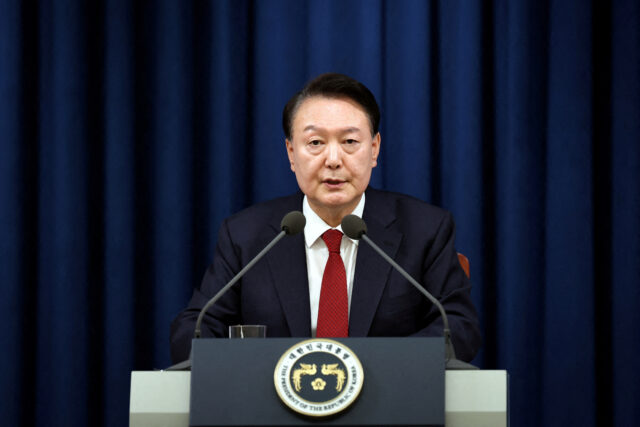
South Korean President Yoon Suk Yeol delivers a speech to declare martial law in Seoul, South Korea, December 3, 2024. The Presidential Office/Handout via REUTERS/File Photo

SEOUL — South Korea’s ousted leader Yoon Suk Yeol argued that his brief martial law declaration late last year was “not a coup d’etat” as he appeared in court on Monday for the start of a criminal trial over charges that he led an insurrection.

The martial law attempt, which lasted about six hours before Mr. Yoon backed down in the face of parliamentary opposition and public protests, plunged the country into months of turmoil and led to the Constitutional Court removing him from the presidency this month for violating constitutional powers.

After departing his house in a motorcade on Monday, Mr. Yoon, who has denied all charges against him, entered a courtroom at the Seoul Central District Court, wearing a dark navy suit and red tie.

At the start of proceedings, prosecutors presented their case by arguing Mr. Yoon lacked the legal grounds to declare martial law and accused him of trying to paralyze state institutions such as parliament.

“The defendant … made it impossible for constitutional institutions to exercise their authority based on an unlawful declaration,” the prosecution said.

Mr. Yoon, who was the country’s chief prosecutor before becoming president, spent about 40 minutes in the morning refuting the prosecution’s allegations.

“Martial law is not a coup d’etat,” Mr. Yoon said, adding that he had no intention of paralyzing the country, but that martial law was needed to alert the people to how the majority opposition party was stonewalling government by impeaching more than 20 officials, including the Board of Audit and Inspection chief, which he saw as a dangerous threshold.

“This was a peaceful ‘message martial law’ to the nation… I knew this martial law would end within half-a-day, a day,” Mr. Yoon said.

Mr. Yoon said although he had communicated this intention to ex-defense minister Kim Yong-hyun, military officials carrying out the order seemed to have overstepped it because they are used to  training for martial law under different guidelines.

INSURRECTION CHARGE
Two senior military officers are expected to take the witness stand in the afternoon.

One of them, Cho Sung-hyun from the army’s capital defense command, already testified at the Constitutional Court in February that he was ordered to send troops to “drag” lawmakers out of parliament during Mr. Yoon’s martial law order.

Mr. Yoon denied this allegation.

The martial law declaration, which cited the need to root out “anti-state” elements, was lifted six hours later after parliamentary staffers used barricades and fire extinguishers to ward off special operations soldiers trying to enter parliament, where lawmakers voted to reject martial law.

The charge of insurrection faced by the impeached leader is punishable by life imprisonment or even death, although South Korea has not executed anyone in decades.

Mr. Yoon’s martial law declaration on Dec. 3 shocked South Koreans, and created chaos in all areas of society, the economy and foreign policy, the Constitutional Court said when ruling to remove him from office.

The upheaval has further exposed deep social rifts between conservatives and liberals and stepped up pressure on institutions and the military, which had found itself in a quandary over whether to enforce martial law.

The former president returned to his private home on Friday from the official residence, with crowds of conservative supporters turning out to greet his motorcade.

He remains defiant and has pledged to “stand by” his supporters. The opposition Democratic Party slammed Mr. Yoon on Monday as delusional for not making any sincere apology.

The country will now hold a snap election on June 3. Questions remain over whether Mr. Yoon might still play a role.

Lee Jae-myung, the opposition leader who is leading presidential polls, visited on Monday a startup that develops artificial intelligence (AI) chips, pledging to ease regulations with aggressive investments in the AI industry. — Reuters

Japan PM warns US tariffs have potential to disrupt global economic order

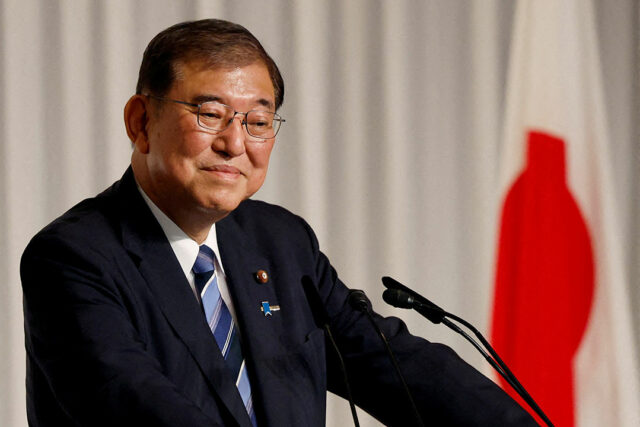
JAPANESE PRIME MINISTER SHIGERU ISHIBA — REUTERS FILE PHOTO

TOKYO — Japanese Prime Minister (PM) Shigeru Ishiba said on Monday that US tariffs have the potential to disrupt the global economic order, issuing his strongest warning to date about the damage President Donald J. Trump’s decisions could inflict on the world economy.

But he stressed that Japan would seek common ground with the United States on how the two countries can cooperate on issues ranging from trade and national security.

“In negotiating with the United States, we need to understand what’s behind Trump’s argument both in terms of the logic and the emotional elements behind his views,” Mr. Ishiba told parliament.

“I am fully aware that what’s happened so far has the potential to disrupt the global economic order,” he said.

Mr. Ishiba also said the government is not thinking of issuing a supplementary budget now but stood ready to act in a timely fashion to cushion the economic blow from US tariffs.

The remarks come ahead of the start of bilateral trade talks on Thursday that are expected to cover themes ranging from tariffs and non-tariff barriers to exchange rates.

In the latest back-and-forth on tariff pronouncements, Mr. Trump said on Sunday that he would be announcing the tariff rate on imported semiconductors over the next week.

Economy Minister Ryosei Akazawa, Japan’s top negotiator on trade talks with the United States, said any discussion on currency rates will be held between Japanese Finance Minister Katsunobu Kato and US Treasury Secretary Scott Bessent.

“Both countries share the view that excessive market volatility would have adverse effects on the economy,” Mr. Kato told the same parliament session. — Reuters

China’s Xi urges stronger trade ties with Vietnam amid US tariff tensions

REUTERS

HANOI/BEIJING — China’s President Xi Jinping on Monday called for stronger ties with Vietnam on trade and supply chains amid disruptions caused by US tariffs, as he kicked off a three-nation trip to Southeast Asia in the Vietnamese capital of Hanoi.

The visit, planned for weeks, comes as Beijing faces 145% US duties, while Vietnam is negotiating a reduction of threatened US tariffs of 46% that would otherwise apply in July after a global moratorium expires.

“There are no winners in trade wars and tariff wars, and protectionism has no way out,” Mr. Xi said in an article in Nhan Dan, the newspaper of Vietnam’s Communist Party, posted ahead of his arrival on Monday.

“The two sides should strengthen cooperation in production and supply chains,” he said, urging more trade and stronger ties with Hanoi on artificial intelligence and the green economy as well.

Under pressure from Washington, Vietnam is tightening controls on some trade with China to make sure goods exported to the United States with a “Made in Vietnam” label have sufficient added value in the country to justify that.

Vietnam is a major industrial and assembling hub in Southeast Asia. It imports most of its goods from China while the United States is its main export market. The country is a crucial source of electronics, shoes and apparel for the United States.

In the first three months of this year Hanoi imported goods worth about $30 billion from Beijing while its exports to Washington amounted to $31.4 billion, Vietnam’s customs data show, confirming a long-term trend in which imports from China closely match the value and swings of exports to Washington.

RAIL LINKS
Mr. Xi will visit Vietnam from April 14 to 15, and Malaysia and Cambodia from April 15 to 18. He last visited Cambodia and Malaysia nine and 12 years ago, respectively.

Mr. Xi’s trip to Hanoi, his second in less than 18 months, aims to consolidate relations with a strategic neighbor that has received billions of dollars of Chinese investments in recent years as China-based manufacturers moved south to avoid tariffs imposed by the first Trump administration.

The two Communist-run countries are set to sign about 40 agreements in multiple sectors, Vietnam’s Deputy Prime Minister Bui Thanh Son said on Saturday.

Vietnam’s top leader To Lam in an article published on Monday on state media said Hanoi wanted to boost cooperation in defense, security and infrastructure, especially on rail links.

It was unclear whether the agreements would be binding and entail financial commitments.

Vietnam has agreed to use Chinese loans to build new railways between the two countries, in a major confidence-building step that would boost bilateral trade and connections.

However, no loan agreement has yet been announced.

Beijing is also seeking Vietnam’s approval for its COMAC planes, which have so far struggled to find foreign buyers.

Despite strong economic ties, tensions frequently surface between the countries over contested boundaries in the South China Sea.

Vietnam’s concessions to the US to avoid tariffs may also irritate Beijing, as they include the deployment of Elon Musk’s Starlink satellite communication service in the Southeast Asian nation, in addition to the crackdown on some trade with China over possible fraud on rules of origin.

Vietnam, in recent months, has also imposed anti-dumping duties on several Chinese steel products and ended a tax waiver for low-value parcels in a move that government officials described as meant to reduce the inflow of cheap Chinese goods.

The two other countries on Mr. Xi’s Southeast Asia itinerary, Cambodia and Malaysia, are facing US duties of 49% and 24%, respectively, and have already begun reaching out to the US to seek a reprieve. — Reuters

Philippines less vulnerable to global trade shocks – Balisacan

PHILIPPINE STAR/WALTER BOLLOZOS

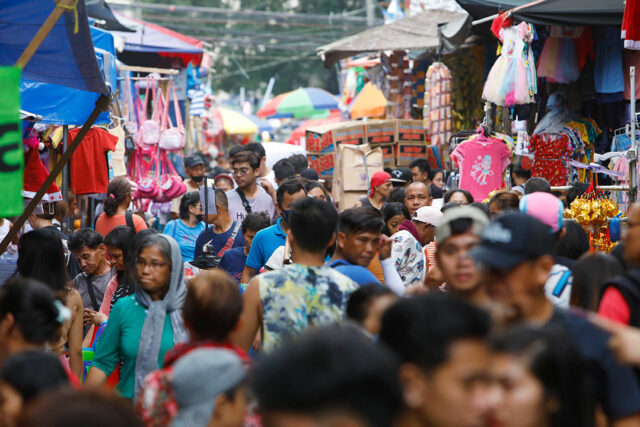
MANILA – The Philippines’ relatively low exposure to trade compared to its Asian neighbours offers a buffer against global economic shocks, National Economic and Development Planning Secretary Arsenio Balisacan said on Monday.

“The economy is not as vulnerable to shocks in the global marketplace as our neighbours… because the Philippine economy’s exposure to trade is fairly small,” Mr. Balisacan told a press conference.

However, he cautioned against complacency, stressing the importance of strengthening export performance by diversifying markets and addressing investment constraints so the country could take advantage of trade diversion opportunities resulting from the sweeping U.S. tariffs.

“We need to double, even triple, our efforts to improve the investment environment so investors see the Philippines as a viable destination,” Mr. Balisacan said.

The Philippines has not been spared from the global trade wars triggered by US President Donald Trump’s tariffs, with Washington threatening levies on Filipino exports.

The Philippines, which already has free-trade agreements with countries such as South Korea and Japan, is actively pursuing a similar pact with the United States to safeguard and expand market access.

Mr. Balisacan said it was premature to revise the country’s economic targets despite the heightened uncertainty. He noted that resilient domestic consumption, which makes up around three-quarters of GDP, should continue to support growth.

He believes hitting the lower end of this year’s 6.0% to 8.0% growth target remains realistic. — Reuters

Beyond tariffs: The case for strategic alliances over bureaucratic quick fixes

By Mon Abrea

The recent imposition of a 17% tariff on Philippine exports by the United States has triggered concern across sectors. While the immediate impact on trade may be evident, the broader question is how the Philippines should respond to such disruptive policies — not with reactive bureaucracy, but with strategic foresight and assertive diplomacy.

The Philippines: More Than Just a Trading Partner

In the midst of rising global protectionism, the Philippines holds a unique and powerful position. As a long-standing treaty ally of the United States and a key player in the Indo-Pacific, the Philippines is not just another trading partner — it is an indispensable strategic partner. Our geographic location, democratic institutions, and military cooperation agreements, including the Visiting Forces Agreement (VFA) and Enhanced Defense Cooperation Agreement (EDCA), reinforce our significance in regional security and global stability.

Economically, US companies remain deeply tied to the Philippines through global supply chains, manufacturing hubs, and business process outsourcing (BPO). These economic interdependencies provide us with leverage — one that should be harnessed wisely to advance our national interest in trade and beyond.

This is not just about tariffs. It’s about reinforcing a strategic alliance in a shifting global order.

The Bureaucracy Trap

In moments of crisis, governments often default to creating new councils or task forces. But more bureaucracy rarely means better solutions. It risks delays, duplications, and political capture.

The Philippines already has capable institutions — the Department of Trade and Industry (DTI), Department of Finance (DoF), National Economic and Development Authority (NEDA), and Department of Foreign Affairs (DFA). What’s needed is not a new layer of governance, but sharper coordination, faster execution, and clearer strategic messaging.

Establishing another body under the Office of the President — especially one composed of select business interests — could unintentionally tilt policy-making in favor of corporate elites. This risks sidelining MSMEs, labor, and the broader public interest.

A Smarter Way Forward

To address global trade disruptions and reinforce economic security, the Philippines must focus on three key strategies:

  1. Strategic Diplomacy

Engage the US at the highest levels, not just through trade representatives. Our role in regional security, democratic resilience, and supply chain continuity should be central to our messaging.

  1. ASEAN Solidarity

Protectionism undermines regional cohesion. By rallying ASEAN partners to take a united stand, the Philippines can amplify its voice and promote multilateral, rules-based trade engagement.

  1. Institutional Agility

Instead of reinventing structures, strengthen existing ones. Mobilize interagency task forces, streamline trade responses, and ensure inclusive consultations — not dominated by corporate lobbyists, but reflective of national interests.

Turning a Tariff into an Opportunity

This 17% US tariff is more than a trade obstacle — it’s a timely reminder for the Philippines to rethink its strategic posture. The response must be agile, inclusive, and internationally informed.

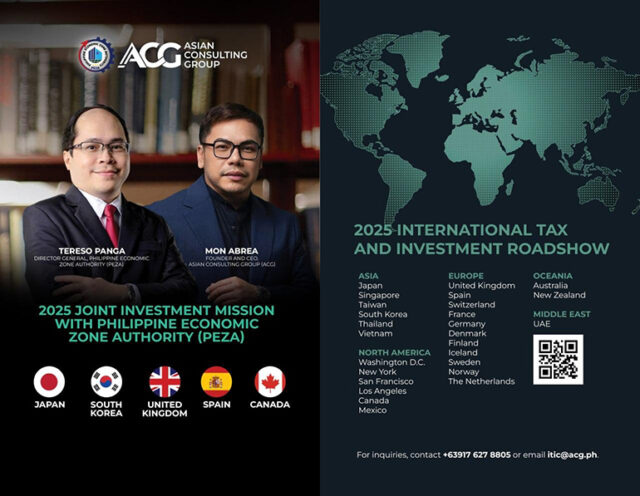
As we continue our international tax and investment roadshow across Asia, Australia, the Middle East, Europe, Canada, and the United States, we are engaging global investors and institutions with one message: the Philippines remains a strategic and sustainable investment destination — now more than ever.

In moments of global uncertainty, it’s not the loudest bureaucracy that leads — it’s the most strategic nation that prevails.

Mon Abrea, CPA, MBA, MPA is the Founder and CEO of the Asian Consulting Group (ACG) and the Philippines’ foremost advocate of genuine tax reform. A Harvard graduate who also completed an executive program on Climate Policy at Oxford, he advises governments, multinational corporations, and global institutions on tax policy, governance, and sustainable investment. He has delivered investment and tax briefings in over 50 countries and states across Asia, North America, Europe, Australia, and the Middle East. He also hosts the podcast Thought Leaders and Game Changers, where he speaks with global experts on taxation, sustainability, and innovation. Follow him: @askthetaxwhiz.


Spotlight is BusinessWorld’s sponsored section that allows advertisers to amplify their brand and connect with BusinessWorld’s audience by publishing their stories on the BusinessWorld Web site. For more information, send an email to online@bworldonline.com.

Join us on Viber at https://bit.ly/3hv6bLA to get more updates and subscribe to BusinessWorld’s titles and get exclusive content through www.bworld-x.com.