Home Blog Page 12

NCR economy grows 4.4% in 2025, weakest in 5 years
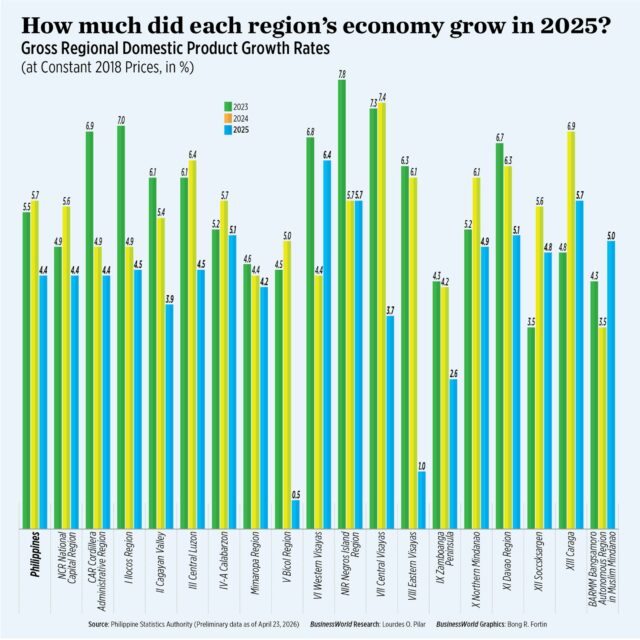
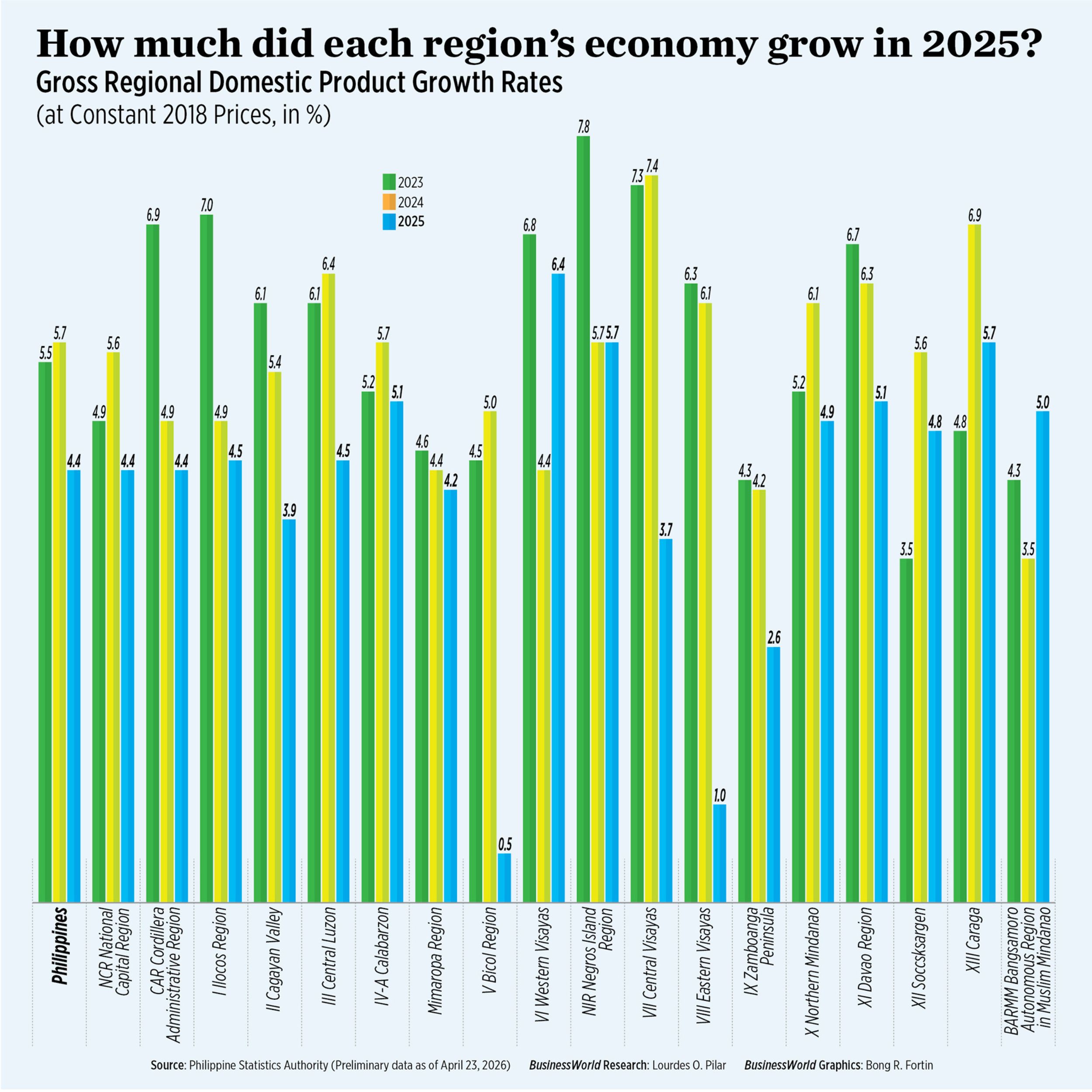
GROWTH in Metro Manila’s economic output slowed to a five-year low of 4.4% in 2025, dragged down by the flood control scandal and severe weather effects, the Philippine Statistics Authority (PSA) reported on Thursday.

Citing preliminary results, the PSA said the National Capital Region’s (NCR) economic output slowed from a 5.6% expansion in 2024.

In 2020, at the height of the pandemic, the NCR economy contracted 10%.

The NCR’s economic growth was in line with the revised 4.4% national gross domestic product (GDP) in 2025.

At constant 2018 prices, NCR economic output amounted to P7.24 trillion in 2025, against P6.94 trillion in 2024.

“NCR’s slower growth picture mainly reflected losses in economic confidence and dynamism following severe weather and the flood control scandal,” Marco Antonio C. Agonia, an economist at the University of Asia and the Pa-cific, said in an e-mailed response to questions.

Mr. Agonia noted that, with the other regions, economic growth eased as spending appetite among households and firms weakened.

“The NCR remains the country’s primary services hub, accounting for about 41% of total services output nationwide, which makes overall growth highly sensitive to changes in household demand, business activity, and urban services,” Union Bank of the Philippines Chief Economist Ruben Carlo O. Asuncion said via Viber.

“Growth was further tempered by weaker investment conditions during the year, as capital spending declined, limiting spillover effects to construction, real estate‑related activity, and supporting services,” Mr. Asuncion added.

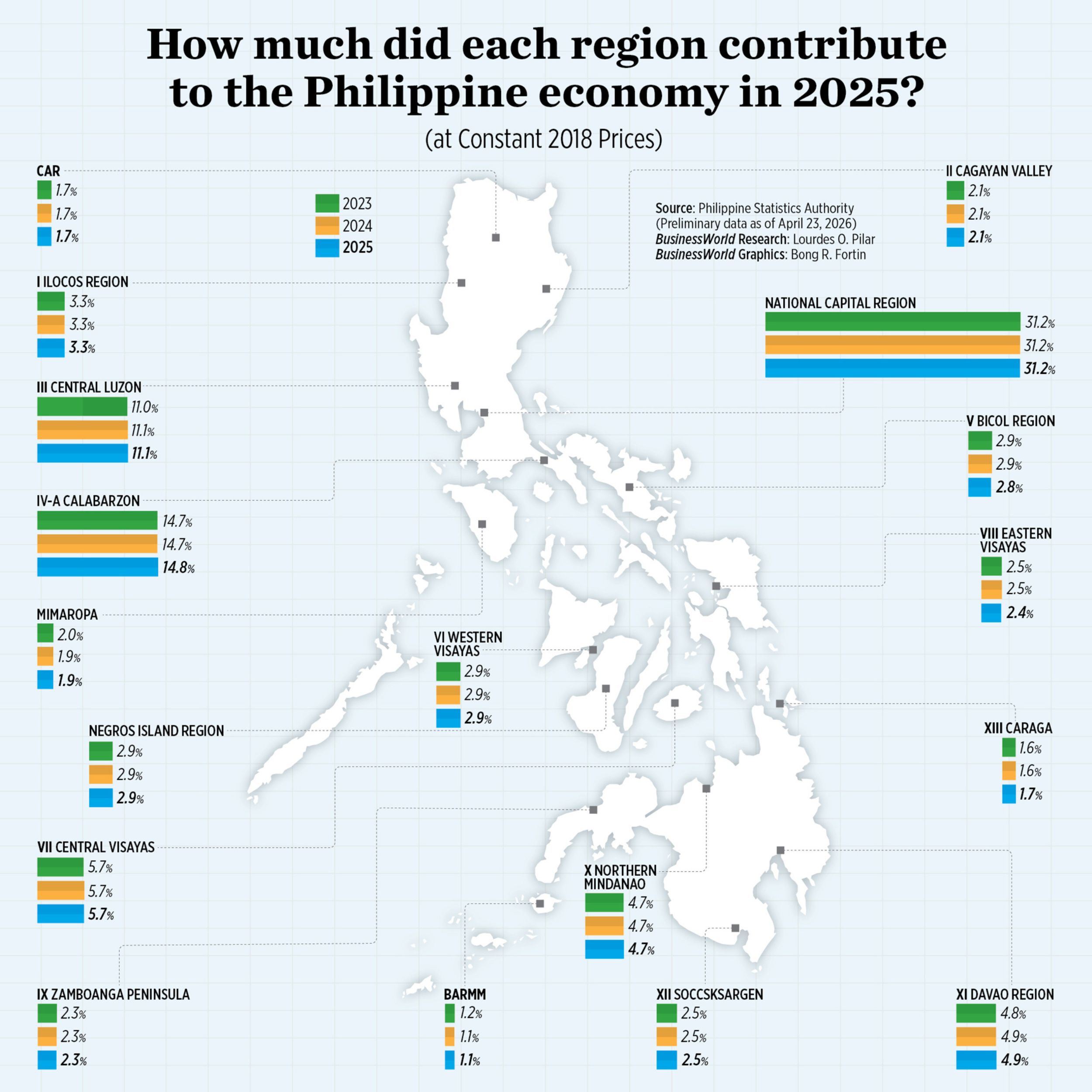
Metro Manila remained the top contributor to the overall Philippine economy last year at 31.2%, followed by Calabarzon (14.8%) and Central Luzon (11.1%).
Among the 18 regions, Western Visayas posted the strongest growth at 6.4% in 2025. This was followed by Caraga (5.7% from 6.9% in 2024) and Negros Island Region (NIR, 5.7% from 5.7%).

On the other hand, Bicol Region posted the weakest growth at 0.5% in 2025, easing from 5% in the previous year. The Eastern Visayas (1% from 6.1% in 2024) and Zamboanga Peninsula (2.6% from 4.2%) followed.

“The large variation in regional growth in 2025 — from Western Visayas (6.4%) at the top to Bicol (0.5%) at the bottom — largely reflects differences in agriculture performance, tourism recovery, infrastructure activity, and ex-posure to weather disturbances,” Ateneo Center for Economic Research and Development Senior Research Fellow Ser Percival K. Peña-Reyes said via Viber.

Mr. Asuncion said the growth in the Western Visayas was mainly driven by strong overall economic activity and per-capita output, while Caraga and the NIR were supported by faster growth in household spending.

“In contrast, regions such as Bicol, Eastern Visayas, and Zamboanga Peninsula experienced slower growth as investment activity weakened sharply, with these areas registering double‑digit contractions in gross capital for-mation,” he added.

In 2025, 83.6% of NCR’s output was driven by the services sector, which grew 5.1%, easing from 6% in 2024.

Wholesale and retail trade, which accounted for 22.4% of the services sector, eased to 3.9% from 4% in 2024.

With a 20.6% share of Metro Manila’s services sector, the financial and insurance activities sector slowed to 5.8% from 8.4% in 2024. Meanwhile, professional and business services (13.2% share) grew 4.9% in 2025, slower from the 6.7% posted in the previous year.

The total value of NCR’s service industry hit P6.05 trillion in 2025, up from P5.76 trillion in 2024.

Meanwhile, the industry sector, which accounted for 16.4% of the NCR economy also slowed to 0.7% in 2025 from 3.6% in 2024.

The PSA mainly attributed the slowdown in NCR’s industry sector to the 1.8% contraction in construction, against the 7.5% growth registered in 2024.

PSA NCR Regional Director Paciano B. Dizon said that, though there are contributions from private building construction, the decline in the construction subsector was due to the government spending freeze at the height of the flood control scandal in 2025.

“With construction, we can see how corruption would slow down not only the economy of the NCR, but it also affects, if not all, most of the economies of the other regions and the growth of the Philippines as a whole,” Mr. Di-zon said during the briefing.

Mr. Peña-Reyes said slower growth in construction was a mix of “delayed public infrastructure spending, high costs and expensive financing, weaker private real estate demand and execution challenges (weather, congestion, permitting).”

“Because construction feeds into manufacturing, real estate, and employment, its decline significantly dragged down the entire industry sector — and ultimately NCR’s overall GDP growth,” Mr. Peña-Reyes added.

Apart from the flood control scandal, Mr. Agonia said periodic bad weather also affected construction growth for public works projects.

“On the private sector side, property developers deferred projects in the metro following relatively high interest rates and the condo oversupply. In a similar vein, the government spending freeze also lowered spending appetite for private firms who usually benefit from infrastructure multiplier effects, dragging growth in the services sector,” he added.

The agriculture sector, which comprised 0.01% of NCR’s economic output, grew 4.2% in 2025 from 0.8% in 2024.

The Bangsamoro Autonomous Region in Muslim Mindanao posted the strongest growth in services at 8.5% in 2025 (from 6.1% in 2024), followed by Northen Mindanao (8% from 7.4%) and Cagayan Valley (7.4% from 6.5%).

In the industry sector, Caraga posted the strongest growth at 4.8%, against 6.1% in 2024.

Meanwhile, the Western Visayas agriculture sector posted the strongest growth among the 18 regions at 9.5%, a turnaround from the 7.4% contraction in 2024.

On the expenditure side, Caraga logged the fastest growth in household spending at 6.7% in 2025 from 4.6% in 2024.

Meanwhile, growth in government spending was fastest in the Ilocos Region, surging 15.6% last year from 4% in 2024.

Caraga posted the strongest expansion in gross capital formation at 8.5%, against 11.6% in 2024.

On a per-capita basis, Metro Manila logged the largest gross regional domestic product at P522,564 in 2025, up 3.8%.

This year, Mr. Peña-Reyes sees stable but slower economic growth for NCR “with services-led resilience offset by inflation, high rates, and global uncertainty.”

“It is not a recession scenario, but rather a compressed-growth environment, where demand is still there, but expansion is cautious and cost-constrained,” he said.

Mr. Agonia expects a “muddled growth outlook” for the NCR and the rest of the country this year.

“We expect higher oil prices and supply chain disruptions harming growth and raising inflation for the entire country. However, AONCR (areas outside of NCR) may suffer more than the capital region due to weaker regional sup-ply chains and poorer infrastructure,” he added.

Mr. Asuncion said sustained growth in the NCR will depend on household spending resilience and a recovery in investment activity.

“While services provide a stable base, renewed capital formation will be key to lifting growth toward firmer levels, especially for construction‑linked and investment‑driven segments of the regional economy,” he added. — Isa Jane D. Acabal

Budget utilization rate hits 98.5% at end of March

GOVERNMENT AGENCIES posted a budget utilization rate of 98.5% in March, behind the year-earlier pace of 99%, the Department of Budget and Management (DBM) said.

In its Notice of Cash Allocations (NCAs) Utilization Report, the DBM said that the National Government, local governments, and state-owned companies used P1.22 trillion out of P1.24 trillion issued NCAs as of the end of March.

Unused NCAs stood at P19.14 billion, the DBM said.

NCAs are quarterly disbursement authorities issued by the DBM to agencies, allowing them to withdraw funds from the Bureau of the Treasury for their spending needs.

In March, line departments used P749.19 billion, or 97.5% of their allotments, while P19.11 billion remained unused.

Six agencies posted a 100% budget utilization rate: the Office of the Vice-President, the Judiciary, the Commission on Audit, the Commission on Elections, the Office of the Ombudsman, and the Commission on Human Rights.

Four had 99.9% utilization rates: State Universities and Colleges and the departments of Foreign Affairs, Migrant Workers, and Transportation.

The departments of Energy, National Defense, and Tourism used 99.8% of their NCAs, while the departments of Education, Health, Human Settlement and Urban Development, Interior and Local Government, and Labor and Em-ployment used up 99.7%.

The Civil Service Commission posted the lowest utilization rate of 58.2% at the end of March.

The other departments with the lowest utilization rates were the departments of Agriculture (84.5%), Social Welfare and Development (86.3%), and Economy, Planning, and Development (87.3%).

Budgetary support to state-run firms, amounting to P87.5 billion, was fully utilized as of the end of March.

Allocations to local government units (LGUs) were 100% utilized, along with NCAs issued to the Metropolitan Manila Development Authority.

Michael L. Ricafort, chief economist at Rizal Commercial Banking Corp., said that the utilization rate still reflects some underspending since the latter part of 2025.

“But the latest improvements may have to do with some government catch-up spending,” he said via Viber, citing the increase of utilization from 87% in February.

However, he said government agencies should spend approved funds faster and more effectively.

“There is a need to maximize the use of government funds … since some of these are financed by loans that charge interest rate costs and amid the policy to optimize the use of funds,” he added. — Justine Irish D. Tabile

Calabarzon working to ‘localize’ Trabaho Para Sa Bayan strategy

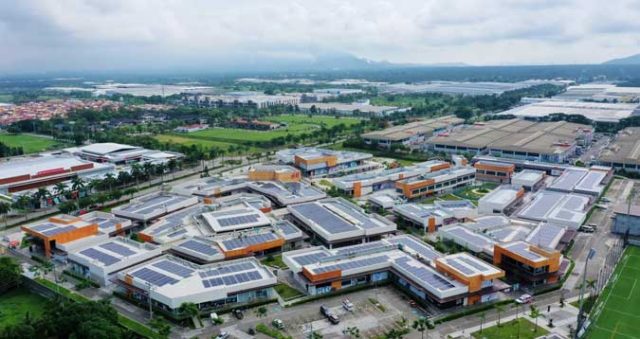
LIMA Estate’s 30-hectare commercial area in Batangas. — BW FILE PHOTO

By Erika Mae P. Sinaking, Reporter

CALAMBA, Laguna — Regional economic and employment planners said they are working to make a nationwide government livelihood plan better reflect local conditions, citing the need to align workforce skills with the industrial demands of the Philippines’ most populous region.

The Calabarzon region, a major industrial hub, continues to grapple with persistent skills mismatches that risk undermining its competitiveness and ability to generate stable, quality employment, officials said on Thursday.

The localization of the Trabaho Para sa Bayan Plan, a 10-year master framework designed to guide labor market development, is being positioned as a critical intervention to bridge these gaps and strengthen coordination be-tween education, industry, and government institutions.

Assistant Secretary Agnes E. Tolentino of the Department of Economy, Planning, and Development (DepDev) Regional Development Group told BusinessWorld that aligning workforce capabilities with industry re-quirements remains a central concern for planners in the region.

The Philippine Statistics Authority (PSA) also on Thursday reported that Calabarzon’s economy grew 5.10% in 2025, exceeding the national average growth rate of 4.40%.

The region remains the country’s primary industrial center, accounting for a 25.4% share of the national industrial sector. It also accounts for 10.9% of services sector output.

“Since this is an industrial region, our demand here has to be addressed under the Trabaho Para sa Bayan to really complement or to provide for the support to our industries,” Ms. Tolentino said. “The mis-match between the skills of the graduates as compared to what is actually being required by the industry (makes it) very crucial for us to create jobs that are stable and decent.”

“When we localize the plan, we have to come up with other strategies not just at the provincial level, but even at the municipal and city level, for us to come up with manpower that is ready for absorption in the industry,” she added.

The DEPDev official said that reducing training costs for employers is also a key consideration, noting that improving baseline skills among graduates could make workforce integration more efficient.

“It doesn’t have to be very expensive on the part of the industry, just to get the level of skills that they need,” she said, in calling for stronger alignment between academic preparation and actual job requirements.

“Of course, we also have to enhance investments in the region, to support the needs of industries and other sectors. We also have agriculture, which is also promising in terms of its contribution,” she added.

Jorge Manuel C. Laude, a senior labor and employment officer at Department of Labor and Employment (DoLE) Region IV-A, said the Trabaho Para sa Bayan Plan serves as a blueprint to guide employment strategies over the next decade.

“This is a 10-year master plan. But we acknowledge that there are pressing challenges and issues that we need to immediately address so that we can mitigate possible adverse effects on the labor market,” Mr. Laude said in a separate interview.

He noted that identifying urgent priorities at the regional level is crucial to ensure that the broader plan remains responsive to current conditions.

“Although these may not yet be fully highlighted in the plan, we need to identify which ones are more pressing that we need to act on,” he said.

“We also want to encourage our applicants to stay and work here in Calabarzon, so they no longer need to go to other regions to find employment,” Mr. Laude said. “Through this plan, we envision generating quality jobs within the region.”

Agriculture dep’t forms office to manage World Bank programs

DA.GOV.PH

THE Department of Agriculture (DA) said it created a dedicated project management office (PMO) to oversee two World Bank-supported programs.

In Department Order No. 13, the DA consolidated the management of the Philippines Sustainable Agriculture Transformation (PSAT) program and the Technical Assistance for Sustainable Agricultural Transformation (TASAT) project in a single office.

The $1-billion PSAT program, structured as a policy-based loan, links the release of funds to performance targets, while the $24.5-million TASAT project provides technical support for institutional reforms in agriculture.

Both programs are financed through official development assistance from the World Bank.

In a statement on Thursday, the DA said the restructuring is intended to streamline execution and address coordination gaps across multiple units involved in delivering the programs.

“The creation of a unified PMO is critical to ensure that these programs are implemented efficiently, transparently, and in full alignment with our reform agenda,” Agriculture Secretary Francisco P. Tiu Laurel, Jr. said in the statement.

Under the new setup, a project director will lead the PMO, supported by a deputy who will handle day-to-day operations and compliance.

The office will also include specialized units tasked with delivering specific reform outcomes tied to disbursement-linked indicators required by the lender.

The units will be supported by technical working groups drawn from across the DA, including divisions handling rice systems, high-value crops, logistics, procurement, and audit functions.

The DA said a project support team will manage finance, procurement, and human resources, with dedicated units expected to help minimize delays that have tended to affect publicly funded projects. — Vonn Andrei E. Vil-lamiel

Fish landed at regional ports up 15% in March

PHILSTAR FILE PHOTO

THE Philippine Fisheries Development Authority (PFDA) said fish landed at regional fish ports totaled 50,608 metric tons (MT) in March, up 15.62% from a year earlier.

In a statement, the PFDA said the volume unloaded for March was the highest recorded in the first quarter.

The PFDA said the Navotas Fish Port Complex posted 24,461 MT of fish landed, up 36.58% from a year earlier.

The General Santos Fish Port Complex landed 16,966 MT in March.

The PFDA said the Bulan Fish Port Complex in Sorsogon posted the largest year-on-year increase, with volume almost doubling to 3,452 MT.

Fish unloaded at the Iloilo Fish Port Complex rose 15.25% in March to 2,818 MT.

The volume of fish landed at the Lucena Fish Port Complex in Quezon grew 12.35% to 1,943 MT, while fish landed at the Zamboanga Fish Port Complex rose 72.84% to 727 MT.

The Davao Fish Port Complex reported landed volume of 237 MT.

The Department of Agriculture has said it is studying a proposal to grant a P10 subsidy per kilo of catch landed at government fish ports to assist municipal fisherfolk and commercial operators deal with rising fuel costs.

Agriculture Secretary Francisco P. Tiu Laurel, Jr. told a Senate hearing that the proposal will require consultation with the government’s economic managers to determine how to fund the scheme.

“If it can be funded, commercial fishers, and even municipal fishers with larger boats, will receive P10 for every kilo they unload at government fish ports. But that needs to be funded,” he said. — Vonn Andrei E. Villamiel

PHL, Malaysia smooth over diesel-sourcing gaffe

REUTERS

THE PHILIPPINES and Malaysia reaffirmed their intent to cooperate on energy after clarifying the sourcing of shipment of diesel, which was obtained from a private trading company rather than Malaysian national oil compa-ny Petronas.

In a statement on Thursday, the Department of Energy (DoE) said it held bilateral talks with Malaysia’s Ministry of Economy and Ministry of Foreign Affairs, after the DoE announced on April 11 that it had secured a 329,000-barrels shipment of diesel from Petronas.

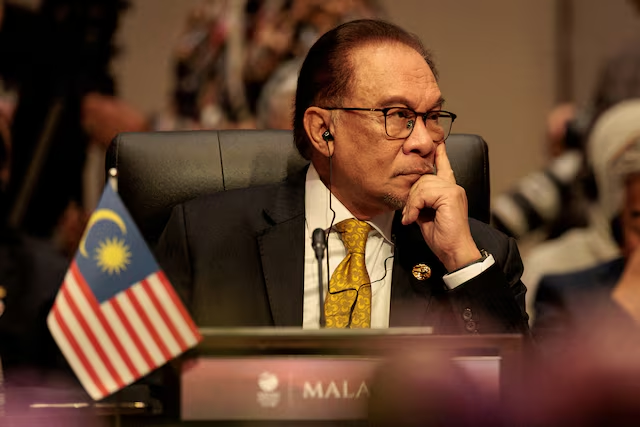
The actual source was the Singapore office of trading company Vitol Asia Pte. Ltd., according to Malaysian Prime Minister Anwar Ibrahim, who rejected reports that the Philippines had obtained diesel from Malaysia. The Prime Minister identified Vitol as the supplier in a social media post.

At the bilateral meeting, the DoE was represented by Secretary Sharon S. Garin, Undersecretary Alessandro O. Sales, and key officials from the Philippine National Oil Co. and PNOC-Exploration Corp.

“The Philippines values its long-standing partnership with Malaysia, particularly in advancing regional energy cooperation,” the DoE said.

“We express our appreciation for the open and productive engagement, which reinforces our shared commitment to ensuring stable and reliable energy supply, strengthening market resilience, and promoting coordinated re-sponses to evolving global conditions,” it added.

The Philippines has been an active buyer of fuel since the outbreak of war in Iran, which has disrupted petroleum shipments from the Persian Gulf. — Sheldeen Joy Talavera

FAO tags PHL as key driver of global meat market

REUTERS

THE Philippines was among the countries that drove growth in global meat shipments in 2025, citing its strong demand and constrained domestic supply, the United Nations’ Food and Agriculture Organization (FAO) said.

In its meat market review, the FAO reported that the global meat trade grew 3.4% to 43.4 million metric tons (MMT) in 2025, supported by robust import demand despite tight availability, animal disease outbreaks, and shifting trade policies.

The FAO said imports declined in major markets such as China and Japan, with the shortfall offset by higher purchases from countries that included the Philippines.

The Philippines was identified as the second-largest contributor to the growth in global pig meat import demand, reflecting continued constraints in domestic production due to African Swine Fever (ASF).

The FAO estimated that Philippine pork production declined 2.46% to 1.38 MMT in 2025, while imports rose 22.05% to 620,000 metric tons.

Overall, meat imports into the Philippines increased to 1.51 MMT in 2025, up 15.33%, which was accompanied by a modest increase in domestic meat production to 3.39 MMT.

Globally, the pork trade expanded 2.3% to 10.02 MMT in 2025, the FAO said. — Vonn Andrei E. Villamiel

NSCR north right-of-way acquisition rate tops 65%

DOTR PHOTO

THE Department of Transportation (DoTr) said it resolved 345 expropriation pleadings, raising the right-of-way (RoW) acquisition rate for the North-South Commuter Railway (NSCR) north segment to 65.5%.

“With our partnership with the OSG (Office of the Solicitor General) we are fast-tracking the right-of-way and site acquisitions for DoTr’s big-ticket projects. We need this to expedite the construction and to ensure the comple-tion of transport projects,” Transportation Acting Secretary Giovanni Z. Lopez said in a statement on Thursday.

The DoTr said securing RoW has always been one of the major challenges in transport project implementation as land acquisition always delays and disrupts construction schedules.

The affected portion of the project is the Clark-Malolos corridor of the NSCR project, including critical sites for the Metro Manila Subway project, Mr. Lopez said.

The DoTr had reported an RoW acquisition rate of 7.59% in March 2025.

It said 1,537 of the 2,647 affected households have received compensation for the acquisition.

The NSCR north section is expected to be operational by 2028, while the southern section will be completed by 2031. The entire NSCR is expected to be fully operational by late 2031 or early 2032.

The 147-kilometer NSCR will connect Malolos, Bulacan with Clark International Airport, and Tutuban, Manila with Calamba, Laguna. The P873-billion project is co-financed by the Japan International Cooperation Agency and the Asian Development Bank. It will have 35 stations and three depots.while, the Metro Manila Subway project’s RoW is now at 90.80%, with the project expected to be completed by 2032. — Ashley Erika O. Jose

VP Duterte denies hidden wealth claims

VICE-PRESIDENT Sara Duterte-Carpio held a press conference with Kamuning Bakery Café owner and Philippine Star columnist Wilson Lee Flores to celebrate World Pandesal Day in Quezon City on Thursday. — PHILIPPINE STAR/MIGUEL DE GUZMAN

By Chloe Mari A. Hufana, Reporter

VICE-PRESIDENT (VP) Sara Duterte-Carpio on Thursday rejected allegations of hidden wealth, accusing political rivals of weaponizing state institutions amid impeachment proceedings at a House of Representatives panel.

In a statement following a hearing which revealed gaps in her wealth statements and billions of suspicious bank transactions, Ms. Duterte asserted her service record is “clean.”

“I have never had a case involving misuse of public funds. All of my properties and money have been declared in my SALN (statement of assets, liabilities, and net worth),” she said in Filipino.

“Every centavo comes from legitimate sources and is backed by proper documentation.”

SALN records presented during the House Justice Committee hearing showed that no liquid assets were declared from 2019 to 2024. No liabilities were also disclosed in her SALNs beginning 2021.

In the same hearing, the Anti-Money Laundering Council (AMLC) said it recorded a total of 630 covered transaction reports and 33 suspicious transaction reports involving bank accounts linked to Ms. Duterte and husband, Manases R. Carpio.

AMLC also confirmed 19 of the 71 bank transactions presented by former Senator Antonio F. Trillanes IV, who alleged the Vice-President has billions in undisclosed bank accounts.

The former lawmaker claimed that joint accounts held between Ms. Duterte and her father, former President Rodrigo R. Duterte, contained millions in transactions and were never reflected in their SALNs.

Ms. Duterte called the accusations recycled, adding that the allegations failed to yield formal findings after nearly a decade.

“From 2016 to 2026, nothing in his narrative has changed. What has changed, however, is the machinery now backing him,” she said.

“Today, he is backed by a sitting President who must be compelled to submit to a simple drug test.”

She also criticized the House of Representatives, calling its members “law-benders;” the Commission on Audit, accusing it of timing its issuances to coincide with political attacks; and “newly installed” AMLC officials for refusing to clarify that no violations were committed and that alleged billions of pesos in bank accounts were “untrue.”

“As the administration’s use and abuse of our institutions for politics deepens, their fear of accountability becomes more evident,” she said in Filipino, referring to a multibillion-peso kickback scheme tied to flood control projects that allegedly involved government officials, lawmakers, and contractors.

Ms. Duterte’s defense team spokesman Michael T. Poa, in a separate livestreamed briefing on Thursday, said all allegations will be answered in the impeachment court, the Senate.

“The defense team is not here to lose… we’re here to show there are no anomalies in the work of the Vice-President,” he said in mixed English and Filipino. “[We’re here to] show the Filipino people the Vice-President is not corrupt.”

The House will resume its impeachment hearings on April 29.

‘LAST-MINUTE’ TRAVEL AUTHORITY

Meanwhile, Ms. Duterte changed her international travel plans following a “last-minute” travel authority issued by the Office of the President.

“I regret to inform you that the plans have since changed due to uncertainty whether I will be permitted to depart,” she said in a statement on Thursday.

According to a document on Wednesday evening confirmed by Palace Press Officer Clarissa A. Castro, the Vice-President was scheduled to fly out of the Philippines from April 23 to May 15, visiting the Netherlands, South Korea, Belgium, Germany and the United Kingdom.

“You are hereby authorized to travel… while on leave of absence, at no cost to the government,” the document, signed by Executive Ralph G. Recto on April 22, read.

Ms. Duterte said the late issuance of her travel authority pushed her to alter her plans.

“Please ensure that the necessary documents be processed and issued promptly, allowing sufficient time for travel preparations rather than only a few hours before the intended departure,” she said.

She emphasized the need to ensure confidentiality and proper handling of sensitive documents to maintain effective security arrangements.

In a separate press briefing, Ms. Castro said the Vice-President applied for a travel authority on April 14 for her April 23 flight.

It takes about five days for the Office of the President to issue travel authorities, Ms. Castro noted.

She said the Vice-President’s travel requests were always granted a day before her intended travel dates.

“The Vice-President, according to records, receives a document for her travel authority a day before her intended vacation,” Ms. Castro said in Filipino. “To say that this is a last-minute resolution or decision, it is not like that because that is always the case; normally, it happens that she is given travel authority a day before.”

The Palace hit on Ms. Duterte’s call for confidentiality, saying she is a public servant and questioning the timing of her travel amid a national energy emergency in the Philippines.

“There are things that the public should know because she is a public servant… In the midst of the crisis in the Middle East, in the midst of the billion-dollar issues that are currently involving the Vice-President and her husband,” said Ms. Castro.

She said Malacañang will only prevent Ms. Duterte from traveling if there is a hold departure order or an immigration lookout bulletin order against her.

“She is the Vice-President. She is a public servant. She says she is promoting accountability and transparency, she should be the one to know what she should do, how to explain it to the people.”

Ms. Duterte’s father is currently detained at the International Criminal Court in The Hague, Netherlands for alleged crimes against humanity tied to his infamous drug war.

President Ferdinand R. Marcos, Jr. and Ms. Duterte were running mates in the 2022 presidential polls, which led to a landslide victory due to their families’ political prominence.

However, their relationship turned sour in 2024 when Ms. Duterte resigned as Mr. Marcos’ Education chief, citing personal reasons, the need for an orderly transition and “genuine concern” for teachers and youth.

She then went on a Zoom briefing where she threatened Mr. Marcos and First Lady Marie Louise A. Marcos. This served as one of her impeachment grounds.

Palace downplays ex-Speaker Romualdez’s remarks on Executive’s role in flood mess

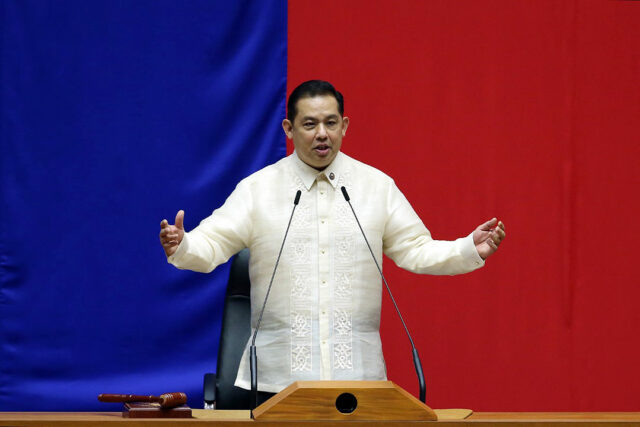
House Speaker Ferdinand Martin G. Romualdez — PHILIPPINE STAR/KRIZ JOHN ROSALES

PRESIDENT Ferdinand R. Marcos, Jr. does not feel blamed by his cousin, former Speaker Ferdinand R. Martin G. Romualdez, after the lawmaker invoked “command responsibility” over the flood control scam, the Palace said on Thursday.

In a briefing, Palace Press Officer Clarissa A. Castro said Mr. Marcos did not feel alluded to by Mr. Romualdez’s statement that accountability falls on the Executive branch.

“The President doesn’t see it that way because,” she said in Filipino, responding to the lawmaker’s video message on Tuesday.

“First of all, in 2025, when he saw that there were anomalies, he was the one who ordered an investigation.”

While the Palace can do little to address why the former Speaker sees himself as a scapegoat, Ms. Castro said the government may benefit from his involvement in ongoing investigations in the multibillion kickback scheme.

“What former Speaker Martin Romualdez feels is beyond our scope,” she said. “If the investigation would benefit from the former Speaker himself, the government, the President would prefer that so that those who should be held accountable are held accountable,” she added.

Despite this, Ms. Castro said she has never seen the cousins talk to each other since she was appointed as spokesperson in February 2025.

STILL IN PHL

Also on Thursday, the camp of Leyte Rep. Mr. Romualdez denied reports that he had fled the country following the issuance of a precautionary hold departure order (PHDO) by the Sandiganbayan upon the request of the Office of the Ombudsman.

In a video statement, Abdiel Dan Elijah Fajardo, the ex-Speaker’s spokesman, said Mr. Romualdez remains in the Philippines and has not left the country. “We categorically clarify: Rep. Romualdez is in the Philippines and has not left the country. Any report or insinuation that he has fled is false and irresponsible,” he said.

Mr. Fajardo also acknowledged the reported issuance of a PHDO against Mr. Romualdez but said the congressman has complied with proper legal processes. He added that Mr. Romualdez secured the necessary travel authority and coordinated in good faith with the Department of Justice and the Bureau of Immigration.

He further said the travel was for a brief, previously scheduled four-day medical check-up in Singapore.

“This is fully consistent with his conduct from the very beginning — one of cooperation, transparency, and respect for legal processes. Unfortunately, this legitimate act has been twisted to create a prejudicial narrative that he intended to flee,” Mr. Fajardo added.

Mr. Fajardo added that their legal team will pursue all appropriate remedies to challenge the issuance of the order before the proper forum. He said Mr. Romualdez remains prepared to face the allegations against him.

ZALDY CO’S RETURN

Meanwhile, Ms. Castro said the Philippine government’s next steps in the repatriation process of former lawmaker Elizaldy “Zaldy” S. Co, who is implicated in the same scandal as Mr. Romualdez, hinge on ongoing negotiations with the Czech Republic.

“It depends… what our country’s action will be, depending on any agreement reached with the Czech Republic and what the method will be for bringing Zaldy Co back,” she said.

Mr. Co is detained in Prague after being caught illegally crossing into the country without proper documentation.

A high-level delegation, led by Justice Secretary Fredderick A. Vida, is on its way to Prague for further talks. He is joined by Chief State Counsel Dennis Arvin L. Chan.

“If we’re talking about the Philippines only, we’re definitely confident,” she said. “Since there are other countries involved in this, let’s just hope that Zaldy Co can be brought back to our country soon.”

Manila and Prague have no standing extradition treaty.

In a message to reporters via Viber, Justice spokesperson Raphael Niccolo L. Martinez said the mission seeks to open formal dialogue and explore “all available legal avenues,” to facilitate Mr. Co’s return.

“These legal avenues include, but are not limited to: deportation, extradition, and the invocation of the United Nations Convention Against Corruption, to which both the Philippines and the Czech Republic are signatories,” he said.

“We wish to remind the public that while the government is committed to pursuing every legitimate legal remedy, the timeline and modality of Co’s return remain subject to ongoing discussions and the applicable processes under Czech and international law,” he added.

Mr. Co is wanted by the Sandiganbayan for graft and malversation over an alleged anomalous road dike project in Naujan, Oriental Mindoro.

The former House Appropriations Committee chair was widely pointed to the massive graft scandal that rocked the Philippines in 2025, causing the country’s economic growth to slow down amid low public and investor confidence. — Chloe Mari A. Hufana, Pexcel John Bacon and Erika Mae P. Sinaking

ICC to try ex-President Duterte for crimes against humanity

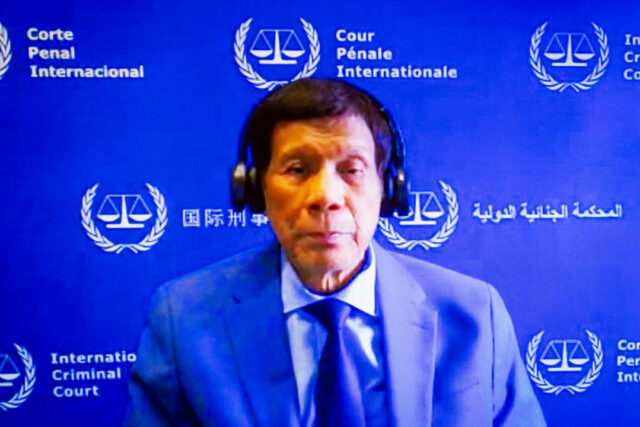
FORMER PRESIDENT RODRIGO R. DUTERTE — INTERNATIONAL CRIMINAL COURT / COUR PÉNALE INTERNATIONALE

AMSTERDAM — Judges at the International Criminal Court (ICC) on Thursday confirmed all three counts of murder as crimes against humanity against former Philippine President Rodrigo R. Duterte and committed him to trial.

The judges said there were “substantial grounds” to believe Mr. Duterte, 81, played a key role in the murders of 76 people and the attempted murder of two others as part of his so-called “war on drugs,” which prosecutors say killed thousands of civilians in the Philippines.

“The available evidentiary material shows the existence of a common plan between Mr. Duterte and his co-perpetrators to kill alleged criminals in the Philippines, including those perceived or alleged to be associated with drug use, sale or production, through violent crimes including murder,” the court said.

Prosecutors have said Mr. Duterte created, funded and armed death squads to target and kill suspected narcotics peddlers and users when he was in power between 2016 and 2022.

Mr. Duterte has long insisted he instructed police to kill only in self-defense and has always defended the crackdown.

Appeals judges at the court on Wednesday dismissed a bid to throw out Mr. Duterte’s trial and said the court had jurisdiction over the case.

In previous cases, it has taken the ICC up to a year between the confirmation of charges and the start of a trial.

In a Viber message to reporters, Palace Press Officer Clarissa A. Castro said Malacañang respects the ICC’s move to proceed with the trial, which it expects to benefit both parties.

“Justice is what must be obtained in these cases,” Ms. Castro said in Filipino on Thursday. “Both parties will benefit from it. Justice for the accused if they are innocent, or justice for the victims if their rights were abused.” — Reuters with Chloe Mari A. Hufana

Half of Filipinos say quality of life worsened in past year

Residents go about their daily lives in Delpan, Tondo, Manila in this file photo. — PHILIPPINE STAR/RYAN BALDEMOR

HALF of adult Filipinos reported a decline in their quality of life over the past 12 months, according to the latest survey by Social Weather Stations (SWS), signaling a sharp drop in public sentiment nationwide.

Results of the March 24-31, 2026 Social Weather Survey showed that 50% of respondents considered themselves worse off, and 26% said their situation was unchanged, while only 23% reported improvement.

According to the SWS report, this translated to a Net Gainers score of -26, a steep drop from -7 in November 2025, indicating that significantly more Filipinos feel their lives have worsened rather than improved. The score falls under SWS’ “low” classification, signaling widespread dissatisfaction.

The report noted that this is the lowest recorded figure in more than four years, or since -44 in September 2021, and is 18 points below the 2025 annual average of -8.

Data also showed a brief recovery in mid-2025 when the score reached +12 before declining again in the following months.

All regions recorded declines, based on SWS data. Metro Manila and Mindanao posted the lowest Net Gainers scores at -31, followed by the Visayas at -25 and Balance Luzon at -23. All areas saw significant drops compared to November 2025.

The survey also found worsening sentiment in both urban and rural areas, with sharper declines recorded in urban communities.

Across demographic groups, sentiment remained negative. Net Gainers declined among both men and women, as well as across all age groups, with older respondents showing the most pessimistic outlook. Even younger Filipinos experienced a notable drop compared to previous months.

Across education levels, SWS said sentiment also worsened, with most groups posting lower scores compared to the previous survey period. — Pexcel John Bacon

ADVERTISEMENT
ADVERTISEMENT