Home Blog Page 1171

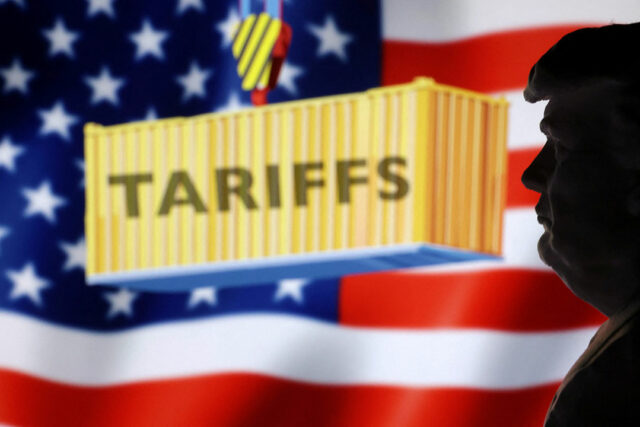
South Korea to seek speedy solution on auto tariffs in US trade talks

REUTERS

 – South Korea’s Industry Minister Ahn Duk-geun said on Wednesday that Seoul will seek a speedy solution over auto tariffs in trade talks with U.S. counterparts and is also prepared for the prospect of Washington bringing up the issue of defense costs.

U.S. ally South Korea is due to hold trade talks in Washington on Thursday after the U.S. introduced 10% blanket tariffs and 25% auto and steel tariffs. Reciprocal 25% tariffs on South Korea have currently been paused for 90 days.

We are preparing for negotiations calmly and carefully. However, in the case of automobiles that are heavily hit by 25% tariffs now, we plan to do our best to come up with a solution as soon as possible,” Mr. Ahn told reporters before boarding a flight to Washington.

South Korea’s overall exports for the first 20 days of April fell 5.2% from a year earlier, dragged down by U.S.-bound shipments. Exports of automobiles fell 6.5% and auto parts dropped 1.7%.

South Korea announced emergency support measures for its auto sector earlier this month, seeking to reduce the blow of the tariffs on a sector that has seen years of sharply rising exports to the United States.

In 2024, South Korea’s exports of automobiles to the United States were valued at $34.7 billion, accounting for 49% of its total auto exports from companies such as Hyundai Motor and Kia.

Mr. Ahn also said that South Korea is prepared for the possibility that the issue of defense costs related to the presence of U.S. troops in the country could become part of the talks.

U.S. President Donald Trump has said that reopening talks on sharing the cost of keeping 28,500 troops in South Korea would be part of “one-stop shopping” negotiations with Seoul. South Korean officials have previously said the issue was not up for negotiation. – Reuters

US to phase out many synthetic food dyes, Kennedy and FDA head say

STOCK PHOTO } By Skoot13 - Own work, CC BY-SA 3.0, https://commons.wikimedia.org/w/index.php?curid=18391518

 – Health Secretary Robert F. Kennedy Jr. and FDA Commissioner Marty Makary said on Tuesday that the agency plans to remove synthetic food dyes from the U.S. food supply by revoking authorizations of some and working with industry to voluntarily remove others.

They cited concerns about a possible link between consumption of the dyes and health conditions like ADHD, obesity and diabetes, an area many scientists say requires more research.

It was not clear what studies Mr. Makary was referencing on the link between dyes and health problems. He held up a study he identified as being from the Lancet, a prestigious European medical journal. In 2007, a study in that journal found a link between food dyes and hyperactivity.

During a joint press conference that also included Mr. Kennedy’s Make America Healthy Again supporters and lawmakers in states that have food dye legislation, Mr. Kennedy and Mr. Makary raised a wide range of issues they want to address in the food supply.

Mr. Kennedy said the efforts to remove additives from food were necessary to address chronic disease in children and, without evidence, suggested it would address rising rates of conditions ranging from ADHD to food allergies.

Mr. Makary said the agency would begin the process of revoking authorization for two synthetic food colorings within the coming months and would work with industry to eliminate six other dyes by the end of next year.

The Food and Drug Administration in a press release said it plans to authorize four new natural color additives in the coming weeks, while also accelerating the review and approval of others.

While Mr. Kennedy and other speakers asserted a strong link between synthetic food dyes and a wide range of health concerns, scientists say there is not yet a large enough body of evidence that food dyes cause any of those problems.

“The information out there is just so minuscule in the scheme of science that it’s really hard to make those generalizations,” said Emily Acri, a clinical transplant dietitian at Yale New Haven Hospital.

Mr. Makary said the transition from artificial food dyes to natural ingredient dyes will not increase food prices. He suggested that food makers use ingredients like watermelon juice, beet juice and carrot juice to color their food.

It also plans to partner with the National Institutes of Health to research how food additives impact children’s health and development.

“For the last 50 years, we have been running one of the largest uncontrolled scientific experiments in the world on our nation’s children without their consent,” Mr. Makary said.

Removing the dyes from the food supply will not instantly make American children healthy, he said, but that it was an important step. Mr. Kennedy said the agency would soon target other additives.

Mr. Kennedy said his Department of Health and Human Services (HHS) had an understanding with the food industry on removing artificial dyes, and Mr. Makary said he was hoping companies would adjust their ingredients without any statutory or regulatory changes, but that he is looking at tools to ensure compliance.

The Consumer Brands Association, which represents food makers such as PepsiCo and Kraft Heinz, in March sent a proposal to HHS outlining actions the industry would take to remove the dyes from its products, according to a document obtained by Reuters. The CBA previously met with Kennedy to discuss food dyes, Reuters reported.

The proposal calls for food companies to pledge to prioritize making new products without artificial colors and start removing them from existing items, according to the document.

By the end of the year, the food companies will make products without artificial dyes available to schools, according to the document.

The CBA and the National Confectioners Association, which represents candy makers, both said late on Tuesday that the ingredients in their member companies’ products are safe.

W.K. Kellogg said it recently met with Mr. Kennedy and is reformulating its cereals served in schools to not include artificial dyes. The cereal manufacturers also said it will not launch any new products with artificial dyes beginning next year. – Reuters

Trump tariffs threaten to pile more pain on Thailand’s rice sector

PIXABAY

 – Thai farmer Daeng Donsingha was already worried for her family of nine when rice prices in the world’s second-largest exporter of the staple crashed this year after India resumed exports.

Now, she’s also fretting over the tariffs unleashed by U.S. President Donald Trump, which could slash demand for Thai rice in its most valuable foreign market and create turmoil in an export industry worth billions of dollars.

“The problem is that the price of rice is very low, while other costs such as fertilizers and farmland rent is higher,” the 70-year-old farmer said, after selling her harvest at a rice mill in central Thailand. “I’m losing money.”

Thailand is among Southeast Asian nations hardest hit by Mr. Trump’s proposed measures, facing a 36% tariff on goods unless ongoing negotiations are successful before the U.S president’s moratorium on the tariffs ends in July.

“If the U.S. imposes the tariff, our jasmine rice will be too expensive to compete,” said Chookiat Ophaswongse, honorary president of the Thai Rice Exporters Association.

Last year, Thailand shipped 849,000 metric tones of rice to the United States, mainly of its most expensive fragrant jasmine variety, worth 28.03 billion baht ($735 million), according to the association.

In all, Thailand exported 9.94 million tons of rice in 2024, worth 225.65 billion baht ($6.82 billion), with the U.S. as its third-largest market by volume, but most lucrative.

Potential U.S. tariffs would stall exports and hand the advantage to Thailand’s main regional competitors, like Vietnam, where prices are significantly lower, said Chookiat, whose association is targeting exports of 7.5 million tons this year.

“From $1,000 per ton, the price would rise to $1,400 to $1,500,” he said. “Importers will shift to Vietnamese jasmine rice, which is only $580 per ton.”

Rice from Vietnam is cheaper because production costs are lower, farmers grow different varieties of the crop and bring in multiple harvests.


‘WON’T SURVIVE’

Farmers in Thailand, Southeast Asia’s second-largest economy, have already been on edge because of a 30% drop in domestic prices after India resumed exports in September. The country accounted for 40% of world rice exports in 2022 before the ban was introduced.

Analysts say there is no room for Thailand to cut prices to compete.

“Our production costs are high, while our yield is low,” said Somporn Isvilanonda, an independent agricultural economist. “If we dump prices, farmers won’t survive.”

The industry and farmers are pinning their hopes on negotiations between a Thai delegation led by Finance Minister Pichai Chunhavajira and the United States.

Rice shipments, however, are already sliding. Overall exports fell 30% in the first quarter as countries delayed buying decisions and India’s return boosted supply, according to the exporters association, forecasting a similar decline over the next three months.

The concessions Thailand is proposing to counter Mr. Trump, including bringing tariffs of U.S corn down from 73% to zero, would also hurt Thai farmers, according to industry groups.

A flood of cheap imported corn could further depress prices of broken rice and rice bran, which are extracted during rice milling and used in animal feed, said Banjong Tangchitwattanakul, President of the Rice Millers Association.

On April 8, four farm groups, including rice millers, petitioned the government to block imports of U.S. corn and soybean meal, arguing they would squeeze prices of domestic crops for animal feed, according to a copy of the letter seen by Reuters.

The government has pledged that any concession it makes in negotiations with the United States will not undermine domestic industries.

But for farmers like Daeng, decisions made halfway across the world could jeopardize her livelihood.

“My children have been following the news,” she said, “They were telling me that ‘we won’t be able to survive, mum, if things go ahead like this.'” – Reuters

IMF slashes global outlook as White House says trade talks pick up pace

REUTERS

WASHINGTON – Worldwide economic output will slow in the months ahead as USUS President Donald Trump’s steep tariffs on virtually all trading partners begin to bite, the International Monetary Fund said on Tuesday, as global finance chiefs swarmed Washington seeking deals with Trump’s team to lower the levies.

Indeed, the pace of negotiations was brisk, White House press secretary Karoline Leavitt said, with 18 different countries offering proposals so far and Trump’s trade negotiating team set to meet with 34 countries this week to discuss tariffs. Trump himself expressed optimism that a trade deal with China could “substantially” cut tariffs, lifting markets.

After setting a baseline import tax of 10% and much higher on dozens of countries earlier this month, Trump abruptly put the steeper levies on hold for 90 days for countries to try to negotiate less stringent rates.

The talks blitz is occurring after hundreds of finance and trade delegates arrived for the spring meetings of the IMF and World Bank Group, almost all with the singular mission of inking a deal to ease the hefty tariffs burden Trump has imposed on US goods imports since beginning his second stint in the White House in January.

With tariffs on goods coming into the world’s No. 1 economy now at their highest in a century, the IMF projects global growth in 2025 will slow to 2.8% – its poorest showing since the COVID-19 pandemic – from 3.3% in 2024.

And it is not just a pain being visited upon others: US gross domestic product growth will drop by a full percentage point to just 1.8% in 2025 from 2.8% last year, the IMF forecast, with “notable” upward revisions to inflation as the cost of imports climbs.

Another big victim of the fallout is China, with the IMF slashing its growth outlook to 4.0% for this year and next under the weight of crushing import taxes of 145% now levied against imports to the US from the world’s largest goods producer.

China has retaliated with 125% tariffs of its own on goods from the US, effectively resulting in a trade embargo between the largest two economies, a standstill that US Treasury Secretary Scott Bessent has said neither sees as sustainable.

According to a person who heard Bessent’s closed-door presentation on Tuesday to investors at a JP Morgan conference in Washington, Bessent believes there will be a de-escalation in US-China trade tensions but described future negotiations with Beijing as a “slog” that has not started yet.

TRUMP ON CHINA
Later on Tuesday, Trump expressed optimism that he would make progress with China that would substantially lower tariffs on their imports but also warned that “if they don’t make a deal, we’ll set the deal.”

Trump said a deal would result in “substantially” lower tariffs on Chinese goods.
“It won’t be that high,” Trump said when asked about the current rates. “It won’t be anywhere near that.”

He added that “it won’t be zero.”

US stocks jumped in extended trade following Trump’s comments, with Amazon and Nvidia gaining 3% each and Apple rising 2%.

While talks have been slow to start with China, Bessent and other members of Trump’s trade team have been pressing on with other key trading partners, though details are scant and no firm deals have been reached so far.

The US and Japan, for one, are moving closer to an interim arrangement on trade, a person familiar with the matter told Reuters, but many of the biggest issues are being put off. Such an interim framework will not tackle the thorniest issues facing the two countries in their trade relationship, and it was still possible that no final deal could be reached, the person said on condition of anonymity.

That movement comes after the US and India said during a visit there by Vice President JD Vance that they had agreed to the broad scope of negotiations. While the two sides touted it as significant progress, agreeing to the so-called “Terms of Reference” mostly provides a roadmap for more extensive talks ahead.

Meanwhile, a number of US companies reporting first-quarter results said tariffs are having an effect on business.

Consumer giant Kimberly-Clark said tariffs would cost it about $300 million this year, with CEO Michael Hsu noting “the breadth and degree of tariffs and also the countries involved have changed significantly since maybe where we were at the end of the last quarter.”

GE Aerospace CEO Larry Culp told Reuters he recently met with Trump and urged him to restore a tariff-free regime for the aerospace industry that existed under a 1979 agreement. Culp said the company’s position was “understood” by the administration, but added “it’s not the only item they’re solving for.”

GE Aerospace hung onto its outlook for the year, despite the cost of tariffs. “We’ll continue to press this point respectfully in the hopes that we can re-establish in effect what we had prior to the recent tariff moves,” he said in the interview.

The affirmation of its outlook helped lift GE Aerospace shares by more than 5%. Indeed, investors rattled over the past two months by Trump’s harsh tariffs and erratic approach to imposing them seemed to find some solace among the earnings being reported. The S&P 500, on the heels of another steep down day on Monday, rose about 2.5% on Tuesday.

(Reporting by Andrea Shalal, David Lawder, Nupur Anand, Trevor Hunnicutt, Brendan O’Brien, Nandita Bose, Steve Holland, Noel Randewich, Rajesh Kumar Singh, Savyata Mishra, and Neil J Kanatt; Writing by Dan Burns; Editing by Colleen Jenkins and Andrea Ricci)

IMF slashes PHL growth forecasts

PEOPLE flock to Baclaran Market in Parañaque City. — PHILIPPINE STAR/RYAN BALDEMOR

By Luisa Maria Jacinta C. Jocson, Senior Reporter

THE INTERNATIONAL Monetary Fund (IMF) slashed its gross domestic product (GDP) growth projections for the Philippines from this year to the next, reflecting heightened global uncertainty arising from US tariff policy.

In its latest World Economic Outlook (WEO), the IMF downgraded its GDP growth forecast for the Philippines to 5.5% this year from the 6.1% projection in its January update.

It also lowered its 2026 forecast to 5.8% from 6.3% previously.

These would fall below the government’s 6-8% growth targets for this year to 2026.

The IMF said its forecasts consider the weaker-than-anticipated Philippine growth in the fourth quarter, as well as external headwinds stemming from heightened trade tensions and policy uncertainty.

“Downward revisions to growth for 2025 and 2026 are observed throughout the region and globally, reflecting the recent external developments,” an IMF spokesperson said in an e-mail.

These include the “direct impact of higher tariffs on the Philippines’ goods exports to the US, downward revisions to trading partners’ growth, and impact of higher uncertainty and financial tightening,” it said.

US President Donald J. Trump on April 2 announced a barrage of reciprocal tariffs on nearly all of its trading partners, with a baseline rate of 10%.

While most of the higher reciprocal tariffs have been suspended until July, the baseline 10% tariff is still in effect.

The Philippines was slapped with a 17% tariff rate on its exports to the US, the second lowest in Southeast Asia.

The IMF said its WEO forecasts are based on information available as of April 4 and are subject to “significant uncertainty.”

However, the IMF said the Philippine economy is seen to remain somewhat resilient.

“Despite a more difficult environment, growth in the Philippines is expected to remain relatively robust in 2025,” it said.

The IMF’s forecast for the Philippines places it as the second-fastest growing economy in emerging and developing Asia this year, just behind India (6.2%).

The region is projected to grow by 4.5% this year and 4.6% in 2026, as Southeast Asian countries are among the most affected by the US tariffs.

In Southeast Asia, the Philippines has the fastest-projected GDP growth forecast this year. It is ahead of Vietnam (5.2%), Indonesia (4.7%), Malaysia (4.1%) and Thailand (1.8%).

“On the upside, recent legislative reforms could facilitate an accelerated implementation of domestic infrastructure projects, including through public-private partnerships, and lead to higher foreign direct investment (FDI) and investment,” the IMF said.

“In terms of growth drivers, domestic consumption remains the key driver for growth and is expected to be supported by lower inflation and low unemployment,” it added.

Meanwhile, the multilateral institution said it expects headline inflation in the Philippines to average 2.6% this year and 2.9% in 2026, well within the central bank’s 2-4% target band.

“Relative to January WEO, the headline inflation projection for 2025 has been revised down by 0.2 percentage point (ppt) to 2.6%.”

This reflects the “lower-than-expected inflation outturn in the first quarter, and downward revisions to global fuel and food price projections.”

The latest data from the local statistics agency showed inflation slowed to 1.8% in March, its slowest rate in nearly five years. This brought average inflation to 2.2% in the first quarter.

Accounting for risks, the central bank sees inflation averaging 2.3% in 2025 and 3.3% in 2026.

The IMF said risks to the inflation outlook are “broadly balanced.”

“On the upside, potential disruptions in global supply chains and trade restrictions can raise imported inflationary pressures, while risk-off shocks could contribute to currency depreciation.”

“The Philippines’ exposure to extreme climate events also poses additional inflationary risks. On the downside, risk of weaker global demand prospects could pose deflationary risks, including through lower commodity prices.”

Meanwhile, the IMF said the Bangko Sentral ng Pilipinas (BSP) has room to further lower interest rates and “firmly move to a neutral stance.”

“With inflation projected to remain around the BSP’s target of 3%, inflation expectations well-anchored, and amid an expected widening of the output gap, there is space for a more accommodative stance.”

The Monetary Board earlier this month resumed its rate-cutting cycle with a 25-basis-point (bp) rate cut, bringing the benchmark to 5.5%.

BSP Governor Eli M. Remolona, Jr. has said they will likely continue cutting rates further this year in “baby steps” or increments of 25 bps.

There are four more Monetary Board policy meetings this year, with the next slated for June 19.

“Amidst prevailing uncertainty and with both upside and downside risks to inflation, a data-dependent approach, and clear and effective communication around policy settings will be important to manage expectations and provide clarity on the BSP’s reaction function,” the IMF added.

‘NEGATIVE SHOCK TO GROWTH’
Meanwhile, the IMF expects global growth to slow to 2.8% this year and to recover to 3% in 2026, reflecting “the direct effects of new trade measures and their indirect effects through trade linkage spillovers, heightened uncertainty, and deteriorating sentiment.”

The new forecasts are lower than the 3.3% projection for both years in the January WEO update.

Trade uncertainties have “surged to unprecedented levels,” the IMF said in the latest report.

“The swift escalation of trade tensions and extremely high levels of policy uncertainty are expected to have a significant impact on global economic activity,” it added.

The US is expected to grow by 1.8% this year, 0.9 percentage point lower than the previous projection “on account of greater policy uncertainty, trade tensions and softer demand momentum.”

“Tariffs are also expected to weigh on (US) growth in 2026, which is projected at 1.7% amid moderate private consumption,” the IMF said.

The IMF also lowered projections for Canada, Japan and the United Kingdom.

For China, it downgraded its growth outlook to 4% this year from 4.6% previously due to the impact of the US tariffs. It also lowered its 2026 China forecast to 4% from 4.5% previously.

The tariffs and consequent countermeasures alone are a “major negative shock to growth,” it added.

“The unpredictability with which these measures have been unfolding also has a negative impact on economic activity and the outlook and, at the same time, makes it more difficult than usual to make assumptions that would constitute a basis for an internally consistent and timely set of projections.”

Global inflation is also seen to ease at a slower pace than initially expected, the IMF said.

It also flagged “intensifying downside risks” on global output.

“Ratcheting up a trade war, along with even more elevated trade policy uncertainty, could further reduce near- and long-term growth, while eroded policy buffers weaken resilience to future shocks.”

“Divergent and rapidly shifting policy stances or deteriorating sentiment could trigger additional repricing of assets beyond what took place after the announcement of sweeping US tariffs on April 2 and sharp adjustments in foreign exchange rates and capital flows, especially for economies already facing debt distress.”

Moving forward, the IMF said there is a need for “clarity and coordination.”

“Countries should work constructively to promote a stable and predictable trade environment, facilitate debt restructuring, and address shared challenges.”

“At the same time, they should address domestic policy and structural imbalances, thereby ensuring their internal economic stability. This will help rebalance growth-inflation trade-offs, rebuild buffers, and reinvigorate medium-term growth prospects, as well as reduce global imbalances,” it added.


Philippines has room to negotiate much lower tariffs with US — BMI

REUTERS

THE PHILIPPINES has room to negotiate with the US to lower its reciprocal tariffs, Fitch Solutions’ unit BMI said, but added that trade tensions are still likely to weigh on economic growth.

“For now, though, Washington has lowered the tariff rate to 10% for 90 days. We think that the Philippines will be successful in keeping them at this level at the very least,” BMI Asia Country Risk Analyst Shi Cheng Low said in a webinar on Tuesday.

US President Donald J. Trump slapped a 17% tariff on the Philippines earlier this month, but suspended this for 90 days, keeping the blanket 10% duty in effect.

The Philippines’ 17% tariff rate is much lower than its Southeast Asian peers, some of which are facing some of the highest reciprocal tariffs. Six Southeast Asian countries were slapped with much larger-than-expected tariffs of between 32% and 49%.

BMI said the Philippines can negotiate with the US on further lowering trade barriers.

To address the US’ demand to increase import volumes, BMI said the Philippines can possibly increase energy and weapon imports, as well as lower levies on US goods.

“(The Philippines) remains an important security partner for the US, especially as Washington is working to counter Beijing’s expanding reach in the South China Sea,” Mr. Low said.

“Therefore, we think that this will give them at least a bit of leverage. If we are right, the final impact will be less severe, and we expect them to shave off about 0.6 percentage point (ppt) of headline growth.”

If the 17% reciprocal tariff is implemented, BMI’s baseline estimates show that this could subtract about 1.1 ppt from the Philippines’ real GDP growth.

“We revised our real GDP growth projections from 6.3% to 5.4%,” Mr. Low said.

BMI’s forecast would fall short of the government’s 6-8% target this year.

“Now, this is more aggressive than the 0.6 ppt we have previously mentioned but because it’s a reflection of a very tepid domestic activity we’ve seen recently. So, more stimulus will be needed to cushion the impact.”

“The Philippines’ exposure to both China and the US economy is pretty balanced. With both economies likely to slow over the next few quarters, the Philippines will definitely follow suit,” he added.

Meanwhile, BMI expects the Bangko Sentral ng Pilipinas to cut rates by an additional 75 basis points (bps).

The Monetary Board earlier this month resumed its easing cycle, cutting rates by 25 bps to bring the benchmark to 5.5%.

The next rate-setting meeting is on June 19. There are four more Monetary Board meetings slated this year, including June. — Luisa Maria Jacinta C. Jocson

NCR economic output jumped by 5.6% in 2024 — PSA

METRO MANILA’S economic output expanded by 5.6% in 2024, the statistics agency said. — PHILIPPINE STAR/MIGUEL DE GUZMAN

THE NATIONAL Capital Region’s (NCR) economic output expanded by 5.6% in 2024, the fastest pace in two years, the Philippine Statistics Authority (PSA) said on Tuesday.

Preliminary PSA data from the latest regional accounts showed Metro Manila’s economic expansion in 2024 was faster than 4.9% in 2023, and the fastest since the 7.6% print in 2022.

However, NCR’s economic output was a tad slower than the revised 5.7% national gross domestic product (GDP) in 2024.

How much did each region contribute to the Philippine economy in 2024?“[The NCR’s] economy’s growth rate is not remarkable, but it is enough to see that we are not in a downward trend,” PSA-NCR Regional Director Paciano B. Dizon said during the briefing.

The size of NCR’s economy at constant 2018 prices reached P6.94 trillion last year, higher than P6.57 trillion in 2023.

Metro Manila was still the largest contributor to the overall Philippine economy with a 31.2% share, followed by Calabarzon (14.7%) and Central Luzon (11.1%).

Central Visayas grew by 7.3% in 2024, the fastest among 18 regions. This was followed by Caraga (6.9% from 4.8% in 2023), and Central Luzon (6.5% from 6.1%).

On the other hand, the Bangsamoro Autonomous Region in Muslim Mindanao posted the slowest growth among the 18 regions with 2.7% in 2024 from 4% in 2023. It was followed by Zamboanga Peninsula (4.2% from 4.5%) and Western Visayas (4.3% from 6.8%).

In 2024, nearly 83% of NCR’s output was driven by the services sector. The sector grew by 5.9%, slightly faster than 5.7% in 2023.

The growth of the wholesale and retail trade sector, which accounted for 22.5% of the services sector, eased to 4.1% last year from 4.4% in 2023.

Financial and insurance activities expanded by 8.4%, slightly faster than 8% in 2023, followed by professional and business services which rose by 7% from 5.9% in 2023.

Nicholas Antonio T. Mapa, a senior economist at the Metropolitan Bank & Trust Co., said that slower inflation contributed to the faster growth in NCR last year.

“Sustainability in the region’s services sector also helped boost the regional economy. However, it was slightly offset by the slowdown in the agricultural sector brought by extreme weather conditions,” he said in an e-mail.

In 2024, headline inflation averaged 3.2%, lower than the 6% average in 2023. In NCR, inflation also eased to 2.6% last year from 6.2% in 2023.

The total value of Metro Manila’s service industry reached P5.76 trillion in 2024, higher than P5.44 trillion in 2023.

Meanwhile, the industry sector, which accounted for 17.1% of the NCR economy, rose by 4% last year, faster than 1.3% in 2023.

The growth of agriculture, which accounted for 0.01% of Metro Manila’s economy, eased to 0.8% in 2024 from 5.4% in 2023.

By sectoral output, the Negros Island Region had the fastest growth in services with 8.5% in 2024 (from 7.9% in 2023), followed by Caraga (8% from 7.5%) and Central Visayas (7.6% from 8.6%).

At the same time, the Negros Island Region’s industry sector posted the quickest growth at 9.8% expansion in 2024 from 8% in 2023.

Meanwhile, Central Visayas’ agricultural output grew by 5.4% last year (from 4.5% in 2023), the fastest among the regions.

On the expenditure side, Central Visayas logged the highest growth in household spending with 7.7% in 2024 from 6.2% in 2023.

Meanwhile, government spending growth was the fastest in NCR at 9.9% last year, a turnaround from the 2.1% contraction in 2023.

Davao Region had the quickest expansion in gross capital formation at 17% last year, slower than 6.3% in 2023.

On a per-capita basis, Metro Manila still had the largest gross regional domestic product at P503,483 last year, up 5% from P479,415 in 2023.

“Economic growth in NCR and the rest of the Philippines will remain robust as long as domestic demand is sustained — lower interest rates and easing inflation will definitely help boost domestic demand,” Mr. Mapa said. — Matthew Miguel L. Castillo

PHL should find right technology to meet rising power demand, experts say

STOCK PHOTO | Image from Freepik

SECURING reliable and efficient power supply for the Philippines means finding the right technologies suited to the country’s demand, energy experts said.

“I think we have enough supply. The thing is do we have the right technologies to provide that supply? Because when there’s a tight supply then you start using expensive power plants,” Emmanuel V. Rubio, president and chief executive officer of Meralco PowerGen Corp. (MGen), said at the BusinessWorld Insights’ “Energy Security: Powering the Philippines’ Economic Growth” forum on Tuesday.

“And hopefully, we won’t use diesel anymore. In fact, we have de-commissioned a number of our diesel plants because we believe that we won’t be needing them,” he added.

Mr. Rubio said that the “primary metric” in determining if the supply and demand ratio is healthy is through the prices at the Wholesale Electricity Spot Market (WESM).

He said that WESM prices have been “stable” for the past year. WESM is where energy companies can buy power when their long-term contracted power supply is insufficient for customer needs. 

However, Mr. Rubio said that as the economy continues to grow, there is a need for more baseload capacity.

“Unfortunately, I think a combination of variable renewable energy… combined with energy storage… to supply baseload, I think, it’s still not there. It’s not going to be competitive,” he said.

“But what we have proven in TerraSolar is that to supply mid merit… a combination of variable renewable energy, which is solar plants, and energy storage, which is lithium-ion battery, is already as competitive as your normal source of energy, which is before diesel and now LNG (liquefied natural gas),” he added.

MGen, the power generation arm of Manila Electric Co., holds a portfolio with a combined gross capacity of 2,602 megawatts (MW) from both traditional and renewable energy sources.

The company is currently developing a project, now known as MTerra Solar, which consists of a 3,500-MW solar power plant and a 4,500-megawatt-hour (MWh) battery energy storage system.

“By working closely with our partners and investors we combine capital, local expertise and operational excellence to deliver a project that responds directly to the country’s energy needs at scale and in alignment with our national targets,” Mr. Rubio said.

Alexander D. Ablaza, president of the Philippine Energy Efficiency Alliance, Inc., said that energy efficiency should be regarded as an “asset class” that should be ready for public private partnerships.

“Every time we talk about clean energy and sustainable energy, we should keep that balance of keeping energy efficiency in renewable energy because that will bring us to our 2050 pathway,” he said.

At the 28th Conference of the Parties (COP28) to the UN Framework Convention on Climate Change last year, a historic agreement was reached, which sets a target of net-zero emission by 2050.

Mr. Ablaza also cited COP28 call to double energy efficiency progress through 2030.

On the government side, state-run National Electrification Administration (NEA) has reaffirmed its commitment to deliver reliable electricity in rural areas, noting its partner electric cooperatives (ECs) are adapting to the changing energy landscape.

“We are not without solutions. These very challenges are driving us to explore new approaches, adopt emerging technologies, and strengthen our partnerships,” said Ernesto O. Silvano, Jr., NEA deputy administrator for technical services.

Mr. Silvano said that ECs are facing various challenges, including vulnerability to natural disasters, volatile WESM prices and aging infrastructure.

He said that the P200-million budget allocated for the Electric Cooperatives Emergency Resiliency Fund of this year “is no longer enough to support crisis response.”     

As of March 13, 98% of the fund has already been dispersed, but there are 25 ECs “severely affected” by last year’s calamities still lack the financial support needed to fully restore their distribution systems.

“By allowing funds to be used for retrofitting infrastructure, enhancing resiliency, and investing in preparedness measures, we can better equip our electric cooperatives to withstand future disasters and minimize their impact,” he said.

The NEA is primarily responsible for rural electrification, bringing electricity to missionary or economically unviable parts of the countryside.

The government hopes to achieve total electrification by 2028. — Sheldeen Joy Talavera

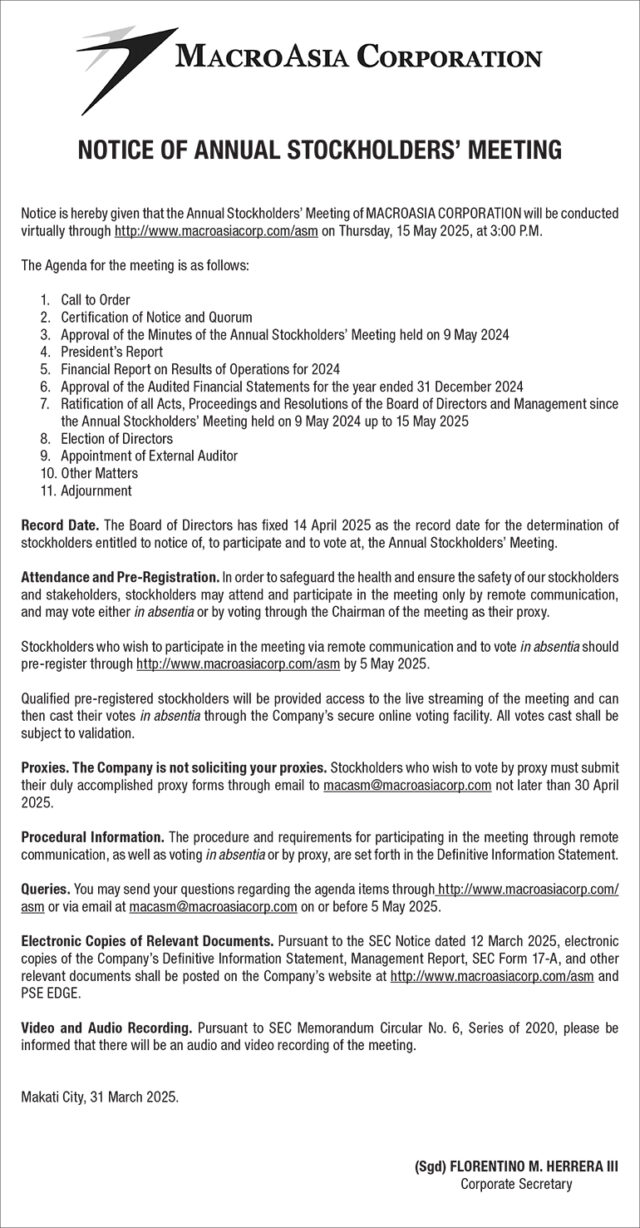
MacroAsia Corp. to conduct virtual Annual Stockholders’ Meeting on May 15


Spotlight is BusinessWorld’s sponsored section that allows advertisers to amplify their brand and connect with BusinessWorld’s audience by publishing their stories on the BusinessWorld Web site. For more information, send an email to online@bworldonline.com.

Join us on Viber at https://bit.ly/3hv6bLA to get more updates and subscribe to BusinessWorld’s titles and get exclusive content through www.bworld-x.com.

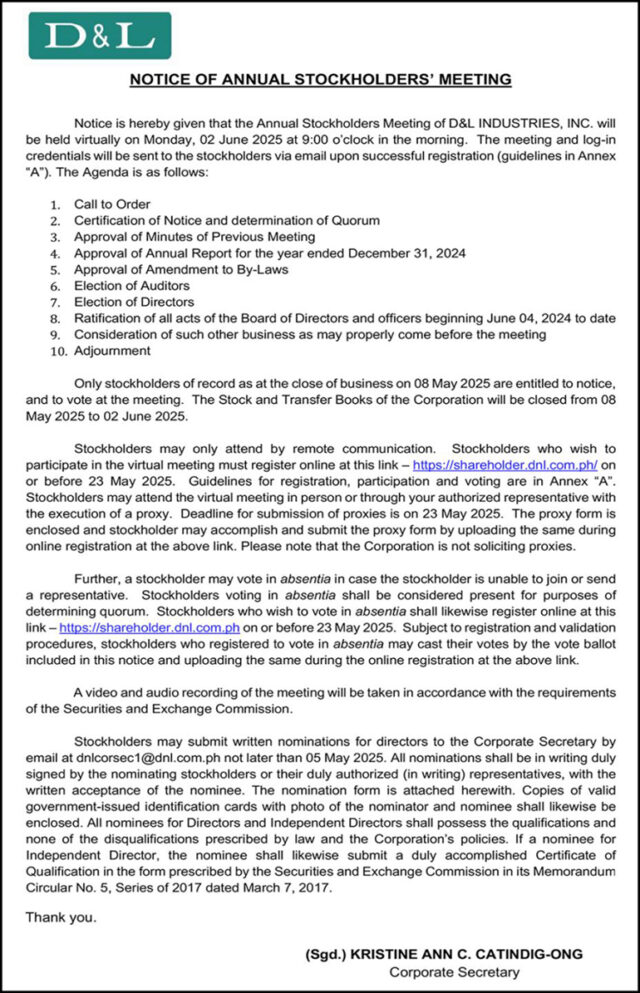
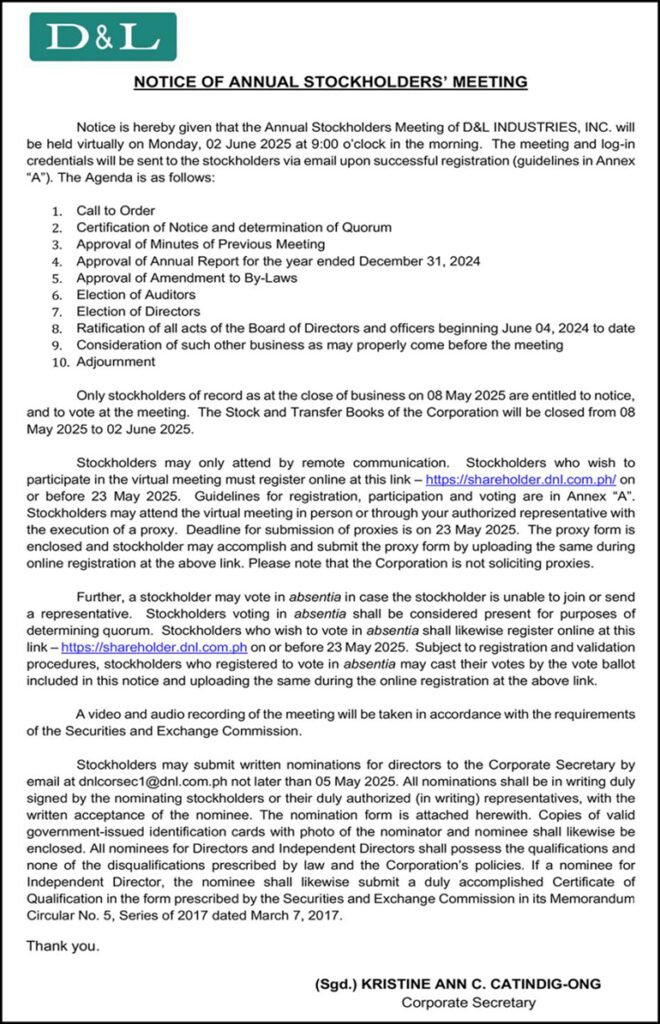
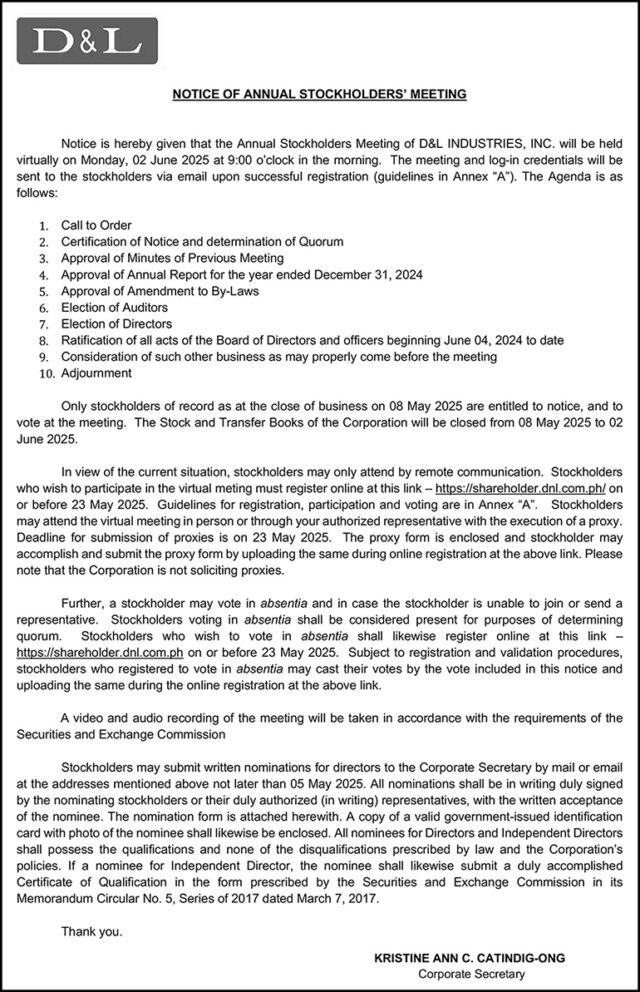
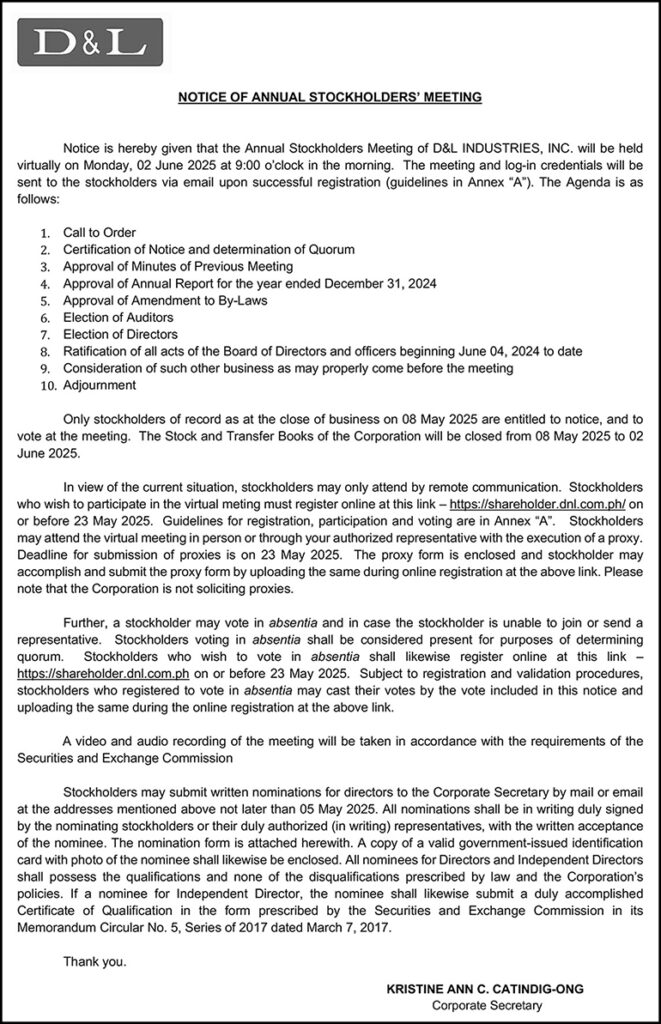
D&L Industries, Inc. to hold Annual Stockholders’ Meeting virtually on June 2


Spotlight is BusinessWorld’s sponsored section that allows advertisers to amplify their brand and connect with BusinessWorld’s audience by publishing their stories on the BusinessWorld Web site. For more information, send an email to online@bworldonline.com.

Join us on Viber at https://bit.ly/3hv6bLA to get more updates and subscribe to BusinessWorld’s titles and get exclusive content through www.bworld-x.com.

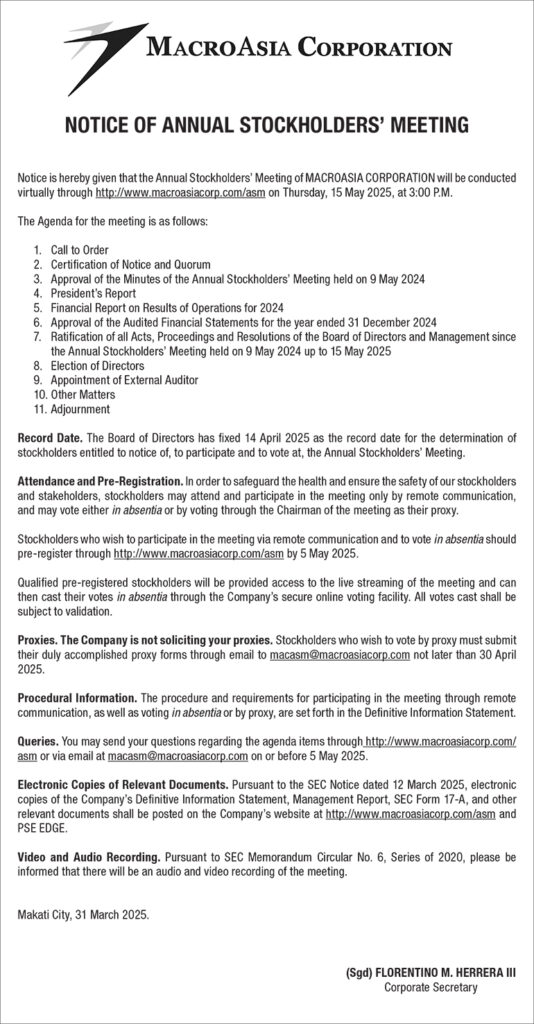
D&L Industries, Inc. to hold virtual Annual Stockholders’ Meeting on June 2


Spotlight is BusinessWorld’s sponsored section that allows advertisers to amplify their brand and connect with BusinessWorld’s audience by publishing their stories on the BusinessWorld Web site. For more information, send an email to online@bworldonline.com.

Join us on Viber at https://bit.ly/3hv6bLA to get more updates and subscribe to BusinessWorld’s titles and get exclusive content through www.bworld-x.com.

Alliance Global cuts 2025 capex to P63B

ALLIANCEGLOBALINC.COM

ALLIANCE GLOBAL Group, Inc. (AGI) has set a P63-billion capital expenditure (capex) budget for 2025, lower than the P68 billion spent in 2024, following weaker performance that year, the company said on Tuesday.

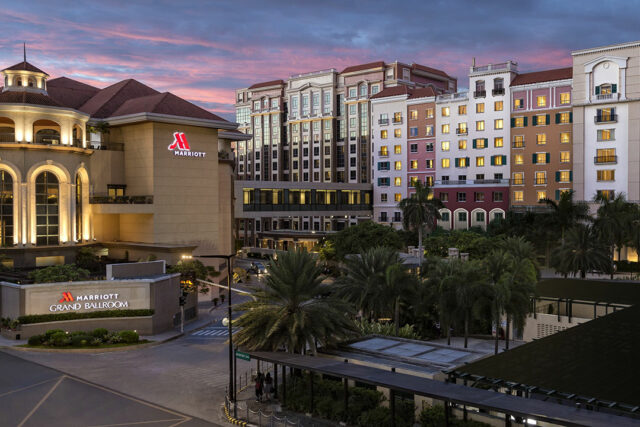
Of the total capex for this year, P50 billion is allocated to listed property developer Megaworld Corp., while P5 billion is earmarked for hotel operator Travellers International Hotel Group, Inc., AGI said in a regulatory filing.

The conglomerate added that P5 billion is for McDonald’s Philippines operator Golden Arches Development Corp. (GADC), with the remaining capex allocated to listed brandy and whisky producer Emperador, Inc.

For 2024, AGI saw a 12% drop in attributable profit to P17.2 billion from P19.6 billion in 2023 due to rising costs.

Total revenue rose by 6% to P223.6 billion from P210.8 billion in 2023. Megaworld accounted for 37% of revenue, followed by Emperador at 28%, GADC at 22%, and Travellers at 14%.

“Strong topline performance buoyed by real estate, hospitality, and quick service restaurant (QSR) segments, although profitability was tempered by rising costs,” AGI said.

For the property business, Megaworld recorded an 8% increase in attributable profit to P18.7 billion as revenue climbed by 17% to P81.7 billion.

The real estate company aims to launch P20 billion worth of projects and secure P130 billion in reservation sales this year.

“Megaworld remained the primary driver of revenue and earnings, bolstered by significant improvements across all segments,” AGI said.

The liquor business led by Emperador posted a 27% drop in attributable profit to P6.3 billion as revenue declined by 6% to P61.6 billion.

“Emperador faced global headwinds that affected international spirits, coupled with challenges in the domestic market; elevated costs and advertising and promotion (A&P) expenses squeezed margins,” AGI said.

For the hotel segment, Travellers saw a 38% decline in attributable profit to P1.2 billion. Total gross revenue fell by 3% to P39.9 billion, while gross gaming revenue (GGR) decreased by 6% to P32 billion.

Non-gaming revenue increased by 13% to P7.9 billion.

“Travellers benefited from strong growth in non-gaming revenues and mass GGR; operating costs and expenses were generally contained,” AGI said.

In the QSR segment, GADC saw an 8% decrease in attributable profit to P2.4 billion. Systemwide sales rose by 9% to P81.4 billion, while sales revenue improved by 12% to P47.9 billion.

“GADC maintained solid sales growth driven by network expansion, but rising input costs and higher A&P compressed margins,” AGI said.

On Tuesday, AGI shares rose by 0.65% or four centavos to P6.16 apiece, while Megaworld stocks improved by 1.69% or three centavos to P1.80 per share, and Emperador shares fell by 1.44% or 18 centavos to P12.28 each. — Revin Mikhael D. Ochave