Home Blog Page 1166

Youth-laden Filipinas football team faces lowly Timor Leste squad at Asean Football Federation

Match on Thursday
(Viet Tri Stadium, Vietnam)
7:30 p.m. (8:30 p.m. Manila time) – Philippines vs Timor Leste

COACH Mark Torcaso expressed confidence the youth-laden Filipinas will step up to the plate as they defend the country’s Asean Football Federation crown beginning on Thursday at the Viet Tri Stadium in Phu Tho, Vietnam.

First up for the 23-member squad composed mostly of age group standouts with a handful of FIFA Women’s World Cup veterans is lightweight Timor Leste at 7:30 p.m. (8:30 p.m.) Manila time.

“We want to win, we want to defend the title and we know how important it is to the country,” Mr. Torcaso said.

“But we also want to make sure that we give our young girls the best opportunity to be ready for the (future high-level competitions like the) Asian Cup and the SEA Games,” he added.

With the Aug. 7 to 19 tournament also known as the MSIG Serenity Cup being held outside the FIFA windows, only Manila-based stalwarts Olivia and Chandler McDaniel, Hali Long, Inna Palacios and Quinley Quezada among the winning crew of 2022 made it to this trip.

“They (veterans) are going to be really, really important for our group, to share their experiences in winning the AFF tournament and in being at the World Cup and Asian Cups,” said Mr. Torcaso.

“They’re going to share that to our young players and there’s no doubt they’ll have open arms in talking to the young girls and I’m sure our young girls will be accepting of the information they take.”

The other Group B opening match features the Australian Under-23 squad against Myanmar at 4:30 p.m. (5:30 p.m. Manila time).

The goal is to finish Top 2 of the group to advance to the semifinals. — Olmin Leyba

PBA imposes three-year ban on Navarro for joining KBL

WILLIAM NAVARRO braved on to Korea despite a looming PBA ban on players joining other leagues.

Mr. Navarro on Wednesday plunged into the training camp right away of his newest club Busan KCC Egis in the Korean Basketball League (KBL), shortly after parting ways with Magnolia and the whipping of PBA’s surprising resolution amidst a new wave of player exodus.

“Fulfilling the dream,” said Mr. Navarro’s agency, the Titan Management Group on his signing.

Mr. Navarro, who met his teammates for the first time in Busan’s first camp in Yongin City near Seoul, is expected to be one of the affected players from PBA’s new ruling, which imposes a three-year ban on players who refused to sign with their mother PBA clubs despite a contract offer to jump ship to other leagues — local or foreign — instead.

The 28-year-old Ateneo stalwart joined with Busan on Tuesday for the 2025-2026 Season albeit the Korean club didn’t disclose the length of the deal. It’s the culmination of his KBL dream after a spoiled stint in 2022 with the Seoul Samsung Thunders to honor contract obligations with original team NorthPort and Gilas Pilipinas as the No. 2 pick in the 2021 special draft.

Also covered in the new rule, which is effective immediately after being approved by the PBA board last month, are rookies not signing the Uniformed Players Contract (UPC) with the teams that drafted them despite a tender offer to join other leagues.

Incoming rookies in this year’s draft slated next month are also included.

The only exemptions from the new rule are players who were not given contract offers during the 30-day grace period after the expiration of their UPC and those considered as unrestricted free agents, who have played a total of seven years in the PBA.

Entering a milestone 50th anniversary in October, the PBA saw another wave of exodus featuring its up-and-coming stars with Mr. Navarro only serving as the latest one.

Mr. Navarro’s move to Korea left the Hotshots, who albeit hold his playing rights in perpetuity in the PBA like other players jumping ship overseas, without any returns from a blockbuster trade in the middle of the just-concluded 2025 PBA Philippine Cup.

Magnolia acquired the 6-foot-6 Mr. Navarro, who has been one of NorthPort’s top players with a double-double average of 20.57 points and 10.57 rebounds but played only five games for the Hotshots, in exchange of Calvin Abueva, Jerrick Balanza and a second-round pick next season.

Mr. Navarro’s former teammate Arvin Tolentino last May also left NorthPort after bagging the Commissioner’s Cup Best Player of the Conference plum to sign with the KBL runner-up Seoul SK Knights.

And just last week, Jamie Malonzo parted ways with Barangay Ginebra to sign with the Kyoto Hannaryz in the Japan B.League while he’s in the middle of Gilas Pilipinas’ campaign in the 2025 FIBA Asia Cup in Jeddah, Saudi Arabia. — John Bryan Ulanday

Cignal, PLDT battle Akari and ZUS Coffee in quarterfinals

Games on Thursday
(PhilSports Arena)
4 p.m. – Cignal vs Akari
6:30 p.m. – PLDT vs ZUS Coffee

SISTER teams PLDT and Cignal are dreaming of winning its breakthrough Premier Volleyball League (PVL) championship.

And what better way to achieve it than doing it at the expense of each other.

The road there starts with the High Speed Hitters and the HD Spikers battling the ZUS Coffee Thunderbelles and the Akari Charger, respectively, on Thursday in the PVL on Tour quarterfinals at the PhilSports Arena.

A win by PLDT over ZUS at 6:30 p.m. and Cignal over Akari at 4 p.m. would catapult the Manny V. Pangilinan-owned franchises straight to knockout semis set on Tuesday at the Smart Araneta Coliseum.

By chance, they would face different foes there so a win by both in the semis would forge what had never happened before in their whole PVL lives — a potential title showdown.

But making it that far is easier said than done as roadblocks could potentially alter its course.

The biggest stumbling block could be ZUS, which has continuously sent shockwaves down the league including a shock, come-from-behind 22-25, 20-25, 25-16, 25-17, 5-10 win over Choco Mucho in last Tuesday’s knockout round at the same Pasig venue.

Other big fishes the giant-slaying Thunderbelles have caught were the Chery Tiggo Crossovers and the Creamline Cool Smashers — the league’s most titled club — in the pool phase.

Meanwhile, Cignal bested Akari in their pool duel, 25-23, 25-14, 25-23, last June 22 at the Chavit Coliseum in Ilocos Sur. — Joey Villar

Metro Manila needs better air monitoring to tackle pollution-linked health risks, says experts

BUILDINGS are seen in Metro Manila’s business district. — PHILIPPINE STAR/RYAN BALDEMOR

As Metro Manila continues to grapple with air pollution, there is a need to raise public awareness of its health risks through more real-time and comprehensive air monitoring, according to experts on Wednesday.

Experts echoed these sentiments during the launch of Breath Metro Manila, a coalition composed of Manila Observatory, Ateneo School of Medicine and Public Health (ASMPH), Ateneo Business Insights Laboratory Development (BUILD), and technology provider Clarity Movement.

“(We have) to make the threat of air pollution more visible to the community and to our stakeholders,” Dr. Annelle Raphayette Chua, head of the Air Quality and Climate Research Institute (ACRI), and focal for environmental quality for ASMPH said in her presentation.

“So one of the most powerful ways to do that is real-time air quality monitoring that’s accessible to all of our stakeholders and locally and nationally published for everyone’s perusal,” she added.

Air pollution is one of the leading causes of premature mortality, responsible for 8.1 million deaths globally in 2021, just behind high blood pressure, Ms. Chua said, citing the United Nations Children’s Fund (UNICEF) report.

Constant exposure to air pollution can lead to serious health complications, accounting for 30% of deaths from lower respiratory infections, 28% from ischemic heart disease, and 48% of deaths related to chronic obstructive pulmonary disease.

In Metro Manila, more than 13 million residents are at risk of being regularly exposed to pollution levels that exceed global safety standards.

Given these potential health risks, access to real-time air quality data becomes even more critical in helping residents to protect themselves, said Engr. Ethel Garcia, regional account manager for SEA and Oceania at Clarity Movement.

“Weather is hyperlocal… With air quality, that’s also the case. It may be at unhealthy levels in some parts of Quezon City, but maybe in Ayala Alabang, it’s not unhealthy — it’s good,” Ms. Garcia told BusinessWorld.

“So that kind of information, we wanted that to be released to the public because it’s the public that is generally affected by that,” she added.

One primary aim of Breath Metro Manila is the installation of advanced and region-wide integrated air monitoring systems, where the results can be accessed publicly through a website.

Ms. Garcia said that this will allow for more credible and cohesive results, enabling better identification of pollution sources and air quality levels in specific localities. – Edg Adrian A. Eva

DOST bets on AI tech for improved weather forecast, healthcare, farming

photo by Edg Adrian A. Eva, BusinessWorld
STOCK IMAGE | Image by Aristal Branson from Pixabay

The Department of Science and Technology (DOST) on Tuesday showcased its ongoing artificial intelligence (AI) development projects aimed at improving the lives of Filipinos, particularly in the areas of disaster preparedness, health, and agriculture.

During the 2nd Advanced Science, Technology, and Innovation Convention (ASTICon), DOST Secretary Renato U. Solidum Jr. commended the agency’s Advanced Science and Technology Institute (DOST-ASTI) for its various flagship AI projects in recent years.

Among the developments are AI-equipped weather prediction systems, AI rovers for agriculture, and AI-powered cervical cancer screening.

“From 2022 to 2025, DOST-ASTI has delivered flagship projects that powerfully demonstrate our research and innovation’s concern for the public good,” Mr. Solidum said.

“These efforts reflect a deliberate strategy to build technologies that not only push scientific boundaries but also solve real-world challenges,” he added.

Among the pool of ongoing AI projects is the AI-powered Weather Forecasting for a Resilient Philippines (AI-4RP), a project in partnership with DOST and US-based AI meteorology company Atmo Inc., which started in 2023.

DOST Undersecretary for Research and Development Leah J. Buendia told reporters on the sidelines that the AI-4RP is still in the process of data input, which allows it to provide with accurate weather predictions covering up to 14 days.

“For example, if you’re flying two weeks from now, you just use that AI platform and you’ll know the probability of rain, of a storm, or if the temperature will be high,” Ms. Buendia said in a mix of English and Tagalog, adding that the agency also aim to make the platform accessible to the public.

Meanwhile, AI-4RP’s technical project III officer, Kent Roger C. Truita, told BusinessWorld that the improved potential 14-day forecast coverage would allow better disaster management compared to the five-day forecast under the current numerical weather prediction model.

“Its advantage is that it’s not compute-intensive. Once you have the model, you can input the data and it will output a forecast for 15 days,” Mr. Truita said in both mixed English and Tagalog.

“Another thing is that it generates predictions quickly—let’s say, in less than 15 minutes, a forecast is already available,” he added.

AI-4RP is now being reviewed by the state weather bureau to check its accuracy, Mr. Truita said. He added that the project shows great potential and could be fully implemented next year if it performs as well as the current forecasting model.


Other AI initiatives

Apart from AI-enabled weather forecasting, Ms. Buendia said that an AI-integrated system for pre-cervical cancer screening has also been developed.

The project, called the Cerv.ai Project, was launched in January in partnership with the advocacy group CerviQ (End Cervical Cancer Philippines Organization, Inc.) and DOST-ASTI.

“With AI, it becomes even easier to detect cases early, making them easier to treat. I think it’s just a matter of feeding in more data to make the early warning system for cervical cancer more precise,” Ms. Buendia said.

She added that the Cerv.ai is expected to be fully accessed by Filipina women before the end of President Ferdinand R. Marcos Jr.’s term.

For agriculture, an AI-powered unmanned ground vehicle (UGV) called the Robot for Optimized and Autonomous Mission-Enhancement Responses (ROAMER) has also been developed.
Equipped with AI capabilities, the ROAMER can track, survey, and map banana farms, enabling precise pesticide application and helping reduce pest damage in plantations.

A memorandum of agreement was also signed during the event between DOST-CARAGA Region, the local government of Quezon City, and the advocacy group End of Cervical Cancer Philippines Inc.

Ms. Buendia said the MOA aims to formalize the joint effort of these stakeholders towards the country’s AI development, with more partners seeking to join. – Edg Adrian A. Eva

Remolona sees room for rate cuts beyond 2025

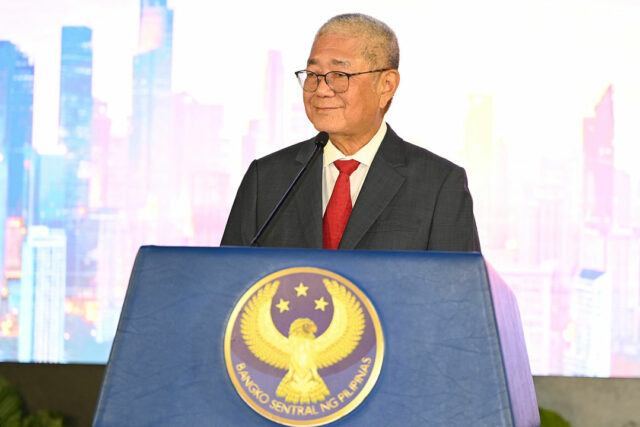
Bangko Sentral ng Pilipinas Governor Eli M. Remolona, Jr. — COURTESY OF BANGKO SENTRAL NG PILIPINAS

The Philippine central bank has room to continue its easing cycle next year after possibly two more quarter-point cuts for the rest of 2025, according to Governor Eli M. Remolona, Jr.

A rate cut is “more likely” this month after inflation eased to a near six-year low in July, Mr. Remolona said in an interview on Tuesday. “Something unexpected would have to happen for us not to cut rates,” he said. That will likely be followed by another reduction in the fourth quarter, the governor said.

With inflation this year likely to average below the central bank’s 2%-4% goal and within that range in 2026, it gives the Bangko Sentral ng Pilipinas (BSP) leeway to further lower borrowing costs “as long as the numbers look good, inflation remains low and the economy can still afford” more easing, he said.

“You can still cut some more,” the governor said, while adding that any decision now on the central bank’s rate path would be premature. “There’s so many things going on globally. There’s less certainty about the global economy.”

Below-target inflation since March has allowed monetary authorities to sustain an easing cycle from August last year, resulting in 125 basis points in cumulative rate reductions.

Central banks from other Southeast Asian nations like Indonesia and Malaysia also recently lowered borrowing costs on expectations that US President Donald Trump’s tariffs will hit global trade. Bets on a September rate cut from the US Federal Reserve have meanwhile risen on weak US jobs data.

The Fed might deliver a half-point rate cut as it seems “to be behind the curve at the moment,” Mr. Remolona said, while adding that the BSP doesn’t necessarily follow US rate moves.

In the Philippines, the government has slashed its 2025 economic growth target due to US tariff concerns and a slower-than-expected expansion in the first quarter. Data on last quarter’s gross domestic product growth are set to be released Thursday.

The US imposed a 19% tariff on Philippine goods that’s on par with most Southeast Asian nations, sparking concerns that Manila may have lost its trade advantage from a proposed 17% initial rate in April. Manila’s relatively low reliance on trade compared with its neighbors may limit the impact of the US levies, Mr. Remolona said, but the central bank will remain watchful of the details of the trade deals.

“There’s more clarity now, but it’s not completely clear because there are all these footnotes, all these details that still have to be worked out,” Remolona said. — Bloomberg

Philippines agricultural output up 5.7% in second quarter

PHILIPPINE STAR/KRIZ JOHN ROSALES

MANILA – The Philippines’ agricultural output grew by 5.7% in the second quarter from a year earlier, the statistics agency said on Wednesday.

Crop output, which accounted for 56% of total farm production, grew 11.3% from a year earlier, the Philippine Statistics Authority said.

Poultry production went up by 7%, while livestock output contracted by 5.9%.

Fisheries output also declined by 4.2% in the second quarter. — Reuters

Nvidia reiterates its chips have no backdoors, urges US against location verification

The logo of technology company Nvidia is seen at its headquarters in Santa Clara, California February 11, 2015. — REUTERS/ROBERT GALBRAITH/FILE PHOTO

 – Nvidia has published a blog post reiterating that its chips did not have backdoors or kill switches and appealed to U.S. policymakers to forgo such ideas saying it would be a “gift” to hackers and hostile actors.

The blog post, which was published on Tuesday in both English and Chinese, comes a week after the Chinese government summoned the U.S. artificial intelligence (AI) chip giant to a meeting saying it was concerned by a U.S. proposal for advanced chips sold abroad to be equipped with tracking and positioning functions.

The White House and both houses of U.S. Congress have proposed the idea of requiring U.S. chip firms to include location verification technology with their chips to prevent them from being diverted to countries where U.S. export laws ban sales. The separate bills and White House recommendation have not become a formal rule, and no technical requirements have been established.

“Embedding backdoors and kill switches into chips would be a gift to hackers and hostile actors. It would undermine global digital infrastructure and fracture trust in U.S. technology,” Nvidia said. It had said last week its products have no backdoors that would allow remote access or control.

A backdoor refers to a hidden method of bypassing normal authentication or security controls.

Nvidia emphasized that “there is no such thing as a ‘good’ secret backdoor – only dangerous vulnerabilities that need to be eliminated.” – Reuters

Australia’s Great Barrier Reef suffers record coral decline following mass bleaching

 – Australia’s Great Barrier Reef has suffered the largest decline in coral cover in two of its three regions over the last year, research released on Wednesday showed, following a mass bleaching of its corals that was among the worst on record.

The Australian Institute of Marine Sciences said the reef has experienced the largest annual decline in coral cover in its northern and southern regions since monitoring began 39 years ago, with coral cover dropping between a quarter and a third after several years of solid growth.

“We are now seeing increased volatility in the levels of hard coral cover,” said Mike Emslie, head of institute’s long term monitoring program.

“This is a phenomenon that emerged over the last 15 years and points to an ecosystem under stress.”

The reef, the world’s largest living ecosystem, stretches for some 2,400 km (1,500 miles) off the coast of the northern state of Queensland.

Since 2016, the reef has experienced five summers of mass coral bleaching, when large sections of the reef turn white due to heat stress, putting them at greater risk of death.

The 2024 event had the largest footprint ever recorded on the reef, with high to extreme bleaching across all of its three regions, the report said.

The Great Barrier Reef is not currently on UNESCO’s list of world heritage sites that are in danger, though the UN recommends it should be added.

Australia has lobbied for years to keep the reef – which contributes A$6.4 billion ($4.2 billion) to the economy annually – off the endangered list, as it could damage tourism. – Reuters

Netanyahu meets security officials as Israel considers full Gaza takeover

ISRAELI PRIME MINISTER BENJAMIN NETANYAHU — REUTERS/EVELYN HOCKSTEIN

 – Israeli Prime Minister Benjamin Netanyahu met senior security officials to finalize a new strategy for the nearly two-year war in the Gaza Strip, his office said on Tuesday, with media reporting he favored a complete military takeover of the Israeli-occupied Palestinian territory.

Despite intense international pressure for a ceasefire to ease hunger and appalling conditions in the besieged enclave, efforts to mediate a truce between Israel and Palestinian militant group Hamas, which governs Gaza, have collapsed.

Local health authorities said at least 20 people were killed by Israeli gunfire as they waited for United Nations aid trucks in the northern Gaza Strip. In southern Gaza, 20 people were wounded by Israeli gunfire as they waited to get aid from U.N. aid trucks near Morag Square near Rafah, medics said.

Eight more people died of starvation or malnutrition in the last day, Gaza’s Health Ministry said, while at least 80 people were killed in the latest Israeli firing.

Mr. Netanyahu’s office said in a statement that the prime minister had held a “limited security discussion” lasting about three hours during which military Chief of Staff Eyal Zamir “presented the options for continuing the campaign in Gaza”.

An Israeli official had earlier told Reuters that Defense Minister Israel Katz and Strategic Affairs Minister Ron Dermer, a confidant of Mr. Netanyahu, would also attend the meeting to decide on a strategy to take to the cabinet this week. Israeli media reported on Tuesday that the cabinet would convene on Thursday at 6 p.m. (1500 GMT).

Israel’s Channel 12, citing an official from Mr. Netanyahu’s office, had said the prime minister was leaning towards taking control of the entire territory. That would reverse a 2005 decision to withdraw Israeli citizens and soldiers from Gaza, while retaining control over its borders, airspace and utilities, a move right-wing parties blame for Hamas gaining power there in the 2006 election.

It was unclear, however, whether Mr. Netanyahu was foreseeing a prolonged takeover or a short-term operation aimed at dismantling Hamas and freeing Israeli hostages. The prime minister’s office declined to comment on the Channel 12 report.

“It is still necessary to complete the defeat of the enemy in Gaza, release our hostages and ensure that Gaza never again constitutes a threat to Israel,” Mr. Netanyahu told new recruits at a military base. “We are not giving up on any of these missions.”

The U.N. called reports about a possible decision to expand Israel’s military operations throughout the Gaza Strip “deeply alarming” if true.

U.S. President Donald Trump declined to say whether the U.S., Israel’s closest military ally, supported Netanyahu’s plans.

“I know that we are there now trying to get people fed,” Mr. Trump told reporters. “As far as the rest of it, I really can’t say. That’s going to be pretty much up to Israel.”

On Saturday, Hamas released a video of the Israeli hostage Evyatar David, appearing emaciated in what seemed to be an underground tunnel. The images shocked Israelis and sparked international condemnation.

Throughout the war, there has been sustained international pressure on Hamas to release the remaining 50 people taken hostage in 2023, of whom Israeli officials estimate 20 are still alive. Most hostages have been released during ceasefires following diplomatic negotiations. Israel broke the last ceasefire.


PRESSURE TACTIC?

A Palestinian official said the suggestion of a full Israeli military takeover of Gaza may be a tactic to pressure Hamas into concessions, while the Palestinian Foreign Ministry urged foreign nations to take heed of the reports.

“The ministry urges countries and the international community to treat these leaks with utmost seriousness and to intervene urgently to prevent their implementation, whether these leaks are meant to exert pressure, test international reactions, or are genuine and serious,” it said.

Israel’s coalition government, the most right-wing and religiously conservative in its history, includes far-right politicians who advocate the annexation of both Gaza and the West Bank and encouraging Palestinians to leave their homeland. The International Court of Justice said in 2024 that Israel’s occupation of Palestinian territories is illegal and should end soon.

Nearly two years of fighting in Gaza have strained Israel’s military, which has a small standing army and has had to repeatedly mobilize reservists; some military leaders have warned against expanding the military occupation.

In a sign of differences between some members of Israel’s ruling coalition and the military, far-right National Security Minister Itamar Ben Gvir challenged military head Zamir to state he would comply with government directives even if a decision was made to take all of Gaza.

The statement from Netanyahu’s office said the Israeli Defense Forces were “prepared to implement any decision that will be made by the Political-Security Cabinet.”


HUNGER

The war was triggered when Hamas-led militants attacked Israeli communities and military bases near Gaza on October 7, 2023. About 1,200 people, including more than 700 civilians, were killed, and 251 hostages were taken to Gaza.

Israel’s military response has devastated the tiny, crowded enclave, killing more than 61,000 people, mostly civilians, according to Palestinian health authorities.

Israel’s campaign has forced nearly all of Gaza’s more than 2 million people from their homes and caused what a global hunger monitor called last week an unfolding famine.

Some 188 Palestinians, including 94 children, have died from hunger since the war began, according to Gaza authorities.

On Tuesday, Israeli tanks pushed into central Gaza, but it was not clear if the move was part of a larger ground offensive.

Palestinians living in the last quarter of territory where Israel has not yet taken military control, via ground incursions or demands for civilians to leave, said any new push would be catastrophic.

“If the tanks pushed through, where would we go, into the sea?” said Abu Jehad, a Gaza wood merchant. “This will be like a death sentence to the entire population.” – Reuters


UN alarmed by reports about possible expansion of Israeli Gaza operations

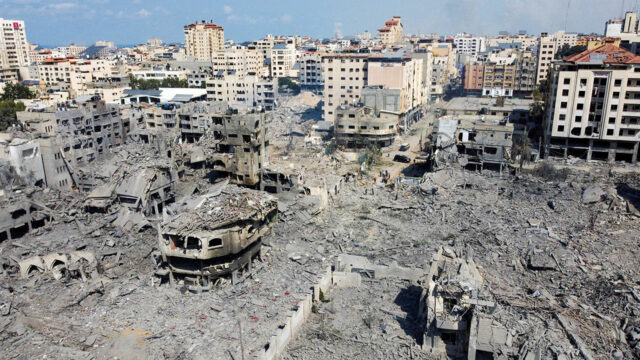
A view shows houses and buildings destroyed by Israeli strikes in Gaza City, Oct. 10, 2023. — REUTERS

The United Nations on Tuesday called reports about a possible decision to expand Israel’s military operations throughout the Gaza Strip “deeply alarming” if true.

U.N. Assistant Secretary-General Miroslav Jenca told a U.N. Security Council meeting on the situation in Gaza that such a move “would risk catastrophic consequences … and could further endanger the lives of the remaining hostages in Gaza.

“International law is clear in the regard; Gaza is and must remain an integral part of the future Palestinian state,” he added.

Israeli Prime Minister Benjamin Netanyahu met senior security officials on Tuesday to finalize a new strategy for the nearly two-year-old war in Gaza with media reporting he favored a complete military takeover of the Palestinian enclave.

China’s deputy U.N. representative, Geng Shuang, expressed “great concern” about the reported plans and added: “We urge Israel to immediately halt such dangerous actions.”

He called for a ceasefire and urged countries with influence to take concrete steps to help bring one about.

Ahead of the U.N. meeting, Israeli Foreign Minister Gideon Saar addressed reporters at the U.N. and criticized countries that sought to pressure Israel by recognizing a “virtual” Palestinian state, saying this had “assassinated” a hostage deal and ceasefire and prolonged the war.

Three Group of Seven countries have announced plans to recognize Palestinian statehood. France and Canada have said they would do so in September at the U.N. General Assembly. Britain said it would also back Palestinian statehood in September unless Israel takes substantive steps to end suffering in Gaza, where it is fighting Hamas, and meets other conditions.

The U.S. ambassador to the U.N., Dorothy Shea, called a U.N. conference last week that saw dozens of ministers urge the world to work toward a two-state solution between Israel and the Palestinians an “unproductive publicity stunt,” and said it had undercut the efforts of mediators.

The brother of Israeli hostage Evyatar David, who was shown appearing emaciated in a video released by Hamas last week, told the Security Council to use its leverage to secure the immediate unconditional release of remaining hostages and to ensure humanitarian aid reaches them.

“Every moment of delay is a step closer to final tragic outcome,” Ilay David told the meeting.

He said the video showed his brother as “a living skeleton. He had barely the strength to move or speak, his voice barely recognizable,” the brother said, adding that neither he nor his mother could bring themselves to watch.

“We knew that if we did, we would be unable to function. My father and sister, however, felt they had to see him, to hear his voice, to feel him somehow. Now these images haunt them. My father cannot sleep, and my mother has not stopped crying ever since,” he said. – Reuters

White House to target banks as Trump claims discrimination

REUTERS

 – President Donald Trump on Tuesday said he believes that banks, including JPMorgan and Bank of America, discriminate against him and his supporters, as he prepares to act against banks for allegedly dropping customers for political reasons.

Mr. Trump also said the country’s top two lenders had previously rejected his deposits, ramping up his attack on the industry.

“They totally discriminate against, I think, me maybe even more, but they discriminate against many conservatives,” he told CNBC in an interview.

Mr. Trump made the comments when asked about a report by the Wall Street Journal that said he planned to punish banks that discriminated against conservatives, but did not address the order specifically.

The executive order instructs regulators to review banks for “politicized or unlawful debanking” practices, according to a draft reviewed by Reuters. It is likely to be announced on Wednesday, an industry source said.

“They did discriminate,” Mr. Trump said of actions taken by JPMorgan after his first term in office. “I had hundreds of millions, I had many, many accounts loaded up with cash … and they told me, ‘I’m sorry sir, we can’t have you. You have 20 days to get out.'”

Mr. Trump’s latest criticism adds pressure on America’s largest lenders. The order would likely require banks to conduct sweeping reviews of their businesses to comply with regulations.

Mr. Trump said, without providing evidence, that the banks’ refusal to take his deposits indicated that the administration of former President Joe Biden had encouraged regulators to “destroy Trump.”

Mr. Trump said he subsequently tried to deposit funds with BofA and was also refused, and eventually split the cash.

“I ended up going to small banks all over the place,” he said. “I was putting $10 million here, $10 million there, did $5 million, $10 million, $12 million,” he said, without naming the lenders.

“I have them all over the place, the craziest thing, and it’s lucky I even had them. They were doing me a favour, and that’s because the banks discriminated against me very badly, and I was very good to the banks.”

In a statement, JPMorgan did not address the president’s specific claims about his account.

“We don’t close accounts for political reasons, and we agree with President Trump that regulatory change is desperately needed,” JPMorgan said. “We commend the White House for addressing this issue and look forward to working with them to get this right.”

BofA also did not address Mr. Trump’s specific claims.


‘REPUTATIONAL RISK’ ISSUE

During Biden’s administration, regulators were able to scrutinize banks’ decisions on the basis of reputational risks, a second source familiar with the matter said.

Lenders were under intense scrutiny and pressure to weigh reputational risks when dealing with Trump because of his legal woes, a third source said.

JPMorgan continues to have a banking relationship with members of the Trump family that dates back years, and it also banks a number of campaign accounts linked to Trump, the third source said.

After Mr. Trump took power, the Federal Reserve announced in June it was directing its supervisors to no longer consider reputational risk when examining banks, a metric that had been a focus of industry complaints.

The Wall Street Journal reported late Monday that the expected executive order would instruct regulators to investigate whether any financial institutions breach the Equal Credit Opportunity Act, antitrust laws or consumer financial protection laws by dropping customers for political reasons.

The order could authorize monetary penalties, consent decrees or other disciplinary measures against violators, according to the draft.

The White House had no immediate comment on the reported order.

“What the White House is doing is telling the banks not to hide behind regulations to deny loans or banking relationships,” said Wells Fargo bank analyst Mike Mayo. “Banks can use their normal underwriting standards and deny services, but not blame regulators or use reputational risk as a justification.”

BofA said it welcomed the administration’s efforts to clarify the policies.

“We’ve provided detailed proposals and will continue to work with the administration and Congress to improve the regulatory framework,” the bank said.

Mr. Trump in January admonished the CEOs of JPMorgan and BofA for denying services to conservatives. At the time, the two banks denied making banking decisions based on politics.


REGULATORY OVERREACH

Banks have consistently argued that any complaints about “debanking” should be aimed at regulators, as they argue onerous rules and overzealous bank supervisors can discourage them from engaging in certain activities.

“The heart of the problem is regulatory overreach and supervisory discretion,” the Bank Policy Institute, an industry group, said in a statement.

Lenders have held discussions around debanking and weighed scenarios around a potential order, the first source said.

Banks are also hopeful the administration may change anti-money laundering laws that they say are outdated and burdensome, the source added. – Reuters