Home Blog Page 1149

What to do with a union-recommended HMO

Our employees’ union strongly recommends a specific Health Maintenance Organization (HMO). The union cites its stellar reputation, extensive hospital network, and quick claims processing. While open bidding remains an option, we are worried that the union may not accept the result. What can we do? — White Lotus.

Stop worrying. Give the union the chance to justify its recommendation within the framework of  an open bidding process. Respect its recommendation without airing any suspicions that it may have been “captured” by the HMO.

But first things first. Review the specific provisions of your Collective Bargaining Agreement (CBA) and be guided by them. Does the CBA specify employee coverage to be any amount or percentage? Whatever the case, I’m sure it will contains certain budgetary limitations.

The union plays an important role in advocating for employee needs, but you must also be aware that, at times, they exceed their boundaries while defeating the letter and spirit of the CBA, wreaking havoc on the company’s financial strategy.

It could be that the HMO the union is pushing for does, in fact, have an excellent reputation, extensive hospital network, and a reputation for quick claims processing. This is true for other HMOs. To find the truth, your organization must answer the following questions:

Should it give in to union pressure? How do you ensure fairness while safeguarding the company’s bottom line?

TRANSPARENCY
The solution lies in building a transparent and competitive bidding process. It’s the best you can do under the circumstances. It eliminates the suspicion of favoritism or backroom deals, not only with the union but also with management. An open bidding is the objective, and all HMOs must be evaluated by the same criteria.

One, publication of objective criteria. The bidding standards must include cost, hospital network, customer service, and average turnaround for claims, as attested by reputable hospitals. The requirements may be drawn up by a joint committee composed of union and management representatives.

Two, competitive pricing. This can be achieved by detailed terms of reference. When HMOs know they are competing openly, they’re more inclined to put in their best bid by offering not just lower premiums, but also improved coverage or providing additional perks.

Three, public announcement of bidding invitation. The platforms for making such an announcement could include the company’s website, industry bulletin boards, employee word-of-mouth, social media, and traditional media, assuming there is a budget for it. The notice must include the project name, deadline for submission, budget range, and other qualifications that bidders must meet.

Four, ensure participation of qualified providers. In addition to making a public announcement, invite all reputable HMO providers in your region. A broad invitation ensures you have a healthy range of offers to compare. When everyone sees the process firsthand, it fosters trust and makes them part of the solution.

Five, strengthen your negotiating position. If the union’s preferred HMO turns out to be more expensive, you now have objective evidence to select another winner. More importantly, do not give the union-backed HMO the option to match competitors’ rates. This defeats the purpose of having an open bidding.

Six, value-for-money coverage. Ensure that the evaluation criteria assign appropriate weight to wide coverage and service quality, and not just price. Sometimes the cheapest HMO might fall short on key hospital tie-ups, while the most expensive one offers features that employees don’t need.

Seven, document and communicate the results. Once a winner is selected, prepare a summary report of all bids, showing why the chosen provider offers the best balance of coverage and cost. Share this with both management and the union to ensure full transparency.

HYBRID SOLUTIONS
Even after an open bidding, there’s a possibility that the union and some employees may still prefer a more expensive HMO. If that happens, consider certain hybrid solutions like the following:

One, a two-tier HMO plan. This means awarding the bid to the winning HMO for all covered employees with the company covering the winning HMO’s premium. At the same time, allow certain employees who prefer the union’s HMO to pay the premium difference via salary deduction.

Two, voluntary top-up plans. Employees contribute a portion to get the additional benefits they want, without burdening the company with the full cost. This way, employees have a choice without the company overspending.

Communication is key. Aim for turning perceptions around from rejecting the union’s choice to a collaborative process to find a best-for-all solution.

Employees want to feel cared for. When you conduct a transparent, competitive process, you’re not just saving the company money — you’re building trust. By involving the union, documenting every step, and offering flexible options, you turn what could be a contentious process into a win-win scenario.


Ask questions and receive Rey Elbo’s insights for free. E-mail elbonomics@gmail.com or DM him on Facebook, LinkedIn, X, or via https://reyelbo.com. Anonymity is guaranteed.

End-June 2025 Gov’t debt-to-GDP ratio climbs to 63.1%, highest since 2005

THE National Government’s (NG) debt as a share of gross domestic product (GDP) rose to 63.1% at the end of June, the highest ratio since 2005, the Bureau of the Treasury reported on Thursday. Read the full story.

End-June 2025 Gov’t Debt-to-GDP Ratio climbs to 63.1%, highest since 2005

World Athletics’ mandatory genetic test for women athletes is misguided. I should know — I discovered the relevant gene in 1990

STOCK PHOTO | Image by Kjpargeter from Freepik

World Athletics president Sebastian Coe recently announced a new rule for women athletes, requiring mandatory genetic tests to verify their biological sex.

This test must be done if athletes wish to compete in September’s World Athletics Championships in Tokyo.

World Athletics has said all athletes competing as women must have an SRY gene test to identify whether a male Y chromosome is present. As the SRY gene is found on the Y chromosome, it is effectively a proxy for the Y chromosome.

Any athlete whose test shows the presence of the SRY gene will be banned from competing in the women’s category in elite events. However if the athlete has a condition called Complete Androgen Insensitivity Syndrome (CAIS), they may be able to qualify for an exemption.

Coe said the decision was made to ensure “the integrity of women’s sport” with World Athletics asserting: “The SRY gene is a reliable proxy for determining biological sex.”

I argue the science does not support this overly simplistic assertion.

I should know, because I discovered the SRY gene on the human Y chromosome in 1990. For 35 years I have been researching it and other genes required for testis development.

A BRIEF PRIMER ON TESTES AND OVARY DEVELOPMENT
If a human embryo has XY chromosomes, then at six weeks of development the SRY gene on the Y chromosome triggers a cascade of events involving some 30 different genes that lead to the formation of testes.

In simplest terms, the testes then produce hormones including testosterone, leading to male development.

However, if an embryo has XX chromosomes, a whole different group of genes come into play, ovaries form, and the hormones produced result in a female.

We know making testes or ovaries requires a complex network of many interacting genes and proteins.

Some genes promote testis development while others promote ovary development.

Other genes either suppress ovary formation or antagonize testis formation.

Even once ovaries or testes are fully formed, we require other genes to maintain them. These genes don’t always function as expected, affecting the development of these organs.

HOW DOES THIS RELATE TO SEX TESTING OF ELITE WOMEN ATHLETES?
Changes or variants in the many genes that regulate the development of a testis or ovary can result in sex reversal or a non-functioning testis or ovary.

What do I mean by this?

If there is a change in the SRY gene so it does not function as usual, then a person can fail to develop testes and be biologically female. Yet they carry XY chromosomes and under the World Athletics tests they would be excluded from competition. However, athletes can appeal World Athletics’ finding if they believe the test result does not reflect their sex.

Other XY individuals may have a functioning SRY gene but are female — with breasts and female genitalia, for example — but have internal testes.

Importantly, the cells of these people are physically unable to respond to the testosterone produced by these testes. Yet, they would receive positive SRY tests and be excluded from competition.

At the 1996 Olympic Games in Atlanta, eight of 3,387 women athletes had positive test results for a Y chromosome. Of these, seven were resistant to testosterone.

THE SRY TEST ISN’T CUT-AND-DRIED
World Athletics asserts the SRY gene is a reliable proxy for determining biological sex. But biological sex is much more complex, with chromosomal, gonadal (testis/ovary), hormonal, and secondary sex characteristics all playing a role.

Using SRY to establish biological sex is wrong because all it tells you is whether or not the gene is present.

It does not tell you how SRY is functioning, whether a testis has formed, whether testosterone is produced and, if so, whether it can be used by the body.

OTHER PROBLEMS WITH THE SRY TESTING PROCESS
World Athletics is recommending all women athletes take a cheek swab or blood sample to test for the presence of SRY.

Normally, the sample would be sent to a lab that would extract DNA and look for the presence of the SRY gene.

This may be easy enough in wealthy countries, but what is going to happen in poorer nations without these facilities?

It is worth noting these tests are sensitive. If a male lab technician conducts the test he can inadvertently contaminate it with a single skin cell and produce a false positive SRY result.

No guidance is given on how to conduct the test to reduce the risk of false results.

Nor does World Athletics recognize the impacts a positive test result would have on a person, which can be more profound than exclusion from sport alone.

There was no mention from World Athletics that appropriate genetic counselling should be provided, which is considered necessary prior to genetic testing and challenging to access in many lower- and middle-income countries.

I, along with many other experts, persuaded the International Olympic Committee to drop the use of SRY for sex testing for the 2000 Sydney Olympics.

It is therefore very surprising that, 25 years later, there is a misguided effort to bring this test back.

Given all the problems outlined above, the SRY gene should not be used to exclude women athletes from competition.

THE CONVERSATION VIA REUTERS  CONNECT


Andrew Sinclair is the deputy director of the Murdoch Children’s Research Institute. He receives funding from NHMRC.

How PSEi member stocks performed — August 7, 2025

Here’s a quick glance at how PSEi stocks fared on Thursday, August 7, 2025.


Philippine central bank developing online gambling rules for banks, e-wallets

REUTERS

By Luisa Maria Jacinta C. Jocson, Senior Reporter

THE BANGKO SENTRAL ng Pilipinas (BSP) is developing rules that require financial institutions to impose stricter safety protocols in an effort to mitigate risks from online gambling.

In a statement on Thursday, the central bank said it is “taking action to protect financial consumers from the risks associated with online gambling.”

The booming gaming industry in the Philippines has led to calls to regulate or even ban the sector amid concerns over rising addiction and financial problems among Filipinos.

Philippine President Ferdinand R. Marcos, Jr. has warned that digitalization has made online gambling more accessible and destructive to Filipino families.

Mr. Marcos earlier expressed openness to supporting both taxation and regulation in the sector but did not bring this up during his State of the Nation Address last month.

The Department of Finance has proposed a tax on online gaming, as well as other possible measures to crimp the public’s access to digital gambling platforms such as imposing limits on playing time or cash-in.

The BSP said it is “finalizing new rules, developed following public consultation, that will require banks, e-wallets, and other financial service providers to adopt stronger safeguards against gambling-related harm.”

These rules will include stricter identity verification measures such as biometric checks and facial recognition when utilizing funds for online gambling.

The central bank also seeks to impose “daily limits on gambling-related transfers to reduce excessive financial losses and time-based restrictions on gambling payments to help curb impulsive behavior.”

Other measures include user tools to implement personal spending caps, voluntary breaks, or options to self-exclude from gambling transactions.

“These safeguards aim to reduce the risks of addiction, fraud, and financial harm while promoting the responsible use of digital financial services,” the BSP added.

The central bank last month released a draft circular which seeks to tighten regulations on online gambling payments to prevent the misuse of financial services.

This would cover payment service providers engaged in these services as well as operators of a payment system serving as payment acquirer or aggregator of the online gambling operator.

“The BSP’s move to strengthen safeguards against online gambling-related harm is a timely and welcome development,” Rizal Commercial Banking Corp. Executive Vice-President and Chief Innovation and Inclusion Officer Angelito M. Villanueva said in a Viber message.

“As digital payments become more accessible, so too does the risk of excessive gambling, fraud, and financial distress, especially among the youth and vulnerable sectors,” he added.

Mr. Villanueva cited the need for a “proactive, risk-based approach that goes beyond blocking transactions.”

“Measures like real-time monitoring, stricter onboarding, merchant classification, and customer self-exclusion tools will help banks and fintechs (financial technology) protect users while upholding financial integrity.”

“This is a vital step toward building a more responsible and resilient digital finance ecosystem,” he added.

Ronald B. Gustilo, national campaigner for Digital Pinoys group, suggested several measures that central bank and Philippine Amusement and Gaming Corp. can consider to discourage online gambling.

“Ban endorsements on social media platforms, e-wallets, banking platforms, super-apps, booking sites, and other websites or apps across the internet — except on the official website of the online gambling platform itself,” Mr. Gustilo said.

Banner ads, the use of celebrities or influencers as promoters, and any content that promotes illegal gambling should also be prohibited, he added.

“We also suggest making it a criminal offense to endorse gambling online. It should also be a crime to steal content or illegally use photos or videos of a personality and edit them to appear as if the influencer or celebrity is endorsing gambling.”

The government can also consider discouraging easy access to betting, such as increasing the minimum bet amount of online gambling platforms and raising the minimum betting age.

Tighter restrictions can also be employed, such as not allowing any gambling until the identity verification process is complete, as well as an automatic cooldown feature.

Mr. Gustilo also proposed not allowing the sharing or lending of accounts. “Anyone caught allowing others to use their account should be banned from the platforms.”

He also called for the ban of using e-wallets or online banking for topping up gambling accounts, as well as banning interfaces that resemble children’s games.

On the other hand, political economist Calixto V. Chikiamco said that the BSP “should not be determining ‘social harm.’”

“It’s a monetary regulator, not a social engineer. It should leave to elected members of Congress regulations affecting online gaming,” he said in a Viber message.

The central bank should also be careful about over-regulation, he said.

“If they set up high bars for poor people to gamble, they might just drive gambling to illegal gaming sites. Gaming is a form of entertainment that should be available to poor and rich alike.”

“The social harm actually comes from gambling addiction and there are tools like allowing relatives to ban their loved ones from gaming sites that should be mandated,” he added.

Mr. Chikiamco said regulations must be “smart” or else these will just “drive players into unlicensed and unregulated markets where they could be exploited and social harm mitigation tools are absent.”

Debt-to-GDP ratio grows to 63.1% at end of June

BW FILE PHOTO

THE National Government’s (NG) debt as a share of gross domestic product (GDP) rose to 63.1% at the end of June, the highest ratio since 2005, the Bureau of the Treasury reported on Thursday.

The ratio at the end of June represented a gain on the previous quarter’s 62% and the 60.9% posted a year earlier. It is also above the 60% debt-to-GDP threshold considered by multilateral lenders to be manageable for developing economies.

The government is aiming to bring down the ratio to 60.4% by the end of 2025, and to 56.9% by 2028.

End-June 2025 Gov’t Debt-to-GDP Ratio climbs to 63.1%, highest since 2005

Rizal Commercial Banking Corp. Chief Economist Michael L. Ricafort said the higher debt-to-GDP was likely due to the wider budget deficit.

In the first six months, the NG budget deficit widened 24.69% to P765.5 billion.

“As well, the relatively slower GDP growth mathematically slowed the growth in the GDP denominator,” he added.

The Philippine Statistics Authority on Thursday reported GDP grew 5.5% in the three months to June, against 5.4% a quarter earlier and 6.5% a year earlier.

Mr. Ricafort cited the need for “more tax and other fiscal reform measures to increase the recurring sources of government tax revenue, ensure more disciplined government spending in an effort to narrow the budget deficit and further bring down the NG debt-to-GDP ratio.”

Palace Press Officer Clarissa A. Castro said the Department of Finance (DoF) considers 70% of GDP to be the international threshold for sustainable borrowing, as opposed to the 60% rule-of-thumb that multilateral banks often hold developing countries to.

According to the Treasury, outstanding debt jumped to a record P17.27 trillion at the end of June.

Some 69.2% of the total debt was owed to domestic creditors, while the rest was owed to foreign creditors.

Domestic debt increased 13% year on year to P11.95 trillion at the end of June.

On the other hand, external debt rose 8.3% to P5.32 trillion. The NG’s outstanding debt is projected to hit P17.35 trillion by the end of 2025.

NG gross borrowing rose 78.16% year on year to P263.99 billion in June.

Until 2027, the NG plans to source at least 80% of its borrowing program from domestic sources and 20% from foreign. — Aubrey Rose A. Inosante

Chip industry association warns of ‘devastating’ Trump tariff impact

REUTERS

By Justine Irish D. Tabile, Reporter

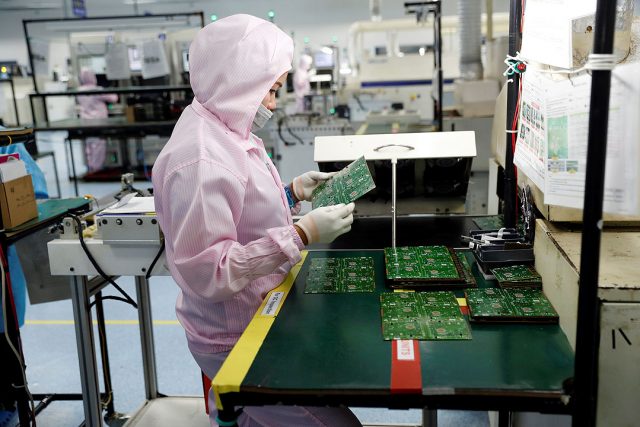
THE Semiconductor and Electronics Industries in the Philippines, Inc. (SEIPI) said the proposed 100% tariff on semiconductors entering the US market would be “devastating” to Philippine exporters.

“The 100% tariff would be devastating,” SEIPI President Danilo C. Lachica said via Viber.

US President Donald J. Trump announced plans to impose tariffs on semiconductors shipped to the US, but offered to exempt companies manufacturing in the US or those that commit to do so, Reuters reported.

Mr. Trump’s broader reciprocal tariffs on major trading partners were set to take effect starting Aug. 7.

In the updated annex, five members of the Association of Southeast Asian Nations (ASEAN), including the Philippines, will be charged 19%. The other countries are Cambodia, Malaysia, Thailand, and Indonesia.

Even prior to the announcement of a 100% tariff on semiconductors, SEIPI had expected the US tariff to temper the industry’s export projections.

“70% of Philippine exports are semiconductors, or about $30 billion last year, and 15%, or about $6 billion, of semiconductor exports are US-bound,” Mr. Lachica said.

Meanwhile, Electronics Industry Association of the Philippines President Earl Lawrence S. Qua noted that “most of the larger semiconductor packaging houses already have operations in the US.” 

“These are the multinationals that have a multi-region footprint, which include the US. So I’m not sure how the tariffs will affect them; they could be insulated like Apple,” he said.

“Having said that, it will force locally owned players to think about expanding or at least investing in the US. But it could be very damaging in the short term,” he added.

Economy Secretary Arsenio M. Balisacan said that he does not expect the semiconductor tariffs to have an “adverse” impact, as the value added of semiconductors and electronics is not that high compared to other manufacturing exports.

“The second consideration is that while our electronics and semiconductor exports are hit by such changes in tariffs, a big chunk, a lot of our exports go to other countries. Maybe 80-90% of that goes to countries like China,” he said.

BCDA approves P53.5B in investments in first 7 months

Filinvest New Clark City (Artist’s Perspective)

THE Bases Conversion and Development Authority (BCDA) said it approved P53.5 billion worth of proposed investments in the first seven months.

In a statement on Thursday, the BCDA said approvals during the period rose 63.82% from a year earlier.

These projects are expected to generate 7,000 jobs in New Clark City in Tarlac and Camp John Hay in Baguio. The year-earlier jobs-generation tally for approved proposals had been 6,544.

BCDA President and Chief Executive Officer Joshua M. Bingcang said the proposals reflect growing investor confidence in BCDA-managed economic zones.

“These numbers represent opportunities for thousands of Filipinos and signal the private sector’s trust in our vision of resilient, smart, and inclusive cities,” he added.

The approvals include projects of Science Park of the Philippines, Inc. which signed a 50-year contract to develop a 100-hectare industrial park in New Clark City worth P2.7 billion.

The BCDA also approved investments by the consortium of Sta. Clara International Corp., Saekyung Realty Corp., and Korea Overseas Infrastructure and Urban Development Corp., as well as by the Bangko Sentral ng Pilipinas, which is setting up a new complex in New Clark City.

Other investors include Ayala Land, Inc., Stern Real Estate, Top Taste and Trading, Inc., Amare La Cucina, and Prime Collective Corp. in Camp John Hay.

“As we drive progress in Central and Northern Luzon, we are proving that government-led development can attract private capital, unlock economic potential, and transform entire regions,” Mr. Bingcang said.

He said approval levels “underscore the growing momentum behind public-private partnerships in transforming government-owned developments into engines of economic growth.”

Earlier this year, the BCDA said it expects investments in Camp John Hay to hit P10 billion after it took over the property in January. — Justine Irish D. Tabile

60-day rice import freeze not seen as inflationary

PHILSTAR FILE PHOTO

THE suspension of rice imports for 60 days is not likely to drive inflation due to ample supplies of the staple grain, the Department of Economy, Planning, and Development (DEPDev) said.

“Even if we suspend import during the harvest — that is, September and October — there will be enough supply. The availability of rice is close to what it is during normal times. It’s not likely going to cause increases in inflation,” Economy Secretary Arsenio M. Balisacan said at a briefing on Thursday.

On Wednesday, President Ferdinand R. Marcos, Jr. ordered a 60-day suspension of rice imports starting Sept. 1 to provide relief to farmers who have been offered low farmgate prices for their grain, and are counting on good prices for the harvest.

Inflation slowed to a near six-year low in July at 0.9% as utilities and food costs continued to ease. For the first seven months, inflation averaged 1.7%, running ahead of the Bangko Sentral ng Pilipinas forecast of 1.6% for 2025.

Mr. Balisacan cited estimates that supply will remain sufficient even if the government pauses imports for more than 40 days.

The Philippines is the world’s biggest rice importer, having brought in 2.44 million metric tons (MMT) at the end of July, according to the Bureau of Plant Industry.

In 2024, the Philippines imported 4.7 MMT, with volumes expected to exceed that level this year.

Asked if economic managers have reached a consensus on whether to raise the rice import tariff  to the original 35% level set by the Rice Tariffication Law of 2019, Mr. Balisacan said they are still studying “long term” measures.

“We want a permanent solution — one that is administratively affordable and predictable — so that farmers can be protected from sharp price swings. It’s okay to have some fluctuations; that’s expected due to seasonality,” he said.

Mr. Balisacan also cited circumstances that are different from when the government slashed the import tariff to 15% last year

“When the rice tariff was reduced from 35% to 15%, world prices were quite high, close to $600 per metric ton. Now it’s down to almost $450-$490 per metric ton. It’s a 31% drop in world prices,” he said.

“Of course, we have to keep watching and looking vigilant because world prices can change suddenly as well and we need to make sure that our policy is flexible enough to address all these changes in the marketplace,” he said. — Aubrey Rose A. Inosante

New ERC chairman sees rate review backlog cleared within four years

THE incoming chairman of the Energy Regulatory Commission (ERC) committed to clearing the backlog of rate reset applications within four years by streamlining the review process.

“Within four years, we will complete the rate reset of all private distribution utilities under the performance-based regulation,” ERC Chairperson and Chief Executive Officer Francis Saturnino C. Juan said during the turnover ceremony on Thursday.

Mr. Juan hopes to streamline the rate reset process by revising the rules for setting distribution wheeling rates.

Under the Electric Power Industry Reform Act (EPIRA) of 2001, the ERC is tasked with establishing the method for setting transmission and distribution wheeling rates. The rates must be set in a way that allows the recovery of “just and reasonable costs and a reasonable return on rate base,” enabling the entity to operate viably.

The rate reset process is typically a forward-looking exercise that requires the regulated entity to forecast expenditures and propose projects over a five-year regulatory period. The ERC assesses the actual performance of the entity and adjusts rates as needed.

Mr. Juan said that the process should be streamlined by proceeding directly to the release of the decision instead of undergoing draft consultations.

“If possible, once the hearings are done and all documents and evidence have been submitted, the ERC should go ahead and make a decision,” he said. “If the utility is not satisfied or wants something changed, it can still file a motion for reconsideration.”

Mr. Juan is set to take the helm of the ERC on Aug. 8, replacing the outgoing Monalisa C. Dimalanta, who submitted her irrevocable resignation in July.

Separately, in a notice, the ERC rejected the joint application of Province of Siquijor Electric Cooperative (Prosielco) and S.I. Power Corp. (Sipcor) to implement their supplemental agreement.

The ERC instead, directed the firms to comply with their obligations under the original power supply agreement, which was approved in 2012.

“Upon evaluation, the Commission determined that the supplemental agreement effectively amended the original agreement that was approved by the Commission, and there was already a commitment to supply what they wanted to cover in the supplemental agreement,” Ms. Dimalanta said.

“So, it seems the Commission no longer saw the necessity for that supplemental agreement if they comply with the original agreement,” she said.

Mr. Juan said that the power issue in Siquijor will be one of the first items the Commission will tackle during his term.

“We will study what the best course of action is to protect the interests of the consumers in Siquijor,” he said. — Sheldeen Joy Talavera

Deals with India seen unlocking economic ties, tourist exchanges

NOEL PABALATE/PPA POOL

DEALS signed between India and the Philippines are expected to accelerate the growth of business exchanges and leisure travel, officials said.

In a statement on Thursday, the Department of Tourism (DoT) said both countries agreed to the Implementation Program on Tourism Cooperation for 2025-2028 on Aug. 5.

Tourism Secretary Ma. Esperanza Christina G. Frasco said the deal signing will serve as a catalyst for raising Indian tourist numbers in the Philippines.

“We reaffirm our commitment to work together in unlocking the full potential of our tourism linkages — from policy exchange and capacity building to investment promotion and cultural tourism,” she said.

“Under the Marcos administration, we continue to advance our efforts toward strengthening global partnerships to bring more tourists to our shores while showcasing the best of Filipino hospitality, culture, and destinations to the world,” she added.

The Implementation Program is designed to facilitate mutual tourism growth and promote people-to-people exchanges.

It outlines joint initiatives between the Philippines and India, including the exchange of best practices and sustainable and responsible tourism.

“The program also highlights mutual efforts to encourage exchanges between tourism professionals and stakeholders, joint promotion and marketing, education and training, and tourism management and operations,” the DoT said.

According to the DoT, arrivals from India totaled 51,116 in the first seven months.

The DoT expects this to increase “with the easing of visa restrictions and establishment of direct flights between Delhi and Manila.”

Meanwhile, the Department of Trade and Industry (DTI) said a memorandum of understanding (MoU)  was signed by the Federation of Indian Chambers of Commerce and Industry and a Philippine-based Indian business association.

“This partnership is a strong symbol of the growing economic ties between the Philippines and India,” Trade Secretary Ma. Cristina A. Roque said in a statement.

“It reflects our shared commitment to advancing trade, promoting investment, and creating more opportunities for collaboration between our business communities,” she added.

The MoU aims to strengthen cooperation on trade promotion and information exchange and facilitate partnerships between Philippine and Indian businesses.

“The MoU builds on a similar agreement first signed in 2019 and expands cooperation to include information-sharing on trade regulations, support for policy advocacy, and coordinated efforts to host delegations and business forums,” the DTI said.

“By formalizing these channels, Filipino and Indian companies are expected to gain faster access to each other’s markets and benefit from simplified procedures for trade and investment activities,” it added.

The DTI said the MoU complements ongoing initiatives to position the Philippines as a hub for manufacturing, services, and technology-driven enterprise.

“The renewed MoU comes as both nations explore opportunities in sectors ranging from pharmaceuticals and information technology to agribusiness and consumer goods, areas where synergies between Indian innovation and Philippine market potential are increasingly being recognized,” the DTI added. — Justine Irish D. Tabile

Port cargo volume up 5.48% in 2nd quarter

ICTSI

THE Philippine Ports Authority (PPA) said port cargo volume grew 5.48% in the second quarter, mainly driven by foreign shipments.

Citing preliminary data, the PPA said ports under its jurisdiction handled 83.30 million metric tons in the quarter.

Domestic cargo throughput totaled 29.54 million metric tons.

Foreign cargo throughput was 53.76 million metric tons, up 3.74% year on year.

PPA container ports serviced 2.14 million twenty-foot equivalent units (TEUs), up 10.31% from a year earlier.

Passenger traffic rose 13.74% to 26 million in the second quarter.

For the six months to June, cargo throughput rose 7.76% to 149.23 million metric tons.

Container traffic amounted to 4.18 million TEUs, up 11.8% from a year earlier.

In a separate statement, the PPA said it generated P14.68 billion in revenue in the first six months, up 13.70% from a year earlier due to higher vessel and cargo traffic. — Ashley Erika O. Jose