
How PSEi member stocks performed — August 19, 2025

Here’s a quick glance at how PSEi stocks fared on Tuesday, August 19, 2025.
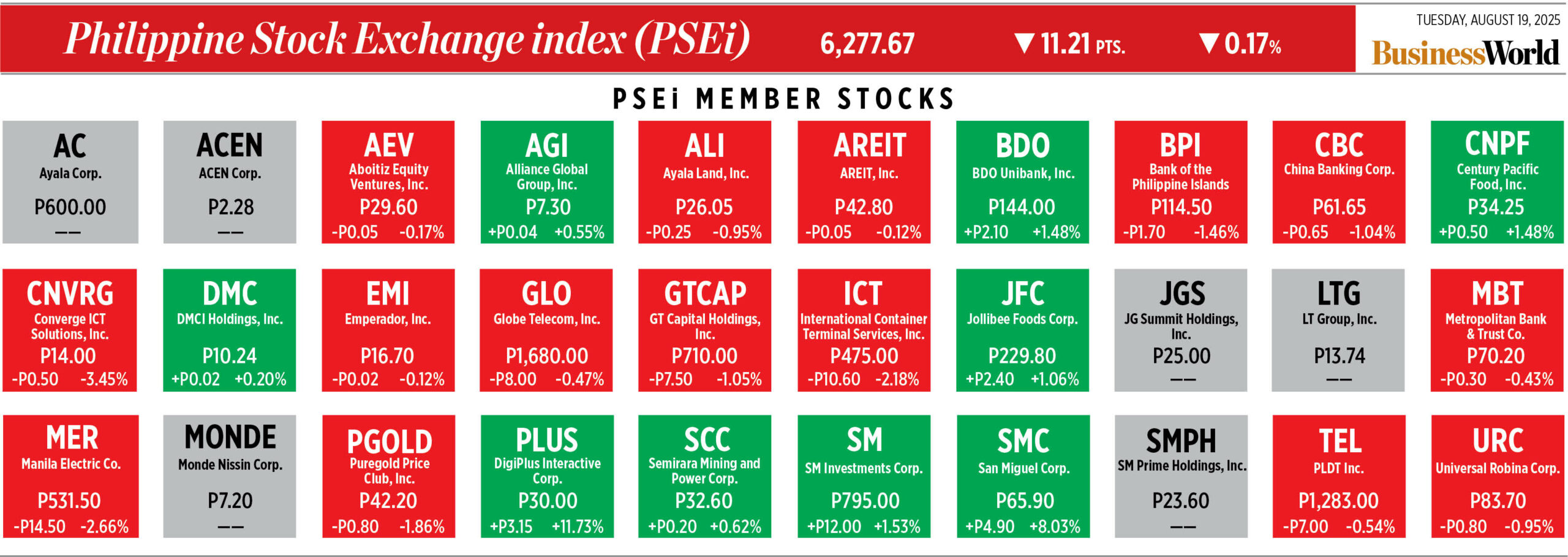

Here’s a quick glance at how PSEi stocks fared on Tuesday, August 19, 2025.

PHILIPPINE STOCKS dropped further on Tuesday due to the absence of fresh leads, with investors looking ahead to the US Federal Reserve’s Jackson Hole symposium later this week, where US central bank officials could provide hints on their policy stance.
The Philippine Stock Exchange index (PSEi) dropped by 0.17% or 11.21 points to close at 6,277.67, while the broader all shares index slipped by 0.08% or 3.21 points to end at 3,737.90.
“The local market extended its decline as investors continued to exit amid the lack of a positive catalyst,” Philstocks Financial Inc. Research Manager Japhet Louis O. Tantiangco said in a Viber message. “Investors are looking forward to the upcoming Jackson Hole Symposium for clues on the Fed’s policy outlook.”
“The market was weighed down by selling pressure as some investors may already be engaging in profit taking. At the same time, with no new catalysts in sight, others are likely adopting a more cautious stance while waiting for the next opportunity,” Regina Capital Development Corp. Head of Sales Luis A. Limlingan said in a Viber message.
Markets are awaiting the US Federal Reserve’s annual symposium in Jackson Hole on Aug. 21-23 for any clues on the likely path of interest rates, Reuters reported. Fed Chair Jerome H. Powell is due to speak on the economic outlook and the central bank’s policy framework.
Analysts reckon that he is unlikely to lock himself onto a monetary path before seeing August’s round of data even though money market expectations of a rate cut next month remain above 80%, according to CME’s FedWatch tool.
The minutes of the Fed’s July 29-30 meeting are also due on Wednesday and could offer insight into policymakers’ thinking about the trajectory of interest rates albeit the meeting took place before a weak labor market report prompted markets to price in cuts more aggressively.
The Fed has kept its target rate at the 4.25%-4.5% range since December 2024.
Majority of sectoral indices closed lower on Tuesday. Services declined by 1.21% or 27.72 points to 2,247.11; industrials went down by 0.41% or 37.13 points to 9,029.19; property retreated by 0.21% or 5.26 points to 2,407.06; and financials decreased by 0.19% or 4.12 points to 2,118.24.
Meanwhile, holding firms rose by 0.86% or 45.82 points to 5,331.41, and mining and oil increased by 0.15% or 14.90 points to 9,602.15.
“DigiPlus Interactive Corp. was the day’s index leader, jumping 11.73% to P30. Converge ICT Solutions, Inc. was the main index laggard, falling 3.45% to P14,” Mr. Tantiangco said.
Value turnover climbed to P7.59 billion on Tuesday with 1.02 billion shares traded from the P6.18 billion with 746.65 million shares exchanged on Monday.
Decliners outnumbered advancers, 101 versus 86, while 63 names were unchanged.
Net foreign selling was at P1.22 billion on Tuesday, a turnaround from the P252.17 million in net buying on Monday. — Revin Mikhael D. Ochave with Reuters

THE Department of Trade and Industry (DTI) said it tapped AstraZeneca Pharmaceuticals to help build the Philippines’ first pharma innovation hub.
The hub stems from a memorandum of understanding (MoU) signed by the Philippine Economic Zone Authority (PEZA) and AstraZeneca Philippines on Tuesday.
“Under the agreement, AstraZeneca’s Innovation Hub will serve as a regional center for digital health technology, research and development collaboration, and patient-centered healthcare solutions,” the DTI said in a statement.
Initially, the hub will feature an Oncology Innovation Center, which is modeled after the company’s pharma hub in the UK.
It will use artificial intelligence for early cancer detection, expand patient-support systems, build healthcare workforce capacity, and promote evidence-based policy development.
It is part of the over P7-billion investment the company has earmarked for the Philippines in the next two years.
“The MoU also includes initiatives where AstraZeneca will support the Philippines’ investment promotion drive by holding business forums, investment briefings, business-to-business matchmaking sessions, and international delegations to attract local and foreign healthcare-related investments,” the DTI said.
“In turn, PEZA will help AstraZeneca identify strategic ecozone locations for its projects, assist with regulatory processes, and connect the company with support industries and potential joint venture partners,” it added.
Trade Secretary Ma. Cristina A. Roque said the partnership “is a big step toward President Ferdinand R. Marcos, Jr.’s goal of making medicines more affordable and accessible, while also laying the foundation for the Philippines to become a hub for research, digital health, and new medical investments.”
PEZA Director General Tereso O. Panga said that the partnership builds on its goal of establishing more medical-centered economic zones.
“We want to attract more companies that are into development, manufacturing, and research in the medical field in order to create a value chain that will lead to the lowering of the cost of medicine,” Mr. Panga said.
“This is a call of the President that we have taken to heart and embraced. We have already established the first pharma ecozone, and this with AstraZeneca is another momentous event towards achieving our objectives,” he added.
According to the DTI, the pharmaceutical industry is among the country’s fastest-growing industries, with over 50 manufacturers and medical device firms currently operating in ecozones.
According to AstraZeneca Asia Area Vice-President Sylvia Varela, the company’s P7-billion investment in the Philippines will include the multi-stakeholder health innovation hub. — Justine Irish D. Tabile

By Justine Irish D. Tabile, Reporter
POTENTIAL foreign investors continue to make inquiries about possibly locating operations in the Philippines even in the face of US tariff uncertainty, Aboitiz InfraCapital Economic Estates (AIC Economic Estates) said.
“Because of the value that we’ve created in our estates, for us from where we’re sitting, it’s business as usual,” Monica Lorenzana Trajano, vice-president and head of commercial strategy at AIC Economic Estates, said at a media roundtable on Tuesday.
She said there has been no slowdown in the inquiries, describing the flow of communications with potential investors as “constant.”
“It’s a constant flow because we are also constantly expanding, so when the international locators see us, they see their ability to scale,” she said.
“Our ecosystem is world-class, so they are able to compare us with other countries in terms of support for their growth or expansion. So, tariff-wise, I would not say there has been a slowdown,” she added.
She said the China plus one strategy, under which investors remain in China but seek an alternative production center, is driving locator behavior because of the need to derisk supply chains.
“What we are also seeing is that a lot of foreign companies are understanding the strength of our domestic market,” she said.
She cited the cases of Epson and Yamaha, two of its major locators which are geared towards the domestic market.
On tariffs, she said: “Right now, we’re a bit at par with the rest of Southeast Asia in terms of tariffs at 19%…” she said. “Things are in flux because things are still being negotiated, if I’m not mistaken, in Washington, DC. But even at 19%, there are exceptions, (including) electronics,” she added.
The company remains optimistic that the country’s unique strengths—such as attractive incentives and world-class Economic Estates—continue to make it an ideal location for global companies in the electronics supply chain.”Earlier this month, the government said it will try to push for the exemption of semiconductors, among other Philippine exports, in its negotiations with the US.
She said interest from US information technology and business process management (IT-BPM) companies continues despite proposals to reshore the US call center industry.
A bill introduced in the US Senate last month proposes restrictions on US firms outsourcing call center operations, including making them ineligible for new Federal grants or guaranteed loans.
She noted, however, that the bill has had “no effect yet … And there are homegrown business process outsourcing (BPO) companies that are actually inquiring about LIMA Tower One,” she added.
To date, about 54% of LIMA Tower One, an office building at its Lime economic zone in Lipa, Batangas, has been leased out since its launch in the fourth quarter of 2024.
“More are coming in, so we are hitting our targets,” she added.
Nico de Leon, assistant vice-president for sales and leasing at AIC Economic Estates, said that BPOs go where the talent pool is, with the focus of expansions turning to the provinces.
“It is more going to provincial areas. BPOs in Metro Manila keep their headquarters here, but are growing in the countryside,” he said.
He said that BPOs still see outsourcing as a response to high costs in the US.
Meanwhile, he said that the Philippine Economic Zone Authority’s proposed implementing rules and regulations for work-from-home arrangements will make economic zones more attractive for IT-BPM locators.
“That is going to help grow the BPO industry. I think at the end of the day, having flexibility in the work setup for the BPO employees is something that the new workforce is looking for right now,” he said.

ONLINE GAMING companies said the government needs to focus on dismantling illegal gambling operators before restricting licensed platforms.
“The first thing that we have to address is the illegals,” PlaySafe Alliance of the Philippines spokesman and former legislator Michael T. Defensor said on the Money Talks with Cathy Yang program on Tuesday.
Even with the proposed restrictions on the industry, the illegal segment of the industry can still say, “kids can play,” he added.
The PlaySafe Alliance of the Philippines consists of 19 companies including DigiPlus Interactive Corp., and World Platinum Technologies, Inc.
“PAGCOR (the Philippine Amusement and Gaming Corp.) would say it’s 60% illegal, 40% legal. For me, it’s worse than that, because I’ve seen some data; 68% are actually illegal,” he said.
Last week, the Bangko Sentral ng Pilipinas (BSP) ordered all e-wallets, banks, and other supervised institutions to remove in-app gambling assets, including links directing users to gaming or gambling websites.
The central bank said the suspension will remain in place until its guidelines for online gambling payment services are finalized.
PAGCOR and the BSP faced intense questioning at a Senate hearing on Aug. 14 amid a burgeoning campaign to ban the entire industry. The government has taken the position that the alleged abuses of the industry, which it taxes, can be managed by regulation.
After the delinking order, gross gaming revenue declined, and platforms have since installed measures to protection against gambling addiction.
“You have to understand, if you are in the online wallet, like Paymaya or GCash, you are actually legal. And in those payment platform wallets, there’s already a KYC (Know Your Customer) mechanism,” he said.
Mr. Defensor said children cannot access such platforms and be exposed to gambling.
“The legal online gaming platforms have their own KYC that is regulated and monitored by the Bangko Sentral ng Pilipinas, the online payment platforms themselves, and also by PAGCOR,” he said.
He proposed adopting the self-regulation measures in the UK, which is based on algorithms.
Regulatory uncertainty continues to loom over the industry, which has pressured gaming stocks, China Bank Securities Corp. Director Rastine Mackie D. Mercado said.
“Over the past month or two, you’ve seen weakness in gaming stocks, and that’s mainly driven by regulatory uncertainty,” he said.
He also noted that bricks-and-mortar companies like Bloomberry have turned less volatile compared to pure online plays.
“Moving forward, a large part of the uncertainty has been priced in. There is some scope for some oversold rallies… but overall, we see that investors will be very closely monitoring how regulations is going to pan out,” he said. — Aubrey Rose A. Inosante

CORPORATE TRAVEL management company ATPI Philippines said it is seeking to expand operations at its International Center of Excellence (ICE) as demand recovers.
Yvette Robles-Araullo, managing director of ATPI Philippines, said the company has filled its 100 seats for the ICE in Makati.
“For our normal business hours, the capacity is already full. We only have 100 seats and we’re at 102 (in staffing),” she told BusinessWorld.
“We wanted after-office hours to handle operations at night,” she added.
In the Philippines, ATPI maintains two businesses: local trading and global travel services, which have 135 and 102 employees, respectively.
The ICE delivers 24/7 travel management services to clients in Australia, Singapore, Hong Kong, Greece, Denmark, and France.
The company is looking to establishing operations in Clark and Baguio City.
“In Clark, there are Koreans, and we have a Korean office, so maybe we could service that market as well,” she said.
“In Baguio, I also want to put up an office to service the business-to-customer market,” she added.
She said that the target is to open the new offices by next year.
She said clients are becoming more cost-conscious and are always seeking to lower travel costs.
“Before, they were okay even if it was a higher fare. Now, the theme of all our business reviews is to lower the cost,” she said.
“It is really different right now; they are very cost-conscious. That is why we are not just issuing a ticket; we are really looking for lower fares and rates, and we talk to the airlines regarding how we are able to help the clients with cost,” she added.
She said that demand for travel management services has recovered to pre-pandemic levels. — Justine Irish D. Tabile
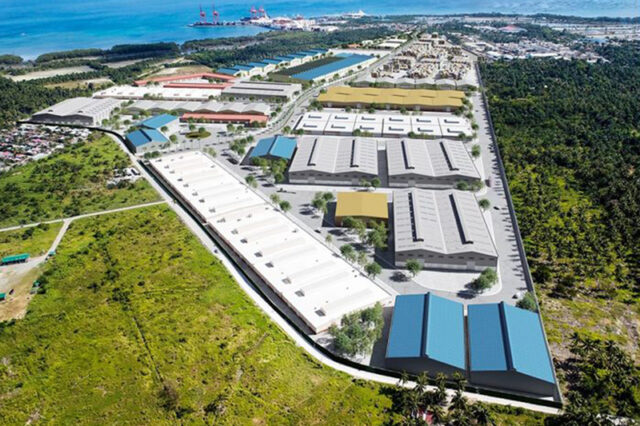
THE Philippine Economic Zone Authority (PEZA) said it expects 700 jobs to be created once Head Sport Philippines, Inc.’s facility in Davao del Norte becomes fully operational.
Head Sport Philippines is a part of the US-Austrian group specializing in tennis equipment.
“The Panabo facility is expected to employ more than 700 workers once fully operational, generating income and skills development opportunities for local communities,” PEZA said in a statement on Tuesday.
“Its presence also supports indirect jobs in logistics, packaging, maintenance, and port services, creating an economic ripple effect that extends beyond the factory gates,” it added.
Head Sport Philippines has set up at a five-hectare facility at Anflo Industrial Estate-Special Economic Zone in Panabo City, which started commercial operations in January.
PEZA is counting on the facility to boost trade when it reaches full capacity of 14 million dozen tennis balls a year, all for export.
According to the investment promotion agency, the production of tennis balls for the US market is currently concentrated in China, Thailand, and the Philippines.
“At present, the Philippines enjoys the distinction of being the most preferred by Head among the three locations, owing to its competitive tariff positioning with the United States, high product quality, innovative and English-proficient workforce, and a reliable export infrastructure,” it said.
“The choice of the Philippines — over other ASEAN manufacturing destinations — underscores the country’s ability to meet the most stringent quality and logistical requirements of a global leader,” it added.
It said the Head operation reflects the Philippines’ standing as a viable option for high-value manufacturers.
PEZA Director General Tereso O. Panga said he expects Head’s Philippine operations to eventually account for 60% of its global production.
“This milestone by Head Sport Philippines affirms that the Philippines is ready to take on a bigger role in global manufacturing. With world-class facilities, a highly skilled workforce, and PEZA’s investor-friendly policies, we are confident that more companies will follow suit,” he said. — Justine Irish D. Tabile

THE Department of Energy (DoE) said five electric cooperatives (ECs) will roll out services to 1,492 households in remote or underserved areas.
The ECs are the Aklan Electric Cooperative, Inc., Aurora Electric Cooperative, Inc., La Union Electric Cooperative, Inc., Quezon II Electric Cooperative, Inc., and Southern Leyte Electric Cooperative, Inc.
With funding of P192.8 million, the power cooperatives will employ a mix of on-grid connections and microgrid solutions.
The recipients were identified in consultation with the National Electrification Administration.
The DoE’s Locally Funded Project-Total Electrification Program funded the service rollout.
“Total electrification is not just a number to be achieved; it is a social contract that ensures every Filipino, regardless of geography or circumstance, can benefit from the progress our nation is making,” Energy Secretary Sharon S. Garin said.
“We are laying down the energy foundations that will sustain our economy and uplift our people for generations to come,” she added.
The government is hoping to achieve 100% electrification by 2028. — Sheldeen Joy Talavera

THE Department of Agriculture (DA) said capacity utilization data are pointing to possible monopolies in rice milling, and signaled measures to bring utilization down to healthier levels.
The measures include reorganizing the Philippine Center for Postharvest Development and Mechanization (PhilMech) to focus more on production-side equipment, leaving the DA the responsibility of producing rice processing systems, it said in a statement.
Agriculture Secretary Francisco P. Tiu Laurel, Jr. said some rice millers are operating at nearly 100% capacity, which he noted was an indicator of “monopolistic conditions.”
“Our target utilization rate is 80% to 85%,” he said, at which level millers can operate with appropriate efficiency.
He said once rice mill usage stabilizes within the target range, PhilMech will be refocused on production-side equipment like tractors and seeders.
PhilMech currently makes large-scale rice processing systems.
“This strategic shift would support the National Food Authority, which has seen its milling and drying capacity significantly diminished since the Rice Tariffication Law of 2019 scaled back its operational role,” he said.
“By focusing on smart utilization rather than unchecked expansion, the DA aims to balance market supply, stabilize rice prices, and protect farmer incomes,” it said.
The Rice Tariffication Law gave rise to the Rice Competitiveness Enhancement Fund, which is financed by rice import tariffs and funds equipment procurement to modernize the rice industry. — Kyle Aristophere T. Atienza

A PEST infestation in Visayas sugar plantations has been reported on 3,394 hectares (ha) as of Aug. 11, according to the Sugar Regulatory Administration (SRA).
On Aug. 1, the area affected by the red-striped soft scale insect (RSSI) had been 3,264 ha, it said.
Some 1,923 farmers were affected by the infestation of RSSI, which has the potential to reduce sugar content in cane by 50%, the SRA told BusinessWorld.
It said the SRA is still “awaiting a permit to use” from the Fertilizer and Pesticides Authority before procuring certain pesticides for sugar cane, after the province of Negros Occidental declared a state of calamity in mid-July.
RSSI was detected in 3,290 ha of Negros Occidental sugar land.
It was followed by Iloilo (59.69 ha), Capiz (25.1 ha), Leyte (12.17 ha), and Negros Oriental (7.6 ha).
SRA researchers were conducting field studies on mass producing pathogenic fungi to counter RSSI.
The fungi reduce the reproductive capacity of the targeted organism. — Kyle Aristophere T. Atienza

ANALYSTS said sovereign debt, which is projected to exceed P19 trillion by the end of 2026, remains manageable, though sluggish economic growth could undermine revenue generation and complicate fiscal consolidation.
Jonathan L. Ravelas, senior adviser at Reyes Tacandong & Co. said the debt burden is manageable “if growth and revenues keep pace.”
Mr. Ravelas said for the debt as a proportion of gross domestic product (GDP) to remain at acceptable limits, the government must step up in enhancing tax collections while spending smartly.
The P19.06-trillion debt estimate is baked into the Budget of Expenditures and Sources of Financing (BESF).
By 2026, the debt-to-GDP ratio is expected to rise to 61.8% from 61.3% at the end of 2025.
Mr. Ravelas said the bigger proposed budget and more borrowing are likely expand the debt by the end of 2026.
He also said external debt costs are rising due to a weaker peso.
“It depends on what reforms the government genuinely undertakes to clean house to boost competitiveness to attract investment,” Ser Percival K. Peña-Reyes, director of the Ateneo Center for Economic Research and Development said via Viber.
External factors such as global interest rates and a weaker peso are also contributing to rising debt costs, Mr. Peña-Reyes noted.
Michael L. Ricafort, chief economist at Rizal Commercial Banking Corp., said the debt ratio is still within “acceptable limits” but below 60% would be ideal.
“If all else fails in terms of bringing down the NG debt-to-GDP ratio to more acceptable levels especially below the international threshold of 60%, new taxes and or higher tax rates are the final option/alternative,” he said via Viber.
The government has promised not to impose new taxes for the rest of its term.
At the end of June, debt rose 11.5% year on year to a record P17.27 trillion, bringing the debt-to-GDP ratio 63.1%, the highest ratio since 2005.
Foundation for Economic Freedom President Calixto V. Chikiamco raised the possibility of slower growth which could weigh on tax collection.
“It’s not so much the increase in debt that’s the problem, but the slowdown in economic growth, that will increase the debt-to-GDP (gross domestic product) ratio,” said via Viber.
In the second quarter, the economy grew 5.5%, against 5.4% in the three months to March but much slower than the year-earlier pace of 6.5%.
The second-quarter reading was at the low end of the revised 5.5% to 6.5% target range for the year. It had previously been set at 6-8%.
As early as June, the government’s top revenue collector, the Bureau of Internal Revenue (BIR) have called for the recalibration of its P3.23-trillion target this year after weak growth in the first quarter.
The Department of Finance said it downgraded the collection target of the Bureau of Customs, which earns from import duties and taxes, due to slower global activity.
In 2026, the BIR is expected to collect P3.58 trillion, while the BoC is projected to generate P1.01 trillion.
Under the 2026 BESF, the government aims to collect P4.98 trillion in revenue, 10.24% higher than the P4.52-trillion projected collection this year.
Asked by Kabataan Party-list Rep. Renee Louise Manda Co if he is open to new sources of revenue such as a wealth tax into a broader fiscal reform package, Finance Secretary Ralph G. Recto said: “We will not oppose your suggestions if you pass one in Congress.”
Mr. Recto earlier said the government is readying an online gambling tax to raise revenue while aiming to curbing social costs like gambling addiction.
Jose Enrique Africa of IBON Foundation rejected the assertion that government debt is manageable, noting the budget cuts resulting from fiscal consolidation, which are hurting social services and failing to meet the needs of the poor.
“Unless there’s a spectacular increase in revenue in the second semester, the government will have to keep borrowing, which will drive end-2026 debt above even the latest target,” he said via Viber.
Mr. Africa supports a wealth tax on billionaires or a windfall land value tax to increase revenue.
Mr. Africa also expressed concern over slower growth and tariff cuts on imports from the US.
The government expects to forgo P3 billion to P6 billion in revenue with the reduction of tariffs to zero on US products like automobiles, wheat, soy, and pharmaceuticals.
Mr. Chikiamco blames the strong peso for contributing to the slowdown in economic growth.
“The peso is too strong, eroding our export competitiveness. This is another reason why tourism is in a slump,” he said.
During the House Committee on Appropriations briefing on Monday, Akbayan Party-list Rep. Percival V. Cendaña pointed out that nearly all of the capital outlays for the next two years will be financed by debt.
“It’s deeply troubling to hear that almost all of our capital outlay for this year and next year will be funded through borrowing,” he said.
Mr. Recto said the projected P4.98 trillion in revenue next year leaves a P1.65 trillion funding gap, going by the P6.793 trillion National Expenditure Program.
“The deficit will be P1.646 trillion. All of the capital outlay that the government will spend this year and next year will be funded through debt,” Mr. Recto said.
The government’s borrowing plan for 2026 is P2.68 trillion, up 3.15%.
“It is more important now to ensure that we spend this money wisely, to ensure that the economy grows at a faster rate than your debt,” Mr. Recto said.
He said most of the debt will come from domestic sources, reducing exchange rate risk.
“We’re essentially paying ourselves back, and that’s how we manage our debt. But of course, there are limits. That’s why we’re working to reduce the deficit over time and staying mindful of key benchmarks like the debt-to-GDP ratio, general government debt-to-GDP, interest rates, inflation, and the growth rate,” Mr. Recto said. — Aubrey Rose A. Inosante

THE PHILIPPINES and the US will stage more than 500 joint military engagements in 2026, ranging from large-scale combat drills to naval patrols and subject-matter exchanges, in what both sides describe as their most extensive defense cooperation plan to date.
The activities were finalized during the Mutual Defense Board-Security Engagement Board meeting in Hawaii, co-headed by Armed Forces of the Philippines (AFP) Chief of Staff General Romeo S. Brawner, Jr. and US Indo-Pacific Command chief Admiral Samuel John Paparo, Jr. Both signed the so-called “8-star memo,” a document outlining next year’s engagements.
“Both leaders renewed their commitment to deepened cooperation and interoperability to bolster deterrence in the Indo-Pacific region and achieve peace through strength,” the US Indo-Pacific Command said in a statement on Tuesday. “These collaborations foster sustained interaction between both militaries and enhance operational readiness.”
Among the key activities approved was the annual Balikatan (shoulder-to-shoulder) exercise, which has evolved into Southeast Asia’s biggest combat rehearsal. Recent iterations have brought in more troops, advanced missile systems, amphibious landing craft and complex warfighting scenarios designed to simulate modern conflict.
Philippine and US officials said the expanded scale reflects a growing emphasis on preparing for high-end warfare and enhancing interoperability between the two allies’ armed forces.
Manila and Washington are bound by their 1951 Mutual Defense Treaty, which obliges both to come to each other’s aid in case of an armed attack in the Pacific, including the South China Sea.
Security cooperation has intensified under President Ferdinand R. Marcos, Jr., who has taken a firmer stance against Beijing’s sweeping maritime claims compared with his predecessor.
The South China Sea remains a volatile flashpoint. China asserts control over almost the entire waterway through its so-called nine-dash line, overlapping with the exclusive economic zones of the Philippines, Vietnam, Malaysia and Brunei.
A 2016 ruling by the Permanent Court of Arbitration in The Hague voided China’s claims, but it has rejected the decision and maintains a strong naval and coast guard presence in contested areas such as the Spratly Islands and Scarborough Shoal.
The US Indo-Pacific Command noted that the Philippines’ holding of joint naval drills with allies in the disputed waters has been a “key success” this year. “These events are essential in ensuring freedom of navigation and improving interoperability.”
Philippine Navy spokesman Rear Admiral Roy Vincent T. Trinidad said the country is looking to “regularize” its maritime cooperative activities (MCA) with foreign navies. These activities, he added, have proven to affect China’s behavior in contested waters.
“For every MCA, there has been a noted change in the actions of the Chinese Coast Guard and the People’s Liberation Army-Navy,” he told a media briefing. “On the frequency, they will be increasing.”
He said the Philippines held only three activities in 2023 but managed to conduct 11 in 2024.
“This year alone, and we’re only two-thirds into the year, we already had around 10 or 11,” he said. “The details and scope of the exercises have also increased in magnitude and complexity.”
The steady growth of these activities shows that the Armed Forces of the Philippines is “now prepared to plug and play with modern militaries,” Mr. Trinidad said.
For Washington, the Philippines has become a critical partner in the Indo-Pacific, not only for defending mutual treaty obligations but also for building a coalition of states committed to upholding international law at sea.
The Marcos administration has welcomed the stronger military partnership, allowing greater US access to Philippine bases under the Enhanced Defense Cooperation Agreement (EDCA), including sites near Taiwan and the South China Sea.
The scheduled 500-plus activities for 2026 mark a significant expansion of the alliance, designed to demonstrate readiness and deter aggression at a time when regional security threats are rising. — Kenneth Christiane L. Basilio
