
Auto Sales (May 2025)

PHILIPPINE AUTOMOTIVE SALES slipped by 1.2% in May to 39,775, amid a double-digit drop in sales of passenger cars, an industry report showed. Read the full story.

PHILIPPINE AUTOMOTIVE SALES slipped by 1.2% in May to 39,775, amid a double-digit drop in sales of passenger cars, an industry report showed. Read the full story.

LISTED educational institution Far Eastern University, Inc. (FEU) is acquiring a majority stake in Higher Academia, Inc. (HAI), an educational provider based in San Fernando, Pampanga, under an P11.43-million deal.
In a regulatory filing on Wednesday, FEU said its board of trustees approved on June 17 an additional equity investment of P11.43 million, which will raise its ownership in HAI to 51%.
The investment will allow FEU to acquire an additional 114,286 common shares in HAI, increasing its total holdings to 2.91 million shares.
FEU said it has not yet signed a definitive subscription agreement pending the finalization of the transaction.
HAI currently offers secondary and tertiary education in San Fernando.
HAI is a 50-50 joint venture between FEU and Unilab Education.
In October 2023, FEU and Unilab announced a P600-million investment in HAI to acquire the assets of Colegio de Sebastian-Pampanga, Inc.
“With HAI’s acquisition of a secondary and tertiary school in San Fernando, Pampanga, the group looks at serving this geographical market, particularly in terms of access to quality education offerings,” FEU said.
Aside from HAI, FEU operates Far Eastern University in Manila and holds majority stakes in East Asia Computer Center, Inc., FEU Alabang, Inc., Far Eastern College Silang, Inc., FEU High School, Inc., and Roosevelt College, Inc.
FEU shares rose by 6.06% or P48.50 to P848.50 each on Wednesday. — Revin Mikhael D. Ochave

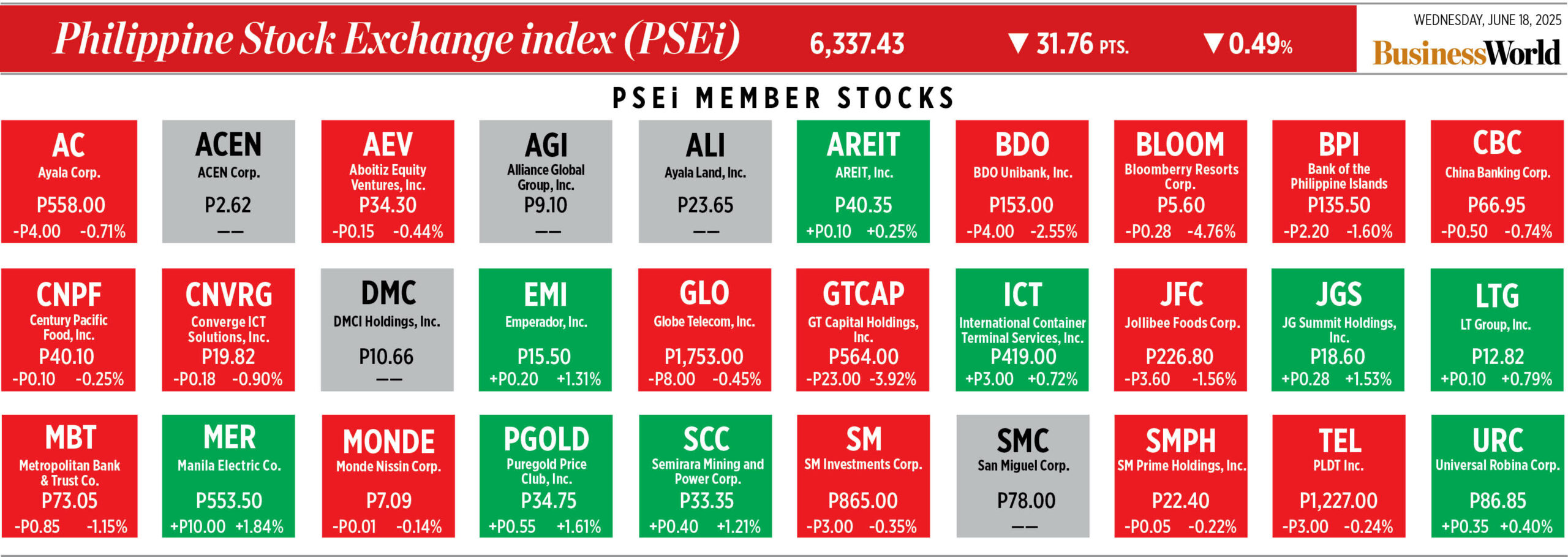
Here’s a quick glance at how PSEi stocks fared on Wednesday, June 18, 2025.


THE PESO dropped against the dollar for a seventh straight session on Wednesday to close near the P57 level as market sentiment stayed gloomy with the conflict between Iran and Israel showing no signs of easing.
The local unit closed at P56.98 versus the greenback on Wednesday, dropping by 28 centavos from its P56.70 finish on Tuesday, Bankers Association of the Philippines data showed.
This was the local unit’s weakest finish in over two months or since it closed at P57.08 on April 14.
The peso has now lost P1.235 since the start of June following its May 30 finish of P55.745.
Year to date, the peso is still up by 1.51% from its end-2024 close of P57.845.
The peso opened Wednesday’s session weaker at P56.75 against the dollar. Its intraday best was at P56.70, while its worst showing was its closing level of P56.98 versus the greenback.
Dollars traded went up to $1.27 billion on Wednesday from $1.203 billion on Tuesday.
The Philippines will tolerate the slide in its currency to a two-month low, with the central bank governor flagging that interventions won’t be effective in the face of global risk aversion, Bloomberg reported.
“It’s futile to intervene when it’s a strong dollar story driven by safe-haven flows,” Bangko Sentral ng Pilipinas (BSP) Governor Eli M. Remolona, Jr. said in a mobile-phone message on Wednesday.
Asian currencies have dropped against the dollar this week as an escalating conflict between Iran and Israel hurt sentiment. With the hostilities triggering a rise in the price of oil, the currencies of import-reliant countries such as the Philippines and India have been particularly affected.
“The dollar-peso closed higher due to escalating tensions in the Middle East,” a trader said in a phone interview.
The peso extended its losing streak amid safe-haven demand for the dollar and the recent climb in oil prices due to the Iran-Israel conflict, Rizal Commercial Banking Corp. Chief Economist Michael L. Ricafort said in a Viber message.
ING Bank said in a research note on Wednesday that higher oil prices could have a “more damaging impact” on the Philippines and could put more pressure on the peso.
“The country has the largest current account deficit in the region, driven by rising imports and softer remittance growth, making it highly vulnerable to oil price shocks. A 10% rise in oil prices could widen its deficit by roughly 0.25% of GDP (gross domestic product), which stood at an elevated 3.7% of GDP in the first quarter of 2025, pressuring the PHP in the near term,” it said.
For Thursday, the trader expects the peso to move between P56.70 and P57.10 per dollar, while Mr. Ricafort sees it ranging from P56.90 to P57.10. — A.M.C. Sy with Bloomberg

PHILIPPINE SHARES dropped anew on Wednesday as the conflict between Iran and Israel continued and as investors stayed on the sidelines ahead of the Bangko Sentral ng Pilipinas’ (BSP) policy meeting on Thursday, where it is expected to deliver a second straight rate cut.
The main Philippine Stock Exchange index (PSEi) went down by 0.49% or 31.76 points to close at 6,337.43, while the broader all shares index declined by 0.29% or 11.07 points to 3,772.79.
“Philippine stocks fell as the Israel-Iran conflict entered its fifth day and US retail sales dropped more than expected, raising concerns about consumer spending,” Regina Capital Development Corp. Head of Sales Luis A. Limlingan said in a Viber message.
“Locals remained on the sidelines as they await the outcome of the latest meeting of the BSP, with many forecasting a rate cut, hoping to ease fears of further conflict escalation in the Middle East,” he added.
A BusinessWorld poll showed that 15 out of 16 analysts expect the Monetary Board to cut the policy rate by 25 basis points (bp) to 5.25% at Thursday’s review from the current 5.5%.
The BSP in April resumed its easing cycle with a 25-bp reduction following a surprise pause in February. It has now slashed borrowing costs by a total of 100 bps since it started cutting rates in August last year.
Iran and Israel launched new missile strikes at each other on Wednesday morning, forcing thousands of people to flee major cities, despite the call of United States President Donald J. Trump for Iran’s unconditional surrender.
“The local market pulled back as investors took a cautious stance ahead of the Federal Reserve’s policy decision,” Philstocks Financial Inc. Research Manager Japhet Louis O. Tantiangco said in a Viber message.
The Fed was set to announce its policy decision overnight at the close of its two-day meeting. It is widely expected to keep rates unchanged, but markets are waiting for fresh clues on the US central bank’s easing path.
Almost all sectoral indices closed lower on Wednesday. Financials sank by 1.7% or 40.05 points to 2,304.06; mining and oil declined by 1.54% or 155.44 points to 9,899.69; holding firms went down by 0.43% or 23.61 points to 5,415.15; services retreated by 0.23% or 5.30 points to 2,219.52; and property decreased by 0.04% or 1.05 points to 2,246.02.
Meanwhile, industrials rose by 0.44% or 40.64 points to 9,150.28.
“Manila Electric Co. was the day’s index leader, climbing 1.84% to P553.50. Bloomberry Resorts Corp. was the main index laggard, falling 4.76% to P5.60,” Mr. Tantiangco said.
Value turnover declined to P5.28 billion on Wednesday with 2.91 billion shares traded from P5.94 billion with 2.11 billion issues exchanged on Tuesday.
Advancers edged out decliners, 96 versus 95, while 52 names were unchanged.
Net foreign selling increased to P254.69 million on Wednesday from P15.05 million on Tuesday. — Revin Mikhael D. Ochave

By Chloe Mari A. Hufana and Adrian H. Halili, Reporters
PRESIDENT Ferdinand R. Marcos, Jr., on Wednesday said the K to 12 program has failed to produce work-ready senior high school graduates, as the Philippines rolls out the pilot of a revised curriculum for school year 2025-2026.
In a video posted on his social media accounts, Mr. Marcos said the program, which started more than a decade ago, has failed to provide any real advantage to graduates.
“It’s costing parents more because two additional years were added,” he told News5 at One PH. “They still have to pay for enrollment, buy a lot of school supplies, purchase books — everything.”
“Yet after 10 years, there’s no real advantage,” he added.
He echoed the frustrations voiced by lawmakers who are calling for the abolition of the mandatory senior high school system under the K to 12 program.
The President said the decision to amend or repeal the K to 12 law rests with Congress.
Employers still prefer college degree holders over K to 12 graduates, said Maria Ella Calaor-Oplas, an economics professor at De La Salle University in Manila.
“There is still preference for degrees, even if it’s not necessary and could be done by K to 12 graduates,” she said in a Facebook Messenger chat. “Senior high school graduates are ready if job opportunities for them are available.”
The Department of Education (DepEd) is rolling out the pilot of a revised K to 12 curriculum this school year that updated the senior high school program.
DepEd is implementing the pilot program in 889 schools across the country, 12 years after the K to 12 system was enacted through Republic Act No. 10533 or the Enhanced Basic Education Act of 2013.
The program, which extended the country’s basic education by two years, has been criticized due to inadequate funding, the added financial burden on families, subpar educational outcomes and questions about whether senior high school graduates are job-ready.
Mr. Marcos said his government is working with the private sector to enhance the K to 12 system and address the issue of skill mismatch.
“But while the law still mandates K to 12, what I told [Education] Secretary [Juan Edgardo M.] Angara is that we should significantly improve the program while it’s still in place,” he said in mixed English and Filipino.
“Because what we often hear is this issue of mismatch — ‘my skills aren’t employable,’ or ‘I trained for this, but that kind of worker isn’t needed.’”
“We’ve partnered with the private sector and asked them: ‘What skills do you need? What kind of workers are you looking for so they can be employed by your company?’” he said.
“In fairness, the private sector went a step further. They said: ‘Do you want us to run the training programs? And once they complete the training, we’ll hire them’ because the training is exactly what we need,’” he added.
Mr. Marcos said the government is also partnering with the private sector to help fix the country’s severe classroom shortage.
DECADES OF NEGLECT
“If the government were to do it alone, we wouldn’t be able to accomplish much,” he said. “But to their credit, the private sector has been very cooperative — they’re willing to invest and genuinely eager to help.”
He also expressed frustration over the poor state of the public school infrastructure, which he attributed to decades of neglect and underinvestment in the education sector.
“Can you imagine that we’re lacking 160,000 classrooms? How did that happen? It was simply ignored,” he said. “Education was completely neglected. That’s what happened. There was no effort to strengthen the system.”
He also lamented the country’s declining performance in key subjects like science, technology, engineering and mathematics (STEM), which he said reflects the long-term consequences of neglect.
“Our students are falling behind in STEM. Many are struggling even with basic reading skills,” he added.
To help reverse the trend, the President said the government is improving the welfare and capacity of public school teachers, addressing longstanding issues such as delayed salaries and administrative overload.
He added that a major retraining and upskilling initiative is under way to help educators keep pace with modern teaching tools and methods.
“We’ve introduced a retraining and re-education program for our teachers because so much has changed,” Mr. Marcos said. “There’s new technology they need to learn. Supporting teachers — that’s our top priority.”
A January 2025 report by the Second Congressional Commission on Education (EDCOM 2) warned about the dire state of basic literacy in Philippine public schools, with students falling four to five years behind the expected reading proficiency for their grade levels.
EDCOM 2 recommended a “teach-at-the-right-level” approach, tailoring instruction to students’ actual learning needs rather than their age or grade. It also sought stronger support from DepEd in enforcing remedial and foundational programs.
Amid a persistent learning crisis, the government fell short of its target to add 20,000 teachers for the school year, managing to recruit only 16,000.
It is also seeking 10,000 additional administrative assistants to support public schools as they handle accounting, paperwork, documentation and other matters.
Meanwhile, EDCOM 2 said DepEd should consider population growth, vulnerabilities, projected deterioration, and available private school capacities in addressing the classroom backlog.
“By looking at these factors collectively, we can diversify our interventions in addressing school congestion, break down silos in resourcing and ensure that our efforts directly support the improvement of learning outcomes of our students,” EDCOM 2 Executive Director Karol Mark Yee said in a statement.
Earlier, the Education department said it could take 55 years to bridge the country’s 165,000 public school classroom backlog.
Under the 2025 budget, DepEd was given P28 billion for basic education facilities, including P7.18 billion for the construction of new kindergarten, elementary and secondary school buildings. Congress also allotted P6.13 billion for the school repairs.
EDCOM 2 Co-Chairman and Senator Sherwin T. Gatchalian is pushing public-private partnerships (PPP) to fix the shortage.
“One strategy that I have been pushing is the implementation of a counterpart program, where local government units (LGU) and the National Government share the cost of constructing new classrooms,” he said in the same statement. “This way, we can have several LGUs building classrooms simultaneously.”
Education Secretary Juan Edgardo M. Angara on Monday said they might pursue a PPP to fast-track the construction of about 105,000 classrooms.
Mr. Gatchalian also pushed the expansion of state assistance to students and teachers in private schools.
“We cannot go about our business-as-usual approach to address the country’s classroom shortage. We need to be innovative in implementing multiple solutions,” he added.

By Kenneth Christiane L. Basilio, Reporter
CHINESE Coast Guard (CCG) vessels carried out “dangerous maneuvers” against Philippine ships deploying fishing devices at disputed features in the South China Sea (SCS) this week, the Philippine Coast Guard (PCG) said on Wednesday.
Four CCG ships harassed Philippine ships, including three from Manila’s coast guard, while they were deploying fish lures at Half Moon and Royal Captain shoals in the contested Spratly Islands, PCG spokesman Jay Tristan Tarriela told a news briefing.
A CCG vessel sideswiped a PCG ship during the encounter, while other Chinese vessels tried to separate Philippine civilian fishing boats from the ship formation, he added.
“They also subjected the coast guard vessels to radio challenges,” he said in mixed English and Filipino. “They kept on saying that what we were doing was unlawful and in violation of their sovereignty.”
The shoals form part of the Spratlys, a region in the South China Sea that is being claimed by the Philippines, China, Taiwan, Vietnam, Brunei and Malaysia.
Manila claims the northeastern section of the island group, while China and Taiwan claim it entirely, according to US-based think-tank National Bureau of Asian Research.
Both Half Moon and Royal Captain shoals are about 55 nautical miles (101 kilometers) off the major Philippine island of Palawan, Mr. Tarriela said.
“This falls within our own exclusive economic zone, and the illegal patrol being conducted by the Chinese coast guard is in violation of the United Nations Convention of the Law of the Sea, the Philippine Maritime Zones Act and the 2016 arbitral award,” he said.
The Chinese Embassy in Manila did not immediately reply to a Viber message seeking comment.
China claims nearly all of the South China Sea via a U-shaped, 1940s nine-dash line map that overlaps with the exclusive waters of the Philippines and neighbors like Vietnam and Malaysia.
A United Nations-backed tribunal in 2016 voided China’s sweeping claims for being illegal, a ruling that Beijing does not recognize.
The mineral-rich waters have become a regional flashpoint as Manila and Beijing have repeatedly clashed over disputed maritime features, fueling tensions.
Manila’s fishery bureau started dropping fish lures in the South China Sea about two years ago, Mr. Tarriela said.
He said the installation of the fishing devices at the shoals were a “success” despite Chinese interference. “[We] successfully deployed 20 fish aggregating devices.”
“Fishermen from Palawan also expressed their commitment to protect the fishing devices we deployed,” he added.
Manila’s exclusive economic zone is ecologically rich and serves as a vital source of food for Filipinos, according to a 2019 Stratbase ADR Institute report.
The waters account for about a third of the country’s fish production, according to the US-based China-Global South Project.

THE IMPEACHMENT trial of Vice-President Sara Duterte-Carpio will not delay the passage of the 2026 national budget, according to a House of Representatives spokeswoman.
“We have a prosecution panel for the impeachment trial, while the rest of the members of the House can continue holding hearings for the 2026 General Appropriations bill,” Priscilla Marie T. Abante, the chamber’s spokeswoman, told a news briefing in mixed English and Filipino. “I don’t think that’s going to be a problem.”
But the House prefers that Ms. Duterte’s trial be swiftly dealt, she added.
“The consequence of delaying the impeachment trial is that it won’t just affect the budget — it will affect the people,” Ms. Abante said. “We want to resolve the issues surrounding Vice-President Duterte, so let’s proceed with the trial.”
Ms. Duterte’s trial is expected to start in late July under the 20th Congress.
The budget process for next year’s spending plan is expected to kick off in August after the Executive branch submits the budget proposal to the House, according to a Budget department briefer.
Under the 1987 Constitution, Malacañang must transmit the proposed budget within 30 days after the opening of the regular session of Congress, which begins on July 28.
The budget bill is initially heard by the House committee on appropriations for months before moving to plenary debates. To fast-track the process, the Senate finance panel often starts discussing the proposed budget before congressmen formally submit it to the Senate.
Critics have accused the Senate of stalling Ms. Duterte’s impeachment trial.
Senators acting as trial judges voted to return the impeachment complaint to the House to certify that lawmakers did not violate the Constitution when it impeached the Vice-President.
“The additional requirements being asked of the prosecution panel aren’t part of the Constitution,” Ms. Abante said. “The only constitutional requirement is a verified complaint that is sufficient in form and substance, approved by members of the House of Representatives.”
Ms. Duterte, who was impeached without a hearing, on Monday said congressmen who signed her impeachment complaint did not read the document.
More than 200 congressmen endorsed a fourth complaint against the Vice-President that was directly sent to the Senate before Congress took a break in February.
“When they signed and took their oath, that included a declaration that they had read, understood and affirmed their agreement to proceed with the impeachment against Vice-President Sara and to transmit it to the Senate,” Ms. Abante said.
“The over 200 congressmen who signed the impeachment complaint did so not for money or any favor they might receive, but out of principle — their own personal conviction,” she added.
Ms. Duterte’s impeachment is the culmination of a months-long feud with President Ferdinand R. Marcos, Jr. after his House allies launched an inquiry into her use of confidential and intelligence funds.
She denies all the accusations in the impeachment complaint, from budget anomalies to amassing unusual wealth and threatening the lives of Mr. Marcos, his wife and the Speaker.
Meanwhile, Senate impeachment court spokesman Reginald A. Tongol urged the House to comply with the court order last week to avoid further delays.
“It is up to the (House), whether to comply or not,” he told a news briefing. “This is the order of the impeachment court, and any lawyer or litigant should comply first before complaining.”
Mr. Tongol said House prosecutors should prepare their case against Ms. Duterte instead of criticizing and fighting the court.
“They may not agree with the actions of the court, but it is still the court that has been vested by the Constitution with the power to solely try and decide impeachment cases,” he said.
Earlier, Antonio Audie Z. Bucoy, spokesman for the House prosecution team, accused the impeachment court of “foot dragging” and delaying the impeachment proceedings.
“We have been expecting communication from the House as to their compliance,” Mr. Tongol said. “Seven days have passed and there has been no notice filed to the impeachment court.”
“They have instead spent their energy criticizing the impeachment court,” he added.
Ms. Duterte has until June 23 to comment on the summons issued by the court, and House prosecutors have until June 30 to submit their reply, Mr. Tongol said. — Kenneth Christiane L. Basilio and Adrian H. Halili

THE Department of Economy, Planning, and Development (DEPDev) said the approved contract extension of the country’s two major water concessionaires could generate up to P50.3 billion for the government’s coffers.
In a statement on Wednesday, DEPDev said the approved 10-year extension of the revised concession agreements for Maynilad Water Services, Inc. and Manila Water Co. is anticipated to raise P50.3 billion in government revenues.
“The extension is expected to accelerate capital investments, minimize tariff pressures, and secure long-term water supply,” it said, following the approval during the inaugural meeting of the Economy and Development (ED) Council, chaired by President Ferdinand R. Marcos, Jr.
Both companies secured the approval of their revised contracts until 2047, to coincide with their 25-year legislative franchises.
Maynilad and Manila Water were each granted a 25-year legislative franchise, through Republic Act Nos. 11600 and 11601, respectively. Both laws took effect in January 2022.
“By aligning the concession agreements with legislative franchises, we are promoting policy coherence and long-term investment planning in the water sector, which are essential for delivering clean, reliable, and affordable water services to millions of Filipinos,” DEPDev Secretary and ED Council Vice Chairperson Arsenio M. Balisacan said.
The ED Council, formerly the National Economic and Development Authority Board, also greenlit infrastructure projects funded through official development assistance (ODA) in a bid to boost connectivity and agricultural development.
According to the 2023 ODA Portfolio Review Report, the country’s active ODA portfolio of loans and grants reached $37.29 billion in 2023. The latest report is scheduled to be released later this month.
Among the projects include the Department of Agriculture’s Farm-to-Market Bridges Development Program, amounting to P27.7 billion. The program seeks to build 300 climate-resilient modular steel bridges across 52 provinces in 15 regions.
“By improving physical connectivity in farming and fishing communities, the Farm-to-Market Bridges Development Program addresses persistent infrastructure gaps that limit market access, increase post-harvest losses, and hinder rural productivity,” Mr. Balisacan said.
He added it seeks to raise rural incomes and improve food logistics, particularly in geographically isolated and disadvantaged areas.
Another project that secured the ED Council approval was the Liloan Bridge Construction Project of the Department of Public Works and Highways. The P5.1-billion project will develop a four-lane, 721-meter bridge connecting Panaon Island to mainland Leyte.
“It is expected to improve mobility and access for residents and travelers in the municipalities of Liloan, San Francisco, Pintuyan, and San Ricardo, while stimulating local economic activity and job creation in the region,” DEPDev said.
Metro Pacific Investments Corp., which has a majority stake in Maynilad, is one of three Philippine units of Hong Kong-based First Pacific Co. Ltd., the others being Philex Mining Corp. and PLDT Inc.
Hastings Holdings, Inc., a unit of PLDT Beneficial Trust Fund subsidiary MediaQuest Holdings, Inc., has an interest in BusinessWorld through the Philippine Star Group, which it controls. — Aubrey Rose A. Inosante

THE Court of Appeals (CA) ordered the government to pay Hacienda Luisita, Inc. (HLI) over P28.49 billion in just compensation for 4,500 hectares of farmland.
In a decision, dated April 25, 2025, the appellate court special twelfth division reversed and set aside the February 2023 decision and August 2023 resolution of a regional trial court, which affirmed the P304-million valuation fixed by the Land Bank of the Philippines (LBP) as just compensation for the lands owned by the HLI.
“To this Court, just compensation was not correctly assessed and determined by the RTC-SAC (RTC, acting as Special Agrarian Court) as what should be paid to the landowner in exchange for the property taken shall be real, substantial, full, ample, just and fair,” the 35-page ruling penned by Justice Raymond Reynold R. Lauigan read.
It ruled that the RTC-SAC failed to follow Section 17 of the Comprehensive Agrarian Reform Law, Republic Act No. 6657, in determining the just compensation owed to Cojuangco-owned HLI for the government’s takeover of its land.
The respondents, LBP and DAR, were ordered to pay P28.48 billion as just compensation as of April 30, 2025, without prejudice to the accrual of interest until fully paid.
DAR Secretary Conrado M. Estrella III and Landbank President Lynette V. Ortiz did not immediately respond to separate Viber chats seeking comment.
HLI filed the case before the RTC-SAC of Tarlac City, Branch 63, after the Department of Agrarian Reform Adjudication Board (DARAB) denied its petition for additional compensation and affirmed LBP’s valuation.
In its January 2015 decision, DARAB noted it denied the claims after HLI already received and withdrew the P304-million principal amount, and an additional P167.4 million in interest.
The CA emphasized that in determining just compensation, factors such as the nature and character of the land at the time of taking, or when the owner was deprived of its use, including the transfer of title to the Republic, must be considered.
The tribunal ruled that the time of taking, Nov. 21, 1989, determines the applicable DAR administrative order for computing just compensation. It found that the RTC-SAC erred by failing to consider HLI’s actual production data in its valuation.
Instead of conducting an independent assessment, the trial court merely adopted the valuation of the LBP and DAR without validating HLI’s submitted financial records, including audited statements and accounting documents.
The CA said HLI established that the land value was P1.029 billion, which should serve as the base amount for just compensation, excluding interest and other possible entitlements. Given that payment was made only in 2013, well after the 1989 taking, the delay entitled HLI to interest.
As a result, the CA ruled that the total just compensation due to HLI, as of April 30, 2025, amounts to P28.49 billion. — Chloe Mari A. Hufana
THE Securities and Exchange Commission (SEC) wants better investor education efforts to help address evolving investment scams, its new chairperson said.
“As these fraudulent schemes continue to evolve, so too must our responses. If scams are now being promoted through viral content and deceptive online communities, then investor protection efforts must likewise go where the public is — on their screens and in their feeds,” SEC Chairperson Francis Ed. Lim said in his speech during a launch event on Tuesday.
“Financial education also now has to include engaging reels, short-form videos, and targeted digital campaigns that resonate with today’s investors — especially the younger and digitally connected generations,” he added.
Mr. Lim also called for coordination among regulators, saying that they should align their strategies, messaging, enforcement priorities, and investor education efforts.
“Investment fraud today is borderless, fast-moving, and significantly complex, requiring a coordinated and collaborative approach,” he said.
“Financial literacy is a cornerstone of investor protection. A financially literate public — able to identify red flags and challenge suspicious promises — is our first and most reliable line of defense,” he added.
Meanwhile, Mr. Lim pushed for the enactment of the Capital Market Development Act to help improve investor education.
“We continue to advocate for the enactment of the Capital Market Development Act, which institutionalizes financial education as a fundamental pillar of investor protection and capital market deepening,” he said.
Mr. Lim said this as the Financial Sector Forum launched its Protect Your Money campaign on Tuesday to address the increasing number of financial scams in the country.
“The Protect Your Money campaign is not just a public awareness drive—it is a signal of our mutual resolve to create a more secure financial environment where fraud finds no safe harbor,” he said. — Revin Mikhael D. Ochave

MASTERCARD and the Department of Tourism (DoT) have entered into a strategic collaboration to boost the country’s appeal to both travelers through digitalization.
“MasterCard, a global leader in technology and payments, is driving inclusive economic growth through powerful data-driven efforts. In tourism, these insights help destinations understand travel behavior, optimize services, and unlock new opportunities, making our industry more connected, resilient, and inclusive,” Tourism Assistant Secretary Sharlene Zabala-Batin said in a speech on Wednesday.
Mastercard Southeast Asia Customer Solutions Center Senior Vice-President Aisha Islam said the DoT and Mastercard will share data to form tourism strategies.
Ms. Islam said the data will allow both parties to understand spending behavior and travel patterns across five potential segments.
“In fact, early on today, we were talking about how some new markets are going to be able to enter the Philippines visa-free, such as those like India, and how we can use these opportunities to attract more South Asian customers and tourists to this country,” she said.
“We need to ensure that we are very aware of new insights, new patterns, as well as new trends to make sure that together we can meet the evolving needs of travelers, not just those who are international but also those who are domestic.”
The DoT noted the partnership was in line with the National Tourism Development Plan 2023-2028.
“Secondly, we will also support tourism’s goal when it comes to creating impactful, priceless destination marketing. We will do this by combining Mastercard’s global Priceless platform with our customized insights as well as secure digital payments, which will aim to showcase the grand best of what the Philippines offers while creating both seamless and safe travel experiences,” Ms. Islam said. — Aaron Michael C. Sy
