Home Blog Page 10005

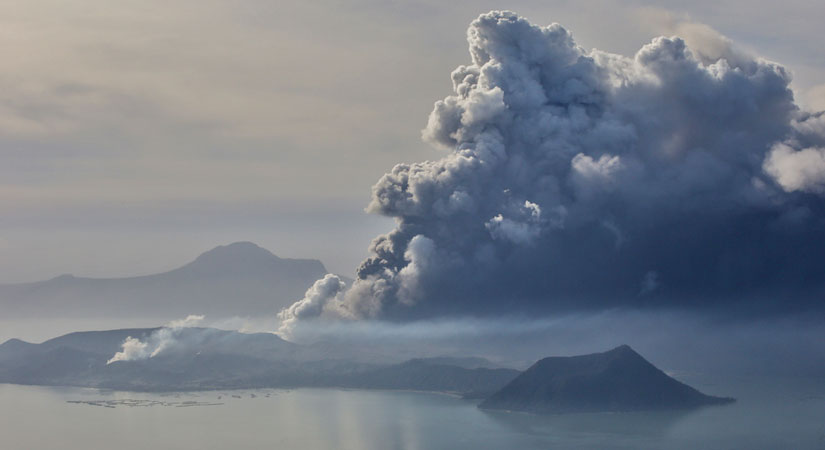
Large-scale Taal Volcano eruption not ruled out

TAAL Volcano emits ash. — REUTERS/ELOISA LOPEZ

STATE seismologists on Thursday said a large-scale eruption of Taal Volcano could not be ruled out as magma continues to build up below the volcano.

“Magma may continue going up and there would be a big explosion,” Renato U. Solidum, Jr., director of the Philippine Institute of Volcanology and Seismology (Phivolcs), said at a briefing streamed on Facebook.

Phivolcs measured an average of 141 tons of sulfur dioxide, according to its 8 a.m. report. This was slightly lower than the 153 tons it measured on Wednesday morning.

The agency has recorded “weak to moderate emission of white-steam laden plumes” that went as high as 500 meters in the past 24 hours.

Phivolcs has also recorded 731 volcanic earthquakes since Jan. 12, 176 of which were felt with intensities 1 to 5.

About 81,000 families in Batangas, Quezon, Laguna and Cavite were affected by Taal Volcano’s eruption, according to the local disaster agency’s 6 am report.

More than 39,000 families were taking temporary shelter in 500 evacuation centers while 30,325 families were being served outside them, it said.

Taal Volcano remained under Alert Level 4, which means “hazardous explosive eruption is possible within hours to days.” — Genshen L. Espedido

More Filipino families rate themselves poor, says SWS

FILIPINO families that rated themselves poor rose to their highest in more than five years in December, according to a poll by the Social Weather Stations (SWS), SWS said 54% of families considered themselves poor, 12 points higher than in September and the highest since the 55% recorded in September 2014.

The estimated number of self-rated poor families reached 13.1 million in December from 10.3 million in September.

The annual average self-rated poverty rate for last year was 45%, 3 points lower than in 2018.

Self-rated poverty was 41% in Metro Manila, 47% in the rest of Luzon, 67% in the Visayas, and 64% in Mindanao.

SWS interviewed 1,200 adults in December for the poll, which had an error margin of ±3 points. — NPA

4 Chinese nabbed for kidnapping, illegal detention

FOUR CHINESE nationals have been arrested in Manila for kidnapping a fellow Chinese over alleged gambling debts, the National Bureau of Investigation (NBI) reported on Thursday. “We received information that a certain Chinese national was abducted on January 18. He was held against his will after he was able to incur P200,000 gambling debt from other Chinese nationals,” Czar Eric M. Nuqui, chief of the NBI Environmental Crime Division, said in a briefing streamed online. The suspects were identified as Chen Zhimin, Luo Canfeng, Li Jai Huang and Wang Yiping. They were nabbed after the NBI received a complaint from a Chinese employee working in the offshore gaming industry. During the operation, two other victims, who were physically maltreated and threatened with death if they could not produce P600,000, were also rescued. The victims subsequently filed a complaint against the suspects. In a statement, the NBI said the suspects have been presented for inquest proceedings before the Manila Prosecutor’s Office for kidnapping and serious illegal detention. — Genshen L. Espedido

Flight attendant with Wuhan travel discharged from hospital but under monitoring

Kalibo Airport
The Kalibo International Airport is one of the gateways to the popular tourist island Boracay.

THE 24-year old flight attendant who was unwell and had a cough following travel in Wuhan, China, the ground zero of the novel coronavirus or 2019-nCoV, has been discharged from hospital but will continue to be monitored, according to the Aklan Provincial Health Office (PHO). Cornelio V. Cuachon Jr., chief of the PHO, said the flight attendant initially consulted a private physician and was referred and admitted to the Dr. Rafael Tumbukon Provincial Hospital. “She had cough so eventually she was admitted… and was discharged this morning,” he said in a phone interview on Wednesday. Blood samples of the patient were sent to the Research Institute for Tropical Medicine (RITM) for testing on Thursday. Mr. Cuachon also said that they are continuously monitoring the three Chinese nationals who were quarantined after showing symptoms upon arrival at the Kalibo International Airport. The first quarantined passenger was a 29-year-old female who arrived Jan. 17, and discharged from hospital the next day as she no longer had a fever. The two others, a three-year-old girl who arrived Jan. 18 and a 65-year-old male on Jan. 20, showed signs of fever and colds. The child was discharged after being diagnosed with a respiratory tract infection, while the senior male was treated as an outpatient after observations indicated that he has already recovered. “While we allowed the three Chinese nationals to proceed to Boracay, we are closely monitoring them as part of surveillance because once their symptoms progresses, they will be advised to seek medical attention,” he said. — Emme Rose S. Santiagudo

Maranao cultural town Taraka chosen as showcase area for poverty reduction program

THE SMALL lakeside town of Taraka, considered an important Maranao historical and cultural preservation area, has been chosen as a showcase site for an agriculture-based poverty reduction program. Among the initial projects identified for implementation involve dairy goat, duck, cattle, backyard chicken farming, egg production, sorghum, rice, corn, and cattle fattening, according to the Mindanao Development Authority (MinDA). The project is a joint undertaking of MinDA, Department of Interior and Local Government, Development Bank of the Philippines, and the local governments of Taraka and Lanao del Sur. Among other components, beneficiaries will be trained to adopt modern farming methods and solar-power irrigation system. A learning site for farmers, to be called Maranao New Hope Agricultural Learning Center (MAHAL Center), is also planned for construction. “It will serve as an informal school for farmers in Lanao del Sur where they could see actual models of livelihood projects and learn how to do it in their farms,” Secretary Emmanuel F. Piñol, chair of MinDA, said.

67% POVERTY LEVEL
Taraka, based on MinDA data, is classified as a 4th class municipality with a population of about 25,000 and poverty level at 67%. “We are very thankful because not all local government units are given this opportunity,” Taraka Mayor Nashida G. Sumagayan is quoted in a MinDA statement. The town, located along Lake Lanao, is home to the Baab Ur-Rahman Masjid, the second oldest mosque in the country. Displayed in one of the old houses in Barangay Gapao Balindong are big Chinese stoneware jars called abdans or gusis, which attest to the town’s history as a trade destination and affluence. It’s lakeside torogans — antique royal houses with high roofs that have intricate carving — have been declared as heritage sites. — Carmelito Q. Francisco

Cebu’s ‘Suroy-Suroy’ tourism program highlights northern towns

THIS year’s first leg of the Suroy-Suroy Sugbo tourism program, intended to promote towns outside the Metro Cebu area, kicked off this week with the northern area getting the spotlight. Suroy-suroy is the Cebuano word for gallivanting while Sugbo is the old name of Cebu. The program organizes group tours led by the Cebu provincial government. This week’s trip — covering the municipalities of Consolacion, Compostela, Carmen, Sogod and Daanbantayan — attracted 249 paying guests, composed of leisure and business travelers. “It feels exciting, it feels amazing to be able to cater and to welcome tourists from different parts of the world,” Consolacion Mayor Joannes P. Alegado told reporters during the Suroy-Suroy’s first stop. He added that their participation in the program is in line with the goal to be upgrade into a city classification. Carmen Mayor Carlo T. Villamor, for his part, said the program is a boost to local businesses. Cebu Tourism Office head Maria Lester Ybañez said they actually had to turn down some interested participants for this trip due to limited accommodations in the destinations. The other Suroy-Suroy trips scheduled this year are the Camotes Escapade on April 25-26, and the Midwest on June 12-13. — The Freeman

Nationwide round-up

Duterte tells Russian TV network he is not going to the US despite Trump invite

PRESIDENT RODRIGO R. Duterte, in an interview with Russian TV network RT on Tuesday, said he is not going to the United States for the US-ASEAN Summit set in March despite an invitation from American President Donald Trump. “No,” Mr. Duterte replied when asked “Will you go?” by the RT interviewer. A video of that portion of the interview was posted on YouTube on January 22. Mr. Trump sent the invitation to all leaders of the member countries of the Association of Southeast Asian Nations. Mr. Duterte said during the interview that he has never been to the US and has also declined previous invitations. He said his grudge stems from the criticism against him made by former US President Barack Obama in a press conference. “He should have criticized me in a proper venue. He should have brought the case to the United Nation rather than castigate a president of another country in a presscon,” he said.

NO VISA
Meanwhile, Presidential Spokesperson Salvador S. Panelo said in a briefing Thursday that the President is uncertain if the US will even give him a visa. “Wala pa siyang visa (He doesn’t have a visa),” Mr. Panelo said. “He just expressed certain sentiments relative to some issues that may affect his entry,” he added. — Gillian M. Cortez

Environment, customs official and staff charged over Canada waste

THE NATIONAL Bureau of Investigation (NBI) has filed graft charges against eight government officials and staff who were found liable for the illegal importation of solid wastes from Canada. Among those charged are Department of Environment and Natural Resources (DENR) Undersecretary Juan Miguel T. Cuna, and DENR-Environmental Management Bureau (EMB) personnel Irvin G. Cadavona, Geri Geronimo R. Sanez and Renato T. Cruz. The four others are Bureau of Customs (BoC) personnel Benjamin T. Perez Jr., Eufracio L. Ednaco, Matilda G. Bacongan and Jose A. Saromo. NBI Director Dante A. Gierran, in a statement, said those accused are linked to the issuance of import clearances for scrap plastic materials to Chronic Plastics, Inc., Canada despite the company’s failure to provide all the necessary information needed for the clearance application. “The EMB personnel-in-charge in the processing of the application was remiss in their duties to strictly examine the application, as to the completeness of its required documents and to the required inspection prior to the approval of its registration as importer,” Mr. Gierran said. He also said that the assigned BoC examiner and appraiser allowed the imports to proceed to the next process despite its “clear violation on DENR.” The charges are based on Republic Act 6969 or the Toxic Substances and Hazardous and Nuclear Waste Control Act of 1990, and Republic Act 3019 or the Anti-Graft and Corrupt Practices Act. In 2013 and 2014, 69 shipping containers mislabeled as carrying recycled materials from Canada were delivered to the Philippines. The shipments contained household wastes, including plastic bottles and used diapers. In May 2019, the containers were shipped back to Canada. — Genshen L. Espedido

Duterte healthy enough for work as President

PCOO-Panelo-Duterte-082216
PRESIDENTIAL PHOTO

PRESIDENTIAL SPOKESPERSON Salvador S. Panelo on Thursday again gave assurance that President Rodrigo R. Duterte is healthy enough for the functions of the country’s top post. “Certainly he can still function effectively as President,” Mr. Panelo said when asked to comment on a recent Social Weather Stations’ survey indicating that 72% of Filipinos are worried about Mr. Duterte’s health. “He keeps on telling us exactly what he feels. He tells us his sufferings on particular illnesses that he got arising from accidents. In other words, he has not hidden, kept from us anything that involves his health. He tells us even when he goes to the doctors for examination,” he said. Mr. Panelo did admit that the President’s energy has waned compared to when he first assumed the position in 2016. — Gillian M. Cortez

Nation at a Glance — (01/24/20)

News stories from across the nation. Visit www.bworldonline.com (section: The Nation) to read more national and regional news from the Philippines.

Nation at a Glance — (01/24/20)

UPSCALE looks to UP community, Taiwanese partners to boost incubation program

Following the celebration of its second anniversary, UPSCALE, an innovation hub based in the University of the Philippines Diliman, opened applications to join the ninth batch of its in-house incubator, Enterprise.

With the goal of shaping globally-competitive startups, UPSCALE is preparing for their next batch of enterprises by forging new partnerships not only across the UP colleges, but also across country borders.

Widespread partnerships

Among UP’s colleges that have pledged support for UPSCALE’s new project are the College of Engineering and the College of Fine Arts. Enterprise’s next batch of startups can look forward to using facilities from both colleges, such as the College of Fine Arts’ Fablab, as well as training from their faculty and staff.

The Virata School of Business (UP-VSB) has pledged their resources and services towards the proper documentation of startup success stories for business cases, as well as mentoring on topics such as business development and regulatory compliance.

“It’s a given fact that only a minimum few are able to sustain their business,” said Joel Tan-Torres, dean of UP-VSB. “The way probably to ensure better success at sustainability is to work at the fundamentals. It’s not the product alone.”

Beyond the University of the Philippines, UPSCALE has sealed partnerships with other universities and incubators both local and abroad.

In collaboration with Indian social enterprise incubator Villgro Philippines, UPSCALE launched Trailblazers 2020, a 15-month incubation program for social enterprises, with Villgro Philippines. The goal is to strengthen local businesses by teaching entrepreneurs how to develop, scale, and sustain their endeavors.

UPSCALE also signed MOUs with institutions in Taiwan, namely the Southern Taiwan Industry Promotions Center, Industrial Technology Research Institute, Kaohsiung Medical University Incubator, and National Kaohsiung University for Science & Technology.

“Taiwan is a leader in many industries, most notably the electronics industry. We hope to beef up that aspect of our mentoring and support here,” said Dr. Luis Sison, Project Leader of UPSCALE.

Two startups, agritech platform Farmwatch and and healthtech device provider Veris, are currently being co-incubated along with UPSCALE’s Taiwanese partners to further develop their technologies and forge connections with other industry players.

Economy expands 6.4% in fourth quarter, 5.9% in 2018

The Philippine economy posted a 6.4% gross domestic product (GDP) growth in the fourth quarter, the Philippine Statistics Authority (PSA) reported this morning.

The October-December outcome was higher than the revised six percent in the third quarter and 6.3% in the fourth quarter of 2018.

This brings growth in 2019 to 5.9%, slower than 2018’s 6.2%. The latest full-year figure matched the median estimate in a BusinessWorld poll last week but missed the downward-revised 6%-6.5% target set by the government for 2019.

The latest full-year reading was the slowest in eight years or since the 3.7% growth in 2011. It also broke the economy’s seven-year streak of at least six-percent growth.

The industry sector grew by 5.4% in the fourth quarter, slower than 6.6% recorded in the fourth quarter of 2018. For the year, it grew by 4.9% compared to 6.7% in 2018.

Agriculture, hunting, forestry and fishing grew 1.5% in the fourth quarter from 1.8% in the same three months in 2018. This brings the sector’s full-year growth at 1.5%, faster than 2018’s 0.9%.

Services remained the main engine of growth on the supply side as it grew by 7.9% in the fourth quarter, faster than the 6.8% recorded in the same period in 2018. For full-year 2019, it grew by 7.1% versus 2018’s 6.8%.

On the expenditure side, household spending grew 5.6%, faster than 5.3% in the fourth quarter of 2018. It logged in a full-year 2019 growth of 5.8% versus 2018’s 5.6%.

Government spending grew by 18.7% in the fourth quarter from 12.6% in 2018’s comparable three months. However, its 10.5% growth in 2019 was slower than the 13% expansion recorded in 2018.

Private investment, represented in the data as capital formation, posted a 0.4% growth during the quarter compared to 4.9% previously. For 2019, it declined by 0.6% compared to a 13.2% growth in 2018.

Exports of goods and services rose by two percent in the fourth quarter (full-year 2019: 3.2%), slower than 14.4% in the fourth quarter of 2018 (2018: 13.4%). Imports likewise slowed, growing by 0.3% in the fourth quarter (2019: 2.1%) compared to 12.4% in the fourth quarter of 2018 (2018: 16%).

Gross national income – the sum of the nation’s GDP and net income received from overseas – registered a growth of 6.2% in the last quarter of 2019 from 5.7% in 2018’s comparable three months. For 2019, it grew 5.5% against 2018’s 5.9%. — J. E. Hernandez

Farm output fails to hit gov’t target

PHILIPPINE agriculture output grew less than a percent in 2019, failing to meet the government’s target as the African Swine Fever (ASF) outbreak dragged the livestock sector.

The Philippine Statistics Authority (PSA) reported on Wednesday that agriculture output, which contributes about a tenth to gross domestic product (GDP) and a fourth of the country’s jobs, inched up by 0.4% in the fourth quarter, compared to the upward-revised year-ago growth at 1.9%, and the third quarter’s growth of 2.85%.

The fourth quarter figure is way below the Agriculture department’s projection of between 2.5% to 3% growth.

For the full-year, farm output rose by 0.70%, slightly higher than the 0.59% in 2018. However, this was lower than the 2.5-3.5% target range for farm output growth under the 2017-2022 Philippine Development Plan.

“In the last quarter of 2019, the country was badly affected by the ASF, which continues up to this day. On top of that, we were disturbed by natural disasters such as powerful typhoons, Tisoy and Ursula,” Agriculture Secretary William D. Dar said in a text message.

Livestock, which accounted for 16.2% of total output, declined by 8.5% during the fourth quarter, as demand slumped due to the ASF outbreak.

Hogs production fell 9.8% to 597,500 metric tons (MT) during the October to December period, which the PSA attributed to “non-replacement of stocks and continuous reduction in the inventory of swine in Central Luzon.”

Demand for pork also dropped in Cordillera Administrative Region (CAR) and Calabarzon (Cavite, Laguna, Batangas, Rizal, and Quezon). The monitoring of the movement of hogs in the country also led to lesser disposal of hogs in Cagayan Valley, Central Visayas, and Central Luzon.

For the full year, livestock output fell 1%, led by carabao production which slipped 1.7%.

According to the report submitted by the Philippines to the World Organization for Animal Health (OIE), the ASF outbreak in the country started on July 25, 2019. Data from the Bureau of Animal Industry (BAI) showed that as of Dec. 15, 2019, the number of pigs culled reached 147,334, of which 18% or 26,077 were found to have been infected by the virus.

Total barangays affected by ASF totaled 612 from the provinces of Bulacan, Pampanga, Nueva Ecija, Aurora, Tarlac, Rizal, Cavite, Pangasinan, and in Metro Manila.

CROPS
Crops, which accounted for half of total output during the fourth quarter, went up by 1%. Year on year, crops value increased 1% to P115.764 billion.

For the full year, crops output fell 0.8% versus 1% decline in 2018.

Broken down, palay production grew 4.7% to 7.494 million metric tons (MT) during the fourth quarter, with increased harvested and planted area reported in Cagayan Valley and Western Visayas “due to sufficient water supply.”

“In addition, there was more usage of high-yielding variety seeds coupled with good weather conditions during the cropping period in these regions,” PSA said.

However, palay production for the full year declined 1.3%.

Corn production slid 8.2% to 1.658 million MT during the fourth quarter due to reduced harvested areas in Cagayan Valley and Zamboanga Peninsula as farmers were discouraged to plant corn due to low buying prices. Despite the three-month slump, full-year corn production rose 2.7%.

Philippine Institute for Development Studies (PIDS) Research Fellow Roehlano M. Briones noted the positive performance of palay, or unmilled rice, production.

“Despite the problem in the palay industry, at least the crop sector as a whole was positive,” Mr. Briones said in a phone interview.

Farmgate prices dropped by an average of 5.7% in the fourth quarter, as crops saw an average 11% decline in prices. Palay prices slumped 25% “due to the effect of lower buying price offered by local buyers and traders, presence of imported rice and higher volume of production,” the PSA said.

University of the Philippine School of Economics Professor Ramon L. Clarete said the implementation of the Rice Tariffication Law led to the decline of the price of the staple food.

Meanwhile, poultry production, which accounts for 17% of total agricultural output, saw a 5.4% growth in the fourth quarter. This brought the full-year print to 5.8%, thanks to increased demand for chicken meat, amid the ASF outbreak.

Fisheries production grew by 3.4% in the October to December period, bringing the full-year figure to 1.9%. — VMPG


Performance of Philippine agriculture (Q4 2019)

Performance of Philippine agriculture (Q4 2019)

PHILIPPINE agriculture output grew less than a percent in 2019, failing to meet the government’s target as the African Swine Fever (ASF) outbreak dragged the livestock sector. Read the full story.

Performance of Philippine agriculture (Q4 2019)

ADVERTISEMENT
ADVERTISEMENT