

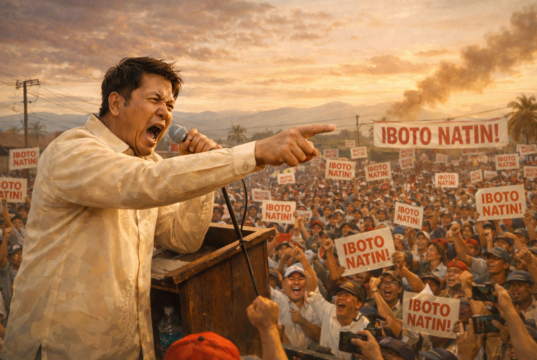




The President’s men: a bunch of meek, docile, and intimidated people
By Oscar P. Lagman, Jr.
Just as he had promised to change the system established by the elitist leaders of the past during his campaign for the presidency, President Rodrigo Duterte has remained the same man that he was when he was the mayor of Davao City. He has kept the simple lifestyle that he lived for 22 years as Mayor Digong.
Price controls on medicines: The zombie is back!
By Ramon L. Clarete
On Nov. 15, the technical working group organized by the Senate Committee on Trade, Commerce and Entrepreneurship chaired by Senator Pimentel met on the proposed Senate bill that would create the drug price regulatory board or DPRB.
The rainbow after the rain
By Amelia H. C. Ylagan
“At the end of the rainbow, you’ll find a pot of gold,” the old song goes. The rainbow points to where, in folklore, the leprechauns buried their riches.
Should we be worried about the fiscal deficit?
By Andrew J. Masigan
My fears were put to rest after I spoke to DTI Secretary Ramon Lopez during the monthly meeting of the Spanish Chamber of Commerce.
Upsilon’s progressive legacy (or why Upsilon should not be associated with Marcos)
By Filomeno S. Sta. Ana III
The University of the Philippines (UP) is again in the news.
Setting up a debate with Mr. Coal
MR. Bienvenido S. Oplas, Jr. writes in his Oct. 10 column, “Corrupted science to justify renewables cronyism,” “if wind-solar are indeed that cheap, then will the lobby agree to (a) abolish the priority and mandatory dispatch of wind-solar to the grid, and (b) abolish the feed-in-tariff (FIT) scheme of guaranteed high price for wind-solar, other variable REs for 20 years?”
IPR, private property and prosperity
By Bienvenido S. Oplas, Jr.
“Every Man has a Property in his own Person. This no Body has any Right to but himself. The Labour of his Body, and the Work of his Hands, we may say are properly his.” -- John Locke, Two Treatises of Government (1689)
Death and body parts
By Jemy Gatdula
The National Transplant Ethics Committee (NTEC) was created for the purpose of overseeing “ethical issues and dilemmas regarding organ donation and transplantation.” Such matters are apparently on the rise and it is a good thing indeed for people to be aware of the concepts and discussions surrounding this highly sensitive topic.
Misreading the news media
By Luis V. Teodoro
Denmark’s Ambassador to the Philippines said he “reads” the media, but has apparently been misreading them. He said “some media” are “systematically negative” in their reporting on the government, but his subsequent statements sounded as if he was describing most, or even all of them.
Superpower rivalry puts the squeeze on Southeast Asia
HENRY PAULSON, former US Treasury secretary, warns of an “economic iron curtain” descending as rivalry between the US and China deepens. Lee Hsien Loong, Singapore’s prime minister, says that, as tensions flare, Southeast Asian nations may be forced to choose which side to be on. The position of smaller nations caught in the middle is already uncomfortable. It will become more so if Washington and Beijing persist in imposing their own exclusive rules. Yet neither side appears willing to work towards an accommodation that is in their own interests.
Where to with IKEA, China?
By Marvin A. Tort
Of the business developments in the last two days, what stand out -- at least, in my opinion -- are the commitment of furniture manufacturing giant IKEA to invest initially about P7 billion in putting up a Philippine store; and the government’s signing of more than 20 agreements with the People’s Republic of China on the occasion of the state visit of Chinese President Xi Jinping.
Please mind the curriculum gap
By Florenz C. Tugas
The ongoing academic year 2018-2019 is critical for Philippine higher education institutions as it is when they have to admit the pioneer batch of senior high school (SHS) graduates under the K-12 basic education reform program of the Department of Education (DepEd) into college. According to DepEd, of the more than 1.2 million graduates from public and private SHS’s in 2018, twenty-five percent (25%) or 300,000 learners will be able to obtain a college degree in the next four to five years. Factoring in the college completion rate of 30% as per Commission on Higher Education (CHEd), we are talking about 1 million (300,000/30%) learners entering college this year.