Peso slips to fresh record low on rate cut bets
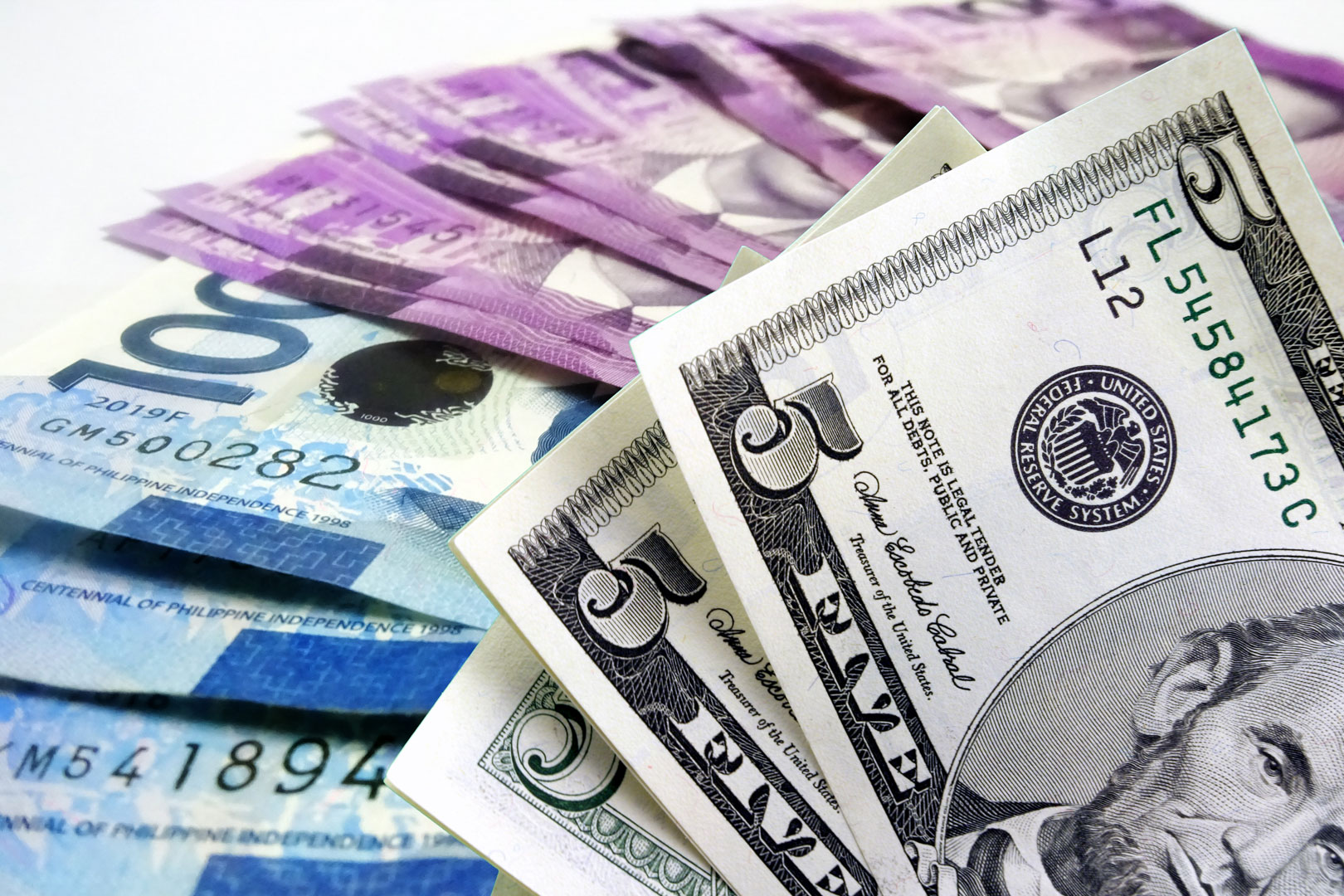
THE Philippine peso weakened to a new record low against the dollar on Thursday as markets priced in the possibility that the Bangko Sentral ng Pilipinas (BSP) could cut interest rates ahead of the US Federal Reserve.
The local currency closed at P59.46 a dollar, down two centavos from Wednesday’s record-low finish of P59.44, data from the Bankers Association of the Philippines showed.
The peso opened Thursday’s session slightly stronger at P59.43, touched an intraday high of P59.35, and weakened to as low as P59.47. Dollar trading volume rose to $1.079 billion, higher than the $951 million recorded the previous day.
“The dollar-peso closed higher on prospects of a narrowing interest rate differential, with the BSP expected to cut rates before the Fed,” a trader said by telephone.
Another trader said the peso continued to soften after recent US producer inflation and retail sales data underscored the resilience of the American economy, reinforcing expectations that the Fed will keep policy rates unchanged in the coming months.
Rizal Commercial Banking Corp. Chief Economist Michael L. Ricafort said market expectations of a BSP rate cut at its February policy meeting also weighed on the peso.
BSP Governor Eli M. Remolona, Jr. said last week that a rate cut at the Monetary Board’s Feb. 19 meeting “remains on the table” but is “unlikely,” as the central bank is nearing the end of its easing cycle.
The BSP has reduced its benchmark rate by a total of 200 basis points since August 2024, bringing the policy rate to a more than three-year low of 4.5%.
Despite the peso’s weakness, the BSP sees no need for immediate intervention. Palace Press Officer Clarissa A. Castro said the central bank continues to closely monitor exchange-rate movements and is prepared to act if necessary.
“The Bangko Sentral ng Pilipinas continues to monitor the peso-dollar exchange rate so it can take appropriate action if needed,” she told a news briefing in Filipino. “For now, the central bank is confident that intervention is not required.”
She said the peso’s depreciation reflects global developments, including the strength of the US dollar driven by expectations on Fed policy and geopolitical tensions abroad.
The government is working to mitigate the impact of a weaker peso by slowing price increases, supporting investments, and strengthening key economic sectors, she added.
MUFG Global Markets Research Senior Currency Analyst Michael Wan said the peso might remain more sensitive to oil price movements than some of its regional peers, although further oil price increases are not his base case scenario.
“Further oil price increases is not our base case, and we will look to see if the peso retraces some weakness on these recent oil price moves,” he said.
Traders said the peso could continue testing record lows until the BSP and Fed hold their respective policy meetings, unless the US central bank signals a shift toward rate cuts.
However, movements will remain data-dependent, particularly on US inflation and labor market indicators.
For Friday, the first trader sees the peso trading from P59.20 to P59.50 a dollar, while the second trader expects a range of P59.25 to P59.50.
Mr. Ricafort said the local currency could move from P59.35 to P59.55, noting that strong foreign exchange reserves and continued net foreign buying in the local stock market might help cushion further depreciation. — Aaron Michael C. Sy