Debt yields end lower on slower Nov. inflation

YIELDS on government securities (GS) traded at the secondary market closed mostly lower last week as slower November inflation bolstered rate cut prospects.
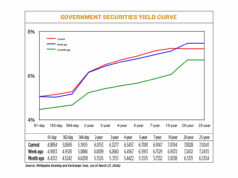
GS yields, which move opposite to prices, declined by an average of 1.04 basis points (bps) week on week, based on the PHP Bloomberg Valuation Service Reference Rates as of Dec. 5 published on the Philippine Dealing System’s website.
At the short end of the curve, yields on the 91-, 182-, and 364-day Treasury bills (T-bills) inched down by 0.88 bp (to 4.8732%), 0.09 bp (4.9990%), and 1.91 bps (5.0520%), respectively.
At the belly, rates also dropped across the board. Yields on the two-, three-, four-, five, and seven-year Treasury bonds (T-bonds) declined by 1.89 bps (to 5.1907%), 2.33 bps (5.3077%), 1.89 bps (5.4312%), 0.95 bp (5.5493%), and 0.25 bp (5.7266%), respectively.
Lastly, at the long end of the curve, the 20- and 25-year notes edged up by 0.26 bp and 0.24 bp to yield 6.3862% and 6.3828%, respectively. On the other hand, the 10-year bond saw its rate go down by 1.86 bps to 5.9178%.
GS volume traded declined to P43.06 billion on Friday from P91.27 billion a week prior.
Jonathan L. Ravelas, a senior advisor at Reyes Tacandong & Co., said yields mostly went down on demand for short-term papers amid expectations of subdued inflation that could lead to a fifth straight cut by the Bangko Sentral ng Pilipinas (BSP) this week.
“With inflation likely below 2%, the market is leaning dovish — favoring short-term paper and locking in rates before any policy shift,” Mr. Ravelas said. “Global cues like softer US yields and weak local GDP (gross domestic product) added buying pressure.”
“Demand for short-term government bonds remained strong [last] week, which helped push yields lower on the front end of the curve. With an expected policy rate cut approaching, investors continue to position in the short to medium parts of the curve where the benefits tend to be more immediate,” Lodevico M. Ulpo, Jr., vice-president and head of fixed-income strategies at ATRAM Trust Corp., said in a Viber message.
He added that concerns about larger bond supply next quarter affected longer tenors and kept the yield curve steeper.
“Despite this, longer-term bonds still find support as the market anticipates a more dovish stance from the BSP,” Mr. Ulpo said. “The latest 10-year auction also confirmed healthy demand for longer duration, posting a solid 4.3x bid-to-cover ratio, while overall government bond yields declined by 2-5 bps week on week.”
“Locally, the BSP noted that economic growth has softened, but also highlighted that inflation expectations remain stable. This combination strengthens the case for a 25-bp rate cut [this] week. Globally, weaker labor data has dominated sentiment, adding to expectations that the US Fed will also deliver another 25-bp cut during its upcoming policy meeting.”
Headline inflation slowed to 1.5% in November from 1.7% the month prior and 2.5% in the same month in 2024, the Philippine Statistics Authority reported on Friday.
This was a tad below the 1.6% median estimate in a BusinessWorld poll of analysts and was within the BSP’s 1.1-1.9% forecast for the month.
The November print brought the 11-month average to 1.6%, lower than the central bank’s 1.7% full-year forecast and 2-4% annual target.
“The outlook for inflation is generally benign, remaining well within the target range over the policy horizon… The Monetary Board likewise noted that the outlook for domestic economic growth has weakened. This outlook reflects in part the impact on business confidence of governance concerns about public infrastructure spending as well as lingering uncertainty from the external environment,” the central bank said in a statement on Friday.
“Going forward, the Monetary Board will continue to review newly available information and reassess the impact of prior monetary actions in light of evolving economic conditions and their implications for inflation and growth.”
Last week, BSP Governor Eli M. Remolona, Jr. said that Philippine GDP growth may only settle between 4% and 5% this year as the corruption scandal continues to limit government spending and weaken investor sentiment. This would be below the government’s 5.5-6.5% full-year goal.
He said this raises the odds of another rate cut at the Monetary Board’s meeting on Thursday (Dec. 11).
In October, the central bank lowered benchmark borrowing costs by 25 bps for a fourth meeting in a row to bring the policy rate to 4.75%. It has reduced benchmark rates by a total of 175 bps since it began its easing cycle in August 2024.
Meanwhile, markets are pricing in an 84% chance of a quarter-point cut at this week’s Fed meeting, LSEG data show, Reuters reported.
The Fed last lowered the policy rate on Oct. 29, to a range of 3.75%-4% from 4%-4.25%, the second consecutive 25-bp cut this year.
The Fed meeting this week is expected to be one of its most contentious in years, and investors are focused on how divided policymakers are over an expected interest rate cut and what Chair Jerome H. Powell signals about the path ahead.
Five of the 12 voting members of the Federal Open Market Committee (FOMC) have voiced opposition or skepticism about further easing, while three members of the Washington-based Board of Governors favor a cut.
The FOMC has not had three or more dissents at a meeting since 2019, and that has happened just nine times since 1990.
For this week, Mr. Ulpo said the market expects both BSP and Fed to cut rates by 25 bps this week, which would be positive for bonds.
“This easing path bodes well for fixed income, especially for RPGBs (Republic of the Philippines Government Bonds), supported by a favorable local macro backdrop and the latest inflation reading, which reinforces the likelihood of a more accommodative policy setting in the coming years,” he said. “Given these developments, we expect yields across the curve to drift lower.”
“Expect a steady to slightly bullish tone, especially if BSP signals a cut,” Mr. Ravelas added. — Heather Caitlin P. Mañago with Reuters