Peso to move sideways amid fresh tariff wave
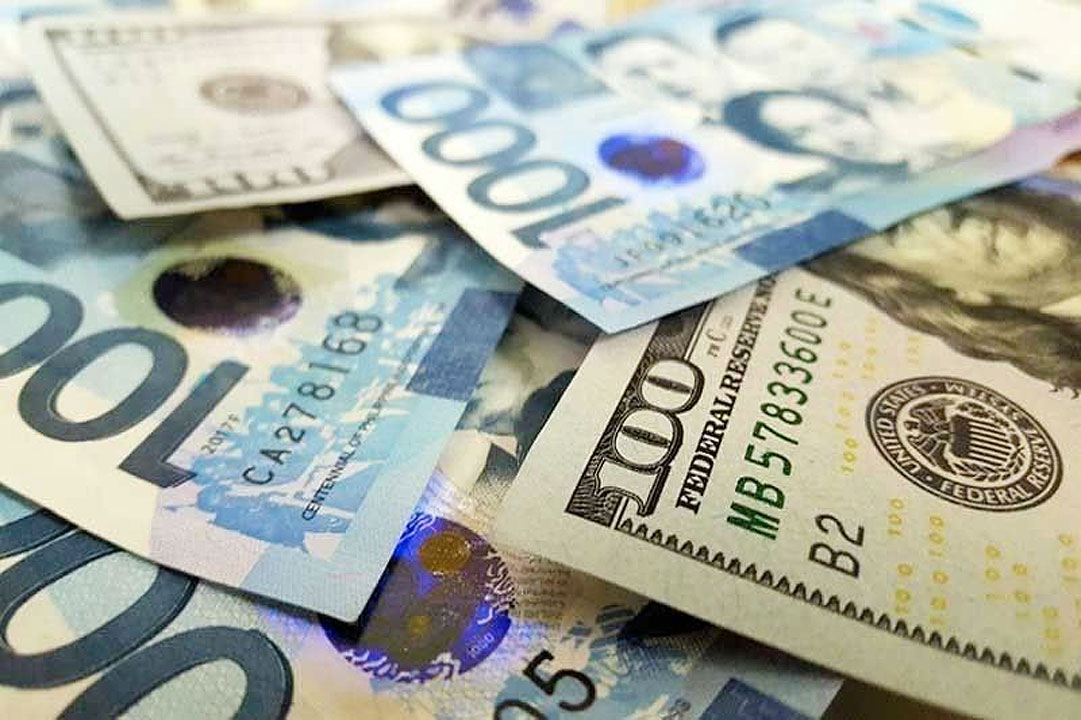
THE PESO could trade sideways against the dollar this week as the market remains cautious after the Trump administration announced new tariffs over the weekend.
The local unit closed unchanged at P56.47 per dollar on Friday, Bankers Association of the Philippines data showed.
Meanwhile, week on week, the peso weakened by seven centavos from its P56.40 per dollar close on July 4.
The peso was flat against the dollar on Friday as “mixed external signals, stable remittances, and inward FDIs (foreign direct investments) offered support, while geopolitical risks and US rate expectations capped gains,” Philippine Institute for Development Studies Senior Research Fellow John Paolo R. Rivera said in a Viber message.
Rizal Commercial Banking Corp. Chief Economist Michael L. Ricafort said the peso was also supported by the government’s plans to negotiate with the United States about the 20% tariffs set to be imposed on Philippine goods by next month.
“For this week, key factors to watch include US inflation data, Fed guidance, and local trade and fiscal developments,” Mr. Rivera said.
He said the peso could trade within the P56.50 to P57.50 range this week “if risk sentiment remains stable.”
Meanwhile, Mr. Ricafort sees the local unit moving between P56.25 and P56.75 versus the greenback in the coming days.
“The markets are still on wait-and-see mode if Trump would be willing to compromise and settle for lower negotiated tariffs during the trade negotiations, given the TACO (Trump Always Chickens Out) track record in recent months,” he said.
The peso could stay range-bound against the dollar in the short term as markets await clarity regarding the US’ planned “reciprocal” tariff rate, analysts said.
“The peso may find some support from relatively stable macroeconomic fundamentals, resilient remittances from OFWs (overseas Filipino workers) and BPOs/KPOs (business and knowledge process outsourcing), and the fact that the Philippines’ tariff rate is still in line with or lower than that of regional peers,” Mr. Rivera said.
“This may help anchor investor sentiment, especially if the government acts quickly to diversify exports and clarify trade policy direction.”
However, the 20% rate and its impact on export revenues, especially from the electronics and garments sectors, could cause the Philippines’ current account deficit (CAD) to widen in the short term, which could hit the local currency, Mr. Rivera added.
“Lower US dollar inflows from trade may weigh on the peso, adding modest depreciation pressure.”
The Philippines’ current account deficit, which covers transactions involving goods, services and income, widened by 105% to $4.25 billion in the first quarter from $2.07 billion in the same period a year ago.
This brought the CAD as a share of gross domestic product (GDP) to 3.7% in the January-to-March period, larger than the 1.9% in the same quarter in 2024.
The Bangko Sentral ng Pilipinas expects the current account deficit to narrow to $16.3 billion or -3.3% of GDP this year from the $17.5-billion gap (-3.8% of GDP) in 2024.
ANZ Research said in a research note on Friday that while current account balances of Southeast Asian countries have mostly stabilized, investments as a share of GDP have declined in the Philippines, Malaysia, and Thailand compared to pre-pandemic averages, which implies a sharp fall in savings.
“This is especially worrying for the Philippines as it runs a current account deficit, which has widened in recent years amid stagnating investments. This suggests that it is increasingly relying on foreign capital to fund domestic consumption rather than productive investments,” it said.
“Savings have remained constrained in the region as high inflation in recent years has led to low real income growth. Although inflation has subsided, wages have not grown sufficiently to offset the impact of higher price levels. This is evident in the Philippines where household savings is structurally low, driven by a large informal sector, low incomes, and limited access to formal saving instruments,” ANZ Research added.
It noted that household savings in the Philippines only returned to the pre-pandemic level last year, with the recent surge in credit card loans also pointing to “higher stress” among households.
“With limited social safety nets, households depleted savings to fulfil their daily needs… Moreover, given the already high household debt, savings are likely to remain constrained in the near term.”
ANZ Research expects the Philippines’ CAD to end this year at 3.6% of GDP, adding that current account positions among Southeast Asian countries are unlikely to improve materially in the coming years, especially amid shifting global trade dynamics.
“Gross savings will remain subdued amid slowing wage growth and moderating economic activity. Lower savings are at best expected to be offset by moderating investments given the ongoing trade policy uncertainty,” it said.
Meanwhile, Regina Capital Development Corp. Head of Sales Luis A. Limlingan said in a Viber message that investors will likely monitor the impact of potentially higher tariffs on consumers, “but any possible short-term to medium-term adverse effects could be offset later by other trade partners or new bilateral concessions.” — A.M.C. Sy