Marcos posts uptick in trust and performance ratings; VP Sara’s score softens
By Erika Mae P. Sinaking, Reporter
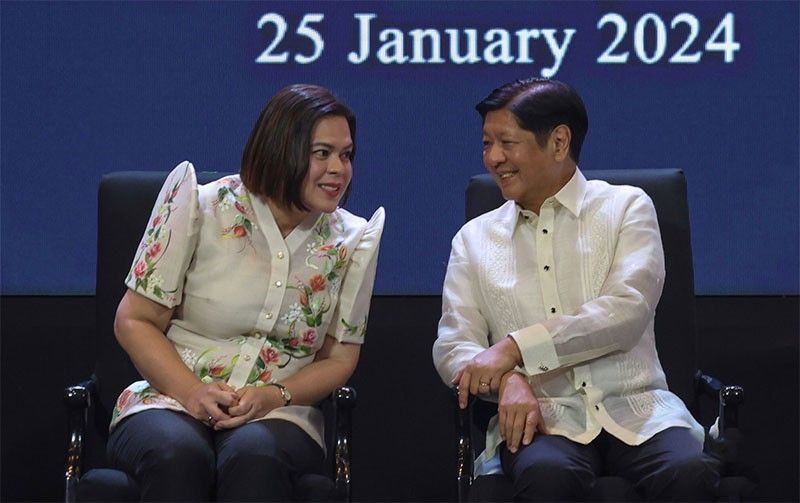
PRESIDENT Ferdinand R. Marcos, Jr. posted improved trust and performance ratings in the first quarter, while Vice-President (VP) Sara Duterte-Carpio’s performance score declined, according to a survey released by OCTA Research on Monday.
The survey, conducted from March 19 to 25, captured public sentiment during the early phase of the Middle East war and rising geopolitical and economic uncertainty, as well as domestic political developments, including the impeachment process involving the Vice-President.
The survey showed Mr. Marcos’ trust rating rising to 54% in March, up six points from December 2025. His performance rating also increased to 55% from 51%.
OCTA said the improvement reflected stronger consolidation in public perception of the President’s leadership, along with a decline in ambivalence among respondents.
Political analyst Anthony Lawrence A. Borja, an associate professor at De La Salle University, said government responses to fuel insecurity might have supported the gains.
“Assuming that it captured the entirety of the oil crisis, the immediate responses of the government ranging from declaring a state of national energy emergency, to securing oil shipments from Russia, to gaining safe passage with Iran, and even opening talks with China might have been enough to bolster ordinary citizens’ sense of resilience,” he said in a Facebook Messenger chat.
Ms. Duterte, meanwhile, maintained a majority trust rating of 55%, slightly higher than 53% in December 2025, a change OCTA said was within the margin of error and statistically stable.
However, her performance rating slipped to 50% from 54% in the previous quarter. OCTA also cited an increase in performance ambivalence, which it said suggested more mixed public assessments of her leadership.
Mr. Borja said the results point to consolidation rather than expansion of support.
“The increase is within the margin of error and for this reason, it probably captured the solidification of sentiments towards Vice-President Duterte,” he said. “Given the cult-like nature of her following, this is unsurprising.”
“Her performance rating dropped by 4 points and though it seems insignificant for now, it shows that support for her, though consolidated, is neither perfect nor absolute,” he added
Regionally, Mr. Marcos posted his highest trust rating in Luzon outside Metro Manila at 59%, while his lowest was in Mindanao at 45%. His performance ratings remained at majority levels across all regions.
Ms. Duterte continued to post strong numbers in Mindanao, where her trust reached 90% and performance rating stood at 83%. Her lowest ratings were recorded in Metro Manila and the rest of Luzon.
Hansley A. Juliano, a political science lecturer at the Ateneo de Manila University, said shifting timelines and overlapping controversies might have softened the impact of earlier issues on public opinion.
He added that divided perceptions between political camps have made it difficult for voters to fully shift support.
“This does mean therefore that Mr. Marcos will likely be vulnerable when the spotlight begins to turn away from his achievements abroad,” he said via Messenger, noting that political attention cycles could reshape future ratings depending on emerging controversies and policy outcomes.
OCTA’s survey covered 1,200 adult registered voters nationwide, with a margin of error of ±3% points.