Fashion designer granddaughter launches book about fashion designer grandmother
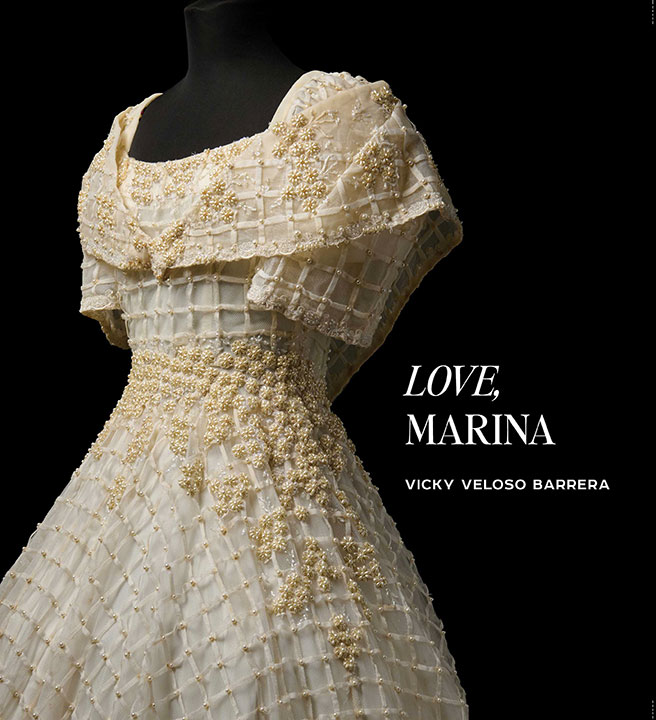
WHILE fashion designer Marina Antonio may have passed in 2006, her gowns live on, and so does her line. Granddaughter Vicky Veloso Barrera preserves the life that these gowns meant in a book, Love, Marina.
Love, Marina, published last year by Far Eastern University (FEU), held a book launch and fashion show at Tesoro’s in Makati where it will be sold (alongside FEU’s own online and physical facilities). The event was held on March 3.
The author appeared on the runway, alongside friends and family to showcase the creations made by Mrs. Antonio (who was the wife of National Artist for Architecture Pablo Antonio) and by the generations of women succeeding her. The author wore a black and white Filipiniana creation, with an extra fold of fabric that appeared like a little sail, from the Antonio archives. This particular dress was strewn all over with little white ribbons rolled to look like sampaguita flowers.
Then Mrs. Antonio’s daughter, Malu Veloso, another storied designer whose work became famous in the 1970s, showed off her own creations. Back then, editing the silhouette of the traje de mestiza, pairing the fichu with Western gowns, was revolutionary.
Ms. Veloso Barrera, alongside her sister Letlet Veloso, was also a fashion designer in the 1990s, making gowns for celebrity weddings like Sharon Cuneta’s to politician Francis Pangilinan. Ms. Veloso showed off dresses with sequins forming the shapes of flowers, appearing like they came straight from a fairy tale.
The fourth generation of designers in the family, Ms. Veloso Barrera’s daughter Hannah Barrera, showed off a yellow gown, hand-ruched and beaded to form a yellow sun, with a train edged with a bit of beadwork cut off from a French couture gown. The young designer is already making a mark — Ms. Barrera was selected last as the first Filipina to show her clothes at the Piattaforma Sistema Formativo Modato show in Milan.
The book, meanwhile, shows off the family’s story, beginning in pre-war Manila with Mrs. Antonio’s own troubled family life. Left by a father and then her husband, she remarried and started a fashion dynasty with her daughter and grandchildren, also helping nurture one in architecture through her sons. The book, with about 200 pages, details this life, a story told through clothes, gardening, and cooking. The book’s title comes from Mrs. Antonio’s sign-off for her letters to her friends, including Jean MacArthur, the second wife of Douglas MacArthur (for whom she also made clothes).
Her granddaughter, Ms. Veloso Barrera, herself an accomplished cook, said that her favorite memory of her grandmother was, “Standing beside her in the kitchen,” she recalled. “She allowed me to make a mess.”
There’s a problem with growing up in a home with an icon: can you ever truly measure up to their success? Mrs. Antonio’s own daughter, Malu Veloso, waved off these fears and said during a Q&A session at the launch: “I don’t think it’s intimidating. My mom is my inspiration.”
Speaking with BusinessWorld, Ms. Veloso Barrera told a story about her artist son, a scion of architects and designers, being asked in school about living with such great names hovering over his career. He answered, “I don’t feel like I walk in their shadow. I feel like I walk in their light.”
“I think it’s genetic and I think that’s in example,” she said about the family’s creative legacy. She notes that her daughter picked up dyeing, painting, and sewing almost naturally. “You see somebody living the life, doing something that’s their passion, and it’s just so natural. It’s like breathing.”
As we celebrate National Women’s Month in March, Ms. Veloso Barrera discussed dynasty and legacy from a woman’s perspective. For so long, we’ve been fed stories about men breaking ground and letting their sons take over, but it’s nice to know about women doing the same with their daughters.
“I think it’s very natural for women to nurture and to want to share what they know with their daughters,” said Ms. Veloso Barrera, explaining that her grandmother helped with the clothes even up to her generation. She said that she and her sister would be summoned by their grandmother and told to look at a certain dress from the inside out. “I have to show you all these things before I pass on,” Ms. Antonio would say. “I think it’s easier with women,” said Ms. Veloso Barrera, citing male dynasties with professional rivalries.
Love, Marina is available for purchase through TAMS Bookstore at TamsBookstore@feu.edu.ph and at Tesoros 1016, A. Arnaiz Ave., Makati City. — Joseph L. Garcia