

Stocks may drop further on bearish sentiment
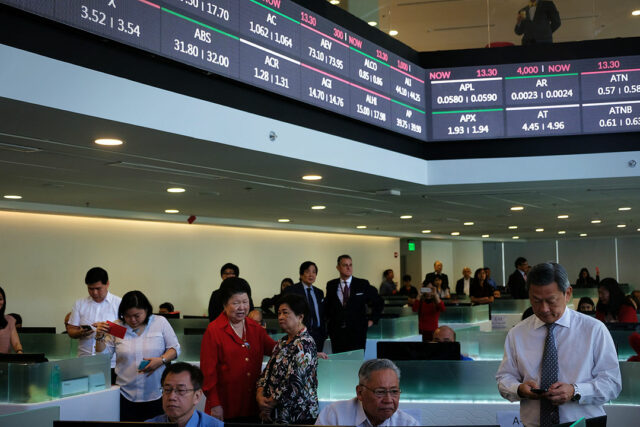
PHILIPPINE STOCKS may continue to move lower this week as the market stays defensive amid the deadlock between the United States and Iran and heightened inflation concerns that have turned the Bangko Sentral ng Pilipinas (BSP) more hawkish.
On Friday, the Philippine Stock Exchange index (PSEi) fell by 0.67% or 40.32 points to close at 5,943.49, while the broader all shares index went down by 0.51% or 17.50 points to end at 3,352.22.
This was the PSEi’s worst finish in over three weeks or since it closed at 5,869.49 on March 30.
Week on week, the bellwether index dropped by 55.64 points from April 17’s 5,999.13.
“The local bourse capped a volatile week on a sour note, with the PSEi breaking below the 6,000 psychological support zone to close at 5,943. This downward pressure followed BSP’s hawkish 25 basis points (bps) rate hike to 4.5%, a move aimed at tempering inflation fueled by surging oil prices,” online brokerage 2TradeAsia.com said in a note.
“The local market exhibited another bearish week as investors dealt with the uncertainties stemming from the Middle East conflict and the interest rate hike by the BSP. The local market is already on a two-week losing streak and is now trading below the crucial 6,000 line,” Philstocks Financial, Inc. Research Manager Japhet Louis O. Tantiangco said in a Viber message.
On Thursday, the BSP raised benchmark interest rates by 25 bps in a preemptive move to mitigate second-round inflation effects from the Middle East war, bringing the policy rate to 4.5%. This was its first hike since October 2023 and was predicted by 11 of 19 analysts in a BusinessWorld poll.
BSP Governor Eli M. Remolona, Jr. also signaled further tightening ahead as they now see inflation breaching their 2%-4% tolerance band until next year.
For this week, Mr. Tantiangco said the market may stay bearish despite low valuations as uncertainties over the Middle East conflict and concerns about rising domestic inflation and interest rates weigh on sentiment.
He added that a sustained weakness in the peso could also drag down the local market. The peso closed at a new three-week low of P60.70 a dollar on Friday.
“Still, the market’s bearish default could be negated if we see positive developments in the geopolitical tensions in the Middle East,” he said.
“Currently, the market’s technicals are also giving a bearish bias. In last week’s trading, the market has already given up its ground at 6,000. With this, its new support is already seen at 5,800.”
2TradeAsia.com placed the PSEi’s immediate support at 5,800, resistance at 6,050, and secondary resistance at 6,300.
“The heightened uncertainty generated by war and its consequences has played its way out not just in oil prices and Treasury rates, but in the higher premiums that investors now charge for risk,” it said. “We expect the market to remain in a consolidatory phase as it digests these pain points.” — Alexandria Grace C. Magno
China’s Luzon drills amid Balikatan signal pushback vs allied exercises
By Kaela Patricia B. Gabriel and Pexcel John Bacon
CHINA’S live-fire naval drills near northern Luzon reflect a “tit-for-tat” strategy aimed at countering expanded military cooperation between the Philippines and its allies, an analyst said.
“Beijing’s simultaneous mirroring of naval live drills shows a tit-for-tat strategy to demonstrate its presence and refusal [to recognize] the US and its allied forces in Philippine maritime and terrestrial domains,” Chester B. Cabalza, president at the International Development and Security Cooperation, said via Facebook Messenger.
The Chinese military’s Southern Theater Command on April 24 confirmed conducting live-fire exercises and maritime operations in waters facing Luzon, describing the activities as tests of joint operational capabilities.
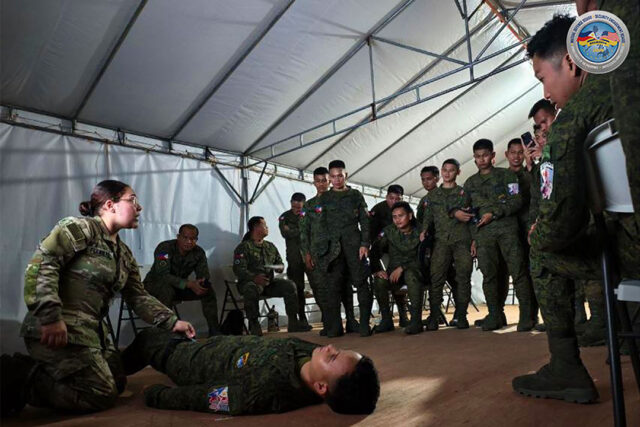
The drills coincided with expanded joint exercises between the Philippines and its partners, including the US, under the annual Balikatan (shoulder-to-shoulder) exercises.
Mr. Cabalza said the timing points to strategic signaling between the two sides, with China asserting its operational space in the South China Sea while responding to allied activities.
“The People’s Liberation Army Southern Command Theater called this intended action as a necessary response to reassure the Chinese people of their tactical space in the South China Sea,” he said.
He added that Manila has maintained an active defense posture during the Balikatan exercises to counter regional pressure.
“Manila reinforced its strategy through the active defense posture to counter Beijing’s pressure during the Balikatan exercises,” Mr. Cabalza said.
The overlapping drills reflect a pattern of reciprocal signaling between China and the Philippines and its allies, he said.
“The nature of the competing drills from both ends signal a cognitive and information warfare creating a dueling exercise scenario,” he added.
The Balikatan exercises, now on their 41st iteration, focus on interoperability, maritime defense and joint operations.
About 17,000 troops from the Philippines, the US and Australia are participating this year, along with first-time participants Japan, France, Canada and New Zealand.
Lieutenant General Christian F. Wortman, commanding general of the I Marine Expeditionary Force, said the drills are not directed at any specific adversary.
China has repeatedly opposed expanded military cooperation between the Philippines and its allies, including Manila’s hosting of large-scale exercises.
In a commentary published in the People’s Daily, the official newspaper of the Communist Party of China, the Philippines was criticized for deepening security ties while pursuing economic engagement with Beijing.
“These contradictory actions reveal an opportunistic strategy by certain Philippine politicians to simultaneously leverage external allies… while seeking economic cooperation with China,” according to the commentary.
Analysts said Beijing’s actions also reflect efforts to use economic tools alongside military signaling.
Mr. Cabalza said China’s moves to leverage resources such as energy and fertilizer signal unease over the Philippines’ alliance with the US.
Far Eastern University Department of International Studies faculty member Francis M. Esteban said the developments highlight risks in relying on China as an economic partner.
“China infamously implies economic statecraft, and it’s a good thing that the Philippines has a profound base of networks and partners we can try and reach out to,” he said.
Both analysts said the Philippines should continue pursuing partnerships aligned with its national interest.
“The dichotomy of choice between the US and China should not stop us from reaching out to other states willing to help,” Mr. Esteban said.
Mr. Cabalza said the Philippines should remain firm in its independent foreign policy, noting that the expansion of Balikatan reflects broader strategic realities in the region.
This year’s joint military exercises marked the 75th year of the Mutual Defense Treaty between the Philippines and the US.
A day after the Balikatan launch, the Chinese Embassy in Manila blamed the military drills for Filipino fisherfolk’s challenges in Subic Bay, saying that the foreign warships’ occupation of the fishing grounds and high fuel prices have made it difficult for fishermen to go out to sea.
Marcos Japan visit seen boosting security ties

By Chloe Mari A. Hufana, Reporter
PRESIDENT Ferdinand R. Marcos, Jr.’s upcoming state visit to Japan is expected to strengthen the Philippines’ alignment with regional partners and deepen cooperation on security and economic resilience, analysts said.
The trip signals Manila’s continued effort to expand ties with countries that support a rules-based order and maritime security in the Indo-Pacific region.
“This also sends signals to China that the Philippines is boosting its defense networks further despite the constant pressure from Beijing,” Francis M. Esteban, a faculty member at the Far Eastern University Department of International Studies, said via Facebook Messenger.
Mr. Marcos is scheduled to visit Japan from May 26 to 29, marking the first state visit by a Philippine president in more than a decade. He is expected to meet with Prime Minister Sanae Takaichi, Emperor Naruhito and Empress Masako, Malacañang said.
The visit comes as the Philippines deepens security cooperation with partners such as Japan and the US through joint military activities, including the annual Balikatan exercises alongside Australia, New Zealand, France and Canada.
Tensions between Manila and Beijing continue to shape the regional security environment, with competing claims in the South China Sea leading to repeated maritime incidents and diplomatic protests.
Ederson DT. Tapia, a political science professor at the University of Makati, said the visit’s significance depends on whether it leads to more sustained and structured cooperation.
“What needs to follow is depth,” he said via Facebook Messenger.
“Interoperability, coordinated maritime domain awareness, and a more regularized presence in joint activities will matter more than headline agreements. The question is whether these can be embedded in routines that outlast political cycles,” he added.
Mr. Tapia said while Japan is already a key partner, further progress depends on integrating existing initiatives into a more durable framework focused on capacity-building and institutional strengthening.
“If the visit is to elevate the relationship, it must move beyond sectoral cooperation toward something more deliberate: a partnership anchored in shared capacity-building,” he said.
He added that advancing ties require aligning defense cooperation with economic resilience and infrastructure development within a broader Indo-Pacific strategy.
Energy cooperation is also expected to be part of discussions, particularly as the Philippines seeks to manage supply risks as an import-dependent economy.
“Energy presents a similar opportunity, though the expectations must be tempered,” Mr. Tapia said. “Japan cannot simply substitute for the Philippines’ traditional energy sources, but it can help change the structure of dependence.”
He said Japan’s strengths in technology, financing and system integration could support long-term investments in areas such as liquefied natural gas infrastructure, grid modernization and alternative fuels.
“Energy diplomacy should no longer be understood as sourcing alone,” he said. “Deeper engagement with Japan can help the Philippines move from a reactive posture to a more anticipatory one.”
Tribunal says anti-violence law not for romantic disputes

By Erika Mae P. Sinaking, Reporter
THE Supreme Court said the Anti-Violence Against Women and Their Children Act could not be used to settle private romantic disputes, setting a higher bar for proving psychological violence under the law.
In a 21-page decision dated Dec. 3, 2025, the Third Division reversed a lower court ruling that found a man guilty of psychological violence, citing insufficient proof of intent and actual harm.
Associate Justice Henri Jean Paul B. Inting, who wrote the ruling, said only acts carried out with specific criminal intent to cause substantial emotional or psychological distress could result in a conviction under Republic Act No. 9262.
“Only that which is done with specific criminal intent to cause substantial emotional or psychological distress to the woman, may give rise to a conviction,” the tribunal said.
The case stems from a four-year relationship that ended acrimoniously, after which the petitioner sent a series of aggressive text messages to the complainant, including threats and demands for money and sexual favors.
Lower courts had ruled that the messages were enough to establish psychological violence under the law. The Supreme Court disagreed, saying the evidence failed to show actual psychological harm.
The tribunal cited the complainant’s behavior, noting that she boarded the petitioner’s motorcycle shortly after receiving the alleged threats. Her social media activity also included posts that appeared to mock the accused during his detention.
The court said these actions undermined claims of substantial emotional distress.
The ruling distinguished between criminal conduct and emotional outbursts common in failed relationships, saying harassing messages alone do not meet the threshold required by law.
The court defined “substantial” distress as harm that is real and significant, not merely perceived or speculative, and said intent to inflict such harm must be proven beyond reasonable doubt.
“Not all forms of harassing behavior will fall under such law, which was never meant to be used either as a resolution to private romantic relationships,” the court said. “Neither should it be used as a weapon to seek vengeance on a former lover.”
The court ordered the immediate release of the petitioner from the Davao Prison and Penal Farm, overturning his conviction and ending his detention under the charge.
The ruling clarifies the scope of Republic Act No. 9262, reinforcing its role as a legal remedy for victims of abuse while preventing its misuse in personal disputes.
Rights body probes deadly Negros clash

THE COMMISSION on Human Rights (CHR) said it has launched an investigation into an April 19 armed encounter in Negros Occidental that left 19 people dead and forced hundreds of residents to flee.
The probe aims to establish the circumstances of the clash in the village of Salamanca, Toboso, including the identities of those killed and whether the use of force complied with human rights and humanitarian standards.
“Allegation of unlawful killing or violation of international humanitarian law and human rights law require a prompt, effective, impartial and independent investigation,” the CHR said in a statement.
The Armed Forces of the Philippines said troops from the 79th Infantry Battalion engaged members of the New People’s Army in what it described as a legitimate, intelligence-driven operation that neutralized a top rebel commander.
Human rights groups have disputed this account, describing the incident as a massacre and saying the fatalities included civilians, among them a 15-year-old girl and several activists.
“The determination of status, circumstances of engagement and proportionality must be based on verifiable facts and due process,” the CHR said.
The rights body said inconsistencies remain in the identification of the victims, particularly in the cases of student leader Alyssa G. Alano and community journalist RJ Nichole L. Ledesma.
It added that its Negros Island Region office has been mobilized to coordinate with local authorities and families in retrieving the remains of those killed.
Local officials said the violence displaced hundreds of residents. In a Facebook post, Toboso Mayor Richard M. Jaojoco said that as of April 19, at least 653 people from 168 households in the villages of Salamanca and San Jose were staying in evacuation centers after the 12-hour gun battle.
The CHR called on authorities to ensure adequate humanitarian assistance and protection for affected communities.
“The commission calls on authorities to ensure adequate humanitarian assistance, protection from further displacement, and access to basic services in line with human rights and humanitarian standards,” it said.
The National Task Force to End Local Communist Armed Conflict said two American nationals were among those killed in the encounter, raising concerns over possible foreign involvement.
In a separate statement, the task force urged Filipinos abroad to remain vigilant and avoid activities that could expose them to risks linked to insurgency-related operations. — Erika Mae P. Sinaking
Marcos: No disruption in services

PRESIDENT Ferdinand R. Marcos, Jr. said the government will sustain infrastructure, social services and law enforcement efforts despite a deepening energy crunch as his administration seeks to prevent disruptions to public services.
In his latest vlog, the President acknowledged intensifying heat and ongoing energy pressures but stressed that road building, healthcare, education and anti-crime operations would continue, alongside support for sports, culture and tourism.
“Service must not stop,” he said in Filipino, adding government work must proceed across all agencies regardless of external shocks.
He reiterated the government’s commitment to provide housing for those in need, saying the government would continue to roll out social programs nationwide to improve living conditions.
The video also highlighted the administration’s flagship housing initiative, the Pambansang Pabahay Para sa Pilipino program, which aims to address the country’s housing backlog by expanding access to affordable homes.
Housing Secretary Jose Ramon P. Aliling said the program now offers various modalities, including house-and-lot options, to better meet the needs of Filipino families.
He added that subsidized interest rates of 1% to 3% have made home ownership more accessible for qualified beneficiaries. — Chloe Mari A. Hufana
Over 1.13M PUV drivers get cash aid
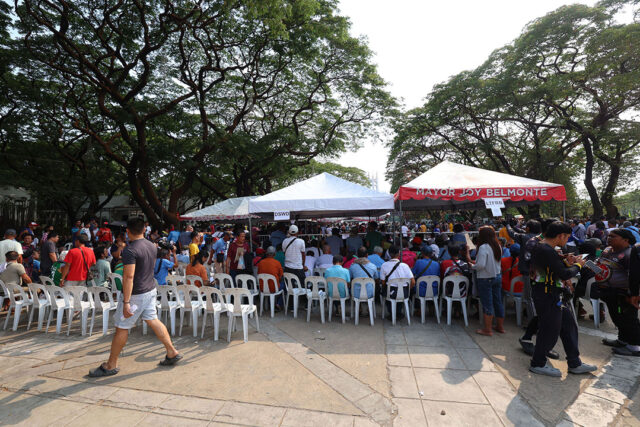
OVER 1.13 million public utility vehicle (PUV) drivers nationwide have received government cash aid as the Philippines ramps up relief efforts to offset the impact of rising fuel costs amid an ongoing energy emergency.
The Department of Social Welfare and Development on Sunday said 1.13 million transport workers have been given P5,000 each as of April 25, in line with a directive from President Ferdinand R. Marcos, Jr. to accelerate assistance for sectors most affected by higher oil prices.
Total disbursements have reached over P5.6 billion, with tricycle drivers accounting for the majority of beneficiaries at about 841,789, equivalent to P4.21 billion in aid.
Mr. Marcos placed the country under a year-long state of energy emergency due to the Middle East crisis.
The Philippines has been grappling with higher global oil prices, which have pushed up domestic pump rates and added strain on transport operators reliant on daily passenger fares.
The cash subsidy for the most vulnerable sectors is part of the government’s efforts to cushion Filipinos from rising fuel prices.
Motorcycle taxi drivers and delivery riders followed at 207,974 recipients, while jeepney drivers and transport network vehicle service operators each accounted for about 40,000 beneficiaries. — Chloe Mari A. Hufana
MMDA reroutes EDSA after bus fire

THE Metropolitan Manila Development Authority (MMDA) rolled out traffic rerouting and vehicle restrictions at the Epifanio de los Santos Avenue (EDSA)-Ortigas Interchange as the agency began safety checks and repairs following a bus fire that damaged the flyover.
In coordination with the Department of Public Works and Highways (DPWH), the MMDA said in a Facebook post on Saturday evening it enforced temporary traffic management measures starting April 26, after Public Works Secretary Vivencio B. Dizon requested support to manage vehicle flow during clearing and structural assessments.
On Sunday, authorities implemented rerouting for northbound vehicles turning left toward Ortigas at the at-grade intersection as DPWH teams conducted clearing operations, reinstalled road safety devices and performed load testing on the affected sections of the interchange.
On April 27, the MMDA will allow the reopening of the interchange, but only to light vehicles, limiting access as engineers continued to assess the structure’s integrity.
Heavier vehicles remained diverted while retrofitting and repair works were carried out to restore full capacity.
Authorities advised drivers to expect delays and plan trips ahead as rehabilitation works continued. — Chloe Mari A. Hufana
Bill seeks to defer BSKE 2026
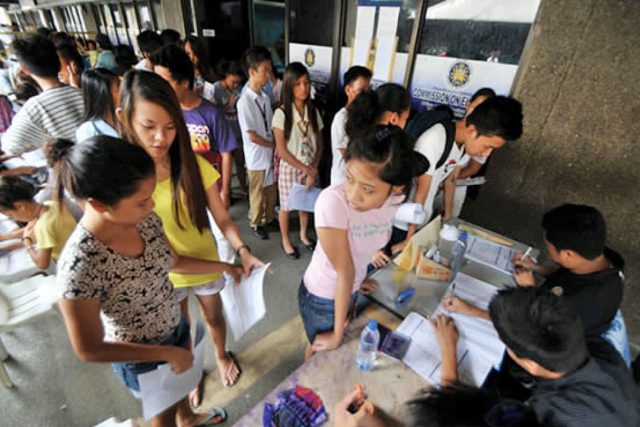
A SENATOR filed a bill seeking to postpone the Barangay and Sangguniang Kabataan Elections (BSKE) scheduled for November, pushing to move the polls to October 2027.
Senator Maria Imelda R. Marcos filed Senate Bill No. 2067 to provide village and youth council officials time to focus on resolving economic challenges caused by the oil crisis by moving the elections to the first Monday of October next year.
“The oil crisis has triggered significant increases in transportation fares, creating a serious risk of disenfranchisement, especially for voters registered outside their residence and marginalized sectors already struggling with the cost of living,” she said in a press release on Sunday.
She added that the original date of the polls will fall on Nov. 2, All Soul’s Day, which may discourage Filipinos to travel back home and vote due to rising transportation costs.
Ms. Marcos said the postponement will also give voters more time to update their registration and voting records.
Several senators have recently weighed on the postponement of the elections, with some considering saving the P16 billion poll funds to use for the oil crisis.
Senate President Pro Tempore Panfilo M. Lacson previously said the Commission on Elections may declare the funds as savings by opting not to spend it.
Last year, President Ferdinand R. Marcos, Jr. moved the village and youth council elections from December 2025 to November 2026 through the Republic Act No. 12232. — Kaela Patricia B. Gabriel
DBP approves P2B for development of housing units

THE DEVELOPMENT Bank of the Philippines (DBP) has approved a P2-billion loan for the construction of new housing units catering to low-cost and mid-tier markets.
The state-run lender will provide bridge financing to local developer PH1 World Landscapes, Inc. for the construction of 8,360 housing units under the Pambansang Pabahay Para sa Pilipino Housing (4PH) program as part of government efforts to address the housing backlog in the country, it said in a press release.
“This collaboration is seen to contribute to the fulfillment of the National Government’s goals of constructing affordable housing units that would unite families, strengthen communities, and generate livelihood opportunities for our countrymen,” DBP President and Chief Executive Officer Michael O. de Jesus said.
The loan will hasten completion of the housing developer’s projects in Caloocan City, and in the cities of Imus and Bacoor in Cavite.
These are expected to generate additional employment opportunities for over 1,000 people.
As of Jan. 31, DBP has approved P1.31 billion worth of assistance to two local government units and one developer under its BAHAY-4PH Program.
“DBP’s support for these projects is deeply aligned with its core development thrusts and it will continue to explore avenues to support the Marcos administration in its noble objective to make homeownership more accessible to low-income households,” Mr. de Jesus said. — Aaron Michael C. Sy
Landfill emergency plans sought
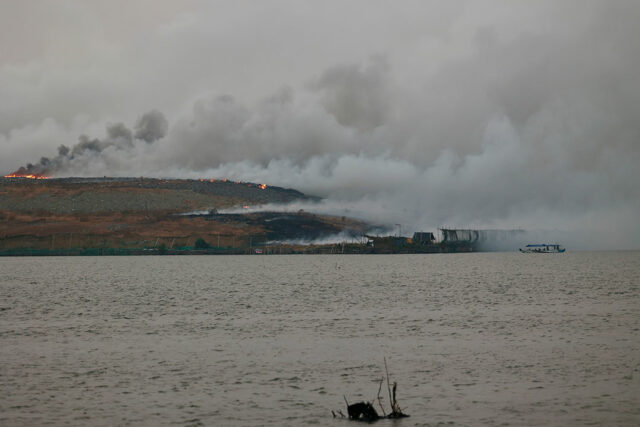
THE Department of Environment and Natural Resources (DENR) said it has ordered sanitary landfill operators nationwide to submit emergency contingency plans, following a series of waste management incidents and a recent audit of disposal facilities.
In a memorandum dated April 22, the agency’s Environmental Management Bureau (EMB) directed landfill operators to submit contingency plans addressing fire and other potential emergencies.
“The required contingency plans must outline fire prevention and suppression measures; emergency response protocols for fires, slope failure, leachate overflow, and gas explosions; installation and maintenance of gas venting and monitoring systems,” the DENR said in a statement on Sunday.
It added that the plans must detail coordination mechanisms with relevant government offices, evacuation and public safety procedures, and post-incident rehabilitation and environmental mitigation measures.
The DENR said the directive aims to reduce risks to nearby communities, particularly amid extreme heat conditions that may heighten the risk of landfill fires.
The agency said the EMB also reminded local government units that open dumping remains prohibited under Republic Act No. 9003, or the Ecological Solid Waste Management Act.
“Open dumping remains strictly prohibited and that operating open or controlled dumpsites should be directed to immediately stop operations and implement their Safe Closure and Rehabilitation Plan,” the DENR said.
For sites that have already been closed, the DENR said its regional offices have been tasked with verifying rehabilitation status and providing technical assistance to operators.
“Regional directors were also ordered to conduct regular inspections and validation of disposal facilities, assess risks and site conditions, and identify high-risk areas requiring immediate intervention,” it added.
The latest directive comes amid a string of landfill-related incidents in recent months that have raised concerns over safety and regulatory enforcement.
In January, at least 35 people were killed when a portion of a privately operated landfill in Binaliw, Cebu City collapsed and buried a nearby materials recovery facility. This was followed in February by a trash slide in Rodriguez, Rizal, which left at least one person dead.
More recently, on April 10, a fire broke out at a landfill in Navotas, scorching an estimated 28 hectares and affecting air quality across parts of Metro Manila and nearby areas. — Vonn Andrei E. Villamiel
Abra lawmaker pushes for agri support to avert food crisis
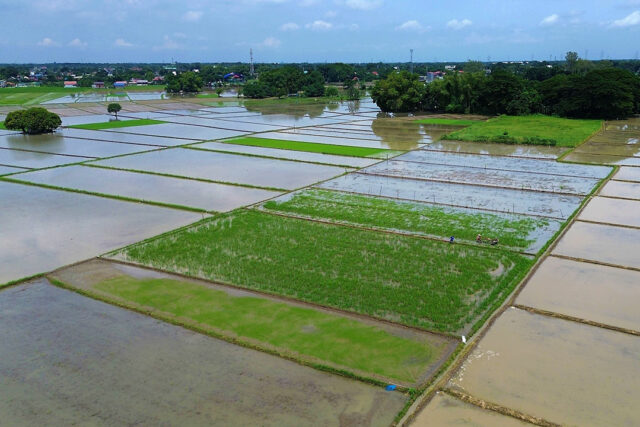
BANGUED, Abra — The government must prioritize agriculture now to prevent a looming food crisis driven by volatile oil prices, Abra Rep. Joseph B. Bernos said.
Mr. Bernos warned that rising fuel costs — flagged by Energy Secretary Sharon S. Garin as likely to stay elevated due to Middle East disruptions — are driving farm inputs and squeezing margins.
Without sustained support, he said, farmers and fisherfolk may abandon production altogether. “The entire country will suffer if farmers and fisherfolk turn their backs to their livelihoods,” he said in Filipino.
He cautioned that prolonged high oil prices could be the “final nail in the coffin” for small producers already struggling with thin returns, with reports of crops left unsold to avoid losses.
To stabilize food supply, Mr. Bernos urged immediate steps to cut production costs, through the procurement of cheaper fertilizer and seeds, wider access to mechanization, and stronger post-harvest systems, alongside scaling up local biofertilizer production to reduce reliance on imports and cushion the sector from global price instability. — Artemio A. Dumlao