Marcos says Philippine oil supply secure beyond 45 days
By Erika Mae P. Sinaking, Reporter
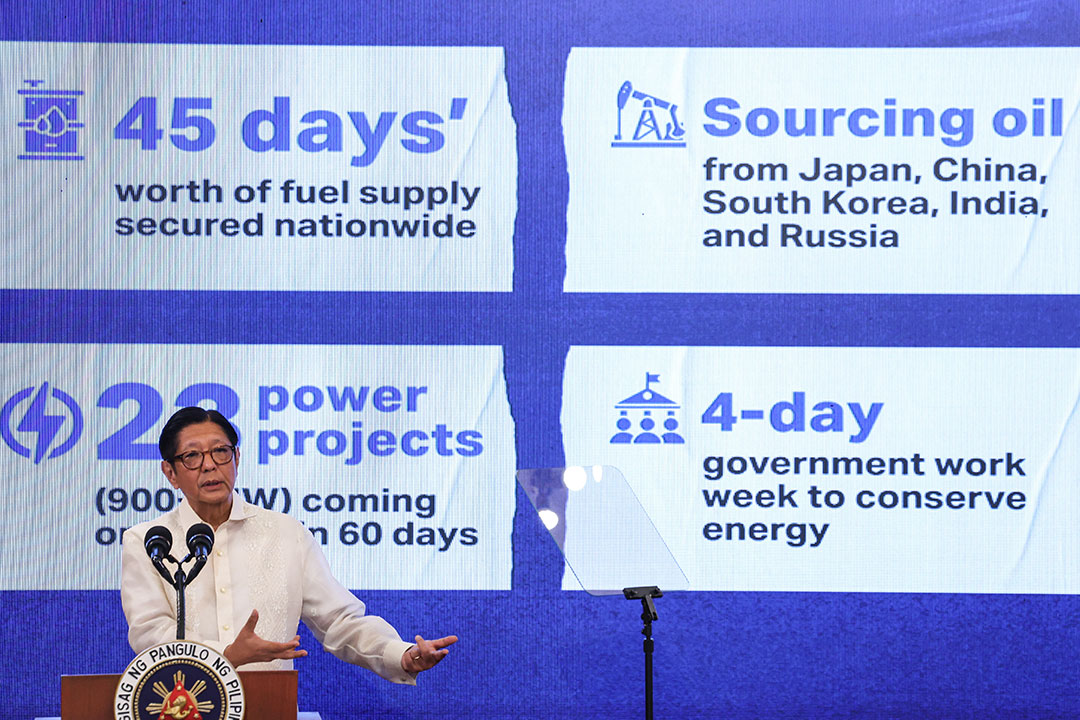
PRESIDENT Ferdinand R. Marcos, Jr. said the Philippines has secured enough fuel supply to last beyond 45 days despite disruptions caused by war in the Middle East, as the government scrambles to line up alternative sources and ensure existing contracts are fulfilled.
Speaking on Wednesday, Mr. Marcos said authorities moved quickly to make sure deliveries under previously signed contracts continued to reach the country, even as uncertainty initially froze communications with oil suppliers.
“In the beginning, our suppliers could not even tell us what was happening, and they couldn’t give us prices,” he told a livestreamed briefing in Filipino from the presidential palace. “But through constant engagement and by putting new systems in place, supply has continued to come in.”
Global oil markets have been jolted by escalating tensions in the Middle East, a key supply region, raising concerns over shortages and higher prices for fuel-importing countries such as the Philippines. The country relies almost entirely on imported petroleum products.
Mr. Marcos said the government is not relying solely on traditional suppliers in the region. Officials have been reaching out to alternative sources unaffected by the conflict, though he cautioned that it is still too early to say whether new contracts have been finalized.
“It would be premature to say that everything has been perfected. But things are beginning to open up,” he said. “I’m very confident in saying that we have sufficient supply.”
The Department of Energy (DoE) on Tuesday said the Philippines has an average fuel inventory equivalent to about 45 days of supply, though levels vary by product.
Mr. Marcos expressed confidence that additional shipments would arrive before stocks run low, ensuring a steady flow rather than isolated deliveries.
“We can be fairly confident that after the 45 days, we will already have oil arriving here in the Philippines,” he said. “Not just one delivery, not just two deliveries, but a flow of petroleum and petroleum-related products.”
Mr. Marcos credited the country’s diplomatic ties for helping secure continued access to fuel, noting that good relations with partner countries have played a key role in keeping supply lines open.
Authorities, he said, would continue to explore new sourcing arrangements while monitoring global developments, as energy prices remain vulnerable to further geopolitical shocks.
He and Energy Secretary Sharon S. Garin earlier said the country is talking to China, Russia, the US, South American countries, Brunei, South Korea, Japan and India, among others, for oil supply, noting the discussions yield positive results.
As a net oil importer, the Philippines is particularly vulnerable to disruptions in global oil supply and volatility in prices. It imports nearly all of its crude oil from the Middle East, with Saudi Arabia as its top supplier.
At the same time, the Department of Budget and Management (DBM) has approved the release of P20 billion to the DoE to secure fuel supply for the country.
The funds were released on March 24 through a Special Allotment Release Order (SARO) and Notice of Cash Allocation (NCA), which was sourced from the Malampaya Gas Fund under the Special Account in the General Fund (SAGF), the DBM said in a statement.
The P20 billion will fund the “strategic procurement of fuel products — including diesel, gasoline, and liquefied petroleum gas (LPG) — to boost national fuel inventory, stabilize pump prices, and ensure uninterrupted operations across transport, logistics, agriculture, emergency response, and other critical sectors.”
It will be implemented by the Philippine National Oil Company-Exploration Corporation, which has already started procurement.
‘DO NOT PANIC’
On Tuesday evening, Mr. Marcos placed the country under a national state of energy emergency under Executive Order (EO) No. 110, noting the ongoing war’s imminent threat to the country’s energy supply. The order will be in effect for a year.
The President on Wednesday clarified that the declaration was only a “precautionary tool” and that only the energy sector was covered by the state of emergency.
“I want to assure everyone that this does not mean that we should panic. It means that we are doing everything that we can to assess and to alleviate the situation,” Mr. Marcos said.
Under the EO, the President created the Unified Package for Livelihoods, Industry, Food, and Transport (UPLIFT) committee for a coordinated response in stabilizing fuel supply, sustaining economic activity and protecting sectors most exposed to rising energy costs.
The EO also allows authorities to focus interventions on ensuring adequate energy supply and mitigating price spikes while mobilizing government resources more efficiently.
“The source of the problem is the supply and the price of energy, and that is what we need to address directly… The reason that I declared an energy emergency is to provide government with more options should the need arise,” Mr. Marcos said.
Transport workers are planning a two-day strike starting Thursday to protest surging oil prices and demand a fare hike, a move Mr. Marcos rejected last week.
They also want him to cut or halt excise taxes on petroleum products to lessen oil prices.
Mr. Marcos on Wednesday signed into law Republic Act No. 12316, a measure granting him the power to temporarily suspend or reduce excise taxes on petroleum products to mitigate the impact of rising global oil prices.
Asked if the government will take control of the oil industry, the President said he hopes the situation won’t call for the move.
“We don’t want to get into that discussion,” Mr. Marcos told reporters and refused to take follow-up questions.
Jay M. Layug, a former energy undersecretary and executive board member of the Philippine Energy Research and Policy Institute, echoed the President’s remarks.
“No need to take control of oil companies,” he said in a Viber message.
“What government needs to do is implement multiple measures to manage demand for petroleum and conserve energy use. Example, coding system expansion, carpooling, expanded WFH (work-from-home) program, expanded EV (electric vehicle) program, etc.”
The government had already mandated a four-day workweek for government offices to lessen energy use.
Fuel prices climbed again this week, extending one of the longest runs of increases in recent years.
Noel M. Baga, co-convenor of the Center for Energy Research and Policy think tank, said the declaration is overdue, noting that the legal tools were already in place and that recent price hikes and suspended public utility operations highlighted the urgency of stronger action.
“Every power generation project in the pipeline must be fast-tracked,” Mr. Baga said. “The emergency declaration signals that the government is finally treating this as the crisis it is. The next measure of seriousness is whether price ceilings follow.”
INFRA SPENDING
Meanwhile, the DBM said it has also released P16.5 billion to the Department of Public Works and Highways (DPWH) in a bid to accelerate infrastructure spending and support economic growth.
The funds will be released via the issuance of an NCA to the DPWH Central Office and will be used to cover the settlement of the department’s due and demandable accounts payable.
“Upon the order of the President, we are accelerating infrastructure spending to keep projects moving and the economy growing. This P16.5 billion release ensures that obligations are paid on time,” Budget Secretary Rolando U. Toledo said in a statement.