Government allots P20B to buy 2M barrels of diesel
By Sheldeen Joy Talavera, Reporter
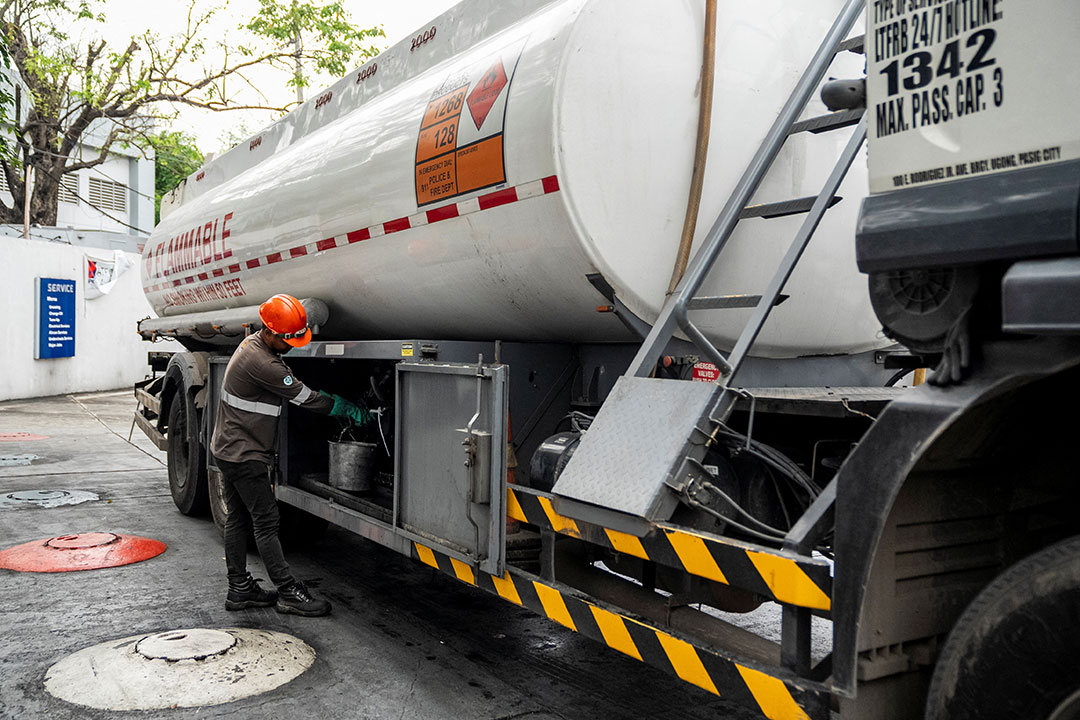
THE PHILIPPINE government has allocated around P20 billion to purchase two million barrels of diesel to boost the country’s stockpile, which is currently equivalent to 45 days of supply.
“We are reserving about P20 billion. It’s very expensive. But what eventually will happen is we sell also the buffer (to fuel retailers) so we can use the money to buy more,” Energy Secretary Sharon S. Garin said in a virtual press briefing on Tuesday.
The planned buffer stock is enough to cover 10 days’ worth of consumption.
Earlier, the Department of Energy (DoE) has tasked the oil and gas exploration arm of state-run Philippine National Oil Co. to procure around two million barrels of fuel to boost the country’s inventory.
So far, the government already secured about 400,000 barrels of oil from Southeast Asian countries and is now negotiating for additional 600,000 barrels outside to ensure arrival this week.
“It’s not that big, but we need to build it up just in case so that we have reserves. It’s better to have little than nothing at all,” Ms. Garin said in a mix of Filipino and English.
The Energy chief said that the country’s existing suppliers of imported supply have assured it will deliver orders even as the Middle East conflict has also affected them.
Currently, the Philippines has 45 days’ worth of fuel supply, Ms. Garin said.
“So far, our supply is still manageable,” she said.
As of March 20, the country’s inventory of gasoline could last 53.14 days, diesel for 45.82 days, and kerosene for 97.93 days.
However, the country’s jet fuel inventory is only 38.62 days, while liquefied petroleum gas or LPG is 23.51 days.
Since the Philippines has very limited domestic oil production to cover its demand, local oil firms mostly rely from imports coming from the Middle East, the world’s biggest oil-producing region that is currently disrupted by the Iran war.
The majority of the finished petroleum products come from Asian countries such as Japan, Korea, and China, but they also source crude oil from the Middle East.
PUMP PRICES SURGE
Meanwhile, pump prices continue to soar this week as the Iran war is about to enter its fourth week.
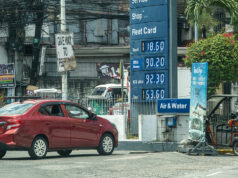
Starting Tuesday, gasoline prices in Metro Manila rose by P8 to P12 per liter, diesel by P15 to P18 per liter, and kerosene by P12 to P22 per liter.
The latest price adjustments have pushed diesel and gasoline prices to as high as P144.20 and P102.50 per liter, respectively. Kerosene prices could have reached as much as P165.79 per liter.
“Even though it is smaller than last week, this is still a significant jump considering that it will still affect our transportation industry, as well as all industries, as well as the buying power of our households,” Ms. Garin said.
So far, Chevron Philippines, Inc. (Caltex) and TOTAL Philippines Corp. have informed the DoE that they are set to stagger the implementation of their respective price adjustments in two to five tranches.
Ms. Garin said fewer companies are staggering price hikes because of the increasing financial burden.
Aside from local pump prices, the ongoing volatility in the global market is also threatening to push electricity rates upward by 16%, according to the simulation conducted by the DoE.
To temper the expected increase in power rates, the government is looking to increase the use of coal in power generation and calling for advanced completion of renewable energy projects.
Ms. Garin said this move could help reduce the expected spike in power rates by P2.
The Philippines is also a major importer of coal, which is mostly used for power generation. The country relies heavily on Indonesia for its coal supply, sourcing approximately 98% of imported coal.
Ms. Garin said the Indonesian government assured the Philippines of “steady supply of coal.”
“We have assurance from them and we’re good partners with Indonesia. We have a long-standing trade relationship with Indonesia,” she said.
Ms. Garin said the government is also in talks with power generators to assess how much domestic coal they can maximize in their operations.