Frontloaded issuance pushes PHL debt to P18.13 trillion

By Justine Irish D. Tabile, Senior Reporter
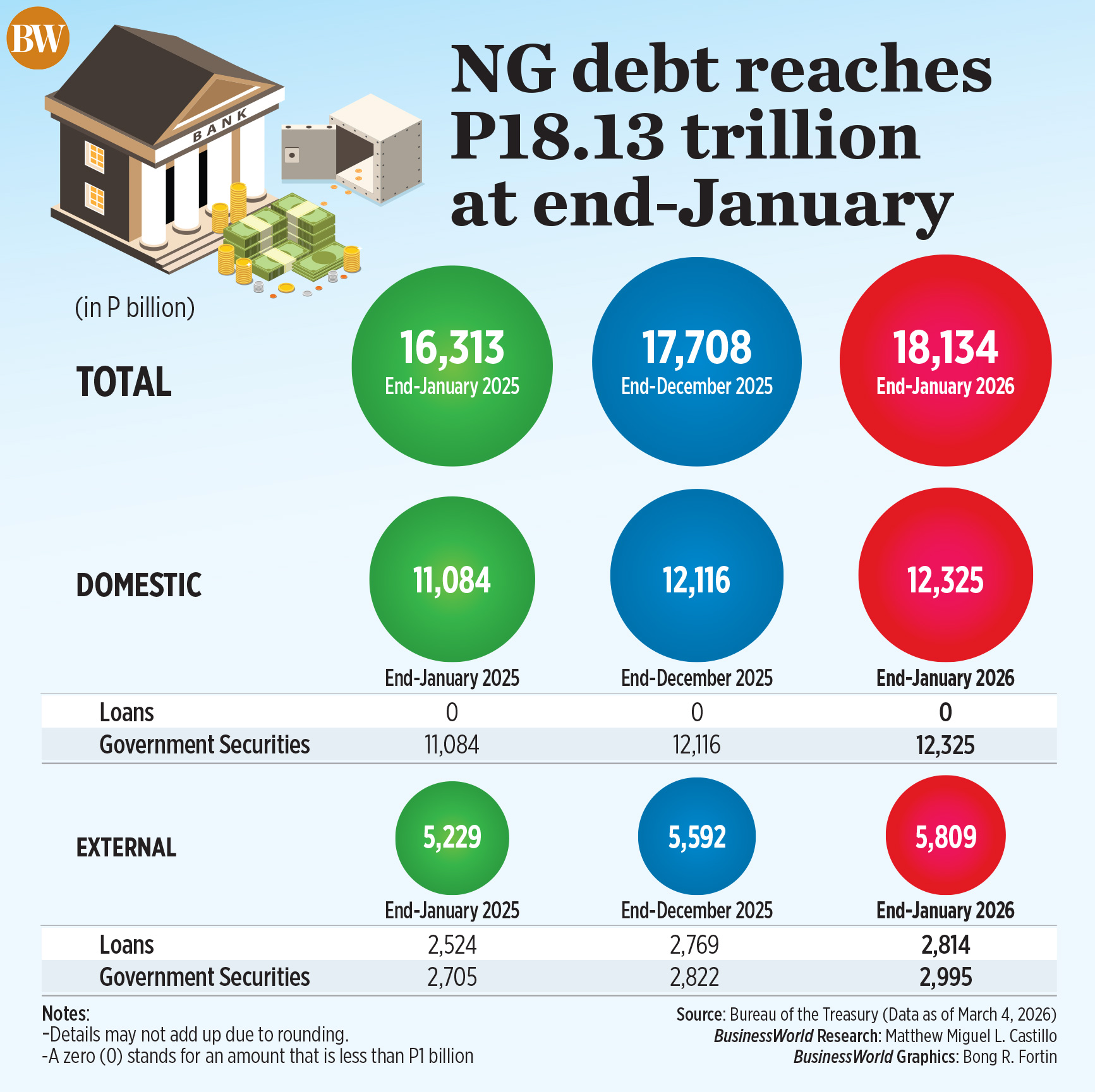
THE PHILIPPINES’ outstanding National Government (NG) debt rose to P18.13 trillion at the end of January, as the state accelerated borrowing at the start of the year to lock in funding ahead of global market volatility.
The debt stock increased by 2.41% or P426.15 billion from P17.71 trillion at end-December, according to data released by the Bureau of the Treasury (BTr) on Wednesday. Year on year, obligations jumped 11.16%.
Despite the surge, the Treasury said the country’s debt portfolio remains stable and within the Marcos administration’s P19.06-trillion projection for the year.
“This level remains sustainable amid pressing challenges in the domestic and global landscape,” the BTr said in a statement.
The month-on-month increase reflected the government’s strategy of frontloading domestic and external debt to secure concessional financing terms before global uncertainties potentially drive up interest costs. The approach gives the government flexibility in managing borrowing requirements for the rest of the year.
National Government debt refers to obligations owed to creditors, including international financial institutions, development partners, banks and global bondholders.
Domestic borrowings continued to account for the bulk of the debt stock. At end-January, 68% of the total outstanding debt was obtained locally, underscoring the government’s preference for peso-denominated funding to limit foreign-exchange risks.
Domestic debt rose 1.72% to P12.32 trillion from a month earlier. Compared with January last year, domestic obligations increased 11.19%. The Treasury attributed the monthly rise to the net issuance of government securities worth P208.05 billion.
“The net incurrence of government securities… reflects the NG’s commitment to prioritize domestic sources of funding,” the BTr said, noting that this strategy provides stable investment instruments for local investors while reducing exposure to exchange rate swings. Domestic debt remains within the P13.28-trillion full-year projection.
External debt climbed 3.89% to P5.81 trillion from December, slightly exceeding the P5.78-trillion program. Year on year, foreign obligations rose 11.1%.
The Treasury said P191.02 billion of the P217.63-billion monthly increase came from the issuance of global bonds and net availments of official development assistance from multilateral and bilateral partners.
The peso’s depreciation against major currencies added P26.61 billion through upward revaluation of foreign currency-denominated debt.
Foreign obligations consist mainly of P3 trillion in global bonds and P2.81 trillion in loans. External debt securities include dollar, euro, Islamic, yen and peso-denominated global bonds.
The Treasury said earlier global bond issuances highlighted sustained investor confidence in the country’s credit standing and long-term growth prospects.
Meanwhile, National Government-guaranteed obligations inched up 0.15% or P510 million to P345.08 billion at end-January, largely due to currency valuation adjustments on foreign currency guarantees. On an annual basis, guaranteed debt declined 0.34%.
Michael L. Ricafort, chief economist at Rizal Commercial Banking Corp., said the debt stock would have been higher if not for slower disbursements, particularly for infrastructure projects since late 2025. He added that lower interest rates could help temper debt service costs, though foreign exchange movements remain a key risk as these can inflate the peso value of external liabilities.
Reyes Tacandong & Co. Senior Adviser Jonathan L. Ravelas said the P18-trillion level might sound alarming, but the more significant risks stem from weaker economic growth or higher borrowing costs.
“For now, Philippine debt remains manageable because growth is holding up and debt servicing is still affordable,” he said in a Viber message.
He added that debt is likely to continue rising in the coming months due to infrastructure spending and refinancing needs, but fiscal discipline would be crucial.
The government should “borrow wisely, spend on growth and strengthen revenues” to keep debt sustainable, Mr. Ravelas said.