A shift to caution among consumers
The world has long been described as a “global village,” but that village has been feeling less like a community and more like a high-tension wire.
When a spark struck in the oil-rich corridors of the Middle East, specifically the intensifying conflict surrounding the Strait of Hormuz, the heat is felt almost instantly in the Philippines.
The Philippines, structurally dependent on imported energy where nearly 95% of oil is imported, finds itself particularly exposed: what begins as a geopolitical rupture transforms into a domestic economic condition, altering not just prices but patterns of living, consumption, and even social perception.
For a Filipino consumer, the geopolitical tremor manifests as a fuel shock. As of this April, crude has surged at almost $100 per barrel, with analysts from International Energy Agency (IEA) warning of a climb toward $150. This translates almost mechanically into higher fuel costs, a widening import bill, and immediate inflationary pressures.
The transmission mechanism from oil shock to consumer experience is neither linear nor purely economic. It unfolds in layers.
For instance, when the Land Transportation Franchising and Regulatory Board (LTFRB) adjusted minimum fares to P14 and P17 to modern units this year, it did more than increase a commute’s cost — it altered the urban ritual.
A certain precarity rises: for the worker, the extra few pesos per ride represents a slow erosion of the social buffer — the small margin of income that allows for a life beyond survival.
When movement becomes expensive, the city itself begins to shrink. People stay closer to home, social circles tighten, and the activities that fuel culture (e.g., dining out, family visits, or exploring new spaces) are the first to be sacrificed.
The consumer market, once animated by upward mobility, shifts toward caution and preservation. This uncertainty is amplified by the structural vulnerabilities of the national economy. In worst-case scenarios, where oil prices surge dramatically and remain elevated, inflation could spike to levels that significantly erode purchasing power and destabilize growth projections.
Already, institutions have begun revisiting outlooks downward, noting that energy shocks could weaken both consumption and investment.
The metro, once a sprawling map of opportunity, becomes a series of high-cost hurdles.
From the Pump to the Plate
In March 2026, Philippine inflation breached the target of the Bangko Sentral ng Pilipinas (BSP), hitting 4.1%. at the same time, the Department of Trade and Industry (DTI) has attempted to freeze prices for basic commodities until mid-May, making the underlying pressure undeniable.
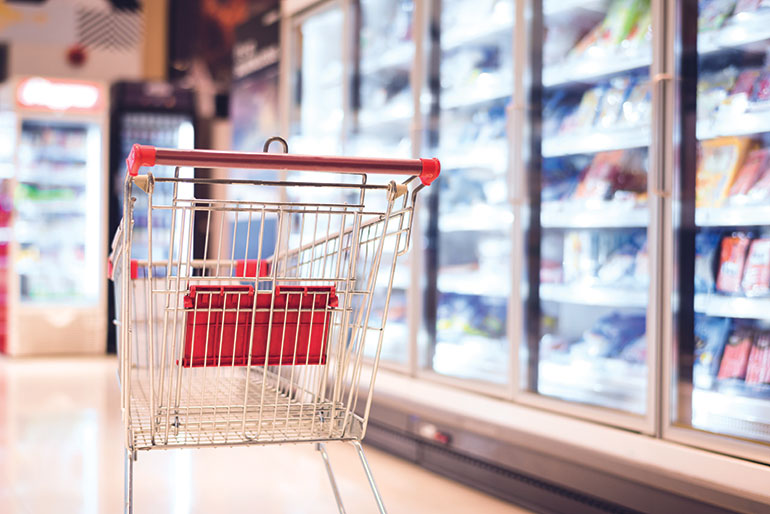
When the price of rice or vegetables climbs because the trucks carrying them are burning expensive diesel, the burden falls on the bottom 30% income households, the lowest earning families. This cascading effect — what economists often describe as “second-round inflation” — begins to shape the broader consumer price environment.
For these families, inflation is not a mere percentage, but a choice between nutrition and education, or between health and debt.
This reflects a certain shift in consumption: instead of buying for the future, households are forced into a hyper-present state, where every peso is scrutinized for its immediate utility. This survival mindset, while necessary, prevents long-term social mobility. It traps the consumer in a cycle of reacting to global shocks rather than planning for local growth.
The ‘Alternative’ Problem
Interestingly, the crisis also exposes the limits of substitution. While there is increasing discourse around renewable energy and alternatives, these remain structurally insufficient in the short term. Petroleum still dominates the Philippines’ energy mix and alternatives account only for a fraction of total consumption.
This dependency constrains policy options and ensures that global oil dynamics continue to exert a strong influence on domestic markets.
Government responses, such as subsidies, tax adjustments, or monetary policy interventions, can mitigate some of the immediate pain. However, they often function as buffers needing further action.
In the end, the impact of the Middle East conflict on Philippine consumer markets is not just about higher prices. It is about the reconfiguration of everyday life under conditions of external uncertainty. — Krystal Anjela H. Gamboa