Pushing global investments to boost competitiveness
The Philippine Economic Zone Authority (PEZA) ended 2025 with approved investments reaching P260.89 billion, exceeding its target and posting a 21.91% increase from the previous year. The figure ranks among the highest in the agency’s 30-year history and represents the strongest growth since 2016. On top of these, PEZA has marked gains in foreign investments, with Japan remaining as the top investor with P32.6 billion, followed by Cayman Islands with P16.7 billion, South Korea with P11.46 billion, Singapore with P11.19 billion, and China with P6.87 billion.
PEZA Director-General Tereso O. Panga said the agency will build on this momentum as it targets P300 billion in investments this year.
“We remain focused on strengthening our ecozone ecosystem, expanding high-quality investments, and creating more jobs for Filipinos, as we position PEZA for sustained growth and greater opportunities in the years ahead,” he said in a statement.
As the Philippines assumes the 2026 chairmanship of the ASEAN Business Advisory Council, the country pushes for advanced regional trade and investment, prioritizing economic corridors and business partnerships across the region.
Meanwhile, PEZA, working with the Department of Trade and Industry (DTI) and overseas trade offices, has launched a coordinated campaign to attract manufacturers, technology firms, and logistics providers to its network of economic zones.
For instance, the government is leveraging the “China+1+1” strategy, where firms diversify operations beyond China to manage risks linked to tariffs and geopolitical pressures. Now, PEZA is receiving inquiries from companies in robotics, electronics, automotive, medical devices and e-commerce.
At the same time, China remains one of the country’s top investment partners, accounting for 22% of total foreign investments. Within PEZA zones, 118 Chinese firms have generated more than $406 million in exports and created over 16,000 jobs.
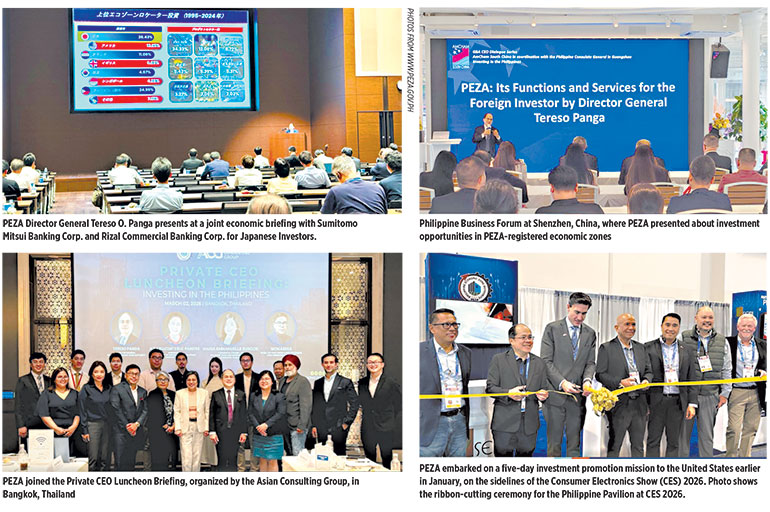
A recent investment mission to Shenzhen brought together Philippine officials and Chinese firms exploring expansion in Southeast Asia. Ten companies joined the Philippine Business Forum, including global motorcycle brand Piaggio, while several firms entered exploratory talks for possible relocation.
PEZA also reported that Shenzhen-based Grandsun plans to expand its Philippine operations and bring more of its supply chain into the country.
Several companies cited proximity to China and uncertainty over US tariffs as key factors in evaluating the Philippines as a production base.
Similar efforts in Taiwan have produced concrete investment commitments and expansion plans in high-value sectors such as electronics and communications.
Aromate Industries signed a $4.3 million agreement to build a new facility in Batangas, while another Taiwanese electronics manufacturer is preparing a $5 million to $6 million project expected to create about 300 jobs by late 2025.
Other firms confirmed plans to establish production facilities, including a video products manufacturer projecting up to $90 million in sales within three years and a broadband equipment supplier set to expand operations in Laguna by 2026.
PEZA said 78 Taiwanese firms already operate in its zones, with investments exceeding P17 billion, exports of $485 million, and more than 26,000 jobs generated.
Still, Japan continues to lead foreign direct investment in Philippine economic zones, with about 800 Japanese firms generating more than P500 billion in investments and employing over 343,000 workers.
Japanese firms, including Sumitomo Wiring Systems, MinebeaMitsumi, and Kaga Electronics, expressed plans to expand operations, while other companies are studying new manufacturing projects.
Discussions with business groups such as Keidanren and Keizai Doyukai also covered labor mobility, skills matching, and supply chain integration, with both parties identifying agriculture, healthcare, and manufacturing engineering as priority sectors.
Within ASEAN, the Philippines engaged business leaders across manufacturing, renewable energy, agro-processing, and IT services, promoting the Philippines as a base for regional expansion.
A Thai food processing firm has established a 5.5-hectare facility in Misamis Oriental, expected to generate up to 2,500 jobs, while other companies are exploring projects in agriculture and industrial production.
DTI and PEZA officials also discussed partnerships with Thailand-based firms for digital infrastructure, including FiberHome, to develop smart industrial communities in economic zones.
Beyond Asia, PEZA led a five-day investment mission to the United States, held alongside the Consumer Electronics Show 2026 in Las Vegas.
The mission secured investment leads across several sectors, including a planned nitrile glove manufacturing project expected to bring about $200 million in capital and more than 2,000 jobs across South Luzon and Cebu.
PEZA also linked with a prospective investor in portable brain imaging systems, a segment within the medical device sector that officials identified as a new source of foreign direct investment following the launch of the country’s first pharmaceutical park.
In New York, the delegation met a global aerospace firm planning to expand its Philippine operations. The company, which has operated in Baguio City since 1984, is considering New Clark City for its next phase. The expansion could bring in more than $15 million in new investments and add 1,000 jobs to its existing workforce of over 2,000 employees.
Beyond manufacturing, the Philippines also engaged a U.S.-based mental health services provider exploring the establishment of a global center of excellence in the country. The proposed IT and business process management (IT-BPM) operation could employ more than 1,500 Filipinos within its first year.
PEZA also held discussions with investors in renewable energy, liquefied natural gas, and housing, reflecting broader interest in infrastructure and energy-related projects.
More than 250 companies with American equity are currently registered in its zones, accounting for over P410 billion in cumulative investments and employing more than 380,000 Filipinos as of November 2025.
In Europe, ongoing negotiations for a Philippines-European Union free trade agreement are boosting investment prospects. PEZA said more than 190 companies with European equity already operate in its zones, contributing over P400 billion in investments and supporting more than 430,000 jobs.
The Philippines’ trade relationship with the European Union currently operates under the Generalised Scheme of Preferences Plus (GSP+), which allows duty-free access for more than 6,000 products. The arrangement supported €2.2 billion in Philippine exports in 2024, while total bilateral trade reached €16.8 billion.
With GSP+ set to expire in 2027, officials from both parties said they are working to complete the free trade agreement to maintain market access and avoid disruptions.
PEZA believes that foreign investors are confident with the country’s economic performance and its economic zones.
“[W]e are confident that the influx of investments and expansion of projects at PEZA will continue,” Mr. Panga explained. “Locators are seeing the value of expanding and consolidating their supply chains in the Philippines.”
Consequently, the agency cited the Corporate Recovery and Tax Incentives for Enterprises to Maximize Opportunities for Reinvigorating the Economy (CREATE MORE) law, green lanes for strategic investments, and ongoing reforms in public-private partnerships (PPP) as key initiatives to attract foreign firms. Such measures complement PEZA’s “one-stop shop” system, which handles investor registration and compliance processes.
While these reforms target national competitiveness, the World Bank noted that sustaining growth depends on how well the government executes its investment plans. Stronger public investment execution and fiscal consolidation remain priorities, particularly in infrastructure and essential services that support business operations. — Mhicole A. Moral