Home Blog Page 9970

Muller, JYH hope Ceres sustains form at AFC CL

By Michael Angelo S. Murillo
Senior Reporter

FACING what arguably its biggest test to date in football club competition, Ceres-Negros FC veterans Roland Muller and James Younghusband hope their team gets to sustain their competitive form in the AFC Champions League 2020 preliminary stages to achieve what no other Philippine club has done before — advance to the main draw of the prestigious Asian tournament.

The “Busmen” are set to face Japanese team FC Tokyo in an away AFC Champions League Qualification Playoffs match on Jan. 28, where a victory pushes them to the group stage of the tournament for the first time.

It is an opportunity whose significance is not lost to the Bacolod-based club, especially being in the same situation back in 2018.

While they have been showing some lapses here in there in two earlier matches in the preliminary stage, both Messrs. Muller and Younghusband said they like what they are seeing, by and large, and are hoping they get to sustain, if not build on, their performance as a team as they collide with FC Tokyo.

“We have had two different teams [to date]. The first game we dominated, especially in the first half but the second half it was made difficult for us but we showed the will to win. In the second game, we knew Port was a tough team and we respect them but we saw our chances and went for them. In general it was a big team performance for us,” said veteran goalkeeper Muller, who has been instrumental in their 3-2 and 1-2 victories over Shan United of Myanmar and Port FC of Thailand in the first and second round, respectively.

He is seconded by Mr. Younghusband, who underscored how the team has be united throughout the process and working hard in training and in the games themselves, finding ways to win.

“… The great thing about this club is that it is united, everyone is supporting one another on and off the field and is excited to make history. Everyone has been fantastic, working their socks off to achieve success,” said Mr. Younghusband, who is playing in his first AFC Champions League tournament.

Both players said they are looking forward to playing Tokyo FC tomorrow albeit recognize that they will have their hands full.

“We’re happy to go through the first two games. The third round is going to be difficult. Tokyo is an organized team. Tactically they are a good team and I’m looking forward to playing this game and expect a big game against a big opponent,” said the Ceres keeper.

“To play Tokyo is an honor. They have competing at a high level against tough competition and these are the teams you want to compete against to see where you are,” Mr. Younghusband, for his part, said.

The Ceres-FC Tokyo match is set for 6 p.m. (Manila time) at the Tokyo Stadium.

Kvitova beats Sakkari, makes it to quarterfinals

MELBOURNE — Petra Kvitova came from a set down and took full advantage as her Greek opponent Maria Sakkari’s self-belief drained away to advance to the Australian Open quarterfinals with a 6-7(4) 6-3 6-2 victory on Rod Laver Arena on Sunday.

Seventh seed Kvitova looked second best early on against Sakkari, who was backed by loud support from local Greek fans, but seized the advantage in a second set where both players struggled to hold serve.

The two-times Wimbledon champion broke Sakkari four times in the second set and then took a 3-0 lead in the decider to give her the advantage she needed to put away the stubborn 22nd-seed in two hours, 12 minutes.

“It’s pretty tough to play Maria. I lost the last time I played her so I knew it would be difficult,” Kvitova said.

“I had to fight pretty hard … but suddenly I got used to her game and was playing more rallies and starting to play my own game.”

Sakkari, 24, had never been in the fourth round of a Grand Slam before but had won the last two of her three previous matches against Kvitova, all of which were played last year.

Sakkari broke early but blew her first chance to seal the opening set when she lost serve leading 5-4. She broke again in the next game to give herself another opportunity at 6-5 but let that slip away too as Kvitova broke back to set up a tiebreak.

The Czech wasted an opportunity to go 3-0 up when her forehand return to a second serve flew long and Sakkari snatched the momentum back, going on to seal the tiebreak to win the set in 52 minutes.

Both players lost their serving rhythm in the second set with Kvitova dropping serve twice but also breaking Sakkari on four occasions, the last of which when the Greek double-faulted on set point.

Sakkari’s shoulders appeared to drop during the set and she frequently argued with her support team sitting courtside.

Kvitova jumped out to a 3-0 advantage in the decider then let her emotions show for the first time in the fifth game, a bellow of celebration coming after a forehand winner put her 4-1 ahead.

The Czech completed the win when a Sakkari return smacked into the net, setting up a meeting with either top seed Ash Barty or Alison Riske, who play later on Sunday, in the last eight. — Reuters

Mobile Legends: Bang Bang offers new arcade mode Magic Chess

A THRILLING, real-time auto-chess strategy game, with a magical twist, Magic Chess: Bang Bang, has finally arrived in the Philippines.

It opens a new world for players of the already-successful Mobile Legends: Bang Bang game and fans of auto-chess games.

Magic Chess is more casual and relaxed compared to the high-intensity of ranked games but despite the more leisurely play style, players need to be sharp and use their wits in order to win.

Beloved heroes from MLBB are transformed into chess pieces and placed on a battlefield where they are matched up against the chosen heroes of another player. Eight players in the match purchase heroes from a random hero pool for each round and form a unique lineup of heroes.

Players can combine those heroes to make stronger versions of the same units. Certain types of units get synergy bonuses for being on the field at the same time. Gamers deploy these units, and they fight each other automatically, with no player input involved whatsoever. Units’ stats and special abilities and the way those abilities counter opponents’ units determine who wins and who loses with the winning army dealing damage to the loser’s central health pool. If a player loses all their health, they’re out.

Mobile Legends: Bang Bang continues to reign supreme when it comes to offering new and exciting game modes that keep fans coming back for more.

With Magic Chess, players don’t need to go through stressful ranked games, tedious hero training or paying for stats to win; all they need is a good strategy and a little bit of luck to claim final victory and rise in the ranks.

The game has proven to already be popular during its early release with top local streamers. With this, Moonton, the game’s developer, has prepared a special ISR event for Chess TD where fans and viewers alike can get in-game rewards by just tuning into their stream.

For more info on the Mobile Legend: Bang Bang’s Magic Chess, follow its official Facebook page https://www.facebook.com/MobileLegendsOnlinePH/ and keep up with the most anticipated arcade game within MLBB.

Rahm leads after 54 holes at Torrey Pines; Woods five back

SAN DIEGO — World number three Jon Rahm made an eagle from 110 yards en route to the third-round lead at the Farmers Insurance Open in San Diego on Saturday as Tiger Woods faded after a strong start.

Rahm shot the day’s best score, a seven-under-par 65, to surge to a one-shot advantage over American halfway leader Ryan Palmer (71) at Torrey Pines, where morning fog delayed the start of play by two hours.

Rory McIlroy, who with a win on Sunday would supplant Brooks Koepka as world number one, boosted his chances with a 67 that left him among a group equal third, three behind.

Woods, seeking a record 83rd PGA Tour victory, sent a proverbial bolt of electricity through the large gallery as he charged within striking distance of the lead with four front nine birdies.

But he struggled on the more difficult inward half and carded three-under-par 69 to end the day equal 14th, five strokes behind Rahm.

“Three-putted (hole) 11 and just never really got anything going coming home,” said Woods, who had to grind to avoid dropping a shot at the par-five 18th, where he sank a 15-foot putt to salvage par.

Woods has won eight times at Torrey Pines and acknowledged he would need a special Sunday to make it number nine.

“Got to go out there and post a low one tomorrow, still got to make a bunch of birdies,” he said.

Leader Rahm, feeling good vibes on the course where he posted his first PGA Tour win three years ago, used his unique, powerful swing to run up five birdies and post a 12-under 204 total.

But it was the eagle at the par-four second that had the gallery most buzzing.

“Landed about four feet short, skipped up and landed in the hole,” said the Spaniard, who had chipped in for birdie at the first.

“Three-under through two holes, no putts, yeah, a pretty good start,” said Rahm.

“The MVP (most valuable player) of today would be my lob wedge. Especially those bunker shots, they weren’t easy and I made it look pretty easy.”

Second-placed Palmer partnered Rahm to win the New Orleans Classic team event last year, but on Sunday they will temporarily put their friendship aside.

“It’s going to be a lot of fun,” Palmer said.

“Of course you’re rooting for him (in New Orleans) and trying to say, ‘hit it here’ and ‘hit it there’, so maybe tomorrow I’ll say, ‘hit over there’ instead.” — Reuters

Undefeated Mighty Sports seeks to continue rolling versus Es Rades of Tunisia

MIGHTY Sports Philippines is off to a good start in the 31st Dubai International Basketball Tournament, winning its first two assignments in Group B to stay undefeated.

It is something it hopes to continue when it returns to action on Jan. 28 versus Es Rades of Tunisia in a match set at the Shabab al Ahli Sports Club.

Mighty Sports, composed of a solid mix of imports, veterans, collegiate and up-and-coming players, downed the United Arab Emirates national team, 88-82, in its opener on Jan. 23 before defeating Al Ittihad of Syria, 77-72, on Jan. 24.

Against Al Ittihad, Gilas Pilipinas naturalized player Andray Blatche led the way, finishing with 28 points, 11 rebounds, two steals and a block.

Renaldo Balkman churned in 15 points, 10 rebounds and four assists in the Mighty Sports win, with McKenzie Moore adding nine points.

Mighty Sports is hoping to finally notch a championship breakthrough since first joining the tournament in 2017.

Last year, it finished at third place, defeating Homentmen of Lebanon in the bronze medal game.

Other members of this year’s team are Jelan Kendrick, Jamie Malonzo, Thirdy Ravena, Beau Belga, Joseph Yeo, Juan and Javi Gomez De Liano, Dave Ildefonso, Isaac Go, Gab Banal, Joaqui Manuel and Jarrell Lim.

The Mighty Sports-Es Rades game will broadcast over One Sports on Cignal TV at 1 a.m.

The 31st Dubai International Basketball Tournament happens until Feb. 1. — Michael Angelo S. Murillo

Simmons dominates as Philadelphia 76ers top Los Angeles Lakers, 108-91

LOS ANGELES — Ben Simmons had 28 points, 10 rebounds, eight assists and four steals to lift the host Philadelphia 76ers past the Los Angeles Lakers 108-91 on Saturday.

Simmons shot 12 of 15 in a 41-minute performance.

Tobias Harris scored 29 points and Al Horford had 16 for the Sixers, who improved to 21-2 at home. Matisse Thybulle also contributed five steals.

The Sixers played without Joel Embiid (finger) for the 16th time this season and were also missing Josh Richardson with a strained hamstring.

Anthony Davis led the Lakers with 31 points while LeBron James had 29 points, eight assists and seven rebounds. James entered the game with 33,626 points and passed Kobe Bryant for third place on the league’s all-time scoring list.

Alex Caruso had six steals for the Lakers, who lost for just the fifth time on the road this season.

Despite being down two starters, the Sixers jumped out to a 59-50 lead at halftime thanks in large part to Harris’ 16 points. The Sixers shot 51% from the field, going 21 of 41.

Davis (16) and James (14) scored 30 of the Lakers’ 50 points. The Lakers committed 12 first half turnovers, including an uncharacteristic five by James.

Philadelphia extended its lead to 68-52 when Simmons found Harris for a wide-open 3-pointer with 9:32 remaining in the third quarter. The Sixers then scored six more and the lead swelled to 22.

James then drove to the basket and scored with 7:23 left in the third, and in the process passed Bryant.

The Lakers made a late push at the end of the third yet still trailed 85-73.

Shake Milton, who made his first career start, scored in the paint with 9:18 to go, giving the Sixers an 89-75 advantage.

Los Angeles closed within 10, 91-81, when James dribbled in from midcourt and threw down a one-handed dunk with 6:57 remaining.

Kentavious Caldwell-Pope soon hit a trey and a jumper to cap an 11-2 run as the Lakers cut the lead to 93-88.

Horford knocked down a jumper from the wing and followed with a 3-pointer to extend the Sixers’ lead back to 10. — Reuters

Planned Premier Golf League to have 48 players, 18 tournaments

LONDON — The British-based World Golf Group (WGG) has finally publicly unveiled its plan for a new global tour that would comprise 18 yearly tournaments featuring 48 of the game’s top players.

Nearly two years after Reuters first reported the group’s plans, the Premier Golf League (PGL) hopes to launch in January, 2022, it said in a detailed news release on Saturday.

Each tournament would have prize money of $10 million.

Whether the tour is feasible remains to be seen on an already-crowded calendar.

The PGL said it wanted to work with established tours rather than as a breakaway circuit, but the US-based PGA Tour and European Tour have been all but dismissive about the proposed circuit.

“We don’t comment on the business of other tours, real or hypothetical. We’re focused on our business,” the PGA Tour said in a statement to Reuters.

The European Tour has been similarly dismissive.

The PGA Tour has a policy in which players must seek a “release” from the commissioner each time they want to play an event on anything other than their home tour.

This effectively restricts American players to a handful of international appearances a year.

Top players already have at least six must-play events each season — the Masters, PGA Championship, US Open, British Open, Players Championship and either the Ryder or Presidents Cup.

No players have publicly committed to the proposed tour, though Rory McIlroy said on Saturday discussions with players had been going on for years.

“Those guys have been talking to a few of us for six years,” the Northern Irishman told reporters at the Farmers Insurance Open.

“It’s a hard one … but I love the PGA Tour, I love the way golf is set up right now. I certainly wouldn’t want to lose, what’s been built in the last 40 or 50 years, tournaments like this.” — Reuters

Powerlifter Adeline Dumapong-Ancheta bent on turning setback to opportunity

By Michael Angelo S. Murillo
Senior Reporter

ADMITTED to being disappointed at first when news broke out that the 10th ASEAN Para Games set to take place in the country this month was moved to a later date, powerlifter Andeline Dumapong-Ancheta said she has since moved past it, bent on turning the setback to opportunity to do well.

Originally set to happen from Jan. 18 to 25, the ASEAN Para Games 2020 was moved to give organizers time to settle “financial and logistical matters.”

Traditionally comes on the heels of the Southeast Asian Games, which the country hosted in December, the decision to defer was made after the Philippine Sports Commission (PSC), the agency tasked to fund the Para Games, acknowledged that it did not have enough funding left to bankroll a successful staging of the Para Games.

It is hoped that by moving the competition to March, enough funding would be raised to get the Games going as seamlessly as possible.

Like most in the Para Games community, Ms. Dumapong-Ancheta greeted the news with disappointment and lament, especially after putting a lot in training and was excited to compete in front of the hometown fans.

Eventually acceptance came to her that such occurrence was beyond their control, and instead chose to do what she is supposed to do — train for the Games and be ready.

“At first it was really disappointing to hear the news that the Para Games was being moved to a later date. It did not help that some people, especially on social media, were criticizing the move hard, saying that how come there was budget for the SEA Games yet there was none for the Para Games. As an athlete it was tough to hear those things and made you think hard,” said Ms. Dumapong-Ancheta, long the face of the Paralympic movement in the country, in an interview on the sidelines of the launch of The Philippines Yearbook 2020: The 50 Greatest Filipino Athletes, where she is included.

“On the other hand, in a way it is a plus for us because we get to train more. Personally for me it helped because I’m coming from an injury. We were ready to compete if the Games started as scheduled. So we just had to adjust our schedules and improve on our programs. Also, I just hope that the postponement would translate to better results for our team and, of course, the organizers,” she added.

Barged into the national and international sports consciousness after winning a bronze medal at the 2000 Sydney Paralympics, Ms. Dumapong-Ancheta, 46, said the drive to succeed and represent the country is still there 20 years since that breakthrough performance.

She said the same mindset continues for her entering this year’s Para Games.

“You’ll still get the best from me. It’s all or nothing as always. I’m 46 years old and I have already proven myself. I’m pretty consistent in international competitions throughout the years,” Ms. Dumapong-Ancheta said.

She vowed to continue what she is doing as long as her body holds up and she still enjoys competing.

“Not yet sure [if this going to be my last Para Games]. When I was 40, I started feeling some pain in different parts of the body and yet I’m still here. As long as I’m producing results and my body is keeping up, I’ll continue. More than winning, the camaraderie keeps me going. And representing the country is truly an honor,” said Ms. Dumapong-Ancheta.

Tiger motivation

Tiger Woods had exactly the start he wanted to his round yesterday. Tied for 17th halfway through the Farmers Insurance Open, he figured putting up a good round would put those ahead of him on notice, not to mention set him up for a final 18 with a legitimate shot at the hardware. And he did hit the ground running; he carded birdies on the first and third, sank a crucial chip for par on the fourth to keep the momentum going, and then capped his front nine with two more birdies to make the turn at four under on Moving Day. By the time he stood on the 10th tee, he was just two strokes off the lead.

Unfortunately for Woods, the back nine of Torrey Pines South proved to be a damper. His three-putt adventure on the 11th was ominous; he lagged his 55-foot attempt for birdie, and then couldn’t make good on the ensuing six-foot putt. He remained erratic the rest of the way, even needing to can a 15-foot knee knocker for par on the last hole to at least sign for a number in the 60s. “It was important to make that putt,” he noted in retrospect. “It was important to have some positive momentum going into tomorrow.”

To be sure, Woods isn’t likely to claim his ninth victory in the pride of La Jolla, California, and, in the process, break a tie with Sam Snead for the most number of career wins on tour at 82. It isn’t simply that he’s five strokes off the pace set by red-hot John Rahm, or that he has 12 others, including the likes of Rory McIlroy, Tony Finau, and Patrick Reed, ahead of him; it’s that he remains inconsistent at best. He could have had an outstanding start; his 69 was just about the worst he could have put up given the way he struck the ball. He then followed it up with a disappointing 71. And then there was his roller-coaster effort yesterday.

Regardless, Woods is certain to keep grinding today — because it’s the way he is, and because he knows he’s going for more than the title. Also at stake is his standing for a spot in the Olympics; he’s right at the cutoff for Team USA, and he’d like to climb higher on the list. And so his motivation isn’t the question. Rather, it’s if his game will cooperate with him enough for his intentions to produce results.


Anthony L. Cuaycong has been writing Courtside since BusinessWorld introduced a Sports section in 1994. He is a consultant on strategic planning, operations and Human Resources management, corporate communications, and business development.

Why pick on Ayala and Metro Pacific?

In an official statement two weeks ago, the Department of Budget and Management declared that government had enough funds to respond to Taal Volcano’s eruption. Upon further inspection, I found that this is not the case.

See, in the P4.1 trillion national budget, P16 billion was earmarked for calamities under the National Risk Reduction and Management Fund. But out of this amount, P3.5 billion was earmarked for Marawi’s reconstruction and P5 billion was appropriated for repairs following the earthquake that hit Davao last year. In other words, there is only P7.5 billion left in the fund and this must be made to suffice not only for Taal’s relief but also for all other disasters that may befall the country this year.

True enough, government is already running low on resources. While Taal’s evacuees have been provided with basic food and shelter, government is falling short on medicines and medical care, water supply, electric generators, etc. It is not clear how the state will finance the resettlement cost of those displaced, let alone reconstruction of the affected areas.

As always, it is the private sector that is filling the gap. Private companies, large and small, have embarked on their own relief operations in the spirit of bayanihan. Interestingly, the conglomerates owned by the very “oligarchs” under attack by this administration are contributing in the biggest way.

Insiders reveal that the owners of the Ayala and Metro Pacific groups have instructed their respective subsidiaries to go all out to assist government in its relief operations.

Within the Metro Pacific Group, Meralco has provided portable electricity generators for most evacuation centers as well as solar powered charging stations. PLDT and SMART are supporting the volunteers of the Metropolitan Manila Development Authority (MMDA), the Red Cross, and Philippine Institute of Volcanology and Seismology (Phivolcs) with load credits and communications support.

Metro Pacific Tollways Corp. is working alongside the Department of Public Works and Highways (DPWH) to clear roads of ash and debris using its own heavy equipment. For its part, the Makati Medical Center has provided 8,000 face masks and 1,500 first aid and hygiene kits to both evacuees and emergency responders. They have also set up free nebulizing stations for those with respiratory problems.

Maynilad has deployed 13 water tankers for the affected communities. Metro Pacific Investments provided 1,000 blankets, 1,000 mats, and 1,500 shirts for the victims. This came with a food truck dispensing hot meals care of TV5.

As for Ayala, its water unit, Manila Water Company, has made available 30 water tankers for the affected communities. It will be refilled when depleted care of another subsidiary, Laguna AAA Water Corp. It has also provided 2,000 five-gallon containers of potable water to various evacuation sites.

Ayala Malls has opened the cinemas of Solenad and Nuvali for those needing shelter. Meanwhile, affected clients of BPI, BPI Family Savings Bank, and BPI Direct BanKo can avail of a 30-day deferred payment window for amortization payments without penalties.

Globe Telecoms is using its reward platform to amass donations for evacuees. Moreover, free wi-fi connection in all four terminals of the Ninoy Aquino International Airport (NAIA) as well select malls in Laguna, Cavite, and Batangas have been set up.

Ayala Motors has donated 10 Kia cargo vans to the local government of Batangas for the relief effort. Ayala Health is offering free medical consultations in its FamilyDOC clinics.

The tremendous contributions extended by the Ayala and Metro Pacific Groups is not for show. They did the same during typhoons Yolanda, Ompong, Lando, and Ondoy. They have contributed too in the reconstruction of Marawi following its siege.

It just proves that these conglomerates, owned by so-called oligarchs, are not enemies of the state. They have proven to be reliable allies of government during national calamities.

In fact, their contributions goes beyond national emergencies. More significantly, they have been government’s partner in national development. Through the years, the Ayalas and Metro Pacific have invested hundreds of billions to modernize the country’s roads and highways, the telecommunication backbone, the development of central business districts, power generation and distribution, health care, banking and, yes, even water distribution.

Its easy for us to take them for granted — but imagine life without 3G and LTE connectivity, without well-maintained expressways, without reliable power, without the Fort and Makati, without world class healthcare services, and without reliable water service. Lest we forget, government had neither the financial resources nor the talent to deliver these facilities to the people.

The point is, the Ayala and Metro Pacific Groups have stepped-up to help in nation building when government could not. This is why it is unfair for them to be singled-out and vilified.

Truth be told, there are worse conglomerates out there whose wealth have been built at the expense of the general public and/or illegal operations. They should be the ones attacked first.

Consider the owners of banks whom are scot-free even if they duped their depositors of their life’s savings. Consider the owners of real estate companies who left scores of buildings unfinished without refunding their buyers. Consider the owners of pre-need companies who left their policy holders high and dry. Consider the billionaires who amassed wealth through illegal gambling or land grabbing,

With so many dubious conglomerates and businessmen out there — I find it puzzling that two of the country’s most respected ones are being singled out.

I would hate to think that this is all politically motivated because if it is, then this administration reveals itself as being more petty and vengeful than everyone thought. Neither would I like to think that this attack stems from the fact that the Ayalas and Manny Pangilinan are poster children of Imperial Manila’s elites. In other words, educated, genteel, proper, hard working, and business savvy. If this is the case, then the attack has nothing to do with injustice but everything to do with personal bias.

I think the Ayalas and Metro Pacific have already been put in their place what with the renegotiation of their water contracts and the losses of hundreds of billions that will result from this. It is punishment enough for whatever “sins” they have committed. I say, let them be so they can focus on helping government build the nation. Instead, let the ire of the administration be channeled to the many dubious and corrupt businessmen out there who truly deserve it.


Andrew J. Masigan is an economist.

A market-friendly way of reducing medicine prices

About two weeks ago, President Rodrigo R. Duterte, in an interview with Ted Failon from ABS-CBN, said that he will sign an executive order imposing a limit on the prices of certain medicines. “That’s good for the Filipino, reduced prices or maintaining a price. I will even sign the document twice over,” the President said.

President Duterte referred to a draft of a Department of Health Administrative Order (DoH-AO) entitled “Guidelines for the Implementation of Maximum Retail Price (MRP) on Drugs and Medicines.” Reportedly, the document is not on the desk of the President yet, and is presently reviewed by the relevant rest of his government.

As users, we are all for lower costs of medicine. I cannot say that that is true for the manufacturers, multinationals, or the local pharmaceutical generic companies. But I say that each of them should be for lower prices of medicines, not because their hearts bleed for the families who sink into poverty if a family member is stricken with a disease that can only be treated with very expensive medicines. But because lower prices increase their market share, and in a highly competitive medicines industry, reduced prices can be a good marketing strategy.

The industry is made up of monopolists. The right to sell a medicine in the market is protected with a trademark, which accords the owner the right to exclusively market its product. But — and this is an important difference with an industry with a single supplier — there are other medicines which are as functionally effective in curing a disease. The companies are monopolistically competitive. All the medicines in the market that are functionally equivalent in treating a disease are differentiated from each other to cater to a particular need or preference of a subset of buyers, and this make each company in the industry monopolists with respect to their own product, but they have to compete with other monopolists.

True, in the first 21 years of the commercial life of a useful pharmaceutical ingredient, the company which first developed the ingredient has exclusive right under our patent law to market the product containing it. The privilege is important to encourage research and development of new and useful medicines. But once the ingredient is off patent, then other companies can use it and introduce slight differentiation on the ingredient to cater to the need or preference of a particular segment of the market, and produce a new product that can be protected with a trademark.

But because there are several medicines which contain the same pharmaceutical ingredient in the market, the firms are always competing with each other. Since they are monopolists, each of them decides at what price it sells its medicine. If the price is just too high, buyers can shift to competing medicines and the company’s share in the market declines. It can reduce its price and gain more revenues. It is not a zero-sum game since the lower price induces more revenues but still market shares would differ.

AN OPPORTUNITY UNDER THE UNIVERSAL HEALTH CARE LAW
The government has the opportunity under the universal health care law to be innovative in solving the problem of high out-of-pocket costs on medicines — an approach that is more market friendly. It can induce more competition among the drug makers through the centralized procurement of medicines. Dividing the medicine procurement among scores of procuring authorities removes the government’s leverage to negotiate the lowest price of a medicine in exchange for a larger volume.

A monopolistically competitive firm can agree to lower its price up to its average cost of producing the product. Average costs goes down with volume because the firm has sunk fixed cost in differentiating its product from other functionally equivalent medicines of other companies. Its capacity to bring down its price depends upon the cost it spent in coming up with its medicine.

Decentralized procurement of medicines by the public sector eliminates the opportunity for the government to make a good deal with the pharmaceutical company. A smaller volume by one procuring authority is not attractive for companies to participate in bidding. This and unrealistically low ceiling unit bids prescribed by the health department would only attract a few bidders in the market, typically the smaller ones which have relatively sunk lower fixed cost in developing their respective products.

Medicine prices then continue to be priced high. Lower volumes sold would mean higher average unit costs of companies, and higher prices. Larger volumes sold through central procurement can bring down average costs as fixed costs are spread out, reducing medicine prices.

The solution is not that easy to do, particularly in an environment of imperfectly coordinated public bureaucracy in the health sector, not to mention the lingering problem of corruption. The central procuring authority has to plan out well the government’s requirements. Gathering information on this is a challenge. We don’t want a situation where some central procuring authority is procuring medicines that some of the public users do not want. An organization of the Department of Health family in coordination with the local government units is needed. The health department may want to know from experts how this can be done.

Then there is the problem of distributing the procured medicines. The good result is that the procured medicine is needed, delivered at the right time, and to the right place. The effective distribution of procured medicines is another challenge for the central procuring authority in addition to planning for an effective central procurement of medicines. Once again, the health department may want to know how the private commercial sector does this task.

The Universal Health Care Law gives the Department of Health this opportunity of a market-friendly approach of bringing down medicine prices, but it has serious challenges to overcome: planning the procurement, executing the bids efficiently, and timely and accurate distribution of medicines to the rest of the health sector bureaucracy.

TREND IS PRICE NEGOTIATIONS
As a solution to high out-of-pocket costs on medicines, maximum drug retail prices (MDRP) belongs to the past. It is, in the first place, premised on shaky ground: the assumption that we charge higher prices here compared to other countries. In design following the guidelines of the health department to implement it, one of the criteria used for including medicines in the program is if their local prices exceed the external reference prices of medicines compiled by the World Health Organization (WHO). However, WHO failed to adjust prices of medicines of several countries for differences in time, exchange rate, health care policies, and other factors between countries (Cameron et al. 2011). This cast doubt on the validity of the price premia of medicines in the Philippines over international prices.

Long term consequences of price controls have always been known to be bad for consumers and producers. As users of medicines, we may be happy to see the prices of medicines go down. But after some years, important medicines may disappear from the local market, and we would be forced to import those from abroad. There can issues on timing and cost of access, and, more importantly, the efficacy of medicines. In the long run, users may be worse off with medicine price capping.

Policymakers often cited India as a model where drug prices are lower than in the Philippines. But according to one account published in BusinessWorld (https://www.bworldonline.com/price-controls-on-drugs-are-not-a-good-idea/), Professor Amir Ullah Khan of the MCR HRDI Institute, Government of Telangana, India enumerated several problems that India experienced with price capping. These included (a.) reduced consumption of medicines; (b.) reduced medicines access of rural areas; (c.) decline of new drug launches; and, (d.) out-of-pocket costs for healthcare did not go down as health care institutions recouped their losses from price capping by charging higher for use of facilities.

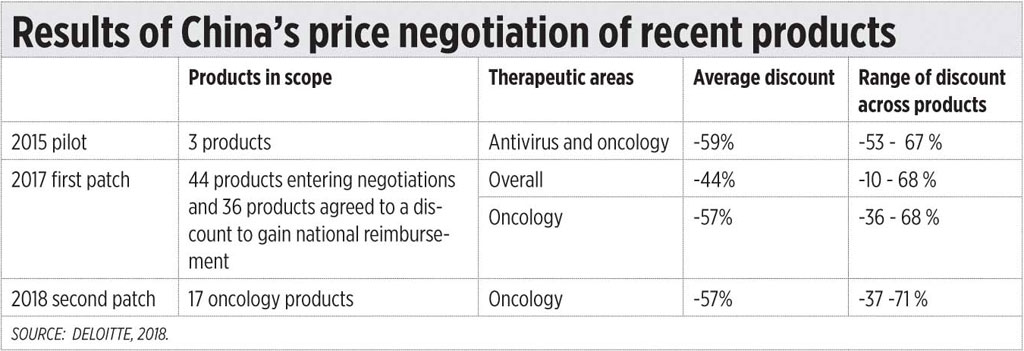
Recent trends in other countries are towards price negotiations. Two studies (one which appeared in Deloitte Insights in 2018 entitled, “A new view on market access and reimbursement: Launching innovative biopharma in China”; and another, which appeared in 2018 in the Value in Health Regional Issues, an Elsevier Journal, on “Recent Pricing Negotiations on Innovative Medicines Pilot in China: Experiences, Implications, and Suggestions,” by several authors) documented the gains China had by using price negotiations on innovative medicines.

In China, for users to benefit from medical insurance, the medicines have to be in its national drug formulary, of which there are two lists. The A list contains the essential medicines which must be available in all health care facilities sin China. The B list may include new drugs following an extensive evaluation and price negotiations, including expensive innovative medicines for diseases like cancer which are normally excluded. The manufacturers can apply for inclusionin List B subject to several criteria including a mutually negotiated price of the product.

Deloitte documented some of these gains. Medicine prices did go down significantly but not because of price capping, but because of price negotiations. (See the table.)

Perhaps, we can learn more from China and India on price capping and price negotiations.


Ramon L. Clarete is a professor at the University of the Philippines School of Economics.

The UP Chancellorship

The University of the Philippines (UP), particularly Diliman, is abuzz. The process of selecting the next UP Diliman Chancellor has aroused the UP community, including the alumni.

Although it is the Board of Regents (BoR) that appoints the Chancellor or for that matter the UP President, it has been a tradition, for good reason, to involve all stakeholders in the decision.

The excitement and the enthusiasm of stakeholders are most marked in the real digital world. On Facebook, I have seen the supporters of the two nominees — Prof. Ferdinand Manegdeg and Prof. Fidel Nemenzo — go all out for their candidate.

To be transparent, the feed that I receive mainly comes from those who support Prof. Nemenzo, a result of self-selection since I am a friend of Fidel.

My friendship with Fidel is based on our core values — upholding decency, standing for truth and fairness, serving the public good, supporting progressive causes, and practicing tolerance. But friendship does not mean an avoidance of disagreements. Fidel and I have contrasting views on different things. But we — precisely because we value tolerance — learn to dissociate differences (say in politics, business, and religion) from our friendship.

When some of Fidel’s supporters requested me to sign a petition letter in support of his candidacy, I opted to beg off. It is better, I thought, to have many statements of support that offer different reasons and perspectives. Hence, this piece serves as my contribution.

I also quibbled over the statement’s premise that UP Diliman is the “flagship” of the UP System. This is debatable, for the other constituents of the UP system are on a par with Diliman. It is the synergy of the constituent universities that define UP as the national university, as the country’s premiere university. UP Los Baños is the national academic center for agriculture. UP Manila is the national health and science academic center. In fact, the recent rise in the UP’s global academic reputation can be attributed to the large number of published journal articles and citations that come from the faculty of UP Manila.

That said, UP Diliman inherently shapes the present and future of UP education and the country’s higher education. Thus, selecting its leader merits the scrutiny not only of the UP Diliman community but also of the whole UP System and the larger society.

Here, I cite a few reasons why Fidel is the better choice, the excellent choice, to become the next UP Diliman Chancellor.

First, the mission of any great university is to serve the country through education, learning and research. Even as UP has to be primarily responsive to the specific development objectives and needs of our country, it must pursue a standard of excellence at the highest international level. Given his national and global stature as an academic, as a scientist and as a public intellectual, Fidel fits the mold of wedding the university to the national and global communities.

Fidel articulates well this challenge in his paper titled “Re-Imagining UP Diliman as an Academic Center of Excellence.” He states that “ internationalization requires an appreciation of our own culture and history because this will serve as our anchor in the globalized world.” In the same breath, he says: “In UP, our internalization policy should also be firmly grounded on the recognition of our duty to our own nation.”

Second, given the weaknesses in our education system and the skills demanded by a country that aspires to become a higher-income country, the university also has a lot of catching up to do with respect to the sciences, technology, engineering and mathematics (STEM). In this respect, it is welcome that the two candidates for the Chancellorship have sciences as their field of discipline.

Nevertheless, STEM, although necessary, is insufficient for students to learn the real world and to become good citizens, for applied research to be robust, and for practical public policies to endure. The role of liberal arts education cannot be diminished.

Here, Fidel shows his superiority. Unlike Prof. Manegdeg who simply enumerates programs and activities to fulfill UP’s inter-disciplinary character, Fidel provides the deeper rationale, even the underlying philosophical foundation, behind an inter-disciplinary mission. Says Fidel: “We will strengthen our General Education program, alongside the specializations, so that our graduates are equipped with the necessary skills of critical thinking, communication, and collaboration, imbued with necessary cultural and ethical moorings in this age of globalization and new technologies.”

Third, the UP, like other great universities, is fiercely vigilant of its academic freedom. It is a bastion of freedom of thought and expression. It protects its constituents from all kinds of discrimination, including political discrimination.

This institutional value or culture constrains UP leaders, regardless of their political leaning. Like it or not, the UP leader, the President or Chancellor, has to be jealous of academic freedom. His or her ideological leaning or political affiliation becomes exogenous with regard to the defense of academic freedom. Thus even during the period of dictatorship, UP presidents — OD Corpuz, Emanuel Soriano, and Edgardo Angara — tried to protect academic freedom, even though activists perceived them as instruments of the dictatorship.

In this regard, the behavior of some of Prof. Manegdeg’s supporters who accuse Fidel of being communist or Red is most uncalled for. It is irrelevant. In the first place, Fidel himself is quite critical of the Reds. But because Fidel values academic freedom, freedom of thought and expression, and freedom from discrimination, he welcomes a multiplicity of colors to flourish and to contend.

Fidel himself wears many colors. He is indeed Red for being a socialist. He is Yellow for his strong belief in liberal values like individual rights, tolerance, and pluralism. He is Purple because his wife trained him to become sensitive to gender and feminism. He is Gold and Blue because he is a member of the Pan Xenia fraternity. And he also wears the colors of the Dutertards because he can relate with them in having a strong and decisive leadership for nation-building.

But yes, Fidel is mainly Red because that is the underlying color of UP — UP Maroon. Fidel represents the best qualities of the UP Maroon.


Filomeno S. Sta. Ana III coordinates the Action for Economic Reforms.

www.aer.ph