Home Blog Page 9820

LGU revenue up 12% in 9 months to Sept., but below target

REVENUE generated by local government units (LGUs) rose 12% in the nine months to September, the Bureau of Local Government Finance (BLGF) reported.

Revenue generated from fees and taxes by all provinces, cities and municipalities rose 12% to P204.09 billion at the end of September, the Department of Finance (DoF) said in a statement Wednesday.

The DoF said LGU tax collections stood at P152.15 billion, up 12% year-on-year, which accounted for 28% of LGU revenue during the period.

Revenue generated from non-tax measures hit P51.94 billion, up 11% year-on-year and made up for nine percent of the LGUs’ total revenue source.

LGU revenue missed the P238.01-billion target, achieving only 84% of the goal for the period.

Of the total tax take, business tax accounted for 47.49% of the total or P95.11 billion, followed by real property tax (P57.03 billion), income from other fees and charges (P30.47 billion) and income from economic enterprises (P17.62 billion), according to the BLGF.

Separately, Finance Secretary Carlos G. Dominguez III approved the appointments of 186 local treasurers last year, representing 21.4% of the 868 vacancies, while the BLGF designated 1,506 others for different assignments.

This year, treasurers of cities, provinces and municipalities have been set a P307.08 billion collection target, up 19% from the 2019 target, “to drive LGUs to optimize their local taxing and revenue-raising powers.”

About 69% of the target is projected to be raised by cities, estimated at P213.71 billion, followed by P54.19 billion worth of collections by provinces and P39.21 billion by municipalities.

The BLGF exercises administrative and technical supervision over the treasury and assessment operations of LGUs. — Beatrice M. Laforga

UK to continue with GSP+ type arrangement with PHL after Brexit

THE Philippines will retain its preferential trade access after the UK’s exit from the European Union, British Ambassador to the Philippines Daniel Pruce said.

The Philippines currently enjoys duty-free entry of up to 6,274 products to the European Union (EU) under the Generalized Scheme of Preferences plus scheme (GSP+), which is set to expire at the end of 2023.

Mr. Pruce told reporters on Tuesday that the scheme will continue in the UK after it fully transitions from the EU.

“We have guaranteed that when we move out of the current relationship, so at the end of this year, we will maintain on a national level a mirror of the GSP+ scheme,” he said.

“There will be no change in terms of the tariff preferences that the Philippines enjoys in its relationship with the UK.”

The Philippines must comply with 27 international conventions on human and labor rights, environmental protection, and good governance under the EU scheme.

Mr. Pruce did not say whether or not the UK will continue this monitoring, but maintains that the preferences available under the scheme will continue.

“The UK remains a very active and engaged player in the international community and the principles that we stand up for, the values we hold dear, the conventions that we are committed to. Obviously, we will sustain our role in the world.”

He said the Philippines and the UK will have another dialogue on economic relations in April.

“We are masters of our own trade policy. We are no longer bound by the EU’s trade policy, so we have the opportunity to talk to all of our partners with whom we trade and collaborate around the world in terms of what the shape of what the future relationship will look like.”

The UK officially left the EU on Jan. 31, and the transition period continues until Dec. 31, 2020.

Philippine exports to the UK fell 7.9% to $492 million in 2019, accounting for 0.7% of total Philippine exports, according to the Philippine Statistics Authority.

Exports to the EU fell 7.8% to $8.22 billion in 2019, accounting for 11.68% of total Philippine exports. — Jenina P. Ibañez

PHL Feb. rice imports expected to decline to 2.5 million MT

PHILIPPINE RICE imports are expected to decline this month amid a slowdown in overseas purchases, the US Department of Agriculture (USDA) said.

In its Grain: World Markets and Trade report for February 2020, the USDA said that it expects the Philippines to import 2.5 million metric tons (MT) this month, down from 2.7 million MT in January, due to the continued “slowing pace” of Philippine overseas purchases.

Consumption and residual totals of purchased rice in February is projected at 14.4 million MT, little changed from January. Output of milled rice is also expected to remain unchanged at 12 million MT.

On Monday, the Philippine Statistics Authority (PSA) estimated the rice inventory at 2.675 million MT at the start of the year, up 4.9% year-on-year, largely due to increased holdings by the National Food Authority (NFA).

Rice stocks in NFA warehouses surged 436.1% to 524,940 MT.

The Rice Tariffication Law liberalized, rice imports, with the NFA stripped off of its importing function. The agency was given a mandate for focus on purchasing rice from domestic farmers on favorable terms. Its purchase price of P19 per kilo for palay, or unmilled rice, is significantly higher than prices offered by commercial traders, whose bargaining power has increased because they can opt to sell imported rice.

In a separate USDA report on World Agricultural Production, rice yields in the Philippines are also expected to remain flat at 4.05 MT per hectare. Area planted to rice is also expected to be stable at 4.7 million hectares.

The USDA noted that even with rice considered a staple in the Philippines, demand for wheat-based products is also growing in Southeast Asia region.

“The Philippines purchases nearly all of its wheat for food consumption from the United States as millers have a preference for the high quality that ensures consistency in final products. This has made the country the top importer of US wheat in the region (and second globally),” the report said.

The USDA projected the Philippines to import a total of 7.3 million MT of wheat this month.

Higher corn prices also drove farmers to use wheat in commercial feed production.

“Corn is the preferred feed ingredient with significant domestic production, making it ideal and cost-effective. However, in the last decade, plant disease, weather conditions, price, and policy issues have encouraged the industry to incorporate imported wheat as an important feed ingredient,” the USDA said in its report.

“This is particularly true for the Philippines where imports of feed wheat nearly tripled in the last decade as it is no longer just a feed substitute,” it added.

Philippine corn production is projected to be stable at 8.1 million MT in February. — Revin Mikhael D. Ochave with Marissa Mae M. Ramos

Recalibrating the Framework for LGU Joint Ventures

According to a 2017 report on Infrastructure Financing Strategies for Sustainable Development in the Philippines written for the United Nations Economic and Social Commission for Asia and the Pacific (UNESCAP), one of the fast-emerging mechanisms utilized to implement infrastructure projects at the level of local government units (LGUs) is through joint ventures (JVs). Majority of LGU-level JV projects that have progressed to actual implementation have been initiated by the private sector in partnership with local government entities in the water sector, government offices, and given recent developments, in reclamation as well.

The 2013 JV Guidelines issued by the National Economic and Development Authority (NEDA) provide the applicable framework for implementing public-private JV projects at the national level. They define a JV as “an arrangement where a private sector entity and a government entity contribute money/capital, services, and/or assets, as well as share profits, risks, and losses, to undertake an investment activity that will facilitate private sector initiative in a particular industry or sector.” At the end of the JV, the activity may eventually be transferred either to the private sector under competitive market conditions or to the government.

Expediency and convenience seem to be the primary driving forces for adopting JVs as the preferred mode of implementing infrastructure projects through private participation at the LGU level. Since the 2013 NEDA JV Guidelines explicitly exclude LGUs, there is a lack of a mandatory framework for evaluating, approving, and tendering JV projects at the local level. Instead, LGUs are given free rein to craft the rules themselves. While this may result in the swift implementation of infrastructure projects, it might also be prone to undermine transparency and competition.

To bridge the gap, the Department of the Interior and Local Government (DILG) issued Memorandum Circular (MC) No. 2016-120 on Sept. 7, 2016, providing Guidelines for the Implementation of Public-Private Partnership for the People Initiative for Local Governments (LGU P4). The Circular encouraged LGUs to draft their respective “PPP for the People or P4 Codes” before undertaking Public-Private Partnership (PPP) projects and likewise provided a template P4 Code to guide them. Insofar as JVs are concerned, the template P4 Code provides the following key characteristics:

• Unlike in the 2013 NEDA JV Guidelines, ownership over the investment activity at the end of the JV may only be transferred to the private sector partner (PSP) under competitive market conditions — the LGU cannot take ownership.

• Apart from money, capital, services, personnel, and assets, the LGU may also extend goodwill, free carry, grant a franchise, concession, usufruct, right-of-way, equity, subsidy or guarantee, provide cost-sharing and credit enhancement mechanisms, exercise police power, grant tax incentives or tax holidays, perform devolved powers, expropriate and reclassify, and enact or integrate zoning ordinances.

• Subject to the terms of the competitive selection process and agreement of the parties, the LGU may be entitled to a greater share than its contribution or equity, among others.

On July 24, 2019, the PPP Center of the Philippines launched its Guidebook on Joint Venture for LGUs. In a sense, the Guidebook recalibrates some of the provisions in the template P4 Code. Specifically,

• The Guidebook openly recommends not adopting some of the restrictions inherent in the definition of JV provided by the template P4 Code – among which is the restriction in the transfer of the investment activity only to the PSP.

• It affirms the two types of JVs that may be established: Contractual and Corporate, which was not made clear in the Circular and its P4 Code.

• It suggests that the LGU’s contributions to the JV be limited only to its available resources, fiscal capacity, what laws and regulations allow, and specifically recommends that no credit guarantees be assumed by the LGU.

• Instead of following the tender process laid out in the P4 Code, the Guidebook recommends the procedures described in Annexes A and B of the 2013 NEDA JV Guidelines, while advising LGUs to tailor some of these procedures according to the proposed guiding principles for LGU-level PPPs (as indicated in Section 3 of the P4 Code).

• It adds an Alternative JV Process, where the LGU is only required to prepare a project concept note (instead of a full feasibility study) before proceeding to competitive tender.

These provisions were later adopted in a template LGU JV Code annexed in Joint Memorandum Circular (JMC) No. 2019-01 (Supplemental Guidelines for the Implementation of LGU P4) issued by the DILG and the PPP Center on Dec. 10, 2019. The JV Code likewise provides that the PSP is not allowed to recover its investment from payments made by the LGU over the lifetime of the JV contract.

The value of the Alternative JV Process cannot be stressed enough. Considering that LGUs have limited technical capabilities and financial resources, this alternative process will help facilitate the implementation of JV projects. Since the task of preparing the full feasibility study is shifted to interested PSPs, the LGU will only submit a concept note to serve as a guide to the PSP in further developing a project proposal.

The above measures, however helpful or relevant, are only recommendatory. Numerous LGUs have already adopted the P4 Code and are implementing JV projects accordingly. Only time will tell whether some would eventually adopt the proposed JV Code under the JMC or amend their existing PPP Codes to incorporate some of the JV Code’s provisions for their future projects.

In any case, whatever framework LGUs decide to utilize in the end, the focus should not stray away from what would serve the best interest of their constituents for whom these projects are implemented.

The views or opinions expressed in this article are solely those of the author and do not necessarily represent those of Isla Lipana & Co. The content is for general information purposes only and should not be used as a substitute for specific advice.


Jose Patrick S. Rosales is an Infrastructure & Tax Senior Manager at the Tax Services Department of Isla Lipana & Co., the Philippine member firm of the PwC network.

(02) 8845-2728 ext. 2275

jose.patrick.s.rosales@pwc.com

King Ina, the docu

By Marian Pastor Roces

WHAT HAS not been said yet about the Lauren Greenfield documentary? Is there anything more to say? The Bloated One who allowed herself to be caught by Greenfield displaying the core of her psychosis — lust for return to power — took up valuable real estate in public discussion. In light of the coronavirus crisis and a still restive Taal Volcano, paying any more attention to Imelda Marcos and family is a matter of resource allocation.

It is our special misfortune that mental and emotional resources, stuff to be otherwise spent prudently, still have to be invested in a dogged Marcos watch. But, well, such is fate, and we can only be alert to moments that might channel ho-hum exasperation into rejuvenating wrath. The Kingmaker may be such a moment.

The documentary — whose title, colloquially, is King Ina, the stage-mothering of kingship — delivers more than a spectacle of greed. It offers more than a keyhole for voyeurs. In exposing the shape and major themes of Imelda’s madness, Greenfield quickens comprehension of the true size of this drawn-out national disaster. Filipino or otherwise, audiences arrive at (apologies to Joseph Conrad) the heart of darkness.

Imelda’s blathering is an endless reprise of three mantras. The ideas are wacko — Mother, Love, Beauty, capitals M, L, and B — and cohere in her mind as transcendent space beyond criticism. That space, she thinks, is above ground; and she, goddess, is suspended in mid-air as the very definition of benevolence. She thinks these words shield her from multiple perspectives.

There is little evidence that she is capable of recognizing evidence-based reality, let alone contrary opinion. Then again, Imelda did say, “Perception is real, truth is not.” Hence a clue: that however delusional she is, Imelda’s cunning is sharp and practiced.

Greenfield helps us detect the Imeldific combination of hard calculation and outlandish posturing. Imelda never stops performing. She means to return to goddess stature, flirting with world figures. To that end, she stages her widowed persona so outrageously, she conjures a strange aura of entitlement.

It is quite an act. Imelda is way better than any superb transvestite show in a bittersweet bar.

We — whoever we are who can still tell one thing from another — appreciate that Imelda can neither be dismissed as perverse entertainment nor spent force. The Imeldific as self-directed theater of excess is a figure to recognize precisely for what it is: a one-woman circus for rabble-rousing. The more immoderate, the better. The more glitzy and crass, the more effective.

The dramaturgy is built on sleights-of-hand. The non-stop intonation of Beauty contrives a hypnotic effect that turns the obviously ugly into simulacra of fabulous. Her paeans to Love manage to obscure otherwise clearly loveless plots, callous agenda, and outright cruelties. And the figure of the Mother which Imelda conjures has nothing to do with maternal nurturance, and everything to do with trying to foreclose — or indeed, kill — political growth.

The Beauty that Imelda venerates is, in truth, the Hideous. She was a patsy to shadowy dealers who preyed on crass dictators’ wives and other overnight billionaires. Portraits of herself and family in faux royal accoutrements, or as mythic beings with no feet on the ground, are the kitsch she consistently mistook for elegance. Her family’s enduring, world-class avarice for power and wealth represents, yes, culture. The culture of impunity.

More, and devastatingly for the Philippines: she supported a representation of the Filipino in romanticized art and performance, particularly in folk dance and painting. This pretend Philippines is institutionalized up to this day in the foreign affairs, the cultural industries, media, and education establishments. It blunted cutting-edge impulses in the art of the last 50 years. Too many Filipinos forgot subtle beauty, notably in instrumentation and speech.

The Love Imelda sings to is, to be sure, Betrayal. The documentary recalls the birth of the rapacious Imelda as literally em-bedded in the Dovie Beams sex record. Imelda’s life-long performance of love for her Ferdie masks her monstrous becoming as virtuoso in exacting vengeance and manipulating to return to top predator status. The performance of love, in place of love, is slimy cover for building family and community on patronage.

Presuming to embody this Love, Imelda usurps and mangles Christian and Islamic theologies to give some kind of strange logic to distributing money to street children and child cancer patients “to buy candy.” This love manipulates a witless son to go for the presidency via the vice-presidential race to a presidential candidate expected to either die or abdicate in his favor — and to set up the machinery for denial of the loss of substantial investment. The loss to Leni Robredo could not be comprehended by a Marcos camp that thinks money can buy everything if couched in the vocabulary of love.

And the Mother that Imelda contrives as avatar is, of course, Beast. The figure is revealed in the section of the documentary when Imelda recalls Ferdinand as the mother she found to fill the vacuum created by the early death of her own mother. This husband-as-mother deserves the attention of shrinks and comedians. He was her mother in political mentorship, of course a sort of nurturance. A mother, to her mind, is the teacher in survival; including outliving the deepest betrayal. Wrought, in her case, by this very “mother.”

Reproducing such motherhood, Imelda schleps inanities, figuring herself as mother of the Philippines and mother of the world. Ferdinand did indeed give birth to Imelda as monied, self-entitled, politically crafty, and wrapped in a femaleness that will make Game of Thrones women cringe. Ferdinand is the mother who erased Imelda’s actual mother, an impoverished second wife.

Ferdinand’s motherhood to Imelda constructed the falsehoods that Imelda lives out as reality. The Philippines that she (therefore he) desires back is a country long abused by this loving, beautifying, and mothering. The drama has to end. King Ina, begone.


Marian Pastor Roces is an independent curator and critic whose research interests include international art events, museums, identity politics, cities, and clothing. She is the founder and principal of TAO, Inc., a museum and exhibition development corporation. More of her critical texts can be found in Gathering: Political Writing on Art and Culture, the first collection of Roces’ essays co-published in 2019 by the Museum of Contemporary Art and Design and ArtAsiaPacific Foundation.

A new privileged class

Any idea or initiative, no matter how good or useful, can be prone to abuse. And this is on the part of either the people proposing or implementing the initiative, or the people that are intended to benefit from it. Worse, the negative consequences of such an initiative at times outweigh its benefits, or have unintended economic or social costs.

Let’s take the case of the Expanded Senior Citizens Act of 2010 (Republic Act 9994), which legally made senior citizens or Filipinos aged 60 and above exclusively “entitled” to certain “privileges.” These include a 20% discount on certain goods and services and VAT exemption. Among these goods and services are medicines and medical supplies and services; transportation fares; restaurant food and hotel accommodation; and funeral services.

Seniors also get free medical and dental services in government facilities; and “express lanes” and parking and seating privileges in government offices and commercial establishments. Many seniors also get retirement benefits from either the SSS or GSIS, and automatically receive PhilHealth coverage in accredited healthcare facilities.

In commercial establishments without “express lanes” for senior citizens, the law actually requires them to prioritize elderly clients. And thus, when in line, seniors get priority, always, even if this is to the inconvenience of the rest. If you are next in line, for instance, and then a dozen seniors suddenly all walk in, then find yourself going down to No. 13. This may seem unfair, but the law is the law. And commercial establishments are required to follow and obey the law, or risk penalties and fines.

I am actually looking forward to becoming a senior citizen in the Philippines, especially in the city where I live, Makati, since the city government offers additional perks and privileges to its senior citizens that other localities do not. A lunch buffet already reasonably priced at P400 cost only P320 for seniors. My only issue is the fact that the senior citizens act, while a laudable initiative, is also prone to abuse by seniors themselves.

The law has, in a way, created a new “privileged class” with a strong sense of entitlement. And sadly, it appears that some seniors fail to realize that there is a cost to all their benefits, and an economic cost borne also by their younger countrymen who tend to be disadvantaged by the privileges granted by law to their elders.

Even the pension system is skewed to have the younger generation — the working generation — fork out the insurance premiums needed to sustain the retirement benefits and state-administered health insurance privileges enjoyed by seniors. And while retirees can claim that they have likewise contributed to the pension system, the fact remains that by design, the retirement pool is generally sustained by present and continuing contributions.

A while back, I had two seniors at the table next to me at a fine dining restaurant at the Power Plant Mall at Rockwell. They ordered food, which was obviously for more than two people, and then opted to pay their bill even as they were still halfway through their meal. As they ended their meal, with plenty of leftovers on the table still, they called in about three people (non-seniors) waiting outside to join them.

At the time they paid for their meal, the full discount could have applied to the entire bill — 20% across the board since only two seniors (both entitled to discount) were dining at the time. Immaterial is the fact that the food ordered was obviously for more than two. And then, with the bill already paid, three other diners (non-seniors) joined in.

I make no judgments here, but it was obvious that the two seniors could easily afford a meal for five at full price. And yet, they seemed to have found a way to “game” the system, or to manipulate it to achieve a desired outcome. What they did was not illegal, but can we consider it an abuse of their privilege? Call them out on what they did, and I am certain they will argue that they did nothing wrong and that they were entitled to the privilege, anyway.

On another occasion, the basement parking at Waltermart on Chino Roces Avenue was full. All the senior parking slots were also taken. In drove a senior, who could not find a parking slot. He chose to double-park, or park where he shouldn’t, and then left his car. When the security guard went after him, he complained that there wasn’t enough parking for seniors, and that his legs already hurt. He refused to move his car. Again, what he did was not illegal, and under the law, he can insist on priority in parking space. But his act of double-parking, and then leaving his car, to the inconvenience of others, was it an abuse of the privilege?

What takes the cake, however, is an incident that I observed just the other day, also at Waltermart. At the second floor, just outside the supermarket, are tables and chairs primarily for the use of people to dine on after they buy food from the outlets. Day in, day out, however, seniors camp out in the area, practically the whole day. While this is not illegal, it is to the inconvenience of people who actually buy food but have nowhere to sit to eat.

The other day, two seniors or “regulars” were occupying a table for four. One of them stood up to buy something. A pregnant woman walked over to ask if the table could be shared so she could also sit. To my surprise, the elderly woman seated at the table, while on the phone, waived her off, claiming that the two seats in front of her were reserved as they were already occupied.

But, when her male companion returned, they both occupied only two of four seats, while another seat was occupied by the old woman’s bag. In fact, one more seat was actually available, and the pregnant woman could have used it, but she was waived off as obviously the old woman did not want to share “her” table. The pregnant woman, perhaps trying to avoid an argument, just walked away.

This, to me, is the height of insensitivity and inconsideration. And sadly, this is not an isolated incident. A woman, a senior with a walking disability, refusing to share an available seat with a younger but very pregnant woman just to keep the exclusivity of “her” table? While I felt sorry for the pregnant woman, I felt even more sorry for the senior woman for her lack of compassion.

The Senior Citizens Act is a laudable initiative, but it seems to have also created a monster. We now have a bunch of privileged old people who deem themselves above the rest, and at every opportunity, should always get priority and consideration. And while we complain about brats and the sense of entitlement of the young, we shouldn’t be too surprised given that even some of our elders also act the same way now.


Marvin Tort is a former managing editor of BusinessWorld, and a former chairman of the Philippines Press Council.

matort@yahoo.com

To love is to ‘co-create’

“Well, she looked at me/ And I, I could see/ That before too long/ I’d fall in love with her”

I “Saw Her Standing There” by The Beatles

It is so romantic to think of love as capturing that lightning-in-a-bottle, falling-in-love-at-first-sight feeling. The Beatles sang about it perfectly: giggles, laughter, and hearts going “boom” during the honeymoon stages of a romantic relationship.

It seems that businesses and customers seek to fall in love at first sight, too. This is most evident during creation and enjoyment of new products: shiny packaging, fantastic promotions, mouth-watering introductory prices, and top-notch quality.

But before long, reality kicks in, and the illusion breaks. We realize that love at first sight is untenable. We are biased and prone to misperceptions. To add, putting their best foot forward all the time is just not viable for both parties. Romantic partners begin to see flaws, businesses use lower-quality ingredients to save costs, and customers begin to expect more but feel disappointed. How do we learn from this?

Enter the “theory of value co-creation.” Drawing from research of other experts on this theory, Galvagno and Dalli, in a 2014 literature review, summarize “co-creation” as a collaborative value creation process between businesses and customers. This perspective rethinks what it means to create value. Previously, value creation was simply a business producing goods, then making customers fall in love at first use. But after much examination and research on business-customer relationships, especially in a service setting, scholars and practitioners have realized that value creation is not the same as production of goods. Rather, customers participate in reimagining how products can be used in ways that businesses may not have intended. Sticky notes came from failed attempts to create new adhesives, but both 3M and its customers found value in using non-permanent adhesives in paper. Bubble wrap failed as a textured wallpaper, but it gained enduring success when it was reimagined as packaging material for fragile goods.

Guided by this theory, we can also deepen our understanding of what it means to love. It is not anymore about loving at first sight, but loving through a thousand fights. Similar to the classic examples cited, co-creation is a collaborative process that is inevitably filled with tension, disagreements, and initial failures. This is challenging, yet beautiful. Although the old paradigm of loving at first sight is great at crafting first impressions, it is prone to fail in managing expectations and relationships in the long term. On the other hand, value co-creation iterates toward more harmonious relationships.

Love, both in business and personal relationships, should then not be about controlling the other. No single party can dictate value; rather, both parties can only craft value propositions that are jointly experienced and improved, similar to the technology and social media platforms we enjoy in this sharing economy. This idea may be uncomfortable for some, but perhaps it brings us closer to understanding true love. To love is to co-create.

“The love you take is equal to the love you make.” — “The End” by The Beatles

Happy Valentine!


Patrick Adriel H. Aure is an Assistant Professor of the Management and Organization Department, Ramon V. Del Rosario College of Business. As head of the Social Enterprise Research Network of the Center for Business Research and Development (CBRD-SERN) and as co-chair for strategic directions of the Lasallian Social Enterprise for Economic Development (LSEED) committee at De La Salle University, he advocates social entrepreneurship.

patrick.aure@dlsu.edu.ph

COVID-19, NCDs and ENDS

“How to make the fitting adjustment between individual independence and social control is a subject on which nearly everything remains to be done… To an ordinary man, however, his own preference… is not only a perfectly satisfactory reason, but the only one he generally has for any of his notions of morality, taste, or propriety…”

John Stuart Mill, On Liberty (1859), Ch. 1 Introduction

As of Feb. 11, the novel coronavirus — now called COVID-19 by the World Health Organization (WHO) — has 44,000+ cases and killed 1,100+ people in China alone. The number of infected and dead people is rising every day and there is no existing proven treatment or vaccine. The nearest vaccine/s would be 12 to 18 months away because there are many processes and clinical trials needed before a new medicine or vaccine can be officially declared as safe and effective.

I checked the website of Pharmaceutical Research and Manufacturers of America (PhRMA), the biggest association of innovator pharma and biotech companies and research institutes in the world, for drugs that are undergoing various clinical trials and research, on top of existing proven medicines (see Table 1).

This should be the result of many years of virtue signalling by the WHO and various Ministry or Department of Health of many countries that the main problem in the world now are non-communicable diseases (NCDs), not infectious diseases like COVID-19. Now we see how unprepared these global and national health authorities are when the real killer diseases come.

And still the WHO and country governments continue with more regulations of products and lifestyles to “protect people from themselves,” the evolving role of a nanny state. Target products are alcohol, tobacco, electronic cigarettes, sugar, and salt/sodium. Despite the fact that anywhere in the world, people are living longer and healthier even if they have rising consumption of alcohol, tobacco, sugar/fatty food and drinks.

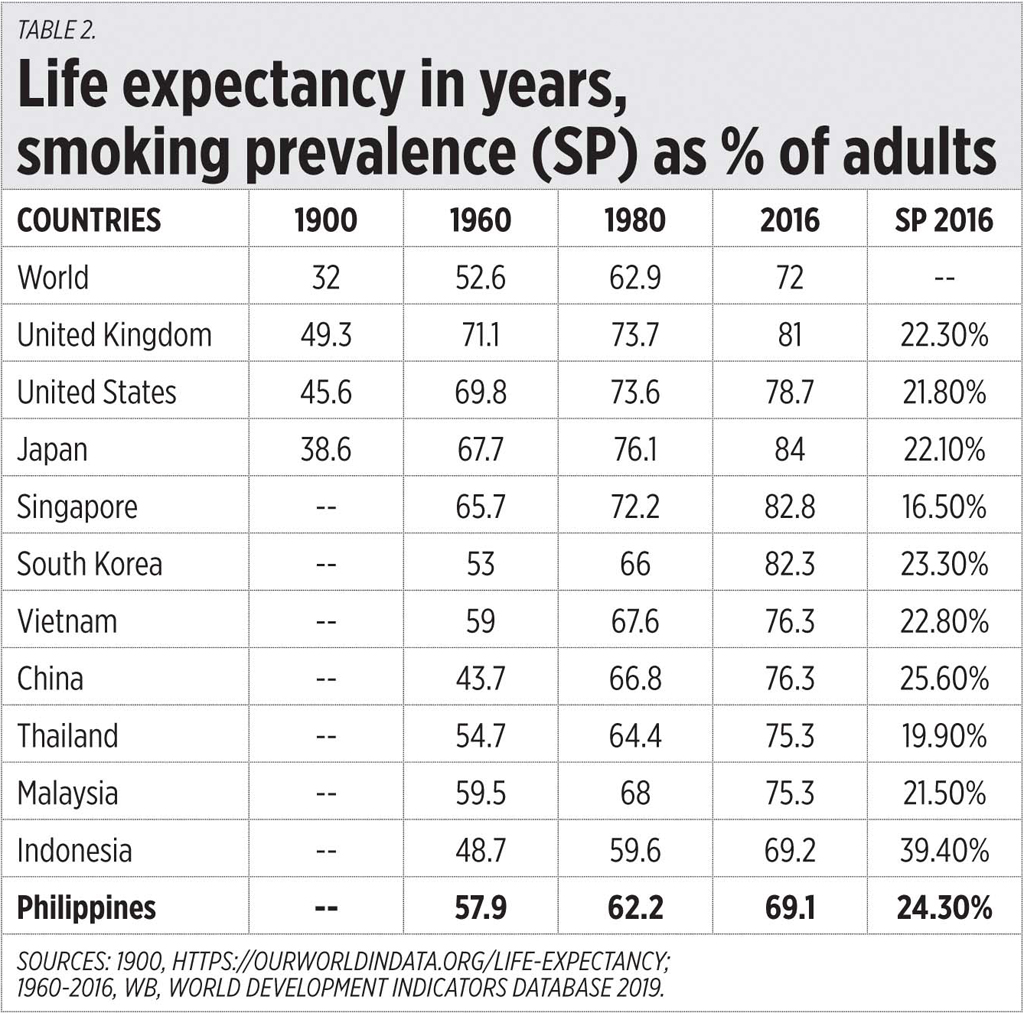
I checked the narrative that “more alcohol and tobacco = more sickness and deaths,” the numbers show that it does not hold water. For instance, China and Indonesia have higher smoking prevalence (SP) than the Philippines yet they have higher life expectancy than us. The US, UK, and Japan have higher SP than Thailand yet they have longer life expectancy than the latter (see Table 2).

In Congress, I saw a bill on “Non-Combustible Nicotine Delivery Systems Regulation Act of 2019” and I was surprised at the huge number of new regulations, restrictions, and prohibitions for e-cigarettes or electronic nicotine delivery systems (ENDS), electronic non-nicotine (ENNDS), heated tobacco products (HTPs) as if these are the normal tobacco, alcohol, prohibited drugs.

For example there are outright bans and prohibitions for those ENDS/HTPs: banning their sale within 500 meters from any perimeter of a school or playground; banning advertisement, promotion, and sponsorship; banning use in schools/universities, hospitals, government offices and facilities; banning users who are below 21 years old.

Then there are allowed but highly restricted acts: online trade, advertisements in retailer establishments, flavorings, designated vaping areas (DVAs), product requirements, etc.

Just recently, Congress raised the tax on those products along with regular tobacco and alcohol products. Meaning government wants more tax money from them to fund its universal healthcare (UHC) and related programs, yet government wants less use and sale of these products. Which is which?

On raising the minimum age for vaping or smoking to 21, this is more double talk. At the age of 18, the government currently believes that people are mature enough to vote and determine political leadership at local and national levels, they can drive vehicles and are mature enough not to cause injuries or deaths on the road, they can get married, and so on. Then government changes the rules because people below 21 are still immature and need to be protected from themselves.

More bans, restrictions, and taxation only encourage more corruption and smuggling. The result is more drinking, smoking, vaping, and drugs because the smuggled products are cheaper. JS Mill has warned of the dangers of more social control — government must heed this.


Bienvenido S. Oplas, Jr. is the president of Minimal Government Thinkers.

minimalgovernment@gmail.com

Into deeper waters

By Raju Mandhyan

HER PALMS were sweaty and her throat was dry. She clenched her notes and the clicker with shaky hands. As she reached the microphone, she was afraid that the audience would hear her heart — it was thudding wildly in her chest.

As she glanced at the expectant faces of her colleagues she suddenly realized that they knew the truth: She was scared to death. She wasn’t sure of what she was going to say and her position at ACME International was now teetering on a cliff. She had to prove that she was an able and confident young woman.

She felt like crying. She would have given her life and soul to be anywhere else but behind the lectern. Somehow, she was able to mumble her way out of the situation. Later that night, when she was alone, she swore to herself that she would never let something like that happen to her again.

That was nearly 25 years ago. Today, Janel Poe is known as a CEO par excellence. She sits on the board of several multi-national corporations and does a lot of social and civil work. She is constantly on the invitation lists of major businesses and social functions organized in the country. In her field of Information Technology, she is referred to as the “Guru.”

After that first disastrous event as a young ACME executive, she took it upon herself to master the art and science of public speaking. Something inside her told her that all her past accomplishments as an honor student in school would not amount to anything if she did not learn to express herself with clarity, creativity, and wit. She took up public speaking like one would pursue a doctoral course. Now in her fifties, she constantly speaks, trains, and practices just as doggedly as she did in her twenties. Over the years her public speaking abilities have become the driving force in her life. Today, she listens effectively, thinks with clarity and precision, and speaks with wit and wisdom.

I asked her once, Janel, as far as public speaking abilities go, do you think you have arrived?” With a twinkle in her eyes she gently answered, “Like Newton, I feel like I am on the edge of an ocean, constantly collecting pebbles while all that is yet to be discovered lies ahead of me.”

Today, across the world there still are thousands of executives and businesspeople who break out into a cold sweat or become dry-mouthed when facing an audience. The cause, without a doubt, is fear in any of its forms; anxiety, nervousness, shyness or what have you. Some quarters call it the imposter syndrome. Whatever your knowledge and expertise level might be, you feel as you do not belong at the helm of the room and whatever you have to say has a hidden agenda, yours.

The way out of this malady is strong resolve and then continuous exposure and learning towards the discipline like Janel Poe in the story. Another insightful way is to trust and strongly believe that what you are bringing to the table or the lectern, while it may be simple and common, is of extreme importance to the audience and you are not the message itself but just a humble messenger, a harbinger. That way your success or failure at the performance becomes secondary to the mission of delivering the message. Ergo, your ego takes the back seat and you become a servant, a leader.

This holds true not just in public speaking but every endeavor and every initiative a leader takes. She steps upon her ego and takes a leap from the edge of the ocean into deeper waters of success and growth for others.


Raju Mandhyan is an author, coach and learning facilitator.

www.mandhyan.com

Coronavirus stokes mask production and mass confusion

By Shuli Ren

FOR FACTORIES to reopen, people to get back to work and the coronavirus to stop spreading, China needs tens of millions of face masks each day. And yet the country’s sprawling bureaucracy is sending out mixed messages about its ability to provide them. The repercussions have been felt even in Hong Kong, where throngs of panicked shoppers cleared the shelves of masks and, more perplexingly, toilet paper last week.

The world’s biggest mask producer is facing a severe shortage. Even running at full capacity, China can make only 20 million a day, nowhere close to meeting the needs of the 776 million who are slowly returning to work. As for prized surgical and N95 masks (which provide even more coverage), China can produce only about 2.2 million and 600,000 daily. The country has roughly 12 million medical professionals.

In the last week of January, China had to purchase more than 56 million masks from overseas, the government said. Apple supplier Hon Hai Precision Industry Co. took matters into its own hands when it started to make masks for employees at its flagship factory in Shenzhen.

Once again, China’s bureaucrats have proven their incompetence, starting with the government of Hubei province, whose slow response accelerated the viral spread in the first place.

Even under lockdown, Hubei of all provinces shouldn’t be this short of protective medical gear. Xiantao, a provincial city there, is a major industrial hub for the non-woven products used in surgical masks. But last week, local officials told producers that unless their goods have been cleared for sale within China, factories can’t reopen until Feb. 14.

This has created a social uproar. Many of these masks aren’t cleared for sale in the mainland because they’re exported. These businesses often lack domestic licenses precisely for this reason. Within days, the provincial government had to reverse course, because the proposed regulation would have shut down roughly half of Xiantao’s production capacity.

In the manufacturing hub of Guangdong, meanwhile, officials went into overdrive, encouraging local businesses to switch to mask production by offering generous subsidies. Companies that purchased production lines and got online by Feb. 7 received as much as 80% in rebates from the government; those meeting a Feb. 20 deadline can have up to half of their equipment costs paid for.

It’s no surprise that companies are now making masks, including automakers such as BYD Co. and Guangzhou Automobile Group Co. But this shift has stoked its own form of panic. When China’s fourth-largest tissue-paper brand, Guangdong-based C&S Paper Co., said it purchased five production lines with a daily capacity of about 350,000 masks, speculation was rife on social media about possible disruption to the paper-goods supply chain. This helps explain why Hong Kong had a toilet-paper run last week: The likes of C&S might just be too busy making surgical masks.

Judging by how well the stock market is doing, it seems global investors have learned to forgive China. Many have argued that, of all countries, China with its centralized command system can weather this epidemic better than others.

The reality is a lot murkier. We have one province so bogged down by licensing issues that its much-needed factories are lying fallow; another whose overly generous subsidies could be providing the wrong incentives and inadvertently stoking consumer panic. As it turns out, China’s bureaucracy is a lot less efficient than we imagined. Don’t be surprised if we see a diaper run, too. Even those manufacturers have switched to making masks.


BLOOMBERG OPINION

Yes, coronavirus is more troubling than the flu

By David Fickling

IS THE WORLD losing its collective mind about the coronavirus (now called COVID-19 by the World Health Organization)? So far 1,115 people have died from the infection — all but 45 of them at the epicenter of the outbreak in Wuhan province, and only two of them outside China.

By contrast, some 10,000 people have died this winter from influenza in the US alone, and worldwide between 290,000 and 650,000 people die each year from seasonal flu. H1N1 swine flu, which first emerged in Mexico and quickly spread across the globe, ultimately killed between 151,700 and 574,600 people in its first year alone. Instead of worrying about the progress of COVID-19 in China, shouldn’t we be asking about that public-health failure?

Well, no. Pandemics are unique, and apples-to-oranges comparisons often obscure more than they illuminate. The current coronavirus outbreak is legitimately more alarming than normal seasonal flu, and public-health officials are probably right to be responding with unusually drastic measures. Such actions shouldn’t be taken with every disease outbreak, though, unless we’re prepared to accept dystopian restrictions on basic freedoms as a routine part of life.

The most obvious difference between COVID-19 and influenza is that it’s considerably more deadly. The case fatality rates for most flu strains, including the pandemic ones like H1N1 that crop up every 25 years or so, tend to be in the region of 10 or 20 deaths for every 100,000 infections. COVID-19 appears to be several orders of magnitude more dangerous, with the equivalent of 2,359 deaths per 100,000 confirmed cases so far.

There’s considerable uncertainty about all these figures. Unlike with COVID-19, most cases of influenza aren’t laboratory-confirmed. That could mean we’re exaggerating the odds of dying from the current outbreak, because we’re measuring deaths only as a proportion of people whose symptoms were severe enough to merit testing.

The extraordinary burden being placed on the health system in Hubei may also be skewing things. More than 3% of cases there have resulted in death, but downriver in Zhejiang there have been no fatalities despite 1,117 confirmed cases. Across China outside Hubei, the fatality rate is around 0.4%. It’s possible that the triage being undertaken by hard-pressed Hubei doctors means they’re only taking in and confirming the most serious cases.

There’s also the possibility that fatality rates are too low. COVID-19 has spread with extraordinary speed, and to date nearly 90% of cases have resulted in neither recovery nor death. If we see increasing mortality from that population over the coming weeks, it may be the case that fatality rates were low simply because people hadn’t died yet.

It’s hard to point with certainty to any rock-solid facts amid this thicket of hypotheses and estimates — and that’s precisely why public-health officials, in China and elsewhere, are now taking this outbreak so seriously. On one hand, coronavirus might fizzle out in weeks or months as the measures currently being taken gain traction. On the other, it might grow into a pandemic that infects 60% of the world’s population, according to the Guardian, likely resulting in millions of deaths.

The brutal truth of epidemics is that in their initial stages there’s no magic bullet to preventing them. New vaccines can’t be developed overnight. The regulatory burden of getting them approved in multiple countries and the manufacturing challenge of producing them are, if anything, bigger bottlenecks than the laboratory work. After enormous efforts to expand pandemic influenza preparedness, in 2015 the world still only had enough production capacity to immunize about 43% of the global population.

Basic hygiene practices such as hand-washing, mouth-covering, and simply staying home will certainly help, too — but beyond that, the sort of quarantine we’re seeing in China is one of the few preventative measures at hand.

The advance of vaccines and antibiotics over the 20th century meant that so-called community quarantine — where entire populations are isolated to prevent the spread of disease — had largely died out as a public-health measure before it came roaring back with Severe Acute Respiratory Syndrome in 2003.

It’s still often controversial. Riots broke out in Liberia when community quarantine was imposed during the Ebola epidemic of 2014. While surveys in Asian and North American countries suggest reasonable levels of support for the practice, that tolerance no doubt has its limits.

It’s unclear if the world is ready for a situation where draconian restrictions like those being used in China become more commonplace. Governments and health officials need to reckon with that possibility, though. Epidemics thrive on large, dense populations. With 7.8 billion people and 21 billion livestock on the planet, we’re providing novel infections an ever-improving environment in which to spread.


BLOOMBERG OPINION

Ceres takes joy in dominant win in AFC Cup ’20 opener

By Michael Angelo S. Murillo
Senior Reporter

FOLLOWING a master class in its AFC Cup 2020 opener where it dominated its opponent, 4-0, Ceres-Negros FC said it takes joy in the solid start it had in the tournament and expressed hope that the team gets to stay the course moving forward.

Took on visiting Preah Khan Reach Svay Rieng FC of Cambodia in their first game in Group G of the competition, the “Busmen” did not waste much time trumpeting its intent to make another solid run in the AFC Cup.

It was something that Ceres coach Risto Vidakovic said he was happy about, seeing how his players played that way they were supposed to.

“It was not an easy game. But we deserved to win because we created a lot of chances,” said Mr. Vidakovic following their game against Svay Rieng on Tuesday night at the Rizal Memorial Stadium.

“I’m happy with the way we played. We’re still adjusting but I think it is a good sign for the team. We have a style of playing and we were able to execute it. Hopefully we get to do that in our next games,” he added.

Ceres was at its element at the onset against Svay Rieng.

It got the leverage early on after midfielder Takashi Odawara and defender Josh Grommen scored back-to-back goals in the 12th and 14th minute, respectively.

The twin goals set the tone for the Busmen the rest of the way en route to the win that set their AFC Cup campaign to a promising start.

Striker Bienvenido Maranon also played a key part, scoring a brace in the 55th and 70th minute, which put the game away and earned for him man of the match honors.

“The team is showing maturity and they’re growing in each game,” said Mr. Vidakovic of his team, the three-time Philippines Football League champion and coming off a spirited showing in the preliminary rounds of the AFC Champions League.

Mr. Vidakovic also took note of the impact come-backing Ceres player Manny Ott had on their team’s performance

“Manny Ott, like what I said before, is an important player for us. He is one of the best players in the team. He has great control and makes our attack better,” said the Ceres coach of Mr. Ott, who spent last season playing in the Thai league.

Next for Ceres is another home game on Feb. 25 against Than Quang Ninh of Vietnam.

It was supposed to be an away match but with the Vietnamese government’s decision to bar any sports event in light of the ongoing COVID-19 acute respiratory disease outbreak, the game was rescheduled to be played here instead.

Than Quang Ninh also played last Tuesday and lost to Bali United FC, 4-1, in Indonesia.