Home Blog Page 9726

Stuff to do at home (03/24/20)

Here are activities to pass the time at home during the second week of quarantine:

BAYANIHAN MUSIKAHAN
Bayanihan Musikahan gathers Pinoy musical artists online through marathon singing. The movement is aimed at raising funds to help urban poor communities in Metro Manila amidst the COVID-19 lockdown. For more information and live shows, visit https://www.facebook.com/pg/bayanihanmusikahan/about/?ref=page_internal. To donate, visit https://donate.paymaya.com/products/philippine-business-for-social-progress.

NHCP DOCUMENTARIES ON YOUTUBE
The National Historical Commission of the Philippines (NHCP) makes Philippine history education accessible through documentaries on YouTube. For more information, visit https://www.facebook.com/historymuseumsPH/posts/997233837339314. Titles include: Jose Rizal: Sa Landas ng Paglaya; Apolinario Mabini: Talino at Paninindigan; Kababaihan ng Rebolusyon; and Gregoria de Jesus: Lakambini ng Katipunan.

ONLINE WRITING WORKSHOP WITH RICKY LEE
Screenwriter Ricky Lee will be conducting free writing workshops on April 8, 15, and 22. Interested applicants must be at least 18 years old and a Filipino citizen. Submit a letter of intent and a writer’s bio to banalramel@gmail.com. Deadline is on March 27, 11:59 p.m. The workshop is limited to 50 participants.

DRAWING LESSONS FOR KIDS WITH MO WILLEMS
Best-selling author and illustrator Mo Willems will be hosting drawing lessons for kids called “Lunch Doodles” every weekday on YouTube. Each session will be between 20- to 28-minutes long. Mr. Willems also welcomes questions (send questions to: LUNCHDOODLES@kennedy-center.org) which he will try to answer during sessions. For sessions of “Lunch Doodles,” visit https://www.youtube.com/playlist?list=PL14hRqd0PELGbKihHuTqx_pbvCLqGbOkF.

PAULO COELHO’S BOOKS ONLINE
Best-selling author Paulo Coelho has made his books available for free. Titles include: The Way of the Bow, The Manuscript Found in Accra, and Brida. Visit his blog at https://paulocoelhoblog.com/books-online/.

SHAKESPEARE PLAYS ONLINE
Shakespeare’s plays recorded at the Globe Theater are now available for online streaming. Titles include Hamlet and The Two Noble Kinsmen. To watch, visit https://globeplayer.tv/

SMC’s Ang calls on power producers to preserve fuel supply

THE head of San Miguel Corp. (SMC) has called on power producers in the country to save up their fuel inventories to ensure their unhampered operations during the Luzon-wide lockdown as most businesses have temporarily closed.

As it continued its operations, SMC Global Power Holdings Corp., the power unit of SMC said on Monday it still has sufficient electricity supply to power Luzon during the enhanced community quarantine from March 15 to April 14.

“If there is excess capacity today, particularly since major business and commercial centers and industries are practically shut down, then perhaps government can require power plants to only produce what is needed in order to save on fuel,” SMC President Ramon S. Ang said in a statement.

“As far as our facilities are concerned, we can assure sufficient and uninterrupted capacity supplied to the Luzon and Mindanao grids,” Mr. Ang added.

SMC Global Power has a portfolio of coal, natural gas, and hydroelectric power plants which collectively has a capacity of 2,903 megawatts representing 22% of the Luzon grid and 17% of the National grid.

“Our plants are equipped to handle the demand for reliability. Protocols have been activated in our power plants as a response to crises such as pandemics,” he said.

Shares in SMC on Monday inched up by 0.18% to close at P83.15 apiece.

How PSEi member stocks performed — March 23, 2020

Here’s a quick glance at how PSEi stocks fared on Monday, March 23, 2020.


BoC exempts donated protective gear from some import clearances

THE Bureau of Customs (BoC) said imported donations of personal protective equipment (PPE) will be exempt from Food and Drug Administration (FDA) clearance requirements to expedite their release to frontline personnel working to contain COVID-19 (coronavirus disease 2019).

In a statement Monday, the bureau said the exempt supplies include N95 face masks, shoe covers, gloves, head covers and gowns.

The BoC said that prior to customs release, importers of all goods, as a rule, are required to secure marketing authorization from the FDA via a Certificate of Product Notification (CPN) or Certificate of Product Registration (CPR) depending on the associated health risks.

However, the bureau said “foreign donations of PPEs are exempted from securing an FDA clearance” considering that these items are urgently needed.

“As to PPEs intended to enter the local market for commercial purposes, the FDA clarified that importers of PPEs for commercial purposes are exempt from presentation of a CPN/CPR prior customs release provided that they are able to provide a copy of License to Operate (LTO) and proof of application for product notification with the FDA,” it added.

According to BoC data, a total of 459 shipments of PPE and medical supplies were released as of Saturday by the bureau, which is implementing a minimal-staffing scheme.

Separately, the bureau said it is now accepting “provisional goods declarations” (PGDs) or an incomplete declaration of goods that will allow tentative release of shipments with pending documents to be provided within a scheduled date.

This is authorized by Customs Memorandum Order No. 07-2020 dated March 6 issued by Commissioner Rey Leonardo B. Guerrero.

“It shall be allowed on cases when there are no necessary permits/clearances from regulatory agencies have been presented at the time of lodgement. This may be allowed as long as the application for such permit were filed to the appropriate regulatory agency pending issuance and that necessary permits/clearances shall still be submitted within the time frame prescribed by the said regulatory agency,” the BoC said in a separate statement.

The bureau said it will also allow PGDs if a tax exemption indorsement has not been issued at the time of lodgement but an application is pending, as well as if the declarant lacks some information or documents to complete the transaction.

The CMO also stipulates that an “accepted PGD” is to be deemed a complete declaration, with regard to duties and taxes. It may be subject to tentative assessment of duties, taxes and other charges, if a tentative release was requested, and is subject to final readjustment once the pending necessary information or documents has been provided. — Beatrice M. Laforga

LGUs preparing food packs urged to buy local, use more fresh produce

THE Department of Agriculture (DA) urged local government units (LGUs) putting together food packs for their more vulnerable citizens to source food from local farmers to stabilize the market for fresh produce during the COVID-19 quarantine.

Agriculture Secretary William D. Dar said that aside from distributing canned goods and processed products, LGUs must also prioritize fresh produce in their purchasing for food packs.

“This is the time to help our farmers sell their produce while we promote healthy consumption in Filipino households. The food supplies can actually come from the ‘kanayunan’ (within the LGU itself), hence minimizing movement from one location to another,” Mr. Dar said.

DA and the Department of the Interior and Local Government (DILG) are working on a food delivery system especially to locked-down communities.

LGUs have begun distributing food packs to poor constituents and to those who cannot go outside their houses due to movement restrictions. The quarantine has also resulted in the establishment of checkpoints around Metro Manila, potentially slowing the flow of food supplies and cutting farmers off from a major market, though the DA has been arranging for the use of special food lanes for accredited haulers of food cargoes.

“We are ready to assist our LGUs in metro areas to ensure stable food supply throughout the country. As much as possible, let’s do it within our communities where supplies are already available,” Mr. Dar said. — Revin Mikhael D. Ochave

Water firms to apply average billing during lockdown

THE Metropolitan Waterworks and Sewerage System Regulatory Office (MWSS-RO) has authorized water concessionaires to apply average billing to their customers, as community quarantine measures on Luzon prevent them from sending out meter readers.

In a statement Monday, MWSS Chief Regulator Patrick Lester N. Ty said that Manila Water Company, Inc. (Manila Water) and Maynilad Water Services, Inc. (Maynilad) have been given approval to suspend their meter reading operations in observance of the COVID-19 quarantine.

Monthly bills will be computed based on average water consumption over the past three months.

MWSS also said that after resumption of regular operations, subsequent water bills will be adjusted based on actual meter readings.

West zone water provider Maynilad announced its meter-reading and billing suspension on March 20 and will be in effect until the end of the quarantine period on April 14.

East zone water concessionaire Manila Water suspended meter-reading on March 17 until further notice, or until the national government officially terminates the enhanced community quarantine.

MWSS said average billing is permitted under current policy.

Manila Water said the water supply is sufficient to serve all is customers during the quarantine.

In a statement Monday, Manila Water said it maintains minimal staffing to run its water supply and wastewater facilities to ensure uninterrupted service.

Manila Water recently expanded its capacity with the operation of the Cardona Water Treatment Plant in Rizal, which can supply 100 million liters of water per day.

Thiry-six deep wells are also in place drawing up to 44 million liters of water, with additional deep wells still under construction across the east zone. Combined with the deep wells now in place, all the wells can potentially draw up to 100 million liters when construction is completed.

Water line boosters have also been installed along distribution lines and in some hospitals along the east zone, it said. — Revin Mikhael D. Ochave

WTO index shows services slowing even before pandemic

By Jenina P. Ibañez
Reporter

SERVICES TRADE in the Philippines is expected to further slow as measures to stop the spread of COVID-19 (coronavirus disease 2019) halts tourism and impacts outsourcing.

The services trade barometer of the World Trade Organization (WTO) said growth in the global services trade slowed in the past year, indicating a reduced likelihood of recovery from the effects of the US-China trade war.

The index read 96.8, indicating below-trend growth, and does not yet reflect the full economic impact of COVID-19.

“The current barometer reading and the spread of COVID-19 suggest that services trade may slow further in coming periods.”

The WTO services trade barometer, which is issued twice per year, describes the current state of the services trade ahead of official statistics. The barometer released on March 11 shows services trade toward the end of 2019 and into the first quarter of 2020.

A reading of 100 shows growth consistent with medium-term trends, while numbers below it indicate below-trend growth.

IMPACT OF LOCKDOWN AND TRAVEL BANS
Rizal Commercial Banking Corp. economist Michael L. Ricafort said in an e-mail Monday that a community quarantine is a necessary and prudent measure in response to the outbreak. He also said that service trade activities in the Philippines may be reduced as the quarantine leads to declines in tourism, transportation, gaming, entertainment, retail trade, and conferences, among others.

President Rodrigo R. Duterte last week announced a community quarantine limiting the movement of people to and from Metro Manila to prevent the spread of COVID-19, which on Monday was extended to Luzon. The enhanced community quarantine suspends public transportation and the operations of most private companies.

The tourism industry, including related sectors such as entertainment and transportation, will take a hit as the Philippines extends its travel ban to foreign citizens coming from countries with local transmission of COVID-19. The quarantine also limits the domestic movement of travelers.

Business process outsourcing companies continue operations under the community quarantine, but do so with minimal staffing.

“These recent developments add to slowdown in services trade, on top of the pre-existing slowdown in global economic growth and in global trade by both coronavirus concerns since the latter part of January 2020 and the lingering US-China trade war since 2019,” Mr. Ricafort said.

Security Bank Corp. chief economist Robert Dan J. Roces in an e-mail said the tourism and airline industries will be affected most, because of the global decline in passenger travel.

“On the other hand, ICT (information and communications technology) services may not be fully affected relative to overall declines as consumers look to or transfer transactions using its services.”

WTO INDEX
According to the WTO barometer, the largest declines in global service trade are in passenger air travel and container shipping.

“Both indices cover developments through January and may partly reflect early efforts to halt the spread of the disease, which intensified toward the end of the month.”

Indices for financial services and ICT services also fell slightly below trend, while the construction index remained steady.

A decline in the global services purchasing manager’s index, the report said, shows how COVID-19 will continue to slow down services trade in the near term. The report said it is the most forward-looking barometer component.

WORSENING TRADE WAR’S NEGATIVE IMPACT
Union Bank of the Philippines chief economist Ruben Carlo Asuncion in an e-mail said globalization had previously increased services trade worldwide.

The recent services trade decline, he said, “is an indication of the ‘de-globalization’ phenomenon that we have observed in the last few years.”

Deglobalization refers to a decline in interdependence between nation states.

“One indicator of this phenomenon is the US-China trade war that has affected perceptions about global trade in general. More and more we have seen less porous borders and higher tariffs that discourage more trade, not just in services but in merchandise as well,” Mr. Asuncion said.

He said that COVID-19 escalates this phenomenon, because of lockdowns and travel bans.

“Services will be hard hit if COVID-19 is not controlled effectively.”

The Department of Tourism said international tourist arrivals fell 41.4% year-on-year in February, after growing 9.8% in January.

Philippine international tourism revenue in February fell 41% year-on-year to P26.73 billion.

Think tank proposes gov’t ditch growth targets, focus on health care

THE GOVERNMENT should abandon its growth targets and focus resources on mitigating the impact of COVID-19 (coronavirus disease 2019) via emergency financial and non-financial aid for affected households and businesses, according to an Ateneo de Manila University think tank.

The Ateneo Center for Economic Research and Development (ACERD) as well as the university’s Economics Department said that government efforts should be funneled into ensuring the supply of critical medical equipment while addressing the economic and social costs of the enhanced community quarantine (ECQ) imposed on Luzon.

“[The] government should set aside its growth targets (firms, in turn, should also let go of their profit targets this year),” they said in a statement.

The government was initially targeting gross domestic product (GDP) growth of 6.5-7.5% this year after a below-target performance of 5.9% in 2019.

With the virus spreading and Luzon locked down, officials are already releasing scaled-back growth estimates this year.

Bangko Sentral ng Pilipinas (BSP) Governor Benjamin E. Diokno said that central bank estimates point to growth of 5-5.5% this year, which he described as not bad and still among the fastest in the region in the context of the imminent global recession expected by analysts.

Socioeconomic Planning Secretary Ernesto M. Pernia has also released preliminary estimates from the National Economic and Development Authority of 4.3% GDP growth for 2020.

The Ateneo economists recommend that the government instead focus its energy on supporting the health care sector as frontliners struggle to contain the virus by ensuring the availability of testing apparatus and personal protective equipment (PPE).

They recommended “appropriating P50 million for each DoH (Department of Health) hospital (about 69 based on DoH website) or about P3.5 billion for PPEs and equipment as well as medicines,” it said.

They likewise noted that the government could increase funding for the Universal Health Care program to ensure that the marginalized do not endure crushing medical expenses during the pandemic.

They also recommended that the government expand disbursements of unconditional cash transfers, currently budgeted at P36.5 billion. They said cash transfers should also be given to those not registered with the Pantawid Pamilyang Pilipino Program.

Another proposal was a P70-billion program for food rations for the poorest families.

They said the government should set aside P10 billion “to hire logistics and movers, particularly motorcycle riders, taxis and transport network vehicle services to move food, medicines and frontline medical staff.”

The economists also recommended a postponement of the income tax deadline to the end of July, waiving all penalties.

Other recommendations were debt relief for small and medium-sized enterprises, extended payment for bank loans, mortgages and consumer loans, and tax credits for firms that continue to pay staff despite suspended business operations.

Last week, the government announced a P27.1-billion stimulus package in response to the pandemic, with P14 billion allotted to support the tourism industry and P3.1 billion for the expedited acquisition of critical medical supplies.

A P108-billion stimulus package bill has also been filed in the House of Representatives.

If passed, House Bill 6606 filed by Representative Stella Luz A. Quimbo of Marikina will allocate P43 billion for the tourism sector, P15 billion for displaced workers, and P50 billion for assistance to businesses. — Luz Wendy T. Noble

Of extensions and lockdowns

It has been a week since the government imposed the enhanced community quarantine (ECQ) and stringent social distancing measures on Luzon. This has resulted in the suspension of classes, public transportation, and travel by land, air, and sea. Strict home quarantine is being imposed and public gatherings are prohibited. Most business establishments, except for those that provide basic necessities, such as public markets, supermarkets, hospitals, pharmacies, banks and public utilities (e.g., power, water and telecommunications facilities) companies, remain open. To ensure the continuity of government services, work from home and minimal staffing arrangements are being implemented in the executive branch, except for the PNP, AFP, PCG, and health and emergency frontline services, border control and other critical services.

In compliance with the government’s directive, our firm has, likewise, adopted a work-from-home policy.

As a tax practitioner, I am concerned about the incoming deadline for filing not only of the returns (income, value-added tax, and withholding), but also the replies, protest letters, and additional documents related to assessment cases. Fortunately, the Bureau of Internal Revenue (BIR) has issued Revenue Memorandum Circular (RMC) Nos. 27-2020, 28-2020, and 29-2020, all of which extend the deadlines for submitting tax returns and other filings.

RMC No. 27-2020 extends to April 30 the deadline for filing value-added tax (VAT) refund applications covering the quarter ending March 2018. RMC No. 27-2020 also suspends the counting of the 90-day period for processing: (1) those claims that are currently being evaluated; and (2) those that may be received from March 16 to April 14, 2020. The counting of the number of processing days will resume after the lifting of the community quarantine.

On another hand, RMC No. 28-2020, which amends RMC No. 25-2020, provides that the deadline for filing and submission of the 2019 annual income tax return (AITR) has been extended from 15 April 2020 to 15 May 2020 without the imposition of penalties to taxpayers. RMC No. 28-2020 also allows taxpayers to file and pay taxes due to any Authorized Agent Banks (ABB) nearest to the location of the taxpayer or to any Revenue Collection Officer under the Revenue District Office. It should be noted however, that RMC No. 28-2020 is silent on whether the required attachments (e.g., Audited Financial Statements, Statement of Management Responsibility) may also be filed until 15 June 2020 without penalties.

Lastly, RMC No. 29-2020 extends the deadlines for the filing and payment of certain returns (e.g., BIR Form No. 1702Q for the fiscal quarter ending January, BIR Form No. 2000 and 200-OT for March 2020, and BIR Form No. 1601C for March 2020) by 30 from the due date. Visit our website for details on the deadlines. In addition, all ONETT (One-Time Transaction) transactions (BIR Form Nos. 1706, 1707, 1800, 1801, and 1606) for which the due date of payment falls within the enhanced quarantine period shall be extended by 30 calendar days from the said due date.

However, there seems to be an oversight on the deadlines provided under RMC No. 29-2020 for BIR Form Nos. 1601C (withholding tax on compensation), 0619E (expanded withholding tax), and 0619F (final withholding tax) for February 2020, since the dates for filing pertains to the deadline for the monthly VAT returns.

While the recently issued RMCs resolved the issues on the filing and payment of tax returns, what about the filing of protest letters and the submission of documents the due date of which would fall within the enhanced community quarantine? Will there also be an extension for the filing of protest letters and submission of documents?

Filing protests, reconciliations, and/or supporting documents is very crucial, as this may result in significant tax liabilities. As much as taxpayers would like to comply, there are various challenges that hinder them in doing so, especially since the quarantine was unplanned.

For example, Company A, which is registered in RDO in Makati City, received a Preliminary Assessment Notice (PAN) on 10 March 2020 will have to submit its letter reply and related attachments by 25 March 2020. The documents are with Company A’s personnel who lives in Ortigas Center.

In another example, Company B, classified as a Large Taxpayer located in CALABARZON area already submitted its protest letter — request for reinvestigation will be submitting additional documents which is due on 30 March 2020 in relation to its Final Assessment Notice (FAN).

In both examples, the deadlines fall within the quarantine period. With public transportation at a halt, how can the personnel of Company A file the letter reply in Makati City? Or even if the personnel of Company A have his own private vehicle, can he be allowed to cross city borders? Can Company B be also allowed to cross regional and city borders? Assuming both can reach a BIR office, there is no assurance that a BIR staff member is available to receive the filing, as they may also have difficulties in reporting to work. Lastly, taxpayers may not have their documents available with the sudden announcement of the ECQ. The ECQ, which was announced late in the evening of 16 March 2020, took effect at 12 midnight of 17 March 2020.

While taxpayers are willing to comply, challenges may hinder them in meeting the deadline, significantly affecting its ongoing assessment cases. If taxpayers wait for the suspension of the ECQ to file or submit documents, their filings may be considered late or, in a worst-case scenario, may not be considered at all. This will burden taxpayers, as late filing will incur additional interest and penalties. As of this writing, there is no issuance yet on the extension of filings in relation to assessment cases. (Hopefully, before this is published, the BIR will issue a circular on this matter.)

Nevertheless, I hope the BIR would consider extending the submission of letter replies, protest letters, and supporting documents the due dates of which fall within the ECQ. An extension is something taxpayers would greatly appreciate, and this will also ensure the health and safety of both taxpayers and BIR personnel. The BIR should provide clearer guidelines on filings that would be due during the ECQ period and should clarify the issues in extending deadlines as they draw near. More importantly, I hope and pray that everyone will take the ECQ seriously to finally put an end to this pandemic.

(Note that the BIR issued on 23 March 2020 RMC No. 31-2020 which extends that period of submission/filing of documents and correspondences related to assessment cases)

Let’s Talk Tax is a weekly newspaper column of P&A Grant Thornton that aims to keep the public informed of various developments in taxation. This article is not intended to be a substitute for competent professional advice.


Anthony Joseph A. Cometa is a manager of Tax Advisory & Compliance division of P&A Grant Thornton, the Philippine member firm of Grant Thornton International Ltd.

pagrantthornton@ph.gt.com

The Hammer and the Dance

I’m giving way to Tomas Pueyo, author of the article “The Hammer and the Dance.” He has much to share with us. The original is long on scholarly research. I rewrote it to suit editorial requirements and make it reader-friendly.

Strong coronavirus measures today should only last a few weeks, there shouldn’t be a big peak of infections afterwards, and it can all be done for a reasonable cost to society, saving millions of lives along the way. If we don’t take these measures, tens of millions will be infected, many will die, along with anybody else that requires intensive care, because the healthcare system will have collapsed.

What’s the situation? Covid-19 has infected 188 countries and territories in six continents. It looks like most countries won’t escape the coronavirus. It’s a matter of time before they see outbreaks and need to take measures. So, what are our options?

Option 1: Do Nothing. If we do nothing: Everybody gets infected, the healthcare system gets overwhelmed, the mortality explodes, and lot of people will die. There’s only two numbers that matter: What share of people will catch the virus and fall sick, and what share of them will die. If we don’t do anything, the number of deaths from the coronavirus will run out of control.

Collateral Damage. What happens if our healthcare system collapses due to the overwhelming number of coronavirus patients? Many more will die from other ailments. It means healthcare systems will collapse and mass death. It’s pretty clear that doing nothing is unacceptable. We should act and there are two options open to us: mitigation and suppression.

Option 2: Mitigation Strategy. Mitigation goes like this: “It’s impossible to prevent the coronavirus now, so let’s just have it run its course, while trying to reduce the peak of infections. Let’s just flatten the curve a little bit to make it more manageable for the healthcare system.”

The mitigation strategy not only assumes millions of deaths but also gambles on the fact that the virus won’t mutate too much — which we know it does. And it will give it the opportunity to mutate. So once we’re done with a few million deaths, we could be ready for a few million more — every year. This coronavirus could become a recurring fact of life, like the flu, but many times deadlier.

So if neither doing nothing and mitigation will work, what’s the alternative?

Option 3: Suppression Strategy. The Suppression Strategy tries to apply heavy measures to quickly get the epidemic under control. We cut the exponential growth of cases and the fatality rate since the healthcare system isn’t overwhelmed. But why do some governments hesitate? They fear three things:

1. This lockdown will last for months, which is unacceptable.

2. A months-long lockdown would destroy the economy.

3. Once physical distancing is lifted, people will still get infected and die.

THE VALUE OF TIME IN SAVING LIVES
Every second the world waits or hesitates to take measures, this exponential threat will continue spreading. The world’s facing an enemy it doesn’t know enough of, which leaves us with two options: Run towards it or escape to buy time to prepare. With effective suppression, the number of true cases and fatality rate would drop; and collateral damage would be minimized. Fewer people would die from other causes and the healthcare system will remain standing.

UNDERSTAND THE TRUE PROBLEM: TESTING AND TRACING
Right now, we have no idea about our true cases, how many there really are. We just know the official number isn’t right — that it could be exponentially higher — because we’re not testing and tracing enough. Once we do, we’ll have better information and know where to be more aggressive, and what communities are safe to be released from a lockdown. If we know where the virus is, we can target these places only.

BUILD UP CAPACITY
Let’s do everything to get our production humming now. Mobilize. Be inventive. We need to triple time. We also need health workers as soon as possible to replace those who fall to the virus and reinforce depleted hospitals. Where will we get them? We need to train orderlies and get medical workers out of retirement. The soonest we get our act together, the better for us in the long-run.

Here’s what a true Suppression Strategy would look like.

THE HAMMER
First, act quickly and aggressively. The time needed for the Hammer is weeks, not months. The model is South Korea. The virus there is now largely under control. They achieved it mostly with very aggressive testing, contact tracing, while enforcing targeted quarantines and isolations. They were prepared for it with stronger epidemiological authority. The population was educated on hygiene and social distancing. Early detection, isolation, discipline, execution, and obedience were crucial to the equation.

THE DANCE
How come South Korea, Singapore, Taiwan and Japan didn’t lock down? The South Korea Foreign Minister explains how her country did it. It was pretty simple: efficient testing, efficient tracing, travel bans, efficient isolating, and efficient quarantining. They complemented with economic help to those in quarantine and travel bans and delays. Even if one is infected, isolation will limit one’s capacity to spread the virus. Lessons learned:

a. If people are massively tested, they can be identified even before they have symptoms. Quarantined, they can’t spread anything.

b. If people are trained to identify their symptoms earlier, they reduce the number of days in public, and hence their overall contagiousness

c. If people are isolated as soon as they have symptoms, the contagions from the next phase disappear.

d. If people are educated about personal distance, mask-wearing, washing hands or disinfecting spaces, they spread less virus throughout the entire period.

CONCLUSION: BUY US TIME
The coronavirus is still spreading nearly everywhere. For the countries where the coronavirus is already here, the only viable option is to fight. The world needs to get its act together now and fast.


Rafael M. Alunan III is a former Secretary of Interior and Local Government and chairs the Philippine Council for Foreign Relations.

rmalunan@gmail.com

The challenge of the COVID-19 Pandemic: A national health security strategy

Currently, the country has a National Security Policy and Strategy (NSPS) that very few in the government and the private sector know about. The document fails to provide guidance and foresight in light of crisis and hazardous situations. This is a major factor on how the government now responds to the COVID-19 pandemic issue: the government offers no clear strategy on how to get out of this crisis.

When the national government declared the “State of National Health Emergency” on March 9, it means the government is invoking its “police power” or the power of the state to regulate and enforce order to promote and protect the general welfare, in this case, to address the COVID-19 pandemic. In other words, the state is utilizing its extraordinary powers. Everything now is viewed from the prism of the “health emergency.” Other issues like mobility of people, employment and livelihood, commerce, leisure, etc. become secondary concerns — the primary being the health issue.

The subtext of the “health emergency” imposition is that the government, based on assessment, is resigned to the fact that (a) many will be infected by the virus if no action is done; and (b) many will die if they all get infected all at the same time. The health system does not have the capacity to take care of many cases at the same time, but people will have a fighting chance if they get sick one-batch-at-a-time. The aim is to “flatten the curve” — to spread out the sick over a period of time so that they all get a chance to be treated. This, apparently, is the primary solution being offered by the national government.

Social/ physical distancing is the mode. Barangay lockdown and COVID-19 checkpoints were set-up. Since the reaction of people can range from obedience to rebellion, peace and order become a potential issue. Police and the military were therefore deployed. Overnight, chaos ensued. Since there was no issuance on how the daily income of people would be addressed, the checkpoints, instead of becoming the platform for social distancing, become instant vectors of crowds and virus transmission.

This is the problem when there is no clear and coherent national health policy, strategy, and guidelines that’s communicated to the people. Interventions are done on piecemeal approach, rendering then ineffective, and worse, confuses the population. Moreover, insistence on “control and compliance” will create more chaos rather than solutions. The Philippines has 1,501 municipalities and component cities, 120 cities, and 81 provinces — each of which has their elected local chief executives, and each one is unique in terms of physical terrain and demographics. In an ideal world, the national government can simply provide the guidelines of the national health strategy and policy,and local government units are given flexibility to implement these, within legal limits, according to the context and realities of their locality. But this is far from ideal.

Many countries are fighting the COVID-19 pandemic, and there are good practices that the Philippines can learn from. If the goal is to contain the spread of the virus, protect the most vulnerable sectors, and return to normalcy in three to six months, this author offers these recommended interventions.

The National government must immediately create a national health command center that is staffed by relevant government units and private sector experts. The command center must put in place systems that (a) would allow public and private research institutions to gather data, collaborate, share information, and mobilize experts; (b) Monitor and regulate the entry and exit of local and international flights; (c) Mobilize public and private resources to safeguard the most affected and most vulnerable sectors (i.e. the daily wage earners, informal sector, elderly, persons with disabilities) by providing safety nets in the form of food subsidy (immediate) and monetary package (medium to long term); (d) Frame a communications plan and create teams that will regularly provide updates to the public. In times of crisis, transparency of information is crucial to generate support from the public.

The Local Government Unit is the front-line in program intervention. They must (a) mobilize and engage the private sector in their localities especially in resource mobilization (e.g. funds, transportation, temporary sleeping facility for frontline workers, etc); (b) Manage the COVID-19 checkpoints, utilizing the Barangay tanod, neighborhood associations, and police, and tapping the military only when necessary; (c) Have a massive distribution of masks and put “disinfectation” boxes in strategic areas of the locality; (d) In the absence of available testing kits for massive testing, deploy LGU workers and community volunteers to do house-to-house thermal scanning of residents. This will not detect the asymptomatic cases, but at least will generate baseline data on how many are potential PUI/PUM. It would also allow the targeted deployment to testing kits; (e) Make vehicles available to community residents. The vehicles can be used for medical and other concerns, giving priority to the elderly and PWDs. If vehicles are few, scheduling on a per-street/community can be done and announced in advance; (f) Conduct community data gathering to identify households in most need of assistance. Rather than the one-size-fits-all distribution of relief package, the data will allow LGUs to distribute assistance only to those who really need them and save on resources; (g) Create a “market-day’” schedule per community/street. Bring the “market” to communities, announcing the schedule and the available commodity to be sold in advance. This will lessen the need of people to get out of communities.

In the end, what will tide the country in this crisis is partnership and cooperation — the coming together of the private sector and the government to work as one in combatting the pandemic. And a national health security policy and strategy provides the platform on how the public and private can work together.


Jennifer Santiago Oreta is the Director of the Ateneo Initiative on South East Asian Studies, and an Assistant. Professor of the Department of Political Science of the Ateneo de Manila University. She is also the Executive Director of the civil society organization Human Security Advocates.

International tax cuts in virus time

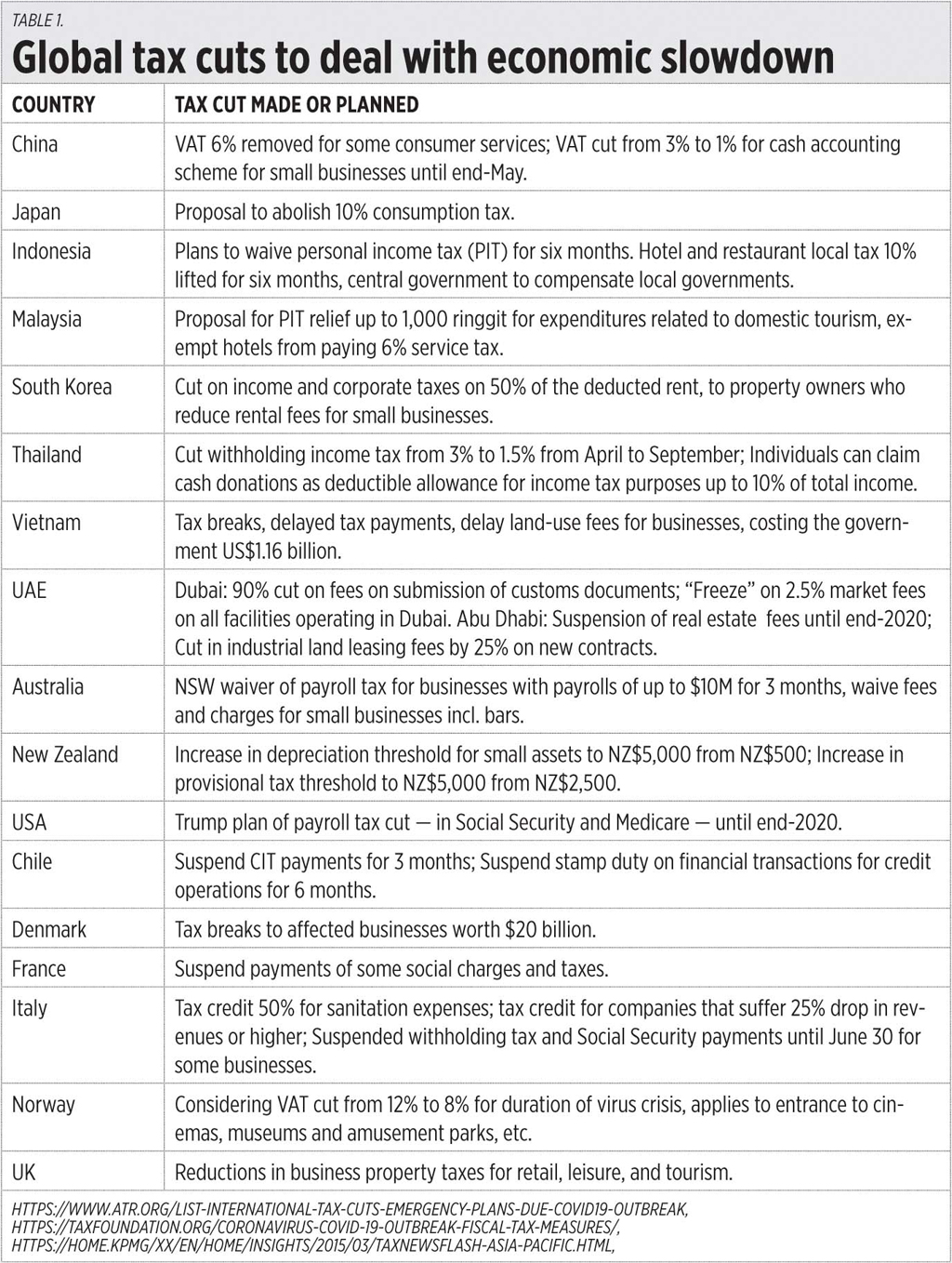
During global health pandemics aided by hysteria, there is global economic slowdown, deep slowdown bordering on contraction (“negative growth”). Millions of jobs are lost as companies and shops either scale down operations or shut down. Some governments around the world adjusted to help the ailing and dying businesses and job creators via various forms of tax cut (see Table 1).

Aside from tax and fees cut, there are various regulatory forbearance made. Examples are:

Canada: Extend tax filing from April 30 to June 1, and income tax payment until Aug. 31.

Germany: Easier for companies to claim subsidies to support workers on reduced working hours.

Spain: SMEs and self-employed persons defer tax obligations (VAT, CIT, PIT) for six months without interest.

Taiwan: Delay payment of taxes for one year or pay their taxes in installments over 36 months or three years.

The Philippines: Delay payment of income tax from April 15 to May 15.

The Philippine government should consider any of the tax cuts above, or one tax cut — in VAT or CIT or PIT — even for 1-2 months after the first full month of recovery. Business losses are everywhere, job losses possibly in millions, they need a respite.

Recently big business groups and federations and some professional organizations in the Philippines issued a joint statement urging the government for big expenditure push of P281 billion on top of the P4.1 trillion approved budget this year.

It is a weird call, businesses and professionals calling for more spending, more borrowings, which will require more taxes, instead of calling for tax cut. As businesses are shut down, many government agencies also shut down.

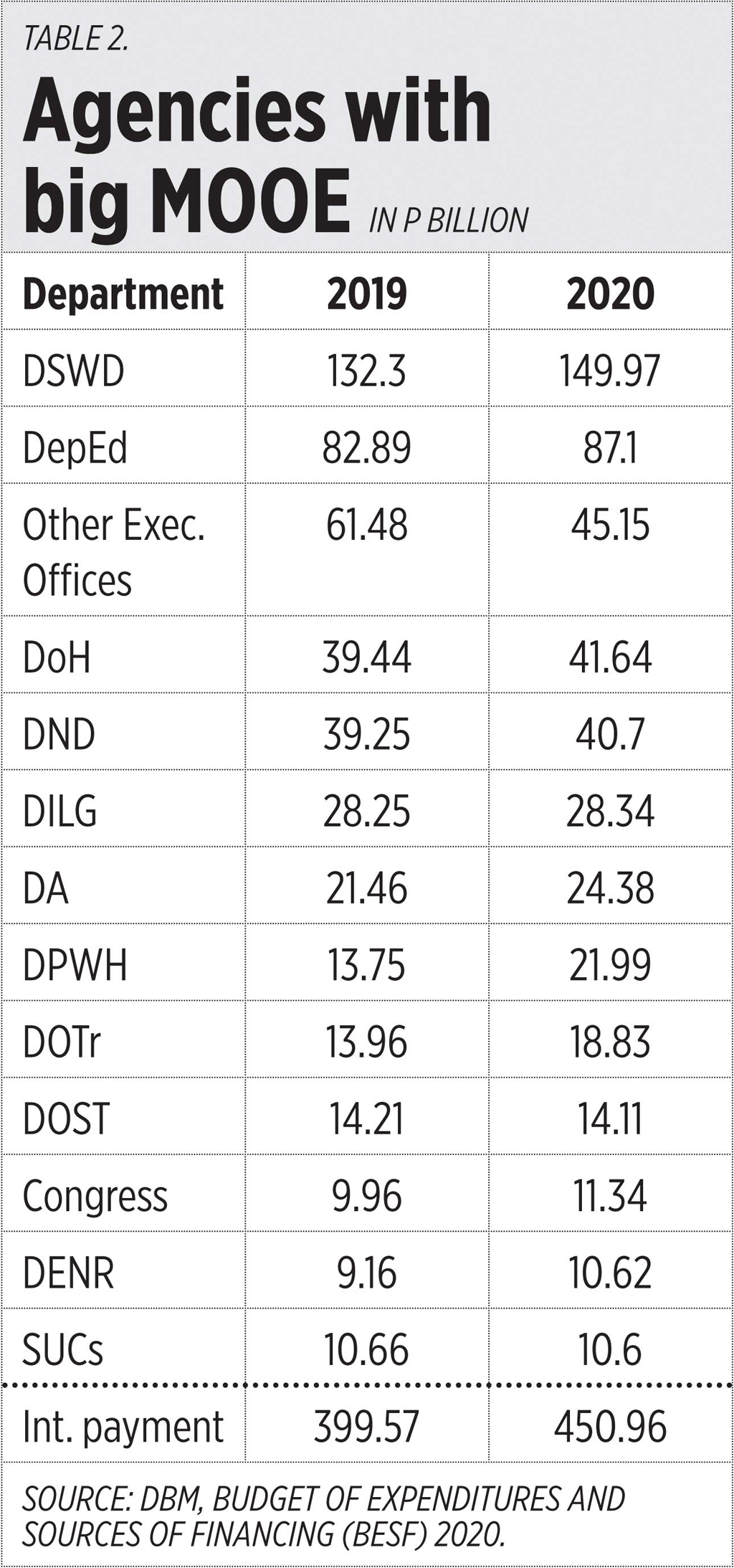
The President can order mandatory cut and savings in all executive offices for certain expenditures especially the maintenance and other operating expenses (MOOE) which includes office rentals and supplies, electricity, many meetings, travels domestic and international, conferences, intelligence funds, etc. The forced savings can be used for whatever fiscal stimulus is decided on, without need for additional spending, borrowings, and higher taxes. Higher public debt should also be avoided because our interest payment alone is approaching half trillion pesos already, principal amortization not included yet (see Table 2).

The Office of the President (OP) has huge MOOE, P5.18 billion and P6.70 billion in 2019 and 2020, respectively.

A sensitive and responsible government would cut spending and taxes this time and allow the businesses and people to recover from at least two months of economic dislocation and revenue losses. An insensitive and irresponsible government would do otherwise.


Bienvenido S. Oplas, Jr. is the president of Minimal Government Thinkers.

minimalgovernment@gmail.com