Home Blog Page 9537

Asian artists gather for livestream concert benefiting UNICEF

Kuala Lumpur-based digital entertainment company WebTVAsia and YouTube will be holding a four-hour livestream concert on May 27 titled ONE LOVE ASIA featuring top artists from the region for the benefit of the United Nations Children’s Fund (UNICEF) Asia to help its “efforts in preventing the pandemic from becoming a lasting crisis for vulnerable children,” a statement read.

“This is one of the biggest initiatives from the Asian entertainment community to show our support for UNICEF through one cohesive message of love and unity,” Fred Chong, CEO of WebTVAsia, said in a statement.

Joining the concert are UNICEF regional ambassador for East Asia and Pacific and K-Pop star Choi Siwon, and several Asian acts including the Philippines’ dance duo Ranz Kyle and Nina Guerrero, and singers Christian Bautista, Morrisette Amon, and Rico Blanco.

Other artists who will be performing are Exile Akira, Karen Mok, Apink’s Jung Eun-Ji, Namewee, G.E.M., Chi Pu, Sam Tsui, Davika Hoorne, Jack Neo, Boy William, Ice Paris, Pearwah, Baim Wong, Raditya Dika, Ismail Izzani, Quang Dang, DatG & DuUyen, Erik, Inul Daratista, Celine Tam, Priscilla Abby, and HaoRen.

“We’re excited to be supporting WebTVAsia and UNICEF to bring this very special concert to YouTube audiences across APAC and globally. ONE LOVE ASIA encapsulates our commitment to championing talent and giving them a platform to share their creativity and make a positive impact in the world,” Gautam Anand, managing director of YouTube Asia-Pacific, said in the statement.

The concert will be streamed on the ONE LOVE ASIA YouTube channel on May 27, 8 p.m. Donations can be made through the YouTube “donate now” button that directly pays to UNICEF’s account during the live stream and will continue to be available for 30 days after the concert.

“UNICEF is thrilled to be part of the ONE LOVE ASIA concert! Together we will create greater awareness of UNICEF’s work for children and families so they will be able to recover, rebound, and reimagine a stronger future,” Karin Hulshof, UNICEF’s regional director for East Asia and Pacific, said in the statement.

For more information about the concert and the cause, visit www.onelove.asia. — ZBC

Worries of surge in infections to pull shares down

LOCAL SHARES are seen to decline this week on lasting worries about second waves of the coronavirus disease 2019 (COVID-19) pandemic.

The local bourse kicks off a four-day trading week today as it was closed for trading on Monday in observance of Eid al-Fitr. The benchmark Philippine Stock Exchange index (PSEi) closed at 5,539.19 on Friday, down 0.05% on a weekly basis.

Online brokerage 2TradeAsia.com said the market might be more volatile this week as investors balance the news of increasing global COVID-19 cases and rising hopes of the development of a vaccine.

“The fact that the coronavirus is ‘novel’ spells unpredictability, as there are no comparative cases in history to match its clout. At this stage, science is on ‘trial-and-error’ mode, especially for advanced diagnosis for asymptomatic-positive cases…,” it said in a market note.

“For now, a delicate balance must be made relative to getting economies restarted and inhibiting progression of new virus strains. Anything that could alter or jolt either of these lead variables would further extend the recovery process and present new challenges for global equities markets,” it added.

For AAA Southeast Equities, Inc. Research Head Christopher John Mangun, what might push the market lower is expectations of a greater economic toll of the quarantine in April and May, which will be reported in the coming weeks.

“Our market will continue moving sideways and perhaps even test support at 5,000 towards the end of the second quarter as economic data will be worse than the previous quarter,” he said in a market note.

Still, he said he is optimistic that the third and fourth quarter would show some improvement, especially as quarantine measures are starting to ease, allowing the economy to recover.

“[W]e also believe that this market will move higher toward the end of the year as the economy will come back stronger in the third and fourth quarter if everything goes well with the containment of the pandemic and the restarting of the broader economy,” he said.

In the Philippines, there are lingering hopes that this is Metro Manila’s last week under modified enhanced community quarantine and that it will transition to a general community quarantine (GCQ) by June 1.

Majority of the Metro Manila Council, the group of mayors of Metro Manila cities, have favored transitioning the capital to a GCQ starting next week.

2TradeAsia.com said support for the market will come mostly from local investors so any development in the Philippines’ handling of the pandemic may trigger the movement of the market.

“While caution is to be expected (as can be gleaned from frail momentum improvement), investors positioning at the market’s present state must be prepared to take on a pro-active view on global economies’ healing and recovery,” it said. — Denise A. Valdez

Contactless payments encouraged at Araneta City

ARANETA City is encouraging customers to use digital payment channels amid the lockdown.

“The COVID-19 pandemic has emphasized the need for businesses to adapt safe and convenient contactless payment options without need to handle physical cash. This allows us to better reach and serve our customers in this time of unprecedented crisis. It’s good that Araneta City is prepared for this situation,” John Castelo, senior vice-president of the Araneta Group, said in a statement.

Hundreds of retail outlets within Araneta City already have contactless payment systems in place. Customers buying food at Pizza Hut, Dairy Queen, and Taco Bell can also use QR mobile payment apps PayMaya and GCash.

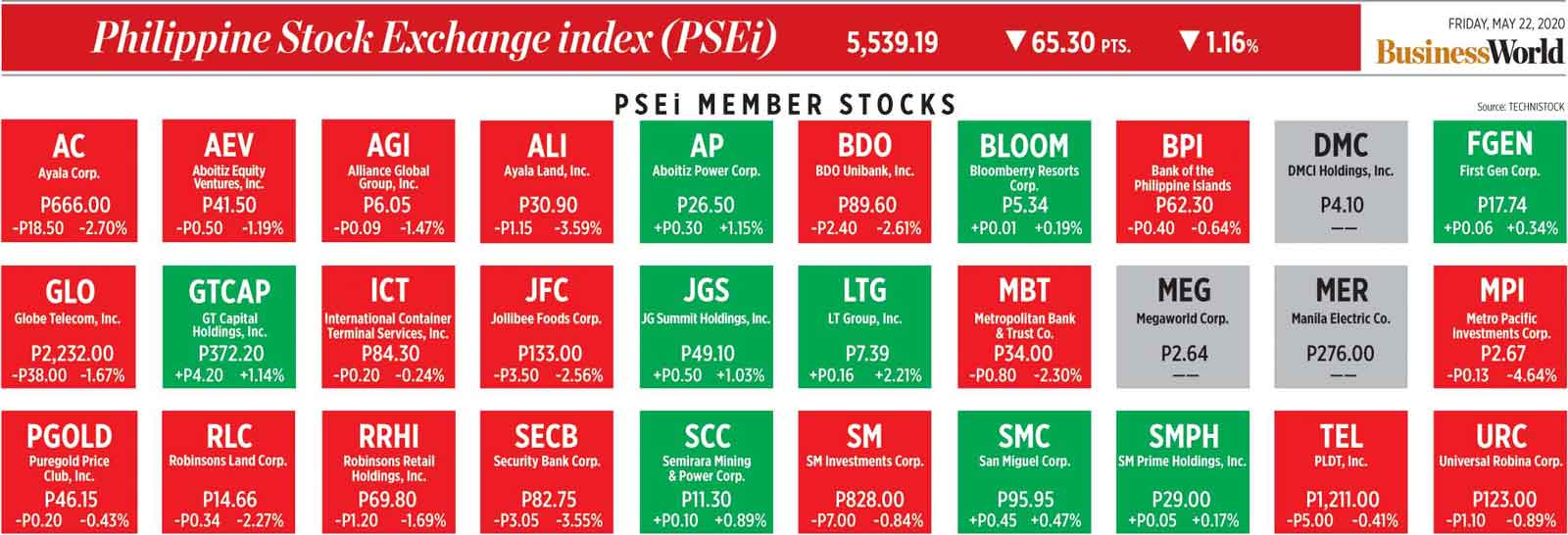
How PSEi member stocks performed — May 22, 2020

Here’s a quick glance at how PSEi stocks fared on Friday, May 22, 2020.


PSE among the worst-performing stock markets so far this year

PSE among the worst-performing stock markets so far this year

Second round of SAP to make use of electronic payments

THE government said second-tranche aid distribution under the social amelioration program (SAP) is expected to be more efficient due to the use of electronic payments.

The President’s Spokesman Herminio “Harry” L. Roque said in a briefing Monday that some inefficiencies have been worked out for the second tranche of aid, targeted at families affected by the coronavirus disease 2019 (COVID-19) crisis living in quarantine zones.

Gagamitin natin ang electronic ways para magbayad du’n sa ating mga kababayan… Naniniwala kami na mas mabilis na ang proseso kasi ang 12 million ay pareho lang na pangalan (We will use electronic payments… We believe that the process will be faster because we are dealing with the same 12 million names [from the first tranche]),” he said.

In addition to the 12 million still living under quarantine, which has prevented them from earning a livelihood, the list will be expanded by 5 million more beneficiaries who did not receive first-round payments.

The first round of the two-month aid scheme was marred by inefficient cash distribution featuring long lines at local government offices and disputes over people not appearing on their local beneficiary lists.

The memorandum authorizing the second SAP distribution was released Friday by Executive Secretary Salvador C. Medialdea.

May is the second month of the SAP.

The Palace memorandum directed the Department of Social Welfare and Development (DSWD) to create an online portal where the list of beneficiaries will be posted. — Gillian M. Cortez

Garin backs more testing for returning workforce

EMPLOYEES returning to work should be tested for coronavirus disease 2019 (COVID-19) to minimize possible transmission by asymptomatic persons, a former Health Secretary said.

Iloilo Representative Janette L. Garin said a worker discovered to be infected has the potential to shut down an entire workplace, resulting in lost productivity and livelihoods.

“The question on whether we need to test people going back to work, not all of them but yes we need to have a baseline of a specific (segment of the) population that can give us a better picture,” Ms. Garin said in a virtual briefing organized by the Foreign Correspondents Association of the Philippines.

She also said that companies should be allowed to perform rapid tests because they will be shouldering the cost and it would be easier to conduct contact tracing.

“If you have an employee who tests positive (in a) rapid antibody test, then you know where they go home, you know what specific barangays have many patients,” she said.

Ms. Garin added that rapid antibody test and Reverse Transcription Polymerase Chain Reaction (RT-PCR) test is necessary.

Ms. Garin, a former health secretary, said 40 to 50% of COVID-19 patients are asymptomatic and 80% of the 50 to 60% symptomatic only have mild symptoms.

Dr. Minguita Padilla, head of Project ARK (Antibody Rapid Test Kits), also said that it would be better if workers are tested, citing the risks from asymptomatic carriers.

“It’s better if we could test, that’s my opinion. It’s the opinion of a lot of business people and you cannot blame them,” she said in the forum. “If we could test, it could really, really be much better because there are many things that we can pick up and identify. but we cannot identify just by presuming that just because you are asymptomatic, you don’t have it.”

The Department of Health issued return-to-work guidelines which include the reduction of people in the workplace.

Testing for workers is not required. Health Undersecretary Maria Rosario S. Vergeire has said that the protocols are a guide to employers, emphasizing that symptomatic screening is ideal.

The department’s testing policy prioritizes patients and health care workers with severe and mild symptoms, those with a history of travel to infected areas, and those with pre-existing conditions rendering them vulnerable to contracting the disease.

Ms. Garin said the current level of testing is “too small.” She said that automation would make tests affordable and increase daily test productivity.

“We need the private sector and the government to work together, because when we do more tests, we will be able to identify the specific cities, the specific barangays, the specific provinces where there are a lot of COVID cases,” she said.

Ms. Padilla also said the problem lies with procurement and inventory of the DoH.

According to DoH data as of May 23, 272,355 individuals were tested. On May 24, a total of 8,283 were tested. The DoH hopes to conduct 30,000 tests daily by the end of May.

Major companies have declared their intention to test workers, including after concessionaire Maynilad Water Services, Inc., which has started conducting antibody screening tests.

In a statement, Maynilad said before redeployment for field assignments, workers underwent Screening Serologic Antibody Tests, including third-party service providers such as meter readers, desludging personnel, and other contractors.

“Those with positive results in this screening will undergo further coronavirus disease 2019 (COVID-19) tests,” Maynilad said.

The tests are being implemented in partnership with the Delos Santos Medical Center.

The company has also ordered safety measures for re-entry into offices.

Only one third of its employees are returning to their respective workplaces, such as those assigned to water and wastewater operations.

The remainder of Maynilad’s employees will continue to work from home.

Maynilad will also require all of its employees and service providers to practice workplace safety measures such as social distancing, temperature checks, and wearing of personal protective equipment. Facilities will also be disinfected regularly.

Meanwhile, Maynilad said that starting June, it will resume major construction projects, as well as meter reading and onsite billing activities.

“Since the start of the enhanced community quarantine, we have been putting in place new safety policies and procedures to adapt to the so-called ‘new normal’ workplace scenario. This is necessary so we can ensure the continued health and safety of our workers and customers,” Maynilad said.

Metro Pacific Investments Corp., which has majority stake in Maynilad, is one of three Philippine units of Hong Kong-based First Pacific Co. Ltd., the others being Philex Mining Corp. and PLDT Inc. Hastings Holdings, Inc., a unit of PLDT Beneficial Trust Fund subsidiary MediaQuest Holdings, Inc., has an interest in BusinessWorld through the Philippine Star Group, which it controls. — Vann Marlo M. Villegas and Revin Mikhael D. Ochave


PCCI seeks 5-year NOLCO also for large corporations

BUSINESS GROUPS are seeking more stimulus programs directed at large companies, including expanded eligibility for the Net Operating Loss Carry Over (NOLCO), and backed immediate passage of legislation reducing the corporate income tax.

They expressed support in statements Monday for the Corporate Recovery and Tax Incentives for Enterprises Act (CREATE), the current form of the CITIRA bill, which cuts the corporate income tax (CIT) to 25% from 30% by July. The earlier proposal, CITIRA, would cut CIT to 20% gradually over a decade.

The Philippine Chamber of Commerce and Industry (PCCI) said that the extension of NOLCO to five years from three will help companies reduce their tax payments for a longer period. The benefit, under the proposal, applies only to “non-large taxpayers,” it noted.

NOLCO allows companies to deduct operating losses recognized in one period from taxable income in future periods, effectively reducing their tax due.

“In view of the community quarantines resulting in substantial losses across all industries and sectors, we request that the (NOLCO privilege) be extended to all firms, regardless of size, to protect current employment,” the country’s largest business group said.

While the PCCI supports the four to nine-year maximum transition period for businesses under the old incentives regime, the Makati Business Club (MBC) is asking for additional time. MBC is asking for an additional five years from the two to seven proposed in CITIRA, as well as a 10-year period for new investors. MBC said this would enable the Philippine Economic Zone Authority (PEZA) to attract foreign investment as other countries improve their incentive offerings.

“PEZA is one of the most successful investment generators of the country and we should enable it to be a leader in attracting relocators.”

MBC said CREATE will help attract companies looking to diversify their global locations after the pandemic, but said the Financial Incentives Review Board (FIRB) must be given the flexibility to vet “very large” investments. “Proponents of very large investments are more willing and able to negotiate, and the government can and should give them special attention,” MBC said.

Businesses support the granting of “tailor-fit” incentives unique to the needs of foreign businesses.

“The damage COVID-19 and the corresponding lockdown… has seriously damaged the economy. The business sector needs the package of reforms introduced under CREATE to help businesses recover, ensure their resilience and create more sustainable economic opportunities,” PCCI said. — Jenina P. Ibañez

Rural utilities start meter reading for May bills

POWER UTILITIES in the countryside have returned to using actual meter readings for computing their customers’ bills for May, their industry association said.

The Philippine Rural Electric Cooperatives Association (Philreca) said Monday that all 121 rural electric cooperatives (EC) have complied with the government’s advisories, including those of the Department of Energy and the Energy Regulatory Commission (ERC), on billing and suspension of meter reading during the enhanced community quarantine (ECQ).

In a report to the Joint Congressional Energy Committee hearing Friday, the association said 64 rural utilities based their May bills on actual meter readings as of May 19.

Some electric cooperatives resorted to estimating their customers’ bills for March and April, complying with the Distribution Services and Open Access Rules (DSOAR), because of mobility restrictions during the quarantine period.

“ERC has given instructions to use estimated billing to avoid the possibility of exposure to COVID-19 (coronavirus disease 2019) in compliance with the Inter-Agency Task Force issuances,” the group said in a statement.

“As of this billing period, ECs have returned to using actual/physical meter reading and have started using such readings in their billing statements,” it added.

The ERC on Friday ordered distribution utilities (DUs) to allow their customers with consumption of 200 kilowatt-hours (kWh) and below in February to pay their unpaid bills, which were due in March to May, in six installments starting mid-June.

Those with above 200 kWh consumption must be allowed to pay their unpaid bills in four portions starting June 15, as well.

Philreca said electric cooperatives have informed their customers of the option to pay their unpaid bills in full or in installments without incurring interest, penalties, or the possibility of disconnection of service.

Responding to complaints on higher electricity charges during the quarantine period, rural utilities have sought to explain the factors contributing to high electricity consumption.

In a letter dated May 22, the ERC said it will penalize those distribution utilities (DU) that do not comply with its advisories.

“DUs that will be found and proven to have breached our directives during the national emergency and deviated from the intent of the President to alleviate the financial difficulties of the Filipino people during the crisis will be penalized through the imposition of appropriate fines pursuant to relevant rules and laws,” ERC Chairperson and Chief Executive Officer Agnes VST Devanadera said. — Adam J. Ang

Power sector ordered to designate quarantine areas for infected workers

THE Department of Energy (DoE) said the power sector will be required to set aside quarantine areas in the event its personnel are suspected of being infected by the coronavirus, in order to minimize disruption to the operations of the essential industry.

According to the DoE’s 30-page protocol for responding to a possible coronavirus disease 2019 (COVID-19) outbreak, the industry has been ordered to designate a quarantine facility or room for any workers suspected of having been exposed to COVID-19 or other infectious diseases pending confirmation tests.

The protocol supplements a Department of Health order outlining the minimum health standards for COVID-19 mitigation in the power industry.

The DoE’s COVID-19 Response Protocol calls on the industry to focus on prevention, detection, isolation, treatment, reintegration into the workforce, and adopting to the “new normal.”

According to an administrative order issued on May 21, a DoE task force on energy resiliency will implement the protocol, “including the alignment of necessary funds and procurement of needed equipment and services and other needs.”

The DoE and its agencies are expected to prepare a Public Service Continuity Plan incorporating the response protocol.

The industry must also integrate the protocol into their business continuity plans.

The power industry is deemed essential and is required to continue operating during quarantine, with its employees issued checkpoint passes to ensure unimpeded movement to and from work. — Adam J. Ang

Are we ‘half-ready’ for the new normal?

Are we prepared for when we begin our “new normal”? Who else misses going out, joining social gatherings, playing outdoor sports, and attending Sunday mass? We spent the summer of 2020 in the comfort of our own homes, thanks to the coronavirus or the COVID-19 pandemic.

We have recently “graduated” from the Enhanced Community Quarantine (ECQ). The World Health Organization and the Department of Health (DoH) recommend lifting the ECQ gradually or in phases to avoid a resurgence or a second wave of COVID-19. In response, Metro Manila, Laguna, and Cebu City are under Modified Enhanced Community Quarantine. Other provinces, meanwhile, are under General Community Quarantine. It has not been easy, as essential services are still limited. Companies are restricted to a 50% physical workforce. Public transportation is not permitted in some areas. Our government has weighed the effects of the quarantine not only on the economy, but especially on the health & safety of Filipinos.

We may not immediately return to a semblance of normalcy without first finding the vaccine or cure for COVID-19. The pandemic has affected us in ways we could have never imagined. Health care providers and frontliners have been working long shifts for the past two months. The need for health care equipment or supplies is critical. The tools for prevention, protection, and testing are what we need right now. Some countries show success in containing COVID-19 by combining mass testing, social distancing, technology, and self-isolation. All of these must come together; otherwise, we are only “half-ready.” The government admits it has limited capacity to conduct mass testing. Sadly, the government does not have a robust program to carry out mass detection of the virus and has passed on the discretion to conduct tests to the private sector.

To address this issue, Section 4(o) of Republic Act No. 11469 — more popularly known as the “Bayanihan to Heal as One Act” — liberalizes the granting of incentives to manufacture or import critical or needed equipment or supplies to address COVID-19. Consequently, importing related equipment and supplies is now exempt from import duties, taxes, and other fees.

The Bureau of Internal Revenue issued Revenue Regulations (RR) No. 6-2020 which exempts from value-added tax (VAT), excise tax, and other fees the importation of personal protective equipment; laboratory equipment and reagents; medical equipment and devices; support and maintenance for laboratory and medical equipment, surgical equipment, and supplies; medical supplies, tools, and consumables; testing kits and such other supplies or equipment, as may be determined by the DoH and other relevant government agencies.

Further, importing materials needed to manufacture health equipment and supplies deemed critical or required to address the pandemic is also exempt from VAT, excise tax, and other fees. However, the importing manufacturer must be on the Master List of the Department Trade and Industry and other incentive granting bodies.

The related importation is also not subject to the issuance of an Authority to Release Imported Goods (ATRIG) under Revenue Memorandum Order No. 35-2002. An ATRIG is no longer needed to release of the goods from the Bureau of Customs (BoC). However, the BIR will conduct post-investigation or audit based on the BoC list of importers that imported without an ATRIG. Thus, it is crucial to keep and maintain documents supporting the imports.

Relative to RR No. 6-2020, the BoC issued Customs Administrative Order (CAO) No. 7-2020 to relax the regulatory clearance process.

CAO No. 7-2020 exempts importers of medical equipment and supplies from presenting a Certificate of Product Notification (CPN) or Certificate of Product Registration (CPR) issued by the Food and Drug Administration (FDA) before the BoC releases the goods. To be exempt, however, importers must provide a copy of their License to Operate (LTO) and proof of CPN or CPR application with the FDA. Importers of ventilators, respirators, and their respective accessories, on the other hands, only need to provide copies of their LTO.

Aside from establishments that provide medical devices, importers or companies that use face masks in performing work can directly import without an FDA certification.

Lastly, imported health products for donation, which are duly certified by the regulatory agency or accredited third party in the originating country, shall automatically be cleared. Certification is no longer needed for health products that are not subject to FDA clearance.

These regulations are in full force only during the three-month effectivity of RA No. 11469, unless extended or withdrawn by Congress. I hope that its effectivity will be extended, since we have a long way to go against the pandemic.

Tax and customs issuances will help hasten the manufacture, production, and distribution of medical supplies, tools, and equipment, especially the need for testing kits. The tax exemptions and incentives discussed above answer an essential question about our preparedness for the “new normal.”

Let’s Talk Tax is a weekly newspaper column of P&A Grant Thornton that aims to keep the public informed of various developments in taxation. This article is not intended to be a substitute for competent professional advice.


Alexander Querido, Jr. is an associate of the Tax Advisory & Compliance division of P&A Grant Thornton, the Philippine member firm of Grant Thornton International Ltd.

pagrantthornton@ph.gt.com

Reliable data sought to aid decision on lockdown

THE ORTIGAS BUSINESS DISTRICT is seen behind a slum area near the Manggahan Floodway in Pasig City on May 25. The government is looking at further easing the lockdown in Metro Manila starting June as it tries to restart business operations brought to a near standstill by a novel coronavirus pandemic. — PHILSTAR/MICHAEL VARCAS

SENATORS on Monday sought reliable data upon which the government should base its decision on whether to further ease the lockdown in Metro Manila, where the Philippines’ coronavirus pandemic is largely concentrated.

Senator Franklin M. Drilon said there must be a “science-based decision” to minimize transmissions.

“The number of cases may not be doubling but it is still increasing,” he said in a statement. “It just breached 14,000 yesterday and another 6,000 who tested positive remain to be validated.”

“They may be silent carriers who unknowingly spread the virus,” Mr. Drilon said.

Senator Panfilo M. Lacson in a separate statement said he supports the shift to a general from an enhanced community quarantine in the capital and nearby cities so some businesses could reopen.

“It is wise for our policy makers to ease up the restrictions currently being imposed,” he said, noting that a prolonged lockdown affects not just people but tax collections as well.

He also said the decision to ease the lockdown in Metro Manila should be based on “sound data,” especially after recent inaccurate COVID-19 reports released by the Department of Health (DoH).

President Rodrigo R. Duterte locked down the entire Luzon island in mid-March, suspending work, classes and public transportation to contain the pandemic. People should stay home except to buy food and other basic goods, he said.

He extended the quarantine for the island twice and thrice for the capital region. Metro Manila remains under an altered lockdown until the end of the month, with some businesses allowed to reopen with minimal workforce.

The President would ease the lockdown if data would show that infections have slowed, his spokesman Harry L. Roque told DZRH radio yesterday.

Defense Secretary Delfin N. Lorenzana, who heads a national task force against the coronavirus, said Metro Manila would probably go back to a more relaxed general community quarantine starting June 1.

But Mr. Roque said nothing was final yet in the absence of an announcement from the task force, which had yet to meet this week to discuss a decision.

Also yesterday, DoH reported 284 new infections, bringing the total to 14,319. The death toll rose to 873 after five more patients died, it said in a bulletin. Seventy-four more patients have gotten well, bringing the total recoveries to 3,323 it added.

Of the 284 new cases, 171 came from Metro Manila, 70 from Central Visayas and 43 from the other regions, DoH said.

Senators last week hit conflicting government information about the coronavirus situation in the country after Health Secretary Francisco Duque III said the country had entered a second wave of coronavirus infections. He later corrected himself.

Countries worldwide including the Philippine have imposed lockdowns and asked people to observe social distancing to slow the virus spread.

Apart from the inaccurate statements, DoH has also been accused of buying overpriced medical supplies. The Senate has vowed to investigate this when the proper time comes.

Senator Juan Edgardo M. Angara, meanwhile, filed a bill that will mandate mass testing. Under the measure, health workers, returning overseas Filipinos and the vulnerable sector will be prioritized.

Sales people in public markets and groceries, construction and factory workers, security guards, pregnant workers and family members whose households have dwellers with travel history abroad since December 2019 will also be prioritized for the tests. — Charmaine A. Tadalan and Gillian M. Cortez